
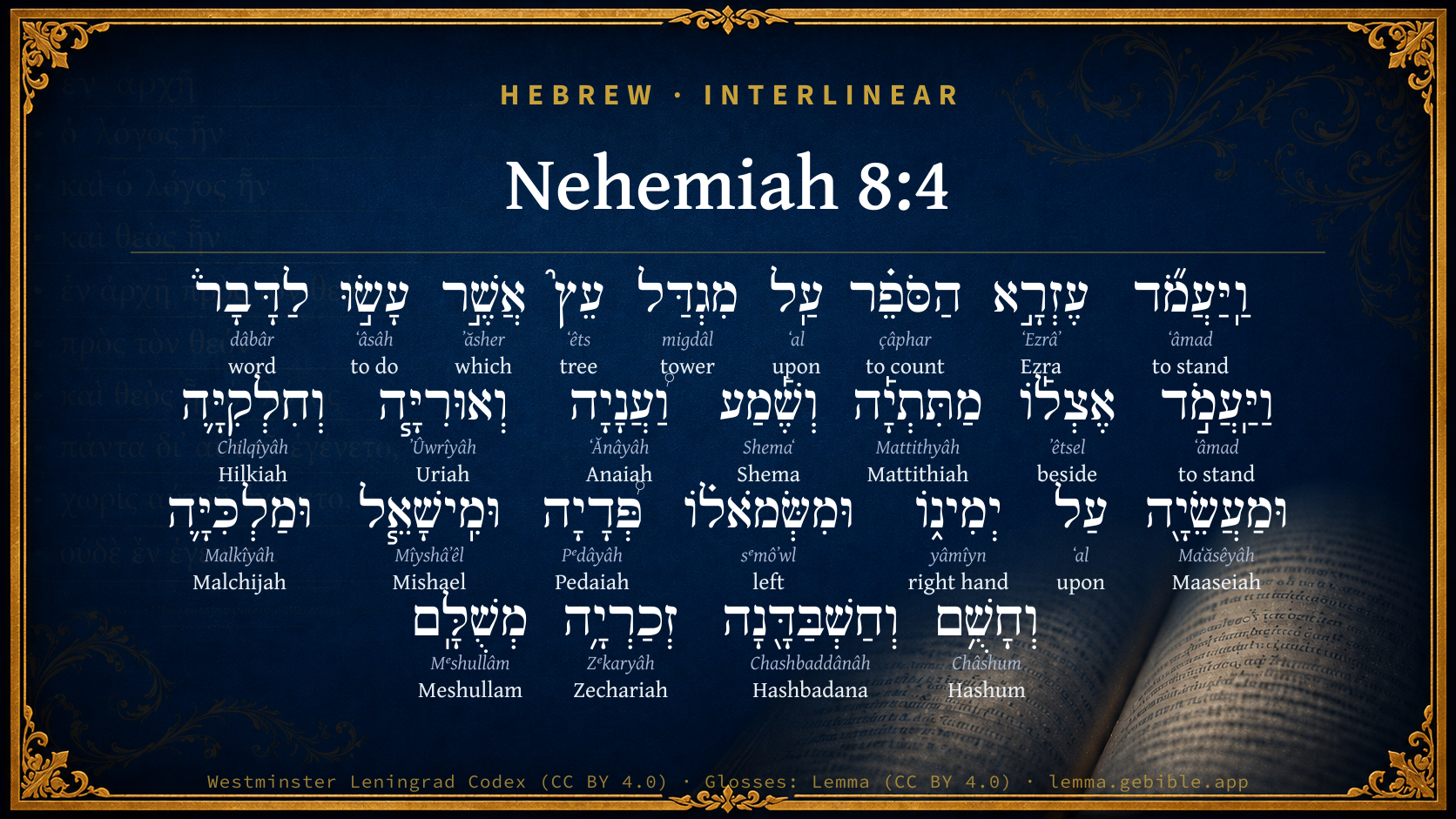
Nehemiah 8:4

Hebrew (Westminster Leningrad Codex) Nehemiah 8:4 appears in the Hebrew Old Testament. The text above is from the Westminster Leningrad Codex. Each word links to its Strong’s number, a concise gloss, and parsing drawn from the Open Scriptures Hebrew Bible morphology. Click any word for its full Brown-Driver-Briggs (BDB) entry.
Download image
Cite this verse

Nehemiah 8:4 (World English Bible). Public Domain. Lemma interlinear Bible study tool, https://lemma.gebible.app/v/nehemiah/8/4.

Show BibTeX & RIS
BibTeX
RIS
English Translation
Ezra the scribe stood on a pulpit of wood, which they had made for the purpose; and beside him stood Mattithiah, and Shema, and Anaiah, and Uriah, and Hilkiah, and Maaseiah, on his right hand; and on his left hand, Pedaiah, and Mishael, and Malchijah, and Hashum, and Hashbaddanah, Zechariah, [and] Meshullam.
World English Bible · Public Domain
Highlights
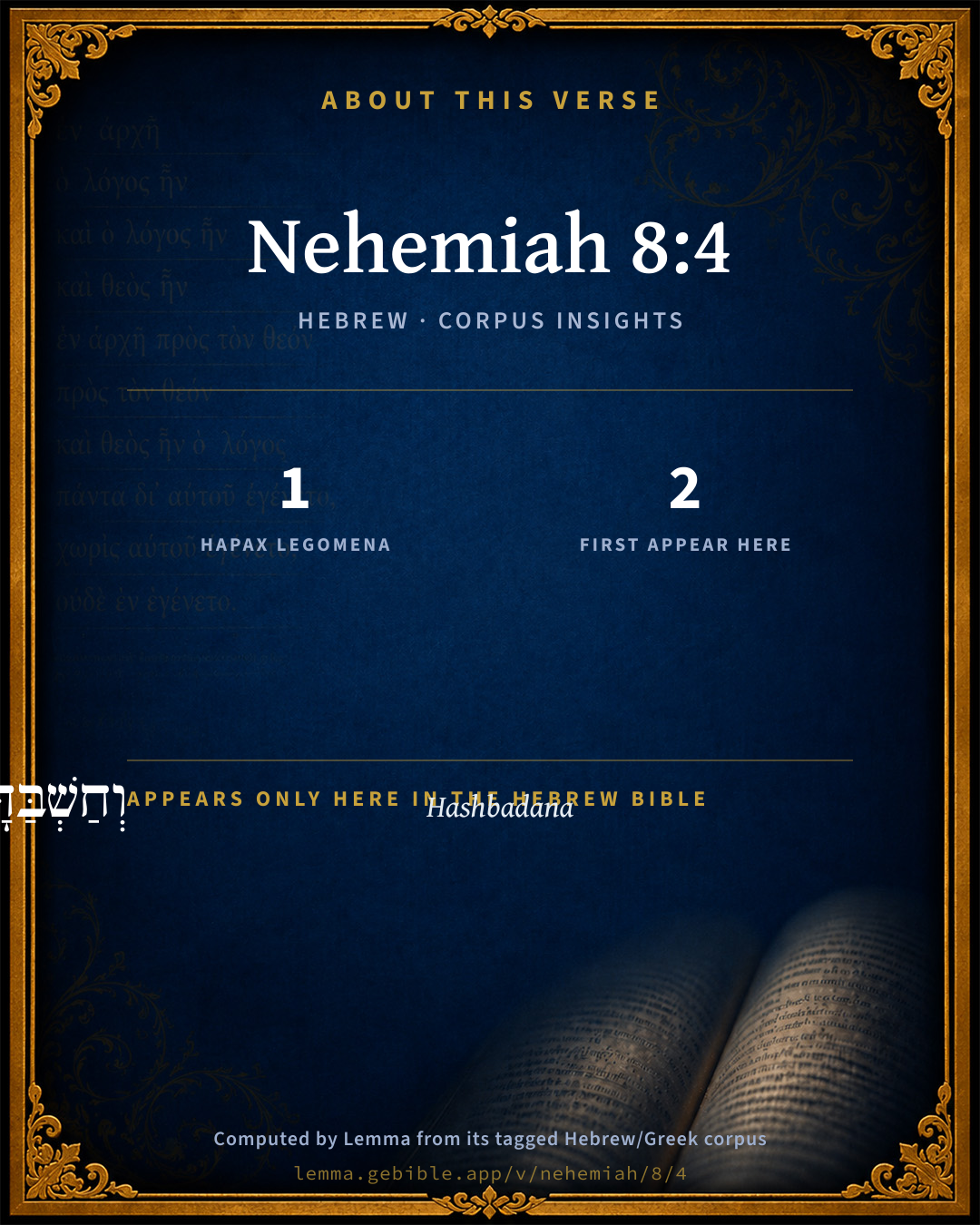
  • 1 hapax legomenon — only here in the Hebrew Bible
  • 2 first appearances in the Hebrew Bible
Full analysis ↓
Download a study sheet

One document with this verse’s original text, its word-by-word gloss line, the meaning frame, cross-references with their text, attributed commentary, and full source and license credits — printable, and it pastes into notes with its structure intact.

This verse Autodidact and up

Study sheet (.html) Plain text (.txt)

A passage Seminary Student

Up to 50 verses in one chapter. A passage sheet keeps up to 6 commentary sources and 12 cross-references per verse, in the order this page ranks them, and says so on the sheet whenever that leaves anything out. Ask for a single verse and you get the Autodidact verse sheet above.

Everything on this page stays free to read, with no account — the sheet is a download of what is already on screen, not access to it.

Want to remove ads? Support Godless Engineer
Compare translations 3

The same verse in 3 English versions, stacked beneath the original-language interlinear above. Click any original word for its lexicon entry.

Each is an independent rendering of the whole verse — the interlinear is not word-aligned to these translations.

Highlighted words mark where these versions differ — a whole-verse word diff, not a word-by-word alignment.

  • World English Bible Public Domain
    Ezra the scribe stood on a pulpit of wood, which they had made for the purpose; and beside him stood Mattithiah, and Shema, and Anaiah, and Uriah, and Hilkiah, and Maaseiah, on his right hand; and on his left hand, Pedaiah, and Mishael, and Malchijah, and Hashum, and Hashbaddanah, Zechariah, [and] Meshullam.
  • King James Version Public Domain
    And Ezra the scribe stood upon a pulpit of wood, which they had made for the purpose; and beside him stood Mattithiah, and Shema, and Anaiah, and Urijah, and Hilkiah, and Maaseiah, on his right hand; and on his left hand, Pedaiah, and Mishael, and Malchiah, and Hashum, and Hashbadana, Zechariah, and Meshullam.
  • unfoldingWord Literal Text CC BY-SA 4.0
    And Ezra the scribe stood on a platform of wood that they had made for the purpose. And beside him stood: Mattithiah, and Shema, and Anaiah, and Uriah, and Hilkiah, and Maaseiah, on his right hand; and from his left, Pedaiah, and Mishael, and Malkijah, and Hashum, and Hashbaddanah, Zechariah, Meshullam.

unfoldingWord Literal Text — © unfoldingWord, licensed CC BY-SA 4.0. Word-aligned USFM3 via Door43 (git.door43.org/unfoldingWord/en_ult).

Versions to compare (up to 4)

3 of 4 selected

Show all 18 translations

Every available English version of this verse, each an independent rendering of the whole verse.

  • World English Bible Public Domain
    Ezra the scribe stood on a pulpit of wood, which they had made for the purpose; and beside him stood Mattithiah, and Shema, and Anaiah, and Uriah, and Hilkiah, and Maaseiah, on his right hand; and on his left hand, Pedaiah, and Mishael, and Malchijah, and Hashum, and Hashbaddanah, Zechariah, [and] Meshullam.
  • Berean Standard Bible Public Domain
    Ezra the scribe stood on a high wooden platform built for this occasion. At his right side stood Mattithiah, Shema, Anaiah, Uriah, Hilkiah, and Maaseiah, and at his left were Pedaiah, Mishael, Malchijah, Hashum, Hash-baddanah, Zechariah, and Meshullam.
  • Majority Standard Bible Public Domain
    Ezra the scribe stood on a high wooden platform built for this occasion. At his right side stood Mattithiah, Shema, Anaiah, Uriah, Hilkiah, and Maaseiah, and at his left were Pedaiah, Mishael, Malchijah, Hashum, Hash-baddanah, Zechariah, and Meshullam.
  • King James Version Public Domain
    And Ezra the scribe stood upon a pulpit of wood, which they had made for the purpose; and beside him stood Mattithiah, and Shema, and Anaiah, and Urijah, and Hilkiah, and Maaseiah, on his right hand; and on his left hand, Pedaiah, and Mishael, and Malchiah, and Hashum, and Hashbadana, Zechariah, and Meshullam.
  • American Standard Version (1901) Public Domain
    And Ezra the scribe stood upon a pulpit of wood, which they had made for the purpose; and beside him stood Mattithiah, and Shema, and Anaiah, and Uriah, and Hilkiah, and Maaseiah, on his right hand; and on his left hand, Pedaiah, and Mishael, and Malchijah, and Hashum, and Hashbaddanah, Zechariah, `and' Meshullam.
  • Revised Version (1885) Public Domain
    And Ezra the scribe stood upon a pulpit of wood, which they had made for the purpose; and beside him stood Mattithiah, and Shema, and Anaiah, and Uriah, and Hilkiah, and Maaseiah, on his right hand; and on his left hand, Pedaiah, and Mishael, and Malchijah, and Hashum, and Hashbaddanah, Zechariah, and Meshullam.
  • Geneva Bible (1599) Public Domain
    And Ezra the Scribe stoode vpon a pulpit of wood which he had made for the preaching, and beside him stood Mattithiah, and Shema, and Ananiah, and Vriiah, and Hilkiah, and Maaseiah on his right hande, and on his left hand Pedaiah, and Mishael, and Malchiah, and Hashum, and Hashbadana, Zechariah, and Meshullam.
  • Douay-Rheims (1899) Public Domain
    And Esdras the scribe stood upon a step of wood, which he had made to speak upon, and there stood by him Mathathias, and Semeia, and Ania, and Uria, and Helcia, and Maasia, on his right hand: and on the left, Phadaia, Misael, and Melchia, and Hasum, and Hasbadana, Zacharia and Mosollam.
  • Young's Literal Translation Public Domain
    And Ezra the scribe standeth on a tower of wood that they made for the purpose, and Mattithiah standeth near him, and Shema, and Anaiah, and Urijah, and Hilkiah, and Maaseiah, on his right; and on his left Pedaiah, and Mishael, and Malchijah, and Hashum, and Hashbaddana, Zechariah, Meshullam.
  • Literal Standard Version CC BY-SA 4.0
    And Ezra the scribe stands on a tower of wood that they made for the purpose, and Mattithiah stands near him, and Shema, and Anaiah, and Urijah, and Hilkiah, and Maaseiah, on his right; and on his left Pedaiah, and Mishael, and Malchijah, and Hashum, and Hashbaddana, Zechariah, Meshullam.
  • Unlocked Literal Bible CC BY-SA 4.0
    Then Ezra the scribe stood on a high wooden platform which the people had made for the purpose. Standing beside him were Mattithiah, Shema, Anaiah, Uriah, Hilkiah, and Maaseiah, on his right side; and Pedaiah, Mishael, Malchijah, Hashum, Hashbaddanah, Zechariah, and Meshullam were standing on his left side.
  • unfoldingWord Literal Text CC BY-SA 4.0
    And Ezra the scribe stood on a platform of wood that they had made for the purpose. And beside him stood: Mattithiah, and Shema, and Anaiah, and Uriah, and Hilkiah, and Maaseiah, on his right hand; and from his left, Pedaiah, and Mishael, and Malkijah, and Hashum, and Hashbaddanah, Zechariah, Meshullam.
  • Darby Bible Public Domain
    And Ezra the scribe stood upon a high stage of wood, which they had made for the purpose. And beside him stood Mattithiah, and Shema, and Anaiah, and Urijah, and Hilkijah, and Maaseiah on his right hand; and on his left hand, Pedaiah, and Mishael, and Malchijah, and Hashum, and Hashbaddana, Zechariah, Meshullam.
  • World Messianic Bible Public Domain
    Ezra the scribe stood on a pulpit of wood, which they had made for the purpose; and beside him stood Mattithiah, Shema, Anaiah, Uriah, Hilkiah, and Maaseiah, on his right hand; and on his left hand, Pedaiah, Mishael, Malchijah, Hashum, Hashbaddanah, Zechariah, and Meshullam.
  • Webster's Bible Public Domain
    And Ezra the scribe stood upon a pulpit of wood, which they had made for the purpose; and beside him stood Mattithiah, and Shema, and Anaiah, and Urijah, and Hilkiah, and Maaseiah, on his right hand; and on his left hand, Pedaiah, and Mishael, and Malchiah, and Hashum, and Hashbadana, Zechariah, and Meshullam.
  • Free Bible Version CC BY-SA 4.0
    Ezra the scribe stood on a high wooden stage built for this event. On his right side stood Mattithiah, Shema, Anaiah, Uriah, Hilkiah, and Maaseiah, and on his left Pedaiah, Mishael, Malchijah, Hashum, Hash-baddanah, Zechariah, and Meshullam.
  • Bible in Basic English Public Domain
    And Ezra the scribe took his place on a tower of wood which they had made for the purpose; and by his side were placed Mattithiah and Shema and Anaiah and Uriah and Hilkiah and Maaseiah on the right; and on the left, Pedaiah and Mishael and Malchijah and Hashum and Hashbaddanah, Zechariah and Meshullam.
  • JPS Tanakh (1917) Public Domain
    And Ezra the scribe stood upon a pulpit of wood, which they had made for the purpose; and beside him stood Mattithiah, and Shema, and Anaiah, and Uriah, and Hilkiah, and Maaseiah, on his right hand; and on his left hand, Pedaiah, and Mishael, and Malchijah, and Hashum, and Hashbaddanah, Zechariah, and Meshullam.

Literal Standard Version (2020), Covenant Press — licensed CC BY-SA 4.0. Text via the HelloAO Bible API (eBible.org). Unlocked Literal Bible (unfoldingWord) — licensed CC BY-SA 4.0. Text via the HelloAO Bible API (eBible.org). unfoldingWord Literal Text — © unfoldingWord, licensed CC BY-SA 4.0. Word-aligned USFM3 via Door43 (git.door43.org/unfoldingWord/en_ult). Free Bible Version, Dr. Jonathan Gallagher — licensed CC BY-SA 4.0. Text via the HelloAO Bible API (eBible.org).

Word by word

More ways to search: Search by grammar → Find every occurrence → Compare this word →

Practice this passage: Drill this verse → Learn its vocabulary →

וְחַשְׁבַּדָּ֖נָה
Chashbaddânâh
H2806
“and · Hashbadana”
Conjunction + Noun, Proper
Part of Speech
Conjunction + Noun
Type
Proper
Full BDB Definition

Origin: from H2803 and H1777

TWOT: None

Hashbadana = "considerate judge" - one of the men who stood on the left of Ezra while he read the law to the people
  1. וַֽיַּעֲמֹ֞ד ʻâmad H5975 “and · to stand” Conjunction + Verb, Qal, Sequential Imperfect, 3rd Person, Masculine, Singular
  2. עֶזְרָ֣א ʻEzrâʼ H5830 “Ezra” Noun, Proper
  3. הַסֹּפֵ֗ר çâphar H5608 “the · scribe” Particle, Definite Article + Noun, Common, Masculine, Singular, Absolute
  4. עַֽל ʻal H5921 “upon” Preposition
  5. מִגְדַּל migdâl H4026 “tower of” Noun, Common, Both, Singular, Construct
  6. עֵץ֮ ʻêts H6086 “tree” Noun, Common, Masculine, Singular, Absolute
  7. אֲשֶׁ֣ר ʼăsher H834 “which” Particle, Relative
  8. עָשׂ֣וּ ʻâsâh H6213 “to do” Verb, Qal, Perfect, 3rd Person, Common, Plural
  9. לַדָּבָר֒ dâbâr H1697 “to/for the · word” Preposition, Determined + Noun, Common, Masculine, Singular, Absolute
  10. וַיַּֽעֲמֹ֣ד ʻâmad H5975 “and · to stand” Conjunction + Verb, Qal, Sequential Imperfect, 3rd Person, Masculine, Singular
  11. אֶצְל֡וֹ ʼêtsel H681 “beside · him” Preposition + Suffix, Personal, 3rd Person, Masculine, Singular
  12. מַתִּתְיָ֡ה Mattithyâh H4993 “Mattithiah” Noun, Proper
  13. וְשֶׁ֡מַע Shemaʻ H8087 “and · Shema” Conjunction + Noun, Proper
  14. וַ֠עֲנָיָה ʻĂnâyâh H6043 “and · Anaiah” Conjunction + Noun, Proper
  15. וְאוּרִיָּ֧ה ʼÛwrîyâh H223 “and · Uriah” Conjunction + Noun, Proper
  16. וְחִלְקִיָּ֛ה Chilqîyâh H2518 “and · Hilkiah” Conjunction + Noun, Proper
  17. וּמַעֲשֵׂיָ֖ה Maʻăsêyâh H4641 “and · Maaseiah” Conjunction + Noun, Proper
  18. עַל ʻal H5921 “upon” Preposition
  19. יְמִינ֑וֹ yâmîyn H3225 “right hand · his” Noun, Common, Feminine, Singular, Construct + Suffix, Personal, 3rd Person, Masculine, Singular
  20. וּמִשְּׂמֹאל֗וֹ sᵉmôʼwl H8040 “and · from · left · his” Conjunction + Preposition + Noun, Common, Masculine, Singular, Construct + Suffix, Personal, 3rd Person, Masculine, Singular
  21. פְּ֠דָיָה Pᵉdâyâh H6305 “Pedaiah” Noun, Proper
  22. וּמִֽישָׁאֵ֧ל Mîyshâʼêl H4332 “and · Mishael” Conjunction + Noun, Proper
  23. וּמַלְכִּיָּ֛ה Malkîyâh H4441 “and · Malchijah” Conjunction + Noun, Proper
  24. וְחָשֻׁ֥ם Châshum H2828 “and · Hashum” Conjunction + Noun, Proper
  25. זְכַרְיָ֥ה Zᵉkaryâh H2148 “Zechariah” Noun, Proper
  26. מְשֻׁלָּֽם Mᵉshullâm H4918 “Meshullam” Noun, Proper

About this verse

These counts appear in no published source. They are computed here, from the morphology-tagged text and Lemma’s own curated glosses. What Lemma adds →

27
words
25
distinct lemmas
Historical
section

Notable vocabulary

1 hapax legomenon — a word that appears only here in the entire Hebrew Bible:

  • וְחַשְׁבַּדָּ֖נָה Hashbadana H2806

First appearance in Scripture

These words make their first canonical appearance in the Hebrew Bible here:

  • וַ֠עֲנָיָה Anaiah H6043
  • וְחַשְׁבַּדָּ֖נָה Hashbadana H2806

Shared distinctive vocabulary

וַ֠עֲנָיָה Anaiah H6043 occurs in 2 verses of the Hebrew Bible. Also found in:

Grammatical profile

  • 3 verbs
  • 20 nouns
  • 3 prepositions
  • 1 particle

Verb forms

  • וַֽיַּעֲמֹ֞ד Qal · Sequential Imperfect
  • עָשׂ֣וּ Qal · Perfect
  • וַיַּֽעֲמֹ֣ד Qal · Sequential Imperfect

Repetition

Words recur within this verse — often emphatic in Hebrew:

  • וַֽיַּעֲמֹ֞ד to stand H5975 ×2
  • עַֽל upon H5921 ×2

Cross-references

10

Topical passages linked to Nehemiah 8:4 in the Treasury of Scripture Knowledge — connected by theme and wording, ordered by reader-vote popularity; previews shown in the World English Bible.

  • Ezra 10:29 Of the sons of Bani: Meshullam, Malluch, and Adaiah, Jashub, and Sheal, Jeremoth.
  • Ezra 10:33 Of the sons of Hashum: Mattenai, Mattattah, Zabad, Eliphelet, Jeremai, Manasseh, Shimei.
  • Nehemiah 10:3 Pashhur, Amariah, Malchijah,
  • Nehemiah 10:7 Meshullam, Abijah, Mijamin,
  • Nehemiah 10:18 Hodiah, Hashum, Bezai,
  • Nehemiah 10:20 Magpiash, Meshullam, Hezir,
  • Nehemiah 10:25 Rehum, Hashabnah, Maaseiah,
  • Nehemiah 11:5 and Maaseiah the son of Baruch, the son of Colhozeh, the son of Hazaiah, the son of Adaiah, the son of Joiarib, the son of Zechariah, the son of the Shilonite.
  • Nehemiah 11:7 These are the sons of Benjamin: Sallu the son of Meshullam, the son of Joed, the son of Pedaiah, the son of Kolaiah, the son of Maaseiah, the son of Ithiel, the son of Jeshaiah.
  • Nehemiah 12:13 of Ezra, Meshullam; of Amariah, Jehohanan;

Cross-references courtesy of OpenBible.info (CC BY 4.0).

Hebrew and Greek witnesses Masoretic Hebrew ↔ Greek Septuagint

The same verse in the two great witnesses to the Old Testament, shown verse-for-verse.

These are two independent witnesses, not word-aligned to each other, and the Septuagint is shown in lemma (dictionary) form.

Hebrew Nehemiah 8:4 Masoretic · Westminster Leningrad Codex

וַֽיַּעֲמֹ֞ד עֶזְרָ֣א הַסֹּפֵ֗ר עַֽל מִגְדַּל עֵץ֮ אֲשֶׁ֣ר עָשׂ֣וּ לַדָּבָר֒ וַיַּֽעֲמֹ֣ד אֶצְל֡וֹ מַתִּתְיָ֡ה וְשֶׁ֡מַע וַ֠עֲנָיָה וְאוּרִיָּ֧ה וְחִלְקִיָּ֛ה וּמַעֲשֵׂיָ֖ה עַל יְמִינ֑וֹ וּמִשְּׂמֹאל֗וֹ פְּ֠דָיָה וּמִֽישָׁאֵ֧ל וּמַלְכִּיָּ֛ה וְחָשֻׁ֥ם וְחַשְׁבַּדָּ֖נָה זְכַרְיָ֥ה מְשֻׁלָּֽם

Ezra the scribe stood on a pulpit of wood, which they had made for the purpose; and beside him stood Mattithiah, and Shema, and Anaiah, and Uriah, and Hilkiah, and Maaseiah, on his right hand; and on his left hand, Pedaiah, and Mishael, and Malchijah, and Hashum, and Hashbaddanah, Zechariah, [and] Meshullam.

World English Bible · Public Domain

Greek LXX Structure differs

The Septuagint has no separate book of Nehemiah. Its Greek text is the second half of Esdras B (2 Esdras), chapters 11–23; Ezra is the first half (1–10).

A verse-for-verse comparison isn’t shown here because the chapters and verses don’t line up. Switch to the LXX edition with the MT / LXX toggle above to read the Greek directly.

On this verse, The Cambridge Bible for Schools and Colleges discusses the Septuagint’s reading. Read the note in Commentary ↓

Hebrew: Westminster Leningrad Codex (CC BY 4.0). Greek: Septuagint (public domain); English from a public-domain English Septuagint. How the Septuagint differs from the Hebrew →

Commentary

Notes on Nehemiah 8:4 from classic Christian and Jewish commentators (each source and its license shown beneath its notes). The classic Christian expositions comment on the surrounding passage and are grouped to its opening verse, so a note may address several verses; the Jewish commentaries on the Tanakh (Rashi and others) are per-verse, so they appear only where the commentator wrote on this verse.

Lemma curates 59 commentaries, every one of them public domain or Creative Commons licensed, each selected and text-cleaned for this edition rather than reprinted as found. About our sources →

Trapp's Complete Commentary

John Trapp

Neh 8:4 And Ezra the scribe stood upon a pulpit of wood, which they had made for the purpose; and beside him stood Mattithiah, and Shema, and Anaiah, and Urijah, and Hilkiah, and Maaseiah, on his right hand; and on his left hand, Pedaiah, and Mishael, and Malchiah, and Hashum, and Hashbadana, Zechariah, [and] Meshullam.

Ver. 4. And Ezra the scribe stood upon a pulpit of wood] Heb. A tower of wood, because high and round, as ours are. The Capuchins and other Popish preachers are said to have long pulpits, wherein they may walk and act, as upon a stage, in Lent especially; at which time it is the custom of Italy for the same man to preach six days in the week upon the gospel of the days, and on the Saturday in honour and praise of the Virgin Mary.

And beside him stood Mattithiah, &c.] For greater authority’ sake, as concurring with Ezra, and ready in their turn to perform the work. Praedicationis officium suscipit quisquis ad sacerdotium accedit, said Gregory long since, No preacher is no minister.

John Trapp, A Commentary or Exposition upon All the Books of the Old and New Testament (1647–1656) — public domain. Text from a community e-Sword module.

Joseph Benson's Commentary

Neh 8:4. Ezra stood upon a pulpit of wood — To raise him higher than the people; that he might be better seen and heard by them all; whence, in the Hebrew, it is called a tower of wood: but it was not like our pulpits, made to contain only one or two persons, but large and long, that many might stand in it at once, as appears from so many as fourteen, here mentioned, standing in it. And beside him stood Mattithiah, &c. — These stood with him, partly to declare their consent and concurrence with what he said and did; and partly that they, or some of them, might bear a part in the work.

Joseph Benson's Commentary on the Old and New Testaments (1811–1818) — public domain. Text from a community e-Sword module.

Tyndale Open Study Notes

Tyndale Open Resources

8:4 These thirteen people were apparently community leaders. Some might have helped Ezra roll the scroll as he read.

Tyndale Open Study Notes — © Tyndale Open Resources, licensed CC BY-SA 4.0. Text via the HelloAO Bible API.

Jamieson, Fausset & Brown

Robert Jamieson, A. R. Fausset & David Brown

Ezra . . . stood upon a pulpit of wood--Not made in the form known to us, but only a raised scaffold or platform, broad enough to allow fourteen persons to stand with ease upon it. Ezra's duty was very laborious, as he continued reading aloud from morning until midday, but his labor was lightened by the aid of the other priests present. Their presence was of importance, partly to show their cordial agreement with Ezra's declaration of divine truth; and partly to take their share with him in the important duty of publicly reading and expounding the Scripture.

Jamieson, Fausset & Brown — Commentary Critical and Explanatory on the Whole Bible (1871) — public domain (CC PDM 1.0). Text via the HelloAO Bible API.

Adam Clarke's Commentary

Verse 4. Stood upon a pulpit of wood] מגדל migdal, a tower, a platform, raised up for the purpose, to elevate him sufficiently for the people both to see and hear him; for it is said, Ne 8:5, that he was above all the people. This is the first intimation we have of a pulpit, or structure of this kind. But we must not suppose that it was any thing similar to those tubs or barrels ridiculously set up in churches and chapels, in which a preacher is nearly as much confined, during the time of his preaching, as if he was in the stocks.

Adam Clarke's Commentary on the Bible (1810–1826) — public domain. Text from a community e-Sword/MySword module.

Ellicott's Commentary for English Readers

(4) Pulpit of wood.—Literally, a tower of wood. Fourteen persons, however, were on what is afterwards called a platform, or stair, by his side.

A Bible Commentary for English Readers, edited by Charles John Ellicott (1878–1897) — public domain. Text from a community e-Sword module.

The Cambridge Bible for Schools and Colleges

gen. ed. J. J. S. Perowne

4. a pulpit of wood] R.V. marg. Heb. tower. Literally ‘upon a tower of wood.’ LXX. ἐπὶ βήματος ξυλίνου, 1 Esdr. ἐπὶ τοῦ ξυλίνου βήματος. Vulg. ‘super gradum ligneum:’ cf. ‘the stairs’ on which the Levites stood in Neh_9:4. The mention of the erection of a platform or tribune which the Jews had erected ‘for the purpose’ shows that the incident was one of exceptional character. This is the first mention of a pulpit or lectern.

for the purpose] Literally ‘for the word,’ which not being understood was omitted by the LXX. The Vulg. ‘quem fecerat ad loquen-dum’ follows a different vocalization, l’dhabbêr for laddâbhâr.

Urijah] R.V. Uriah: possibly the same as is mentioned in Neh_3:4. ‘Hilkiah,’ possibly mentioned also Neh_12:7. ‘Pedaiah’ possibly mentioned Neh_3:25. ‘Meshullam’ possibly mentioned Neh_10:7.

Malchiah … Hashbadana] R.V. Malchijah … Hashbaddanah.

There is a discrepancy respecting the numbers and position of the individuals here mentioned. The Hebrew text and the LXX. mention six names on the right hand, seven on the left: the parallel passage in 1 Esdras gives seven on the right hand, inserting an Azariah between Anaiah and Uriah, but six only on the left, omitting the last name Meshullam. If we retain both Azariah and Meshullam we should have seven on either side; if we reject them both, we should have six on either side. It seems probable that the names are those of Levites. There would be especial appropriateness in the number twelve, symbolizing the union of Israel in obedience to the Law. The conjecture of Rawlinson that they ‘were probably the chief priests of the course which was at the time performing the Temple service’ is improbable. (1) They were clearly men who could leave the Temple precincts for six or seven hours consecutively. (2) On such an impressive occasion Ezra, if he were attended by priests, would probably have selected either those who represented the principal houses or those who especially supported his religious attitude. (3) Ezra’s supporters in this great religious movement seem to have been Laymen and Levites, not Priests. The popularizing of the knowledge of ‘the Law’ struck a blow at a priestly monopoly. The thirteen names are in one respect of especial interest. They seem to be the names of individuals and not as in Neh_8:7 and ch. Neh_9:4, Neh_10:9 the names of houses or clans, which happened to be represented. The reader should take notice that the high-priest’s name is not mentioned on this occasion. If as some critics have supposed, Ezra himself had composed the Priestly Laws, and was now promulgating them for the first time, the high-priest, whose position owed so much of its dignity in later days to those laws, would surely have been mentioned as countenancing Ezra’s action. If however, as seems more probable, Ezra was for the first time publishing to the people laws which had hitherto been kept in the priests’ hands, we have a possible explanation for the absence of the high-priest and his party, who would regard his action as subversive of their authority.

The Cambridge Bible for Schools and Colleges (gen. ed. J. J. S. Perowne; Cambridge University Press, 1878–1918) — public domain. Text from a community e-Sword module.

John Gill's Exposition

And Ezra the scribe stood upon a pulpit of wood, which they had made for the purpose,.... Or to speak out of, as the Syriac and Arabic versions; this, in the Hebrew text, is called a "tower" (i), partly because of its height, and partly because in the form of one; and also for its largeness, considering the use it was for; for it was so large as to hold fourteen men, as appears by what follows: a pulpit of wood was made for the king in the court, to read the law from (k); though, according to Jacob Leo, it was a throne like an high tower; see Gill on Kg2 11:14, the pulpits, in the Jewish synagogues, made after the same manner, as Aben Ezra observes, are called by the same (l) name:

and beside him stood Mattithiah, and Shema, and Anaiah; and Urijah, and Hilkiah, and Maaseiah, on his right hand; and on his left hand, Pedaiah, and Mishael, and Malchiah, and Hashum, and Hashbadana, Zechariah, and Meshullam; in all thirteen; there were six on his right, and seven on his left, who stood here, not merely in honour to him, and as approvers and supporters of the truth of what he read, but to relieve him when weary.

(i) "super turrem ligni", Montanus; so Dionysius is said, "concionari ex turri alta", Ciceron. Tuscul. Quaest. l. 5. (k) Schulchan Aruch, par. 1. c. 141. sect. 7. (l) Misn. Sotah, c. 7. sect. 8.

John Gill's Exposition of the Whole Bible (1746–1763) — public domain (CC PDM 1.0). Text via the HelloAO Bible API.

Albert Barnes' Notes on the Bible

The 13 persons mentioned were probably the chief priests of the course (shift) which was at the time performing the temple service.

Albert Barnes' Notes on the Bible (1834–1885) — public domain. Text from a community e-Sword/MySword module.

Haydock's Catholic Bible Commentary

Step. Hebrew, "wooden tower." (Calmet) --- Protestants, "pulpit," (Haydock) made in the form of a cup," (Calmet) like the cior, or tribune of Solomon, 2 Paralipomenon vi. 13. --- Mosollam. We should imagine that this was not the person who had given his daughter in marriage to the son of Tobias, chap. vi. 18. (Haydock)

George Leo Haydock (1774–1849), Haydock's Catholic Family Bible and Commentary, 1859 edition — public domain. Excludes Psalms (Douay-Rheims chapter numbering differs from Protestant) and Deuterocanonical books (Catholic canon only).

Matthew Poole's English Annotations

Partly to declare their consent and concurrence with Ezra in what-he said and did; and partly that they, or some of them, might bear a part in the work.

Matthew Poole's English Annotations on the Holy Bible (1683–1685) — public domain. Text from a community e-Sword/MySword module.

Whedon's Commentary on the Bible

Daniel D. Whedon

4. A pulpit of wood — Septuagint, a wooden platform. Some elevated stage or platform, from which a speaker could easily be seen and heard by the people.

Mattathiah… Shema… Anaiah — The persons named in this verse, who stood beside Ezra and assisted him, were priests; those named in Neh_8:7 were Levites.

Daniel D. Whedon (gen. ed.), Commentary on the Old and New Testaments (1874–1909) — public domain. Text from a community e-Sword module.

The Pulpit Commentary

Ezra...stood upon a pulpit of wood. Compare 2Ki_11:14 2Ki_23:3, where, however, the term used is dwm, "stand," and not ldgm, "tower." In either case an elevated platform seems to be meant. Mattithiah, and Shema. These persons are commonly supposed to have been priests, but there is nothing to prove it. They need not even have been Levites, since they were there not to teach, but only to do honour to Ezra.

The Pulpit Commentary (1880–1919), ed. H.D.M. Spence-Jones & Joseph S. Exell — public domain. Text from a community e-Sword module.

unfoldingWord translationNotes

Door43 World Missions Community

Mattithiah, Shema, Anaiah, Uriah, Hilkiah, and Maaseiah ... Pedaiah, Mishael, Malchijah, Hashum, Hashbaddanah, Zechariah, and Meshullam

These are all names of men. (See: How to Translate Names)

Ezra opened the book in the sight of all the people

The abstract noun "sight" can be expressed with the verb "see." AT: "Everyone saw Ezra open the book" (See: Abstract Nouns)

the book

"The Book of the Law"

he was standing above the people

"he was standing higher than the people"

when he opened it all the people stood up

The people stood up out of respect for God's word. (See: Assumed Knowledge and Implicit Information)

translationWords

Ezra

scribe

Zechariah (OT)

unfoldingWord translationNotes — © Distant Shores Media and the Door43 World Missions Community, licensed CC BY-SA 4.0. Source: git.door43.org/Door43/en_tn.

Rashi

Rabbi Shlomo Yitzchaki (Rashi)

on a wooden tower That wooden tower was made for the purpose of reading the Scroll of the Law upon it.

Rashi on the Tanakh — English translations: “The Judaica Press complete Tanach with Rashi, translated by A. J. Rosenberg” (CC BY 4.0); “Pentateuch with Rashi's commentary by M. Rosenbaum and A.M. Silbermann, 1929-1934” (public domain); “The Metsudah Tanach series, Lakewood, N.J” (CC BY 4.0); and “The Book of Joshua, Metsudah Publications, 1997” (CC BY 4.0). Text via Sefaria.

Lesson kit

Teaching starters — assembled from the data on this page, not authored interpretation. Every prompt links to the verse data it draws on. Edit before teaching.

Nehemiah, in the Historical, opens this verse with 27 words (25 distinct Hebrew lemmas). Its most distinctive word is Chashbaddânâh (“Hashbadana”). A historical commentator’s framing appears above. Read the whole chapter for the surrounding context.

Discussion questions

  1. How does “Hashbadana” (Chashbaddânâh) shape what this verse is saying?
  2. 1 word here appears nowhere else in the Hebrew Bible. Why might the author reach for such rare wording?
  3. 2 words make their first appearance in Scripture here. What does this debut establish?
  4. How does Nehemiah 10:22, which shares the word «Anaiah», read alongside this verse?
  5. What does the repetition of “to stand” (2× in this one verse) do in this verse?
  6. These translations render this verse differently. What is at stake in choosing one wording over another?
  7. «וַֽיַּעֲמֹ֞ד» is a Qal Sequential Imperfect verb. How does that grammatical form shape the action described?
  8. Compare how Trapp's Complete Commentary and Joseph Benson's Commentary read this verse. Where do they agree or differ?

Things to notice

  • 1 word in this verse appears nowhere else in the Hebrew Bible.
  • 2 words make their first canonical appearance in Scripture here.
  • These translations choose different wording for 11 words in this verse.
  • “to stand” occurs 2× in this single verse.
  • 25 distinct Hebrew lemmas span 27 words in this verse.

Reading settings

Reading text

Shown beneath each verse's original-language words.

Old Testament
Old Testament edition

Read the OT as the Masoretic Hebrew (MT) or the Greek Septuagint (LXX).

English shown for the Greek Septuagint (in the Hebrew ↔ Greek comparison).

Comparing translations? Open the Compare panel on any verse page to stack up to four side by side.