Nehemiah 9:7

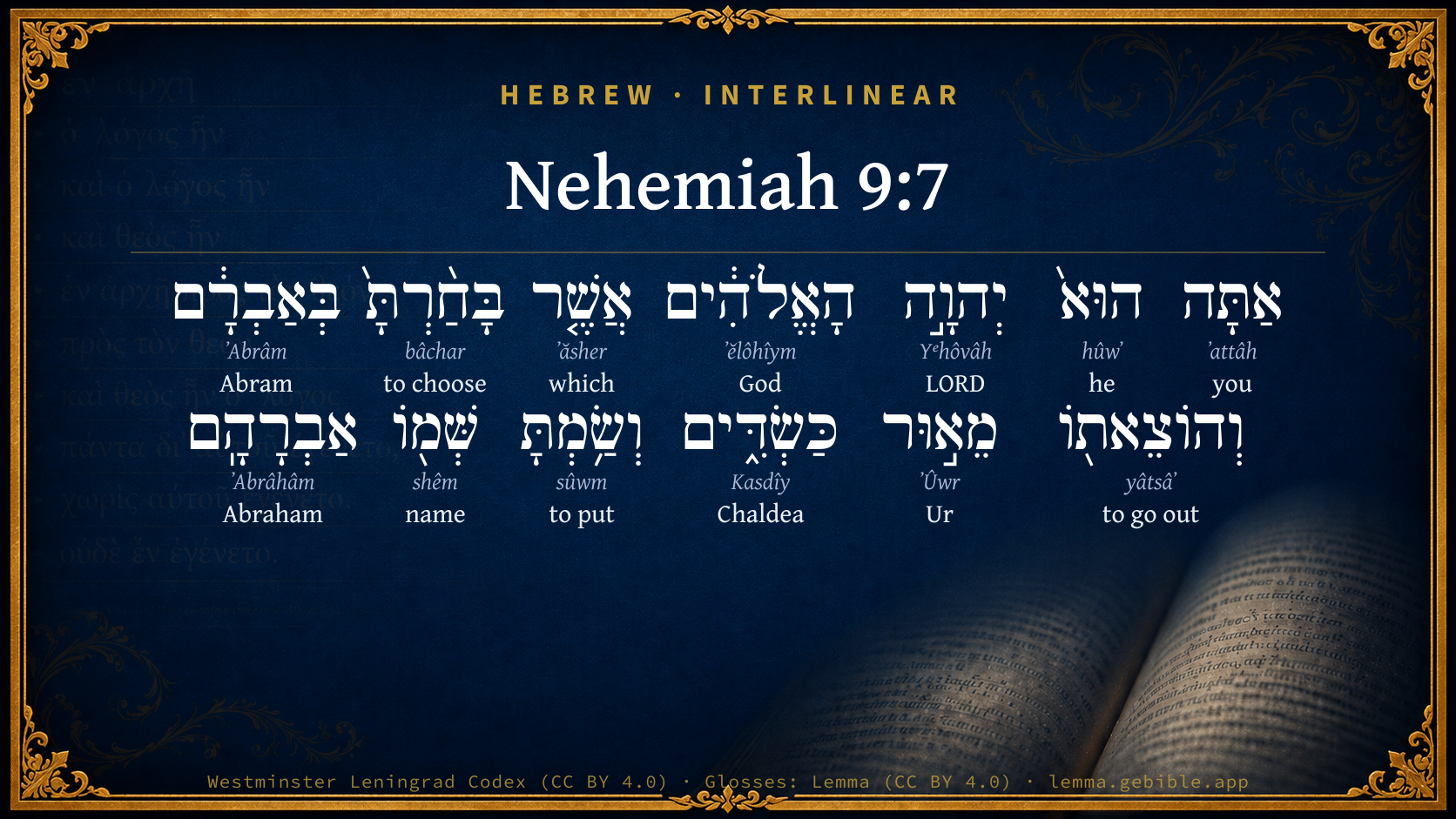
Hebrew (Westminster Leningrad Codex) Nehemiah 9:7 appears in the Hebrew Old Testament. The text above is from the Westminster Leningrad Codex. Each word links to its Strong’s number, a concise gloss, and parsing drawn from the Open Scriptures Hebrew Bible morphology. Click any word for its full Brown-Driver-Briggs (BDB) entry.
Download image
Cite this verse

Nehemiah 9:7 (World English Bible). Public Domain. Lemma interlinear Bible study tool, https://lemma.gebible.app/v/nehemiah/9/7.

Show BibTeX & RIS
BibTeX
RIS
English Translation
You are Yahweh the God, who did choose Abram, and brought him forth out of Ur of the Chaldees, and gave him the name of Abraham,
World English Bible · Public Domain
Download a study sheet

One document with this verse’s original text, its word-by-word gloss line, the meaning frame, cross-references with their text, attributed commentary, and full source and license credits — printable, and it pastes into notes with its structure intact.

This verse Autodidact and up

Study sheet (.html) Plain text (.txt)

A passage Seminary Student

Up to 50 verses in one chapter. A passage sheet keeps up to 6 commentary sources and 12 cross-references per verse, in the order this page ranks them, and says so on the sheet whenever that leaves anything out. Ask for a single verse and you get the Autodidact verse sheet above.

Everything on this page stays free to read, with no account — the sheet is a download of what is already on screen, not access to it.

Want to remove ads? Support Godless Engineer
Compare translations 3

The same verse in 3 English versions, stacked beneath the original-language interlinear above. Click any original word for its lexicon entry.

Each is an independent rendering of the whole verse — the interlinear is not word-aligned to these translations.

Highlighted words mark where these versions differ — a whole-verse word diff, not a word-by-word alignment.

  • World English Bible Public Domain
    You are Yahweh the God, who did choose Abram, and brought him forth out of Ur of the Chaldees, and gave him the name of Abraham,
  • King James Version Public Domain
    Thou art the LORD the God, who didst choose Abram, and broughtest him forth out of Ur of the Chaldees, and gavest him the name of Abraham;
  • unfoldingWord Literal Text CC BY-SA 4.0
    You are he, Yahweh, the God who chose Abram. Also, you brought him out from Ur of the Chaldees. Also, you made his name ‘Abraham.’

unfoldingWord Literal Text — © unfoldingWord, licensed CC BY-SA 4.0. Word-aligned USFM3 via Door43 (git.door43.org/unfoldingWord/en_ult).

Versions to compare (up to 4)

3 of 4 selected

Show all 18 translations

Every available English version of this verse, each an independent rendering of the whole verse.

  • World English Bible Public Domain
    You are Yahweh the God, who did choose Abram, and brought him forth out of Ur of the Chaldees, and gave him the name of Abraham,
  • Berean Standard Bible Public Domain
    You are the LORD, the God who chose Abram, who brought him out of Ur of the Chaldeans and gave him the name Abraham.
  • Majority Standard Bible Public Domain
    You are the LORD, the God who chose Abram, who brought him out of Ur of the Chaldeans and gave him the name Abraham.
  • King James Version Public Domain
    Thou art the LORD the God, who didst choose Abram, and broughtest him forth out of Ur of the Chaldees, and gavest him the name of Abraham;
  • American Standard Version (1901) Public Domain
    Thou art Jehovah the God, who didst choose Abram, and broughtest him forth out of Ur of the Chaldees, and gavest him the name of Abraham,
  • Revised Version (1885) Public Domain
    Then art the LORD the God, who didst choose Abram and broughtest him forth out of Ur of the Chaldees, and gavest him the name of Abraham;
  • Geneva Bible (1599) Public Domain
    Thou art, O Lord, the God, that hast chosen Abram, and broughtest him out of Vr in Caldea, and madest his name Abraham,
  • Douay-Rheims (1899) Public Domain
    Thou, O Lord God, art he who chosest Abram, and broughtest him forth out of the fire of the Chaldeans, and gavest him the name of Abraham.
  • Young's Literal Translation Public Domain
    `Thou `art' He, O Jehovah God, who didst fix on Abraham, and didst bring him out from Ur of the Chaldeans, and didst make his name Abraham,
  • Literal Standard Version CC BY-SA 4.0
    You [are] He, O YHWH God, || Who fixed on Abraham, || And brought him out from Ur of the Chaldeans, || And made his name Abraham,
  • Unlocked Literal Bible CC BY-SA 4.0
    You are Yahweh, the God who chose Abram, and brought him out of Ur of the Chaldees, and gave him the name Abraham.
  • unfoldingWord Literal Text CC BY-SA 4.0
    You are he, Yahweh, the God who chose Abram. Also, you brought him out from Ur of the Chaldees. Also, you made his name ‘Abraham.’
  • Darby Bible Public Domain
    Thou art the Same, Jehovah Elohim, who didst choose Abram and broughtest him forth out of Ur of the Chaldees, and gavest him the name of Abraham;
  • World Messianic Bible Public Domain
    You are the LORD, the God who chose Abram, brought him out of Ur-Kasdim, gave him the name of Abraham,
  • Webster's Bible Public Domain
    Thou art the LORD the God, who chosest Abram, and broughtest him forth from Ur of the Chaldees, and gavest him the name of Abraham;
  • Free Bible Version CC BY-SA 4.0
    You are the Lord, the God who chose Abram, who led him out of Ur of the Chaldeans and named him Abraham.
  • Bible in Basic English Public Domain
    You are the Lord, the God, who took Abram and made him yours, guiding him from Ur of the Chaldees, and gave him the name of Abraham;
  • JPS Tanakh (1917) Public Domain
    Thou art the LORD the God, who didst choose Abram, and broughtest him forth out of Ur of the Chaldees, and gavest him the name of Abraham;

Literal Standard Version (2020), Covenant Press — licensed CC BY-SA 4.0. Text via the HelloAO Bible API (eBible.org). Unlocked Literal Bible (unfoldingWord) — licensed CC BY-SA 4.0. Text via the HelloAO Bible API (eBible.org). unfoldingWord Literal Text — © unfoldingWord, licensed CC BY-SA 4.0. Word-aligned USFM3 via Door43 (git.door43.org/unfoldingWord/en_ult). Free Bible Version, Dr. Jonathan Gallagher — licensed CC BY-SA 4.0. Text via the HelloAO Bible API (eBible.org).

Word by word

More ways to search: Search by grammar → Find every occurrence → Compare this word →

Practice this passage: Drill this verse → Learn its vocabulary →

מֵא֣וּר
ʼÛwr
H218
“from · Ur”
Preposition + Noun, Proper
Part of Speech
Preposition + Noun
Type
Proper
Full BDB Definition

Origin: the same as H217

TWOT: None

Ur = "flame" - city in southern Babylonia, city of the Chaldeans, centre of moon worship, home of Abraham's father, Terah, and departure point for the Abraham's migration to Mesopotamia and Canaan
  1. אַתָּה ʼattâh H859 “you” Pronoun, Personal, 2nd Person, Masculine, Singular
  2. הוּא֙ hûwʼ H1931 “he” Pronoun, Personal, 3rd Person, Masculine, Singular
  3. יְהוָ֣ה Yᵉhôvâh H3068 “LORD” Noun, Proper
  4. הָאֱלֹהִ֔ים ʼĕlôhîym H430 “the · God(s)” Particle, Definite Article + Noun, Common, Masculine, Plural, Absolute
  5. אֲשֶׁ֤ר ʼăsher H834 “which” Particle, Relative
  6. בָּחַ֨רְתָּ֙ bâchar H977 “to choose” Verb, Qal, Perfect, 2nd Person, Masculine, Singular
  7. בְּאַבְרָ֔ם ʼAbrâm H87 “in/at · Abram” Preposition + Noun, Proper
  8. וְהוֹצֵאת֖וֹ yâtsâʼ H3318 “and · to go out · him” Conjunction + Verb, Hiphil, Perfect, 2nd Person, Masculine, Singular + Suffix, Personal, 3rd Person, Masculine, Singular
  9. כַּשְׂדִּ֑ים Kasdîy H3778 “Chaldea” Noun, Proper
  10. וְשַׂ֥מְתָּ sûwm H7760 “and · to put” Conjunction + Verb, Qal, Perfect, 2nd Person, Masculine, Singular
  11. שְּׁמ֖וֹ shêm H8034 “name · his” Noun, Common, Masculine, Singular, Construct + Suffix, Personal, 3rd Person, Masculine, Singular
  12. אַבְרָהָֽם ʼAbrâhâm H85 “Abraham” Noun, Proper

About this verse

These counts appear in no published source. They are computed here, from the morphology-tagged text and Lemma’s own curated glosses. What Lemma adds →

13
words
13
distinct lemmas
Historical
section

Notable vocabulary

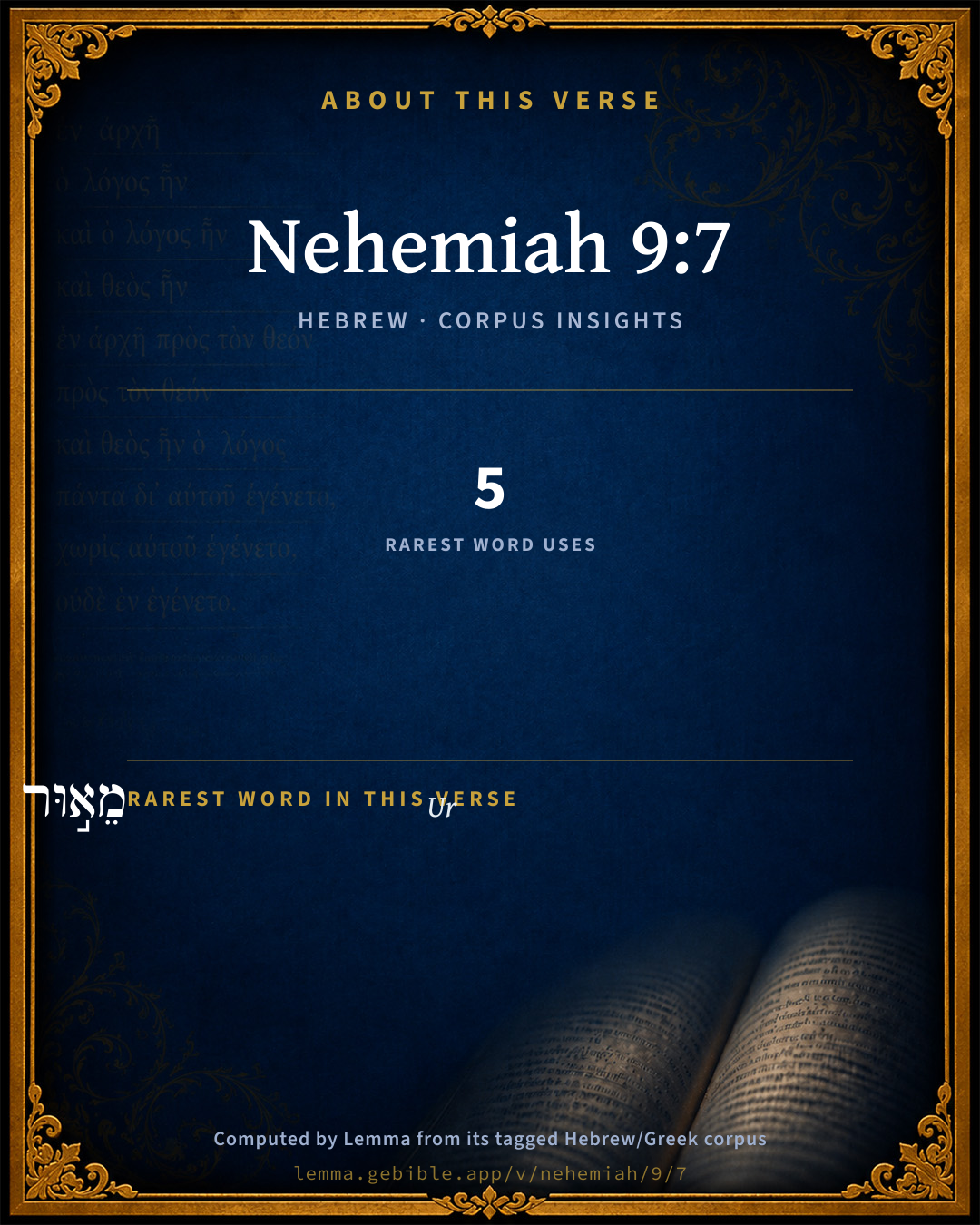
The rarest word here is מֵא֣וּר Ur H218 — appearing just 5 times in the whole Hebrew Bible.

Shared distinctive vocabulary

מֵא֣וּר Ur H218 occurs in 5 verses of the Hebrew Bible. Also found in:

Grammatical profile

  • 3 verbs
  • 7 nouns
  • 2 pronouns
  • 1 particle

Verb forms

  • בָּחַ֨רְתָּ֙ Qal · Perfect
  • וְהוֹצֵאת֖וֹ Hiphil · Perfect
  • וְשַׂ֥מְתָּ Qal · Perfect

Cross-references

9

Topical passages linked to Nehemiah 9:7 in the Treasury of Scripture Knowledge — connected by theme and wording, ordered by reader-vote popularity; previews shown in the World English Bible.

  • Genesis 11:31 Terah took Abram his son, Lot the son of Haran, his son's son, and Sarai his daughter-in-law, his son Abram's wife. They went forth from Ur of the Chaldees, to go into the land of Canaan. They came to Haran, and lived there.
  • Genesis 17:5 Neither will your name any more be called Abram, but your name will be Abraham; for the father of a multitude of nations have I made you.
  • Isaiah 51:2 Look to Abraham your father, and to Sarah who bore you; for when he was but one I called him, and I blessed him, and made him many.
  • Acts 7:2–4 He said, "Brothers and fathers, listen. The God of glory appeared to our father Abraham, when he was in Mesopotamia, before he lived in Haran,
  • Genesis 12:1–2 Now Yahweh said to Abram, "Get out of your country, and from your relatives, and from your father's house, to the land that I will show you.
  • Genesis 15:7 He said to him, "I am Yahweh who brought you out of Ur of the Chaldees, to give you this land to inherit it."
  • Deuteronomy 10:15 Only Yahweh had a delight in your fathers to love them, and he chose their seed after them, even you above all peoples, as at this day.
  • Joshua 24:2–3 Joshua said to all the people, Thus says Yahweh, the God of Israel, Your fathers lived of old time beyond the River, even Terah, the father of Abraham, and the father of Nahor: and they served other gods.
  • Isaiah 41:8–9 But you, Israel, my servant, Jacob whom I have chosen, the seed of Abraham my friend,

Cross-references courtesy of OpenBible.info (CC BY 4.0).

Hebrew and Greek witnesses Masoretic Hebrew ↔ Greek Septuagint

The same verse in the two great witnesses to the Old Testament, shown verse-for-verse.

These are two independent witnesses, not word-aligned to each other, and the Septuagint is shown in lemma (dictionary) form.

Hebrew Nehemiah 9:7 Masoretic · Westminster Leningrad Codex

אַתָּה הוּא֙ יְהוָ֣ה הָאֱלֹהִ֔ים אֲשֶׁ֤ר בָּחַ֨רְתָּ֙ בְּאַבְרָ֔ם וְהוֹצֵאת֖וֹ מֵא֣וּר כַּשְׂדִּ֑ים וְשַׂ֥מְתָּ שְּׁמ֖וֹ אַבְרָהָֽם

You are Yahweh the God, who did choose Abram, and brought him forth out of Ur of the Chaldees, and gave him the name of Abraham,

World English Bible · Public Domain

Greek LXX Structure differs

The Septuagint has no separate book of Nehemiah. Its Greek text is the second half of Esdras B (2 Esdras), chapters 11–23; Ezra is the first half (1–10).

A verse-for-verse comparison isn’t shown here because the chapters and verses don’t line up. Switch to the LXX edition with the MT / LXX toggle above to read the Greek directly.

On this verse, Haydock's Catholic Bible Commentary discusses the Septuagint’s reading. Read the note in Commentary ↓

Hebrew: Westminster Leningrad Codex (CC BY 4.0). Greek: Septuagint (public domain); English from a public-domain English Septuagint. How the Septuagint differs from the Hebrew →

Commentary

Notes on Nehemiah 9:7 from classic Christian and Jewish commentators (each source and its license shown beneath its notes). The classic Christian expositions comment on the surrounding passage and are grouped to its opening verse, so a note may address several verses; the Jewish commentaries on the Tanakh (Rashi and others) are per-verse, so they appear only where the commentator wrote on this verse.

Lemma curates 59 commentaries, every one of them public domain or Creative Commons licensed, each selected and text-cleaned for this edition rather than reprinted as found. About our sources →

Trapp's Complete Commentary

John Trapp

Neh 9:7 Thou [art] the LORD the God, who didst choose Abram, and broughtest him forth out of Ur of the Chaldees, and gavest him the name of Abraham;

Ver. 7. Thou art the Lord the God] Heb. That Lord, with an emphasis, with an accent; and besides thee there is none other. See Neh 9:6. This is proved by his free favours to Israel, and patient bearing with their evil manners in the wilderness; there being not any God like unto our God, for pardoning of sin, and passing by the transgression of the remnant of his heritage, Mic 7:18.

Who didst choose Abram] God first chose him for his love, and then loved him for his choice.

And broughtest him forth out of Ur of the Chaldees] Pulling him as a brand out of that fire, where, till then, he had lived (and might else have died) an idolater, Jos 24:2.

And gavest him the name of Abraham] {See Trapp on "Gen 17:5"}

John Trapp, A Commentary or Exposition upon All the Books of the Old and New Testament (1647–1656) — public domain. Text from a community e-Sword module.

Joseph Benson's Commentary

Neh 9:7. Thou art the Lord who didst choose Abraham — Here follows a compendious history of the affairs of the Hebrew nation, which, it is likely was composed by Ezra or Nehemiah in the form of a prayer, and delivered to the Levites, that they might pronounce it distinctly before the whole congregation, from their several scaffolds, which were conveniently placed, in several parts of the assembly, for that purpose.

Joseph Benson's Commentary on the Old and New Testaments (1811–1818) — public domain. Text from a community e-Sword module.

Tyndale Open Study Notes

Tyndale Open Resources

9:7-8 God’s actions with Abram—calling him (Gen 12:1-3; 15:7), giving him a new name and identity (Gen 17:5), making a covenant with him (Gen 15:6-21; 17:4-5), and fulfilling his promises of land and descendants (Gen 15:18-21)—demonstrated God’s faithfulness and inspired confidence about what God would do in the future.

Tyndale Open Study Notes — © Tyndale Open Resources, licensed CC BY-SA 4.0. Text via the HelloAO Bible API.

Adam Clarke's Commentary

Verse 7. Who didst choose Abram] See the notes on the passages referred to in the margin.

The name of Abraham] For the explanation of this name, See Clarke on Ge 17:5.

Adam Clarke's Commentary on the Bible (1810–1826) — public domain. Text from a community e-Sword/MySword module.

The Cambridge Bible for Schools and Colleges

gen. ed. J. J. S. Perowne

7, 8. The Patriarch Abraham; the choice, the call, the name, and the character of the man, and the covenant made with him

Thou art the Lord the God] R.V. marg. ‘Or, O Lord’, i.e. Thou, O Jahveh (Jehovah), art the God, as in 1Ki_18:37.

didst choose Abram] The Divine ‘choice’ is only mentioned here in reference to the calling of Abraham. The selection of the ‘chosen people’ was the free act of God’s love. This thought lay at the root of the covenant relation between Him and Israel; cf. Deu_4:37, ‘and because he loved thy fathers, therefore he chose their seed after them,’ Neh_7:7, Neh_9:4-6.

and broughtest him forth out of Ur of the Chaldees] Ur of the Chaldees is only mentioned here and Gen_11:28; Gen_11:31; Gen_15:7, and from these passages the present allusion is almost certainly drawn. According to some scholars, ‘Ur of the Chaldees’ is to be found in S. Babylonia, on the right bank of the Euphrates, and to be identified either with Warka (= Erech, Gen_10:10) or Mugheir = Uru, one of the oldest Babylonian cities. According to others, it was situate in Northern Assyria, with which would agree the descent of Terah from Aram (Gen_10:23) and the home of Abraham’s kinsfolk being Padan-Aram (Gen_25:20). The latter view is perhaps most favoured by Israelite tradition, cf. Deu_26:5; Isa_41:9. It was Terah who moved from Ur of the Chaldees to Haran; but Jewish tradition always regarded this as the expression of a Divine call to Abraham. Compare Act_7:4 with Gen_11:31. The Vulgate ‘de igne Chaldaeorum’ treats ‘Ur’ as if it were the Hebrew word (spelt with the same consonants) meaning ‘light.’

the name of Abraham] The change of the patriarch’s name from Abram to Abraham is recorded in Gen_17:5, to which the reference is probably made. That Abram means ‘lofty father’ and Abraham ‘the father of a multitude’ is probably only an instance of popular Israelite etymology. ‘Abu-ra-mu’ is found as the proper name of a man in Assyrian inscriptions; and the change from the shorter to the longer form, is perhaps a return to an older and more venerated form of the name. The precise meaning of the name is of slight moment. The important point to notice is, that the change of name corresponds with the institution of the covenant sign of circumcision. The change of the name was a pledge of the new relation, into which Abraham and his seed passed; cf. ‘Jacob’ and ‘Israel’ (Gen_35:10).

The Cambridge Bible for Schools and Colleges (gen. ed. J. J. S. Perowne; Cambridge University Press, 1878–1918) — public domain. Text from a community e-Sword module.

John Gill's Exposition

Thou art the Lord the God, who didst choose Abram,.... From among the Chaldeans, and out of his father's family:

and broughtest him forth out of Ur of the Chaldees; by calling him from thence, of which see Gen 11:28, to which may be added what Amama (x) on that place observes; that some think that the sacred fire, which the Chaldeans worshipped, was kept in this city, from whence it was called Ur, that being worshipped by them and by the Assyrians under the name of Ur (y):

and gavest him the name of Abraham; which was changed when the covenant of circumcision was given him, Gen 17:5.

(x) Anti-barbar. Biblic. l. 3. p. 652. (y) Fortunati Schaech. Elaeochrism. Myrothec. l. 1. c. 9. col. 44.

John Gill's Exposition of the Whole Bible (1746–1763) — public domain (CC PDM 1.0). Text via the HelloAO Bible API.

Haydock's Catholic Bible Commentary

The fire of the Chaldeans. The city of Ur, in Chaldea, the name of which signifies fire. Or out of the fire of tribulations and temptations, to which he was there exposed. The ancient Rabbins understood this literally, affirming that Abraham was cast into the fire by the idolaters, and brought out by a miracle without any hurt. (Challoner) --- The Chaldeans adored fire, (St. Jerome, q. Heb. in Genesis xi. 31.) and the Persians probably imitated them. (Strabo xv.) --- The emperor Heraclius destroyed their Pyreia. (Suidas.) --- St. Jerome translates Ur of the Chaldeans, in all other places. (Amama) --- Septuagint, "the country of," &c. (Calmet) --- It is supposed that he sacred fire preserved in this city, gave name to it, (Ur, "fire,") as Heliopolis was so called, from the particular worship of "the sun." (Haydock) --- Abraham, to imply some mystery, Genesis xvii. (Worthington) --- See Isaias xliii. 27.

George Leo Haydock (1774–1849), Haydock's Catholic Family Bible and Commentary, 1859 edition — public domain. Excludes Psalms (Douay-Rheims chapter numbering differs from Protestant) and Deuterocanonical books (Catholic canon only).

Matthew Poole's English Annotations

Didst choose Abram out of the midst of all his nation and family. When thou didst pass by and neglect the rest of them, suffering them to walk on in their idolatrous and destructive courses; thou didst choose and single out him to serve and glorify thee, to be father of all the faithful, the progenitor of the Messias, and the person in whom, not we only, but all nations, should be blessed, and to enjoy thee to all eternity.

Matthew Poole's English Annotations on the Holy Bible (1683–1685) — public domain. Text from a community e-Sword/MySword module.

Whedon's Commentary on the Bible

Daniel D. Whedon

7. Abram… Abraham — See Gen_17:5. For the various historical allusions throughout the chapter, see the marginal references.

Daniel D. Whedon (gen. ed.), Commentary on the Old and New Testaments (1874–1909) — public domain. Text from a community e-Sword module.

The Pulpit Commentary

Vers. 7-31. Compare with this long historical resume the still longer ones in Psa_78:5-72 and Act_7:2-47. God"s dealings with his people furnished a moral lesson of extraordinary force, and moral teachers, naturally, made frequent reference to them. But it is not often that we have so complete and elaborate a recapitulation as the present, which, beginning with the call of Abraham, brings the history down to the time of the Persian servitude. God"s goodness and his people"s ingratitude form the burthen of the whole.

Vers. 7, 8. God"s favour to Abraham.

The multitude, led by the Levites, now begin the recital of God"s gracious dealings with their race; and, first, with their great ancestor, Abraham. By the words, "Thou art Jehovah God," they allege that it was the only living and true God, the Creator of all things, who distinguished Abraham, and through him their nation, by his favour. They then recount

I His CHOICE of Abraham. Of his own gracious will separating him from others, to preserve the knowledge and worship of himself, and to be the Father of the people whom he appointed to be peculiarly his own.

II His LEADING him from Chaldaea to Canaan.

III His CHANGE of his name from Abram to Abraham. Thus promising him a numerous posterity.

IV His RECOGNITION Of his faithfulness. A reference to Gen_15:6, where "believed" is part of the same verb as the word "faithful" here. (comp. Gal_3:9 faithful Abraham) Abraham was faithful in heart, and that before God. He trusted God, and continued to trust him through all trials of his faith. He was faithful in maintaining the worship of God in the midst of idolaters, and in teaching his household to "keep the way of the Lord, to do justice and judgment". (Gen_18:19) And God marked and rewarded his fidelity.

V His COVENANT with him. Gen_15:18-21 seems especially referred to. The larger promises, that Abraham and his posterity should be a blessing to all men, do not here come into view.

VI His PERFORMANCE Of the covenant. In which God"s righteousness is recognised (ver. 6).

Reflections:

1. All blessings enjoyed by men have their origin in the free grace and choice of God.

2. Yet God in his treatment of men has regard to their faithfulness to him.

3. The righteousness, as well as the goodness, of God assures us that he will fulfil all his promises.

4. We as well as the Jews have reason to praise God for the grace shown to Abraham. For he is our spiritual ancestor, "the father of all them that believe". (Rom_4:11)

The Pulpit Commentary (1880–1919), ed. H.D.M. Spence-Jones & Joseph S. Exell — public domain. Text from a community e-Sword module.

unfoldingWord translationNotes

Door43 World Missions Community

Connecting Statement:

The Levites continue their prayer before all the people.

Ur of the Chaldees

"Ur, where the Chaldean people group lived"

You found his heart was faithful before you

The heart, the inner being of the person, represents the person. AT: "You saw that he was completely faithful to you" (See: Synecdoche)

Canaanites ... Hittites ... Amorites ... Perizzites ... Jebusites ... Girgashites

people group names (See: How to Translate Names)

translationWords

Yahweh

God

Abraham

Ur

Chaldea

name

heart

faithful

covenant

descend

Canaan

Hittite

Amorite

Perizzite

Jebus

promise

righteous

unfoldingWord translationNotes — © Distant Shores Media and the Door43 World Missions Community, licensed CC BY-SA 4.0. Source: git.door43.org/Door43/en_tn.

Rashi

Rabbi Shlomo Yitzchaki (Rashi)

and made Heb. וְשַּׂמְתָּ. The accent is on the first syllable on the “sin,” because its meaning is in the past tense.

Rashi on the Tanakh — English translations: “The Judaica Press complete Tanach with Rashi, translated by A. J. Rosenberg” (CC BY 4.0); “Pentateuch with Rashi's commentary by M. Rosenbaum and A.M. Silbermann, 1929-1934” (public domain); “The Metsudah Tanach series, Lakewood, N.J” (CC BY 4.0); and “The Book of Joshua, Metsudah Publications, 1997” (CC BY 4.0). Text via Sefaria.

Lesson kit

Teaching starters — assembled from the data on this page, not authored interpretation. Every prompt links to the verse data it draws on. Edit before teaching.

Nehemiah, in the Historical, opens this verse with 13 words (13 distinct Hebrew lemmas). Its most distinctive word is ʼÛwr (“Ur”). A historical commentator’s framing appears above. Read the whole chapter for the surrounding context.

Discussion questions

  1. What does “Ur” (ʼÛwr) contribute to the verse as a whole?
  2. How does Genesis 11:28, which shares the word «Ur», read alongside this verse?
  3. The translations on this page render this verse differently — a whole-verse word diff, not a word-by-word alignment. What might account for the different wordings?
  4. «בָּחַ֨רְתָּ֙» is a Qal Perfect verb. How does that grammatical form shape the action described?
  5. Compare how Trapp's Complete Commentary and Joseph Benson's Commentary read this verse. Where do they agree or differ?

Things to notice

Reading settings

Reading text

Shown beneath each verse's original-language words.

Old Testament
Old Testament edition

Read the OT as the Masoretic Hebrew (MT) or the Greek Septuagint (LXX).

English shown for the Greek Septuagint (in the Hebrew ↔ Greek comparison).

Comparing translations? Open the Compare panel on any verse page to stack up to four side by side.