
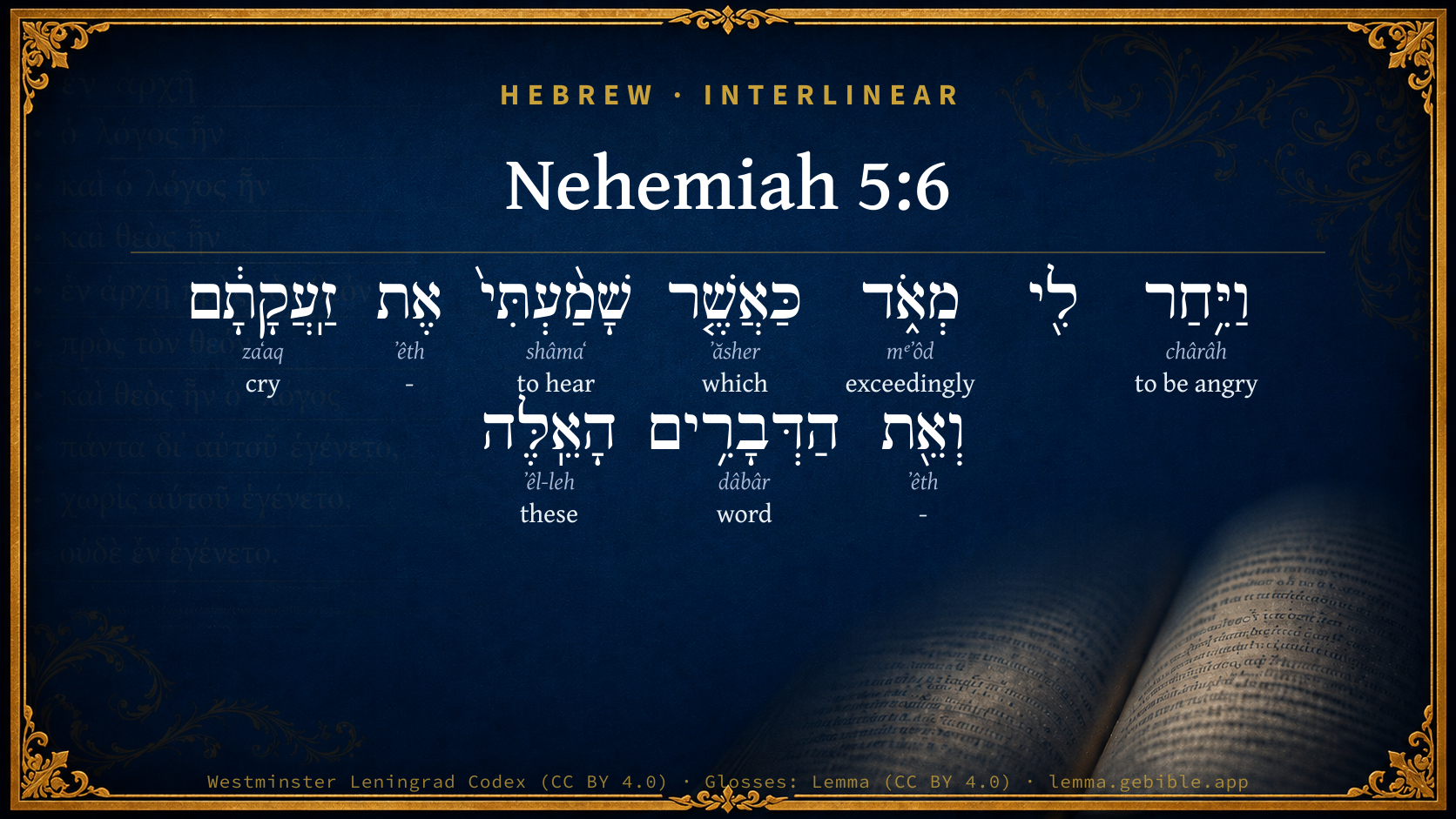
Nehemiah 5:6

Hebrew (Westminster Leningrad Codex) Nehemiah 5:6 appears in the Hebrew Old Testament. The text above is from the Westminster Leningrad Codex. Each word links to its Strong’s number, a concise gloss, and parsing drawn from the Open Scriptures Hebrew Bible morphology. Click any word for its full Brown-Driver-Briggs (BDB) entry.
Download image
Cite this verse

Nehemiah 5:6 (World English Bible). Public Domain. Lemma interlinear Bible study tool, https://lemma.gebible.app/v/nehemiah/5/6.

Show BibTeX & RIS
BibTeX
RIS
English Translation
I was very angry when I heard their cry and these words.
World English Bible · Public Domain
Download a study sheet

One document with this verse’s original text, its word-by-word gloss line, the meaning frame, cross-references with their text, attributed commentary, and full source and license credits — printable, and it pastes into notes with its structure intact.

This verse Autodidact and up

Study sheet (.html) Plain text (.txt)

A passage Seminary Student

Up to 50 verses in one chapter. A passage sheet keeps up to 6 commentary sources and 12 cross-references per verse, in the order this page ranks them, and says so on the sheet whenever that leaves anything out. Ask for a single verse and you get the Autodidact verse sheet above.

Everything on this page stays free to read, with no account — the sheet is a download of what is already on screen, not access to it.

Want to remove ads? Support Godless Engineer
Compare translations 3

The same verse in 3 English versions, stacked beneath the original-language interlinear above. Click any original word for its lexicon entry.

Each is an independent rendering of the whole verse — the interlinear is not word-aligned to these translations.

Highlighted words mark where these versions differ — a whole-verse word diff, not a word-by-word alignment.

  • World English Bible Public Domain
    I was very angry when I heard their cry and these words.
  • King James Version Public Domain
    And I was very angry when I heard their cry and these words.
  • unfoldingWord Literal Text CC BY-SA 4.0
    And it burned me extremely when I heard their outcry and these words.

unfoldingWord Literal Text — © unfoldingWord, licensed CC BY-SA 4.0. Word-aligned USFM3 via Door43 (git.door43.org/unfoldingWord/en_ult).

Versions to compare (up to 4)

3 of 4 selected

Show all 18 translations

Every available English version of this verse, each an independent rendering of the whole verse.

  • World English Bible Public Domain
    I was very angry when I heard their cry and these words.
  • Berean Standard Bible Public Domain
    When I heard their outcry and these complaints, I became extremely angry,
  • Majority Standard Bible Public Domain
    When I heard their outcry and these complaints, I became extremely angry,
  • King James Version Public Domain
    And I was very angry when I heard their cry and these words.
  • American Standard Version (1901) Public Domain
    And I was very angry when I heard their cry and these words.
  • Revised Version (1885) Public Domain
    And I was very angry when I heard their cry and these words.
  • Geneva Bible (1599) Public Domain
    Then was I very angrie when I heard their crie and these wordes.
  • Douay-Rheims (1899) Public Domain
    And I was exceedingly angry when I heard their cry according to these words.
  • Young's Literal Translation Public Domain
    And it is very displeasing to me when I have heard their cry and these words,
  • Literal Standard Version CC BY-SA 4.0
    And it is very displeasing to me when I have heard their cry and these words,
  • Unlocked Literal Bible CC BY-SA 4.0
    I was very angry when I heard their outcry and these words.
  • unfoldingWord Literal Text CC BY-SA 4.0
    And it burned me extremely when I heard their outcry and these words.
  • Darby Bible Public Domain
    And I was very angry when I heard their cry and these words.
  • World Messianic Bible Public Domain
    I was very angry when I heard their cry and these words.
  • Webster's Bible Public Domain
    And I was very angry when I heard their cry and these words.
  • Free Bible Version CC BY-SA 4.0
    I became very angry when I heard them protesting their grievances.
  • Bible in Basic English Public Domain
    And on hearing their outcry and what they said I was very angry.
  • JPS Tanakh (1917) Public Domain
    And I was very angry when I heard their cry and these words.

Literal Standard Version (2020), Covenant Press — licensed CC BY-SA 4.0. Text via the HelloAO Bible API (eBible.org). Unlocked Literal Bible (unfoldingWord) — licensed CC BY-SA 4.0. Text via the HelloAO Bible API (eBible.org). unfoldingWord Literal Text — © unfoldingWord, licensed CC BY-SA 4.0. Word-aligned USFM3 via Door43 (git.door43.org/unfoldingWord/en_ult). Free Bible Version, Dr. Jonathan Gallagher — licensed CC BY-SA 4.0. Text via the HelloAO Bible API (eBible.org).

Word by word

More ways to search: Search by grammar → Find every occurrence → Compare this word →

Practice this passage: Drill this verse → Learn its vocabulary →

זַֽעֲקָתָ֔ם
zaʻaq
H2201
“cry · their”
Noun, Common, Feminine, Singular, Construct + Suffix, Personal, 3rd Person, Masculine, Plural
Part of Speech
Noun
Type
Common
Gender
Feminine
Number
Singular
State
Construct
Full BDB Definition

Origin: from H2199

TWOT: 570a

cry, outcry - outcry - cry of distress - outcry, clamour
  1. וַיִּ֥חַר chârâh H2734 “and · to be angry” Conjunction + Verb, Qal, Sequential Imperfect, 3rd Person, Masculine, Singular
  2. מְאֹ֑ד mᵉʼôd H3966 “exceedingly” Adverb
  3. כַּאֲשֶׁ֤ר ʼăsher H834 “like/as · which” Preposition + Particle, Relative
  4. שָׁמַ֨עְתִּי֙ shâmaʻ H8085 “to hear” Verb, Qal, Perfect, 1st Person, Common, Singular
  5. אֶת ʼêth H853 “-” Particle, Direct Object
  6. וְאֵ֖ת ʼêth H853 “and · -” Conjunction + Particle, Direct Object
  7. הַדְּבָרִ֥ים dâbâr H1697 “the · words” Particle, Definite Article + Noun, Common, Masculine, Plural, Absolute
  8. הָאֵֽלֶּה ʼêl-leh H428 “the · these” Particle, Definite Article + Pronoun, Demonstrative, Common, Plural

About this verse

These counts appear in no published source. They are computed here, from the morphology-tagged text and Lemma’s own curated glosses. What Lemma adds →

10
words
8
distinct lemmas
Historical
section

Notable vocabulary

The rarest word here is זַֽעֲקָתָ֔ם cry H2201 — appearing just 19 times in the whole Hebrew Bible.

Shared distinctive vocabulary

זַֽעֲקָתָ֔ם cry H2201 occurs in 19 verses of the Hebrew Bible. Also found in:

Grammatical profile

  • 2 verbs
  • 2 nouns
  • 1 pronoun
  • 1 preposition
  • 1 adverb
  • 3 particles

Verb forms

  • וַיִּ֥חַר Qal · Sequential Imperfect
  • שָׁמַ֨עְתִּי֙ Qal · Perfect

Cross-references

6

Topical passages linked to Nehemiah 5:6 in the Treasury of Scripture Knowledge — connected by theme and wording, ordered by reader-vote popularity; previews shown in the World English Bible.

  • Exodus 11:8 All these your servants shall come down to me, and bow down themselves to me, saying, 'Get out, and all the people who follow you; and after that I will go out.'" He went out from Pharaoh in hot anger.
  • Nehemiah 13:25 I contended with them, and cursed them, and struck certain of them, and plucked off their hair, and made them swear by God, [saying], You shall not give your daughters to their sons, nor take their daughters for your sons, or for yourselves.
  • Numbers 16:15 Moses was very angry, and said to Yahweh, "Don't respect their offering: I have not taken one donkey from them, neither have I hurt one of them."
  • Ephesians 4:26 "Be angry, and don't sin." Don't let the sun go down on your wrath,
  • Nehemiah 13:8 It grieved me sore: therefore I cast forth all the household stuff of Tobiah out of the chamber.
  • Mark 3:5 When he had looked around at them with anger, being grieved at the hardening of their hearts, he said to the man, "Stretch out your hand." He stretched it out, and his hand was restored as healthy as the other.

Cross-references courtesy of OpenBible.info (CC BY 4.0).

Hebrew and Greek witnesses Masoretic Hebrew ↔ Greek Septuagint

The same verse in the two great witnesses to the Old Testament, shown verse-for-verse.

These are two independent witnesses, not word-aligned to each other, and the Septuagint is shown in lemma (dictionary) form.

Hebrew Nehemiah 5:6 Masoretic · Westminster Leningrad Codex

וַיִּ֥חַר לִ֖י מְאֹ֑ד כַּאֲשֶׁ֤ר שָׁמַ֨עְתִּי֙ אֶת זַֽעֲקָתָ֔ם וְאֵ֖ת הַדְּבָרִ֥ים הָאֵֽלֶּה

I was very angry when I heard their cry and these words.

World English Bible · Public Domain

Greek LXX Structure differs

The Septuagint has no separate book of Nehemiah. Its Greek text is the second half of Esdras B (2 Esdras), chapters 11–23; Ezra is the first half (1–10).

A verse-for-verse comparison isn’t shown here because the chapters and verses don’t line up. Switch to the LXX edition with the MT / LXX toggle above to read the Greek directly.

Hebrew: Westminster Leningrad Codex (CC BY 4.0). Greek: Septuagint (public domain); English from a public-domain English Septuagint. How the Septuagint differs from the Hebrew →

Commentary

Notes on Nehemiah 5:6 from classic Christian and Jewish commentators (each source and its license shown beneath its notes). The classic Christian expositions comment on the surrounding passage and are grouped to its opening verse, so a note may address several verses; the Jewish commentaries on the Tanakh (Rashi and others) are per-verse, so they appear only where the commentator wrote on this verse.

Lemma curates 59 commentaries, every one of them public domain or Creative Commons licensed, each selected and text-cleaned for this edition rather than reprinted as found. About our sources →

Matthew Henry's Commentary

It should seem the foregoing complaint was made to Nehemiah at the time when he had his head and hands as full as possible of the public business about building the wall; yet, perceiving it to be just, he did not reject it because it was unseasonable; he did not chide the petitioners, nor fall into a passion with them, for disturbing him when they saw how much he had to do, a fault which men of business are too often guilty of; nor did he so much as adjourn the hearing of the cause or proceedings upon it till he had more leisure. The case called for speedy interposition, and therefore he applied himself immediately to the consideration of it, knowing that, let him build Jerusalem's walls ever so high, so thick, so strong, the city could not be safe while such abuses as these were tolerated. Now observe, What method he took for the redress of this grievance which was so threatening to the public.

I. He was very angry (Neh 5:6); he expressed a great displeasure at it, as a very bad thing. Note, It well becomes rulers to show themselves angry at sin, that by the anger itself they may be excited to their duty, and by the expressions of it others may be deterred from evil.

II. He consulted with himself, Neh 5:7. By this it appears that his anger was not excessive, but kept within bounds, that, though his spirit was provoked, he did not say or do any thing unadvisedly. Before he rebuked the nobles, he consulted with himself what to say, and when, and how. Note, Reproofs must be given with great consideration, that what is well meant may not come short of its end for want of being well managed. It is the reproof of instruction that giveth life. Even wise men lose the benefit of their wisdom sometimes for want of consulting with themselves and taking time to deliberate.

III. He rebuked the nobles and rulers, who were the monied men, and whose power perhaps made them the more bold to oppress. Note, Even nobles and rulers, if they do that which is evil, ought to be told of it by proper persons. Let no man imagine that his dignity sets him above reproof.

IV. He set a great assembly against them. He called the people together to be witnesses of what he said, and to bear their testimony (which the people will generally be forward to do) against the oppressions and extortions their rulers were guilty of, Neh 5:12. Ezra and Nehemiah were both of them very wise, good, useful men, yet, in cases not unlike, there was a great deal of difference between their management: when Ezra was told of the sin of the rulers in marrying strange wives he rent his clothes, and wept, and prayed, and was hardly persuaded to attempt a reformation, fearing it to be impracticable, for he was a man of a mild tender spirit; when Nehemiah was told of as bad a thing he kindled immediately, reproached the delinquents, incensed the people against them, and never rested till, by all the rough methods he could use, he forced them to reform; for he was a man of a hot and eager spirit. Note, 1. Very holy men may differ much from each other in their natural temper and in other things that result from it. 2. God's work may be done, well done, and successfully, and yet different methods taken in the doing of it, which is a good reason why we should neither arraign the management of others nor make our own a standard. There are diversities of operation, but the same Spirit.

V. He fairly reasoned the case with them, and showed them the evil of what they did. The regular way of reforming men's lives is to endeavour, in the first place, to convince their consciences. Several things he offered to their consideration, which are so pertinent and just that it appeared he had consulted with himself. He lays it before them, 1. That those whom they oppressed were their brethren: You exact every one of his brother. It was bad enough to oppress strangers, but much worse to oppress their poor brethren, from whom the divine law did not allow them to take any usury, Deu 23:19, Deu 23:20. 2. That they were but lately redeemed out of the hand of the heathen. The body of the people were so by the wonderful providence of God; some particular persons among them were so, who, besides their share in the general captivity, were in servitude to heathen masters, and ransomed at the charge of Nehemiah and other pious and well-disposed persons. "Now," says he, "have we taken all this pains to get their liberty out of the hands of the heathen, and shall their own rulers enslave them? What an absurd thing is this! Must we be at the same trouble and expense to redeem them from you as we were to redeem them from Babylon?" Neh 5:8. Those whom God by his grace has made free ought not to be again brought under a yoke of bondage, Gal 5:1; Co1 7:23. 3. That it was a great sin thus to oppress the poor (Neh 5:9): "It is not good that you do; though you get money by it, you contract guilt by it, and ought you not to walk in the fear of God? Certainly you ought, for you profess religion, and relation to him; and, if you do walk in the fear of God, you will not be either covetous of worldly gain or cruel towards your brethren." Those that walk in the fear of God will not dare to do a wicked thing, Job 31:13, Job 31:14, Job 31:23. 4. That it was a great scandal, and a reproach to their profession. "Consider the reproach of the heathen our enemies, enemies to us, to our God, and to our holy religion. They will be glad of any occasion to speak against us, and this will give them great occasion; they will say, These Jews, that profess so much devotion to God, see how barbarous they are one to another." Note, (1.) All that profess religion should be very careful that they do nothing to expose themselves to the reproach of those that are without, lest religion be wounded through their sides. (2.) Nothing exposes religion more to the reproach of its enemies than the worldliness and hard-heartedness of the professors of it. 5. That he himself had set them a better example (Neh 5:10), which he enlarges upon afterwards, Neh 5:14, etc. Those that rigorously insist upon their right themselves will with a very ill grace persuade others to recede from theirs.

VI. He earnestly pressed them not only not to make their poor neighbours any more such hard bargains, but to restore that which they had got into their hands, Neh 5:11. See how familiarly he speaks to them: Let us leave off this usury, putting himself in, as becomes reprovers, though far from being any way guilty of the crime. See how earnestly, and yet humbly, he persuades them: I pray you leave off; and I pray you restore. Though he had authority to command, yet, for love's sake, he rather beseeches. See how particularly he presses them to be kind to the poor, to give them up their mortgages, put them again in possession of their estates, remit the interest, and give them time to pay in the principal. He urged them to their loss, yet, urging them to their duty, it would be, at length, to their advantage. What we charitably forgive will be remembered and recompensed, as well as what we charitably give.

VII. He laid them under all the obligations possible to do what he pressed them to. 1. He got a promise from them (Neh 5:12): We will restore them. 2. He sent for the priests to give them their oath that they would perform this promise; now that their convictions were strong, and they seemed resolved, he would keep them to it. 3. He bound them by a solemn curse or execration, hoping that would strike some awe upon them: So let God shake out every man that performeth not this promise, Neh 5:13. This was a threatening that he would certainly do so, to which the people said Amen, as to those curses at Mount Ebal (Deu. 27), that their throats might be cut with their own tongues if they should falsify their engagement, and that by the dread of that they might be kept to their promise. With this Amen the people praised the Lord; so far were they from promising with regret that they promised with all possible expressions of joy and thankfulness. Thus David, when he took God's vows upon him, sang and gave praise, Psa 56:12. This cheerfulness in promising was well, but that which follows was better: They did according to this promise, and adhered to what they had done, not as their ancestors in a like case, who re-enslaved those whom a little before they had released, Jer 34:10, Jer 34:11. Good promises are good things, but good performances are all in all.

Matthew Henry's Commentary on the Whole Bible (1708–1710) — public domain (CC PDM 1.0). Text via the HelloAO Bible API.

Jamieson, Fausset & Brown

Robert Jamieson, A. R. Fausset & David Brown

THE USURERS REBUKED. (Neh 5:6-19)

I was very angry when I heard their cry and these words--When such disorders came to the knowledge of the governor, his honest indignation was roused against the perpetrators of the evil. Having summoned a public assembly, he denounced their conduct in terms of just severity. He contrasted it with his own in redeeming with his money some of the Jewish exiles who, through debt or otherwise, had lost their personal liberty in Babylon. He urged the rich creditors not only to abandon their illegal and oppressive system of usury, but to restore the fields and vineyards of the poor, so that a remedy might be put to an evil the introduction of which had led to much actual disorder, and the continuance of which would inevitably prove ruinous to the newly restored colony, by violating the fundamental principles of the Hebrew constitution. The remonstrance was effectual. The conscience of the usurious oppressors could not resist the touching and powerful appeal. With mingled emotions of shame, contrition, and fear, they with one voice expressed their readiness to comply with the governor's recommendation. The proceedings were closed by the parties binding themselves by a solemn oath, administered by the priests, that they would redeem their pledge, as well as by the governor invoking, by the solemn and significant gesture of shaking a corner of his garment, a malediction on those who should violate it. The historian has taken care to record that the people did according to this promise.

Jamieson, Fausset & Brown — Commentary Critical and Explanatory on the Whole Bible (1871) — public domain (CC PDM 1.0). Text via the HelloAO Bible API.

Trapp's Complete Commentary

John Trapp

Neh 5:6 And I was very angry when I heard their cry and these words.

Ver. 6. And I was very angry] Red-hot with anger, and not without cause. To be angry without cause is to be guilty of judgment, Mat 5:22, but in case of God’s dishonour, and public prejudice, moderation is mopishness, toleration cowardice, &c. Nehemiah was a magistrate, that is, a mortal god; as God is an immortal magistrate. Therefore as God is angry at the oppressions of poor people (Lactantius hath written a book De Ira Dei), so should his lieutenants; and this holy anger should be cos fortitudinis, a means to encourage, or rather to enrage them against oppressors, who grind the faces of the poor, and take from them burdens of wheat, Amo 5:11. Yea, lands and vineyards, as here, eating bread baked with the tears of men, coining their money on their skins, and wringing their spunges into their own purses.

When I heard their cry] His anger then was mixed with grief, as was our Saviour’s, Mar 3:5: it was pure zeal, which is nothing else but an extreme (but regular) heat of all the affections.

John Trapp, A Commentary or Exposition upon All the Books of the Old and New Testament (1647–1656) — public domain. Text from a community e-Sword module.

Joseph Benson's Commentary

Neh 5:6-7. Then I was very angry — Grieved exceedingly at this sin of the nobles. Then I consulted with myself — I restrained the emotions of my mind, being afraid to do any thing in a fit of anger or vexation and coolly considered, and deliberated with myself, what was best to be done. And I rebuked the nobles and rulers — Who were the moneyed men, and whose power, perhaps, made them more bold to oppress; and said, You exact usury every one from his brother — Which was against the plain and positive law of God, (Deu 23:19-20,) especially in this time of public calamity and dearth. And I set a great assembly against them — I called a public congregation, both of the rulers and people, the greatest part whereof were free from this guilt, and therefore more impartial judges of the matter, and I represented it to them, that the offenders might be convinced and reformed; if not for fear of God, or love of their brethren, yet at least for the public shame, and the cries of the poor. Ezra and Nehemiah were both good and useful men; but of how different tempers! Ezra was a man of a mild, tender spirit, and when told of the sin of the rulers, rent his clothes and wept. Nehemiah forced them to reform, being of a warm and eager spirit. So God’s work may be done, and yet different methods taken in doing it; which is a good reason why we should not arraign the management of others, nor make our own a standard.

Joseph Benson's Commentary on the Old and New Testaments (1811–1818) — public domain. Text from a community e-Sword module.

Keil & Delitzsch

C. F. Keil & F. Delitzsch

The abolition of usury. - Neh 5:6 Nehemiah was very angry at this complaint and these things, i.e., the injustice which had been brought to his knowledge.

Neh 5:7

"And my heart took counsel upon it (ימּלך according to the Chaldee use of מלך, Dan 4:24), and I contended with the nobles and rulers, and said to them, Ye exact usury every one of his brother." ב נשׁא means to lend to any one, and משּׁא, also משּׁאה, Deu 24:10; Pro 22:26, and mashe', is the thing lent, the loan, what one borrows from or lends to another. Consequently משּׁא נשׁא is to lend some one a loan; comp. Deu 24:10. This does not seem to suit this verse. For Nehemiah cannot reproach the nobles for lending loans, when he and his servants had, according to Neh 5:10, done so likewise. Hence the injustice of the transaction which he rebukes must be expressed in the emphatic precedence given to משּׁא. Bertheau accordingly regards משּׁא not as the accusative of the object, but as an independent secondary accusative in the sense of: for the sake of demanding a pledge, ye lend. But this rendering can be neither grammatically nor lexically justified. In the first respect it is opposed by משּׁאה השּׁא, Deu 24:10, which shows that משּׁא in conjunction with נשׁא is the accusative of the object; in the other, by the constant use of משּׁא in all passages in which it occurs to express a loan, not a demand for a pledge. From Exo 22:24, where it is said, "If thou lend money (תּלוה) to the poor, thou shalt not be to him כּנשׁה, shalt not lay upon him usury," it is evident that נשׁה is one who lends money on usury, or carries on the business of a money-lender. This evil secondary meaning of the word is here strongly marked by the emphatic praeposition of משּׁא; hence Nehemiah is speaking of those who practise usury. "And I appointed a great assembly on their account," to put a stop to the usury and injustice by a public discussion of the matter. עליהם, not against them (the usurers), but on their account.

Neh 5:8

In this assembly he reproached them with the injustice of their behaviour. "We" (said he) "have, after our ability, redeemed our brethren the Jews which were sold unto the heathen; yet ye would sell your brethren, and they are to be sold to us." We (i.e., Nehemiah and the Jews living in exile, who were like-minded with him) have bought, in contrast to ye sell. They had redeemed their Jewish brethren who were sold to the heathen. בנוּ כּדי for בנוּ אשׁר כּדי, i.e., not according to the full number of those who were among us, meaning as often as a sale of this kind occurred (Bertheau); for דּי does not mean completeness, multitude, but only sufficiency, supply, adequacy of means (Lev 25:26); hence בנוּ כּדי is: according to the means that we had: secundum sufficientiam vel facultatem, quae in nobis est (Ramb.), or secundum possibilitatem nostram (Vulg.). The contrast is still more strongly expressed by the placing of גּם before אתּם, so that וגם acquires the meaning of nevertheless (Ewald, 354, a). The sale of their brethren for bond-servants was forbidden by the law, Lev 25:42. The usurers had nothing to answer to this reproach. "They held their peace, and found no word," sc. in justification of their proceedings.

Neh 5:9

Nehemiah, moreover, continued (ויאמר, the Chethiv, is evidently a clerical error for ואמר, for the Niphal ויּאמר does not suit): "The thing ye do is not good: ought ye not (= ye surely ought) to walk in the fear of our God, because of the reproach of the heathen our enemies?" i.e., we ought not, by harsh and unloving conduct towards our brethren, to give our enemies occasion to calumniate us.

Neh 5:10-12

"I, likewise my brethren and my servants (comp. Neh 4:17), have lent them money and corn; let us, I pray, remit (not ask back) this loan!" The participle נשׁים says: we are those who have lent. Herewith he connects the invitation, Neh 5:11 : "Restore unto them, I pray you, even this day (כּהיּום, about this day, i.e., even to-day, Sa1 9:13), their fields, their vineyards, their olive gardens, and their houses, and the hundredth of the money, and of the corn, wine, and oil which you have lent them." Nehemiah requires, 1st, that those who held the lands of their poorer brethren in pledge should restore them their property without delay: 2nd, that they should remit to their debtors all interest owing on money, corn, etc. that had been lent; not, as the words have been frequently understood, that they should give back to their debtors such interest as they had already received. That the words in Neh 5:11 bear the former, and not the latter signification, is obvious from the reply, Neh 5:12, of those addressed: "We will restore, sc. their lands, etc., and will not querie of them, sc. the hundredth; so will we do as thou sayest." Hence we must not translate בּהם נשׁים אתּם אשׁר, "which you had taken from them as interest" (de Wette), - a translation which, moreover, cannot be justified by the usage of the language, for ב נשׁה does not mean to take interest from another, to lend to another on interest. The אשׁר relates not to וּמאת, but to והיּצהר ... הדּגן; and השׁיב, to restore, to make good, is used of both the transactions in question, meaning in the first clause the restoration of the lands retained as pledges, and in the second, the remission (the non-requirement) of the hundredth. The hundredth taken as interest is probably, like the centesima of the Romans, to be understood of a monthly payment. One per cent. per month was a very heavy interest, and one which, in the case of the poor, might be exorbitant. The law, moreover, forbade the taking of any usury from their brethren, their poor fellow-countrymen, Exo 22:25 and Lev 25:36. When the creditors had given the consent required, Nehemiah called the priests, and made them (the creditors) swear to do according to this promise, i.e., conscientiously to adhere to their agreement. Nehemiah obtained the attendance of the priests, partly for the purpose of giving solemnity to the oath now taken, and partly to give to the declaration made in the presence of the priests legal validity for judicial decisions.

Neh 5:13

To make the agreement thus sworn to still more binding, Nehemiah confirmed the proceeding by a symbolical action: Also I shook my lap, and said, So may God shake out every man from his house, and from his labour, that performeth (fulfilleth) not this promise, and thus may he be shaken out and emptied. חצן means the lap of the garment, in which things are carried (Isa 49:22), where alone the word is again found. The symbolical action consisted in Nehemiah's gathering up his garment as if for the purpose of carrying something, and then shaking it out with the words above stated, which declared the meaning of the act. The whole congregation said Amen, and praised the Lord, sc. for the success with which God had blessed his efforts to help the poor. And the people did according to this promise, i.e., the community acted in accordance with the agreement entered into.

Keil & Delitzsch — Biblical Commentary on the Old Testament (1861–1891) — public domain (CC PDM 1.0). Text via the HelloAO Bible API. (Old Testament only.)

Tyndale Open Study Notes

Tyndale Open Resources

5:6-7 Nehemiah was very angry, but he controlled himself, thought it over, and then spoke out in order to resolve the conflict rather than make it worse (see Jas 1:19-20).

Tyndale Open Study Notes — © Tyndale Open Resources, licensed CC BY-SA 4.0. Text via the HelloAO Bible API.

Ellicott's Commentary for English Readers

(6) And I was very angry.—Nehemiah, recently arrived, had not known this state of things. The common wailing and the three complaints in which it found expression are distinct.

A Bible Commentary for English Readers, edited by Charles John Ellicott (1878–1897) — public domain. Text from a community e-Sword module.

The Cambridge Bible for Schools and Colleges

gen. ed. J. J. S. Perowne

6. I was very angry, &c.] Nehemiah’s indignation was excited at the excessive usury, which his own brethren and servants required (Neh_5:10), but still more at the degree to which the brotherhood of Israel was forgotten in days of common peril and of which the sale of fellow-countrymen for debt (Neh_5:8) and the alienation of the poor man’s inheritance (Neh_5:11) were the worst symptoms. Cf. Psa_119:53 ‘Hot indignation hath taken hold upon me, because of the wicked that forsake thy law.’

The Cambridge Bible for Schools and Colleges (gen. ed. J. J. S. Perowne; Cambridge University Press, 1878–1918) — public domain. Text from a community e-Sword module.

John Gill's Exposition

And I was very angry when I heard their cry, and these words. Their complaint expressed in this manner; it not only raised pity and compassion in his breast towards these poor distressed people, but indignation at the rich that oppressed them.

And I was very angry when I heard their cry, and these words. Their complaint expressed in this manner; it not only raised pity and compassion in his breast towards these poor distressed people, but indignation at the rich that oppressed them.

Nehemiah 5:7

neh 5:7

neh 5:7

neh 5:7Then I consulted with myself,.... What was to be done, what method to be taken to redress such grievances:

and I rebuked the nobles and the rulers; who were the men that monopolized the corn in this dear season, and sold it at an extravagant price, and had got the lands, vineyards, and houses of the poor mortgaged to them, and to whom they had lent money on usury:

and said unto them, you exact usury everyone of his brother; which was contrary to the express law of God, Exo 22:25 and which even the Indians (h) strictly observed, who neither let out money, nor took any upon usury:

and I set a great assembly against them; either of the poor that were oppressed, who brought in their accusations and complaints against them, or a large body of the people, who were not guilty, to hear them, that the delinquents might be put to public shame; or he called a large court of judicature, and set them to examine these allegations, and to do justice.

(h) Aelian. Var. Hist. l. 4. c. 1.

John Gill's Exposition of the Whole Bible (1746–1763) — public domain (CC PDM 1.0). Text via the HelloAO Bible API.

Whedon's Commentary on the Bible

Daniel D. Whedon

6. Very angry — Highly indignant, to find that such abuses existed among a people so recently escaped from exile.

Daniel D. Whedon (gen. ed.), Commentary on the Old and New Testaments (1874–1909) — public domain. Text from a community e-Sword module.

The Pulpit Commentary

I was very angry. It is not clear that the letter of the law was infringed, unless it were in the matter of taking interest (ver. 11), of which the people had not complained. That men might sell their daughters to be concubines or secondary wives is clear from Exo_21:7; and it is therefore probable that they might sell their sons for servants. But the servitude might only be for six years" (Exo_21:2) and if a jubilee year occurred before the sexennial period was out, the service was ended. (Lev_25:10) Land too might be either mortgaged or sold (ibid. vers. 14-16), but under the condition that it returned to the seller, or at any rate to his tribe, in the jubilee year (ibid. vers. 10, 13). The spirit, however, of the law the command, "Ye shall not oppress one another" (ibid. vers. 14, 17) was transgressed by the proceedings of the rich men. It was their duty in a time of scarcity not to press hard upon their poorer brethren, but freely to alleviate their necessities. Nehemiah, his near relations, and his followers had done so to the utmost of their power (ver. 10, with the comment). The rich men had acted differently, and made all the profit that they could out of the need of their fellow-countrymen. Hence Nehemiah"s anger.

Vers. 6, 7. Righteous anger.

"And I was very angry when I heard their cry and these words. Then I consulted with myself, and I rebuked the nobles, and the rulers." Anger is always dangerous, often evil. The anger is sinful which has its root in selfishness, which is excited by slight causes, or is blended with hatred, or issues in malice or revenge, or lasts long in any form. But there is an anger which is righteous, and the absence of which, so far from being a commendable meekness, may be occasioned by indifference to great principles, and to the general welfare of men. The text illustrates

I THE NATURE OF RIGHTEOUS ANGER.

1. Whence it springs. Love to God and man; love to righteousness, hatred of sin.

2. By what it is excited.

a. Flagrant wrong-doing,

b. consequent injury to society, and

c. counteraction of efforts for its good.

II ITS USES. To stimulate to

1. The rebuke and restraint of evil-doers.

2. Efforts for their reformation.

3. The discovery and application of remedies for the mischief they have wrought.

III ITS BEST PRESERVATIVE FROM EVIL. Reflection before acting. "I consulted with myself." No passion more demands self-control, that it run not to excess, nor hurry into unwise and sinful words and deeds. A pause to consider, and the exercise of reflection itself, will supply the needful corrective, and enable us so to govern and guide our anger that it may subserve the ends for which this passion was given.

The Pulpit Commentary (1880–1919), ed. H.D.M. Spence-Jones & Joseph S. Exell — public domain. Text from a community e-Sword module.

unfoldingWord translationNotes

Door43 World Missions Community

when I heard their outcry

The word "outcry" can be expressed as a verb. AT: "when I heard them cry out" (See: Abstract Nouns)

You are exacting interest, each from his own brother

Every Jew would have known that it is wrong under the Law to charge interest to another Jew. The full meaning of this can be made clear. AT: "Each of you is charging interest to your own brother, and that is wrong under the Law" (See: Assumed Knowledge and Implicit Information)

I held a great assembly against them

This means that he brought together a large group of people and brought these charges against them. The meaning of statement this can be made clear. AT: "I held a great assembly and brought these charges against them" or "I held them on trial in front of the assembly" (See: Assumed Knowledge and Implicit Information)

but you even sell your brothers and sisters that they may be sold back to us

This means that they are selling their family members as slaves to their fellow Jews. The full meaning of this statement can be made clear. AT: "Now you are selling your own people to be slaves of your fellow Jews, so that they might later sell them back to us" (See: Assumed Knowledge and Implicit Information)

who had been sold to the nations

This can be stated in active form. AT: "who people had sold as slaves to the nations" (See: Active or Passive)

translationWords

anger

word

brother

assembly

servant

Jew

nation

sister

unfoldingWord translationNotes — © Distant Shores Media and the Door43 World Missions Community, licensed CC BY-SA 4.0. Source: git.door43.org/Door43/en_tn.

Lesson kit

Teaching starters — assembled from the data on this page, not authored interpretation. Every prompt links to the verse data it draws on. Edit before teaching.

Nehemiah, in the Historical, opens this verse with 10 words (8 distinct Hebrew lemmas). Its most distinctive word is zaʻaq (“cry”). A historical commentator’s framing appears above. Read the whole chapter for the surrounding context.

Discussion questions

  1. How does “cry” (zaʻaq) shape what this verse is saying?
  2. Genesis 18:20 shares the word «cry» with this verse. How do the two illuminate each other?
  3. These translations render this verse differently; the difference is in the English rendering, not the original. What questions does that raise?
  4. The verb «וַיִּ֥חַר» is Qal Sequential Imperfect. How does its form color the action?
  5. Reading how Matthew Henry's Commentary and Jamieson, Fausset & Brown read this verse, where do the two commentators agree and where do they part?

Things to notice

Reading settings

Reading text

Shown beneath each verse's original-language words.

Old Testament
Old Testament edition

Read the OT as the Masoretic Hebrew (MT) or the Greek Septuagint (LXX).

English shown for the Greek Septuagint (in the Hebrew ↔ Greek comparison).

Comparing translations? Open the Compare panel on any verse page to stack up to four side by side.