
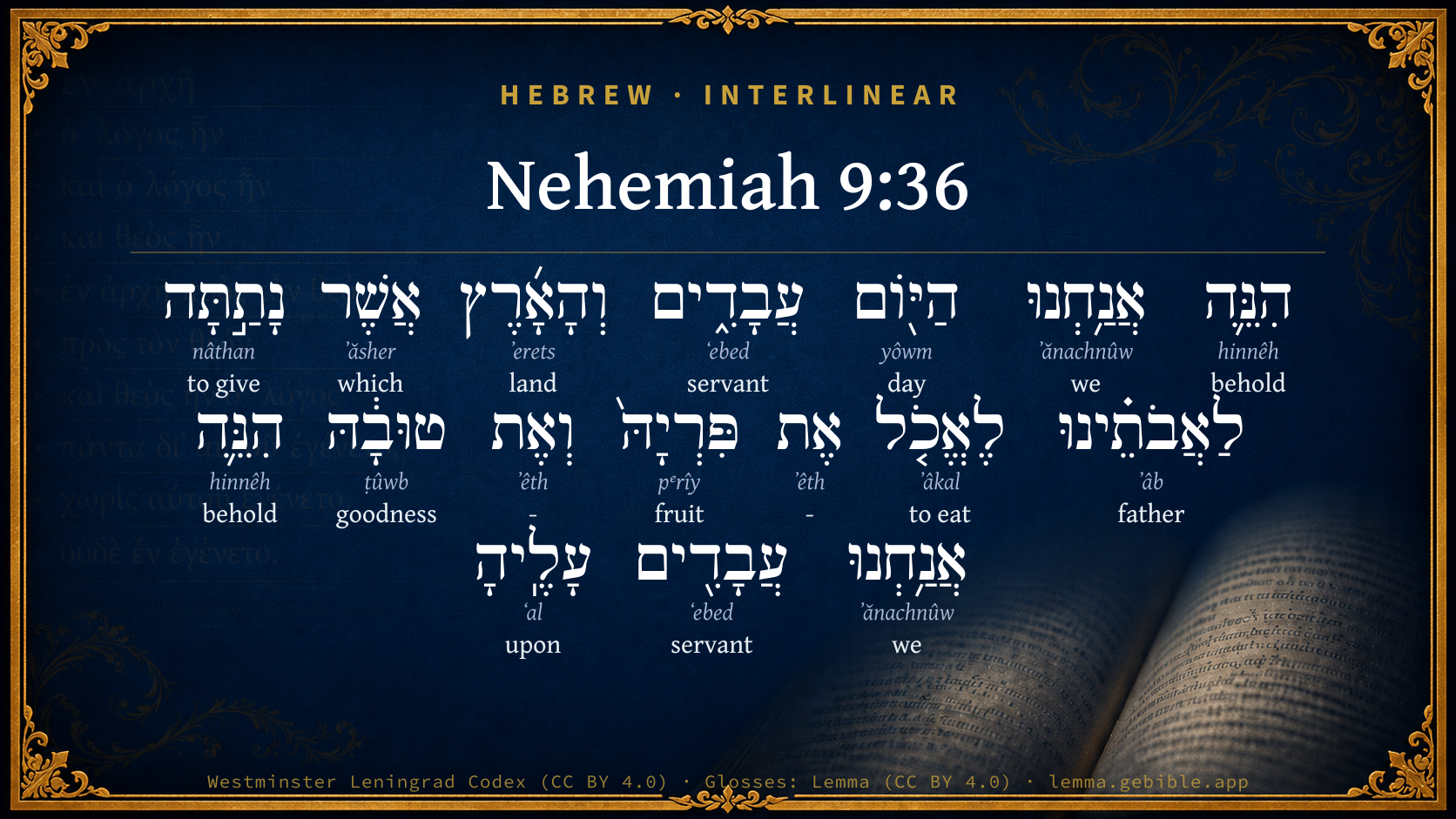
Nehemiah 9:36

Hebrew (Westminster Leningrad Codex) Nehemiah 9:36 appears in the Hebrew Old Testament. The text above is from the Westminster Leningrad Codex. Each word links to its Strong’s number, a concise gloss, and parsing drawn from the Open Scriptures Hebrew Bible morphology. Click any word for its full Brown-Driver-Briggs (BDB) entry.
Download image
Cite this verse

Nehemiah 9:36 (World English Bible). Public Domain. Lemma interlinear Bible study tool, https://lemma.gebible.app/v/nehemiah/9/36.

Show BibTeX & RIS
BibTeX
RIS
English Translation
Behold, we are servants this day, and as for the land that you gave to our fathers to eat the fruit of it and the good of it, behold, we are servants in it.
World English Bible · Public Domain
Download a study sheet

One document with this verse’s original text, its word-by-word gloss line, the meaning frame, cross-references with their text, attributed commentary, and full source and license credits — printable, and it pastes into notes with its structure intact.

This verse Autodidact and up

Study sheet (.html) Plain text (.txt)

A passage Seminary Student

Up to 50 verses in one chapter. A passage sheet keeps up to 6 commentary sources and 12 cross-references per verse, in the order this page ranks them, and says so on the sheet whenever that leaves anything out. Ask for a single verse and you get the Autodidact verse sheet above.

Everything on this page stays free to read, with no account — the sheet is a download of what is already on screen, not access to it.

Want to remove ads? Support Godless Engineer
Compare translations 3

The same verse in 3 English versions, stacked beneath the original-language interlinear above. Click any original word for its lexicon entry.

Each is an independent rendering of the whole verse — the interlinear is not word-aligned to these translations.

Highlighted words mark where these versions differ — a whole-verse word diff, not a word-by-word alignment.

  • World English Bible Public Domain
    Behold, we are servants this day, and as for the land that you gave to our fathers to eat the fruit of it and the good of it, behold, we are servants in it.
  • King James Version Public Domain
    Behold, we are servants this day, and for the land that thou gavest unto our fathers to eat the fruit thereof and the good thereof, behold, we are servants in it:
  • unfoldingWord Literal Text CC BY-SA 4.0
    Behold us today; we are servants. And the land that you gave to our fathers, to eat its fruit and its goodness; behold us, we are servants in it!

unfoldingWord Literal Text — © unfoldingWord, licensed CC BY-SA 4.0. Word-aligned USFM3 via Door43 (git.door43.org/unfoldingWord/en_ult).

Versions to compare (up to 4)

3 of 4 selected

Show all 18 translations

Every available English version of this verse, each an independent rendering of the whole verse.

  • World English Bible Public Domain
    Behold, we are servants this day, and as for the land that you gave to our fathers to eat the fruit of it and the good of it, behold, we are servants in it.
  • Berean Standard Bible Public Domain
    So here we are today as slaves in the land You gave our fathers to enjoy its fruit and goodness—here we are as slaves!
  • Majority Standard Bible Public Domain
    So here we are today as slaves in the land You gave our fathers to enjoy its fruit and goodness—here we are as slaves!
  • King James Version Public Domain
    Behold, we are servants this day, and for the land that thou gavest unto our fathers to eat the fruit thereof and the good thereof, behold, we are servants in it:
  • American Standard Version (1901) Public Domain
    Behold, we are servants this day, and as for the land that thou gavest unto our fathers to eat the fruit thereof and the good thereof, behold, we are servants in it.
  • Revised Version (1885) Public Domain
    Behold, we are servants this day, and as for the land that thou gavest unto our fathers to eat the fruit thereof and the good thereof, behold, we are servants in it.
  • Geneva Bible (1599) Public Domain
    Beholde, we are seruants this day, and the lande that thou gauest vnto our fathers, to eate the fruite thereof, and the goodnesse thereof, beholde, we are seruants therein.
  • Douay-Rheims (1899) Public Domain
    Behold we ourselves this day are bondmen: and the land, which thou gavest our fathers, to eat the bread thereof, and the good things thereof, and we ourselves are servants in it.
  • Young's Literal Translation Public Domain
    `Lo, we -- to-day -- `are' servants, and the land that Thou hast given to our fathers, to eat its fruit and its good -- lo, we `are' servants on it,
  • Literal Standard Version CC BY-SA 4.0
    Behold, we—today—[are] servants, || And the land that You have given to our fathers, || To eat its fruit and its good, || Behold, we [are] servants on it,
  • Unlocked Literal Bible CC BY-SA 4.0
    Now we are slaves in the land you gave our ancestors to enjoy its fruit and its good gifts, and behold, we are slaves in it!
  • unfoldingWord Literal Text CC BY-SA 4.0
    Behold us today; we are servants. And the land that you gave to our fathers, to eat its fruit and its goodness; behold us, we are servants in it!
  • Darby Bible Public Domain
    Behold, we are servants this day, and the land that thou gavest unto our fathers to eat the fruit thereof and the good thereof, behold, we are bondmen in it.
  • World Messianic Bible Public Domain
    “Behold, we are servants today, and as for the land that you gave to our fathers to eat its fruit and its good, behold, we are servants in it.
  • Webster's Bible Public Domain
    Behold, we are servants this day, and for the land that thou gavest to our fathers to eat the fruit of it and the good of it, behold, we are servants in it:
  • Free Bible Version CC BY-SA 4.0
    Look at us now, slaves in the land you gave our forefathers to enjoy its fruit and all its good things. Look at us slaves here!
  • Bible in Basic English Public Domain
    Now, today, we are servants, and as for the land which you gave to our fathers, so that the produce of it and the good might be theirs, see, we are servants in it:
  • JPS Tanakh (1917) Public Domain
    Behold, we are servants this day, and as for the land that Thou gavest unto our fathers to eat the fruit thereof and the good thereof, behold, we are servants in it.

Literal Standard Version (2020), Covenant Press — licensed CC BY-SA 4.0. Text via the HelloAO Bible API (eBible.org). Unlocked Literal Bible (unfoldingWord) — licensed CC BY-SA 4.0. Text via the HelloAO Bible API (eBible.org). unfoldingWord Literal Text — © unfoldingWord, licensed CC BY-SA 4.0. Word-aligned USFM3 via Door43 (git.door43.org/unfoldingWord/en_ult). Free Bible Version, Dr. Jonathan Gallagher — licensed CC BY-SA 4.0. Text via the HelloAO Bible API (eBible.org).

Word by word

More ways to search: Search by grammar → Find every occurrence → Compare this word →

Practice this passage: Drill this verse → Learn its vocabulary →

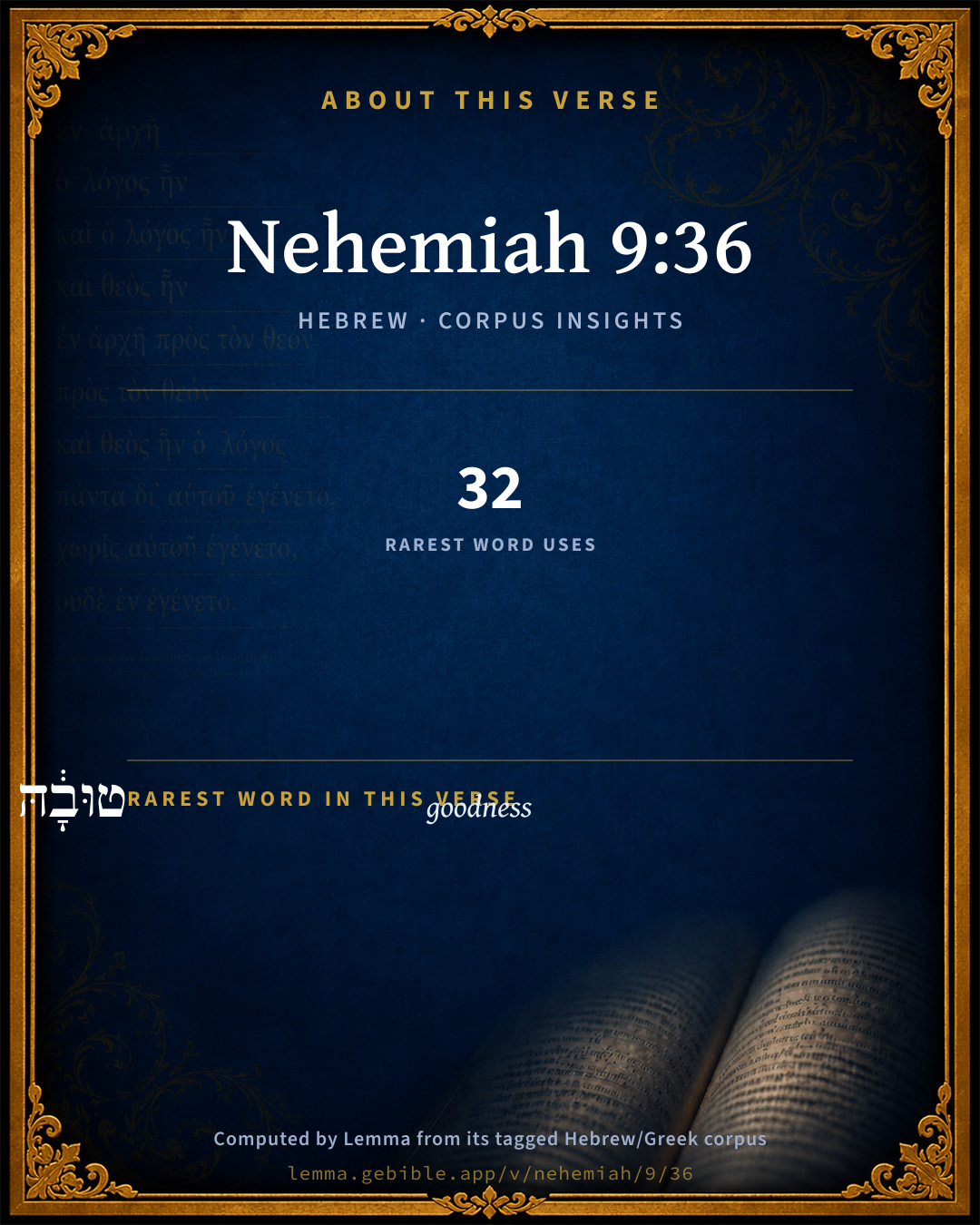
טוּבָ֔הּ
ṭûwb
H2898
“goodness · her”
Noun, Common, Masculine, Singular, Construct + Suffix, Personal, 3rd Person, Feminine, Singular
Part of Speech
Noun
Type
Common
Gender
Masculine
Number
Singular
State
Construct
Full BDB Definition

Origin: from H2895

TWOT: 793b

goods, good things, goodness - good things - goods, property - fairness, beauty, joy, prosperity, goodness (abstract) - goodness (of taste, discernment) - goodness (of God) (abstract)
  1. הִנֵּ֛ה hinnêh H2009 “behold” Particle, Demonstrative
  2. אֲנַ֥חְנוּ ʼănachnûw H587 “we” Pronoun, Personal, 1st Person, Common, Plural
  3. הַיּ֖וֹם yôwm H3117 “the · day” Particle, Definite Article + Noun, Common, Masculine, Singular, Absolute
  4. עֲבָדִ֑ים ʻebed H5650 “servants” Noun, Common, Masculine, Plural, Absolute
  5. וְהָאָ֜רֶץ ʼerets H776 “and · the · land” Conjunction + Particle, Definite Article + Noun, Common, Both, Singular, Absolute
  6. אֲשֶׁר ʼăsher H834 “which” Particle, Relative
  7. נָתַ֣תָּה nâthan H5414 “to give” Verb, Qal, Perfect, 2nd Person, Masculine, Singular
  8. לַאֲבֹתֵ֗ינוּ ʼâb H1 “to/for · fathers · our” Preposition + Noun, Common, Masculine, Plural, Construct + Suffix, Personal, 1st Person, Common, Plural
  9. לֶאֱכֹ֤ל ʼâkal H398 “to eat” Preposition + Verb, Qal, Infinitive Construct
  10. אֶת ʼêth H853 “-” Particle, Direct Object
  11. פִּרְיָהּ֙ pᵉrîy H6529 “fruit · her” Noun, Common, Masculine, Singular, Construct + Suffix, Personal, 3rd Person, Feminine, Singular
  12. וְאֶת ʼêth H853 “and · -” Conjunction + Particle, Direct Object
  13. הִנֵּ֛ה hinnêh H2009 “behold” Particle, Demonstrative
  14. אֲנַ֥חְנוּ ʼănachnûw H587 “we” Pronoun, Personal, 1st Person, Common, Plural
  15. עֲבָדִ֖ים ʻebed H5650 “servants” Noun, Common, Masculine, Plural, Absolute
  16. עָלֶֽיהָ ʻal H5921 “upon · her” Preposition + Suffix, Personal, 3rd Person, Feminine, Singular

About this verse

These counts appear in no published source. They are computed here, from the morphology-tagged text and Lemma’s own curated glosses. What Lemma adds →

17
words
13
distinct lemmas
Historical
section

Shared distinctive vocabulary

טוּבָ֔הּ goodness H2898 occurs in 31 verses of the Hebrew Bible. Also found in:

Grammatical profile

  • 2 verbs
  • 7 nouns
  • 2 pronouns
  • 1 preposition
  • 5 particles

Verb forms

  • נָתַ֣תָּה Qal · Perfect
  • לֶאֱכֹ֤ל Qal · Infinitive Construct

Repetition

Words recur within this verse — often emphatic in Hebrew:

  • הִנֵּ֛ה behold H2009 ×2
  • עֲבָדִ֑ים servant H5650 ×2
  • אֲנַ֥חְנוּ we H587 ×2

Cross-references

3

Topical passages linked to Nehemiah 9:36 in the Treasury of Scripture Knowledge — connected by theme and wording, ordered by reader-vote popularity; previews shown in the World English Bible.

  • Ezra 9:9 For we are bondservants; yet our God has not forsaken us in our bondage, but has extended loving kindness to us in the sight of the kings of Persia, to give us a reviving, to set up the house of our God, and to repair the ruins of it, and to give us a wall in Judah and in Jerusalem.
  • Deuteronomy 28:48 therefore shall you serve your enemies whom Yahweh shall send against you, in hunger, and in thirst, and in nakedness, and in want of all things: and he shall put a yoke of iron on your neck, until he have destroyed you.
  • 2 Chronicles 12:8 Nevertheless they shall be his servants, that they may know my service, and the service of the kingdoms of the countries.

Cross-references courtesy of OpenBible.info (CC BY 4.0).

Hebrew and Greek witnesses Masoretic Hebrew ↔ Greek Septuagint

The same verse in the two great witnesses to the Old Testament, shown verse-for-verse.

These are two independent witnesses, not word-aligned to each other, and the Septuagint is shown in lemma (dictionary) form.

Hebrew Nehemiah 9:36 Masoretic · Westminster Leningrad Codex

הִנֵּ֛ה אֲנַ֥חְנוּ הַיּ֖וֹם עֲבָדִ֑ים וְהָאָ֜רֶץ אֲשֶׁר נָתַ֣תָּה לַאֲבֹתֵ֗ינוּ לֶאֱכֹ֤ל אֶת פִּרְיָהּ֙ וְאֶת טוּבָ֔הּ הִנֵּ֛ה אֲנַ֥חְנוּ עֲבָדִ֖ים עָלֶֽיהָ

Behold, we are servants this day, and as for the land that you gave to our fathers to eat the fruit of it and the good of it, behold, we are servants in it.

World English Bible · Public Domain

Greek LXX Structure differs

The Septuagint has no separate book of Nehemiah. Its Greek text is the second half of Esdras B (2 Esdras), chapters 11–23; Ezra is the first half (1–10).

A verse-for-verse comparison isn’t shown here because the chapters and verses don’t line up. Switch to the LXX edition with the MT / LXX toggle above to read the Greek directly.

Hebrew: Westminster Leningrad Codex (CC BY 4.0). Greek: Septuagint (public domain); English from a public-domain English Septuagint. How the Septuagint differs from the Hebrew →

Commentary

Notes on Nehemiah 9:36 from classic Christian and Jewish commentators (each source and its license shown beneath its notes). The classic Christian expositions comment on the surrounding passage and are grouped to its opening verse, so a note may address several verses; the Jewish commentaries on the Tanakh (Rashi and others) are per-verse, so they appear only where the commentator wrote on this verse.

Lemma curates 59 commentaries, every one of them public domain or Creative Commons licensed, each selected and text-cleaned for this edition rather than reprinted as found. About our sources →

Trapp's Complete Commentary

John Trapp

Neh 9:36 Behold, we [are] servants this day, and [for] the land that thou gavest unto our fathers to eat the fruit thereof and the good thereof, behold, we [are] servants in it:

Ver. 36. Behold, we are servants this day] This is twice here bewailed, as a singular unhappiness. They that live under the Turkish slavery feel it so. Poor Greece, that was once Sol et sal gentium, terrarum flos, et fons literarum, the sun and salt of the nations, the flower of countries, and the font of literature, is now -- vel Priamo miseranda manus even [is become] the wretched hand to Priam.

Princess of nations, queen of provinces

She was, that now thus tributary is, Lam 1:1.

Out of Greece and other countries that had sometime received the faith of Christ, the Turkish tyrants draw with them to the wars great multitudes of wretched people, whom they call Asape. These carry all the baggage; these carry wood and water for other soldiers of better account; these serve instead of pioneers to cast up trenches, and raise bulwarks; and when battle is to be given, if it be in a plain field, these have then weapons put into their hands, and are thrust into the forefront of the battle, to blunt the enemy’s swords: but if a city is to be besieged, these serve as fit matter to fill the ditches with their dead bodies, or to make bridges for other soldiers to pass over upon. And if they shrink to attempt anything they are commanded, then are they more cruelly used by their commanders than by their enemies. And this the Ottoman kings count good policy.

John Trapp, A Commentary or Exposition upon All the Books of the Old and New Testament (1647–1656) — public domain. Text from a community e-Sword module.

Joseph Benson's Commentary

Neh 9:36. Behold, we are servants in the land — In that land wherein heretofore, under thee, and by thy favour, we were rightful lords and owners. God had, indeed, marvellously restored them to their own country; yet the marks of his displeasure for their sins still remained very visible: for they were tributary unto others, and not free owners and proprietors of the land which God had given to their fathers.

Joseph Benson's Commentary on the Old and New Testaments (1811–1818) — public domain. Text from a community e-Sword module.

Geneva Bible (1599)

Geneva Bible translators

That is, to be the Lord’s therof.

Geneva Bible (1599) marginal notes — public domain. Text via Bolls.life.

Jamieson, Fausset & Brown

Robert Jamieson, A. R. Fausset & David Brown

Behold, we are servants this day--Notwithstanding their happy restoration to their native land, they were still tributaries of a foreign prince whose officers ruled them. They were not, like their fathers, free tenants of the land which God gave them.

Jamieson, Fausset & Brown — Commentary Critical and Explanatory on the Whole Bible (1871) — public domain (CC PDM 1.0). Text via the HelloAO Bible API.

Adam Clarke's Commentary

Verse 36. Behold, we are servants] They had no king of their own: and were under the government of the kings of Persia, to whom they paid a regular tribute.

Adam Clarke's Commentary on the Bible (1810–1826) — public domain. Text from a community e-Sword/MySword module.

The Cambridge Bible for Schools and Colleges

gen. ed. J. J. S. Perowne

36, 37. Israel’s present humiliation: her children slaves, her land subject to foreign kings, who oppress it

36. servants] i.e. subject to Persian supremacy. Cf. Ezra’s very similar words in his confession, Ezr_9:9.

for the land] R.V. as for the land.

behold, we are servants] Repeated for emphasis. Israel who should have been mistress of the promised land is a bondservant in it.

The Cambridge Bible for Schools and Colleges (gen. ed. J. J. S. Perowne; Cambridge University Press, 1878–1918) — public domain. Text from a community e-Sword module.

John Gill's Exposition

Behold, we are servants this day,.... For though they had leave to return to their land, and rebuild their city and temple, yet they were still in subjection to the kings of Persia:

and for the land thou gavest unto our fathers, to eat the fruit thereof, and the good thereof, behold, we are servants in it; though the rightful owners and proprietors of it by the gift of God to their ancestors, to hold it and enjoy the good of it, and yet were obliged to pay tribute for it to the kings of Persia, all excepting priests and Levites; see Ezr 6:8.

John Gill's Exposition of the Whole Bible (1746–1763) — public domain (CC PDM 1.0). Text via the HelloAO Bible API.

Haydock's Catholic Bible Commentary

In it. Tributary to Persia, chap. v. 4., and 1 Esdras vii. 24., and ix. 9. (Calmet)

George Leo Haydock (1774–1849), Haydock's Catholic Family Bible and Commentary, 1859 edition — public domain. Excludes Psalms (Douay-Rheims chapter numbering differs from Protestant) and Deuterocanonical books (Catholic canon only).

Matthew Poole's English Annotations

In that land wherein heretofore, under thee, and by thy favour, we were rightful lords and owners.

Matthew Poole's English Annotations on the Holy Bible (1683–1685) — public domain. Text from a community e-Sword/MySword module.

The Pulpit Commentary

We are servants this day. i.e. we have now no kingdom, we are slaves the Persian is our master. As we would not be God"s servants, we are handed over to him. (comp. 2Ch_12:8, where "the service of God" and "the service of the kingdoms of the countries" are contrasted)

The Pulpit Commentary (1880–1919), ed. H.D.M. Spence-Jones & Joseph S. Exell — public domain. Text from a community e-Sword module.

unfoldingWord translationNotes

Door43 World Missions Community

Connecting Statement:

In these verses, the Levites continue to praise Yahweh in the presence of the people of Israel.

its good gifts

"all the good things in it" or "all the good things we can get from it"

The rich yield from our land goes to the kings

"We pay tribute to kings for working our own land"

They rule

The kings rule.

translationWords

servant

fruit

good

gift

king

sin

rule

livestock

unfoldingWord translationNotes — © Distant Shores Media and the Door43 World Missions Community, licensed CC BY-SA 4.0. Source: git.door43.org/Door43/en_tn.

Rashi

Rabbi Shlomo Yitzchaki (Rashi)

Behold, today we are slaves upon it [the land], for we pay tribute to all the nations.

Rashi on the Tanakh — English translations: “The Judaica Press complete Tanach with Rashi, translated by A. J. Rosenberg” (CC BY 4.0); “Pentateuch with Rashi's commentary by M. Rosenbaum and A.M. Silbermann, 1929-1934” (public domain); “The Metsudah Tanach series, Lakewood, N.J” (CC BY 4.0); and “The Book of Joshua, Metsudah Publications, 1997” (CC BY 4.0). Text via Sefaria.

Lesson kit

Teaching starters — assembled from the data on this page, not authored interpretation. Every prompt links to the verse data it draws on. Edit before teaching.

Nehemiah, in the Historical, opens this verse with 17 words (13 distinct Hebrew lemmas). Its most distinctive word is ṭûwb (“goodness”). A historical commentator’s framing appears above. Read the whole chapter for the surrounding context.

Discussion questions

  1. How does “goodness” (ṭûwb) shape what this verse is saying?
  2. How does Genesis 24:10, which shares the word «goodness», read alongside this verse?
  3. What does the repetition of “behold” (2× in this one verse) do in this verse?
  4. The translations on this page render this verse differently — a whole-verse word diff, not a word-by-word alignment. What might account for the different wordings?
  5. «נָתַ֣תָּה» is a Qal Perfect verb. How does that grammatical form shape the action described?
  6. Compare how Trapp's Complete Commentary and Joseph Benson's Commentary read this verse. Where do they agree or differ?

Things to notice

Reading settings

Reading text

Shown beneath each verse's original-language words.

Old Testament
Old Testament edition

Read the OT as the Masoretic Hebrew (MT) or the Greek Septuagint (LXX).

English shown for the Greek Septuagint (in the Hebrew ↔ Greek comparison).

Comparing translations? Open the Compare panel on any verse page to stack up to four side by side.