Nehemiah 9:18

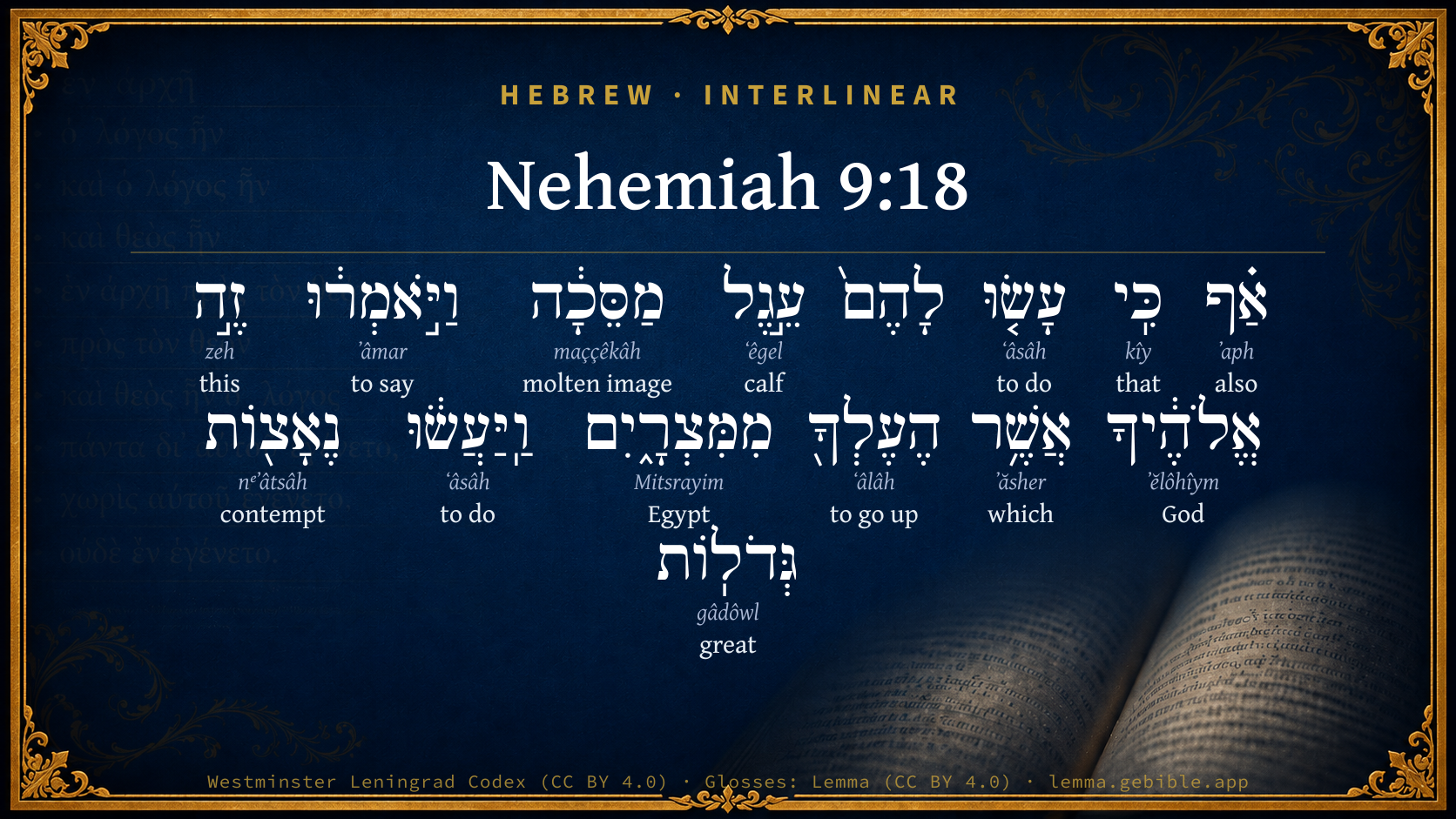
Hebrew (Westminster Leningrad Codex) Nehemiah 9:18 appears in the Hebrew Old Testament. The text above is from the Westminster Leningrad Codex. Each word links to its Strong’s number, a concise gloss, and parsing drawn from the Open Scriptures Hebrew Bible morphology. Click any word for its full Brown-Driver-Briggs (BDB) entry.
Download image
Cite this verse

Nehemiah 9:18 (World English Bible). Public Domain. Lemma interlinear Bible study tool, https://lemma.gebible.app/v/nehemiah/9/18.

Show BibTeX & RIS
BibTeX
RIS
English Translation
Yes, when they had made them a molten calf, and said, This is your God who brought you up out of Egypt, and had committed awful blasphemies;
World English Bible · Public Domain
Download a study sheet

One document with this verse’s original text, its word-by-word gloss line, the meaning frame, cross-references with their text, attributed commentary, and full source and license credits — printable, and it pastes into notes with its structure intact.

This verse Autodidact and up

Study sheet (.html) Plain text (.txt)

A passage Seminary Student

Up to 50 verses in one chapter. A passage sheet keeps up to 6 commentary sources and 12 cross-references per verse, in the order this page ranks them, and says so on the sheet whenever that leaves anything out. Ask for a single verse and you get the Autodidact verse sheet above.

Everything on this page stays free to read, with no account — the sheet is a download of what is already on screen, not access to it.

Want to remove ads? Support Godless Engineer
Compare translations 3

The same verse in 3 English versions, stacked beneath the original-language interlinear above. Click any original word for its lexicon entry.

Each is an independent rendering of the whole verse — the interlinear is not word-aligned to these translations.

Highlighted words mark where these versions differ — a whole-verse word diff, not a word-by-word alignment.

  • World English Bible Public Domain
    Yes, when they had made them a molten calf, and said, This is your God who brought you up out of Egypt, and had committed awful blasphemies;
  • King James Version Public Domain
    Yea, when they had made them a molten calf, and said, This is thy God that brought thee up out of Egypt, and had wrought great provocations;
  • unfoldingWord Literal Text CC BY-SA 4.0
    Even when they made for themselves a calf image and said, ‘This is your God who brought you up from Egypt,’ and they performed great blasphemies,

unfoldingWord Literal Text — © unfoldingWord, licensed CC BY-SA 4.0. Word-aligned USFM3 via Door43 (git.door43.org/unfoldingWord/en_ult).

Versions to compare (up to 4)

3 of 4 selected

Show all 18 translations

Every available English version of this verse, each an independent rendering of the whole verse.

  • World English Bible Public Domain
    Yes, when they had made them a molten calf, and said, This is your God who brought you up out of Egypt, and had committed awful blasphemies;
  • Berean Standard Bible Public Domain
    Even when they cast for themselves an image of a calf and said, ‘This is your God who brought you up out of Egypt,’ and when they committed terrible blasphemies,
  • Majority Standard Bible Public Domain
    Even when they cast for themselves an image of a calf and said, ‘This is your God who brought you up out of Egypt,’ and when they committed terrible blasphemies,
  • King James Version Public Domain
    Yea, when they had made them a molten calf, and said, This is thy God that brought thee up out of Egypt, and had wrought great provocations;
  • American Standard Version (1901) Public Domain
    Yea, when they had made them a molten calf, and said, This is thy God that brought thee up out of Egypt, and had wrought great provocations;
  • Revised Version (1885) Public Domain
    Yea, when they had made them a molten calf, and said, This is thy God that brought thee up out of Egypt, and had wrought great provocations;
  • Geneva Bible (1599) Public Domain
    Moreouer, when they made them a molten calfe (and said, This is thy God that brought thee vp out of the land of Egypt) and committed great blasphemies,
  • Douay-Rheims (1899) Public Domain
    Yea when they had made also to themselves a molten calf, and had said: This is thy God, that brought thee out of Egypt: and hail committed great blasphemies:
  • Young's Literal Translation Public Domain
    `Also, when they have made to themselves a molten calf, and say, this `is' thy god that brought thee up out of Egypt, and do great despisings,
  • Literal Standard Version CC BY-SA 4.0
    Also, when they have made to themselves a molten calf, || And say, This [is] your god || That brought you up out of Egypt, || And do great despisings,
  • Unlocked Literal Bible CC BY-SA 4.0
    Even when they had cast a calf out of molten metal and said, 'This is your God who brought you up out of Egypt,' and had committed great blasphemies,
  • unfoldingWord Literal Text CC BY-SA 4.0
    Even when they made for themselves a calf image and said, ‘This is your God who brought you up from Egypt,’ and they performed great blasphemies,
  • Darby Bible Public Domain
    Yea, when they had made them a molten calf, and said, This is thy god that brought thee up out of Egypt! and they had wrought great provocation,
  • World Messianic Bible Public Domain
    Yes, when they had made themselves a molded calf, and said, ‘This is your God who brought you up out of Egypt,’ and had committed awful blasphemies,
  • Webster's Bible Public Domain
    Yea, when they had made them a molten calf, and said, This is thy God that brought thee out of Egypt, and had wrought great provocations;
  • Free Bible Version CC BY-SA 4.0
    even when they made themselves a metal calf and said, ‘This is your god who led you out of Egypt,’ and committed terrible blasphemies.
  • Bible in Basic English Public Domain
    Even when they had made for themselves an ox of metal, and said, This is your God who took you up out of Egypt, and had done so much to make you angry;
  • JPS Tanakh (1917) Public Domain
    Yea, when they had made them a molten calf, and said: 'This is thy God that brought thee up out of Egypt, and had wrought great provocations;

Literal Standard Version (2020), Covenant Press — licensed CC BY-SA 4.0. Text via the HelloAO Bible API (eBible.org). Unlocked Literal Bible (unfoldingWord) — licensed CC BY-SA 4.0. Text via the HelloAO Bible API (eBible.org). unfoldingWord Literal Text — © unfoldingWord, licensed CC BY-SA 4.0. Word-aligned USFM3 via Door43 (git.door43.org/unfoldingWord/en_ult). Free Bible Version, Dr. Jonathan Gallagher — licensed CC BY-SA 4.0. Text via the HelloAO Bible API (eBible.org).

Word by word

More ways to search: Search by grammar → Find every occurrence → Compare this word →

Practice this passage: Drill this verse → Learn its vocabulary →

נֶאָצ֖וֹת
nᵉʼâtsâh
H5007
“acts of contempt”
Noun, Common, Feminine, Plural, Absolute
Part of Speech
Noun
Type
Common
Gender
Feminine
Number
Plural
State
Absolute
Full BDB Definition

Origin: from H5006

TWOT: 1274a , 1274b

contempt, contumely - contempt, blasphemy
  1. אַ֗ף ʼaph H637 “also” Particle, Accusative
  2. כִּֽי kîy H3588 “that” Conjunction
  3. עָשׂ֤וּ ʻâsâh H6213 “to do” Verb, Qal, Perfect, 3rd Person, Common, Plural
  4. עֵ֣גֶל ʻêgel H5695 “calf of” Noun, Common, Masculine, Singular, Construct
  5. מַסֵּכָ֔ה maççêkâh H4541 “molten image” Noun, Common, Feminine, Singular, Absolute
  6. וַיֹּ֣אמְר֔וּ ʼâmar H559 “and · to say” Conjunction + Verb, Qal, Sequential Imperfect, 3rd Person, Masculine, Plural
  7. זֶ֣ה zeh H2088 “this” Pronoun, Demonstrative, Masculine, Singular
  8. אֱלֹהֶ֔יךָ ʼĕlôhîym H430 “God(s) · your” Noun, Common, Masculine, Plural, Construct + Suffix, Personal, 2nd Person, Masculine, Singular
  9. אֲשֶׁ֥ר ʼăsher H834 “which” Particle, Relative
  10. הֶעֶלְךָ֖ ʻâlâh H5927 “to go up · you” Verb, Hiphil, Perfect, 3rd Person, Masculine, Singular + Suffix, Personal, 2nd Person, Masculine, Singular
  11. מִמִּצְרָ֑יִם Mitsrayim H4714 “from · Egypt” Preposition + Noun, Proper
  12. וַֽיַּעֲשׂ֔וּ ʻâsâh H6213 “and · to do” Conjunction + Verb, Qal, Sequential Imperfect, 3rd Person, Masculine, Plural
  13. גְּדֹלֽוֹת gâdôwl H1419 “great” Adjective, Adjective, Feminine, Plural, Absolute

About this verse

These counts appear in no published source. They are computed here, from the morphology-tagged text and Lemma’s own curated glosses. What Lemma adds →

15
words
13
distinct lemmas
Historical
section

Notable vocabulary

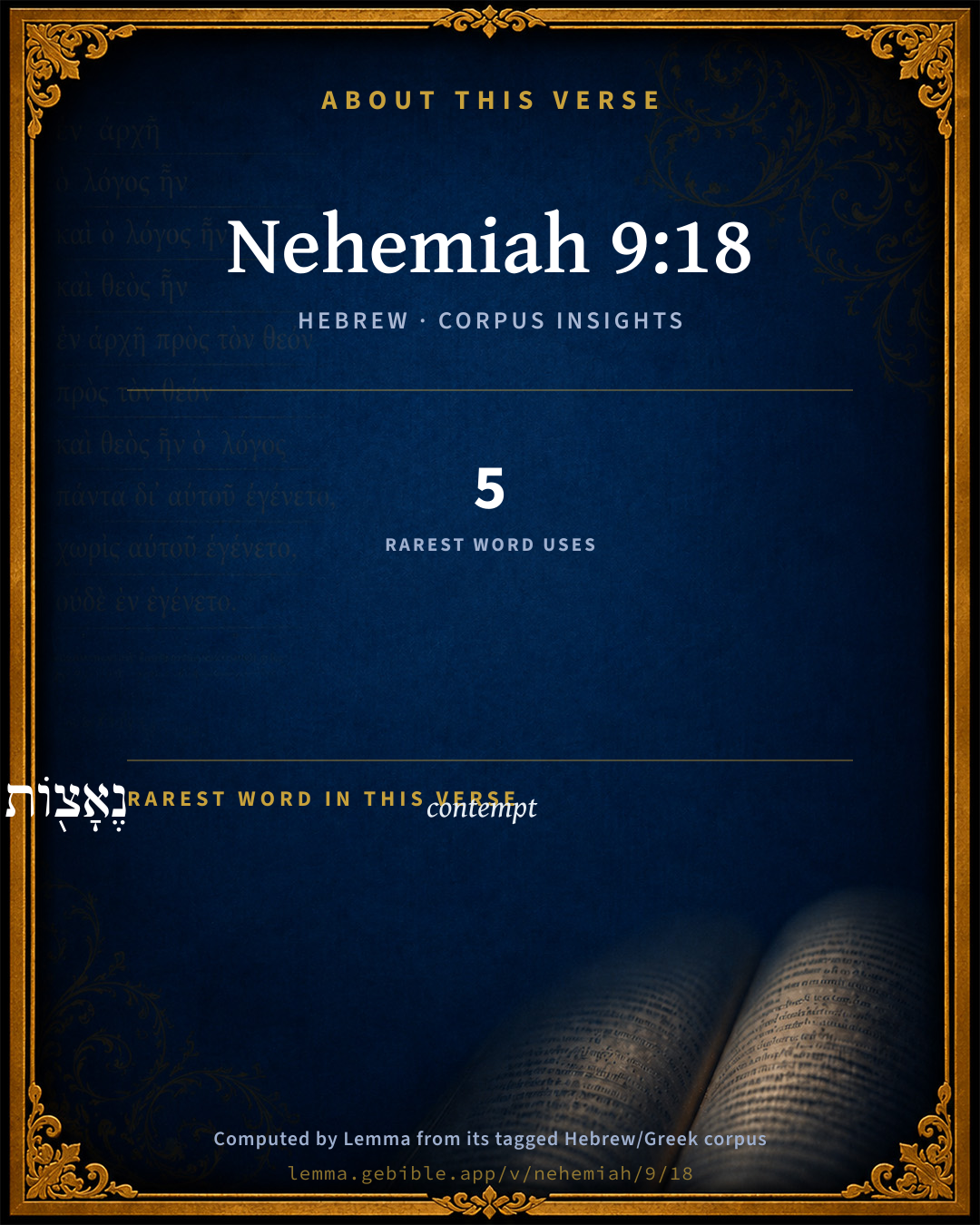
The rarest word here is נֶאָצ֖וֹת contempt H5007 — appearing just 5 times in the whole Hebrew Bible.

Shared distinctive vocabulary

נֶאָצ֖וֹת contempt H5007 occurs in 5 verses of the Hebrew Bible. Also found in:

Grammatical profile

  • 4 verbs
  • 5 nouns
  • 1 adjective
  • 1 pronoun
  • 1 preposition
  • 1 conjunction
  • 2 particles

Verb forms

  • עָשׂ֤וּ Qal · Perfect
  • וַיֹּ֣אמְר֔וּ Qal · Sequential Imperfect
  • הֶעֶלְךָ֖ Hiphil · Perfect
  • וַֽיַּעֲשׂ֔וּ Qal · Sequential Imperfect

Repetition

A word recurs within this verse — often emphatic in Hebrew:

  • עָשׂ֤וּ to do H6213 ×2

Cross-references

5

Topical passages linked to Nehemiah 9:18 in the Treasury of Scripture Knowledge — connected by theme and wording, ordered by reader-vote popularity; previews shown in the World English Bible.

  • Psalms 106:19–23 They made a calf in Horeb, And worshiped a molten image.
  • Exodus 32:4–8 He received what they handed him, and fashioned it with an engraving tool, and made it a molten calf; and they said, "These are your gods, Israel, which brought you up out of the land of Egypt."
  • Exodus 32:31–32 Moses returned to Yahweh, and said, "Oh, this people have sinned a great sin, and have made themselves gods of gold.
  • Deuteronomy 9:12–16 Yahweh said to me, Arise, get you down quickly from hence; for your people whom you have brought forth out of Egypt have corrupted themselves; they have quickly turned aside out of the way which I commanded them; they have made them a molten image.
  • Ezekiel 20:7–44 I said to them, Cast you away every man the abominations of his eyes, and don't defile yourselves with the idols of Egypt; I am Yahweh your God.

Cross-references courtesy of OpenBible.info (CC BY 4.0).

Hebrew and Greek witnesses Masoretic Hebrew ↔ Greek Septuagint

The same verse in the two great witnesses to the Old Testament, shown verse-for-verse.

These are two independent witnesses, not word-aligned to each other, and the Septuagint is shown in lemma (dictionary) form.

Hebrew Nehemiah 9:18 Masoretic · Westminster Leningrad Codex

אַ֗ף כִּֽי עָשׂ֤וּ לָהֶם֙ עֵ֣גֶל מַסֵּכָ֔ה וַיֹּ֣אמְר֔וּ זֶ֣ה אֱלֹהֶ֔יךָ אֲשֶׁ֥ר הֶעֶלְךָ֖ מִמִּצְרָ֑יִם וַֽיַּעֲשׂ֔וּ נֶאָצ֖וֹת גְּדֹלֽוֹת

Yes, when they had made them a molten calf, and said, This is your God who brought you up out of Egypt, and had committed awful blasphemies;

World English Bible · Public Domain

Greek LXX Structure differs

The Septuagint has no separate book of Nehemiah. Its Greek text is the second half of Esdras B (2 Esdras), chapters 11–23; Ezra is the first half (1–10).

A verse-for-verse comparison isn’t shown here because the chapters and verses don’t line up. Switch to the LXX edition with the MT / LXX toggle above to read the Greek directly.

On this verse, Haydock's Catholic Bible Commentary discusses the Septuagint’s reading. Read the note in Commentary ↓

Hebrew: Westminster Leningrad Codex (CC BY 4.0). Greek: Septuagint (public domain); English from a public-domain English Septuagint. How the Septuagint differs from the Hebrew →

Commentary

Notes on Nehemiah 9:18 from classic Christian and Jewish commentators (each source and its license shown beneath its notes). The classic Christian expositions comment on the surrounding passage and are grouped to its opening verse, so a note may address several verses; the Jewish commentaries on the Tanakh (Rashi and others) are per-verse, so they appear only where the commentator wrote on this verse.

Lemma curates 59 commentaries, every one of them public domain or Creative Commons licensed, each selected and text-cleaned for this edition rather than reprinted as found. About our sources →

Trapp's Complete Commentary

John Trapp

Neh 9:18 Yea, when they had made them a molten calf, and said, This [is] thy God that brought thee up out of Egypt, and had wrought great provocations;

Ver. 18. Yea, when they had made them a golden calf] An ounce whereof the Jews say is still to this day in all the punishments that befall them; though some of their Rabbis have the face to excuse this gross idolatry of their forefathers, Neh 9:18, εμοσχοποιησαν, Vitulificarunt (Piscat.).

And said, This is thy God] Exo 32:4. These be thy gods. It was the serpent’s grammar that first taught men to decline God in the plural number: Ye shall be as Gods, Gen 3:5

That brought thee up out of Egypt] Some of them, then, did mean to worship the true God, in this false manner; hence Exo 32:5, there is proclaimed a feast (not to the golden calf, but) to Jehovah. Here, then, falls to the ground the Papists’ plea for their image worship.

And had wrought great provocations] Or, blasphemies, 2Ki 19:3. Idolatry is no better. Jerome, as oft as be meeteth with this Hebrew word in the Book of Psalms (and that is five several times), he translateth it, to blaspheme.

John Trapp, A Commentary or Exposition upon All the Books of the Old and New Testament (1647–1656) — public domain. Text from a community e-Sword module.

The Biblical Illustrator

Joseph S. Exell

Neh_9:18

Thou careen down also upon mount Sinai, and spakest with them from heaven.

Go by the directions

I saw a picture once which has stuck to my memory for years and years. It was a picture of a dark, wild, stormy night, and a traveller was standing up in the stirrups of his horse at a parting of the way, trying to read the directions on the finger-post. How eagerly he is looking! I can see him yet-holding the lighted match carefully in his hands lest the wind should blow it out before he had read the directions I It was a good thing for him that there were directions, and it is a good thing we have them too. Where are our directions? They are--the Bible. That is Gods Word to us, telling us which road to take when we come to the parting of the way. Go by the directions. Do what God rays, and you will never go wrong. (J. Reid Howatt.)

The Biblical Illustrator, edited by Joseph S. Exell (c. 1880s–1900s) — public domain. Text from a community e-Sword module.

Joseph Benson's Commentary

Neh 9:18-19. Yea, they made them, a molten calf — This was a very high provocation, considering how little a time before God had expressly commanded them not to make any graven image, and how many cautious he had afterward given them against doing any such thing. Yet thou forsookest them not in the wilderness — Where, if thou hadst left them without thy conduct and support, they would have been utterly undone and lost. The pillar of cloud departed not, &c. — Notwithstanding their great provocations, thou didst still continue thy gracious presence among them, of which the pillar of the cloud was a glorious token.

Joseph Benson's Commentary on the Old and New Testaments (1811–1818) — public domain. Text from a community e-Sword module.

The Cambridge Bible for Schools and Colleges

gen. ed. J. J. S. Perowne

18–20. The Golden Calf and God’s Mercy

18. molten calf … Egypt.] The language is based on Exo_32:4, ‘… made it a molten calf, and they said, These be thy gods (marg. This is thy god), O Israel, which brought thee up out of the land of Egypt.’

wrought great provocations] Cf. Neh_9:26. The same word is rendered ‘blasphemies’ in Eze_35:12.

The Cambridge Bible for Schools and Colleges (gen. ed. J. J. S. Perowne; Cambridge University Press, 1878–1918) — public domain. Text from a community e-Sword module.

John Gill's Exposition

Yea, when they had made them a molten calf,.... In imitation of the Apis, or ox of the Egyptians:

and said, this is thy god that brought thee out of Egypt; or the image of thy god, as the Arabic version, see Exo 32:4,

and had wrought great provocations; of all which nothing was greater than idolatry.

John Gill's Exposition of the Whole Bible (1746–1763) — public domain (CC PDM 1.0). Text via the HelloAO Bible API.

Haydock's Catholic Bible Commentary

CHAPTER IX.

Blasphemies. By attributing the perfections of God to a senseless idol. Protestants follow the Septuagint, "provocations." Neatsoth (Haydock) properly implies words of an insulting nature. (Calmet)

George Leo Haydock (1774–1849), Haydock's Catholic Family Bible and Commentary, 1859 edition — public domain. Excludes Psalms (Douay-Rheims chapter numbering differs from Protestant) and Deuterocanonical books (Catholic canon only).

The Pulpit Commentary

Great provocations. Or "great blasphemies," as the same word is rendered in Eze_35:12.

The Pulpit Commentary (1880–1919), ed. H.D.M. Spence-Jones & Joseph S. Exell — public domain. Text from a community e-Sword module.

unfoldingWord translationNotes

Door43 World Missions Community

Connecting Statement:

In these verses, the Levites continue to praise Yahweh in the presence of the people of Israel.

you ... did not abandon them

Yahweh did not abandon the Israelites.

cast a calf out of molten metal

melted metal and molded it in the shape of a calf

The pillar of cloud ... the pillar of fire

See how you translated this in Nehemiah 09:12.

translationWords

cow

God

Egypt

blasphemy

compassion

desert

unfoldingWord translationNotes — © Distant Shores Media and the Door43 World Missions Community, licensed CC BY-SA 4.0. Source: git.door43.org/Door43/en_tn.

Lesson kit

Teaching starters — assembled from the data on this page, not authored interpretation. Every prompt links to the verse data it draws on. Edit before teaching.

Nehemiah, in the Historical, opens this verse with 15 words (13 distinct Hebrew lemmas). Its most distinctive word is nᵉʼâtsâh (“contempt”). A historical commentator’s framing appears above. Read the whole chapter for the surrounding context.

Discussion questions

  1. What does “contempt” (nᵉʼâtsâh) contribute to the verse as a whole?
  2. How does 2 Kings 19:3, which shares the word «contempt», read alongside this verse?
  3. What does the repetition of “to do” (2× in this one verse) do in this verse?
  4. These translations render this verse differently; the difference is in the English rendering, not the original. What questions does that raise?
  5. «עָשׂ֤וּ» is a Qal Perfect verb. How does that grammatical form shape the action described?
  6. Compare how Trapp's Complete Commentary and The Biblical Illustrator read this verse. Where do they agree or differ?

Things to notice

Reading settings

Reading text

Shown beneath each verse's original-language words.

Old Testament
Old Testament edition

Read the OT as the Masoretic Hebrew (MT) or the Greek Septuagint (LXX).

English shown for the Greek Septuagint (in the Hebrew ↔ Greek comparison).

Comparing translations? Open the Compare panel on any verse page to stack up to four side by side.