

Psalms 33:22

Hebrew (Westminster Leningrad Codex) Psalms 33:22 appears in the Hebrew Old Testament. The text above is from the Westminster Leningrad Codex. Each word links to its Strong’s number, a concise gloss, and parsing drawn from the Open Scriptures Hebrew Bible morphology. Click any word for its full Brown-Driver-Briggs (BDB) entry.
Download image
Cite this verse

Psalms 33:22 (World English Bible). Public Domain. Lemma interlinear Bible study tool, https://lemma.gebible.app/v/psalms/33/22.

Show BibTeX & RIS
BibTeX
RIS
English Translation
Let your loving kindness be on us, Yahweh, Since we have hoped in you.
World English Bible · Public Domain
Download a study sheet

One document with this verse’s original text, its word-by-word gloss line, the meaning frame, cross-references with their text, attributed commentary, and full source and license credits — printable, and it pastes into notes with its structure intact.

This verse Autodidact and up

Study sheet (.html) Plain text (.txt)

A passage Seminary Student

Up to 50 verses in one chapter. A passage sheet keeps up to 6 commentary sources and 12 cross-references per verse, in the order this page ranks them, and says so on the sheet whenever that leaves anything out. Ask for a single verse and you get the Autodidact verse sheet above.

Everything on this page stays free to read, with no account — the sheet is a download of what is already on screen, not access to it.

Want to remove ads? Support Godless Engineer
Compare translations 3

The same verse in 3 English versions, stacked beneath the original-language interlinear above. Click any original word for its lexicon entry.

Each is an independent rendering of the whole verse — the interlinear is not word-aligned to these translations.

Highlighted words mark where these versions differ — a whole-verse word diff, not a word-by-word alignment.

  • World English Bible Public Domain
    Let your loving kindness be on us, Yahweh, Since we have hoped in you.
  • King James Version Public Domain
    Let thy mercy, O LORD, be upon us, according as we hope in thee.
  • unfoldingWord Literal Text CC BY-SA 4.0
    Let your covenant faithfulness, Yahweh, be upon us, just as we have hoped in you.

unfoldingWord Literal Text — © unfoldingWord, licensed CC BY-SA 4.0. Word-aligned USFM3 via Door43 (git.door43.org/unfoldingWord/en_ult).

Versions to compare (up to 4)

3 of 4 selected

Show all 18 translations

Every available English version of this verse, each an independent rendering of the whole verse.

  • World English Bible Public Domain
    Let your loving kindness be on us, Yahweh, Since we have hoped in you.
  • Berean Standard Bible Public Domain
    May Your loving devotion rest on us, O LORD, as we put our hope in You.
  • Majority Standard Bible Public Domain
    May Your loving devotion rest on us, O LORD, as we put our hope in You.
  • King James Version Public Domain
    Let thy mercy, O LORD, be upon us, according as we hope in thee.
  • American Standard Version (1901) Public Domain
    Let thy lovingkindness, O Jehovah, be upon us, According as we have hoped in thee. Psalm 34 A Psalm of David; when he changed his behavior before Abimelech, who drove him away, and he departed.
  • Revised Version (1885) Public Domain
    Let thy mercy, O LORD, be upon us, according as we have hoped in thee.
  • Geneva Bible (1599) Public Domain
    Let thy mercie, O Lord, be vpon vs, as we trust in thee.
  • Douay-Rheims (1899) Public Domain
    Let thy mercy, O Lord, be upon us, as we have hoped in thee.
  • Young's Literal Translation Public Domain
    Let Thy kindness, O Jehovah, be upon us, As we have waited for Thee!
  • Literal Standard Version CC BY-SA 4.0
    Let Your kindness, O YHWH, be on us, || As we have waited for You!
  • Unlocked Literal Bible CC BY-SA 4.0
    Let your covenant faithfulness, Yahweh, be with us as we put our hope in you.
  • unfoldingWord Literal Text CC BY-SA 4.0
    Let your covenant faithfulness, Yahweh, be upon us, just as we have hoped in you.
  • Darby Bible Public Domain
    Let thy loving-kindness, O Jehovah, be upon us, according as we have hoped in thee.
  • World Messianic Bible Public Domain
    Let your loving kindness be on us, LORD, since we have hoped in you.
  • Webster's Bible Public Domain
    Let thy mercy, O LORD, be upon us, according as we hope in thee.
  • Free Bible Version CC BY-SA 4.0
    Lord, let your trustworthy love rest upon us as we hope in you.
  • Bible in Basic English Public Domain
    Let your mercy be on us, O Lord, as we are waiting for you.
  • JPS Tanakh (1917) Public Domain
    Let Thy mercy, O LORD, be upon us, according as we have waited for Thee.

Literal Standard Version (2020), Covenant Press — licensed CC BY-SA 4.0. Text via the HelloAO Bible API (eBible.org). Unlocked Literal Bible (unfoldingWord) — licensed CC BY-SA 4.0. Text via the HelloAO Bible API (eBible.org). unfoldingWord Literal Text — © unfoldingWord, licensed CC BY-SA 4.0. Word-aligned USFM3 via Door43 (git.door43.org/unfoldingWord/en_ult). Free Bible Version, Dr. Jonathan Gallagher — licensed CC BY-SA 4.0. Text via the HelloAO Bible API (eBible.org).

Word by word

More ways to search: Search by grammar → Find every occurrence → Compare this word →

Practice this passage: Drill this verse → Learn its vocabulary →

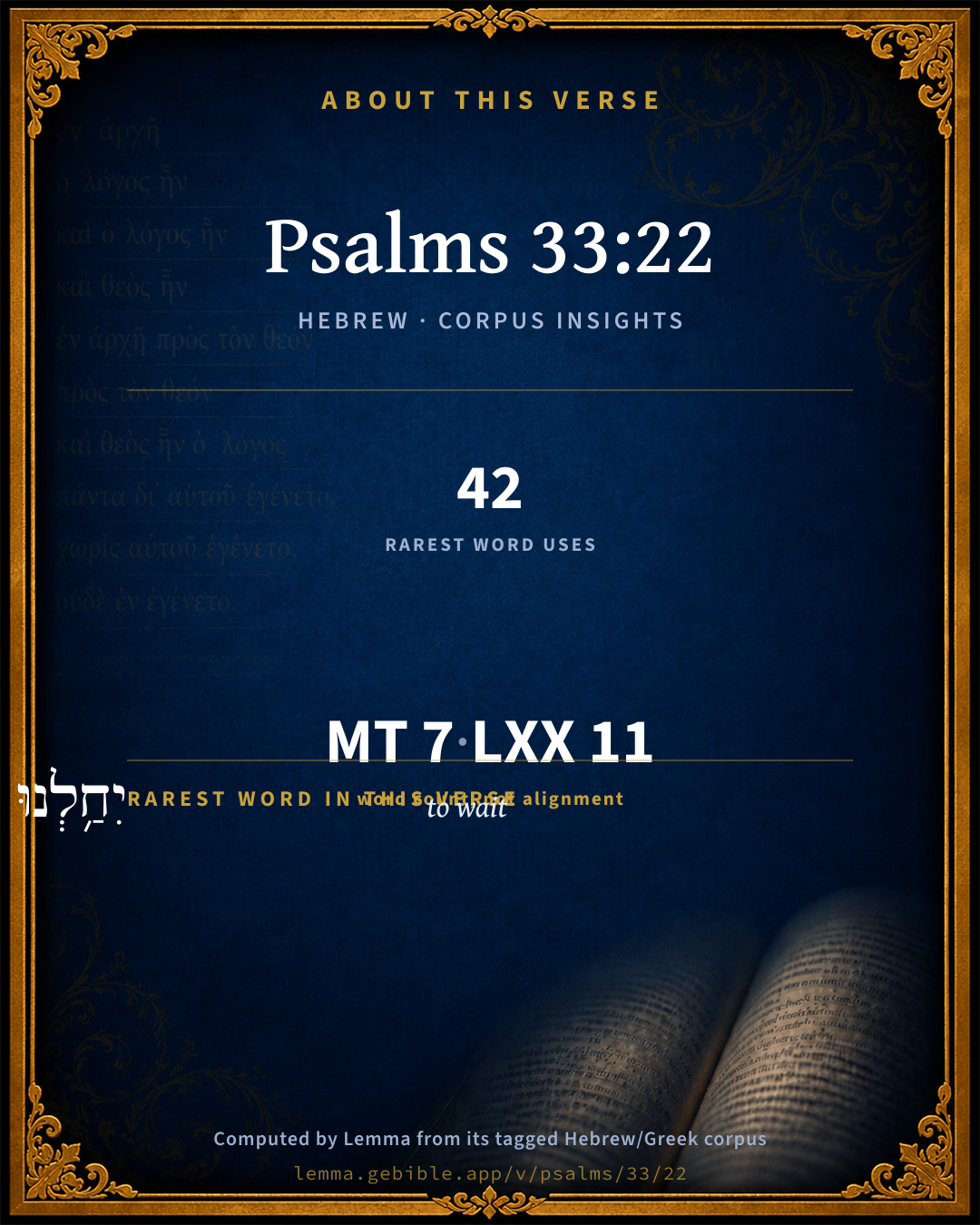
About this verse

These counts appear in no published source. They are computed here, from the morphology-tagged text and Lemma’s own curated glosses. What Lemma adds →

7
words
6
distinct lemmas
Wisdom
section

Shared distinctive vocabulary

יִחַ֥לְנוּ to wait H3176 occurs in 41 verses of the Hebrew Bible. Also found in:

Grammatical profile

  • 2 verbs
  • 2 nouns
  • 2 prepositions
  • 1 particle

Verb forms

  • יְהִֽי Qal · Jussive
  • יִחַ֥לְנוּ Piel · Perfect

Hebrew & Septuagint length

In English translation the verse runs 14 words from the Hebrew and 15 from the Septuagint (LXX English) — closely comparable.

A rough comparison of the two English renderings, which tokenize alike — not a word-level alignment.

Word counts can differ between the Hebrew and the Greek without any difference in meaning — e.g. the Hebrew direct-object marker אֵת has no separate Greek word, and Greek often adds the article ὁ.

In the original languages it is 7 Hebrew tokens and 11 Greek tokens — but the two are counted differently (Hebrew bundles its prefixes and suffixes into one token; the Greek is in lemma form), so that isn’t a like-for-like length.

Cross-references

6

Topical passages linked to Psalms 33:22 in the Treasury of Scripture Knowledge — connected by theme and wording, ordered by reader-vote popularity; previews shown in the World English Bible.

  • Psalms 13:5 But I trust in your loving kindness. My heart rejoices in your salvation.
  • Psalms 119:76 Please let your loving kindness be for my comfort, According to your word to your servant.
  • Matthew 9:29 Then he touched their eyes, saying, "According to your faith be it done to you."
  • Psalms 5:11–12 But let all those who take refuge in you rejoice, Let them always shout for joy, because you defend them. Let them also who love your name be joyful in you.
  • Psalms 119:49 Remember your word to your servant, Because you gave me hope.
  • Psalms 32:10 Many sorrows shall be to the wicked, But he who trusts in Yahweh, loving kindness shall surround him.

Cross-references courtesy of OpenBible.info (CC BY 4.0).

Hebrew and Greek witnesses Masoretic Hebrew ↔ Greek Septuagint

The same verse in the two great witnesses to the Old Testament, shown verse-for-verse.

You’re reading Greek Psalm 32 (Hebrew Psalm 33). The Septuagint counts the superscription, so verse numbers can differ from the Hebrew — chapter-level alignment, not verse-by-verse. Numbering follows Rahlfs.

These are two independent witnesses, not word-aligned to each other, and the Septuagint is shown in lemma (dictionary) form.

Hebrew Psalms 33:22 Masoretic · Westminster Leningrad Codex

יְהִֽי חַסְדְּךָ֣ יְהוָ֣ה עָלֵ֑ינוּ כַּ֝אֲשֶׁ֗ר יִחַ֥לְנוּ לָֽךְ

Let your loving kindness be on us, Yahweh, Since we have hoped in you.

World English Bible · Public Domain

Greek LXX Greek Psalm 32:22 Septuagint · lemma form

γίγνομαι ὁ ἔλεος σύ κύριος ἐπί ἐγώ καθάπερ ἐλπίζω ἐπί σύ

Let your mercy, O Lord, be upon us, according as we have hoped in you.

LXX2012 (modern English Septuagint) · Public Domain

Hebrew: Westminster Leningrad Codex (CC BY 4.0). Greek: Septuagint (public domain); English from LXX2012 (modern English Septuagint) (Public Domain). How the Septuagint differs from the Hebrew →

Commentary

Notes on Psalms 33:22 from classic Christian and Jewish commentators (each source and its license shown beneath its notes). The classic Christian expositions comment on the surrounding passage and are grouped to its opening verse, so a note may address several verses; the Jewish commentaries on the Tanakh (Rashi and others) are per-verse, so they appear only where the commentator wrote on this verse.

Lemma curates 59 commentaries, every one of them public domain or Creative Commons licensed, each selected and text-cleaned for this edition rather than reprinted as found. About our sources →

Trapp's Complete Commentary

John Trapp

Psa 33:22 Let thy mercy, O LORD, be upon us, according as we hope in thee.

Ver. 22. Let thy mercy, O Lord, be upon us, according as we hope in thee] Not that we would have no more mercy than we have trust; but we would show that our trust is bottomed upon thy promises, and that we humbly expect the full accomplishment of the same, in due time.

John Trapp, A Commentary or Exposition upon All the Books of the Old and New Testament (1647–1656) — public domain. Text from a community e-Sword module.

J. A. Alexander on Psalms

Joseph Addison Alexander

22. (Psa 33:22) Be thy mercy, Jehovah, upon us, as we have waited for thee. The faith implied in this hope being the sole condition of God's mercy, its possession constitutes a claim upon that mercy, which is here urged as the sum of all the previous petitions. What is thus waited for cannot but be realised. A merciful and righteous God cannot, without denial of himself, withhold that which his people thus expect. Any appearance of a meritorious claim is excluded by the doctrine sufficiently implied here and abundantly taught elsewhere, that the condition is as much the gift of God as that which is suspended on it. The claim in reality amounts to a petition that as God had given the desire he would fulfil it.—As, according as, not merely since, because, in proportion to our faith, so deal with us. Compare Mat 9:29.

Joseph Addison Alexander, The Psalms Translated and Explained (1850) — public domain. Text from a community e-Sword module.

Tyndale Open Study Notes

Tyndale Open Resources

33:22 Using a play on words, the psalmist contrasts his people’s sure hope (Hebrew yakhal) in the Lord with the supposed strength (33:17; Hebrew khayil) of the horses of the wicked.

Tyndale Open Study Notes — © Tyndale Open Resources, licensed CC BY-SA 4.0. Text via the HelloAO Bible API.

Adam Clarke's Commentary

Verse 22. Let thy mercy, O Lord, be upon us] We cannot abide in this state unless upheld by thee; and, as we disclaim all merit, we seek for a continuance of thy mercy, and this we cannot expect but in a continual dependence on thee. "Let thy mercy, O Lord be upon us, according as we hope in thee."

ANALYSIS OF THE THIRTY-THIRD PSALM

This Psalm is eucharistic: the contents are -

I. An exhortation to praise God, Ps 33:1-3.

II. The arguments he uses to enforce the duty, Ps 33:4-19.

III. The confidence of God's people in his name. Their happiness, and petition, Ps 33:20-22.

I. In the three first verses he exhorts men to praise God: but whom?

1. The upright; those who are not upright, cannot praise God.

2. That it be done with zeal and affection; with singing, with voice, and the instruments then in use; with some new song, composed on the occasion, for some new mercy; and that the whole be skilfully expressed.

II. This he urges on several good grounds: -

1. The first argument, in general drawn from the truth, the faithfulness, the justice, and goodness of God: 1. "For the word of the Lord is right." 2. "All his works are done in truth." 3. "He loveth righteousness and judgment." 4. "The earth is full of his goodness."

2. His second argument is drawn from God's power in the creation of all things, and that by his word alone, Ps 33:6-9; and upon it introduces, "Let all the earth fear the Lord; let all the inhabitants of the world stand in awe of him."

3. His third argument is drawn from God's providence in governing the world, which may easily be discerned by those who will diligently consider his ways and proceedings, both to other people and to his Church.

1. He makes void all enterprises undertaken against his will, not only of single men, but of whole nations. "The Lord bringeth the counsel of the heathen to naught; he maketh the devices of the people of none effect."

2. Whereas, on the contrary, what he hath decreed shall be done. "The counsel of the Lord standeth for ever; the thoughts of his heart to all generations." On the consideration of which he breaks out into this epiphonema, or joyous reflection: "Blessed is the nation whose God is the Lord! and the people whom he hath chosen for his own inheritance!"

After which he returns to his discourse on God's providence, and by a hypotyposis, or splendid imagery, amplifies his former argument. For he sets God before us, as some great king on his throne, providing for all the parts of his empire, examining all causes, and doing justice to every one.

1. "The Lord looks from heaven, and beholds all the sons of men."

2. "From the place of his habitation he looks upon all the inhabitants of the earth."

3. And he is not an idle spectator: "He sees and considers their hearts and their works."

And he sees in what they put their confidence; in their armies, their strength, their horse, but not in him. But all in vain; for "there is no king saved by the multitude of a host: a mighty man is not delivered by much strength. A horse is a vain thing for safety." Multitude, strength, c., without God, are useless.

Hitherto he had given a proof of God's providence towards all men, but now he descends to a particular proof of it, by his care over his Church, which he wonderfully guides, defends, and protects, in all dangers and assaults: and that notice may be taken of it, he begins with, Behold!

1. "Behold, the eye of the Lord," his tenderest care, "is over them that fear him, upon them that hope in his mercy."

2. "To deliver their soul from death, and keep them alive in famine."

III. The three last verses contain the acclamation of God's people, who place all their hope and trust in him for, being stimulated by the former arguments, they do three things: -

1. They profess and express their faith and dependence on God: "Our soul waiteth on God, he is our help and our shield."

2. They declare the hope by which they are upheld, and how comforted: "For our heart shall rejoice in him, because we have trusted in his holy name."

3. Upon this hope they commend themselves by prayer to God; "Let thy mercy, O Lord, be upon us, according as we hope in thee."

Adam Clarke's Commentary on the Bible (1810–1826) — public domain. Text from a community e-Sword/MySword module.

John Calvin's Commentaries

22. Let thy mercy be on us, O Jehovah! At length the psalm concludes with a prayer, which the sacred writer offers in the name of all the godly, that God would make them feel from the effect that they have not relied on the divine goodness in vain. In the meantime, the Spirit, by dictating to us this rule of prayer by the mouth of the prophet, teaches us, that the gate of divine grace is opened for us when salvation is neither sought nor hoped for from any other quarter. This passage gives us another very sweet consolation, namely, that if our hope faint not in the midst of our course, we have no reason to fear that God will fail to continue his mercy towards us, without intermission, to the end of it.

John Calvin's Commentaries (1540-1563) — public domain. Text from the Calvin Translation Society English edition (1840s-50s) via the Christian Classics Ethereal Library (ccel.org). Calvin's coverage is partial (roughly two-thirds of the Bible); uncommented books and verses are honest gaps, never fabricated. The 19th-century editor's footnotes and remarks are omitted so the notes are faithfully Calvin's own voice.

The Cambridge Bible for Schools and Colleges

gen. ed. J. J. S. Perowne

22. Let thy lovingkindness (Psa_33:5; Psa_33:18), O Lord, be upon us,

According as we have hoped in thee (or, waited for thee).

Comp. Psa_31:1; Psa_31:24; Rom_5:4-5.

The Cambridge Bible for Schools and Colleges (gen. ed. J. J. S. Perowne; Cambridge University Press, 1878–1918) — public domain. Text from a community e-Sword module.

John Gill's Exposition

Let thy mercy, O Lord, be upon us,.... That is, an application of it in its effects: it is a prayer for a communication of grace and mercy to help in a time of need; and for a discovery of pardoning grace and mercy; and it is a prayer of faith; for the mercy of the Lord is upon his people in great plenty, and it continues; and they have reason to believe it ever will, Psa 103:17;

according as we hope in thee; not according to any merits of theirs, but according to the measure of grace, of the grace of hope which God had bestowed on them, and encouraged them to exercise on him, in expectation of finding grace and mercy with him.

Next: Psalms Chapter 34

John Gill's Exposition of the Whole Bible (1746–1763) — public domain (CC PDM 1.0). Text via the HelloAO Bible API.

Albert Barnes' Notes on the Bible

Let thy mercy, O Lord, be upon us - Let us find or obtain thy mercy or thy favor.

According as we hope in thee - It may be remarked in regard to this:

(a) it is but “reasonable” that we should look for the favor of God only as we trust in him, for we could not with propriety expect his favor beyond the measure of our confidence in him.

(b) This may be regarded as the most that we are entitled to hope from God. We have no reason to suppose that he will go beyond our wishes and prayers, or that he will confer favors on us which we neither expect nor desire.

(c) One of the reasons why the people of God are no more blessed, or why they receive no more favors from him, may be found in what is here suggested. As they expect little, they obtain little; as they have no intense, burning, lofty desire for the favor of God, either for themselves personally, or for their families, or for the world, so they obtain but slight tokens of that favor.

(d) The true principle, therefore, upon which God is willing to bestow His favors, and which will be the rule that He will observe, is, that if people desire much, they will obtain much; that if they have big expectations, they will not be disappointed; and that God is willing to bestow His mercies upon His people and upon the world to the utmost of their desires and hopes. Compare Psa 81:10, “Open thy mouth wide, and I will fill it.” Psa 37:4, “delight thyself in the Lord, and he shall give thee the desires of thy heart.” How intense and fervent, then, should be the prayers and the petitions of the people of God! How earnest the supplications of sinners that God would have mercy on them!

Albert Barnes' Notes on the Bible (1834–1885) — public domain. Text from a community e-Sword/MySword module.

The Treasury of David

Charles H. Spurgeon

Ver. 22. Here is a large and comprehensive prayer to close with. It is an appeal for mercy, which even joyful believers need; and it is sought for in a proportion which the Lord has sanctioned. "According to your faith be it unto you, "is the Master's word, and he will not fall short of the scale which he has himself selected. Yet, Master, do more than this when hope is faint, and bless us far above what we ask or even think.

Ver. 22. According as we hope in thee; not according to any merits of theirs, but according to the measure of grace, of the grace of hope which God had bestowed on them, and encouraged them to exercise on him, in expectation of finding grace and mercy with him. John Gill.

Ver. 22. A prayer for believers only.

Ver. 22. Measure for measure, or mercy proportioned to faith.

Charles H. Spurgeon's The Treasury of David (1869–1885) — public domain. Psalms only. Text from a community e-Sword/MySword module.

The Pulpit Commentary

Let thy mercy, O Lord, be upon us, according as we hope in thee. The measure of men"s hope and trust in God is the measure of his mercy and goodness to them. Those who are assured that they have a full trust in him may confidently expect a fall and complete deliverance. Thus, "according as rvak is emphatic.

The Pulpit Commentary (1880–1919), ed. H.D.M. Spence-Jones & Joseph S. Exell — public domain. Text from a community e-Sword module.

unfoldingWord translationNotes

Door43 World Missions Community

Let your covenant faithfulness, Yahweh, be with us

Yahweh acting faithfully towards the people is spoken of as if Yahweh's covenant faithfulness were with them. The abstract noun "faithfulness" can be translated with an adverb. AT: "May you always act faithfully towards us because of your covenant, Yahweh" (See: Metaphor and Abstract Nouns)

as we put our hope in you

"as we hope for your help"

translationWords

covenant faithfulness

Yahweh

hope

unfoldingWord translationNotes — © Distant Shores Media and the Door43 World Missions Community, licensed CC BY-SA 4.0. Source: git.door43.org/Door43/en_tn.

Lesson kit

Teaching starters — assembled from the data on this page, not authored interpretation. Every prompt links to the verse data it draws on. Edit before teaching.

Psalms, in the Wisdom, opens this verse with 7 words (6 distinct Hebrew lemmas). Its most distinctive word is yâchal (“to wait”). A historical commentator’s framing appears above. Read the whole chapter for the surrounding context.

Discussion questions

  1. How does “to wait” (yâchal) shape what this verse is saying?
  2. Genesis 8:12 shares the word «to wait» with this verse. How do the two illuminate each other?
  3. These translations render this verse differently. What is at stake in choosing one wording over another?
  4. The verb «יְהִֽי» is Qal Jussive. How does its form color the action?
  5. Reading how Trapp's Complete Commentary and J. A. Alexander on Psalms read this verse, where do the two commentators agree and where do they part?

Things to notice

Reading settings

Reading text

Shown beneath each verse's original-language words.

Old Testament
Old Testament edition

Read the OT as the Masoretic Hebrew (MT) or the Greek Septuagint (LXX).

English shown for the Greek Septuagint (in the Hebrew ↔ Greek comparison).

Comparing translations? Open the Compare panel on any verse page to stack up to four side by side.