

Nehemiah 2:5

Hebrew (Westminster Leningrad Codex) Nehemiah 2:5 appears in the Hebrew Old Testament. The text above is from the Westminster Leningrad Codex. Each word links to its Strong’s number, a concise gloss, and parsing drawn from the Open Scriptures Hebrew Bible morphology. Click any word for its full Brown-Driver-Briggs (BDB) entry.
Download image
Cite this verse

Nehemiah 2:5 (World English Bible). Public Domain. Lemma interlinear Bible study tool, https://lemma.gebible.app/v/nehemiah/2/5.

Show BibTeX & RIS
BibTeX
RIS
English Translation
I said to the king, If it please the king, and if your servant have found favor in your sight, that you would send me to Judah, to the city of my fathers' tombs, that I may build it.
World English Bible · Public Domain
Download a study sheet

One document with this verse’s original text, its word-by-word gloss line, the meaning frame, cross-references with their text, attributed commentary, and full source and license credits — printable, and it pastes into notes with its structure intact.

This verse Autodidact and up

Study sheet (.html) Plain text (.txt)

A passage Seminary Student

Up to 50 verses in one chapter. A passage sheet keeps up to 6 commentary sources and 12 cross-references per verse, in the order this page ranks them, and says so on the sheet whenever that leaves anything out. Ask for a single verse and you get the Autodidact verse sheet above.

Everything on this page stays free to read, with no account — the sheet is a download of what is already on screen, not access to it.

Want to remove ads? Support Godless Engineer
Compare translations 3

The same verse in 3 English versions, stacked beneath the original-language interlinear above. Click any original word for its lexicon entry.

Each is an independent rendering of the whole verse — the interlinear is not word-aligned to these translations.

Highlighted words mark where these versions differ — a whole-verse word diff, not a word-by-word alignment.

  • World English Bible Public Domain
    I said to the king, If it please the king, and if your servant have found favor in your sight, that you would send me to Judah, to the city of my fathers' tombs, that I may build it.
  • King James Version Public Domain
    And I said unto the king, If it please the king, and if thy servant have found favour in thy sight, that thou wouldest send me unto Judah, unto the city of my fathers' sepulchres, that I may build it.
  • unfoldingWord Literal Text CC BY-SA 4.0
    And I said to the king, “If it is good to the king, and if your servant is good before your face, that you would send me to Judah, to the city of the graves of my fathers, and I will build it.”

unfoldingWord Literal Text — © unfoldingWord, licensed CC BY-SA 4.0. Word-aligned USFM3 via Door43 (git.door43.org/unfoldingWord/en_ult).

Versions to compare (up to 4)

3 of 4 selected

Show all 18 translations

Every available English version of this verse, each an independent rendering of the whole verse.

  • World English Bible Public Domain
    I said to the king, If it please the king, and if your servant have found favor in your sight, that you would send me to Judah, to the city of my fathers' tombs, that I may build it.
  • Berean Standard Bible Public Domain
    and answered the king, “If it pleases the king, and if your servant has found favor in your sight, I ask that you send me to Judah, to the city where my fathers are buried, so that I may rebuild it.”
  • Majority Standard Bible Public Domain
    and answered the king, “If it pleases the king, and if your servant has found favor in your sight, I ask that you send me to Judah, to the city where my fathers are buried, so that I may rebuild it.”
  • King James Version Public Domain
    And I said unto the king, If it please the king, and if thy servant have found favour in thy sight, that thou wouldest send me unto Judah, unto the city of my fathers' sepulchres, that I may build it.
  • American Standard Version (1901) Public Domain
    And I said unto the king, If it please the king, and if thy servant have found favor in thy sight, that thou wouldest send me unto Judah, unto the city of my fathers' sepulchres, that I may build it.
  • Revised Version (1885) Public Domain
    And I said unto the king, If it please the king, and if thy servant have found favour in thy sight, that thou wouldest send me unto Judah, unto the city of my fathers’ sepulchres, that I may build it.
  • Geneva Bible (1599) Public Domain
    And sayde vnto the King, If it please the King, and if thy seruant haue found fauour in thy sight, I desire that thou wouldest send me to Iudah vnto the city of the sepulchres of my fathers, that I may buyld it.
  • Douay-Rheims (1899) Public Domain
    And I said to the king: If it seem good to the king, and if thy servant hath found favour in thy sight, that thou wouldst send me into Judea to the city of the sepulchre of my father, and I will build it.
  • Young's Literal Translation Public Domain
    and say to the king, `If to the king `it be' good, and if thy servant be pleasing before thee, that thou send me unto Judah, unto the city of the graves of my fathers, and I built it.'
  • Literal Standard Version CC BY-SA 4.0
    and say to the king, “If [it is] good to the king, and if your servant is pleasing before you, that you send me to Judah, to the city of the graves of my fathers, and I have built it.”
  • Unlocked Literal Bible CC BY-SA 4.0
    I replied to the king, “If it seems good to the king, and if your servant has done well in your sight, you could send me to Judah, to the city of my fathers' tombs, that I may rebuild it.”
  • unfoldingWord Literal Text CC BY-SA 4.0
    And I said to the king, “If it is good to the king, and if your servant is good before your face, that you would send me to Judah, to the city of the graves of my fathers, and I will build it.”
  • Darby Bible Public Domain
    And I said to the king, If it please the king, and if thy servant have found favour in thy sight, that thou wouldest send me to Judah, to the city of my fathers' sepulchres, that I may build it.
  • World Messianic Bible Public Domain
    I said to the king, “If it pleases the king, and if your servant has found favor in your sight, I ask that you would send me to Judah, to the city of my fathers’ tombs, that I may build it.”
  • Webster's Bible Public Domain
    And I said to the king, If it should please the king, and if thy servant hath found favor in thy sight, that thou wouldst send me to Judah, to the city of my fathers' sepulchers, that I may build it.
  • Free Bible Version CC BY-SA 4.0
    “If it pleases Your Majesty, and if you are happy with me, I request you send me to Judah, to the city where my forefathers are buried, so I can rebuild it.”
  • Bible in Basic English Public Domain
    And I said to the king, If it is the king's pleasure, and if your servant has your approval, send me to Judah, to the town where the bodies of my fathers are at rest, so that I may take in hand the building of it.
  • JPS Tanakh (1917) Public Domain
    And I said unto the king: 'If it please the king, and if thy servant have found favour in thy sight, that thou wouldest send me unto Judah, unto the city of my fathers' sepulchres, that I may build it.'

Literal Standard Version (2020), Covenant Press — licensed CC BY-SA 4.0. Text via the HelloAO Bible API (eBible.org). Unlocked Literal Bible (unfoldingWord) — licensed CC BY-SA 4.0. Text via the HelloAO Bible API (eBible.org). unfoldingWord Literal Text — © unfoldingWord, licensed CC BY-SA 4.0. Word-aligned USFM3 via Door43 (git.door43.org/unfoldingWord/en_ult). Free Bible Version, Dr. Jonathan Gallagher — licensed CC BY-SA 4.0. Text via the HelloAO Bible API (eBible.org).

Word by word

More ways to search: Search by grammar → Find every occurrence → Compare this word →

Practice this passage: Drill this verse → Learn its vocabulary →

ט֔וֹב
ṭôwb
H2895
“good”
Adjective, Adjective, Masculine, Singular, Absolute
Part of Speech
Adjective
Type
Adjective
Gender
Masculine
Number
Singular
State
Absolute
Full BDB Definition

Origin: a primitive root

TWOT: 793

to be good, be pleasing, be joyful, be beneficial, be pleasant, be favourable, be happy, be right - (Qal) - to be pleasant, be delightful - to be glad, be joyful - to be better - to be well with, be good for - to be pleasing - (Hiphil) to do well, do good, act right, act rightly
  1. וָאֹמַ֣ר ʼâmar H559 “and · to say” Conjunction + Verb, Qal, Sequential Imperfect, 1st Person, Common, Singular
  2. לַמֶּ֔לֶךְ melek H4428 “to/for the · king” Preposition, Determined + Noun, Common, Masculine, Singular, Absolute
  3. אִם ʼim H518 “if” Conjunction
  4. עַל ʻal H5921 “upon” Preposition
  5. הַמֶּ֣לֶךְ melek H4428 “the · king” Particle, Definite Article + Noun, Common, Masculine, Singular, Absolute
  6. וְאִם ʼim H518 “and · if” Conjunction + Conjunction
  7. יִיטַ֥ב yâṭab H3190 “to be good” Verb, Qal, Imperfect, 3rd Person, Masculine, Singular
  8. עַבְדְּךָ֖ ʻebed H5650 “servant · your” Noun, Common, Masculine, Singular, Construct + Suffix, Personal, 2nd Person, Masculine, Singular
  9. לְפָנֶ֑יךָ pânîym H6440 “to/for · face(s) · your” Preposition + Noun, Common, Both, Plural, Construct + Suffix, Personal, 2nd Person, Masculine, Singular
  10. אֲשֶׁ֧ר ʼăsher H834 “which” Particle, Relative
  11. תִּשְׁלָחֵ֣נִי shâlach H7971 “to send · me” Verb, Qal, Imperfect, 2nd Person, Masculine, Singular + Suffix, Personal, 1st Person, Common, Singular
  12. אֶל ʼêl H413 “to” Preposition
  13. יְהוּדָ֗ה Yᵉhûwdâh H3063 “Judah” Noun, Proper
  14. אֶל ʼêl H413 “to” Preposition
  15. עִ֛יר ʻîyr H5892 “city of” Noun, Common, Feminine, Singular, Construct
  16. קִבְר֥וֹת qeber H6913 “graves of” Noun, Common, Masculine, Plural, Construct
  17. אֲבֹתַ֖י ʼâb H1 “fathers · my” Noun, Common, Masculine, Plural, Construct + Suffix, Personal, 1st Person, Common, Singular
  18. וְאֶבְנֶֽנָּה bânâh H1129 “and · to build · her” Conjunction + Verb, Qal, Imperfect, 1st Person, Common, Singular + Suffix, Personal, 3rd Person, Feminine, Singular

About this verse

These counts appear in no published source. They are computed here, from the morphology-tagged text and Lemma’s own curated glosses. What Lemma adds →

19
words
16
distinct lemmas
Historical
section

Notable vocabulary

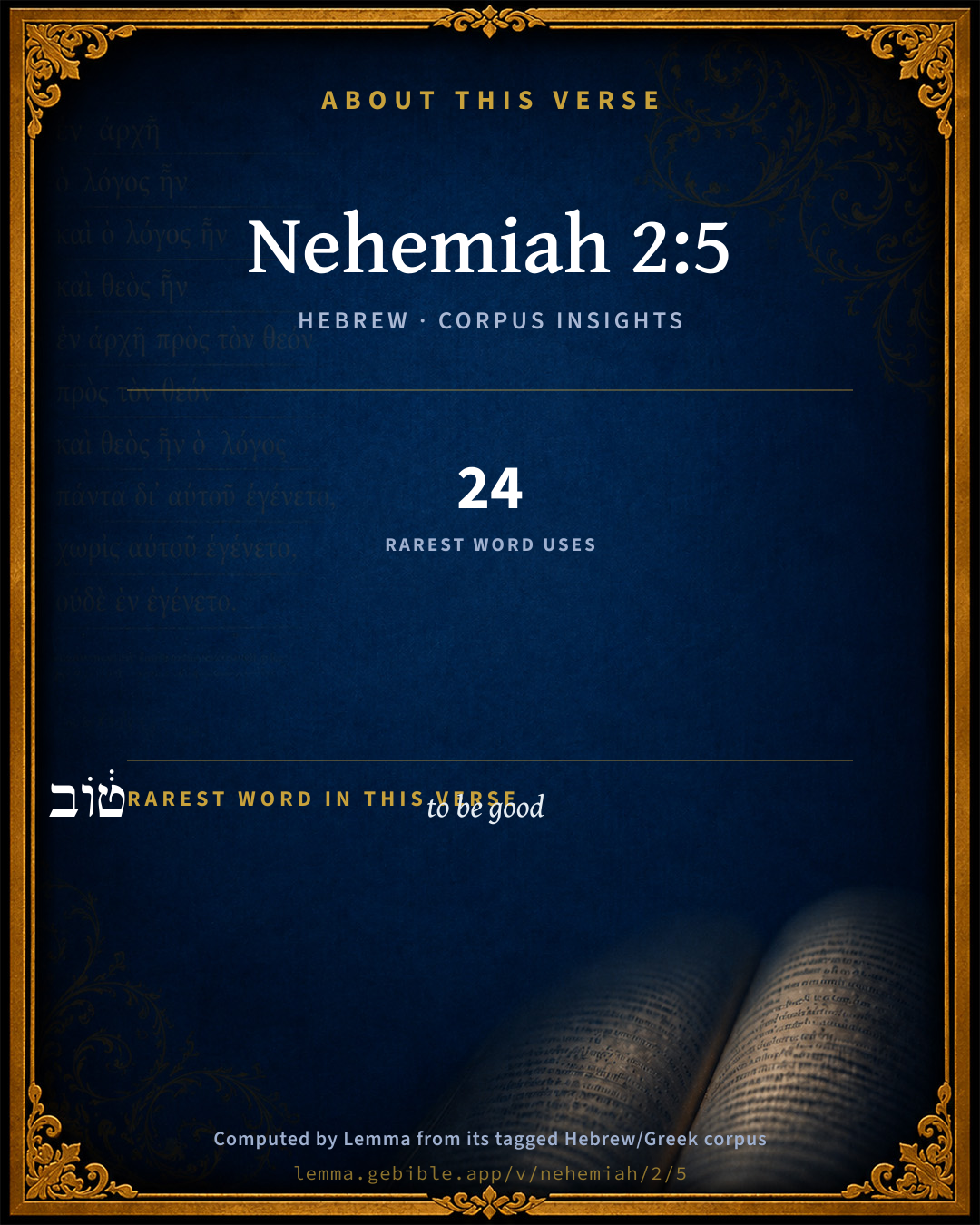
The rarest word here is ט֔וֹב to be good H2895 — appearing just 24 times in the whole Hebrew Bible.

Shared distinctive vocabulary

ט֔וֹב to be good H2895 occurs in 24 verses of the Hebrew Bible. Also found in:

Grammatical profile

  • 4 verbs
  • 8 nouns
  • 1 adjective
  • 3 prepositions
  • 2 conjunctions
  • 1 particle

Verb forms

  • וָאֹמַ֣ר Qal · Sequential Imperfect
  • יִיטַ֥ב Qal · Imperfect
  • תִּשְׁלָחֵ֣נִי Qal · Imperfect
  • וְאֶבְנֶֽנָּה Qal · Imperfect

Repetition

Words recur within this verse — often emphatic in Hebrew:

  • לַמֶּ֔לֶךְ king H4428 ×2
  • אִם if H518 ×2
  • אֶל to H413 ×2

Cross-references

8

Topical passages linked to Nehemiah 2:5 in the Treasury of Scripture Knowledge — connected by theme and wording, ordered by reader-vote popularity; previews shown in the World English Bible.

  • Ruth 2:13 Then she said, Let me find favor in your sight, my lord, because you have comforted me, and because you have spoken kindly to your handmaid, though I am not as one of your handmaidens.
  • 2 Samuel 14:22 Joab fell to the ground on his face, and did obeisance, and blessed the king: and Joab said, Today your servant knows that I have found favor in your sight, my lord, king, in that the king has performed the request of his servant.
  • Ezra 5:17 Now therefore, if it seem good to the king, let there be search made in the king's treasure-house, which is there at Babylon, whether it be so, that a decree was made of Cyrus the king to build this house of God at Jerusalem; and let the king send his pleasure to us concerning this matter.
  • Esther 5:8 if I have found favor in the sight of the king, and if it please the king to grant my petition, and to perform my request, let the king and Haman come to the banquet that I shall prepare for them, and I will do tomorrow as the king has said.
  • Esther 7:3 Then Esther the queen answered, If I have found favor in your sight, O king, and if it please the king, let my life be given me at my petition, and my people at my request:
  • Esther 8:5 She said, If it please the king, and if I have found favor in his sight, and the thing seem right before the king, and I be pleasing in his eyes, let it be written to reverse the letters devised by Haman, the son of Hammedatha the Agagite, which he wrote to destroy the Jews who are in all the king's provinces:
  • Proverbs 3:4 So you will find favor, And good understanding in the sight of God and man.
  • Esther 1:19 If it please the king, let there go forth a royal commandment from him, and let it be written among the laws of the Persians and the Medes, that it not be altered, that Vashti come no more before king Ahasuerus; and let the king give her royal estate to another who is better than she.

Cross-references courtesy of OpenBible.info (CC BY 4.0).

Hebrew and Greek witnesses Masoretic Hebrew ↔ Greek Septuagint

The same verse in the two great witnesses to the Old Testament, shown verse-for-verse.

These are two independent witnesses, not word-aligned to each other, and the Septuagint is shown in lemma (dictionary) form.

Hebrew Nehemiah 2:5 Masoretic · Westminster Leningrad Codex

וָאֹמַ֣ר לַמֶּ֔לֶךְ אִם עַל הַמֶּ֣לֶךְ ט֔וֹב וְאִם יִיטַ֥ב עַבְדְּךָ֖ לְפָנֶ֑יךָ אֲשֶׁ֧ר תִּשְׁלָחֵ֣נִי אֶל יְהוּדָ֗ה אֶל עִ֛יר קִבְר֥וֹת אֲבֹתַ֖י וְאֶבְנֶֽנָּה

I said to the king, If it please the king, and if your servant have found favor in your sight, that you would send me to Judah, to the city of my fathers' tombs, that I may build it.

World English Bible · Public Domain

Greek LXX Structure differs

The Septuagint has no separate book of Nehemiah. Its Greek text is the second half of Esdras B (2 Esdras), chapters 11–23; Ezra is the first half (1–10).

A verse-for-verse comparison isn’t shown here because the chapters and verses don’t line up. Switch to the LXX edition with the MT / LXX toggle above to read the Greek directly.

Hebrew: Westminster Leningrad Codex (CC BY 4.0). Greek: Septuagint (public domain); English from a public-domain English Septuagint. How the Septuagint differs from the Hebrew →

Commentary

Notes on Nehemiah 2:5 from classic Christian and Jewish commentators (each source and its license shown beneath its notes). The classic Christian expositions comment on the surrounding passage and are grouped to its opening verse, so a note may address several verses; the Jewish commentaries on the Tanakh (Rashi and others) are per-verse, so they appear only where the commentator wrote on this verse.

Lemma curates 59 commentaries, every one of them public domain or Creative Commons licensed, each selected and text-cleaned for this edition rather than reprinted as found. About our sources →

The Cambridge Bible for Schools and Colleges

gen. ed. J. J. S. Perowne

5. If it please the king, and if thy servant, &c.] A double conditional sentence precedes the request. On the king’s approbation of the policy and on the king’s personal favour to Nehemiah must depend the issue.

The words run literally, ‘If it is good before the king and if thy servant be good in thy presence.’ The phrase in the first clause is the same as that used, e.g. in Est_1:19; Est_9:13. The second clause differs from the common phrase ‘to find favour or grace,’ e.g. 1Sa_26:22; Est_2:15. The verb which with this meaning is generally used impersonally, here has a subject; elsewhere this construction is unusual, cf. Est_5:14, ‘the thing pleased Haman;’ Ecc_7:26, ‘whoso pleaseth God,’ literally, ‘is good in the presence of God.’

that I may build it] If, as is most probably the case, Ezr_4:7-24 refers to the events of the reign of Artaxerxes, Nehemiah in alluding to the city of Jerusalem introduces a subject that had some time previously engaged the king’s attention. According to the letters in that chapter the work of ‘building’ the city had been stopped. But the decree, which had stopped the work, also contemplated the possibility of its being resumed: see Ezr_4:21, ‘Make ye now a decree to cause these men to cease and that this city be not builded until a decree shall be made by me.’ Nehemiah makes request that such a decree should be made. The knowledge of this previous edict would have increased his apprehensions. ‘Build’ in this passage is equivalent to ‘building the walls,’ cf. Ezr_4:12; Ezr_4:16.

5b–73a. The Register of those who returned with Zerubbabel = Ezr_2:1-70

a register of the genealogy] R.V. the book.

of them which came up at the first] The only natural explanation of these words is that Nehemiah found in the archives of Jerusalem the list of those that accompanied Zerubbabel from Babylon. This seems to be conclusively proved (a) by the words in Neh_2:5, ‘I found,’ ‘who came up at the first,’ ‘found written therein,’ and Neh_2:7, ‘who came with Zerubbabel,’ (b) by the position of the parallel extract in Ezr_2:1-70. Nehemiah recognises the national importance of the register and transcribes it into his ‘Memoirs;’ he had not known of its existence before.

The view that the list in this chapter contains the results of Nehemiah’s census which were mistakenly inserted by the Compiler into Ezra 2, rests on the quite insufficient grounds of (1) the mention of the name Nehemiah in Ezr_2:7, (2) the title Tirshatha in Ezr_2:65, (3) the relation of Ezra 2:73 to the events of chap. 8, (4) the apparent omission of Nehemiah’s census. But (1) the name Nehemiah (Ezr_2:7) is not necessarily that of the governor of Jerusalem; (2) there is no evidence that the title ‘Tirshatha’ was appropriated to Nehemiah alone; (3) only the first part of Ezra 2:73 belongs to this extract; the latter part is freely adapted by the chronicler for the purpose of resuming the narrative; (4) traces of Nehemiah’s own census may well be recognised in chap. 11.

This long extract illustrates in an interesting manner the method of compilation adopted by Jewish chroniclers.

The double insertion of the list is probably due to its great importance in the eyes of the stricter Jews. It stands first of all in its right place, chronologically, in the narrative (Ezra 2); it is repeated here in the place which it occupied in the Memoirs of Nehemiah transcribed by the Compiler.

at the first] A general expression, sometimes used in the sense of ‘before’ ‘formerly,’ cf. Gen_13:4; 1Ch_17:9, sometimes in the sense of ‘first of all,’ Num_10:13-14.

6–73. See notes on the parallel passage Ezr_2:1, &c. The variations are very slight, and are for the most part such as would arise from errors of transcription.

The Cambridge Bible for Schools and Colleges (gen. ed. J. J. S. Perowne; Cambridge University Press, 1878–1918) — public domain. Text from a community e-Sword module.

Trapp's Complete Commentary

John Trapp

Neh 2:5 And I said unto the king, If it please the king, and if thy servant have found favour in thy sight, that thou wouldest send me unto Judah, unto the city of my fathers’ sepulchres, that I may build it.

Ver. 5. If it please the king] Silken words must be given to kings, as the mother of Darius said (η διστα, η ηκιστα); neither must they be rudely and roughly dealt with, as Joab dealt with David, 2Sa 19:5, who, therefore, could never well brook him afterward, but set another in his place.

And if thy servant have found favour] Pellican observeth here, that Nehemiah was a great favourite of this king’s; as appeared in that having so many nobles, he chose him to this office, rather than any of them. He, therefore, pleads it as a pledge of further favour; so may we with God, as being no small favourites in the beloved one, Eph 1:5.

That thou wouldest send me unto Judah] Not only give me leave to go, but also send me with a commission to be governor. This was a bold request, but modestly proposed, and easily obtained. The king is not he that can deny you anything, Jer 38:5. Love is liberal, charity is no churl.

John Trapp, A Commentary or Exposition upon All the Books of the Old and New Testament (1647–1656) — public domain. Text from a community e-Sword module.

The Biblical Illustrator

Joseph S. Exell

Neh_2:5

If it please the king, and if thy servant have found favour.

The man of business

Such a man was Nehemiah. His strong practical sagacity is manifest throughout the whole record of his work in Jerusalem. And in his case this business ability was blended with enthusiasm. It is by such men--men combining practical sagacity with noble impulse--that the best work of the world is done. Sometimes we find men of enthusiastic zeal or true piety who have little or no business faculty, who are deficient in powers of observation and management, who lack the tough energy of perseverance, who perhaps scorn tact and prudence, and who have little capability of adapting means to ends. Such men are apt to become either crotchety or fanatical; they waste both time and strength on impracticable schemes; they may have noble aims, but they seek to carry them out by unwise methods; they damage the cause which they have at heart by their own blundering; they isolate themselves from those with whom they ought to work, and alienate those whom they ought to conciliate; they grow impatient of their imperfect instruments and agents; and, failing to realise the best conceivable, they become careless as to realising the best practicable. And, on the other hand, we find men of shrewd sagacity and business ability, of keen observation and ready tact, who lack all the higher inspiration of noble and generous impulse; who are deficient in imagination, affection, and piety; who have no real enthusiasm even in their business; and who carry on their practical work with the successful persistency of a cold, clever, and calculating selfishness. A man of this type might have gone to rebuild the walls of Jerusalem if he had been well paid for the work, and if he had received money with which to hire the labour of the builders; but he would never have gone, like Nehemiah, impelled by the fervours of a pious patriotism, nor could he have roused the people, as Nehemiah did, to voluntary effort and sacrifice. The practical business faculty is a gift of no mean order; but, like all other gifts, it ought to be devoted to the service of God. If a man possesses energy, persistency, tact, quickness in forecasting necessities and results, skill in adapting means to ends, he ought not to regard these powers as mere instruments for the promotion of his own selfish objects. These faculties are part of himself, and he is himself called to live as a servant of God. Then, again, the exclusive development of mere business faculty is attended with the utmost danger. It is, indeed, a faculty for which we may well thank God; but there are other powers of our nature-some of them higher and more important--which ought also to be exercised. The whole spiritual side of our being, looking out on God, on righteousness, and on eternity, calls for cultivation. Nor ought we to neglect the affections and emotions of the heart. Even the culture of the imagination is not to be despised; it furnishes a healthy counterpoise where the practical faculty is keen and strong. If there be no exercise of the imagination, no deepening of the affections, no quickening of the conscience and the spiritual nature, then a mans practical sagacity may only tend to make him a hard-headed and hardhearted worldling. His tact will be constantly degenerating into mere manoeuvre, finesse, and deceit. His power of managing men will lead him to deal with them as tools. He may thus get on in the world, as some people count getting on; he may perhaps gather wealth, and leave it behind him to his heirs. But his own nature will deteriorate; it will become narrow, stunted, and impoverished, and he will never do any of the best kind of work in the world, either for God or for mankind. By all means let a man cultivate practical sagacity; but let him take care to consecrate it to God, and to make it the handmaid of aims that shall be worthy of his spiritual nature. We want neither fanatics nor worldlings, neither unpractical dreamers nor mere selfish tacticians; we want men who, like Nehemiah, are open to the promptings of generous impulse and pure enthusiasm, and at the same time can carry out their projects with wise foresight, patient energy, and prudent self-control. (T. C. Finlayson.)

The mission of Nehemiah

The text harmonises with the historic truth that for every great work there must be an inspired leader. Every great revival has hinged upon the deeds of some one man. The success of Nehemiah depended upon three traits, which must be characteristic of every great leader in human affairs. A lack as to either one of the three would render his undertaking a failure.

I. His faith. There is nothing in this world more sublime than the man of faith, and there is no one more truly ridiculed. Faith, dissatisfied with the present, looks into futurity. The multitudes are content with to-days attainments. Nehemiah pondered upon the Jerusalem which should be. Plans, at the first, were indistinct. It seemed an impossibility. His were the words of faith and not of sight: The God of heaven, He will prosper us; therefore we His servants will arise and build.

II. His sagacity. Faith incites to the purest wisdom. The intellect of man is made to be the servant his faith. His faith was reasonable, yet, after it had become most perfect, in order to attain its object he was compelled to reason out each step of the way. Thus is it many a man works out his prayers. Artaxerxes had chosen a sagacious man for his cup-bearer, and Jehovah said Artaxerxes had chosen wisely. Jehovah needed not only a man of faith, but a shrewd man, to restore Jerusalem to its former greatness.

III. His courage. Grant him to have been a man of strongest faith, and of shrewdest mind to reason out the successive steps, yet without courage to take each step, he had failed after all. (Monday Club Sermons.)

Nehemiah before Artaxerxes

And now it was that the man of piety appeared in the man of patriotism; and admirably does Nehemiah stand forth as an example to those who profess to have at heart their countrys good, and to be stricken by its calamities. He did not immediately call a meeting of the Jews, to consult what might be done for their afflicted countrymen. He did not gather round him a knot of politicians, that plans might be discussed, and assistance levied. But Nehemiah sat down, and wept. But Nehemiah did not count his part done when he had thus, in all humility, confessed the sins of his nation, and entreated the interference of God. He was not one of those who substitute prayer for endeavour, though he would not make an endeavour until he had prepared himself by prayer. Fortified through humiliation and supplication, he now sought to take advantage of his position with the king, and, true patriot as he was, to render that position useful to his countrymen. Nehemiah was sore afraid when Artaxerxes, struck with the sorrow depicted on his features, imperiously asked the cause of the too evident grief. It was the moment for which he had wished, yea, for which he had prayed, yet, now that it had come, he felt so deeply what consequences hung upon a word, that he was almost unmanned, and could scarce venture to unburden his heart. The facts are these: the first, that it was as the city of his fathers sepulchres that Jerusalem excited the solicitude of Nehemiah the second, that Nehemiah found a moment before answering the king to offer petition to the Almighty. Now Jerusalem had not yet received its most illustrious distinction, forasmuch as the fulness of time had not arrived, and therefore there had not yet been transacted within her circuits the wondrous scenes of the redemption of the world. Nevertheless, to every man, especially to a devout Jew, there were already reasons in abundance why thought should turn to Jerusalem, and centre there as on a place of peculiar sanctity and interest. There had a temple been reared, magnifical beyond what earth beforetime had seen, rich with the marble and the gold, but richer in the visible tokens of the presence of the universal Lord. There had sacrifices been continually offered, whose efficacy was manifest even to those who discerned not their typical import, forasmuch as at times they prevailed to the arrest of temporal visitations, and pestilence was dispersed by the smoke of the oblation. There had monarchs reigned of singular and wide-spread renown. Hence, it might easily have been accounted for why Nehemiah should have looked with thrilling interest to Jerusalem. But the observable thing is, that Nehemiah fixes not on any of these obvious reasons when he would explain, or account for, his interest in Jerusalem. Before he offered his silent prayer to God, and afterwards, when he might be supposed to have received fresh wisdom from above, he spake of the city merely as the place of the sepulchres of his fathers, as though no stronger reason could be given why he should wish to rebuild it; none, at least, whose force was more felt by himself, or more likely to be confessed by the king. The language of Nehemiah is too express and too personal to allow of our supposing that he adopted it merely from thinking that it would prevail with Artaxerxes. If we may argue from the expressions of Nehemiah, then, it is a melancholy sight--that of a ruined town, a shattered navy, or a country laid waste by famine and war; but there is s more melancholy sight too, that of a churchyard, where sleeps the dust of our kindred, desecrated and destroyed, whether by violence or neglect. There is something so ungenerous in forgetfulness or contempt of the dead--they cannot speak for themselves; they so seem, in dying, to bequeath their dust to survivors, as though they would give affection something to cherish, and some kind office still to perform. We do not, however, suppose that the strong marks of respect for the dead, which occur so frequently in the Bible, are to be thoroughly accounted for by the workings of human feelings and affections. We must have recourse to the great doctrine of the resurrection of the body if we would fully understand why the dying Joseph gave commandment concerning his bones, and Nehemiah offered no description of Jerusalem, but that it was the place of the sepulchres of his fathers. The doctrine of the resurrection throws, as you must all admit, a sacredness round the remains of the dead, because it proves, that, though we have committed the body to the ground, ashes to ashes, dust to dust, that body is reserved for noble allotments, destined to reappear in a loftier scene, and discharge more glorious functions. Then the well-kept churchyard, with its various monuments, each inscribed with lines not more laudatory of the past than hopeful of the future, what is it but the public testimony, to all that is precious in Christianity, forasmuch as it is the public testimony that the dead shall live again? We are now to detach our minds from Nehemiah pleading for his fathers sepulchres, and fix them upon Nehemiah addressing himself to God in ejaculatory prayer. Under how practical and comforting a point of view does this place the truth of the omnipresence of God. Yet, with all its mysteriousness, this is no merely sublime but barren speculation, no subject to exercise the mind rather than benefit the heart. It should minister wondrously to our comfort, to know that, whether we can explain it or not, we are always, so to speak, in contact with God; so that in the crowd and in the solitude, in the retirement of the closet, the bustle of business, and the privacies of home, by day and by night, He is alike close at hand, near enough for every whisper, and plenteous enough for every want. It is not so with a human patron or friend, who, whatever be his power, and his desire to use it on our behalf, cannot always be with us, to observe each necessity, and appoint each supply. It is not indispensable that there should be outward prostration and set supplication. The heart has but to breathe its desire, and God is acquainted with it so soon as formed, and may grant it, if He will, before the tongue could have given it utterance. The man of business, he need not enter on a single undertaking without prayer; the mariner, he need not unfurl a sail without prayer; the traveller, he need not face a danger without prayer; the statesman, he need not engage in a debate without prayer; the invalid, he need not try a remedy without prayer; the accused, he need not meet an accuser without prayer. We may hallow and enlighten everything by prayer, though we seem, and are, engaged from morning to night with secular business, and thronged by eager adherents. We cannot be in a difficulty for which we have not time to ask guidance, in a peril so sudden that we cannot find a guardian, in a spot so remote that we may not people it with supporters. (H. Melvill, B. D.)

Unto the city of my fathers sepulchres.

The place of my fathers sepulchres

Any reference to the history of the fame and power of the city of God might have inflamed the jealousy of the Persian king, and fixed his resolution to leave it in its present ruin. But the human heart naturally softens into tenderness at the graves of the dead. Hence the consummate skill and delicacy with which Nehemiah frames his plea for sorrow. (W. Ritchie.)

Wise musings

Men love to think of the honour of their fathers titles, or of the grandeur of their fathers habitations. It is wise in us to muse sometimes on the place of our fathers sepulchres. The graves where they lie are mementoes whither we must follow them, and from their tomb they call us to prepare for entering the narrow house appointed, for all living. (W. Ritchie.)

God always helps His faithful witnesses

In these touching and powerful words we remark the almighty aid God gives His servants in pleading for, and bearing witness to, His cause. He gives Nehemiah mouth and wisdom in this trying hour. It has been so with all faithful witnesses for God in every age. It was so with Luther at the Diet of Worms. (W. Ritchie.)

The Biblical Illustrator, edited by Joseph S. Exell (c. 1880s–1900s) — public domain. Text from a community e-Sword module.

Joseph Benson's Commentary

Neh 2:5. I said, If it please the king, &c. — My request, whatever it is, I humbly and wholly submit to the king’s good pleasure, in which I am resolved to acquiesce. If thy servant have found favour in thy sight — I plead no merit, but humbly supplicate thy grace and favour, of which, having received some tokens, I am imboldened to make this farther request. That thou wouldst send me unto Judah, &c. — Wouldst give me a commission to go and build the walls of Jerusalem, and thereby make it a city again, for it is now in a defenceless state, as an open town, exposed on all sides to the attacks of its enemies. “A generous spirit,” says Lord Clarendon, “can think of nothing but relieving his country while it is under a general misery and calamity.”

Joseph Benson's Commentary on the Old and New Testaments (1811–1818) — public domain. Text from a community e-Sword module.

Tyndale Open Study Notes

Tyndale Open Resources

2:5 send me to Judah to rebuild the city: Artaxerxes’ openness to this proposal seems surprising in light of Jerusalem’s history of rebellions against Persia (Ezra 4:17-23). The king might have viewed Nehemiah’s plan as a way to solidify his own control over a troubled area of his empire.

Tyndale Open Study Notes — © Tyndale Open Resources, licensed CC BY-SA 4.0. Text via the HelloAO Bible API.

Adam Clarke's Commentary

Verse 5. The city of my fathers' sepulchres] The tombs of the dead were sacred among the ancients, and nothing could appear to them more detestable than disturbing the ashes or remains of the dead. Nehemiah knew that in mentioning this circumstance he should strongly interest the feelings of the Persian king.

Adam Clarke's Commentary on the Bible (1810–1826) — public domain. Text from a community e-Sword/MySword module.

John Gill's Exposition

And I said unto the king; if it please the king, and if thy servant have found favour in thy sight,.... He submits what he had to say wholly to the pleasure of the king, and puts it upon his unmerited favour, and not on any desert of his own:

that thou wouldest send me unto Judah, unto the city of my fathers' sepulchres, that I may build it; the wall of it, and the houses in it; the favour was, that he might have leave to go thither, and set about such a work, for which he was so much concerned.

John Gill's Exposition of the Whole Bible (1746–1763) — public domain (CC PDM 1.0). Text via the HelloAO Bible API.

Matthew Poole's English Annotations

If it please the king: my request, whatsoever it is, I humbly and wholly submit it to the king’s good pleasure, being resolved to acquiesce in it.

If thy servant have found favour in thy sight: I pretend no merit, but am a humble suppliant for thy grace and favour, whereof having received some tokens, I am thereby imboldened to make this further request.

Matthew Poole's English Annotations on the Holy Bible (1683–1685) — public domain. Text from a community e-Sword/MySword module.

Whedon's Commentary on the Bible

Daniel D. Whedon

5. Send me… that I may build it — To obtain this request had been the anxious desire of his heart, and the burden of his prayer for many days — even from the time of his hearing of the desolation of Judah. Neh_1:3-4.

Daniel D. Whedon (gen. ed.), Commentary on the Old and New Testaments (1874–1909) — public domain. Text from a community e-Sword module.

Rashi

Rabbi Shlomo Yitzchaki (Rashi)

that you send me that you grant me permission to ascend to Jerusalem and build it.

Rashi on the Tanakh — English translations: “The Judaica Press complete Tanach with Rashi, translated by A. J. Rosenberg” (CC BY 4.0); “Pentateuch with Rashi's commentary by M. Rosenbaum and A.M. Silbermann, 1929-1934” (public domain); “The Metsudah Tanach series, Lakewood, N.J” (CC BY 4.0); and “The Book of Joshua, Metsudah Publications, 1997” (CC BY 4.0). Text via Sefaria.

Lesson kit

Teaching starters — assembled from the data on this page, not authored interpretation. Every prompt links to the verse data it draws on. Edit before teaching.

Nehemiah, in the Historical, opens this verse with 19 words (16 distinct Hebrew lemmas). Its most distinctive word is ṭôwb (“to be good”). A historical commentator’s framing appears above. Read the whole chapter for the surrounding context.

Discussion questions

  1. How does “to be good” (ṭôwb) shape what this verse is saying?
  2. Numbers 11:18 shares the word «to be good» with this verse. How do the two illuminate each other?
  3. “king” occurs 2× in this one verse. What is the effect of the repetition?
  4. The translations on this page render this verse differently — a whole-verse word diff, not a word-by-word alignment. What might account for the different wordings?
  5. The verb «וָאֹמַ֣ר» is Qal Sequential Imperfect. How does its form color the action?
  6. Reading how The Cambridge Bible for Schools and Colleges and Trapp's Complete Commentary read this verse, where do the two commentators agree and where do they part?

Things to notice

Reading settings

Reading text

Shown beneath each verse's original-language words.

Old Testament
Old Testament edition

Read the OT as the Masoretic Hebrew (MT) or the Greek Septuagint (LXX).

English shown for the Greek Septuagint (in the Hebrew ↔ Greek comparison).

Comparing translations? Open the Compare panel on any verse page to stack up to four side by side.