
Nehemiah 2:19

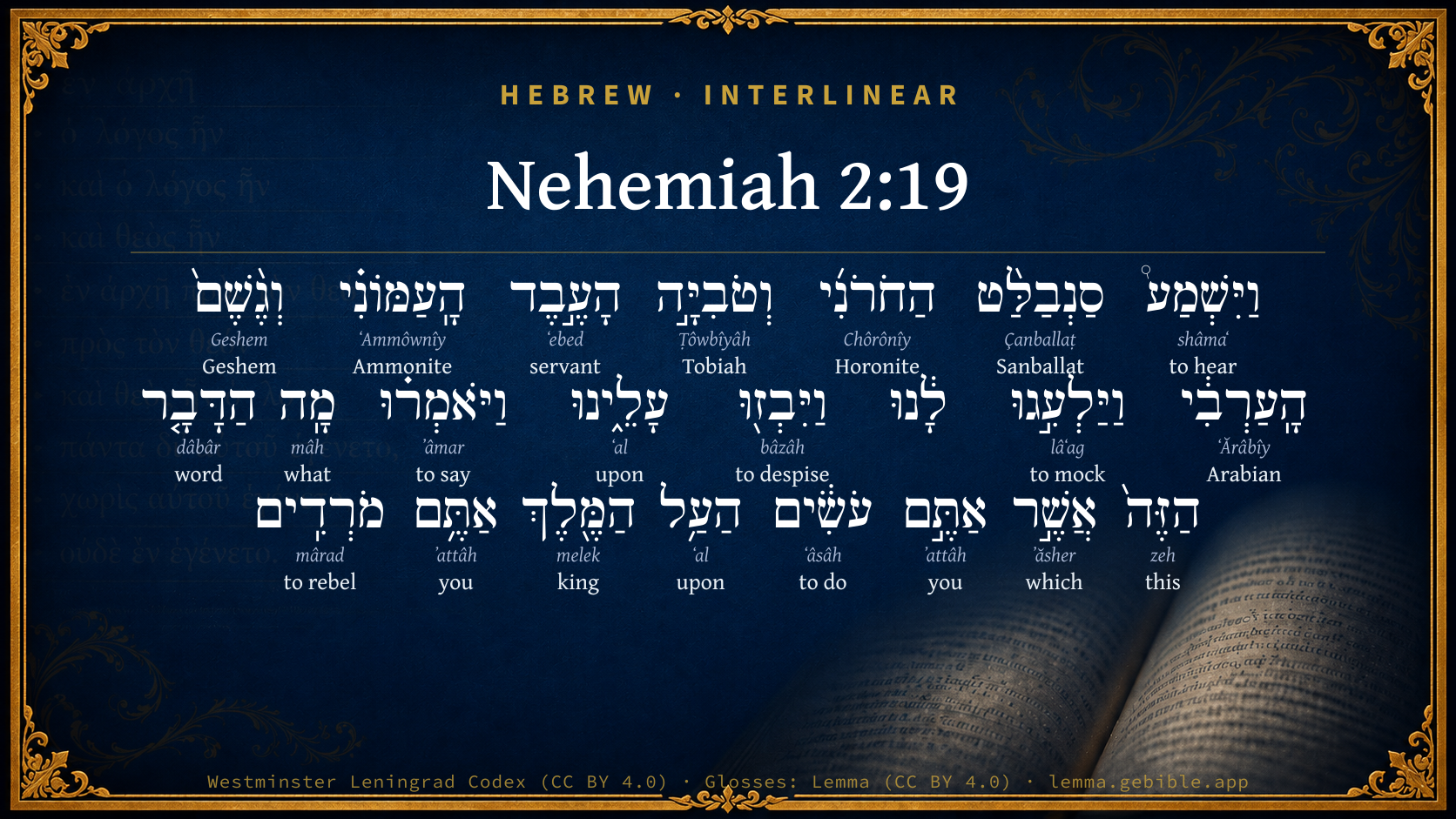
Hebrew (Westminster Leningrad Codex) Nehemiah 2:19 appears in the Hebrew Old Testament. The text above is from the Westminster Leningrad Codex. Each word links to its Strong’s number, a concise gloss, and parsing drawn from the Open Scriptures Hebrew Bible morphology. Click any word for its full Brown-Driver-Briggs (BDB) entry.
Download image
Cite this verse

Nehemiah 2:19 (World English Bible). Public Domain. Lemma interlinear Bible study tool, https://lemma.gebible.app/v/nehemiah/2/19.

Show BibTeX & RIS
BibTeX
RIS
English Translation
But when Sanballat the Horonite, and Tobiah the servant, the Ammonite, and Geshem the Arabian, heard it, they ridiculed us, and despised us, and said, What is this thing that you do? will you rebel against the king?
World English Bible · Public Domain
Highlights
  • 1 first appearance in the Hebrew Bible
Full analysis ↓
Download a study sheet

One document with this verse’s original text, its word-by-word gloss line, the meaning frame, cross-references with their text, attributed commentary, and full source and license credits — printable, and it pastes into notes with its structure intact.

This verse Autodidact and up

Study sheet (.html) Plain text (.txt)

A passage Seminary Student

Up to 50 verses in one chapter. A passage sheet keeps up to 6 commentary sources and 12 cross-references per verse, in the order this page ranks them, and says so on the sheet whenever that leaves anything out. Ask for a single verse and you get the Autodidact verse sheet above.

Everything on this page stays free to read, with no account — the sheet is a download of what is already on screen, not access to it.

Want to remove ads? Support Godless Engineer
Compare translations 3

The same verse in 3 English versions, stacked beneath the original-language interlinear above. Click any original word for its lexicon entry.

Each is an independent rendering of the whole verse — the interlinear is not word-aligned to these translations.

Highlighted words mark where these versions differ — a whole-verse word diff, not a word-by-word alignment.

  • World English Bible Public Domain
    But when Sanballat the Horonite, and Tobiah the servant, the Ammonite, and Geshem the Arabian, heard it, they ridiculed us, and despised us, and said, What is this thing that you do? will you rebel against the king?
  • King James Version Public Domain
    But when Sanballat the Horonite, and Tobiah the servant, the Ammonite, and Geshem the Arabian, heard it, they laughed us to scorn, and despised us, and said, What is this thing that ye do? will ye rebel against the king?
  • unfoldingWord Literal Text CC BY-SA 4.0
    And Sanballat the Horonite, and Tobiah, the servant, the Ammonite, and Geshem the Arabian heard, and they mocked us, and they despised us. And they said, “What is this thing that you are doing? Are you rebelling against the king?”

unfoldingWord Literal Text — © unfoldingWord, licensed CC BY-SA 4.0. Word-aligned USFM3 via Door43 (git.door43.org/unfoldingWord/en_ult).

Versions to compare (up to 4)

3 of 4 selected

Show all 18 translations

Every available English version of this verse, each an independent rendering of the whole verse.

  • World English Bible Public Domain
    But when Sanballat the Horonite, and Tobiah the servant, the Ammonite, and Geshem the Arabian, heard it, they ridiculed us, and despised us, and said, What is this thing that you do? will you rebel against the king?
  • Berean Standard Bible Public Domain
    But when Sanballat the Horonite, Tobiah the Ammonite official, and Geshem the Arab heard about this, they mocked us and ridiculed us, saying, “What is this you are doing? Are you rebelling against the king?”
  • Majority Standard Bible Public Domain
    But when Sanballat the Horonite, Tobiah the Ammonite official, and Geshem the Arab heard about this, they mocked us and ridiculed us, saying, “What is this you are doing? Are you rebelling against the king?”
  • King James Version Public Domain
    But when Sanballat the Horonite, and Tobiah the servant, the Ammonite, and Geshem the Arabian, heard it, they laughed us to scorn, and despised us, and said, What is this thing that ye do? will ye rebel against the king?
  • American Standard Version (1901) Public Domain
    But when Sanballat the Horonite, and Tobiah the servant, the Ammonite, and Geshem the Arabian, heard it, they laughed us to scorn, and despised us, and said, What is this thing that ye do? will ye rebel against the king?
  • Revised Version (1885) Public Domain
    But when Sanballat the Horonite, and Tobiah the servant, the Ammonite, and Geshem the Arabian, heard it, they laughed us to scorn, and despised us, and said, What is this thing that ye do? will ye rebel against the king?
  • Geneva Bible (1599) Public Domain
    But when Sanballat the Horonite, and Tobiah the seruant an Ammonite, and Geshem the Arabian heard it, they mocked vs and despised vs, and said, What a thing is this that ye doe? Will ye rebell against the King?
  • Douay-Rheims (1899) Public Domain
    But Sanaballat the Horonite, and Tobias the servant, the Ammonite, and Gossem the Arabian heard of it, and they scoffed at us, and despised us, and said: What is this thing that you do? are you going to rebel against the king?
  • Young's Literal Translation Public Domain
    And Sanballat the Horonite heareth, and Tobiah the servant, the Ammonite, and Geshem the Arabian, and they mock at us, and despise us, and say, `What `is' this thing that ye are doing? against the king are ye rebelling?'
  • Literal Standard Version CC BY-SA 4.0
    And Sanballat the Horonite hears, and Tobiah the servant, the Ammonite, and Geshem the Arabian, and they mock at us, and despise us, and say, “What [is] this thing that you are doing? Are you rebelling against the king?”
  • Unlocked Literal Bible CC BY-SA 4.0
    But when Sanballat the Horonite, and Tobiah the Ammonite servant, and Geshem the Arabian heard about it, they mocked and ridiculed us, and they said, “What are you doing? Are you rebelling against the king?”
  • unfoldingWord Literal Text CC BY-SA 4.0
    And Sanballat the Horonite, and Tobiah, the servant, the Ammonite, and Geshem the Arabian heard, and they mocked us, and they despised us. And they said, “What is this thing that you are doing? Are you rebelling against the king?”
  • Darby Bible Public Domain
    And Sanballat the Horonite, and Tobijah the servant, the Ammonite, and Geshem the Arabian, heard it; and they mocked us and despised us, and said, What is this thing which ye do? will ye rebel against the king?
  • World Messianic Bible Public Domain
    But when Sanballat the Horonite, Tobiah the Ammonite servant, and Geshem the Arabian, heard it, they ridiculed us and despised us, and said, “What is this thing that you are doing? Will you rebel against the king?”
  • Webster's Bible Public Domain
    But when Sanballat the Horonite, and Tobiah the servant, the Ammonite, and Geshem the Arabian, heard it, they laughed us to scorn, and despised us, and said, What is this thing that ye do? will ye rebel against the king?
  • Free Bible Version CC BY-SA 4.0
    But when Sanballat the Horonite, Tobiah the Ammonite official, and Geshem the Arab got to hear about it, they mocked and taunted us, asking, “What are you up to? Are you rebelling against the king?”
  • Bible in Basic English Public Domain
    But Sanballat the Horonite and Tobiah the servant, the Ammonite, and Geshem the Arabian, hearing of it, made sport of us, laughing at us and saying, What are you doing? will you go against the king?
  • JPS Tanakh (1917) Public Domain
    But when Sanballat the Horonite, and Tobiah the servant, the Ammonite, and Geshem the Arabian, heard it, they laughed us to scorn, and despised us, and said: 'What is this thing that ye do? will ye rebel against the king?'

Literal Standard Version (2020), Covenant Press — licensed CC BY-SA 4.0. Text via the HelloAO Bible API (eBible.org). Unlocked Literal Bible (unfoldingWord) — licensed CC BY-SA 4.0. Text via the HelloAO Bible API (eBible.org). unfoldingWord Literal Text — © unfoldingWord, licensed CC BY-SA 4.0. Word-aligned USFM3 via Door43 (git.door43.org/unfoldingWord/en_ult). Free Bible Version, Dr. Jonathan Gallagher — licensed CC BY-SA 4.0. Text via the HelloAO Bible API (eBible.org).

Word by word

More ways to search: Search by grammar → Find every occurrence → Compare this word →

Practice this passage: Drill this verse → Learn its vocabulary →

הַחֹרֹנִ֜י
Chôrônîy
H2772
“the · Horonite”
Particle, Definite Article + Noun, Gentilic, Masculine, Singular, Absolute
Part of Speech
Particle + Noun
Type
Gentilic
Gender
Masculine
Number
Singular
State
Absolute
Full BDB Definition

Origin: from H2773

TWOT: None

Horonite = "native of Horonaim" - an inhabitant of Horonaim in Moab - the designation of Sanballat, the opponent of Nehemiah
  1. וַיִּשְׁמַע֩ shâmaʻ H8085 “and · to hear” Conjunction + Verb, Qal, Sequential Imperfect, 3rd Person, Masculine, Singular
  2. סַנְבַלַּ֨ט Çanballaṭ H5571 “Sanballat” Noun, Proper
  3. וְטֹבִיָּ֣ה Ṭôwbîyâh H2900 “and · Tobiah” Conjunction + Noun, Proper
  4. הָעֶ֣בֶד ʻebed H5650 “the · servant” Particle, Definite Article + Noun, Common, Masculine, Singular, Absolute
  5. הָֽעַמּוֹנִ֗י ʻAmmôwnîy H5984 “the · Ammonite” Particle, Definite Article + Noun, Gentilic, Masculine, Singular, Absolute
  6. וְגֶ֨שֶׁם֙ Geshem H1654 “and · Geshem” Conjunction + Noun, Proper
  7. הָֽעַרְבִ֔י ʻĂrâbîy H6163 “the · Arabian” Particle, Definite Article + Noun, Gentilic, Masculine, Singular, Absolute
  8. וַיַּלְעִ֣גוּ lâʻag H3932 “and · to mock” Conjunction + Verb, Hiphil, Sequential Imperfect, 3rd Person, Masculine, Plural
  9. וַיִּבְז֖וּ bâzâh H959 “and · to despise” Conjunction + Verb, Qal, Sequential Imperfect, 3rd Person, Masculine, Plural
  10. עָלֵ֑ינוּ ʻal H5921 “upon · us” Preposition + Suffix, Personal, 1st Person, Common, Plural
  11. וַיֹּאמְר֗וּ ʼâmar H559 “and · to say” Conjunction + Verb, Qal, Sequential Imperfect, 3rd Person, Masculine, Plural
  12. מָֽה mâh H4100 “what” Particle, Interrogative
  13. הַדָּבָ֤ר dâbâr H1697 “the · word” Particle, Definite Article + Noun, Common, Masculine, Singular, Absolute
  14. הַזֶּה֙ zeh H2088 “the · this” Particle, Definite Article + Pronoun, Demonstrative, Masculine, Singular
  15. אֲשֶׁ֣ר ʼăsher H834 “which” Particle, Relative
  16. אַתֶּ֣ם ʼattâh H859 “you” Pronoun, Personal, 2nd Person, Masculine, Plural
  17. עֹשִׂ֔ים ʻâsâh H6213 “doing” Verb, Qal, Participle Active, Masculine, Plural, Absolute
  18. הַעַ֥ל ʻal H5921 “upon” Particle, Interrogative + Preposition
  19. הַמֶּ֖לֶךְ melek H4428 “the · king” Particle, Definite Article + Noun, Common, Masculine, Singular, Absolute
  20. אַתֶּ֥ם ʼattâh H859 “you” Pronoun, Personal, 2nd Person, Masculine, Plural
  21. מֹרְדִֽים mârad H4775 “rebelling” Verb, Qal, Participle Active, Masculine, Plural, Absolute

About this verse

These counts appear in no published source. They are computed here, from the morphology-tagged text and Lemma’s own curated glosses. What Lemma adds →

23
words
20
distinct lemmas
Historical
section

Notable vocabulary

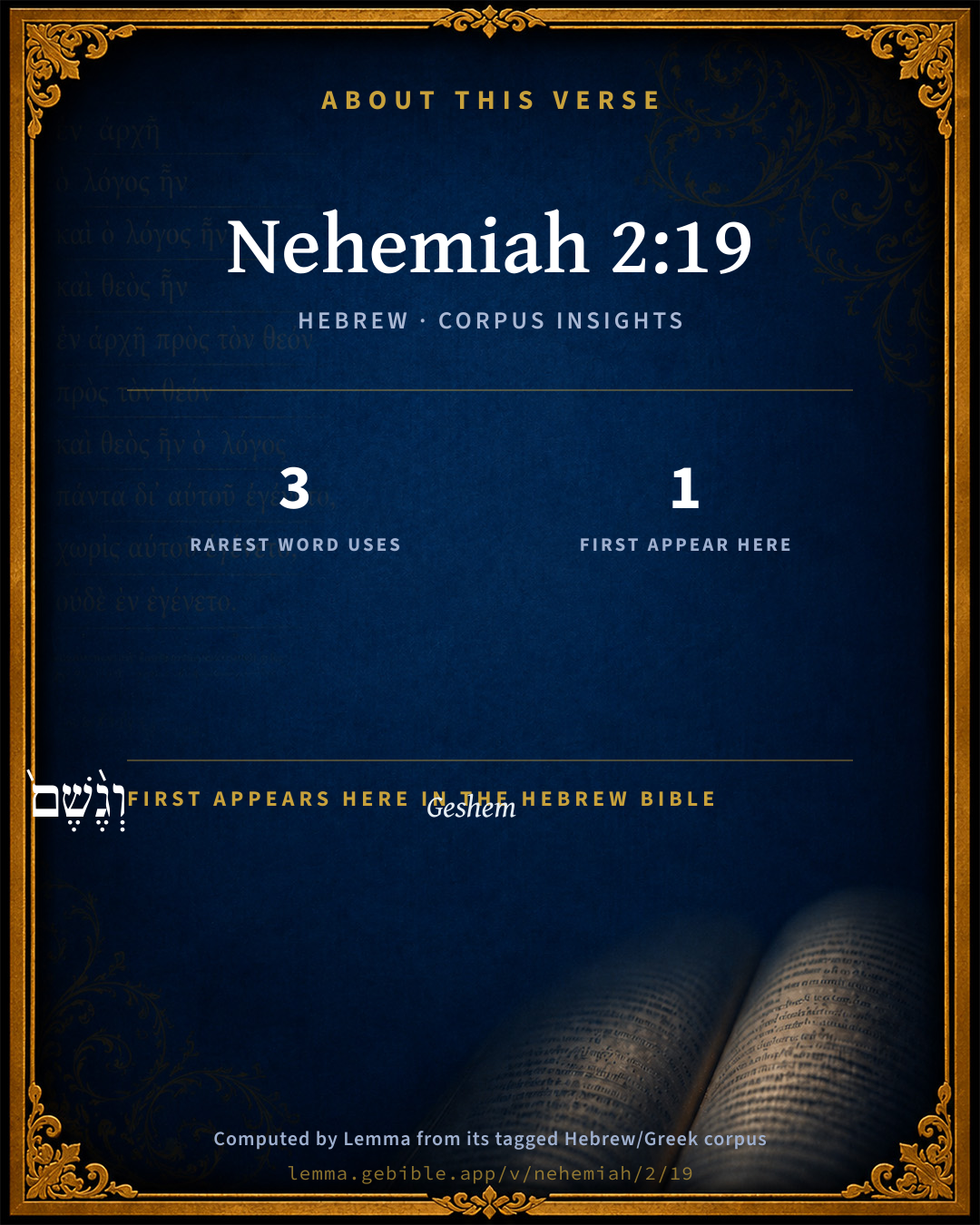
The rarest word here is הַחֹרֹנִ֜י Horonite H2772 — appearing just 3 times in the whole Hebrew Bible.

First appearance in Scripture

This word makes its first canonical appearance in the Hebrew Bible here:

  • וְגֶ֨שֶׁם֙ Geshem H1654

Shared distinctive vocabulary

הַחֹרֹנִ֜י Horonite H2772 occurs in 3 verses of the Hebrew Bible. Also found in:

Grammatical profile

  • 6 verbs
  • 9 nouns
  • 3 pronouns
  • 3 prepositions
  • 2 particles

Verb forms

  • וַיִּשְׁמַע֩ Qal · Sequential Imperfect
  • וַיַּלְעִ֣גוּ Hiphil · Sequential Imperfect
  • וַיִּבְז֖וּ Qal · Sequential Imperfect
  • וַיֹּאמְר֗וּ Qal · Sequential Imperfect
  • עֹשִׂ֔ים Qal · Participle Active
  • מֹרְדִֽים Qal · Participle Active

Repetition

Words recur within this verse — often emphatic in Hebrew:

  • עָלֵ֑ינוּ upon H5921 ×2
  • אַתֶּ֣ם you H859 ×2

Cross-references

16

Topical passages linked to Nehemiah 2:19 in the Treasury of Scripture Knowledge — connected by theme and wording, ordered by reader-vote popularity; previews shown in the World English Bible.

  • Nehemiah 6:6 in which was written, It is reported among the nations, and Gashmu says it, that you and the Jews think to rebel; for which cause you are building the wall: and you would be their king, according to these words.
  • Nehemiah 6:1–2 Now it happened, when it was reported to Sanballat and Tobiah, and to Geshem the Arabian, and to the rest of our enemies, that I had built the wall, and that there was no breach left therein; (though even to that time I had not set up the doors in the gates;)
  • Psalms 44:13–14 You make us a reproach to our neighbors, A scoffing and a derision to those who are around us.
  • Psalms 80:6 You make us a source of contention to our neighbors. Our enemies laugh among themselves.
  • Mark 5:40 They ridiculed him. But he, having put them all out, took the father of the child and her mother and those who were with him, and went in where the child was lying.
  • Ezra 4:15–16 that search may be made in the book of the records of your fathers: so shall you find in the book of the records, and know that this city is a rebellious city, and hurtful to kings and provinces, and that they have moved sedition within the same of old time; for which cause was this city laid waste.
  • Nehemiah 2:10 When Sanballat the Horonite, and Tobiah the servant, the Ammonite, heard of it, it grieved them exceedingly, because a man had come to seek the welfare of the children of Israel.
  • Nehemiah 4:1 But it happened that when Sanballat heard that we were building the wall, he was angry, and took great indignation, and mocked the Jews.
  • Nehemiah 6:9 For they all would have made us afraid, saying, Their hands shall be weakened from the work, that it not be done. But now, [God], strengthen you my hands.
  • Job 30:1 "But now those who are younger than I, have me in derision, Whose fathers I would have disdained to put with my sheep dogs.
  • Psalms 79:4 We have become a reproach to our neighbors, A scoffing and derision to those who are around us.
  • Jeremiah 20:8 For as often as I speak, I cry out; I cry, Violence and destruction! because the word of Yahweh is made a reproach to me, and a derision, all the day.
  • Luke 23:2 They began to accuse him, saying, "We found this man perverting the nation, forbidding paying taxes to Caesar, and saying that he himself is Christ, a king."
  • John 19:12 At this, Pilate was seeking to release him, but the Jews cried out, saying, "If you release this man, you aren't Caesar's friend! Everyone who makes himself a king speaks against Caesar!"
  • Acts 24:5 For we have found this man to be a plague, an instigator of insurrections among all the Jews throughout the world, and a ringleader of the sect of the Nazarenes.
  • Hebrews 11:36 Others were tried by mocking and scourging, yes, moreover by bonds and imprisonment.

Cross-references courtesy of OpenBible.info (CC BY 4.0).

Hebrew and Greek witnesses Masoretic Hebrew ↔ Greek Septuagint

The same verse in the two great witnesses to the Old Testament, shown verse-for-verse.

These are two independent witnesses, not word-aligned to each other, and the Septuagint is shown in lemma (dictionary) form.

Hebrew Nehemiah 2:19 Masoretic · Westminster Leningrad Codex

וַיִּשְׁמַע֩ סַנְבַלַּ֨ט הַחֹרֹנִ֜י וְטֹבִיָּ֣ה הָעֶ֣בֶד הָֽעַמּוֹנִ֗י וְגֶ֨שֶׁם֙ הָֽעַרְבִ֔י וַיַּלְעִ֣גוּ לָ֔נוּ וַיִּבְז֖וּ עָלֵ֑ינוּ וַיֹּאמְר֗וּ מָֽה הַדָּבָ֤ר הַזֶּה֙ אֲשֶׁ֣ר אַתֶּ֣ם עֹשִׂ֔ים הַעַ֥ל הַמֶּ֖לֶךְ אַתֶּ֥ם מֹרְדִֽים

But when Sanballat the Horonite, and Tobiah the servant, the Ammonite, and Geshem the Arabian, heard it, they ridiculed us, and despised us, and said, What is this thing that you do? will you rebel against the king?

World English Bible · Public Domain

Greek LXX Structure differs

The Septuagint has no separate book of Nehemiah. Its Greek text is the second half of Esdras B (2 Esdras), chapters 11–23; Ezra is the first half (1–10).

A verse-for-verse comparison isn’t shown here because the chapters and verses don’t line up. Switch to the LXX edition with the MT / LXX toggle above to read the Greek directly.

On this verse, The Cambridge Bible for Schools and Colleges discusses the Septuagint’s reading. Read the note in Commentary ↓

Hebrew: Westminster Leningrad Codex (CC BY 4.0). Greek: Septuagint (public domain); English from a public-domain English Septuagint. How the Septuagint differs from the Hebrew →

Commentary

Notes on Nehemiah 2:19 from classic Christian and Jewish commentators (each source and its license shown beneath its notes). The classic Christian expositions comment on the surrounding passage and are grouped to its opening verse, so a note may address several verses; the Jewish commentaries on the Tanakh (Rashi and others) are per-verse, so they appear only where the commentator wrote on this verse.

Lemma curates 59 commentaries, every one of them public domain or Creative Commons licensed, each selected and text-cleaned for this edition rather than reprinted as found. About our sources →

Trapp's Complete Commentary

John Trapp

Neh 2:19 But when Sanballat the Horonite, and Tobiah the servant, the Ammonite, and Geshem the Arabian, heard [it], they laughed us to scorn, and despised us, and said, What [is] this thing that ye do? will ye rebel against the king?

Ver. 19. But when Sanballat the Horonite, &c.] At first these men were sad, but now mad with malice. Wicked men grow worse and worse, in peius proficiunt, but they shall proceed no further: for their madness shall appear to all men.

And Geshem the Arabian] Lieutenant of Arabia for the king of Persia. He also joins himself to the two former to hinder the work in hand. Such opposition met Luther with, when he began to reform. The pope excommunicated him; the emperor proscribed him; Henry, king of England, and Lewis, king of Hungary, wrote against him; but the work went on, nevertheless, because it was of God.

They laughed us to scorn and despised us] As a company of fools, that could never effect what we attempted. So Erasmus and Sir Thomas More thought to have mocked the Lutherans out of their religion, Notum est Erasmi dicterium, Qualem a se decimum Capito fore sperat? &c. This the Scripture calleth cruel mocking, Heb 11:36; and ranks it with bloody persecution. Indeed, the favourablest persecution, saith one, of any good cause is the lash of lewd tongues; whether by bitter taunts or scurrilous invectives; which it is as impossible to avoid as necessary to condemn, &c. Bravely condemn, saith another worthy, all contumelies and contempts for thy conscience; taking them as crowns and confirmations of thy conformity to Christ.

And said, What is this thing that ye do?] Scoffingly they said it; like as Pilate said to our Saviour, What is truth? Oh how easy is it to wag a wicked tongue! Nihil tam volucre quam maledictum, nihil facilius emittitur (Cicero). One while they charge this people with folly; another while with treachery. If to accuse a man only were sufficient to make him guilty, none should be innocent.

Will ye rebel against the king?] This was ever, saith Lipsius, Unicum crimen eorum, qui crimine vacabant, the only and ordinary charge laid upon the most innocent. Elias is a troubler, Jeremiah a traitor, Paul a pest, Luther a trumpet of rebellion, all the orthodox antimagistratical. To colour the massacre of Paris, and to accuse it to the world, there was coin stamped in the forepart, whereof (together with the king’s picture) was this inscription: Virtus in Rebelles, Valour against the rebels; and on the other side, Pietas excitavit iustitiam, Piety hath excited justice.

John Trapp, A Commentary or Exposition upon All the Books of the Old and New Testament (1647–1656) — public domain. Text from a community e-Sword module.

Joseph Benson's Commentary

Neh 2:19-20. When Sanballat, Tobiah, and Geshem, &c. — These three seem to have been chief men among the Samaritans, and perhaps were invested with some offices or authority by the king of Persia. You have no portion nor right — Do not trouble yourselves about this matter, who have no possession among us, no authority over us, nor interest in our church or state; nor memorial in Jerusalem — No testimony or monument either of your relation to us by birth or religion, or of your kindness to us or to this place, but you are aliens from the commonwealth of Israel: therefore mind your own business, and do not meddle with ours.

Joseph Benson's Commentary on the Old and New Testaments (1811–1818) — public domain. Text from a community e-Sword module.

Whedon's Commentary on the Bible

Daniel D. Whedon

SCORN OF THE SAMARITANS, Neh_2:19-20.

19. Sanballat… Tobiah — See on Neh_2:10.

Geshem the Arabian — Written Gashum in Neh_6:6. Whether he was associated with Sanballat and Tobiah in the government at Samaria, or represented some Arab tribe in another quarter, is uncertain; but in either case he was in league with the Samaritans against the Jews, and most malignant was his enmity to the latter. Compare his vile slander, Neh_6:6. The Arabians of the desert south of Palestine would naturally oppose the re-establishment of the kingdom of Jerusalem, for it might oppose a barrier to their predatory invasions of that section of the country.

Will ye rebel — The building of the walls was construed into a design to fortify themselves, and then revolt and become an independent state.

Daniel D. Whedon (gen. ed.), Commentary on the Old and New Testaments (1874–1909) — public domain. Text from a community e-Sword module.

Tyndale Open Study Notes

Tyndale Open Resources

2:19 Nehemiah’s enemies immediately scoffed and tried to stop progress. These opponents were dangerous because of their potential ability to discourage the people and undermine Nehemiah’s credibility. • Are you rebelling against the king? This serious charge could bring death (see also Ezra 4:6-23).

Tyndale Open Study Notes — © Tyndale Open Resources, licensed CC BY-SA 4.0. Text via the HelloAO Bible API.

Geneva Bible (1599)

Geneva Bible translators

These were three chief governors under the king of Persia beyond Euphrates.

Thus the wicked when they will burden the children of God, ever lay treason unto their charge, both because it maketh them most odious to the world, and also stirreth the hatred of princes most against them.

Geneva Bible (1599) marginal notes — public domain. Text via Bolls.life.

Adam Clarke's Commentary

Verse 19. Geshem the Arabian] Some chief of the Arabs contiguous to Samaria, who had joined with Sanballat and Tobiah to distress the Jews, and hinder their work.

Will ye rebel against the king?] This they said in order to raise jealousies in the king's mind, and induce him to recall his ordinance.

Adam Clarke's Commentary on the Bible (1810–1826) — public domain. Text from a community e-Sword/MySword module.

Ellicott's Commentary for English Readers

(19) Geshem the Arabian.—This name completes the triumvirate of the leaders of the opposition to the mission of Nehemiah. They were not independent chieftains: Tobiah was Sanballat’s servant and counsellor, while Geshem was probably the leader of an Arabian company mostly in his service. The account of their contemptuous opposition is given in a few touches, as is the contempt with which it was met They charged Nehemiah with rebellion, as afterwards, in chapter 6:6.

A Bible Commentary for English Readers, edited by Charles John Ellicott (1878–1897) — public domain. Text from a community e-Sword module.

The Cambridge Bible for Schools and Colleges

gen. ed. J. J. S. Perowne

19, 20. The Derision of the Enemy

19. Sanballat … Tobiah] See Neh_2:10.

Geshem the Arabian] A third prominent adversary of Nehemiah is here introduced. His name occurs again in Neh_6:1-2. In Neh_6:6, the name is written as ‘Gashmu,’ a dialectical variety agreeing, as it is said, with North-Arabian usage. Geshem is clearly the chief of some Arabian tribe. But whether he represented Arabians on the Southern border of Judah or the Arabian community established by Sargon king of Assyria in the depopulated neighbourhood of Samaria (715) is a disputed point. If the former, then the movement, which he now took part in, must be regarded as a coalition of all the neighbouring peoples against the restoration of Jerusalem’s greatness. If the latter, then the movement is to be chiefly connected with the hostility of the Samaritans.

the Arabian] See on Neh_4:7.

laughed us to scorn] A strong word, familiar to us from its occurrence in the Psalter (Psa_2:4, Psa_22:7, Psa_59:8, Psa_80:6). We are not told whether this scorn was expressed by letter or in a personal interview.

despised us] See the two words occurring together in 2Ki_19:21; Eze_36:4. The ground of the contempt here expressed is not quite obvious. Some suppose that the enemy scoffed in ignorance of the king’s decree in favour of Nehemiah’s action, and that, regarding the Jews as embarking upon a course of open rebellion, they derided an undertaking which they thought could have but one conclusion. On the other hand, it is hardly likely that Nehemiah would have kept in the background the royal authority for his undertaking. We know he had been to the ‘governors’ of the province (Neh_2:9).

It is more probable that in order to alienate the Persian officials and to frighten the more timid spirits among the Jews, they pretended to interpret Nehemiah’s action as the first step towards a real rebellion. The insignificance of the Jewish community in size and strength—its inability to take any political step of real importance—presented an easy target for ridicule, which was calculated to arouse the suspicions of Persian officials at the same time that it promoted disaffection amongst the waverers in Jerusalem.

will ye rebel] Or ‘are ye rebelling?’ Vulg. Numquid contra regem vos rebellatis? LXX. ἀποστατεῖτε.

The Cambridge Bible for Schools and Colleges (gen. ed. J. J. S. Perowne; Cambridge University Press, 1878–1918) — public domain. Text from a community e-Sword module.

John Gill's Exposition

Then answered I them, and said unto them,.... With much spirit and boldness, not at all intimidated by their scoffs or threats:

the God of heaven, he will prosper us; whom we serve, and under whose protection we are, who will supply us with everything we want, and succeed this undertaking, in whose name we engage in it, and on whom we depend, and we care not what man can do to us:

therefore we his servants will arise and build; in spite of all opposition, difficulties, and discouragements:

but you have no portion, nor right, nor memorial in Jerusalem; no part of the city belonged to them; they had no jurisdiction there; they had no name there, nor their ancestors, in times past; nor had they done anything to perpetuate their memory in it: in short, they had nothing to do with them, neither in religious nor in civil things; and it was best for them to mind their own affairs where they presided, and not trouble themselves about theirs.

Next: Nehemiah Chapter 3

John Gill's Exposition of the Whole Bible (1746–1763) — public domain (CC PDM 1.0). Text via the HelloAO Bible API.

Albert Barnes' Notes on the Bible

Geshem the Arabian - The discovery that Sargon populated Samaria in part with an Arab colony explains why Arabs should have opposed the fortification of Jerusalem.

Albert Barnes' Notes on the Bible (1834–1885) — public domain. Text from a community e-Sword/MySword module.

Haydock's Catholic Bible Commentary

Arabian governor. He afterwards accuses Nehemias, chap. vi. 6. (Calmet)

George Leo Haydock (1774–1849), Haydock's Catholic Family Bible and Commentary, 1859 edition — public domain. Excludes Psalms (Douay-Rheims chapter numbering differs from Protestant) and Deuterocanonical books (Catholic canon only).

Matthew Poole's English Annotations

Geshem the Arabian; either the king’s lieutenant in Arabia, as Tobiah was among the Ammonites, and Sanballat among the Moabites; or rather, an Arabian by his birth. And it seems probable that both he, and Sanballat, and Tobiah were chief men or governors among the Samaritans, or in their army. See Neh 4:1-3.

Will ye rebel against the king? do you design to fortify the city against the king.

Matthew Poole's English Annotations on the Holy Bible (1683–1685) — public domain. Text from a community e-Sword/MySword module.

The Pulpit Commentary

Geshem the Arabian, elsewhere called Gashmu, (Neh_6:6) may have been an independent sheikh possessing authority in Idumea, or in the desert country adjoining upon Ammon; but it seems quite as likely that he was merely the head of a body of Arab troops maintained by Sanballat at Samaria. (Neh_4:7) Sanballat, Tobiah, and Geshem are united so closely, and act so much together, (Neh_4:1-7 Neh_6:1, Neh_6:2, Neh_6:6, Neh_6:12, Neh_6:14) that it is difficult to suppose them to be three chieftains residing on three sides of Judaea, the north, the east, and the south, merely holding diplomatic intercourse with each other, which is the ordinary idea. Note that Tobiah is present with Sanballat in Samaria on one occasion, (Neh_4:3) and that Geshem and Sanballat propose a joint interview with Nehemiah on another. (Neh_6:2) They laughed us to scorn, and said. Either by messengers, like Sennacherib, (2Ki_18:17-35) or by a formal written communication, as Ewald supposes ("History of Israel," vol. 5. p. 154, E. Tr.). Will ye rebel? Compare Neh_6:6; and see also Ezr_4:12-16. Had Artaxerxes not granted permission, Nehemiah"s proceedings might naturally have borne this interpretation.

Vers. 19, 20. Religion and ridicule.

I That religion is often made the subject of RIDICULE. "They laughed us to scorn.

1. Its doctrines are ridiculed. Men laugh at the supernatural.

2. Its enterprise is ridiculed. Men scorn the idea of a world-wide moral conquest.

3. Its agencies are ridiculed. "Is not this the carpenter"s son?

4. Its experiences are ridiculed. "Much learning doth make thee mad." This ridicule is

a. envious;

b. imbecile;

c. contemptuous;

d. ignorant;

5. Rebellious. "Will ye rebel against the king?" Christ was despised and rejected of men.

II The REPLY which religion should make to ridicule.

1. That it is often wise to reply to ridicule. "Then answered I them.

2. That religion must meet ridicule by expressing confidence in God. "The God of heaven, he will prosper us.

3. That religion must meet ridicule by determination which cannot be moved by it. "Therefore we his servants will arise and build.

4. That religion must meet ridicule by denying its right or ability to interfere. "But ye have no portion, nor right, nor memorial, in Jerusalem.

5. That religion must meet ridicule by declaring it alien to the high privileges of the truth. It has no portion in Jerusalem. This is the ideal reply to derision. E.

The Pulpit Commentary (1880–1919), ed. H.D.M. Spence-Jones & Joseph S. Exell — public domain. Text from a community e-Sword module.

Keil & Delitzsch

C. F. Keil & F. Delitzsch

When the adversaries of the Jews heard this, they derided their resolution. Beside Sanballat and Tobiah (comp. Neh 2:10), Geshem the Arabian is also named as an adversary: so, too, Neh 6:1-2, and Neh 6:6, where Gashmu, the fuller pronunciation of his name, occurs. He was probably the chief of some Arab race dwelling in South Palestine, not far from Jerusalem (comp. the Arabians, Neh 6:1). These enemies ironically exclaimed: What is this thing that ye do? will ye rebel against the king? The irony lies in the fact that they did not give the Jews credit for power to build fortifications, so as to be able to rebel. Comp. Neh 6:6, where Sanballat, in an open letter to Nehemiah, again reproaches them with rebellion.

Neh 2:20

Nehemiah replied with impressive gravity: "The God of heaven, He will prosper us, and we His servants will arise and build; but ye have no portion, nor right, nor memorial in Jerusalem." צדקה like Sa2 19:29. זכּרון, memorial; only members of the congregation, who may hope to live in their descendants in Jerusalem, can be said to have a memorial there.

Keil & Delitzsch — Biblical Commentary on the Old Testament (1861–1891) — public domain (CC PDM 1.0). Text via the HelloAO Bible API. (Old Testament only.)

Scofield Reference Notes

C. I. Scofield

laughed

The obstacle of ridicule.

The Scofield Reference Bible (1917 edition), notes by C. I. Scofield — public domain. Text from a community e-Sword module.

unfoldingWord translationNotes

Door43 World Missions Community

Sanballat ... Tobiah

These are the names of men. See how you translated this in Nehemiah 02:9-10. (See: How to Translate Names)

Geshem

This is the name of a man. (See: How to Translate Names)

What are you doing? Are you rebelling against the king?

These rhetorical questions are used to mock Nehemiah. These can be written as statements. AT: "You are acting foolishly! You should not be rebelling against the king!" (See: Rhetorical Question)

the king

This refers to Artaxerses, the king of Persia.

will arise and build

This is an idiom. AT: "will begin rebuilding" (See: Idiom)

But you have no share, no right, and no historic claim in Jerusalem

"But you have no share, legal right, or religious claim to Jerusalem"

translationWords

Ammon

servant

Arabia

mock

rebel

king

God

heaven

raise

Jerusalem

unfoldingWord translationNotes — © Distant Shores Media and the Door43 World Missions Community, licensed CC BY-SA 4.0. Source: git.door43.org/Door43/en_tn.

Rashi

Rabbi Shlomo Yitzchaki (Rashi)

and they mocked When our adversaries heard the news of the building of the walls of the city, they mocked us.

are...against the king Are you rebelling against the king by building the wall of the city in order to rebel against him?

Rashi on the Tanakh — English translations: “The Judaica Press complete Tanach with Rashi, translated by A. J. Rosenberg” (CC BY 4.0); “Pentateuch with Rashi's commentary by M. Rosenbaum and A.M. Silbermann, 1929-1934” (public domain); “The Metsudah Tanach series, Lakewood, N.J” (CC BY 4.0); and “The Book of Joshua, Metsudah Publications, 1997” (CC BY 4.0). Text via Sefaria.

Lesson kit

Teaching starters — assembled from the data on this page, not authored interpretation. Every prompt links to the verse data it draws on. Edit before teaching.

Nehemiah, in the Historical, opens this verse with 23 words (20 distinct Hebrew lemmas). Its most distinctive word is Chôrônîy (“Horonite”). A historical commentator’s framing appears above. Read the whole chapter for the surrounding context.

Discussion questions

  1. How does “Horonite” (Chôrônîy) shape what this verse is saying?
  2. This is the first place “Geshem” appears in Scripture (first appears here). What does its debut here establish?
  3. How does Nehemiah 2:10, which shares the word «Horonite», read alongside this verse?
  4. What does the repetition of “upon” (2× in this one verse) do in this verse?
  5. These translations render this verse differently; the difference is in the English rendering, not the original. What questions does that raise?
  6. «וַיִּשְׁמַע֩» is a Qal Sequential Imperfect verb. How does that grammatical form shape the action described?
  7. Compare how Trapp's Complete Commentary and Joseph Benson's Commentary read this verse. Where do they agree or differ?

Things to notice

  • 1 word makes its first canonical appearance in Scripture here.
  • These translations choose different wording for 11 words in this verse.
  • “upon” occurs 2× in this single verse.
  • 20 distinct Hebrew lemmas span 23 words in this verse.

Reading settings

Reading text

Shown beneath each verse's original-language words.

Old Testament
Old Testament edition

Read the OT as the Masoretic Hebrew (MT) or the Greek Septuagint (LXX).

English shown for the Greek Septuagint (in the Hebrew ↔ Greek comparison).

Comparing translations? Open the Compare panel on any verse page to stack up to four side by side.