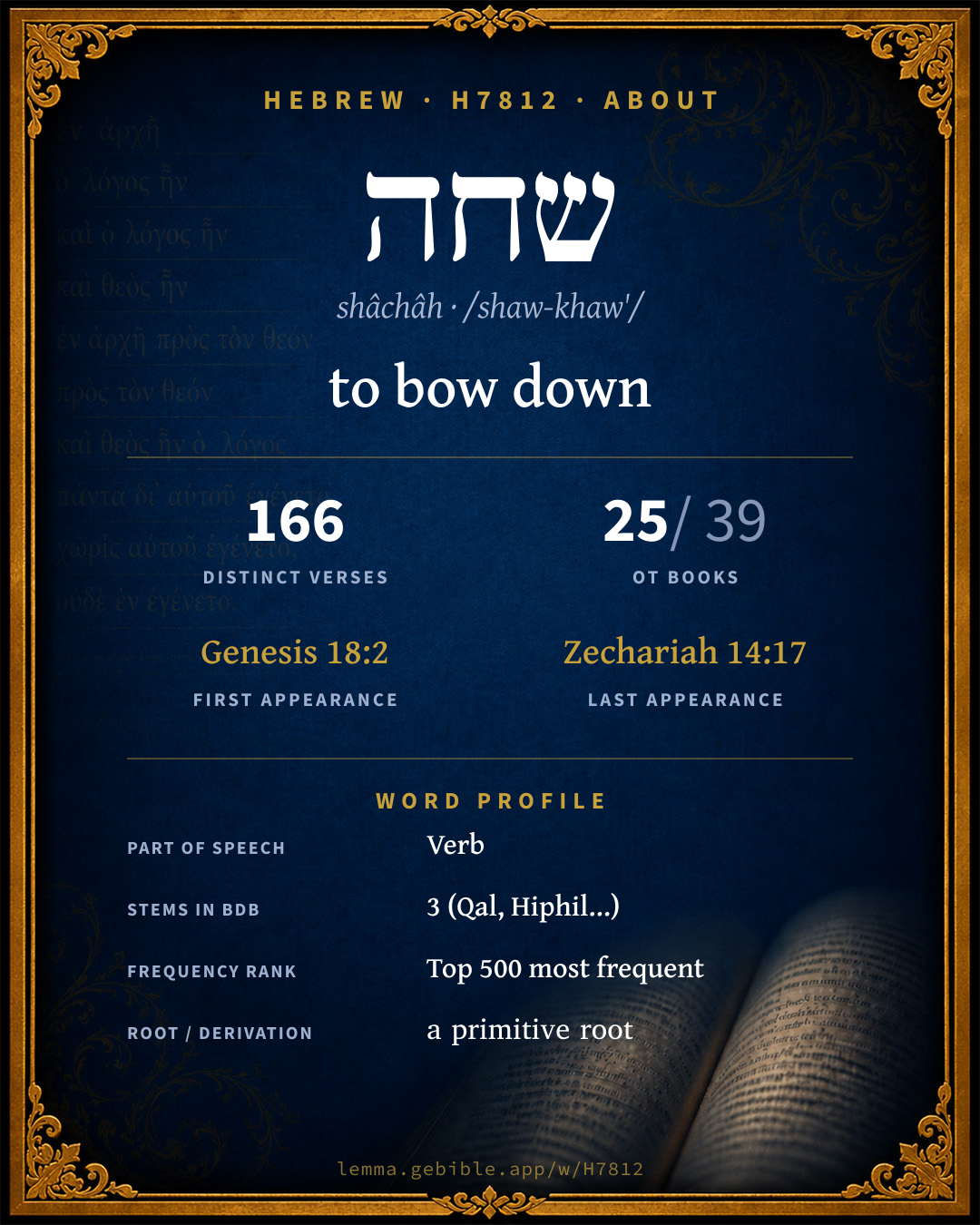
שָׁחָה
to bow down
‘to bow down’ is one of 3 main senses fuller range ↓
Full lexicon entry — Brown-Driver-Briggs (BDB)
From Brown-Driver-Briggs (BDB)
Where this word appears
See every Hishtaphel verb in the Hebrew Bible →
Grammar key — what these labels mean
Part of speech
- Verb
- An action or state-of-being word.
Stem
- Hithpael
- The reflexive or reciprocal stem (the subject acts on itself).
- Hiphil
- The causative active stem (“he caused / brought about”).
- Qal
- The basic, simple active stem — the plain form of the verb (“he wrote”). Here: ‘bow down’
Form
- Sequential Imperfect
- An imperfect with prefixed waw — the standard past-narrative form (waw-consecutive imperfect).
- Infinitive Construct
- A bound verbal noun, frequently with prepositions (“to write / in writing”).
- Imperfect
- An incomplete, ongoing, or future action (“he will / would write”).
- Sequential Perfect
- A perfect with prefixed waw continuing a preceding imperfect or command (waw-consecutive perfect).
- Participle Active
- A verbal adjective expressing ongoing or characteristic action (“writing / one who writes”).
- Imperative
- A direct command (“write!”).
- Jussive
- A third- or second-person volitional form expressing wish or command (“let him write”).
- Perfect
- A completed action or state — Hebrew marks aspect (completeness) more than strict tense (“he wrote”).
- Cohortative
- A first-person volitional form expressing wish or resolve (“let me / let us write”).
State
- Absolute
- The independent form of a noun, not bound to a following word.
Person
- 3rd Person
- The one spoken about (“he / she / it / they”).
- 2nd Person
- The one addressed (“you”).
- 1st Person
- The speaker (“I / we”).
Gender
- Masculine
- Grammatically masculine.
- Feminine
- Grammatically feminine.
- Common
- Either gender — not distinguished for this form.
Number
- Singular
- One.
- Plural
- More than one (in Hebrew, generally three or more).
Grammatical forms 31 distinct
- Verb, Hithpael, Sequential Imperfect, 3rd Person, Masculine, Singular 40 times (23%)
- Verb, Hithpael, Sequential Imperfect, 3rd Person, Masculine, Plural 23 times (13%)
- Verb, Hithpael, Infinitive Construct 14 times (8%)
- Verb, Hishtaphel, Imperfect, 3rd Person, Masculine, Plural 11 times (6%)
- Verb, Hishtaphel, Participle Active, Masculine, Plural, Absolute 8 times (5%)
- Verb, Hishtaphel, Sequential Imperfect, 3rd Person, Feminine, Singular 7 times (4%)
- Verb, Hishtaphel, Sequential Imperfect, 3rd Person, Masculine, Plural 6 times (3%)
- Verb, Hishtaphel, Imperfect, 2nd Person, Masculine, Plural 6 times (3%)
+23 more forms (60 occurrences)
Parsed forms decoded from the imported morphology (morphhb / Westminster Leningrad Codex — WLC text public domain, morphhb tagging CC BY 4.0), counted across 175 parsed occurrences — not distinct verses.
Every verse where H7812 appears — 166 distinct verses across 25 books. Click any verse to open its interlinear word-by-word view. Verse text shown in the World English Bible for context — . Each verse’s Hebrew form is shown with its reference; the English is not keyword-highlighted, since the data carries no word-level English alignment. Use “Compare translations” on any verse to read it across multiple English versions. This concordance covers the Hebrew Bible; Septuagint (Greek Old Testament) occurrences are not indexed here.
Genesis 21 verses
- Genesis 18:2 וַ/יִּשְׁתַּ֖חוּ conj + Hithpael wimpf 3ms He lifted up his eyes and looked, and saw that three men stood opposite him. When he saw them, he ran to meet them from the tent door, and bowed himself to the earth,
- Genesis 19:1 וַ/יִּשְׁתַּ֥חוּ conj + Hithpael wimpf 3ms The two angels came to Sodom at evening. Lot sat in the gate of Sodom. Lot saw them, and rose up to meet them. He bowed himself with his face to the earth,
- Genesis 22:5 וְ/נִֽשְׁתַּחֲוֶ֖ה conj + Hishtaphel impf 1cp Abraham said to his young men, "Stay here with the donkey. The boy and I will go yonder. We will worship, and come back to you.
- Genesis 23:7 וַ/יִּשְׁתַּ֥חוּ conj + Hithpael wimpf 3ms Abraham rose up, and bowed himself to the people of the land, even to the children of Heth.
- Genesis 23:12 וַ/יִּשְׁתַּ֨חוּ֙ conj + Hithpael wimpf 3ms Abraham bowed himself down before the people of the land.
- Genesis 24:26 וַ/יִּשְׁתַּ֖חוּ conj + Hithpael wimpf 3ms The man bowed his head, and worshiped Yahweh.
- Genesis 24:48 וָֽ/אֶשְׁתַּחֲוֶ֖ה conj + Hishtaphel wimpf 1cs I bowed my head, and worshiped Yahweh, and blessed Yahweh, the God of my master Abraham, who had led me in the right way to take my master's brother's daughter for his son.
- Genesis 24:52 וַ/יִּשְׁתַּ֥חוּ conj + Hithpael wimpf 3ms It happened that when Abraham's servant heard their words, he bowed himself down to the earth to Yahweh.
- Genesis 27:29 ו/ישתחו וְ/יִֽשְׁתַּחֲו֤וּ וְ/יִשְׁתַּחֲוּ֥וּ conj + Hishtaphel juss 3ms conj + Hishtaphel juss 3mp conj + Hishtaphel juss 3mp Let peoples serve you, Nations bow down to you. Be lord over your brothers, Let your mother's sons bow down to you. Cursed be everyone who curses you, Blessed be everyone who blesses you."
- Genesis 33:3 וַ/יִּשְׁתַּ֤חוּ conj + Hithpael wimpf 3ms He himself passed over in front of them, and bowed himself to the ground seven times, until he came near to his brother.
- Genesis 33:6 וַ/תִּֽשְׁתַּחֲוֶֽיןָ conj + Hishtaphel wimpf 3fp Then the handmaids came near with their children, and they bowed themselves.
- Genesis 33:7 וַ/יִּֽשְׁתַּחֲו֑וּ וַ/יִּֽשְׁתַּחֲוֽוּ conj + Hithpael wimpf 3mp conj + Hithpael wimpf 3mp Leah also and her children came near, and bowed themselves. After them, Joseph came near with Rachel, and they bowed themselves.
- Genesis 37:7 וַ/תִּֽשְׁתַּחֲוֶ֖יןָ conj + Hishtaphel wimpf 3fp for, behold, we were binding sheaves in the field, and behold, my sheaf arose and also stood upright; and behold, your sheaves came around, and bowed down to my sheaf."
- Genesis 37:9 מִֽשְׁתַּחֲוִ֖ים Hishtaphel ptcp.act mp He dreamed yet another dream, and told it to his brothers, and said, "Behold, I have dreamed yet another dream: and behold, the sun and the moon and eleven stars bowed down to me."
- Genesis 37:10 לְ/הִשְׁתַּחֲוֺ֥ת prep + Hithpael inf.cs He told it to his father and to his brothers. His father rebuked him, and said to him, "What is this dream that you have dreamed? Will I and your mother and your brothers indeed come to bow ourselves down to you to the earth?"
- Genesis 42:6 וַ/יִּשְׁתַּֽחֲווּ conj + Hithpael wimpf 3mp Joseph was the governor over the land. It was he who sold to all the people of the land. Joseph's brothers came, and bowed themselves down to him with their faces to the earth.
- Genesis 43:26 וַ/יִּשְׁתַּחֲווּ conj + Hithpael wimpf 3mp When Joseph came home, they brought him the present which was in their hand into the house, and bowed down themselves to him to the earth.
- Genesis 43:28 ו/ישתחו וַ/יִּֽשְׁתַּחֲוּֽוּ conj + Hishtaphel wimpf 3ms conj + Hishtaphel wimpf 3mp They said, "Your servant, our father, is well. He is still alive." They bowed the head, and did homage.
- Genesis 47:31 וַ/יִּשְׁתַּ֥חוּ conj + Hithpael wimpf 3ms He said, "Swear to me," and he swore to him. Israel bowed himself on the bed's head.
- Genesis 48:12 וַ/יִּשְׁתַּ֥חוּ conj + Hithpael wimpf 3ms Joseph brought them out from between his knees, and he bowed himself with his face to the earth.
- Genesis 49:8 יִשְׁתַּחֲוּ֥וּ Hishtaphel impf 3mp "Judah, your brothers will praise you: Your hand will be on the neck of your enemies; Your father's sons will bow down before you.
Exodus 11 verses
- Exodus 4:31 וַ/יִּֽשְׁתַּחֲוּֽוּ conj + Hishtaphel wimpf 3mp The people believed, and when they heard that Yahweh had visited the children of Israel, and that he had seen their affliction, then they bowed their heads and worshiped.
- Exodus 11:8 וְ/הִשְׁתַּֽחֲוּוּ conj + Hishtaphel wpf 3cp All these your servants shall come down to me, and bow down themselves to me, saying, 'Get out, and all the people who follow you; and after that I will go out.'" He went out from Pharaoh in hot anger.
- Exodus 12:27 וַ/יִּֽשְׁתַּחֲוּֽוּ conj + Hithpael wimpf 3mp that you shall say, 'It is the sacrifice of Yahweh's Passover, who passed over the houses of the children of Israel in Egypt, when he struck the Egyptians, and spared our houses.'" The people bowed their heads and worshiped.
- Exodus 18:7 וַ/יִּשְׁתַּ֨חוּ֙ conj + Hithpael wimpf 3ms Moses went out to meet his father-in-law, and bowed and kissed him. They asked each other of their welfare, and they came into the tent.
- Exodus 20:5 תִשְׁתַּחֲוֶ֥ה Hishtaphel impf 2ms you shall not bow yourself down to them, nor serve them, for I, Yahweh your God, am a jealous God, visiting the iniquity of the fathers on the children, on the third and on the fourth generation of those who hate me,
- Exodus 23:24 תִשְׁתַּחֲוֶ֤ה Hishtaphel impf 2ms You shall not bow down to their gods, nor serve them, nor follow their practices, but you shall utterly overthrow them and demolish their pillars.
- Exodus 24:1 וְ/הִשְׁתַּחֲוִיתֶ֖ם conj + Hishtaphel wpf 2mp He said to Moses, "Come up to Yahweh, you, and Aaron, Nadab, and Abihu, and seventy of the elders of Israel; and worship from a distance.
- Exodus 32:8 וַ/יִּשְׁתַּֽחֲווּ conj + Hithpael wimpf 3mp They have turned aside quickly out of the way which I commanded them. They have made themselves a molten calf, and have worshiped it, and have sacrificed to it, and said, 'These are your gods, Israel, which brought you up out of the land of Egypt.'"
- Exodus 33:10 וְ/הִֽשְׁתַּחֲוּ֔וּ conj + Hishtaphel wpf 3cp All the people saw the pillar of cloud stand at the door of the Tent, and all the people rose up and worshiped, everyone at their tent door.
- Exodus 34:8 וַ/יִּשְׁתָּֽחוּ conj + Hithpael wimpf 3ms Moses hurried and bowed his head toward the earth, and worshiped.
- Exodus 34:14 תִֽשְׁתַּחֲוֶ֖ה Hishtaphel impf 2ms for you shall worship no other god: for Yahweh, whose name is Jealous, is a jealous God.
Leviticus 1 verse
Numbers 2 verses
- Numbers 22:31 וַ/יִּשְׁתַּ֖חוּ conj + Hithpael wimpf 3ms Then Yahweh opened the eyes of Balaam, and he saw the angel of Yahweh standing in the way, with his sword drawn in his hand; and he bowed his head, and fell on his face.
- Numbers 25:2 וַ/יִּֽשְׁתַּחֲוּ֖וּ conj + Hishtaphel wimpf 3mp for they called the people to the sacrifices of their gods; and the people ate, and bowed down to their gods.
Deuteronomy 8 verses
- Deuteronomy 4:19 וְ/הִשְׁתַּחֲוִ֥יתָ conj + Hishtaphel wpf 2ms and lest you lift up your eyes to the sky, and when you see the sun and the moon and the stars, even all the host of the sky, you are drawn away and worship them, and serve them, which Yahweh your God has allotted to all the peoples under the whole sky.
- Deuteronomy 5:9 תִשְׁתַּחֲוֶ֥ה Hishtaphel impf 2ms you shall not bow down yourself to them, nor serve them; for I, Yahweh, your God, am a jealous God, visiting the iniquity of the fathers on the children, and on the third and on the fourth generation of those who hate me;
- Deuteronomy 8:19 וְ/הִשְׁתַּחֲוִ֣יתָ conj + Hishtaphel wpf 2ms It shall be, if you shall forget Yahweh your God, and walk after other gods, and serve them, and worship them, I testify against you this day that you shall surely perish.
- Deuteronomy 11:16 וְ/הִשְׁתַּחֲוִיתֶ֖ם conj + Hishtaphel wpf 2mp Take heed to yourselves, lest your heart be deceived, and you turn aside, and serve other gods, and worship them;
- Deuteronomy 17:3 וַ/יִּשְׁתַּ֖חוּ conj + Hithpael wimpf 3ms and has gone and served other gods, and worshiped them, or the sun, or the moon, or any of the host of the sky, which I have not commanded;
- Deuteronomy 26:10 וְ/הִֽשְׁתַּחֲוִ֔יתָ conj + Hishtaphel wpf 2ms Now, behold, I have brought the first of the fruit of the ground, which you, Yahweh, have given me. You shall set it down before Yahweh your God, and worship before Yahweh your God:
- Deuteronomy 29:26 וַ/יִּֽשְׁתַּחֲוּ֖וּ conj + Hishtaphel wimpf 3mp and went and served other gods, and worshiped them, gods that they didn't know, and that he had not given to them:
- Deuteronomy 30:17 וְ/הִֽשְׁתַּחֲוִ֛יתָ conj + Hishtaphel wpf 2ms But if your heart turn away, and you will not hear, but shall be drawn away, and worship other gods, and serve them;
Joshua 3 verses
- Joshua 5:14 וַ/יִּשְׁתָּ֔חוּ conj + Hithpael wimpf 3ms He said, No; but [as] prince of the host of Yahweh am I now come. Joshua fell on his face to the earth, and did worship, and said to him, What says my lord to his servant?
- Joshua 23:7 תִֽשְׁתַּחֲו֖וּ Hishtaphel impf 2mp that you not come among these nations, these that remain among you; neither make mention of the name of their gods, nor cause to swear [by them], neither serve them, nor bow down yourselves to them;
- Joshua 23:16 וְ/הִשְׁתַּחֲוִיתֶ֖ם conj + Hishtaphel wpf 2mp When you disobey the covenant of Yahweh your God, which he commanded you, and go and serve other gods, and bow down yourselves to them; then will the anger of Yahweh be kindled against you, and you shall perish quickly from off the good land which he has given to you.
Judges 4 verses
- Judges 2:12 וַ/יִּֽשְׁתַּחֲו֖וּ conj + Hithpael wimpf 3mp and they forsook Yahweh, the God of their fathers, who brought them out of the land of Egypt, and followed other gods, of the gods of the peoples who were round about them, and bowed themselves down to them: and they provoked Yahweh to anger.
- Judges 2:17 וַ/יִּֽשְׁתַּחֲו֖וּ conj + Hithpael wimpf 3mp Yet they didn't listen to their judges; for they played the prostitute after other gods, and bowed themselves down to them: they turned aside quickly out of the way in which their fathers walked, obeying the commandments of Yahweh; [but] they didn't do so.
- Judges 2:19 וּ/לְ/הִשְׁתַּחֲוֺ֣ת conj + prep + Hishtaphel inf.cs But it happened, when the judge was dead, that they turned back, and dealt more corruptly than their fathers, in following other gods to serve them, and to bow down to them; they didn't cease from their doings, nor from their stubborn way.
- Judges 7:15 וַ/יִּשְׁתָּ֑חוּ conj + Hithpael wimpf 3ms It was so, when Gideon heard the telling of the dream, and the interpretation of it, that he worshiped; and he returned into the camp of Israel, and said, Arise; for Yahweh has delivered into your hand the host of Midian.
Ruth 1 verse
1 Samuel 12 verses
- 1 Samuel 1:3 לְ/הִֽשְׁתַּחֲוֺ֧ת prep + Hithpael inf.cs This man went up out of his city from year to year to worship and to sacrifice to Yahweh of Hosts in Shiloh. The two sons of Eli, Hophni and Phinehas, priests to Yahweh, were there.
- 1 Samuel 1:19 וַ/יִּֽשְׁתַּחֲווּ֙ conj + Hithpael wimpf 3mp They rose up in the morning early, and worshiped before Yahweh, and returned, and came to their house to Ramah: and Elkanah knew Hannah his wife; and Yahweh remembered her.
- 1 Samuel 1:28 וַ/יִּשְׁתַּ֥חוּ conj + Hithpael wimpf 3ms therefore also I have granted him to Yahweh; as long as he lives he is granted to Yahweh. He worshiped Yahweh there.
- 1 Samuel 2:36 לְ/הִשְׁתַּחֲוֺ֣ת prep + Hithpael inf.cs It shall happen, that everyone who is left in your house shall come and bow down to him for a piece of silver and a loaf of bread, and shall say, Please put me into one of the priests' offices, that I may eat a morsel of bread.
- 1 Samuel 15:25 וְ/אֶֽשְׁתַּחֲוֶ֖ה conj + Hishtaphel impf 1cs Now therefore, please pardon my sin, and turn again with me, that I may worship Yahweh.
- 1 Samuel 15:30 וְ/הִֽשְׁתַּחֲוֵ֖יתִי conj + Hishtaphel pf 1cs Then he said, I have sinned: yet honor me now, Please, before the elders of my people, and before Israel, and turn again with me, that I may worship Yahweh your God.
- 1 Samuel 15:31 וַ/יִּשְׁתַּ֥חוּ conj + Hithpael wimpf 3ms So Samuel turned again after Saul; and Saul worshiped Yahweh.
- 1 Samuel 20:41 וַ/יִּשְׁתַּ֖חוּ conj + Hithpael wimpf 3ms As soon as the boy was gone, David arose out of [a place] toward the South, and fell on his face to the ground, and bowed himself three times: and they kissed one another, and wept one with another, until David exceeded.
- 1 Samuel 24:8 וַ/יִּשְׁתָּֽחוּ conj + Hithpael wimpf 3ms David also arose afterward, and went out of the cave, and cried after Saul, saying, My lord the king. When Saul looked behind him, David bowed with his face to the earth, and did obeisance.
- 1 Samuel 25:23 וַ/תִּשְׁתַּ֖חוּ conj + Hishtaphel wimpf 3fs When Abigail saw David, she hurried, and alighted from her donkey, and fell before David on her face, and bowed herself to the ground.
- 1 Samuel 25:41 וַ/תִּשְׁתַּ֥חוּ conj + Hishtaphel wimpf 3fs She arose, and bowed herself with her face to the earth, and said, Behold, your handmaid is a servant to wash the feet of the servants of my lord.
- 1 Samuel 28:14 וַ/יִּשְׁתָּֽחוּ conj + Hithpael wimpf 3ms He said to her, What form is he of? She said, An old man comes up; and he is covered with a robe. Saul perceived that it was Samuel, and he bowed with his face to the ground, and did obeisance.
2 Samuel 13 verses
- 2 Samuel 1:2 וַ/יִּשְׁתָּֽחוּ conj + Hithpael wimpf 3ms it happened on the third day, that behold, a man came out of the camp from Saul, with his clothes torn, and earth on his head: and so it was, when he came to David, that he fell to the earth, and did obeisance.
- 2 Samuel 9:6 וַ/יִּשְׁתָּ֑חוּ conj + Hithpael wimpf 3ms Mephibosheth, the son of Jonathan, the son of Saul, came to David, and fell on his face, and did obeisance. David said, Mephibosheth. He answered, Behold, your servant!
- 2 Samuel 9:8 וַ/יִּשְׁתַּ֕חוּ conj + Hithpael wimpf 3ms He did obeisance, and said, "What is your servant, that you should look on such a dead dog as I am?"
- 2 Samuel 12:20 וַ/יִּשְׁתָּ֑חוּ conj + Hithpael wimpf 3ms Then David arose from the earth, and washed, and anointed himself, and changed his clothing; and he came into the house of Yahweh, and worshiped: then he came to his own house; and when he required, they set bread before him, and he ate.
- 2 Samuel 14:4 וַ/תִּשְׁתָּ֑חוּ conj + Hishtaphel wimpf 3fs When the woman of Tekoa spoke to the king, she fell on her face to the ground, and did obeisance, and said, Help, O king.
- 2 Samuel 14:22 וַ/יִּשְׁתַּ֖חוּ conj + Hithpael wimpf 3ms Joab fell to the ground on his face, and did obeisance, and blessed the king: and Joab said, Today your servant knows that I have found favor in your sight, my lord, king, in that the king has performed the request of his servant.
- 2 Samuel 14:33 וַ/יִּשְׁתַּ֨חוּ conj + Hithpael wimpf 3ms So Joab came to the king, and told him; and when he had called for Absalom, he came to the king, and bowed himself on his face to the ground before the king: and the king kissed Absalom.
- 2 Samuel 15:5 לְ/הִשְׁתַּחֲוֺ֖ת prep + Hithpael inf.cs It was so, that when any man came near to do him obeisance, he put forth his hand, and took hold of him, and kissed him.
- 2 Samuel 15:32 יִשְׁתַּחֲוֶ֥ה Hishtaphel impf 3ms It happened that when David had come to the top [of the ascent], where God was worshiped, behold, Hushai the Archite came to meet him with his coat torn, and earth on his head.
- 2 Samuel 16:4 הִֽשְׁתַּחֲוֵ֔יתִי Hishtaphel pf 1cs Then said the king to Ziba, Behold, all that pertains to Mephibosheth is yours. Ziba said, I do obeisance; let me find favor in your sight, my lord, O king.
- 2 Samuel 18:21 וַ/יִּשְׁתַּ֧חוּ conj + Hithpael wimpf 3ms Then said Joab to the Cushite, Go, tell the king what you have seen. The Cushite bowed himself to Joab, and ran.
- 2 Samuel 18:28 וַ/יִּשְׁתַּ֧חוּ conj + Hithpael wimpf 3ms Ahimaaz called, and said to the king, All is well. He bowed himself before the king with his face to the earth, and said, Blessed be Yahweh your God, who has delivered up the men who lifted up their hand against my lord the king.
- 2 Samuel 24:20 וַ/יִּשְׁתַּ֧חוּ conj + Hithpael wimpf 3ms Araunah looked forth, and saw the king and his servants coming on toward him: and Araunah went out, and bowed himself before the king with his face to the ground.
1 Kings 11 verses
- 1 Kings 1:16 וַ/תִּשְׁתַּ֖חוּ conj + Hishtaphel wimpf 3fs Bathsheba bowed, and did obeisance to the king. The king said, What would you?
- 1 Kings 1:23 וַ/יִּשְׁתַּ֧חוּ conj + Hithpael wimpf 3ms They told the king, saying, Behold, Nathan the prophet. When he was come in before the king, he bowed himself before the king with his face to the ground.
- 1 Kings 1:31 וַ/תִּשְׁתַּ֖חוּ conj + Hishtaphel wimpf 3fs Then Bathsheba bowed with her face to the earth, and did obeisance to the king, and said, Let my lord king David live forever.
- 1 Kings 1:47 וַ/יִּשְׁתַּ֥חוּ conj + Hithpael wimpf 3ms Moreover the king's servants came to bless our lord king David, saying, Your God make the name of Solomon better than your name, and make his throne greater than your throne: and the king bowed himself on the bed.
- 1 Kings 1:53 וַ/יִּשְׁתַּ֖חוּ conj + Hithpael wimpf 3ms So king Solomon sent, and they brought him down from the altar. He came and did obeisance to king Solomon; and Solomon said to him, Go to your house.
- 1 Kings 2:19 וַ/יִּשְׁתַּ֣חוּ conj + Hithpael wimpf 3ms Bathsheba therefore went to king Solomon, to speak to him for Adonijah. The king rose up to meet her, and bowed himself to her, and sat down on his throne, and caused a throne to be set for the king's mother; and she sat on his right hand.
- 1 Kings 9:6 וְ/הִשְׁתַּחֲוִיתֶ֖ם conj + Hishtaphel wpf 2mp But if you shall turn away from following me, you or your children, and not keep my commandments and my statutes which I have set before you, but shall go and serve other gods, and worship them;
- 1 Kings 9:9 ו/ישתחו וַ/יִּשְׁתַּחֲו֥וּ conj + Hishtaphel wimpf 3ms conj + Hishtaphel wimpf 3mp and they shall answer, Because they forsook Yahweh their God, who brought forth their fathers out of the land of Egypt, and laid hold on other gods, and worshiped them, and served them: therefore has Yahweh brought all this evil on them.
- 1 Kings 11:33 וַ/יִּֽשְׁתַּחֲווּ֮ conj + Hithpael wimpf 3mp because that they have forsaken me, and have worshiped Ashtoreth the goddess of the Sidonians, Chemosh the god of Moab, and Milcom the god of the children of Ammon; and they have not walked in my ways, to do that which is right in my eyes, and [to keep] my statutes and my ordinances, as did David his father.
- 1 Kings 16:31 וַ/יִּשְׁתַּ֖חוּ conj + Hithpael wimpf 3ms It happened, as if it had been a light thing for him to walk in the sins of Jeroboam the son of Nebat, that he took as wife Jezebel the daughter of Ethbaal king of the Sidonians, and went and served Baal, and worshiped him.
- 1 Kings 22:53 וַ/יִּֽשְׁתַּחֲוֶ֖ה conj + Hishtaphel wimpf 3ms He served Baal, and worshiped him, and provoked to anger Yahweh, the God of Israel, according to all that his father had done.
2 Kings 10 verses
- 2 Kings 2:15 וַ/יִּשְׁתַּחֲווּ conj + Hithpael wimpf 3mp When the sons of the prophets who were at Jericho over against him saw him, they said, The spirit of Elijah does rest on Elisha. They came to meet him, and bowed themselves to the ground before him.
- 2 Kings 4:37 וַ/תִּשְׁתַּ֖חוּ conj + Hishtaphel wimpf 3fs Then she went in, and fell at his feet, and bowed herself to the ground; and she took up her son, and went out.
- 2 Kings 5:18 לְ/הִשְׁתַּחֲוֺ֨ת וְ/הִֽשְׁתַּחֲוֵ֨יתִי֙ בְּ/הִשְׁתַּחֲוָיָ֨תִ/י֙ prep + Hithpael inf.cs conj + Hishtaphel wpf 1cs prep + Hishtaphel inf.cs + sfx pers 1cs In this thing Yahweh pardon your servant: when my master goes into the house of Rimmon to worship there, and he leans on my hand, and I bow myself in the house of Rimmon, when I bow myself in the house of Rimmon, Yahweh pardon your servant in this thing.
- 2 Kings 17:16 וַ/יִּֽשְׁתַּחֲווּ֙ conj + Hithpael wimpf 3mp They forsook all the commandments of Yahweh their God, and made them molten images, even two calves, and made an Asherah, and worshiped all the host of the sky, and served Baal.
- 2 Kings 17:35 תִשְׁתַּחֲו֣וּ Hishtaphel impf 2mp with whom Yahweh had made a covenant, and charged them, saying, You shall not fear other gods, nor bow yourselves to them, nor serve them, nor sacrifice to them:
- 2 Kings 17:36 תִֽשְׁתַּחֲו֖וּ Hishtaphel impf 2mp but Yahweh, who brought you up out of the land of Egypt with great power and with an outstretched arm, him shall you fear, and to him shall you bow yourselves, and to him shall you sacrifice:
- 2 Kings 18:22 תִּֽשְׁתַּחֲו֖וּ Hishtaphel impf 2mp But if you tell me, We trust in Yahweh our God; isn't that he whose high places and whose altars Hezekiah has taken away, and has said to Judah and to Jerusalem, You shall worship before this altar in Jerusalem?
- 2 Kings 19:37 מִֽשְׁתַּחֲוֶ֜ה Hishtaphel ptcp.act ms It happened, as he was worshipping in the house of Nisroch his god, that Adrammelech and Sharezer struck him with the sword: and they escaped into the land of Ararat. Esar Haddon his son reigned in his place.
- 2 Kings 21:3 וַ/יִּשְׁתַּ֨חוּ֙ conj + Hithpael wimpf 3ms For he built again the high places which Hezekiah his father had destroyed; and he reared up altars for Baal, and made an Asherah, as did Ahab king of Israel, and worshiped all the host of the sky, and served them.
- 2 Kings 21:21 וַ/יִּשְׁתַּ֖חוּ conj + Hithpael wimpf 3ms He walked in all the way that his father walked in, and served the idols that his father served, and worshiped them:
1 Chronicles 3 verses
- 1 Chronicles 16:29 הִשְׁתַּחֲו֥וּ Hishtaphel impv 2mp Ascribe to Yahweh the glory due to his name: Bring an offering, and come before him: Worship Yahweh in holy array.
- 1 Chronicles 21:21 וַ/יִּשְׁתַּ֧חוּ conj + Hithpael wimpf 3ms As David came to Ornan, Ornan looked and saw David, and went out of the threshing floor, and bowed himself to David with his face to the ground.
- 1 Chronicles 29:20 וַ/יִּֽשְׁתַּחֲו֛וּ conj + Hithpael wimpf 3mp David said to all the assembly, Now bless Yahweh your God. All the assembly blessed Yahweh, the God of their fathers, and bowed down their heads, and worshiped Yahweh, and the king.
2 Chronicles 11 verses
- 2 Chronicles 7:3 וַ/יִּֽשְׁתַּֽחֲו֔וּ conj + Hithpael wimpf 3mp All the children of Israel looked on, when the fire came down, and the glory of Yahweh was on the house; and they bowed themselves with their faces to the ground on the pavement, and worshiped, and gave thanks to Yahweh, [saying], For he is good; for his loving kindness endures for ever.
- 2 Chronicles 7:19 וְ/הִשְׁתַּחֲוִיתֶ֖ם conj + Hishtaphel wpf 2mp But if you turn away, and forsake my statutes and my commandments which I have set before you, and shall go and serve other gods, and worship them;
- 2 Chronicles 7:22 וַ/יִּשְׁתַּחֲו֥וּ conj + Hithpael wimpf 3mp They shall answer, Because they forsook Yahweh, the God of their fathers, who brought them forth out of the land of Egypt, and laid hold on other gods, and worshiped them, and served them: therefore has he brought all this evil on them.
- 2 Chronicles 20:18 לְ/הִֽשְׁתַּחֲוֺ֖ת prep + Hithpael inf.cs Jehoshaphat bowed his head with his face to the ground; and all Judah and the inhabitants of Jerusalem fell down before Yahweh, worshipping Yahweh.
- 2 Chronicles 24:17 וַ/יִּֽשְׁתַּחֲו֖וּ conj + Hithpael wimpf 3mp Now after the death of Jehoiada came the princes of Judah, and made obeisance to the king. Then the king listened to them.
- 2 Chronicles 25:14 יִֽשְׁתַּחֲוֶ֖ה Hishtaphel impf 3ms Now it happened, after that Amaziah was come from the slaughter of the Edomites, that he brought the gods of the children of Seir, and set them up to be his gods, and bowed down himself before them, and burned incense to them.
- 2 Chronicles 29:28 מִֽשְׁתַּחֲוִ֔ים Hishtaphel ptcp.act mp All the assembly worshiped, and the singers sang, and the trumpeters sounded; all this [continued] until the burnt offering was finished.
- 2 Chronicles 29:29 וַ/יִּֽשְׁתַּחֲוֽוּ conj + Hithpael wimpf 3mp When they had made an end of offering, the king and all who were present with him bowed themselves and worshiped.
- 2 Chronicles 29:30 וַ/יִּֽשְׁתַּחֲוֽוּ conj + Hithpael wimpf 3mp Moreover Hezekiah the king and the princes commanded the Levites to sing praises to Yahweh with the words of David, and of Asaph the seer. They sang praises with gladness, and they bowed their heads and worshiped.
- 2 Chronicles 32:12 תִּֽשְׁתַּחֲו֖וּ Hishtaphel impf 2mp Has not the same Hezekiah taken away his high places and his altars, and commanded Judah and Jerusalem, saying, You shall worship before one altar, and on it shall you burn incense?
- 2 Chronicles 33:3 וַ/יִּשְׁתַּ֨חוּ֙ conj + Hithpael wimpf 3ms For he built again the high places which Hezekiah his father had broken down; and he reared up altars for the Baals, and made Asheroth, and worshiped all the host of the sky, and served them.
Nehemiah 3 verses
- Nehemiah 8:6 וַ/יִּשְׁתַּחֲוֻּ֛ conj + Hithpael wimpf 3mp and Ezra blessed Yahweh, the great God. All the people answered, Amen, Amen, with the lifting up of their hands: and they bowed their heads, and worshiped Yahweh with their faces to the ground.
- Nehemiah 9:3 וּ/מִֽשְׁתַּחֲוִ֔ים conj + Hishtaphel ptcp.act mp They stood up in their place, and read in the book of the law of Yahweh their God a fourth part of the day; and [another] fourth part they confessed, and worshiped Yahweh their God.
- Nehemiah 9:6 מִשְׁתַּחֲוִֽים Hishtaphel ptcp.act mp You are Yahweh, even you alone; you have made heaven, the heaven of heavens, with all their host, the earth and all things that are thereon, the seas and all that is in them, and you preserve them all; and the host of heaven worships you.
Esther 2 verses
- Esther 3:2 וּ/מִֽשְׁתַּחֲוִים֙ יִֽשְׁתַּחֲוֶֽה conj + Hishtaphel ptcp.act mp Hishtaphel impf 3ms All the king's servants, who were in the king's gate, bowed down, and did reverence to Haman; for the king had so commanded concerning him. But Mordecai didn't bow down, nor did him reverence.
- Esther 3:5 וּ/מִֽשְׁתַּחֲוֶ֖ה conj + Hishtaphel ptcp.act ms When Haman saw that Mordecai didn't bow down, nor did him reverence, then was Haman full of wrath.
Job 1 verse
Psalms 17 verses
- Psalms 5:7 אֶשְׁתַּחֲוֶ֥ה Hishtaphel impf 1cs But as for me, in the abundance of your loving kindness I will come into your house: I will bow toward your holy temple in reverence of you.
- Psalms 22:27 וְ/יִֽשְׁתַּחֲו֥וּ conj + Hishtaphel impf 3mp All the ends of the earth shall remember and turn to Yahweh. All the relatives of the nations shall worship before you.
- Psalms 22:29 וַ/יִּֽשְׁתַּחֲוּ֨וּ conj + Hishtaphel wimpf 3mp All the rich ones of the earth shall eat and worship. All those who go down to the dust shall bow before him, Even he who can't keep his soul alive.
- Psalms 29:2 הִשְׁתַּחֲו֥וּ Hishtaphel impv 2mp Ascribe to Yahweh the glory due to his name. Worship Yahweh in holy array.
- Psalms 45:11 וְ/הִשְׁתַּֽחֲוִי conj + Hishtaphel impv 2fs So the king will desire your beauty, Honor him, for he is your lord.
- Psalms 66:4 יִשְׁתַּחֲו֣וּ Hishtaphel impf 3mp All the earth will worship you, And will sing to you; They will sing to your name." Selah.
- Psalms 72:11 וְ/יִשְׁתַּחֲווּ conj + Hishtaphel impf 3mp Yes, all kings shall fall down before him. All nations shall serve him.
- Psalms 81:9 תִ֝שְׁתַּחֲוֶ֗ה Hishtaphel impf 2ms There shall be no strange god in you, Neither shall you worship any foreign god.
- Psalms 86:9 וְ/יִשְׁתַּחֲו֣וּ conj + Hishtaphel impf 3mp All nations you have made will come and worship before you, Lord. They shall glorify your name.
- Psalms 95:6 נִשְׁתַּחֲוֶ֣ה Hishtaphel impf 1cp Oh come, let's worship and bow down. Let's kneel before Yahweh, our Maker,
- Psalms 96:9 הִשְׁתַּחֲו֣וּ Hishtaphel impv 2mp Worship Yahweh in holy array. Tremble before him, all the earth.
- Psalms 97:7 הִשְׁתַּחֲווּ Hishtaphel impv 2mp Let all them be shamed who serve engraved images, Who boast in their idols. Worship him, all you gods!
- Psalms 99:5 וְֽ֭/הִשְׁתַּחֲווּ conj + Hishtaphel impv 2mp Exalt Yahweh our God. Worship at his footstool. He is Holy!
- Psalms 99:9 וְ֭/הִֽשְׁתַּחֲווּ conj + Hishtaphel impv 2mp Exalt Yahweh, our God. Worship at his holy hill, For Yahweh, our God, is holy!
- Psalms 106:19 וַ֝/יִּשְׁתַּחֲו֗וּ conj + Hithpael wimpf 3mp They made a calf in Horeb, And worshiped a molten image.
- Psalms 132:7 נִ֝שְׁתַּחֲוֶ֗ה Hishtaphel coh 1cp "We will go into his dwelling place. We will worship at his footstool.
- Psalms 138:2 אֶשְׁתַּחֲוֶ֨ה Hishtaphel impf 1cs I will bow down toward your holy temple, And give thanks to your Name for your loving kindness and for your truth; For you have exalted your Name and your Word above all.
Proverbs 1 verse
Isaiah 14 verses
- Isaiah 2:8 יִֽשְׁתַּחֲו֔וּ Hishtaphel impf 3mp Their land also is full of idols. They worship the work of their own hands, That which their own fingers have made.
- Isaiah 2:20 לְ/הִֽשְׁתַּחֲוֺ֔ת prep + Hithpael inf.cs In that day, men shall cast away their idols of silver, And their idols of gold, Which have been made for themselves to worship, To the moles and to the bats;
- Isaiah 27:13 וְ/הִשְׁתַּחֲו֧וּ conj + Hishtaphel wpf 3cp It shall happen in that day, that a great trumpet shall be blown; and they shall come who were ready to perish in the land of Assyria, and those who were outcasts in the land of Egypt; and they shall worship Yahweh in the holy mountain at Jerusalem.
- Isaiah 36:7 תִּֽשְׁתַּחֲוֽוּ Hishtaphel impf 2mp But if you tell me, We trust in Yahweh our God: isn't that he, whose high places and whose altars Hezekiah has taken away, and has said to Judah and to Jerusalem, You shall worship before this altar?
- Isaiah 37:38 מִֽשְׁתַּחֲוֶ֜ה Hishtaphel ptcp.act ms It happened, as he was worshipping in the house of Nisroch his god, that Adrammelech and Sharezer his sons struck him with the sword; and they escaped into the land of Ararat. Esar Haddon his son reigned in his place.
- Isaiah 44:15 וַ/יִּשְׁתָּ֔חוּ conj + Hithpael wimpf 3ms Then shall it be for a man to burn; and he takes of it, and warms himself; yes, he kindles it, and bakes bread: yes, he makes a god, and worships it; he makes it an engraved image, and falls down to it.
- Isaiah 44:17 וְ/יִשְׁתַּ֨חוּ֙ conj + Hishtaphel impf 3ms The residue of it he makes a god, even his engraved image; he falls down to it and worships, and prays to it, and says, Deliver me; for you are my god.
- Isaiah 45:14 יִֽשְׁתַּחֲוּוּ֙ Hishtaphel impf 3mp Thus says Yahweh: "The labor of Egypt, and the merchandise of Ethiopia, and the Sabeans, men of stature, shall come over to you, and they shall be yours. They shall go after you. In chains they shall come over; and they shall fall down to you. They shall make supplication to you: 'Surely God is in you; and there is none else, there is no other god.
- Isaiah 46:6 יִֽשְׁתַּחֲוּֽוּ Hishtaphel impf 3mp Some pour out gold from the bag, and weigh silver in the balance. They hire a goldsmith, and he makes it a god. They fall down--yes, they worship.
- Isaiah 49:7 וְ/יִֽשְׁתַּחֲוּ֑וּ conj + Hishtaphel impf 3mp Thus says Yahweh, the Redeemer of Israel, [and] his Holy One, to him whom man despises, to him whom the nation abhors, to a servant of rulers: Kings shall see and arise; princes, and they shall worship; because of Yahweh who is faithful, [even] the Holy One of Israel, who has chosen you.
- Isaiah 49:23 יִשְׁתַּ֣חֲווּ Hishtaphel impf 3mp Kings shall be your nursing fathers, and their queens your nursing mothers: they shall bow down to you with their faces to the earth, and lick the dust of your feet; and you shall know that I am Yahweh; and those who wait for me shall not be disappointed.
- Isaiah 51:23 שְׁחִ֣י Qal impv 2fs and I will put it into the hand of those who afflict you, who have said to your soul, Bow down, that we may go over; and you have laid your back as the ground, and as the street, to those who go over.
- Isaiah 60:14 וְ/הִֽשְׁתַּחֲו֛וּ conj + Hishtaphel wpf 3cp The sons of those who afflicted you shall come bending to you; and all those who despised you shall bow themselves down at the soles of your feet; and they shall call you The city of Yahweh, The Zion of the Holy One of Israel.
- Isaiah 66:23 לְ/הִשְׁתַּחֲוֺ֥ת prep + Hithpael inf.cs It shall happen, that from one new moon to another, and from one Sabbath to another, shall all flesh come to worship before me, says Yahweh.
Jeremiah 8 verses
- Jeremiah 1:16 וַ/יִּֽשְׁתַּחֲו֖וּ conj + Hithpael wimpf 3mp I will utter my judgments against them touching all their wickedness, in that they have forsaken me, and have burned incense to other gods, and worshiped the works of their own hands.
- Jeremiah 7:2 לְ/הִֽשְׁתַּחֲוֺ֖ת prep + Hithpael inf.cs Stand in the gate of Yahweh's house, and proclaim there this word, and say, Hear the word of Yahweh, all you of Judah, who enter in at these gates to worship Yahweh.
- Jeremiah 8:2 הִֽשְׁתַּחֲו֖וּ Hishtaphel pf 3cp and they shall spread them before the sun, and the moon, and all the host of the sky, which they have loved, and which they have served, and after which they have walked, and which they have sought, and which they have worshiped: they shall not be gathered, nor be buried, they shall be for dung on the surface of the earth.
- Jeremiah 13:10 וּ/לְ/הִשְׁתַּחֲוֺ֣ת conj + prep + Hishtaphel inf.cs This evil people, who refuse to hear my words, who walk in the stubbornness of their heart, and are gone after other gods to serve them, and to worship them, shall even be as this belt, which is profitable for nothing.
- Jeremiah 16:11 וַ/יִּשְׁתַּחֲו֣וּ conj + Hithpael wimpf 3mp Then shall you tell them, Because your fathers have forsaken me, says Yahweh, and have walked after other gods, and have served them, and have worshiped them, and have forsaken me, and have not kept my law;
- Jeremiah 22:9 וַ/יִּֽשְׁתַּחֲו֛וּ conj + Hithpael wimpf 3mp Then they shall answer, Because they forsook the covenant of Yahweh their God, and worshiped other gods, and served them.
- Jeremiah 25:6 וּ/לְ/הִשְׁתַּחֲוֺ֣ת conj + prep + Hishtaphel inf.cs and don't go after other gods to serve them or worship them, and don't provoke me to anger with the work of your hands; and I will do you no harm.
- Jeremiah 26:2 לְ/הִשְׁתַּחֲוֺ֣ת prep + Hithpael inf.cs Thus says Yahweh: Stand in the court of Yahweh's house, and speak to all the cities of Judah, which come to worship in Yahweh's house, all the words that I command you to speak to them; don't diminish a word.
Ezekiel 4 verses
- Ezekiel 8:16 מִשְׁתַּחֲוִיתֶ֥ם Hishtaphel ptcp.act mp He brought me into the inner court of Yahweh's house; and see, at the door of the temple of Yahweh, between the porch and the altar, were about twenty-five men, with their backs toward the temple of Yahweh, and their faces toward the east; and they were worshipping the sun toward the east.
- Ezekiel 46:2 וְ/הִֽשְׁתַּחֲוָ֛ה conj + Hishtaphel wpf 3ms The prince shall enter by the way of the porch of the gate outside, and shall stand by the post of the gate; and the priests shall prepare his burnt-offering and his peace-offerings, and he shall worship at the threshold of the gate: then he shall go forth; but the gate shall not be shut until the evening.
- Ezekiel 46:3 וְ/הִשְׁתַּחֲו֣וּ conj + Hishtaphel wpf 3cp The people of the land shall worship at the door of that gate before Yahweh on the Sabbaths and on the new moons.
- Ezekiel 46:9 לְ/הִֽשְׁתַּחֲוֺ֗ת prep + Hithpael inf.cs But when the people of the land shall come before Yahweh in the appointed feasts, he who enters by the way of the north gate to worship shall go forth by the way of the south gate; and he who enters by the way of the south gate shall go forth by the way of the north gate: he shall not return by the way of the gate by which he came in, but shall go forth straight before him.
Micah 1 verse
Zephaniah 2 verses
- Zephaniah 1:5 הַ/מִּשְׁתַּחֲוִ֥ים הַ/מִּֽשְׁתַּחֲוִים֙ ptcl def.art + Hishtaphel ptcp.act mp ptcl def.art + Hishtaphel ptcp.act mp those who worship the host of the sky on the housetops, those who worship and swear by Yahweh and also swear by Malcam,
- Zephaniah 2:11 וְ/יִשְׁתַּֽחֲווּ conj + Hishtaphel impf 3mp Yahweh will be awesome to them, for he will famish all the gods of the land. Men will worship him, everyone from his place, even all the shores of the nations.
Zechariah 2 verses
- Zechariah 14:16 לְ/הִֽשְׁתַּחֲוֺת֙ prep + Hithpael inf.cs It will happen that everyone who is left of all the nations that came against Jerusalem will go up from year to year to worship the King, Yahweh of Hosts, and to keep the feast of tents.
- Zechariah 14:17 לְ/הִֽשְׁתַּחֲוֺ֔ת prep + Hithpael inf.cs It will be, that whoever of all the families of the earth doesn't go up to Jerusalem to worship the King, Yahweh of Hosts, on them there will be no rain.
About this entry
At a glance — auto-summarized from this page’s data, not written by a person. Every figure links to its source below. This summary describes the numbers; it doesn’t interpret them.
The Hebrew verb שחה centers on the idea of “to bow down.” Its English rendering has broadened — “worship” classically, “bow down” (unfoldingWord Literal Text) in modern versions; see the renderings breakdown. The Hebrew Bible uses it across 166 verses — common. Its earliest occurrence is Genesis 18:2. Across 3 stems, its meaning turns on the binyan (Qal, Hiphil). For the data behind this summary, explore the sense tree and the renderings breakdown below.
Gloss history
Strong's 1890 vs modern scholarship
About this word
Strong's H7812 catalogs a Hebrew word from the Hebrew Old Testament.
These counts are not copied from any lexicon or concordance. They are computed here, from the morphology-tagged Hebrew Old Testament. What Lemma adds →
- 166
- distinct verses
- The word appears in 166 distinct verses.
- 25 / 39
- OT books
- The word appears in 25 of 39 Old Testament books.
- #266
- by frequency
- Top 500 most frequent Hebrew words (rank 266 of 8,640 Hebrew words by occurrence).
View all 166 occurrences in the concordance →
By section of the Old Testament
By traditional corpus
Conventional, traditional groupings — biblical authorship is debated, so this is a traditional corpus grouping, not an authorship claim. Each share is this word’s portion of its verses in that division of the Hebrew canon. Each figure is a share of the word’s 166 distinct verses.
- Prophets (Nevi'im) 84 verses · 51%
- Torah (Pentateuch) 43 verses · 26%
- Writings (Ketuvim) 39 verses · 23%
How translations render this word
Counts come from each version’s own published word-to-Strong’s tagging or interlinear alignment — an approximate guide to how each version renders this word, not a word-level alignment the data otherwise carries. Because each total is that version’s own tagged count, the per-version totals vary from one another and need not match the appearance or distinct-verse counts above. These counts may also differ from a printed concordance because Lemma counts each distinctly tagged rendering and does not collapse phrase taggings into a single head-word total. This is a fixed set of word-tagged versions (KJV, ASV, BSB, ULT) and does not change with the reading translation you choose elsewhere. Each version’s license is shown beside its name below (and on Sources).
- King James Version: Worship 31×, Worshipped 27×, Bowed 23×
- American Standard Version: Worshipped 26×, Worship 20×, Bowed 14×
- Berean Standard Bible: Worship 29×, Bow down 22×, Worshiped 17×
- unfoldingWord Literal Text: Bow down 31×, He prostrated himself 13×, Bowed down 12×
King James Version Public Domain
Renders H7812 across 172 tagged occurrences — most commonly:
Plus other, less common renderings. Plus 38 renderings that appear only once — usually multi-word phrases or single function words the recovered tagging swept in, not distinct renderings.
American Standard Version Public Domain
Renders H7812 across 172 tagged occurrences — most commonly:
Plus other, less common renderings. Plus 47 renderings that appear only once — usually multi-word phrases or single function words the recovered tagging swept in, not distinct renderings.
Berean Standard Bible Public Domain
Renders H7812 across 171 tagged occurrences — most commonly:
Plus other, less common renderings. Plus 38 renderings that appear only once — usually multi-word phrases or single function words the recovered tagging swept in, not distinct renderings. Not rendered by a distinct English word in 1 further occurrence.
unfoldingWord Literal Text CC BY-SA 4.0
Renders H7812 across 193 tagged occurrences — most commonly:
Plus other, less common renderings. Plus 29 renderings that appear only once — usually multi-word phrases or single function words the recovered tagging swept in, not distinct renderings.
Senses in the full BDB
Hebrew verbs can shift meaning by stem (binyan): Qal is the basic action, Niphal is often passive or reflexive, Piel often intensifies or makes it factitive, and Hiphil is typically causative. The senses below are grouped under the stem BDB assigns to each. This entry also uses one or more reduplicated stems (the Pōlēl/Pilpēl type), which for hollow or geminate roots behave much like Piel — often intensive or iterative.
What do BDB’s symbols mean?
BDB uses these scholarly abbreviations:
| Symbol | Meaning |
|---|---|
| 𝔊 | the Septuagint (the ancient Greek translation, LXX) |
| 𝔙 | the Vulgate (the Latin translation) |
| 𝔖 | the Syriac version (the Peshitta) |
| 𝔗 | the Targum (the Aramaic translation) |
| ψ | the Psalms |
| √ | root (the underlying root or stem) |
| ‖ | parallel passage (a synonymous or contrasted parallel) |
| † | the dagger: every passage where the word occurs is cited |
The 5 senses and sub-senses the full Brown-Driver-Briggs lexicon distinguishes for this word, in lexicon order (not ranked by frequency), with BDB’s own verbatim wording and sub-sense lettering. Shown in Hebrew script with BDB’s own scholarly abbreviations. The condensed entry is in the Lexicon Entry tab. See also the Forms in the corpus table below.
Qal
- bow down
Hiphil
- . fig., anxiety depresses it
Hithpa‛lēl
- 1. bow down, prostrate oneself, before a monarch or superior, in homage, etc.
- 2. before God, in worship
- 3. before other gods
Senses from the full Brown-Driver-Briggs lexicon (Brown, Driver, Briggs; Oxford 1906 — public domain), digitized via Sefaria, supplemented by the OpenScriptures HebrewLexicon (CC BY 4.0). Full attribution on Sources.
Word origin
[ שָׁחָה ] 172 vb. bow down
— Brown-Driver-Briggs (Oxford 1906, public domain), digitized via Sefaria, supplemented by the OpenScriptures HebrewLexicon (CC BY 4.0). See Sources.
Origin: a primitive root
Jastrow Dictionary
A second Hebrew/Aramaic lexicon for comparison, covering Aramaic and post-biblical (Talmudic, Targumic, Midrashic) usage that the biblical-Hebrew BDB does not. Matched by lemma rather than by Strong’s number, so a lemma may carry more than one Jastrow headword (shown separately below), and the entries cover usage well beyond the Bible.
שָׁחָה
- , v. שחי
שחי
- to curve; to bend, bow; to lower one’s self. Tosef. Ber. I, 9; Ber. 34ᵃ; Gen. R. s. 39, a. e., v. שָׁחַח. Pesik. Shek., p. 11ᵇ (ref. to Is. II, 9) יודע אני ששָׁחוּ … והָשְׁפַּלְתִּי אני והם I know that Israel lowered themselves by bowing to the calf, and I and they were humbled; Yalk. Ex. 386; Yalk. Is. 260; Tanḥ. Ki Thissa 4; Pesik. R. s. 10 אימתי שחו ונשפלו when was it that they bent and were lowered?; a. fr. e.g. Isaiah 2:9
- to prostrate one’s self. Snh. VII, 6 (60ᵇ) המִשְׁתַּחֲוֶה he that prostrates himself (before an idol). Ib. 62ᵃ זיבח … וה׳ וכ׳ if a person sacrificed, burnt incense, offered libation, and prostrated himself, all in one act. Yoma 69ᵃ כיון שראה … וה׳ לפניו when he (king Alexander) saw Simon the righteous, he alighted from his chariot and threw himself down before him; מלך … יִשְׁתַּחֲוֶה וכ׳ should a great king like thee prostrate himself before this Jew?; a. fr.
A Dictionary of the Targumim, the Talmud Babli and Yerushalmi, and the Midrashic Literature (Marcus Jastrow; London, Luzac, 1903) — Public Domain. Digitized via Sefaria. Digitized via Sefaria. Full attribution on Sources.
Forms in the corpus
The 110 distinct written forms H7812 takes in the Hebrew Bible, most frequent first — each parse links to that stem’s occurrences in the concordance. Hebrew forms include their vowel points and cantillation, so a single lemma takes many written forms.
The 60 most common forms are shown; 50 rarer forms follow in the full concordance.
Same root — word family
Other BDB entries built from the same root as H7812, grouped by Strong’s listed origin. These share a root / origin per the lexicon — not necessarily a shared meaning. Each links to that word’s own entry.
Derived from this word
Compare all same-root words → They share a root, not necessarily a meaning.
Septuagint verse parallels
This word appears in 157 verses that also exist in the Greek Old Testament (Septuagint), out of the 166 Hebrew verses it occurs in. You can read those verses in Greek by switching the Old Testament edition to the Septuagint.
Read these verses in the Septuagint
- Genesis 18:2
- Exodus 4:31
- Leviticus 26:1
- Numbers 22:31
- Deuteronomy 4:19
- Joshua 5:14
- Judges 2:12
- Ruth 2:10
- 1 Samuel 1:3
- 2 Samuel 1:2
- 1 Kings 1:16
- 2 Kings 2:15
This is a verse-level parallel only — the same verses exist in both the Hebrew and Greek Old Testaments. No word-level Hebrew↔Greek correspondence is claimed: the data carries no such alignment, so no Greek word is shown as this Hebrew word’s translation. Coverage is not total — the Septuagint omits the deuterocanon and renumbers the Psalms, so some Hebrew verses have no direct Greek parallel.