
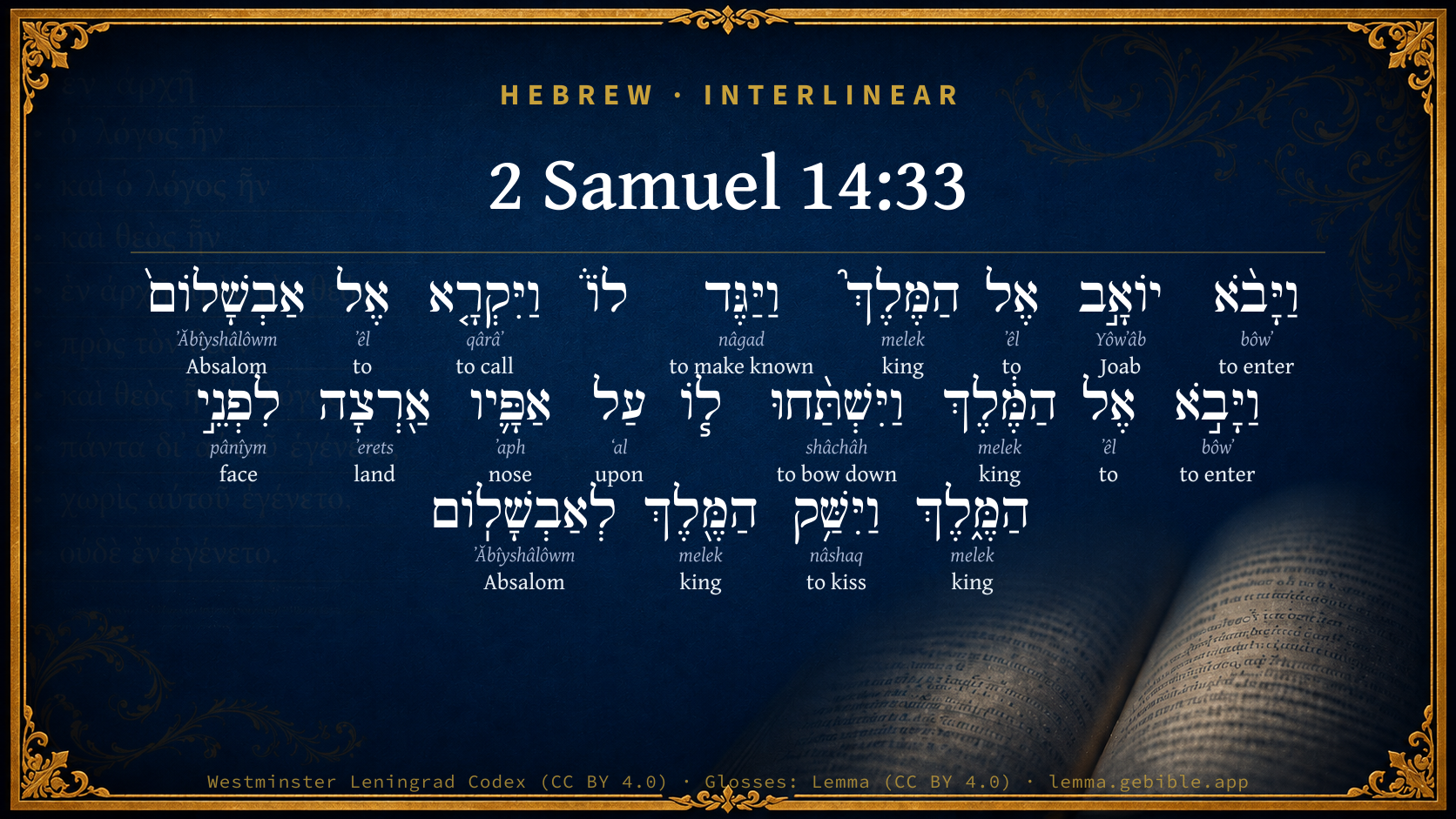
2 Samuel 14:33

Hebrew (Westminster Leningrad Codex) 2 Samuel 14:33 appears in the Hebrew Old Testament. The text above is from the Westminster Leningrad Codex. Each word links to its Strong’s number, a concise gloss, and parsing drawn from the Open Scriptures Hebrew Bible morphology. Click any word for its full Brown-Driver-Briggs (BDB) entry.
Download image
Cite this verse

2 Samuel 14:33 (World English Bible). Public Domain. Lemma interlinear Bible study tool, https://lemma.gebible.app/v/2-samuel/14/33.

Show BibTeX & RIS
BibTeX
RIS
English Translation
So Joab came to the king, and told him; and when he had called for Absalom, he came to the king, and bowed himself on his face to the ground before the king: and the king kissed Absalom.
World English Bible · Public Domain
Download a study sheet

One document with this verse’s original text, its word-by-word gloss line, the meaning frame, cross-references with their text, attributed commentary, and full source and license credits — printable, and it pastes into notes with its structure intact.

This verse Autodidact and up

Study sheet (.html) Plain text (.txt)

A passage Seminary Student

Up to 50 verses in one chapter. A passage sheet keeps up to 6 commentary sources and 12 cross-references per verse, in the order this page ranks them, and says so on the sheet whenever that leaves anything out. Ask for a single verse and you get the Autodidact verse sheet above.

Everything on this page stays free to read, with no account — the sheet is a download of what is already on screen, not access to it.

Want to remove ads? Support Godless Engineer
Compare translations 3

The same verse in 3 English versions, stacked beneath the original-language interlinear above. Click any original word for its lexicon entry.

Each is an independent rendering of the whole verse — the interlinear is not word-aligned to these translations.

Highlighted words mark where these versions differ — a whole-verse word diff, not a word-by-word alignment.

  • World English Bible Public Domain
    So Joab came to the king, and told him; and when he had called for Absalom, he came to the king, and bowed himself on his face to the ground before the king: and the king kissed Absalom.
  • King James Version Public Domain
    So Joab came to the king, and told him: and when he had called for Absalom, he came to the king, and bowed himself on his face to the ground before the king: and the king kissed Absalom.
  • unfoldingWord Literal Text CC BY-SA 4.0
    So Joab came to the king, and he declared to him. And he called to Absalom, and he came to the king, and he prostrated himself to him on his nose to the ground to the face of the king. And the king kissed Absalom.

unfoldingWord Literal Text — © unfoldingWord, licensed CC BY-SA 4.0. Word-aligned USFM3 via Door43 (git.door43.org/unfoldingWord/en_ult).

Versions to compare (up to 4)

3 of 4 selected

Show all 18 translations

Every available English version of this verse, each an independent rendering of the whole verse.

  • World English Bible Public Domain
    So Joab came to the king, and told him; and when he had called for Absalom, he came to the king, and bowed himself on his face to the ground before the king: and the king kissed Absalom.
  • Berean Standard Bible Public Domain
    So Joab went and told the king, and David summoned Absalom, who came to him and bowed facedown before him. Then the king kissed Absalom.
  • Majority Standard Bible Public Domain
    So Joab went and told the king, and David summoned Absalom, who came to him and bowed facedown before him. Then the king kissed Absalom.
  • King James Version Public Domain
    So Joab came to the king, and told him: and when he had called for Absalom, he came to the king, and bowed himself on his face to the ground before the king: and the king kissed Absalom.
  • American Standard Version (1901) Public Domain
    So Joab came to the king, and told him; and when he had called for Absalom, he came to the king, and bowed himself on his face to the ground before the king: and the king kissed Absalom.
  • Revised Version (1885) Public Domain
    So Joab came to the king, and told him: and when he had called for Absalom, he came to the king, and bowed himself on his face to the ground before the king: and the king kissed Absalom.
  • Geneva Bible (1599) Public Domain
    Then Ioab came to the King, and told him: and he called for Absalom, who came to the King, and bowed himselfe to the grounde on his face before the King, and the King kissed Absalom.
  • Douay-Rheims (1899) Public Domain
    So Joab going in to the king, told him all: and Absalom was called for, and he went in to the king: and prostrated himself on the ground before him: and the king kissed Absalom.
  • Young's Literal Translation Public Domain
    And Joab cometh unto the king, and declareth `it' to him, and he calleth unto Absalom, and he cometh unto the king, and boweth himself to him, on his face, to the earth, before the king, and the king giveth a kiss to Absalom.
  • Literal Standard Version CC BY-SA 4.0
    And Joab comes to the king, and declares [it] to him, and he calls to Absalom, and he comes to the king, and bows himself to him, on his face, to the earth, before the king, and the king gives a kiss to Absalom.
  • Unlocked Literal Bible CC BY-SA 4.0
    So Joab went to the king and told him. When the king called for Absalom, he came to the king and bowed low to the ground before the king, and the king kissed Absalom.
  • unfoldingWord Literal Text CC BY-SA 4.0
    So Joab came to the king, and he declared to him. And he called to Absalom, and he came to the king, and he prostrated himself to him on his nose to the ground to the face of the king. And the king kissed Absalom.
  • Darby Bible Public Domain
    And Joab came to the king, and told him. And he called Absalom, and he came to the king, and bowed himself on his face to the ground before the king; and the king kissed Absalom.
  • World Messianic Bible Public Domain
    So Joab came to the king and told him; and when he had called for Absalom, he came to the king and bowed himself on his face to the ground before the king; and the king kissed Absalom.
  • Webster's Bible Public Domain
    So Joab came to the king, and told him: and when he had called for Absalom, he came to the king, and bowed himself on his face to the ground before the king: and the king kissed Absalom.
  • Free Bible Version CC BY-SA 4.0
    So Joab went and told the king what Absalom had said. Then David summoned Absalom, who came and bowed down with his face to the ground before him in respect. Then the king kissed Absalom.
  • Bible in Basic English Public Domain
    So Joab went to the king and said these words to him: and when the king had sent for him, Absalom came, and went down on his face on the earth before the king: and the king gave him a kiss.
  • JPS Tanakh (1917) Public Domain
    So Joab came to the king, and told him; and when he had called for Absalom, he came to the king, and bowed himself on his face to the ground before the king; and the king kissed Absalom.

Literal Standard Version (2020), Covenant Press — licensed CC BY-SA 4.0. Text via the HelloAO Bible API (eBible.org). Unlocked Literal Bible (unfoldingWord) — licensed CC BY-SA 4.0. Text via the HelloAO Bible API (eBible.org). unfoldingWord Literal Text — © unfoldingWord, licensed CC BY-SA 4.0. Word-aligned USFM3 via Door43 (git.door43.org/unfoldingWord/en_ult). Free Bible Version, Dr. Jonathan Gallagher — licensed CC BY-SA 4.0. Text via the HelloAO Bible API (eBible.org).

Word by word

More ways to search: Search by grammar → Find every occurrence → Compare this word →

Practice this passage: Drill this verse → Learn its vocabulary →

וַיִּשַּׁ֥ק
nâshaq
H5401
“and · to kiss”
Conjunction + Verb, Qal, Sequential Imperfect, 3rd Person, Masculine, Singular
Part of Speech
Conjunction + Verb
Stem
Qal
Form
Sequential Imperfect
Person
3rd Person
Gender
Masculine
Number
Singular
Full BDB Definition

Origin: a primitive root [identical with H5400 , through the idea of fastening up

TWOT: 1435 , 1436

to put together, kiss - (Qal) to kiss - (Piel) to kiss - (Hiphil) to touch gently - to handle, be equipped with - (Qal) to be equipped
  1. וַיָּבֹ֨א bôwʼ H935 “and · to enter” Conjunction + Verb, Qal, Sequential Imperfect, 3rd Person, Masculine, Singular
  2. יוֹאָ֣ב Yôwʼâb H3097 “Joab” Noun, Proper
  3. אֶל ʼêl H413 “to” Preposition
  4. הַמֶּלֶךְ֮ melek H4428 “the · king” Particle, Definite Article + Noun, Common, Masculine, Singular, Absolute
  5. וַיַּגֶּד nâgad H5046 “and · to make known” Conjunction + Verb, Hiphil, Sequential Imperfect, 3rd Person, Masculine, Singular
  6. וַיִּקְרָ֤א qârâʼ H7121 “and · to call” Conjunction + Verb, Qal, Sequential Imperfect, 3rd Person, Masculine, Singular
  7. אֶל ʼêl H413 “to” Preposition
  8. אַבְשָׁלוֹם֙ ʼĂbîyshâlôwm H53 “Absalom” Noun, Proper
  9. וַיָּבֹ֣א bôwʼ H935 “and · to enter” Conjunction + Verb, Qal, Sequential Imperfect, 3rd Person, Masculine, Singular
  10. אֶל ʼêl H413 “to” Preposition
  11. הַמֶּ֔לֶךְ melek H4428 “the · king” Particle, Definite Article + Noun, Common, Masculine, Singular, Absolute
  12. וַיִּשְׁתַּ֨חוּ shâchâh H7812 “and · to bow down” Conjunction + Verb, Hithpael, Sequential Imperfect, 3rd Person, Masculine, Singular
  13. עַל ʻal H5921 “upon” Preposition
  14. אַפָּ֛יו ʼaph H639 “nostrils · his” Noun, Common, Masculine, Dual, Construct + Suffix, Personal, 3rd Person, Masculine, Singular
  15. אַ֖רְצָה ʼerets H776 “land · toward” Noun, Common, Both, Singular, Absolute + Suffix, Demonstrative
  16. לִפְנֵ֣י pânîym H6440 “to/for · face(s) of” Preposition + Noun, Common, Both, Plural, Construct
  17. הַמֶּ֑לֶךְ melek H4428 “the · king” Particle, Definite Article + Noun, Common, Masculine, Singular, Absolute
  18. הַמֶּ֖לֶךְ melek H4428 “the · king” Particle, Definite Article + Noun, Common, Masculine, Singular, Absolute
  19. לְאַבְשָׁלֽוֹם ʼĂbîyshâlôwm H53 “to/for · Absalom” Preposition + Noun, Proper

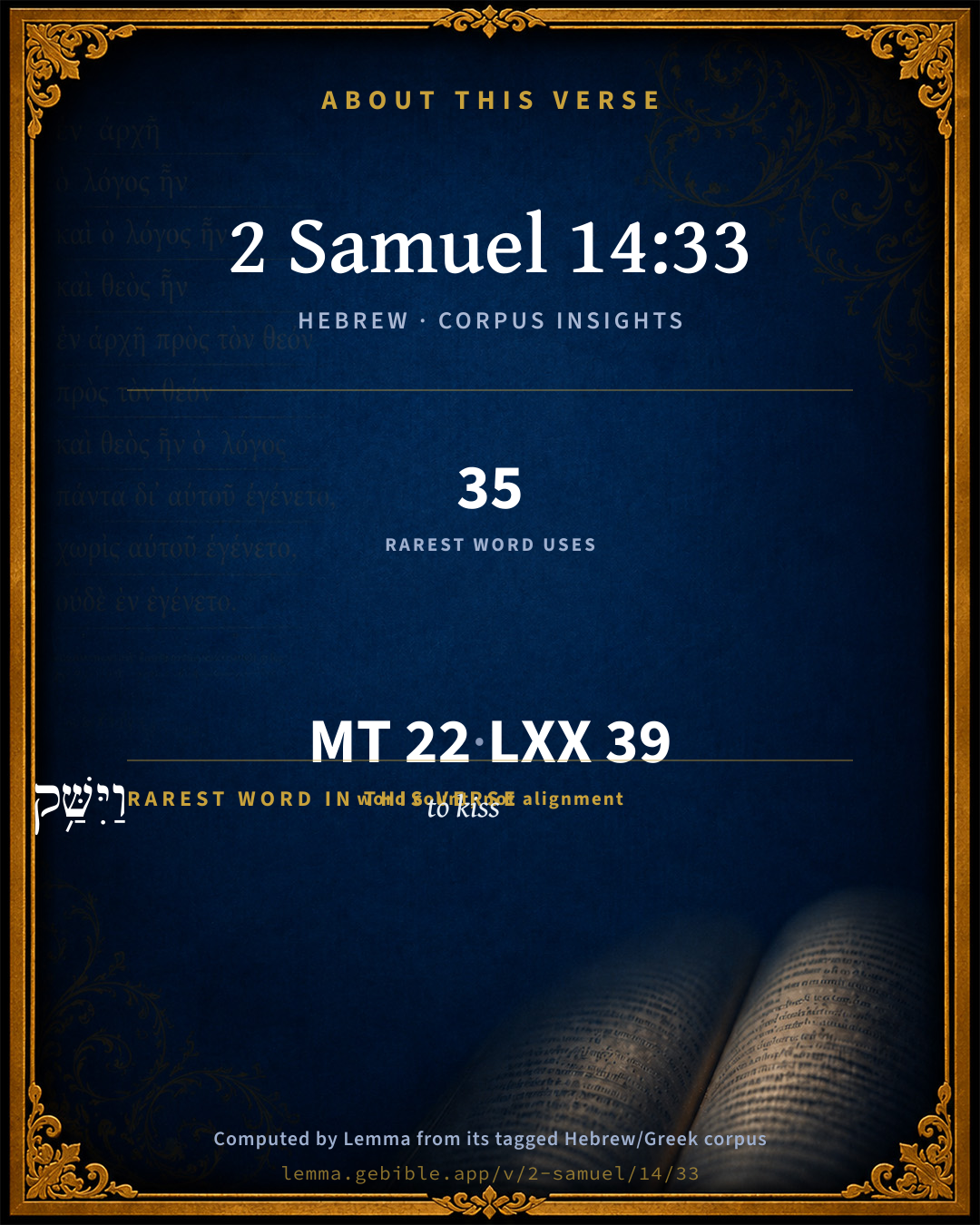
About this verse

These counts appear in no published source. They are computed here, from the morphology-tagged text and Lemma’s own curated glosses. What Lemma adds →

22
words
13
distinct lemmas
Historical
section

Shared distinctive vocabulary

וַיִּשַּׁ֥ק to kiss H5401 occurs in 35 verses of the Hebrew Bible. Also found in:

Grammatical profile

  • 6 verbs
  • 10 nouns
  • 6 prepositions

Verb forms

  • וַיָּבֹ֨א Qal · Sequential Imperfect
  • וַיַּגֶּד Hiphil · Sequential Imperfect
  • וַיִּקְרָ֤א Qal · Sequential Imperfect
  • וַיָּבֹ֣א Qal · Sequential Imperfect
  • וַיִּשְׁתַּ֨חוּ Hithpael · Sequential Imperfect
  • וַיִּשַּׁ֥ק Qal · Sequential Imperfect

Repetition

Words recur within this verse — often emphatic in Hebrew:

  • הַמֶּלֶךְ֮ king H4428 ×4
  • וַיָּבֹ֨א to enter H935 ×2
  • אַבְשָׁלוֹם֙ Absalom H53 ×2
  • אֶל to H413 ×3

Hebrew & Septuagint length

In English translation the verse runs 38 words from the Hebrew and 46 from the Septuagint (LXX English) — closely comparable.

A rough comparison of the two English renderings, which tokenize alike — not a word-level alignment.

Word counts can differ between the Hebrew and the Greek without any difference in meaning — e.g. the Hebrew direct-object marker אֵת has no separate Greek word, and Greek often adds the article ὁ.

In the original languages it is 22 Hebrew tokens and 39 Greek tokens — but the two are counted differently (Hebrew bundles its prefixes and suffixes into one token; the Greek is in lemma form), so that isn’t a like-for-like length.

Cross-references

4

Topical passages linked to 2 Samuel 14:33 in the Treasury of Scripture Knowledge — connected by theme and wording, ordered by reader-vote popularity; previews shown in the World English Bible.

  • Genesis 33:4 Esau ran to meet him, embraced him, fell on his neck, kissed him, and they wept.
  • Luke 15:20 "He arose, and came to his father. But while he was still far off, his father saw him, and was moved with compassion, and ran, and fell on his neck, and kissed him.
  • Genesis 27:26 His father Isaac said to him, "Come near now, and kiss me, my son."
  • Genesis 45:15 He kissed all his brothers, and wept on them. After that his brothers talked with him.

Cross-references courtesy of OpenBible.info (CC BY 4.0).

Hebrew and Greek witnesses Masoretic Hebrew ↔ Greek Septuagint

The same verse in the two great witnesses to the Old Testament, shown verse-for-verse.

These are two independent witnesses, not word-aligned to each other, and the Septuagint is shown in lemma (dictionary) form.

Hebrew 2 Samuel 14:33 Masoretic · Westminster Leningrad Codex

וַיָּבֹ֨א יוֹאָ֣ב אֶל הַמֶּלֶךְ֮ וַיַּגֶּד לוֹ֒ וַיִּקְרָ֤א אֶל אַבְשָׁלוֹם֙ וַיָּבֹ֣א אֶל הַמֶּ֔לֶךְ וַיִּשְׁתַּ֨חוּ ל֧וֹ עַל אַפָּ֛יו אַ֖רְצָה לִפְנֵ֣י הַמֶּ֑לֶךְ וַיִּשַּׁ֥ק הַמֶּ֖לֶךְ לְאַבְשָׁלֽוֹם

So Joab came to the king, and told him; and when he had called for Absalom, he came to the king, and bowed himself on his face to the ground before the king: and the king kissed Absalom.

World English Bible · Public Domain

Greek LXX 2 Samuel 14:33 Septuagint · lemma form

καί εἰςἔρχομαι ιωαβ πρός ὁ βασιλεύς καί ἀποἀγγέλλω αὐτός καί καλέω ὁ αβεσσαλωμ καί εἰςἔρχομαι πρός ὁ βασιλεύς καί προςκυνέω αὐτός καί πίπτω ἐπί πρόσωπον αὐτός ἐπί ὁ γῆ κατά πρόσωπον ὁ βασιλεύς καί καταφιλέω ὁ βασιλεύς ὁ αβεσσαλωμ

And Joab went in to the king, and brought him word: and he called Abessalom, and he went in to the king, and did him obeisance, and fell upon his face to the ground, even in the presence of the king; and the king kissed Abessalom.

LXX2012 (modern English Septuagint) · Public Domain

Hebrew: Westminster Leningrad Codex (CC BY 4.0). Greek: Septuagint (public domain); English from LXX2012 (modern English Septuagint) (Public Domain). How the Septuagint differs from the Hebrew →

Targum (Aramaic paraphrase)

1

The Targum is the ancient Jewish Aramaic paraphrase of the Hebrew Scriptures — an interpretive translation, not the Hebrew text itself. Onkelos (literal) and Pseudo-Jonathan (expansive) render the Torah, and Jonathan the Prophets. Coverage is partial: where no permissively-licensed English translation exists for a verse, only the Aramaic is shown. This is verse-level text, not a word-by-word alignment to the Hebrew.

  1. Targum Jonathan Prophets (Joshua–Malachi)
    וַאֲתָא יוֹאָב לְוַת מַלְכָּא וְחַוִי לֵיהּ וּקְרָא לְאַבְשָׁלוֹם וַאֲתָא לְוַת מַלְכָּא וּסְגִיד לֵיהּ עַל אַפּוֹהִי עַל אַרְעָא קֳדָם מַלְכָּא וּנְשַׁק מַלְכָּא לְאַבְשָׁלוֹם:

    (no public-domain English translation for this verse)

    Targum Jonathan — Aramaic: “Mikraot Gedolot” (public domain). English: “Sefaria Community Translation” (CC0 1.0 (public-domain dedication)); “London "Chaldee Paraphrase," 1871” (public domain). Text via Sefaria.

Commentary

Notes on 2 Samuel 14:33 from classic Christian and Jewish commentators (each source and its license shown beneath its notes). The classic Christian expositions comment on the surrounding passage and are grouped to its opening verse, so a note may address several verses; the Jewish commentaries on the Tanakh (Rashi and others) are per-verse, so they appear only where the commentator wrote on this verse.

Lemma curates 59 commentaries, every one of them public domain or Creative Commons licensed, each selected and text-cleaned for this edition rather than reprinted as found. About our sources →

Trapp's Complete Commentary

John Trapp

2Sa 14:33 So Joab came to the king, and told him: and when he had called for Absalom, he came to the king, and bowed himself on his face to the ground before the king: and the king kissed Absalom.

Ver. 33. And the king kissed Absalom.] He should have kicked him rather; and not have hardened him to further villainy. But he believed him to be a true penitent; and smarted for his credulity.

John Trapp, A Commentary or Exposition upon All the Books of the Old and New Testament (1647–1656) — public domain. Text from a community e-Sword module.

The Biblical Illustrator

Joseph S. Exell

2Sa_14:33

And the soul of King David longed to go forth unto Absalom.

A fathers tender solicitude for his son

I well remember, says a present-day writer, the effect produced on my mind on being told by a servant, soon after I had recovered from a dangerous illness, that during the crisis of the malady my father was seen to shed tears. Though far from being a stern parent, he was not an emotional man; and the statement was a revelation to me, at least in degree. It is now more than half a century ago, but it will never be forgotten..

The Biblical Illustrator, edited by Joseph S. Exell (c. 1880s–1900s) — public domain. Text from a community e-Sword module.

Joseph Benson's Commentary

2Sa 14:33. So Joab came to the king — Absalom’s impetuosity prevailed: these passionate expressions that he was weary of life, while he continued to be debarred his father’s presence; nay, that he desired to die so he might but see him, moved Joab to intercede with the king for him, and he was admitted into the royal presence, where he did obeisance, humbling himself before the king with his face to the ground. And the king kissed Absalom — In token of reconciliation. Josephus says, the king raised him up from the ground, and promised him an oblivion of what was past; which was a great weakness in David; for the impenitent become only more wicked by the pardon of their offences; as we find Absalom did, who, being thus received into the king’s favour, soon found means to ingratiate himself with the people, and raise a rebellion against his own father who had thus graciously pardoned him. But we may here properly ask, with Henry, “Did the bowels of a father prevail to reconcile him to an impenitent son, and shall penitent sinners question the compassion of Him who is the Father of mercy? If Ephraim bemoan himself, God soon bemoans him, with all the expressions of fatherly tenderness: He is a dear son, a pleasant child,” Jer 31:20.

Joseph Benson's Commentary on the Old and New Testaments (1811–1818) — public domain. Text from a community e-Sword module.

Tyndale Open Study Notes

Tyndale Open Resources

14:33 Absalom bowed low, assuming a posture of respect and deference to the king’s majesty (see also 14:4, 22). • and the king kissed him: The lack of conversation, hugging (cp. Luke 15:20), or weeping (cp. Gen 33:4; 45:2, 14) suggests that this was a formal meeting rather than an affectionate reunion.

Tyndale Open Study Notes — © Tyndale Open Resources, licensed CC BY-SA 4.0. Text via the HelloAO Bible API.

The Cambridge Bible for Schools and Colleges

gen. ed. J. J. S. Perowne

33. the king kissed Absalom] As a pledge of reconciliation. See Gen_33:4; Gen_45:15; Luk_15:20.

The Cambridge Bible for Schools and Colleges (gen. ed. J. J. S. Perowne; Cambridge University Press, 1878–1918) — public domain. Text from a community e-Sword module.

John Gill's Exposition

So Joab came to the king, and told him,.... What Absalom had said to him:

and when he had called for Absalom; sent messengers to his house to order him to come to him:

he came to the king, and bowed himself on his face to the ground before the king; made a very reverend bow to him, according to the custom of those times, throwing himself at his feet in great submission to him:

and the king kissed Absalom; in token of his reconciliation to him; which laid the foundation of his after troubles from him, related in the following chapters.

Next: 2 Samuel Chapter 15

John Gill's Exposition of the Whole Bible (1746–1763) — public domain (CC PDM 1.0). Text via the HelloAO Bible API.

Albert Barnes' Notes on the Bible

Kissed - This was the pledge of reconciliation. (See the marginal references and Gen 45:15.)

Albert Barnes' Notes on the Bible (1834–1885) — public domain. Text from a community e-Sword/MySword module.

Haydock's Catholic Bible Commentary

Kissed Absalom, and thus was reconciled to his prodigal son, Luke xv. 20. The ungrateful wretch only took occasion, from his father’s goodness, to alienate the minds of the people from him, by insinuating that he neglected the welfare of the people. (Haydock)

George Leo Haydock (1774–1849), Haydock's Catholic Family Bible and Commentary, 1859 edition — public domain. Excludes Psalms (Douay-Rheims chapter numbering differs from Protestant) and Deuterocanonical books (Catholic canon only).

Matthew Poole's English Annotations

In testimony of his thorough reconciliation to him; which Absalom did very ill requite, as the next chapter manifesteth.

Matthew Poole's English Annotations on the Holy Bible (1683–1685) — public domain. Text from a community e-Sword/MySword module.

The Pulpit Commentary

The king kissed Absalom. The father"s kiss was, as in the case of the prodigal son, (Luk_15:20) the sign of perfect reconciliation, and of the restoration of Absalom to his place as a son, with all its privileges. But God"s pardon was immediate, (2Sa_12:13) while David"s was unwilling, and wrung from him. The kiss, we may feel quite sure, was preceded by a conversation between David and his son, the record of which is omitted simply for the sake of brevity. Evidently it satisfied the king, and ended in the kiss which gave the son all he desired. But whatever may have been his professions, Absalom"s subsequent conduct is proof that he still regarded Amnon"s death as a just retribution for his conduct to Tamar, and secretly cherished a sullen anger against his father for not having punished the wrong doer himself. It was the contrast between his own five years of punishment and the mere verbal reproof which was all that Amnon had to suffer for his shameless conduct, which rankled in Absalom"s mind, and gave him an excuse for finally plotting his father"s ruin.

The Pulpit Commentary (1880–1919), ed. H.D.M. Spence-Jones & Joseph S. Exell — public domain. Text from a community e-Sword module.

John Wesley's Explanatory Notes

Kissed - Did the bowels of a father prevail to reconcile him to an impenitent son? And shall penitent sinners question the compassion of him who is the Father of mercy? If Ephraim bemoan himself, God soon bemoans him, with all the expressions of fatherly tenderness. He is a dear son, a pleasant child.

John Wesley, Explanatory Notes Upon the Whole Bible (1754–1765) — public domain. Text via the GEBible commentary corpus.

Lesson kit

Teaching starters — assembled from the data on this page, not authored interpretation. Every prompt links to the verse data it draws on. Edit before teaching.

2 Samuel, in the Historical, opens this verse with 22 words (13 distinct Hebrew lemmas). Its most distinctive word is nâshaq (“to kiss”). A historical commentator’s framing appears above. Read the whole chapter for the surrounding context.

Discussion questions

  1. What does “to kiss” (nâshaq) contribute to the verse as a whole?
  2. Genesis 27:26 shares the word «to kiss» with this verse. How do the two illuminate each other?
  3. “king” occurs 4× in this one verse. What is the effect of the repetition?
  4. The translations on this page render this verse differently — a whole-verse word diff, not a word-by-word alignment. What might account for the different wordings?
  5. The verb «וַיָּבֹ֨א» is Qal Sequential Imperfect. How does its form color the action?
  6. Reading how Trapp's Complete Commentary and The Biblical Illustrator read this verse, where do the two commentators agree and where do they part?

Things to notice

Reading settings

Reading text

Shown beneath each verse's original-language words.

Old Testament
Old Testament edition

Read the OT as the Masoretic Hebrew (MT) or the Greek Septuagint (LXX).

English shown for the Greek Septuagint (in the Hebrew ↔ Greek comparison).

Comparing translations? Open the Compare panel on any verse page to stack up to four side by side.