
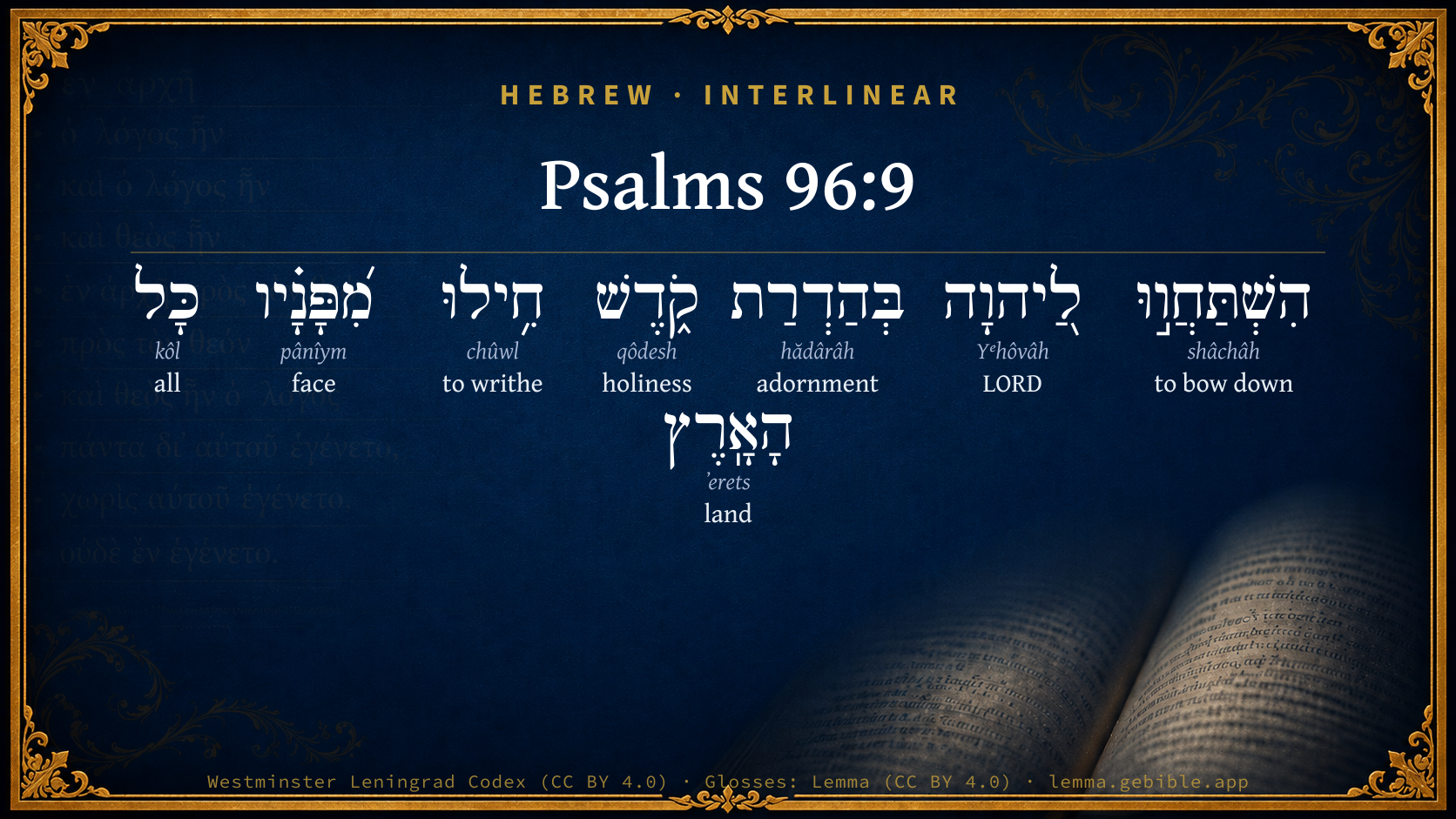
Psalms 96:9

Hebrew (Westminster Leningrad Codex) Psalms 96:9 appears in the Hebrew Old Testament. The text above is from the Westminster Leningrad Codex. Each word links to its Strong’s number, a concise gloss, and parsing drawn from the Open Scriptures Hebrew Bible morphology. Click any word for its full Brown-Driver-Briggs (BDB) entry.
Download image
Cite this verse

Psalms 96:9 (World English Bible). Public Domain. Lemma interlinear Bible study tool, https://lemma.gebible.app/v/psalms/96/9.

Show BibTeX & RIS
BibTeX
RIS
English Translation
Worship Yahweh in holy array. Tremble before him, all the earth.
World English Bible · Public Domain
Download a study sheet

One document with this verse’s original text, its word-by-word gloss line, the meaning frame, cross-references with their text, attributed commentary, and full source and license credits — printable, and it pastes into notes with its structure intact.

This verse Autodidact and up

Study sheet (.html) Plain text (.txt)

A passage Seminary Student

Up to 50 verses in one chapter. A passage sheet keeps up to 6 commentary sources and 12 cross-references per verse, in the order this page ranks them, and says so on the sheet whenever that leaves anything out. Ask for a single verse and you get the Autodidact verse sheet above.

Everything on this page stays free to read, with no account — the sheet is a download of what is already on screen, not access to it.

Want to remove ads? Support Godless Engineer
Compare translations 3

The same verse in 3 English versions, stacked beneath the original-language interlinear above. Click any original word for its lexicon entry.

Each is an independent rendering of the whole verse — the interlinear is not word-aligned to these translations.

Highlighted words mark where these versions differ — a whole-verse word diff, not a word-by-word alignment.

  • World English Bible Public Domain
    Worship Yahweh in holy array. Tremble before him, all the earth.
  • King James Version Public Domain
    O worship the LORD in the beauty of holiness: fear before him, all the earth.
  • unfoldingWord Literal Text CC BY-SA 4.0
    Bow down to Yahweh in the splendor of holiness; tremble from his face, all the earth.

unfoldingWord Literal Text — © unfoldingWord, licensed CC BY-SA 4.0. Word-aligned USFM3 via Door43 (git.door43.org/unfoldingWord/en_ult).

Versions to compare (up to 4)

3 of 4 selected

Show all 18 translations

Every available English version of this verse, each an independent rendering of the whole verse.

  • World English Bible Public Domain
    Worship Yahweh in holy array. Tremble before him, all the earth.
  • Berean Standard Bible Public Domain
    Worship the LORD in the splendor of His holiness; tremble before Him, all the earth.
  • Majority Standard Bible Public Domain
    Worship the LORD in the splendor of His holiness; tremble before Him, all the earth.
  • King James Version Public Domain
    O worship the LORD in the beauty of holiness: fear before him, all the earth.
  • American Standard Version (1901) Public Domain
    Oh worship Jehovah in holy array: Tremble before him, all the earth.
  • Revised Version (1885) Public Domain
    O worship the LORD in the beauty of holiness: tremble before him, all the earth.
  • Geneva Bible (1599) Public Domain
    Worship the Lord in the glorious Sanctuarie: tremble before him all the earth.
  • Douay-Rheims (1899) Public Domain
    adore ye the Lord in his holy court. Let all the earth be moved at his presence.
  • Young's Literal Translation Public Domain
    Bow yourselves to Jehovah, In the honour of holiness, Be afraid of His presence, all the earth.
  • Literal Standard Version CC BY-SA 4.0
    Bow yourselves to YHWH, || In the honor of holiness, || Be afraid of His presence, all the earth.
  • Unlocked Literal Bible CC BY-SA 4.0
    Bow down to Yahweh in the splendor of holiness; tremble before him, all the earth.
  • unfoldingWord Literal Text CC BY-SA 4.0
    Bow down to Yahweh in the splendor of holiness; tremble from his face, all the earth.
  • Darby Bible Public Domain
    Worship Jehovah in holy splendour; tremble before him, all the earth.
  • World Messianic Bible Public Domain
    Worship the LORD in holy array. Tremble before him, all the earth.
  • Webster's Bible Public Domain
    O worship the LORD in the beauty of holiness: fear before him, all the earth.
  • Free Bible Version CC BY-SA 4.0
    Worship the Lord in his magnificent holiness; let all the earth tremble in his presence.
  • Bible in Basic English Public Domain
    O give worship to the Lord in holy robes; be in fear before him, all the earth.
  • JPS Tanakh (1917) Public Domain
    O worship the LORD in the beauty of holiness; tremble before Him, all the earth.

Literal Standard Version (2020), Covenant Press — licensed CC BY-SA 4.0. Text via the HelloAO Bible API (eBible.org). Unlocked Literal Bible (unfoldingWord) — licensed CC BY-SA 4.0. Text via the HelloAO Bible API (eBible.org). unfoldingWord Literal Text — © unfoldingWord, licensed CC BY-SA 4.0. Word-aligned USFM3 via Door43 (git.door43.org/unfoldingWord/en_ult). Free Bible Version, Dr. Jonathan Gallagher — licensed CC BY-SA 4.0. Text via the HelloAO Bible API (eBible.org).

Word by word

More ways to search: Search by grammar → Find every occurrence → Compare this word →

Practice this passage: Drill this verse → Learn its vocabulary →

About this verse

These counts appear in no published source. They are computed here, from the morphology-tagged text and Lemma’s own curated glosses. What Lemma adds →

8
words
8
distinct lemmas
Wisdom
section

Notable vocabulary

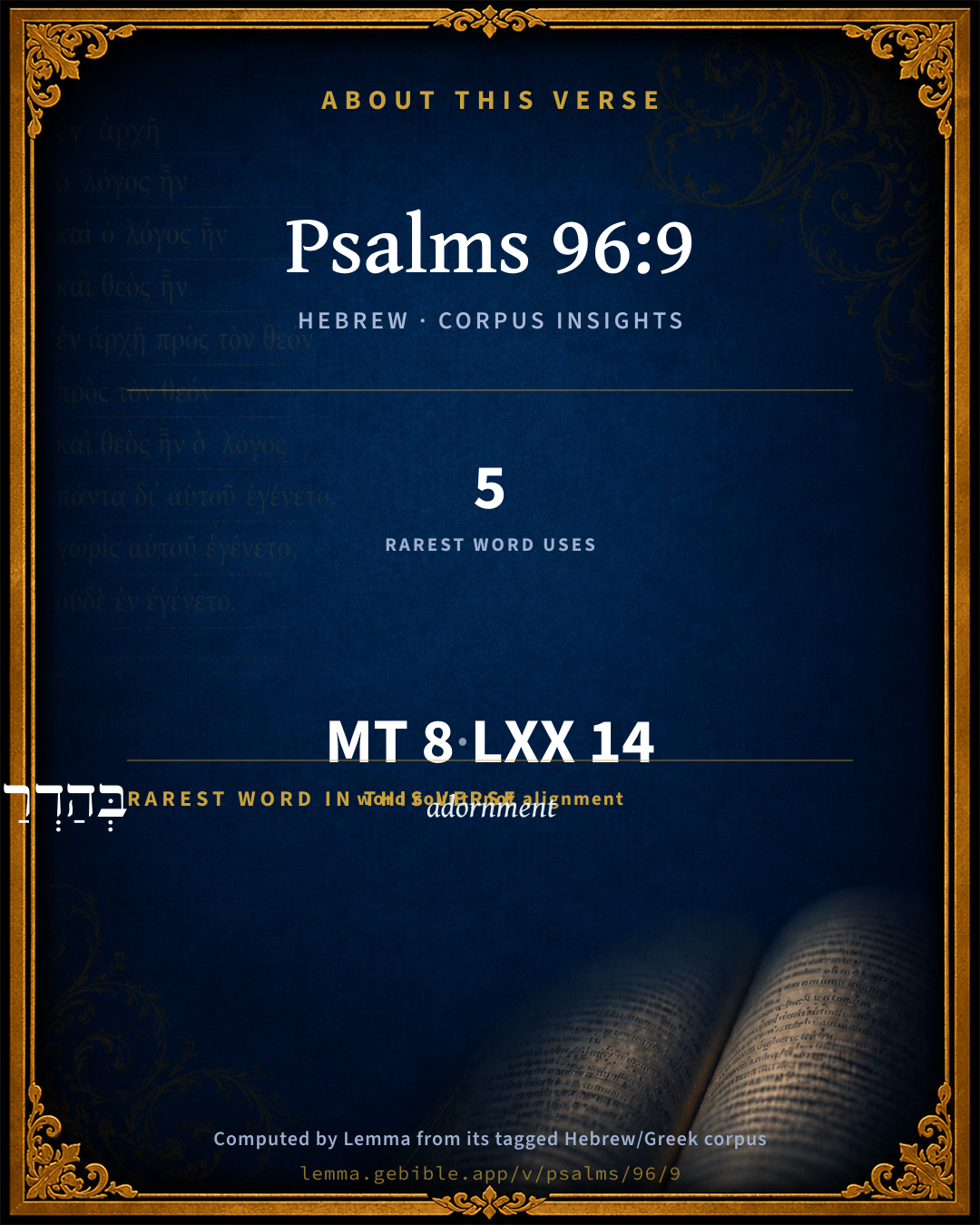
The rarest word here is בְּהַדְרַת adornment H1927 — appearing just 5 times in the whole Hebrew Bible.

Shared distinctive vocabulary

בְּהַדְרַת adornment H1927 occurs in 5 verses of the Hebrew Bible. Also found in:

Grammatical profile

  • 2 verbs
  • 6 nouns

Verb forms

  • הִשְׁתַּחֲו֣וּ Hishtaphel · Imperative
  • חִ֥ילוּ Qal · Imperative

Hebrew & Septuagint length

In English translation the verse runs 11 words from the Hebrew and 14 from the Septuagint (LXX English) — closely comparable.

A rough comparison of the two English renderings, which tokenize alike — not a word-level alignment.

Word counts can differ between the Hebrew and the Greek without any difference in meaning — e.g. the Hebrew direct-object marker אֵת has no separate Greek word, and Greek often adds the article ὁ.

In the original languages it is 8 Hebrew tokens and 14 Greek tokens — but the two are counted differently (Hebrew bundles its prefixes and suffixes into one token; the Greek is in lemma form), so that isn’t a like-for-like length.

Cross-references

10

Topical passages linked to Psalms 96:9 in the Treasury of Scripture Knowledge — connected by theme and wording, ordered by reader-vote popularity; previews shown in the World English Bible.

  • Psalms 29:2 Ascribe to Yahweh the glory due to his name. Worship Yahweh in holy array.
  • Psalms 114:7 Tremble, you earth, at the presence of the Lord, At the presence of the God of Jacob,
  • Psalms 110:3 Your people offer themselves willingly in the day of your power, in holy array. Out of the womb of the morning, you have the dew of your youth.
  • Daniel 11:45 He shall plant the tents of his palace between the sea and the glorious holy mountain; yet he shall come to his end, and none shall help him.
  • Psalms 33:8 Let all the earth fear Yahweh. Let all the inhabitants of the world stand in awe of him.
  • Ezra 7:27 Blessed be Yahweh, the God of our fathers, who has put such a thing as this in the king's heart, to beautify the house of Yahweh which is in Jerusalem;
  • Psalms 76:11 Make vows to Yahweh your God, and fulfill them! Let all of his neighbors bring presents to him who is to be feared.
  • Ezekiel 7:20 As for the beauty of his ornament, he set it in majesty; but they made the images of their abominations [and] their detestable things therein: therefore have I made it to them as an unclean thing.
  • Luke 21:5–6 As some were talking about the temple and how it was decorated with beautiful stones and gifts, he said,
  • Psalms 76:7 You, even you, are to be feared. Who can stand in your sight when you are angry?

Cross-references courtesy of OpenBible.info (CC BY 4.0).

Hebrew and Greek witnesses Masoretic Hebrew ↔ Greek Septuagint

The same verse in the two great witnesses to the Old Testament, shown verse-for-verse.

You’re reading Greek Psalm 95 (Hebrew Psalm 96). The Septuagint counts the superscription, so verse numbers can differ from the Hebrew — chapter-level alignment, not verse-by-verse. Numbering follows Rahlfs.

These are two independent witnesses, not word-aligned to each other, and the Septuagint is shown in lemma (dictionary) form.

Hebrew Psalms 96:9 Masoretic · Westminster Leningrad Codex

הִשְׁתַּחֲו֣וּ לַ֭יהוָה בְּהַדְרַת קֹ֑דֶשׁ חִ֥ילוּ מִ֝פָּנָ֗יו כָּל הָאָֽרֶץ

Worship Yahweh in holy array. Tremble before him, all the earth.

World English Bible · Public Domain

Greek LXX Greek Psalm 95:9 Septuagint · lemma form

προςκυνέω ὁ κύριος ἐν αὐλή ἅγιος αὐτός σαλεύω ἀπό πρόσωπον αὐτός πᾶς ὁ γῆ

Worship the Lord in his holy court: let all the earth tremble before him.

LXX2012 (modern English Septuagint) · Public Domain

On this verse, Ellicott's Commentary for English Readers discusses the Septuagint’s reading. Read the note in Commentary ↓

Hebrew: Westminster Leningrad Codex (CC BY 4.0). Greek: Septuagint (public domain); English from LXX2012 (modern English Septuagint) (Public Domain). How the Septuagint differs from the Hebrew →

Commentary

Notes on Psalms 96:9 from classic Christian and Jewish commentators (each source and its license shown beneath its notes). The classic Christian expositions comment on the surrounding passage and are grouped to its opening verse, so a note may address several verses; the Jewish commentaries on the Tanakh (Rashi and others) are per-verse, so they appear only where the commentator wrote on this verse.

Lemma curates 59 commentaries, every one of them public domain or Creative Commons licensed, each selected and text-cleaned for this edition rather than reprinted as found. About our sources →

Trapp's Complete Commentary

John Trapp

Psa 96:9 O worship the LORD in the beauty of holiness: fear before him, all the earth.

Ver. 9. O worship the Lord, &c.] Supplicate proni, fall flat on your faces (Geneb.). See Psa 95:6.

In the beauty of holiness] i.e. In his courts, as Psa 96:8, or in holy beauty, as some render it; that is, in true faith, and with good affections.

Fear before him] Rejoice before him with trembling, Psa 2:11

John Trapp, A Commentary or Exposition upon All the Books of the Old and New Testament (1647–1656) — public domain. Text from a community e-Sword module.

J. A. Alexander on Psalms

Joseph Addison Alexander

9. (Psa 96:9) Bow down to Jehovah in beauty of holiness; tremble before him, all the earth? The first verb denotes the act of bowing to the ground, as practised in the East. For the meaning of the next phrase, beauty of holiness, see above, on Psa 29:2, from which place it is borrowed here. The last clause enjoins the reverential awe due to the exhibition of the divine ma-jesty. Compare Psa 2:11. The plural form of the verb (tremble ye) shews that the earth is put for its inhabitants. Before him, literally from his face. The parallel passage (1Ch 16:30) has a double preposition, a Hebrew idiom which cannot be reproduced in English, and which does not in the least affect the sense. We also find there added to the verse before us the middle clause or member of the next verse.

Joseph Addison Alexander, The Psalms Translated and Explained (1850) — public domain. Text from a community e-Sword module.

Tyndale Open Study Notes

Tyndale Open Resources

96:9 Worshipers should tremble in awe (96:4; see 18:7-15; 97:4) at the splendor of the Lord’s majesty and holiness (Heb 12:25).

Tyndale Open Study Notes — © Tyndale Open Resources, licensed CC BY-SA 4.0. Text via the HelloAO Bible API.

Adam Clarke's Commentary

Verse 9. Worship the Lord in the beauty of holiness] I think בהדרת קדש behadrath kodesh, signifies holy ornaments, such as the high priest wore in his ministrations. These were given him for glory and beauty; and the psalmist calls on him to put on his sacerdotal garments, to bring his offering, מנחה minchah, and come into the courts of the Lord, and perform his functions, and make intercession for the people.

Adam Clarke's Commentary on the Bible (1810–1826) — public domain. Text from a community e-Sword/MySword module.

John Calvin's Commentaries

9 Worship before Jehovah The Psalmist prosecutes the same train of sentiment. In requiring oblations of his people, God was not to be considered as standing in need of the services of the creature, but as giving them an opportunity of professing their faith. The true reason, therefore, is here mentioned why the oblation was enjoined, That his people might prostrate themselves before him, and acknowledge that they and all belonging to them were his. Mention is made of the beauty of the temple, referring to the fact that the Gentiles should be raised to a new honor, in being associated into one body with God’s chosen people. At the time when this psalm was written, it was generally deemed scarcely credible that the heathen nations would be admitted into the temple in company with the holy seed of Abraham. This should make us think all the more highly of our calling as Gentiles, which seemed then so incredible and impracticable a thing. We may be convinced that God only could have opened for us the door of salvation. The beauty of the temple is an expression intended to beget a reverential view of the temple, that men may approach it with humble fear, instead of rushing without consideration into God’s presence. The clause which follows in the verse is inserted for the same purpose — tremble before his face, intimating that we should prostrate ourselves as suppliants before him when we consider his awful majesty. Not that he would deter worshippers from drawing near to God. They should esteem it their greatest pleasure and enjoyment to seek his face. But he would have us humbled to the right and serious worship of God. I may add, that the beauty or glory of the sanctuary did not consist in silver and gold, in the preciousness of the material of which it was made, nor in polished stones, nor in any splendor and decoration of this kind, but in the representation of the heavenly pattern which was shown to Moses on the mount, (Exodus 25:9.)

John Calvin's Commentaries (1540-1563) — public domain. Text from the Calvin Translation Society English edition (1840s-50s) via the Christian Classics Ethereal Library (ccel.org). Calvin's coverage is partial (roughly two-thirds of the Bible); uncommented books and verses are honest gaps, never fabricated. The 19th-century editor's footnotes and remarks are omitted so the notes are faithfully Calvin's own voice.

Ellicott's Commentary for English Readers

(9) O worship the Lord in the beauty of holiness.—Better, Bow before Jehovah in holy attire. But the LXX. and Vulgate have as in margin.

Fear before him.—Or literally, let all the earth be moved before his face.

A Bible Commentary for English Readers, edited by Charles John Ellicott (1878–1897) — public domain. Text from a community e-Sword module.

The Cambridge Bible for Schools and Colleges

gen. ed. J. J. S. Perowne

9. in the beauty of holiness] In holy array. See on Psa_29:2. “As the priests were to minister only in ‘holy attire’ (Exo_28:2) so must the nations be now clothed with holiness” (Kay).

The Cambridge Bible for Schools and Colleges (gen. ed. J. J. S. Perowne; Cambridge University Press, 1878–1918) — public domain. Text from a community e-Sword module.

John Gill's Exposition

O worship the Lord in the beauty of holiness,.... See Gill on Psa 29:2, in this and the three preceding verses there is a manifest allusion to the form of addresses made to kings in the eastern nations; who being arrayed, and seated in a majestic manner, with all the marks of royal honour and dignity about them, whom their subjects approach with ascriptions of glory to them; bringing presents in their hands, and bowing down to the ground before them, as the word (r) for "worship" signifies; expressing the utmost awe and reverence of them, as in the next clause:

fear before him, all the earth; or, as the Targum,

"all the inhabitants of the earth;''

it is the duty of all men to fear the Lord; but none can fear him aright without his grace, or an heart given them to fear him: this respects the latter day, when the Jews shall seek the Lord, and fear him and his goodness; when all nations shall fear and worship him; when, from the rising of the sun to the going down of the same, the name of the Lord shall be great and tremendous among the Gentiles; see Hos 3:5.

(r) "incurvate vos", Pagninus, Montanus, Junius & Tremellius, Piscator; "prosternite vos", Tigurine version.

John Gill's Exposition of the Whole Bible (1746–1763) — public domain (CC PDM 1.0). Text via the HelloAO Bible API.

Albert Barnes' Notes on the Bible

O worship the Lord in the beauty of holiness - This verse is literally taken from 1Ch 16:29-30. The margin here is, “in the glorious sanctuary.” The Septuagint, ἐν αὐλῇ ἁγίᾳ en aulē hagia - “in his holy court.” So the Latin Vulgate. On the meanings of the expression, see the notes at Psa 29:2.

Fear before him, all the earth - All lands; all people. The word rendered “fear” means properly to writhe, to twist, to be in pain; and then, to tremble, to quake, to be afraid. The word “tremble” would perhaps best express the idea here. It is that solemn awe produced by the sense of the divine presence and majesty which causes trembling. It denotes profound reverence for God.

Albert Barnes' Notes on the Bible (1834–1885) — public domain. Text from a community e-Sword/MySword module.

Matthew Poole's English Annotations

In the beauty of holiness; either in the holy place which he shall appoint to that end; or clothed with all those holy ornaments, those gifts and graces, which are necessary and required in God’s worship.

Matthew Poole's English Annotations on the Holy Bible (1683–1685) — public domain. Text from a community e-Sword/MySword module.

The Treasury of David

Charles H. Spurgeon

Ver. 9. 0 worship the Lord in the beauty of holiness. This is the only beauty which he cares for in our public services, and it is one for which no other can compensate. Beauty of architecture and apparel he does not regard; moral and spiritual beauty is that in which his soul delighteth. Worship must not be rendered to God in a slovenly, sinful, superficial manner; we must be reverent, sincere, earnest, and pure in heart both in our prayers and praises. Purity is the white linen of the Lord's choristers, righteousness is the comely garment of his priests, holiness is the royal apparel of his servants.

Fear before him, all the earth. "Tremble" is the word in the original, and it expresses the profoundest awe, just as the word "worship" does, which would be more accurately translated by "bow down." Even the bodily frame would be moved to trembling and prostration if men were thoroughly conscious of the power and glory of Jehovah. Men of the world ridiculed "the Quakers" for trembling when under the power of the Holy Spirit; had they been able to discern the majesty of the Eternal they would have quaked also. There is a sacred trembling which is quite consistent with joy, the heart may even quiver with an awful excess of delight. The sight of the King in his beauty caused no alarm to John in Patmos, and yet it made him fall at his feet as dead. Oh, to behold him and worship him with prostrate awe and sacred fear!

Ver. 9. In the beauty of holiness, or, in the ornament of holiness, alluding to the splendid robes of eastern worshippers. W. Wilson.

Ver. 9. The beauty of holiness. Shall I call holiness an attribute? Is it not rather the glorious combination of all his attributes into one perfect whole? As all his attributes proceed from the absolute, so all again converge and meet in holiness. As from the insufferable white light of the Absolute they all seem to diverge and separate into prismatic hues, so they all seem again to converge and meet and combine in the dazzling white radiance of his holiness. This, therefore, is rather the intense whiteness, purity, clearness, the infinite lustre and splendour of his perfect naturelike a gem without flaw, without stain, and without colour. All of his attributes are glorious, but in this we have a combination of all into a still more glorious whole. It is for this reason that it is so frequently in Scripture associated with the Divine beauty. The poetic nature of the psalmist is exalted to ecstasy in contemplation of the "beauty of holiness, "the "beauty of the Lord." Beauty is a combination of elements according to the laws of harmony; the more beautiful the parts or elements, and the more perfect the harmonious combination, the higher the beauty. How high and glorious, therefore, must be the beauty of this attribute which is the perfect combination of all his infinite perfections!

You see, then, why this attribute is awful to us. In the ideal man all the faculties and powers, mental, moral, and bodily, work together in perfect harmony, making sweet musicthe image of God is clear and pure in the human heart. But, alas! how far are we from the ideal! In the actual man the purity is stained, the beauty is defaced, the harmony is changed into jarring discord, "like sweet bells jangled out of tune." How it came so, we are not now inquiring. We all feel that it is so. Therefore is this attribute so awful to us. It is the awfulness of absolute purity in the presence of impurity; it is the awfulness of perfect beauty in the presence of deformity; it is the awfulness of honour in the presence of dishonour and shame; in one word, it is the awfulness of holiness in the presence of sinfulness. How, then, shall we approach him before whom angels bow and archangels veil their faceshim in whose sight the white radiance of heaven itself is stained with impurity? Joseph Le Coute, in "Religion and Science, "1874.

Ver. 9. The beauty of holiness. The religion of the gospel of Christ is "the beauty of holiness, "as it concerns its Author, its plan, its fruits. First, As it concerns its Author. Whatever we can understand as meant by beauty or holiness, we see in the attributes of God, whether we consider them in all their harmony, or contemplate any one of them in particular... Secondly. As to its plan. Survey the gospel where we will, or regard whatever we can that is revealed concerning it, we find it to be all "beauty"; and we cannot call it by a more appropriate name than "the beauty of holiness." Thirdly, As to its fruits. There is a holy separation, a beautiful character of holiness, a separation as to character, feelings, and conduct; these are all the various fruits of grace; and so the man becomes beautiful in holiness. Leigh Richmond, 1772-1827.

Ver. 9. (first clause). An examination of true and false worship.

1. False worship, in the obscurity of ignorance, in the dulness of formalism, in the offensiveness of indulged sin, in the hideousness of hypocrisy.

2. True worship, in the beauty of holiness. C. D.

Ver. 9. Holy fear an essential ingredient in true religion.

Psalms 96:10*

Charles H. Spurgeon's The Treasury of David (1869–1885) — public domain. Psalms only. Text from a community e-Sword/MySword module.

Whedon's Commentary on the Bible

Daniel D. Whedon

9. Beauty of holiness—See notes on Psa_29:2; Psa_110:3

Daniel D. Whedon (gen. ed.), Commentary on the Old and New Testaments (1874–1909) — public domain. Text from a community e-Sword module.

The Pulpit Commentary

O worship the Lord in the beauty of holiness. (comp. 1Ch_16:29 Psa_29:2) This is generally explained as "holiday attire." or "in vestments suited to holy service," but may include, besides vestments, the other material accessories of Divine worship. Fear before him, all the earth; or, tremble before him. (comp. Psa_97:4) The fear of God is constantly inculcated by the psalmists, not only as "the beginning of wisdom", (Psa_111:10) but as required of every man during his whole life. (Psa_19:9 Psa_34:9 Psa_40:3 Psa_64:9 Psa_86:11 Psa_119:63, etc.)

The essential feature of God"s worship.

"O worship the Lord in the beauty of holiness." This is also read, "in the glorious sanctuary," and "in holy vestments." The Authorized Version is the more poetic sentiment, and may therefore be preferred. The expression is given in 2Ch_20:21, where Jehoshaphat, in sending forth his army, "appointed singers who should praise the beauty of holiness." Holiness is the keynote of the worship of Jehovah; but it is the keynote of the worship of no other god. "Had a medal been struck in praise of Jupiter, who is the best of the pagan gods, on one side might have been engraved "Almightiness, omnipresence, justice;" and on the reverse, "Caprice, vengeance, lust. But the association of beauty with holiness now requires our attention. The best idea may be gained by thinking of ripe fruit; if it is really healthy and ripe, it cannot help having a bloom on. That bloom is the beauty of ripeness. "Beauty is a combination of elements according to the laws of harmony; the more beautiful the parts or elements, and the more perfect the harmonious combination, the higher the beauty." Then we must find the elements that go to make a worship so holy that, both in God"s sight and in man"s, it should be beautiful. Worship that can be thought of as showing the "beauty of holiness" must be

I LAWFUL. It may not be sufficiently recognized that public worship was arranged for, authorized. There is no room for self-will. There may be different views as to the ultimate authority for forms of worship. If it is to be "holy," the elements of mere self-willedness and pleasure must be excluded.

II PURE. "Be ye clean that bear the vessels of the Lord." This was at once typified and testified by the clean white linen garments of the priests, and by their washing before engaging in their offices. Bodily purity did but represent the moral purity God requires.

III SINCERE. This brings before us the condition of the will. God"s great reproach is levelled at the divided mind. That worship cannot be acceptable in which the man"s hand is one way and his heart is another. Worship is only ceremony and routine unless a man"s heart is in it. Absolute simple-mindedness is the beauty of worship, the bloom on the fruit.

IV CHEERFUL. The psalmists constantly remind us of the joyousness of worship. It excited high emotions. Lifted out of all drudgery to become a holy delight, we feel still the "beauty of holiness" in God"s glorious sanctuary and exalted worship. R.T.

The Pulpit Commentary (1880–1919), ed. H.D.M. Spence-Jones & Joseph S. Exell — public domain. Text from a community e-Sword module.

John Wesley's Explanatory Notes

Beauty - Cloathed with all the gifts and graces, which are necessary in God's worship.

John Wesley, Explanatory Notes Upon the Whole Bible (1754–1765) — public domain. Text via the GEBible commentary corpus.

unfoldingWord translationNotes

Door43 World Missions Community

Bow down to Yahweh

The implied information is that the people were to bow down in worship. AT: "Bow down to worship Yahweh" (See: Assumed Knowledge and Implicit Information and Symbolic Action)

in the splendor of holiness

The abstract nouns "splendor" and "holiness" can be translated as adjectives. AT: "because he is gloriously beautiful and holy" (See: Abstract Nouns)

tremble

to shake because of fear

all the earth

Here "earth" represents the people. AT: "all the people of the earth" (See: Metonymy)

The world also is established

This can be translated in active form. AT: "He also established the world" (See: Active or Passive)

it cannot be shaken

This can be translated in active form. AT: "nothing can shake it" (See: Active or Passive)

translationWords

bow

holy

earth

reign

world

judge

unfoldingWord translationNotes — © Distant Shores Media and the Door43 World Missions Community, licensed CC BY-SA 4.0. Source: git.door43.org/Door43/en_tn.

Lesson kit

Teaching starters — assembled from the data on this page, not authored interpretation. Every prompt links to the verse data it draws on. Edit before teaching.

Psalms, in the Wisdom, opens this verse with 8 words (8 distinct Hebrew lemmas). Its most distinctive word is hădârâh (“adornment”). A historical commentator’s framing appears above. Read the whole chapter for the surrounding context.

Discussion questions

  1. The word hădârâh carries the sense “adornment.” How does it shape the verse?
  2. 1 Chronicles 16:29 shares the word «adornment» with this verse. How do the two illuminate each other?
  3. These translations render this verse differently. What is at stake in choosing one wording over another?
  4. The verb «הִשְׁתַּחֲו֣וּ» is Hishtaphel Imperative. How does its form color the action?
  5. Reading how Trapp's Complete Commentary and J. A. Alexander on Psalms read this verse, where do the two commentators agree and where do they part?

Things to notice

Reading settings

Reading text

Shown beneath each verse's original-language words.

Old Testament
Old Testament edition

Read the OT as the Masoretic Hebrew (MT) or the Greek Septuagint (LXX).

English shown for the Greek Septuagint (in the Hebrew ↔ Greek comparison).

Comparing translations? Open the Compare panel on any verse page to stack up to four side by side.