
Genesis 37:9

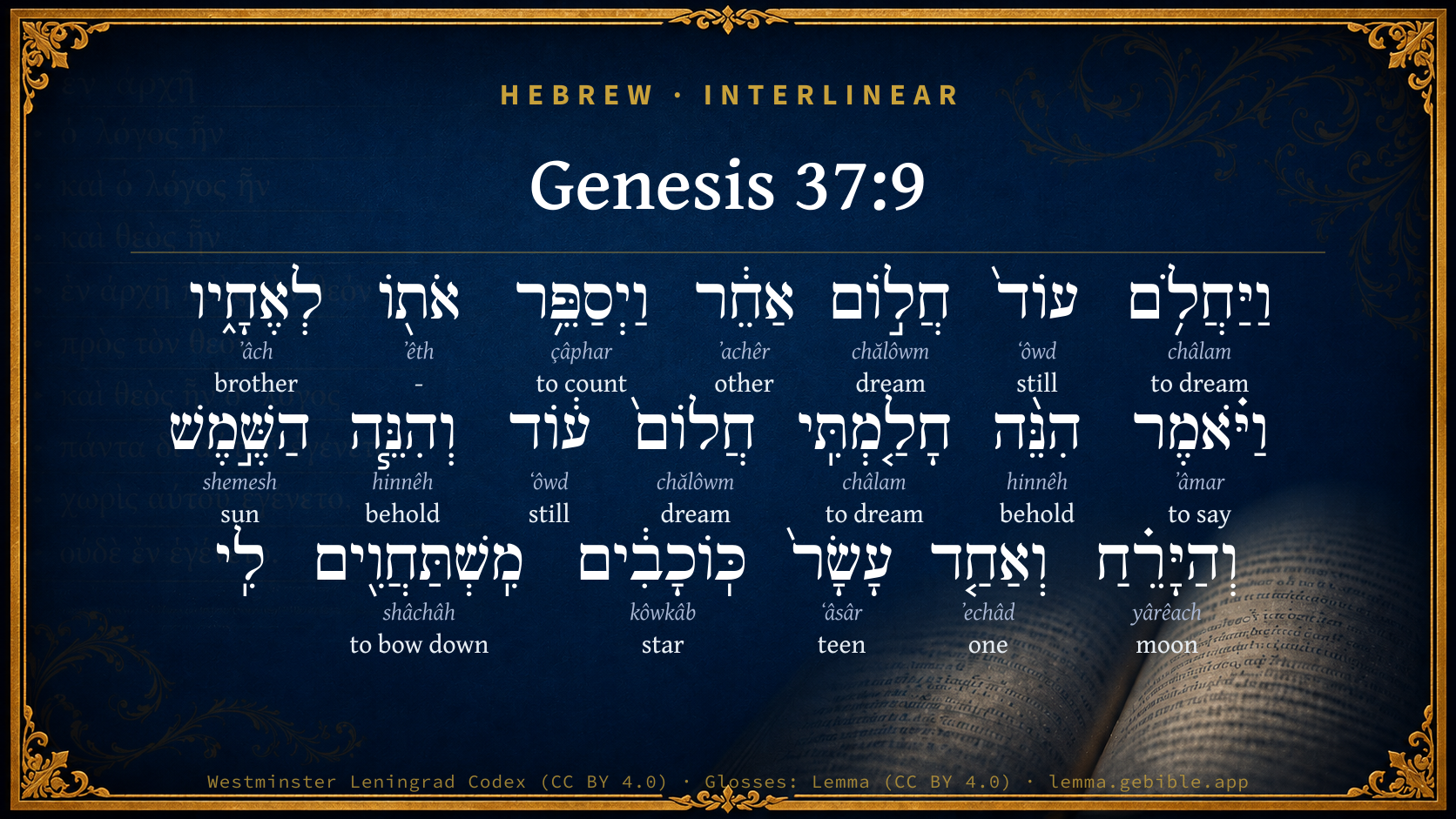
Hebrew (Westminster Leningrad Codex) Genesis 37:9 appears in the Hebrew Old Testament. The text above is from the Westminster Leningrad Codex. Each word links to its Strong’s number, a concise gloss, and parsing drawn from the Open Scriptures Hebrew Bible morphology. Click any word for its full Brown-Driver-Briggs (BDB) entry.
Download image
Cite this verse

Genesis 37:9 (World English Bible). Public Domain. Lemma interlinear Bible study tool, https://lemma.gebible.app/v/genesis/37/9.

Show BibTeX & RIS
BibTeX
RIS
English Translation
He dreamed yet another dream, and told it to his brothers, and said, "Behold, I have dreamed yet another dream: and behold, the sun and the moon and eleven stars bowed down to me."
World English Bible · Public Domain
Highlights
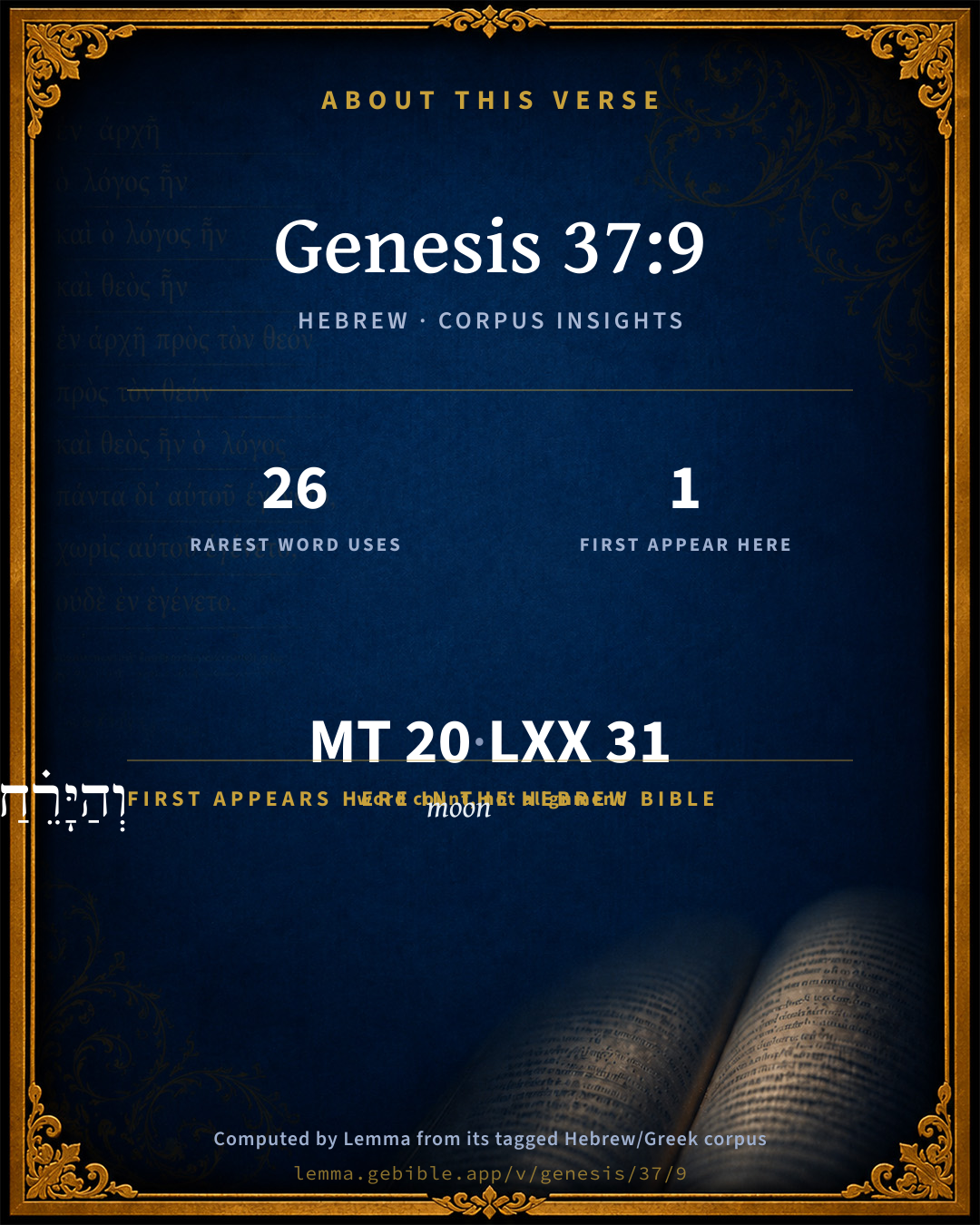
  • 1 first appearance in the Hebrew Bible
Full analysis ↓
Download a study sheet

One document with this verse’s original text, its word-by-word gloss line, the meaning frame, cross-references with their text, attributed commentary, and full source and license credits — printable, and it pastes into notes with its structure intact.

This verse Autodidact and up

Study sheet (.html) Plain text (.txt)

A passage Seminary Student

Up to 50 verses in one chapter. A passage sheet keeps up to 6 commentary sources and 12 cross-references per verse, in the order this page ranks them, and says so on the sheet whenever that leaves anything out. Ask for a single verse and you get the Autodidact verse sheet above.

Everything on this page stays free to read, with no account — the sheet is a download of what is already on screen, not access to it.

Want to remove ads? Support Godless Engineer
Compare translations 3

The same verse in 3 English versions, stacked beneath the original-language interlinear above. Click any original word for its lexicon entry.

Each is an independent rendering of the whole verse — the interlinear is not word-aligned to these translations.

Highlighted words mark where these versions differ — a whole-verse word diff, not a word-by-word alignment.

  • World English Bible Public Domain
    He dreamed yet another dream, and told it to his brothers, and said, "Behold, I have dreamed yet another dream: and behold, the sun and the moon and eleven stars bowed down to me."
  • King James Version Public Domain
    And he dreamed yet another dream, and told it his brethren, and said, Behold, I have dreamed a dream more; and, behold, the sun and the moon and the eleven stars made obeisance to me.
  • unfoldingWord Literal Text CC BY-SA 4.0
    Then he dreamed yet another dream, and he related it to his brothers. And he said, “Behold, I dreamed another dream, and behold, the sun and the moon and eleven stars were bowing down to me.”

unfoldingWord Literal Text — © unfoldingWord, licensed CC BY-SA 4.0. Word-aligned USFM3 via Door43 (git.door43.org/unfoldingWord/en_ult).

Versions to compare (up to 4)

3 of 4 selected

Show all 18 translations

Every available English version of this verse, each an independent rendering of the whole verse.

  • World English Bible Public Domain
    He dreamed yet another dream, and told it to his brothers, and said, "Behold, I have dreamed yet another dream: and behold, the sun and the moon and eleven stars bowed down to me."
  • Berean Standard Bible Public Domain
    Then Joseph had another dream and told it to his brothers. “Look,” he said, “I had another dream, and this time the sun and moon and eleven stars were bowing down to me.”
  • Majority Standard Bible Public Domain
    Then Joseph had another dream and told it to his brothers. “Look,” he said, “I had another dream, and this time the sun and moon and eleven stars were bowing down to me.”
  • King James Version Public Domain
    And he dreamed yet another dream, and told it his brethren, and said, Behold, I have dreamed a dream more; and, behold, the sun and the moon and the eleven stars made obeisance to me.
  • American Standard Version (1901) Public Domain
    And he dreamed yet another dream, and told it to his brethren, and said, Behold, I have dreamed yet a dream: and, behold, the sun and the moon and eleven stars made obeisance to me.
  • Revised Version (1885) Public Domain
    And he dreamed yet another dream, and told it to his brethren, and said, Behold, I have dreamed yet a dream; and, behold, the sun and the moon and eleven stars made obeisance to me.
  • Geneva Bible (1599) Public Domain
    Againe hee dreamed an other dreame, and tolde it his brethren, and saide, Behold, I haue had one dreame more, and beholde, the Sunne and the Moone and eleuen starres did reuerence to me.
  • Douay-Rheims (1899) Public Domain
    He dreamed also another dream, which he told his brethren, saying: I saw in a dream, as it were the sun, and the moon, and eleven stars worshipping me.
  • Young's Literal Translation Public Domain
    And he dreameth yet another dream, and recounteth it to his brethren, and saith, `Lo, I have dreamed a dream again, and lo, the sun and the moon, and eleven stars, are bowing themselves to me.'
  • Literal Standard Version CC BY-SA 4.0
    And he dreams yet another dream, and recounts it to his brothers, and says, “Behold, I have dreamed a dream again, and behold, the sun and the moon, and eleven stars, are bowing themselves to me.”
  • Unlocked Literal Bible CC BY-SA 4.0
    He dreamed another dream and told it to his brothers. He said, “Look, I have dreamed another dream: The sun and the moon and eleven stars bowed down to me.”
  • unfoldingWord Literal Text CC BY-SA 4.0
    Then he dreamed yet another dream, and he related it to his brothers. And he said, “Behold, I dreamed another dream, and behold, the sun and the moon and eleven stars were bowing down to me.”
  • Darby Bible Public Domain
    And he dreamed yet another dream, and told it to his brethren, and said, Behold, I have dreamt another dream, and behold, the sun and the moon and eleven stars bowed down to me.
  • World Messianic Bible Public Domain
    He dreamed yet another dream, and told it to his brothers, and said, “Behold, I have dreamed yet another dream: and behold, the sun and the moon and eleven stars bowed down to me.”
  • Webster's Bible Public Domain
    And he dreamed yet another dream, and told it to his brethren, and said, Behold, I have dreamed a dream more: and behold, the sun and the moon and the eleven stars made obeisance to me.
  • Free Bible Version CC BY-SA 4.0
    Then he had another dream and told his brothers about it. “Listen, I had another dream,” he explained. “The sun and moon and eleven stars were bowing down before me.”
  • Bible in Basic English Public Domain
    Then he had another dream, and gave his brothers an account of it, saying, I have had another dream: the sun and the moon and eleven stars gave honour to me.
  • JPS Tanakh (1917) Public Domain
    And he dreamed yet another dream, and told it to his brethren, and said: 'Behold, I have dreamed yet a dream: and, behold, the sun and the moon and eleven stars bowed down to me.'

Literal Standard Version (2020), Covenant Press — licensed CC BY-SA 4.0. Text via the HelloAO Bible API (eBible.org). Unlocked Literal Bible (unfoldingWord) — licensed CC BY-SA 4.0. Text via the HelloAO Bible API (eBible.org). unfoldingWord Literal Text — © unfoldingWord, licensed CC BY-SA 4.0. Word-aligned USFM3 via Door43 (git.door43.org/unfoldingWord/en_ult). Free Bible Version, Dr. Jonathan Gallagher — licensed CC BY-SA 4.0. Text via the HelloAO Bible API (eBible.org).

Word by word

More ways to search: Search by grammar → Find every occurrence → Compare this word →

Practice this passage: Drill this verse → Learn its vocabulary →

וְהַיָּרֵ֗חַ
yârêach
H3394
“and · the · moon”
Conjunction + Particle, Definite Article + Noun, Common, Masculine, Singular, Absolute
Part of Speech
Conjunction + Particle + Noun
Type
Common
Gender
Masculine
Number
Singular
State
Absolute
Full BDB Definition

Origin: from the same as H3391

TWOT: 913a

moon
  1. וַיַּחֲלֹ֥ם châlam H2492 “and · to dream” Conjunction + Verb, Qal, Sequential Imperfect, 3rd Person, Masculine, Singular
  2. עוֹד֙ ʻôwd H5750 “still” Adverb
  3. חֲל֣וֹם chălôwm H2472 “dream” Noun, Common, Masculine, Singular, Absolute
  4. אַחֵ֔ר ʼachêr H312 “other” Adjective, Adjective, Masculine, Singular, Absolute
  5. וַיְסַפֵּ֥ר çâphar H5608 “and · to count” Conjunction + Verb, Piel, Sequential Imperfect, 3rd Person, Masculine, Singular
  6. אֹת֖וֹ ʼêth H853 “- · him” Particle, Direct Object + Suffix, Personal, 3rd Person, Masculine, Singular
  7. לְאֶחָ֑יו ʼâch H251 “to/for · brothers · his” Preposition + Noun, Common, Masculine, Plural, Construct + Suffix, Personal, 3rd Person, Masculine, Singular
  8. וַיֹּ֗אמֶר ʼâmar H559 “and · to say” Conjunction + Verb, Qal, Sequential Imperfect, 3rd Person, Masculine, Singular
  9. הִנֵּ֨ה hinnêh H2009 “behold” Particle, Demonstrative
  10. חָלַ֤מְתִּֽי châlam H2492 “to dream” Verb, Qal, Perfect, 1st Person, Common, Singular
  11. חֲלוֹם֙ chălôwm H2472 “dream” Noun, Common, Masculine, Singular, Absolute
  12. ע֔וֹד ʻôwd H5750 “still” Adverb
  13. וְהִנֵּ֧ה hinnêh H2009 “and · behold” Conjunction + Particle, Demonstrative
  14. הַשֶּׁ֣מֶשׁ shemesh H8121 “the · sun” Particle, Definite Article + Noun, Common, Both, Singular, Absolute
  15. וְאַחַ֤ד ʼechâd H259 “and · one” Conjunction + Adjective, Cardinal number, Masculine, Singular, Construct
  16. עָשָׂר֙ ʻâsâr H6240 “teen” Adjective, Cardinal number, Masculine, Singular, Absolute
  17. כּֽוֹכָבִ֔ים kôwkâb H3556 “stars” Noun, Common, Masculine, Plural, Absolute
  18. מִֽשְׁתַּחֲוִ֖ים shâchâh H7812 “bowing down” Verb, Hishtaphel, Participle Active, Masculine, Plural, Absolute

About this verse

These counts appear in no published source. They are computed here, from the morphology-tagged text and Lemma’s own curated glosses. What Lemma adds →

20
words
15
distinct lemmas
Pentateuch
section

First appearance in Scripture

This word makes its first canonical appearance in the Hebrew Bible here:

  • וְהַיָּרֵ֗חַ moon H3394

Shared distinctive vocabulary

וְהַיָּרֵ֗חַ moon H3394 occurs in 26 verses of the Hebrew Bible. Also found in:

Grammatical profile

  • 5 verbs
  • 6 nouns
  • 3 adjectives
  • 1 preposition
  • 2 adverbs
  • 3 particles

Verb forms

  • וַיַּחֲלֹ֥ם Qal · Sequential Imperfect
  • וַיְסַפֵּ֥ר Piel · Sequential Imperfect
  • וַיֹּ֗אמֶר Qal · Sequential Imperfect
  • חָלַ֤מְתִּֽי Qal · Perfect
  • מִֽשְׁתַּחֲוִ֖ים Hishtaphel · Participle Active

Repetition

Words recur within this verse — often emphatic in Hebrew:

  • וַיַּחֲלֹ֥ם to dream H2492 ×2
  • עוֹד֙ still H5750 ×2
  • חֲל֣וֹם dream H2472 ×2
  • הִנֵּ֨ה behold H2009 ×2

Hebrew & Septuagint length

In English translation the verse runs 34 words from the Hebrew and 38 from the Septuagint (LXX English) — closely comparable.

A rough comparison of the two English renderings, which tokenize alike — not a word-level alignment.

Word counts can differ between the Hebrew and the Greek without any difference in meaning — e.g. the Hebrew direct-object marker אֵת has no separate Greek word, and Greek often adds the article ὁ.

In the original languages it is 20 Hebrew tokens and 31 Greek tokens — but the two are counted differently (Hebrew bundles its prefixes and suffixes into one token; the Greek is in lemma form), so that isn’t a like-for-like length.

Cross-references

14

Topical passages linked to Genesis 37:9 in the Treasury of Scripture Knowledge — connected by theme and wording, ordered by reader-vote popularity; previews shown in the World English Bible.

  • Acts 7:9–14 "The patriarchs, moved with jealousy against Joseph, sold him into Egypt. God was with him,
  • Genesis 37:7 for, behold, we were binding sheaves in the field, and behold, my sheaf arose and also stood upright; and behold, your sheaves came around, and bowed down to my sheaf."
  • Genesis 46:29 Joseph made ready his chariot, and went up to meet Israel, his father, in Goshen. He presented himself to him, and fell on his neck, and wept on his neck a good while.
  • Daniel 8:10 It grew great, even to the host of the sky; and some of the host and of the stars it cast down to the ground, and trampled on them.
  • Genesis 37:10 He told it to his father and to his brothers. His father rebuked him, and said to him, "What is this dream that you have dreamed? Will I and your mother and your brothers indeed come to bow ourselves down to you to the earth?"
  • Genesis 41:25 Joseph said to Pharaoh, "The dream of Pharaoh is one. What God is about to do he has declared to Pharaoh.
  • Genesis 41:32 The dream was doubled to Pharaoh, because the thing is established by God, and God will shortly bring it to pass.
  • Genesis 43:28 They said, "Your servant, our father, is well. He is still alive." They bowed the head, and did homage.
  • Genesis 44:14 Judah and his brothers came to Joseph's house, and he was still there. They fell on the ground before him.
  • Genesis 44:19 My lord asked his servants, saying, 'Have you a father, or a brother?'
  • Genesis 45:9 Hurry, and go up to my father, and tell him, 'This is what your son Joseph says, "God has made me lord of all Egypt. Come down to me. Don't wait.
  • Genesis 47:12 Joseph nourished his father, his brothers, and all of his father's household, with bread, according to their families.
  • Genesis 50:15–21 When Joseph's brothers saw that their father was dead, they said, "It may be that Joseph will hate us, and will fully pay us back for all of the evil which we did to him.
  • Philippians 2:15 that you may become blameless and harmless, children of God without blemish in the midst of a crooked and perverse generation, among whom you are seen as lights in the world,

Cross-references courtesy of OpenBible.info (CC BY 4.0).

Hebrew and Greek witnesses Masoretic Hebrew ↔ Greek Septuagint

The same verse in the two great witnesses to the Old Testament, shown verse-for-verse.

These are two independent witnesses, not word-aligned to each other, and the Septuagint is shown in lemma (dictionary) form.

Hebrew Genesis 37:9 Masoretic · Westminster Leningrad Codex

וַיַּחֲלֹ֥ם עוֹד֙ חֲל֣וֹם אַחֵ֔ר וַיְסַפֵּ֥ר אֹת֖וֹ לְאֶחָ֑יו וַיֹּ֗אמֶר הִנֵּ֨ה חָלַ֤מְתִּֽי חֲלוֹם֙ ע֔וֹד וְהִנֵּ֧ה הַשֶּׁ֣מֶשׁ וְהַיָּרֵ֗חַ וְאַחַ֤ד עָשָׂר֙ כּֽוֹכָבִ֔ים מִֽשְׁתַּחֲוִ֖ים לִֽי

He dreamed yet another dream, and told it to his brothers, and said, "Behold, I have dreamed yet another dream: and behold, the sun and the moon and eleven stars bowed down to me."

World English Bible · Public Domain

Greek LXX Genesis 37:9 Septuagint · lemma form

ὁράω δέ ἐνύπνιον ἕτερος καί διαἡγέομαι αὐτός ὁ πατήρ αὐτός καί ὁ ἀδελφός αὐτός καί εἶπον ἰδού ἐνὑπνιάζω ἐνύπνιον ἕτερος ὥσπερ ὁ ἥλιος καί ὁ σελήνη καί ἕνδεκα ἀστήρ προςκυνέω ἐγώ

And he dreamed another dream, and related it to his father, and to his brethren, and said, Behold, I have dreamed another dream: as it were the sun, and the moon, and the eleven stars did me reverence.

LXX2012 (modern English Septuagint) · Public Domain

Hebrew: Westminster Leningrad Codex (CC BY 4.0). Greek: Septuagint (public domain); English from LXX2012 (modern English Septuagint) (Public Domain). How the Septuagint differs from the Hebrew →

Targum (Aramaic paraphrase)

2

The Targum is the ancient Jewish Aramaic paraphrase of the Hebrew Scriptures — an interpretive translation, not the Hebrew text itself. Onkelos (literal) and Pseudo-Jonathan (expansive) render the Torah, and Jonathan the Prophets. Coverage is partial: where no permissively-licensed English translation exists for a verse, only the Aramaic is shown. This is verse-level text, not a word-by-word alignment to the Hebrew.

  1. Targum Onkelos Torah (Genesis–Deuteronomy)
    וַחֲלַם עוֹד חֶלְמָא אָחֲרָנָא וְאִשְׁתָּעֵי יָתֵהּ לַאֲחוֹהִי וַאֲמַר הָא חֲלֵמִית חֶלְמָא עוֹד וְהָא שִׁמְשָׁא וְסִהֲרָא וְחַד עֲשַׂר כּוֹכְבַיָּא סָגְדָן לִי

    (no public-domain English translation for this verse)

    Targum Onkelos — Aramaic: “Onkelos Genesis” (public domain); “Onkelos Exodus” (public domain); “Onkelos Leviticus” (public domain); “Onkelos Numbers” (public domain); “Onkelos Deuteronomy” (public domain). English: “Sefaria Community Translation” (CC0 1.0 (public-domain dedication)); “J.W. Etheridge. The Targums of Onkelos and Jonathan Ben Uzziel on the Pentateuch. London: Longmans, Green, 1862” (public domain). Text via Sefaria.

  2. Targum Pseudo-Jonathan Torah (Genesis–Deuteronomy)
    וַחֲלָם תּוּב חֶלְמָא חוֹרָנָא וְתַנִי יָתֵיהּ לְאָחוֹי וַאֲמַר הָא חֲלֵימִית חֶלְמָא תּוּב וְהָא שִׁמְשָׁא וְסִיהֲרָא וְחַד סַר כּוֹכְבַיָא גָחֲנָן לִי

    And he dreamed again another dream, and told it to his brothers, and said, Behold, I have dreamed yet a dream, and lo, the sun, and the moon, and eleven stars, bowed to me.

    Targum Pseudo-Jonathan — Aramaic: “Targum Jonathan on Genesis” (public domain); “Targum Jonathan on Exodus” (public domain); “Targum Jonathan on Leviticus” (public domain); “Targum Jonathan on Numbers” (public domain); “Targum Jonathan on Deuteronomy” (public domain). English: “The Targum of Jonathan ben Uzziel, trans. J. W. Etheridge, London, 1862” (public domain). Text via Sefaria.

Commentary

Notes on Genesis 37:9 from classic Christian and Jewish commentators (each source and its license shown beneath its notes). The classic Christian expositions comment on the surrounding passage and are grouped to its opening verse, so a note may address several verses; the Jewish commentaries on the Tanakh (Rashi and others) are per-verse, so they appear only where the commentator wrote on this verse.

Lemma curates 59 commentaries, every one of them public domain or Creative Commons licensed, each selected and text-cleaned for this edition rather than reprinted as found. About our sources →

Trapp's Complete Commentary

John Trapp

Gen 37:9 And he dreamed yet another dream, and told it his brethren, and said, Behold, I have dreamed a dream more; and, behold, the sun and the moon and the eleven stars made obeisance to me.

Ver. 9. Behold, the sun, and the moon.] The father of the family should be as the sun, full of heavenly light, and illightening all about him: The mother, as the moon, shining out in her husband’s absence, and veiling to him, when he is in place. The children, as stars of light, or rather, as a heaven full of stars, as one saith well of Joseph: Fuit Iosephi vita coelum quoddam lucidissimis virtutum stellis exornatum. The people of God are called, "the host of heaven," {Dan 8:10} and are bid to shine as lamps, or rather, [φωστηρες,] as those great lights of heaven. {Php 2:15}

John Trapp, A Commentary or Exposition upon All the Books of the Old and New Testament (1647–1656) — public domain. Text from a community e-Sword module.

Joseph Benson's Commentary

Gen 37:9. Yet another dream — The repetition of the same thing in another shape, might have taught them that it was both certain and very observable. Behold the sun and the moon — His father and mother, here signified by the sun and moon, were not represented in the first dream, because, in the event, his brethren only went at first to Egypt, and there did him obeisance, and it was not till afterward that his father went with them.

Joseph Benson's Commentary on the Old and New Testaments (1811–1818) — public domain. Text from a community e-Sword module.

Tyndale Open Study Notes

Tyndale Open Resources

37:9 The sun, moon, and eleven stars: Astrological symbols often represent rulers. The dream predicted Joseph’s elevation to a position of authority over the whole clan of Israel.

Tyndale Open Study Notes — © Tyndale Open Resources, licensed CC BY-SA 4.0. Text via the HelloAO Bible API.

Adam Clarke's Commentary

Verse 9. He dreamed yet another dream] This is as clear as the preceding. But how could Jacob say, Shall I and thy mother, c., when Rachel his mother was dead some time before this? Perhaps Jacob might hint, by this explanation, the impossibility of such a dream being fulfilled, because one of the persons who should be a chief actor in it was already dead. But any one wife or concubine of Jacob was quite sufficient to fulfil this part of the dream. It is possible, some think, that Joseph may have had these dreams before his mother Rachel died but were even this the case, she certainly did not live to fulfil the part which appears to refer to herself.

The sun and the moon and the eleven stars] Why eleven stars? Was it merely to signify that his brothers might be represented by stars? Or does he not rather there allude to the Zodiac, his eleven brethren answering to eleven of the celestial signs, and himself to the twelfth? This is certainly not an unnatural thought, as it is very likely that the heavens were thus measured in the days of Joseph; for the zodiacal constellations have been distinguished among the eastern nations from time immemorial. See Clarke on Ge 49:33.

Adam Clarke's Commentary on the Bible (1810–1826) — public domain. Text from a community e-Sword/MySword module.

John Calvin's Commentaries

9. And he dreamed yet another dream. The scope of this dream is the same. The only difference is, that God, to inspire greater confidence in the oracle, presents him with a figure from heaven. The brethren of Joseph had despised what was said concerning the sheaves; the Lord now calls upon them to look towards heaven, where his august Majesty shines forth. It may, however, be asked, how it can be reconciled with fact, that his mother, who was now dead, could come and bow down to him. The interpretation of certain Hebrews, who refer it to Bilhah, is frigid, and the sense appears plain without such subterfuges: for the sun and moon designate the head of the family on each side: thus, in this figure, Joseph sees himself reverenced by the whole house of his father.

John Calvin's Commentaries (1540-1563) — public domain. Text from the Calvin Translation Society English edition (1840s-50s) via the Christian Classics Ethereal Library (ccel.org). Calvin's coverage is partial (roughly two-thirds of the Bible); uncommented books and verses are honest gaps, never fabricated. The 19th-century editor's footnotes and remarks are omitted so the notes are faithfully Calvin's own voice.

Ellicott's Commentary for English Readers

(9) He dreamed yet another dream.—In Joseph’s history the dreams are always double, though in the case of those of the chief butler and baker, the interpretation was diverse.

A Bible Commentary for English Readers, edited by Charles John Ellicott (1878–1897) — public domain. Text from a community e-Sword module.

The Cambridge Bible for Schools and Colleges

gen. ed. J. J. S. Perowne

9. another dream] The repetition (cf. Gen_41:5-32) seems to indicate stronger certainty and greater importance. The first dream had its symbolism on earth, the second in the heavens. The first included the brethren only. The second included the father and the mother in the same act of obeisance with the brethren. Israel, in its widest sense, as a father’s house, is to recognize the predominance of Joseph.

eleven stars] Supposed by some scholars to refer to the signs of the Zodiac (cf. 2Ki_23:5 marg.), the twelfth being either Joseph or obscured by Joseph. But the theory is improbable: it is not “the eleven stars.”

The Cambridge Bible for Schools and Colleges (gen. ed. J. J. S. Perowne; Cambridge University Press, 1878–1918) — public domain. Text from a community e-Sword module.

John Gill's Exposition

And he told it to his father, and to his brethren,.... After he had told it to his brethren, he told it to his father a second time in their hearing, that he might pass his judgment on it, and give his sense of it before them:

and his father rebuked him; not as being ignorant of the meaning of the dream, for by what follows he had a clear understanding of it, or as if he thought it was an idle dream, and would never have any accomplishment: but he thought fit, in his great wisdom and prudence, to put on such an air, partly to check young Joseph, lest he should grow proud, and haughty, and insolent upon it, and behave in a disagreeable manner to himself and to his brethren; and partly to conciliate the minds of his brethren to him, which he perceived were exasperated by his dreams:

and said unto him, what is this dream that thou hast dreamed? what dost thou take to be the meaning of it? canst thou imagine that it is of God? is it not a mere whim and imagination of thine own wandering brain in thy sleep? why dost thou tell such an idle dream as this, as if there were something divine in it, when it appears the most absurd and irrational?

shall I, thy mother, and thy brethren, indeed come to bow down ourselves to thee to the earth? whereby it plainly shows he understood the meaning of the dream, though he would not seem to countenance it. By the "sun" he understood himself, the principal and head of the family, the active instrument of the generation of it, the light, life, and support of it; and by the "moon" his wife, the passive instrument of generation, who had the lesser share of rule in the family, yet contributed much to its good and welfare; by whom is meant not Rachel, the real mother of Joseph, who was dead, unless this is observed to show the seeming absurdity of it, from whence the whole might appear ridiculous; but rather Leah, who was now Jacob's only true wife, and the stepmother of Joseph; or else Bilhah, Rachel's handmaid, who since her death was a mother to Joseph; and by the eleven "stars" he understood the eleven brethren of Joseph, who were as stars that receive their light from the sun; and in allusion to the twelve constellations in the Zodiac, to which Joseph and his eleven brethren answered. This had its fulfilment, in some measure, when Jacob sent presents to Joseph when governor of Egypt, though unknown to him, and when he and his family went thither, when, no doubt, Jacob showed a civil respect according to his dignity, and in regard to the office he bore: and so his wife, if he then had any, that went with him, and if not personally, yet in her posterity paid a deference to him, as it is certain all his brethren did. Grotius observes from the Oneirocritics or interpreters of dreams, particularly Achmes, that according to the doctrine of the Persians and Egyptians, that if anyone should dream that he rules over the stars, he shall rule over all people.

John Gill's Exposition of the Whole Bible (1746–1763) — public domain (CC PDM 1.0). Text via the HelloAO Bible API.

Haydock's Catholic Bible Commentary

The sun. This second dream confirmed the truth of the former. Joseph relates it with simplicity, not suspecting the ill will of his brethren: but his father easily perceives what effect the narration would have, and desires him to be more cautious. He even points out the apparent incoherence of the dream, as Rachel, who seemed intended by the moon, was already dead; unless this dream happened before that event. St. Augustine (q. 123) observes, this was never literally verified in Joseph, but it was in Jesus Christ, whom he prefigured. (Calmet) --- Some think that Bala, the nurse of Joseph, was intended by the moon. (Tirinus)

George Leo Haydock (1774–1849), Haydock's Catholic Family Bible and Commentary, 1859 edition — public domain. Excludes Psalms (Douay-Rheims chapter numbering differs from Protestant) and Deuterocanonical books (Catholic canon only).

Matthew Poole's English Annotations

He dreamed another dream, that the repetition of the same thing in another shape might teach them that the thing was both certain and very observable.

The sun and the moon were not mentioned in the first dream, because in the event his brethren only went at first to Egypt and there worshipped him, as afterwards his father went with them.

Object. His father did not worship him in Egypt.

Answ. 1. He did worship him mediately by his sons, who in their father’s name and stead bowed before him, and by the presents which he sent as testimonies of that respect which he owed to him.

2. It is probable that Jacob did, before the Egyptians, pay that reverence to his son which all the rest did, and which was due to the dignity of his place. As the Roman consul was commended by his father for requiring him to alight from his horse, as the rest did, when he met him upon the way.

Matthew Poole's English Annotations on the Holy Bible (1683–1685) — public domain. Text from a community e-Sword/MySword module.

The Pulpit Commentary

And he dreamed yet another dream, the doubling of the dream was designed to indicate its certainty (cf. Gen_41:32) and told it his brethren, and said, Behold, I have dreamed a dream more; and, behold, the sun (vmVh, the minister, from Chaldee root vmv, the pael of which occurs in Dan_7:10) and the moon jreYh, probably, if the word be not a primitive, the circuit-maker, from the unused root jry jra; to go about (Furst); or the yellow one, from jry qry; to be yellow, j and q being interchanged (Gesenius) and the eleven stars rather, eleven stars, globes, or bails, from bbK to roll up in a ball (vide Gen_1:10) made obeisance to me literally, bowing themselves to me, the participles being employed ut supra, ver. 7. It is apparent that Joseph understood this second dream, even more plainly than the first, to foreshadow, in some way unexplained, his future supremacy over his brethren, who were unmistakably pointed out by the eleven stars of the vision; and this remarkable coincidence between the number of the stars and the number of his brethren would facilitate the inference that his parents were referred to under the other symbols of the sun and moon. In the most ancient symbology, Oriental and Grecian as well as Biblical, (Num_24:17) it was customary to speak of noble personages, princes, &c., under such figures; and the employment of such terminology by a nomadic people like the Hebrew patriarchs, who constantly lived beneath the open sky, may almost be regarded as a watermark attesting the historic credibility of this page at least of the sacred record (vide Havernick, "Introd.," in opposition to Bohlen, who finds in the symbolical character of Joseph s dreams an evidence of their unreality, and De Wette, who explains them as the offspring of his aspiring mind.

The Pulpit Commentary (1880–1919), ed. H.D.M. Spence-Jones & Joseph S. Exell — public domain. Text from a community e-Sword module.

unfoldingWord translationNotes

Door43 World Missions Community

He dreamed another dream

"Joseph had another dream"

eleven stars

"11 stars" (See: Numbers)

his father rebuked him. He said to him

"Israel scolded him, saying"

What is this dream that you have dreamed? Will your mother ... to the ground to you?

Israel uses questions to correct Joseph. This can be written as statements. AT: "This dream you had is not real. Your mother, brothers, and I will not bow down before you!" (See: Rhetorical Question)

jealous

This means being angry because someone else is successful or more popular.

kept the matter in mind

The means that he kept thinking about the meaning of Joseph's dream. AT: "kept thinking about what the dream might mean" (See: Idiom)

translationWords

dream

bow

rebuke

jealous

mind

unfoldingWord translationNotes — © Distant Shores Media and the Door43 World Missions Community, licensed CC BY-SA 4.0. Source: git.door43.org/Door43/en_tn.

Radak

Rabbi David Kimhi (Radak)

ויחלום, in this dream the meaning is crystal clear. Sun and moon refer to Joseph’s parents, whereas the stars refer to his brothers, seeing there were 11 stars in the dream and Joseph had eleven brothers. All the dreams the content of which the Torah described are to be understood as posing a riddle, a challenge to translate the symbols described in the respective dreams into the matching reality in the “real” world. This is true not only of Joseph’s dreams, but equally of the dreams of the cup-bearer and of the Chief of the bakers whom Joseph met in jail. Also Pharaoh’s dream as related in the Torah, and the dream of Nevuchadnezzar as described in the Book of Daniel follow the same pattern. All of them became reality in accordance with the manner in which they had been interpreted.

Radak on the Tanakh — English translations: “Sefaria Community Translation” (CC0 1.0 (public-domain dedication)); “Eliyahu Munk, HaChut Hameshulash” (CC BY 4.0); “Rabbi Mike Feuer, Jerusalem Anthology” (CC BY 4.0); and “R. David Kimhi on the first book of Psalms, Translated by R.G. Finch, London, 1919” (public domain). Text via Sefaria.

Lesson kit

Teaching starters — assembled from the data on this page, not authored interpretation. Every prompt links to the verse data it draws on. Edit before teaching.

Genesis, in the Pentateuch, opens this verse with 20 words (15 distinct Hebrew lemmas). Its most distinctive word is yârêach (“moon”). A historical commentator’s framing appears above. Read the whole chapter for the surrounding context.

Discussion questions

  1. What does “moon” (yârêach) contribute to the verse as a whole?
  2. This is the first place “moon” appears in Scripture (first appears here). What does its debut here establish?
  3. How does Deuteronomy 4:19, which shares the word «moon», read alongside this verse?
  4. What does the repetition of “to dream” (2× in this one verse) do in this verse?
  5. These translations render this verse differently; the difference is in the English rendering, not the original. What questions does that raise?
  6. «וַיַּחֲלֹ֥ם» is a Qal Sequential Imperfect verb. How does that grammatical form shape the action described?
  7. Compare how Trapp's Complete Commentary and Joseph Benson's Commentary read this verse. Where do they agree or differ?

Things to notice

Reading settings

Reading text

Shown beneath each verse's original-language words.

Old Testament
Old Testament edition

Read the OT as the Masoretic Hebrew (MT) or the Greek Septuagint (LXX).

English shown for the Greek Septuagint (in the Hebrew ↔ Greek comparison).

Comparing translations? Open the Compare panel on any verse page to stack up to four side by side.