
Isaiah 60:14

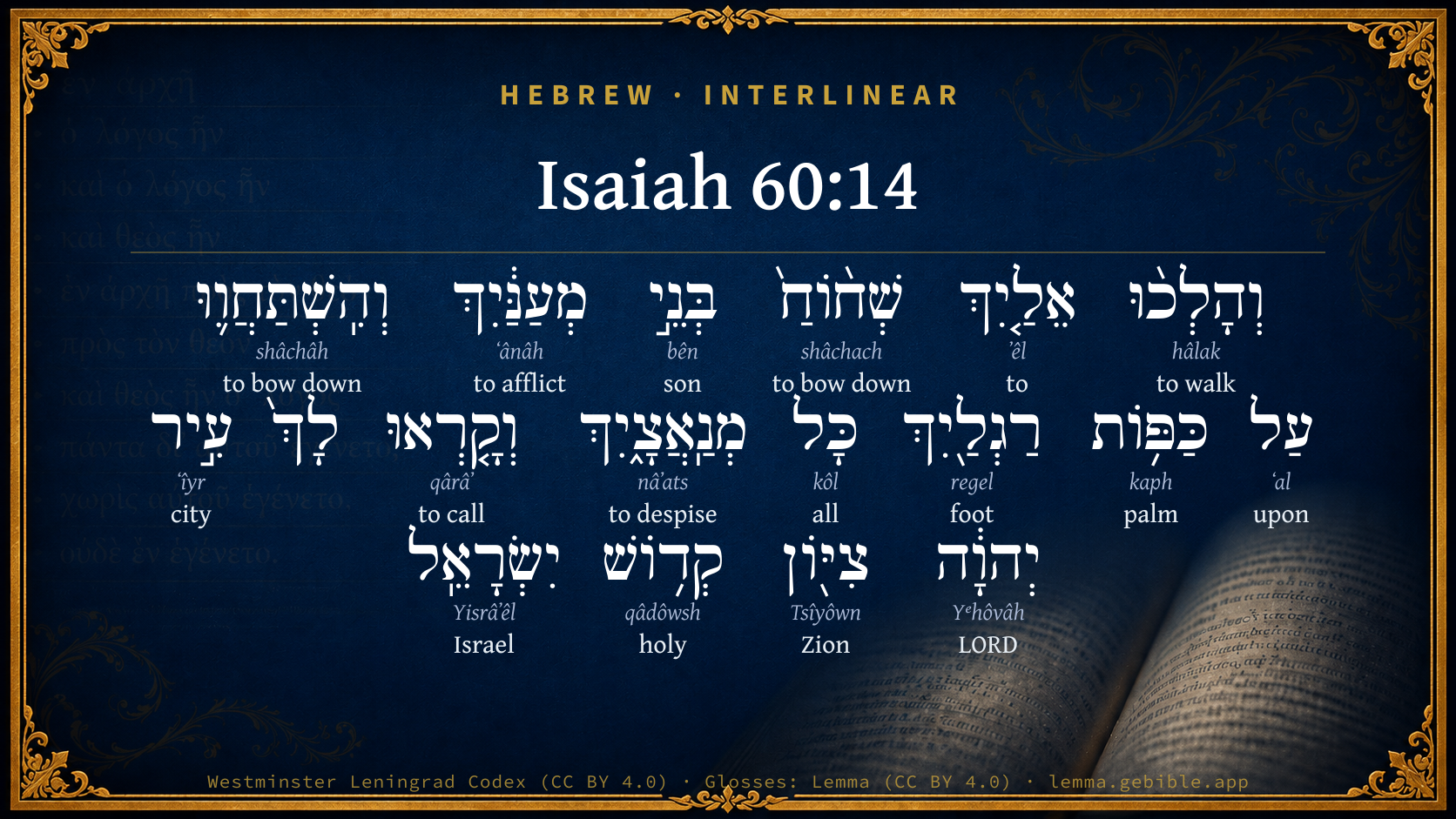
Hebrew (Westminster Leningrad Codex) Isaiah 60:14 appears in the Hebrew Old Testament. The text above is from the Westminster Leningrad Codex. Each word links to its Strong’s number, a concise gloss, and parsing drawn from the Open Scriptures Hebrew Bible morphology. Click any word for its full Brown-Driver-Briggs (BDB) entry.
Download image
Cite this verse

Isaiah 60:14 (World English Bible). Public Domain. Lemma interlinear Bible study tool, https://lemma.gebible.app/v/isaiah/60/14.

Show BibTeX & RIS
BibTeX
RIS
English Translation
The sons of those who afflicted you shall come bending to you; and all those who despised you shall bow themselves down at the soles of your feet; and they shall call you The city of Yahweh, The Zion of the Holy One of Israel.
World English Bible · Public Domain
Download a study sheet

One document with this verse’s original text, its word-by-word gloss line, the meaning frame, cross-references with their text, attributed commentary, and full source and license credits — printable, and it pastes into notes with its structure intact.

This verse Autodidact and up

Study sheet (.html) Plain text (.txt)

A passage Seminary Student

Up to 50 verses in one chapter. A passage sheet keeps up to 6 commentary sources and 12 cross-references per verse, in the order this page ranks them, and says so on the sheet whenever that leaves anything out. Ask for a single verse and you get the Autodidact verse sheet above.

Everything on this page stays free to read, with no account — the sheet is a download of what is already on screen, not access to it.

Want to remove ads? Support Godless Engineer
Compare translations 3

The same verse in 3 English versions, stacked beneath the original-language interlinear above. Click any original word for its lexicon entry.

Each is an independent rendering of the whole verse — the interlinear is not word-aligned to these translations.

Highlighted words mark where these versions differ — a whole-verse word diff, not a word-by-word alignment.

  • World English Bible Public Domain
    The sons of those who afflicted you shall come bending to you; and all those who despised you shall bow themselves down at the soles of your feet; and they shall call you The city of Yahweh, The Zion of the Holy One of Israel.
  • King James Version Public Domain
    The sons also of them that afflicted thee shall come bending unto thee; and all they that despised thee shall bow themselves down at the soles of thy feet; and they shall call thee; The city of the LORD, The Zion of the Holy One of Israel.
  • unfoldingWord Literal Text CC BY-SA 4.0
    And they will go to you bowing down, the sons of the ones having humbled you, and all of the ones having despised you will prostrate themselves at the soles of your feet, and they will call to you “The City of Yahweh,” “Zion of the Holy One of Israel.”

unfoldingWord Literal Text — © unfoldingWord, licensed CC BY-SA 4.0. Word-aligned USFM3 via Door43 (git.door43.org/unfoldingWord/en_ult).

Versions to compare (up to 4)

3 of 4 selected

Show all 18 translations

Every available English version of this verse, each an independent rendering of the whole verse.

  • World English Bible Public Domain
    The sons of those who afflicted you shall come bending to you; and all those who despised you shall bow themselves down at the soles of your feet; and they shall call you The city of Yahweh, The Zion of the Holy One of Israel.
  • Berean Standard Bible Public Domain
    The sons of your oppressors will come and bow down to you; all who reviled you will fall facedown at your feet and call you the City of the LORD, Zion of the Holy One of Israel.
  • Majority Standard Bible Public Domain
    The sons of your oppressors will come and bow down to you; all who reviled you will fall facedown at your feet and call you the City of the LORD, Zion of the Holy One of Israel.
  • King James Version Public Domain
    The sons also of them that afflicted thee shall come bending unto thee; and all they that despised thee shall bow themselves down at the soles of thy feet; and they shall call thee; The city of the LORD, The Zion of the Holy One of Israel.
  • American Standard Version (1901) Public Domain
    And the sons of them that afflicted thee shall come bending unto thee; and all they that despised thee shall bow themselves down at the soles of thy feet; and they shall call thee The city of Jehovah, The Zion of the Holy One of Israel.
  • Revised Version (1885) Public Domain
    And the sons of them that afflicted thee shall come bending unto thee; and all they that despised thee shall bow themselves down at the soles of thy feet; and they shall call thee The city of the LORD, The Zion of the Holy One of Israel.
  • Geneva Bible (1599) Public Domain
    The sonnes also of them that afflicted thee, shall come and bowe vnto thee: and all they that despised thee, shall fall downe at the soles of thy feete: and they shall call thee, The citie of the Lord, Zion of the Holy one of Israel.
  • Douay-Rheims (1899) Public Domain
    And the children of them that afflict thee, shall come bowing down to thee, and all that slandered thee shall worship the steps of thy feet, and shall call thee the city of the Lord, the Sion of the Holy One of Israel.
  • Young's Literal Translation Public Domain
    And come unto thee, bowing down, Have sons of those afflicting thee, And bowed themselves to the soles of thy feet Have all despising thee, And they have cried to thee: `City of Jehovah, Zion of the Holy One of Israel.'
  • Literal Standard Version CC BY-SA 4.0
    And the sons of those afflicting you || Have come to you, bowing down, || And all despising you || Have bowed themselves to the soles of your feet, || And they have cried to you: The City of YHWH, || Zion of the Holy One of Israel!
  • Unlocked Literal Bible CC BY-SA 4.0
    They will come to you to bow down, the sons of those who humbled you; they will bow at your feet; they will call you The City of Yahweh, Zion of the Holy One of Israel.
  • unfoldingWord Literal Text CC BY-SA 4.0
    And they will go to you bowing down, the sons of the ones having humbled you, and all of the ones having despised you will prostrate themselves at the soles of your feet, and they will call to you “The City of Yahweh,” “Zion of the Holy One of Israel.”
  • Darby Bible Public Domain
    And the children of them that afflicted thee shall come bending unto thee; and all they that despised thee shall bow themselves down at the soles of thy feet; and they shall call thee The city of Jehovah, the Zion of the Holy One of Israel.
  • World Messianic Bible Public Domain
    The sons of those who afflicted you will come bowing to you; and all those who despised you will bow themselves down at the soles of your feet. They will call you the LORD’s City, the Zion of the Holy One of Israel.
  • Webster's Bible Public Domain
    The sons also of them that afflicted thee shall come bending to thee; and all they that despised thee shall bow themselves down at the soles of thy feet; and they shall call thee, The city of the LORD, The Zion of the Holy One of Israel.
  • Free Bible Version CC BY-SA 4.0
    The children of those who persecuted you will come and bow before you; everyone who looked down on you will bow down at your feet and will call you the City of the Lord, Zion of the Holy One of Israel.
  • Bible in Basic English Public Domain
    And the sons of those who were cruel to you will come before you with bent heads; and those who made sport of you will go down on their faces at your feet; and you will be named, The Town of the Lord, The Zion of the Holy One of Israel.
  • JPS Tanakh (1917) Public Domain
    And the sons of them that afflicted thee shall come bending unto thee, and all they that despised thee shall bow down at the soles of thy feet; and they shall call thee The city of the LORD, the Zion of the Holy One of Israel.

Literal Standard Version (2020), Covenant Press — licensed CC BY-SA 4.0. Text via the HelloAO Bible API (eBible.org). Unlocked Literal Bible (unfoldingWord) — licensed CC BY-SA 4.0. Text via the HelloAO Bible API (eBible.org). unfoldingWord Literal Text — © unfoldingWord, licensed CC BY-SA 4.0. Word-aligned USFM3 via Door43 (git.door43.org/unfoldingWord/en_ult). Free Bible Version, Dr. Jonathan Gallagher — licensed CC BY-SA 4.0. Text via the HelloAO Bible API (eBible.org).

Word by word

More ways to search: Search by grammar → Find every occurrence → Compare this word →

Practice this passage: Drill this verse → Learn its vocabulary →

שְׁח֨וֹחַ֙
shâchach
H7817
“to bow down”
Verb, Qal, Infinitive Construct
Part of Speech
Verb
Stem
Qal
Form
Infinitive Construct
Full BDB Definition

Origin: a primitive root

TWOT: 2361

to bow, crouch, bow down, be bowed down - (Qal) - to be bowed down, be prostrated, be humbled - to bow (in homage) - to bow (of mourner) - to crouch (of wild beast in lair) - (Niphal) to be prostrated, be humbled, be reduced, be weakened, proceed humbly, be bowed down - (Hiphil) to prostrate, lay low, bow down - (Hithpolel) to be cast down, be despairing
  1. וְהָלְכ֨וּ hâlak H1980 “and · to walk” Conjunction + Verb, Qal, Sequential Perfect, 3rd Person, Common, Plural
  2. אֵלַ֤יִךְ ʼêl H413 “to · you” Preposition + Suffix, Personal, 2nd Person, Feminine, Singular
  3. בְּנֵ֣י bên H1121 “sons of” Noun, Common, Masculine, Plural, Construct
  4. מְעַנַּ֔יִךְ ʻânâh H6031 “afflicting · you” Verb, Piel, Participle Active, Masculine, Plural, Construct + Suffix, Personal, 2nd Person, Feminine, Singular
  5. וְהִֽשְׁתַּחֲו֛וּ shâchâh H7812 “and · to bow down” Conjunction + Verb, Hishtaphel, Sequential Perfect, 3rd Person, Common, Plural
  6. עַל ʻal H5921 “upon” Preposition
  7. כַּפּ֥וֹת kaph H3709 “palms of” Noun, Common, Feminine, Plural, Construct
  8. רַגְלַ֖יִךְ regel H7272 “feet · your” Noun, Common, Feminine, Dual, Construct + Suffix, Personal, 2nd Person, Feminine, Singular
  9. כָּל kôl H3605 “all of” Noun, Common, Masculine, Singular, Construct
  10. מְנַֽאֲצָ֑יִךְ nâʼats H5006 “despising · you” Verb, Piel, Participle Active, Masculine, Plural, Construct + Suffix, Personal, 2nd Person, Feminine, Singular
  11. וְקָ֤רְאוּ qârâʼ H7121 “and · to call” Conjunction + Verb, Qal, Sequential Perfect, 3rd Person, Common, Plural
  12. עִ֣יר ʻîyr H5892 “city of” Noun, Common, Feminine, Singular, Construct
  13. יְהוָ֔ה Yᵉhôvâh H3068 “LORD” Noun, Proper
  14. צִיּ֖וֹן Tsîyôwn H6726 “Zion” Noun, Proper
  15. קְד֥וֹשׁ qâdôwsh H6918 “holy of” Adjective, Adjective, Masculine, Singular, Construct
  16. יִשְׂרָאֵֽל Yisrâʼêl H3478 “Israel” Noun, Proper

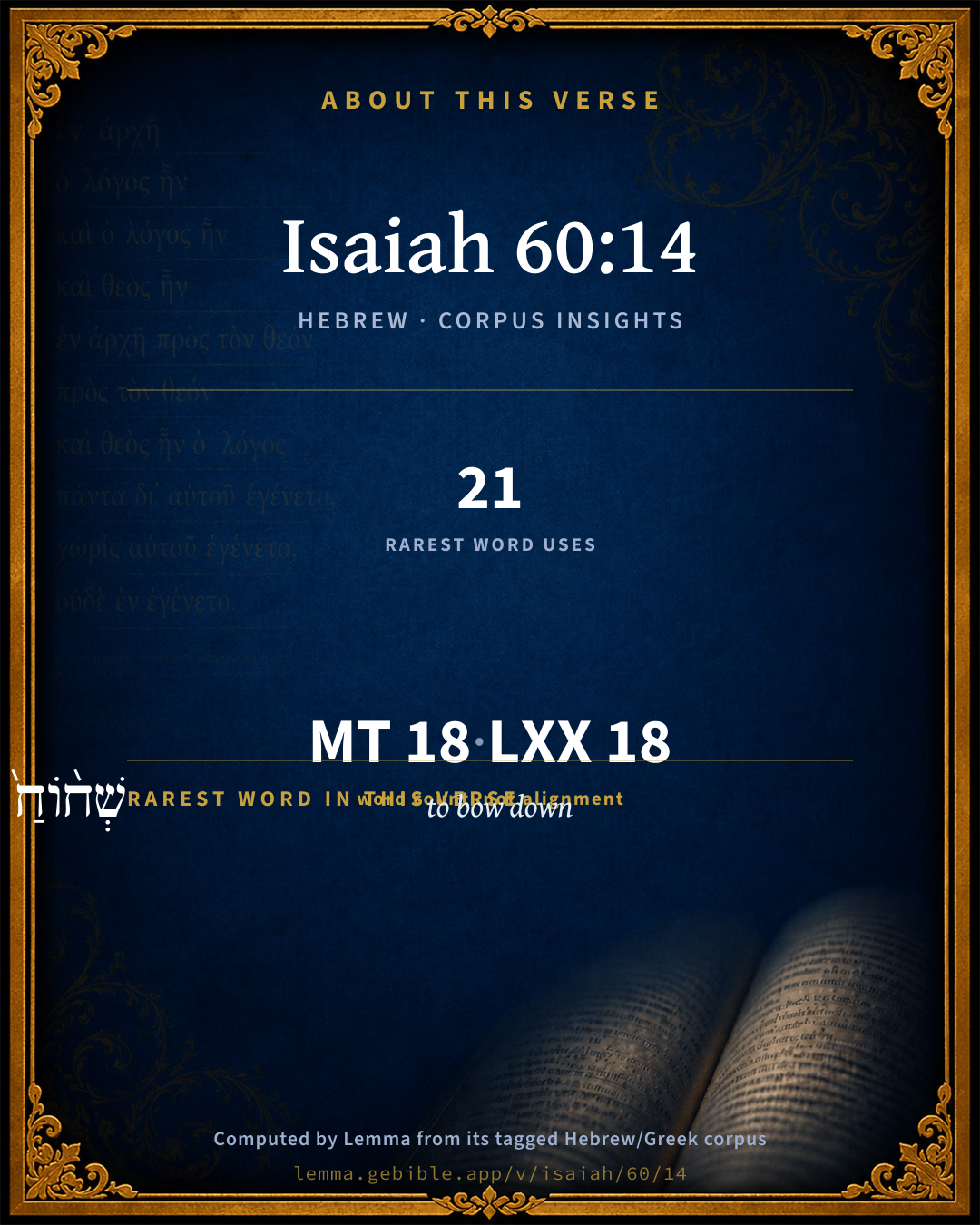
About this verse

These counts appear in no published source. They are computed here, from the morphology-tagged text and Lemma’s own curated glosses. What Lemma adds →

18
words
17
distinct lemmas
Prophets
section

Notable vocabulary

The rarest word here is שְׁח֨וֹחַ֙ to bow down H7817 — appearing just 21 times in the whole Hebrew Bible.

Shared distinctive vocabulary

שְׁח֨וֹחַ֙ to bow down H7817 occurs in 21 verses of the Hebrew Bible. Also found in:

Grammatical profile

  • 6 verbs
  • 8 nouns
  • 1 adjective
  • 3 prepositions

Verb forms

  • וְהָלְכ֨וּ Qal · Sequential Perfect
  • שְׁח֨וֹחַ֙ Qal · Infinitive Construct
  • מְעַנַּ֔יִךְ Piel · Participle Active
  • וְהִֽשְׁתַּחֲו֛וּ Hishtaphel · Sequential Perfect
  • מְנַֽאֲצָ֑יִךְ Piel · Participle Active
  • וְקָ֤רְאוּ Qal · Sequential Perfect

Hebrew & Septuagint length

In English translation the verse runs 45 words from the Hebrew and 34 from the Septuagint (LXX English) — closely comparable.

A rough comparison of the two English renderings, which tokenize alike — not a word-level alignment.

Word counts can differ between the Hebrew and the Greek without any difference in meaning — e.g. the Hebrew direct-object marker אֵת has no separate Greek word, and Greek often adds the article ὁ.

In the original languages it is 18 Hebrew tokens and 18 Greek tokens — but the two are counted differently (Hebrew bundles its prefixes and suffixes into one token; the Greek is in lemma form), so that isn’t a like-for-like length.

Cross-references

11

Topical passages linked to Isaiah 60:14 in the Treasury of Scripture Knowledge — connected by theme and wording, ordered by reader-vote popularity; previews shown in the World English Bible.

  • Revelation 3:9 Behold, I give of the synagogue of Satan, of those who say they are Jews, and they are not, but lie. Behold, I will make them to come and worship before your feet, and to know that I have loved you.
  • Isaiah 49:23 Kings shall be your nursing fathers, and their queens your nursing mothers: they shall bow down to you with their faces to the earth, and lick the dust of your feet; and you shall know that I am Yahweh; and those who wait for me shall not be disappointed.
  • Isaiah 45:14 Thus says Yahweh: "The labor of Egypt, and the merchandise of Ethiopia, and the Sabeans, men of stature, shall come over to you, and they shall be yours. They shall go after you. In chains they shall come over; and they shall fall down to you. They shall make supplication to you: 'Surely God is in you; and there is none else, there is no other god.
  • Hebrews 12:22 But you have come to Mount Zion, and to the city of the living God, the heavenly Jerusalem, and to innumerable hosts of angels,
  • Isaiah 1:26 I will restore your judges as at the first, And your counselors as at the beginning. Afterward you shall be called 'The city of righteousness, A faithful town.'
  • Isaiah 14:1–2 For Yahweh will have compassion on Jacob, and will yet choose Israel, and set them in their own land: and the foreigner shall join himself with them, and they shall cleave to the house of Jacob.
  • Isaiah 62:12 They shall call them The holy people, The redeemed of Yahweh: and you shall be called Sought out, A city not forsaken.
  • Revelation 3:12 He who overcomes, I will make him a pillar in the temple of my God, and he will go out from there no more. I will write on him the name of my God, and the name of the city of my God, the new Jerusalem, which comes down out of heaven from my God, and my own new name.
  • Jeremiah 16:19 Yahweh, my strength, and my stronghold, and my refuge in the day of affliction, to you shall the nations come from the ends of the earth, and shall say, Our fathers have inherited nothing but lies, [even] vanity and things in which there is no profit.
  • Psalms 87:3 Glorious things are spoken about you, city of God. Selah.
  • Revelation 14:1 I saw, and behold, the Lamb standing on Mount Zion, and with him a number, one hundred forty-four thousand, having his name, and the name of his Father, written on their foreheads.

Cross-references courtesy of OpenBible.info (CC BY 4.0).

Hebrew and Greek witnesses Masoretic Hebrew ↔ Greek Septuagint

The same verse in the two great witnesses to the Old Testament, shown verse-for-verse.

These are two independent witnesses, not word-aligned to each other, and the Septuagint is shown in lemma (dictionary) form.

Hebrew Isaiah 60:14 Masoretic · Westminster Leningrad Codex

וְהָלְכ֨וּ אֵלַ֤יִךְ שְׁח֨וֹחַ֙ בְּנֵ֣י מְעַנַּ֔יִךְ וְהִֽשְׁתַּחֲו֛וּ עַל כַּפּ֥וֹת רַגְלַ֖יִךְ כָּל מְנַֽאֲצָ֑יִךְ וְקָ֤רְאוּ לָךְ֙ עִ֣יר יְהוָ֔ה צִיּ֖וֹן קְד֥וֹשׁ יִשְׂרָאֵֽל

The sons of those who afflicted you shall come bending to you; and all those who despised you shall bow themselves down at the soles of your feet; and they shall call you The city of Yahweh, The Zion of the Holy One of Israel.

World English Bible · Public Domain

Greek LXX Isaiah 60:14 Septuagint · lemma form

καί πορεύομαι πρός σύ δείδω υἱός ταπεινόω σύ καί παραὀξύνω σύ καί καλέω πόλις κύριος σιων ἅγιος ἰσραήλ

And the sons of them that afflicted you, and of them that provoked you, shall come to you in fear; and you shall be called Sion, the city of the Holy One of Israel.

LXX2012 (modern English Septuagint) · Public Domain

On this verse, The Cambridge Bible for Schools and Colleges discusses the Septuagint’s reading. Read the note in Commentary ↓

Hebrew: Westminster Leningrad Codex (CC BY 4.0). Greek: Septuagint (public domain); English from LXX2012 (modern English Septuagint) (Public Domain). How the Septuagint differs from the Hebrew →

Targum (Aramaic paraphrase)

1

The Targum is the ancient Jewish Aramaic paraphrase of the Hebrew Scriptures — an interpretive translation, not the Hebrew text itself. Onkelos (literal) and Pseudo-Jonathan (expansive) render the Torah, and Jonathan the Prophets. Coverage is partial: where no permissively-licensed English translation exists for a verse, only the Aramaic is shown. This is verse-level text, not a word-by-word alignment to the Hebrew.

  1. Targum Jonathan Prophets (Joshua–Malachi)
    וִיהָכוּן לְגַוִיךְ כְּפִיפִין בְּנֵי מְשַׁעְבְּדַיִךְ וְיִשְׁטַתְּחוּן לְמִבְעֵי מִנִיךְ עַל פַּרְסַת רִגְלִיךְ כָּל דַהֲווֹ מַרְגְזִין לִיךְ וְיִקְרוֹן לִיךְ קַרְתָּא דַייָ צִיוֹן דְאִתְרְעֵי בָהּ קַדִישָׁא דְיִשְׂרָאֵל:

    The sons of them that enslaved thee shall come and bow down to thee, and all that provoked thee to anger shall prostrate themselves at the soles of thy feet to make supplication unto thee; and they shall call thee, The city of the Lord, The Zion in which the Holy One of Israel delights.

    Targum Jonathan — Aramaic: “Mikraot Gedolot” (public domain). English: “Sefaria Community Translation” (CC0 1.0 (public-domain dedication)); “London "Chaldee Paraphrase," 1871” (public domain). Text via Sefaria.

Commentary

Notes on Isaiah 60:14 from classic Christian and Jewish commentators (each source and its license shown beneath its notes). The classic Christian expositions comment on the surrounding passage and are grouped to its opening verse, so a note may address several verses; the Jewish commentaries on the Tanakh (Rashi and others) are per-verse, so they appear only where the commentator wrote on this verse.

Lemma curates 59 commentaries, every one of them public domain or Creative Commons licensed, each selected and text-cleaned for this edition rather than reprinted as found. About our sources →

Trapp's Complete Commentary

John Trapp

Isa 60:14 The sons also of them that afflicted thee shall come bending unto thee; and all they that despised thee shall bow themselves down at the soles of thy feet; and they shall call thee, The city of the LORD, The Zion of the Holy One of Israel.

Ver. 14. The sons also of them that afflicted thee.] When once they shall return and discern between the righteous and the wicked, {as Mal 3:18} there shall be a strange alteration wrought in them, as was in Paul, Cyprian, Vergerius, Latimer, and others.

Shall bow themselves at the soles of thy feet.] Such was the custom of the Easterlings; and this, the Popish writers say, is fulfilled in their vicegod, as we may, in the worst sense, best call him. The first that held forth his feet to be kissed was Dioclesian the Tyrant. {a}

{a} Eutrop.

John Trapp, A Commentary or Exposition upon All the Books of the Old and New Testament (1647–1656) — public domain. Text from a community e-Sword module.

The Biblical Illustrator

Joseph S. Exell

Isa_60:14

The sons also of them that afflicted thee shall come bending unto thee

Honour done to the Church

A promise like this is made to the Church of Philadelphia (Rev_3:9); and it is intended to be--

1.

A mortification to the proud oppressors of the Church.

2. An exaltation to the poor, oppressed ones of the Church.

3. And this is the honour that shall be done them: they shall have an opportunity of doing good to those who have done evil to them, and saving those alive that have afflicted and despised them. It is a pleasure to a good man, and he accounts it an honour, to show mercy to those with whom he has found no mercy. (M. Henry.)

The city of the Lord

The city of the Lord

1. He hath built it for the honour of His majesty.

2. It bears His name.

3. He hath fortified it with impregnable walls and bulwarks.

4. He hath beautified it with the graces of His spirit.

5. He hath replenished it with the blessings of His goodness.

6. He hath felicitated it with His gracious presence.

7. It is the city wherein reside the peculiar people of God, who are the beloved of the Lord, on whom His eyes and His heart are continually fixed.

8. He esteems it above all the kingdoms and empires of the world. (R. Macculloch.)

An ideal city

That city is truly great and honourable, it is strong, it is rich, it is safe, it is beautiful, it is the most desirable place that can be to live in, which is the city of the Lord, which He owns, in which He dwells, in which religion is uppermost. (M. Henry.)

The Biblical Illustrator, edited by Joseph S. Exell (c. 1880s–1900s) — public domain. Text from a community e-Sword module.

Joseph Benson's Commentary

Isa 60:14. The sons of them, that afflicted thee — Their posterity, or themselves, for it is the manner of the Hebrews so to speak; shall come bending unto thee — Humbling themselves as penitents, and thus manifesting their respect and reverence for thee. They shall acknowledge their former errors, or the errors of their fathers, and instead of being persecutors shall become proselytes. And all they that despised thee — As a poor, mean, insignificant, and despicable people; shall bow themselves down at the soles of thy feet — Shall prostrate themselves before thee as humble suppliants, or rather before Christ, the head, husband, and king of his church. And they shall call thee, The city of the Lord — They shall acknowledge thee to be so, and to be so called, both from the love that God hath to thee, and from the presence of God with thee. As there is no account of any thing like this happening to the Jews, that any people, who had before persecuted and afflicted them, came and made submission to them in such a suppliant manner as is here represented, this must, of necessity, be considered as a description, either, 1st, Of that change of things which was made in the Roman empire, when the highest powers in it, even the emperors themselves, became Christians, in consequence of which the heathen became suppliants to the Christians, whom they had before treated in the most cruel and barbarous manner: or, 2d, Of that still greater change which shall take place, in this respect, when the kingdoms of this world shall become the kingdoms of our God and of his Christ, and he will make his church’s enemies to come and worship, that is, to prostrate themselves before her feet, and to know that he has loved her, Rev 3:9.

Joseph Benson's Commentary on the Old and New Testaments (1811–1818) — public domain. Text from a community e-Sword module.

Geneva Bible (1599)

Geneva Bible translators

To worship their head Christ, by obeying his doctrine.

Geneva Bible (1599) marginal notes — public domain. Text via Bolls.life.

Jamieson, Fausset & Brown

Robert Jamieson, A. R. Fausset & David Brown

The sons--Their fathers who "afflicted" Israel having been cut off by divine judgments (Isa 14:1-2; Isa 49:23).

The Zion of the Holy One--The royal court of the Holy One. MAURER translates, "Zion, the sanctuary (holy place) of Israel" (Isa 57:15; Psa 46:4).

Jamieson, Fausset & Brown — Commentary Critical and Explanatory on the Whole Bible (1871) — public domain (CC PDM 1.0). Text via the HelloAO Bible API.

Ellicott's Commentary for English Readers

(14) The sons also of them that afflicted thee . . .—The explanation commonly given is that the “sons” are named because the persecutors themselves are thought of as no more. It seems better, however, to see in the words an expression of the law of inherited retribution, which entered so largely into the Hebrew’s thought of the moral government of the world. That law will show itself in the prostrate homage with which the descendants of the old oppressors will recognise that the restored city is indeed the Zion of the Holy One of Israel.

A Bible Commentary for English Readers, edited by Charles John Ellicott (1878–1897) — public domain. Text from a community e-Sword module.

The Cambridge Bible for Schools and Colleges

gen. ed. J. J. S. Perowne

14. The homage done to Zion by her former oppressors is probably to be regarded as the consequence of the new glory which accrues to the Sanctuary (Isa_60:13).

The sons also … feet] The LXX. reads simply: “And there shall come crouching unto thee the sons of thine afflicters and despisers.” The words omitted (“all” and “shall bow … feet”) are probably a gloss.

The Zion of the Holy One of Israel] On the construction of the proper name followed by a genitive see Davidson, Syntax, § 24, R. 6.

The Cambridge Bible for Schools and Colleges (gen. ed. J. J. S. Perowne; Cambridge University Press, 1878–1918) — public domain. Text from a community e-Sword module.

John Gill's Exposition

The sons also of them that afflicted thee shall come bending unto thee,.... The posterity of the Jews, who persecuted the first Christian churches, even those who say they are Jews and are not; these shall be convinced of the truth of the Christian religion, and be converted to it, and shall come and worship before the church, and in fellowship with it, and own it to be the true church of God; which is what is foretold shall be in the Philadelphian state, which is the same with the spiritual reign here described; see Rev 3:9 or the children of the Roman Heathens, their remote descendants, who formerly greatly distressed the Christians; or rather the posterity of Rome Papal, many of whom shall be called out of her at the time of her destruction, and be humble suppliants to the church of Christ, and be subject to the doctrines, rules, and laws of it, whose ancestors cruelly persecuted it:

and all they that despised thee shall bow themselves down at the soles of thy feet; a phrase expressive of great respect, veneration, and submission; see Isa 49:23,

and they shall call thee the city of the Lord, the Zion of the Holy One of Israel; instead of calling them heretics, schismatics, and fanatics, as their fathers did, they shall own them to be the true church of Christ; a city of his building, and where he dwells; the object of his choice, delight, and love, as Zion was; a holy people made meet to be the habitation of the God of Israel; which are so many names for the church under the Gospel dispensation; see Heb 12:22.

John Gill's Exposition of the Whole Bible (1746–1763) — public domain (CC PDM 1.0). Text via the HelloAO Bible API.

Albert Barnes' Notes on the Bible

The sons of them that afflicted thee - In the previous verses the prophet had said that strangers and foreigners would become tributary to the true religion. Here, to give variety and interest to the description, he says, that even the descendants of those who had oppressed them would become tributary to them, and acknowledge them as favored by Yahweh.

Shall come bending unto thee - Shall come to time in a posture of humiliation and respect, In regard to the fulfillment of this, we may observe:

1. That there was a partial fulfillment of it in the conquest of Babylon. The sons, the descendants of those who had destroyed Jerusalem, and led the Jews into captivity, were constrained to acknowledge them, and, under Cyrus, to reconduct them to the land of their fathers (see the notes at Isa 14:1-2).

2. It has often occurred, in times of persecution, that the immediate descendants of the persecutors, and that too by means of the persecution, became converted to the true religion, and acknowledged the God of those whom they bad persecuted to be the true God.

3. It often occurs in times when there is no open and public persecution. Many of those now in the church are the children or descendants of those who had been the enemies of the gospel. They themselves did all that could be done, by their lives and examples, to train up their children in opposition to it. But the sovereign mercy of God interposed, and from such he selected heralds of salvation and preachers of righteousness to a lost world, or such as should become shining lights in the more obscure walks of the Christian life.

And all they that despised thee - There shall yet be a universal acknowledgment of the true religion even in those nations that have spurned the gospel. This does not mean that all who have ever despised the true religion shall be converted and saved, but that there shall be a universal acknowledgement that it is of God, and that the church is under his care. See an explanation of this sentiment in the notes at Isa 45:23.

At the soles of thy feet - In a posture of the utmost reverence and submission (see Rev 3:9; compare the notes at Isa 49:23).

And they shall call thee - They shall honor thee as the favored of the Lord; as the abode of the true God (see Isa 2:3).

The Zion ... - The Zion, or the royal court where the holy God that is worshipped in Israel dwells.

Albert Barnes' Notes on the Bible (1834–1885) — public domain. Text from a community e-Sword/MySword module.

Haydock's Catholic Bible Commentary

Feet. Protestants, "shall bow themselves down at the soles of thy feet." This posture is not then essentially idolatrous. (Haydock) --- Jerusalem shall be rebuilt by those who destroyed it, chap. xlix. 17. It is not easy to prove this of the earthly city: but the pagans, who persecuted the Church, have embraced her communion, and begged to receive baptism.

George Leo Haydock (1774–1849), Haydock's Catholic Family Bible and Commentary, 1859 edition — public domain. Excludes Psalms (Douay-Rheims chapter numbering differs from Protestant) and Deuterocanonical books (Catholic canon only).

Matthew Poole's English Annotations

The sons; either their posterity, acknowledging their fathers’ sins in afflicting thee; or themselves; for it is the manner of the Hebrews to put the sons of a thing for the thing itself.

Bending; humbling themselves, as penitents; this being the sign of reverence and respect; and that either for love or fear submit to the yoke of Christ; they shall be like Christ, of a humble and meek spirit, and the degree of this is mentioned in the next clause.

Bow themselves down at the soles of thy feet: this notes that great degree of submission, that even despisers and enemies shall yield to the church, prostrating themselves as humble suppliants; see Isa 49:23; or rather to Christ, the Head, King, and Husband of the church.

They shall call thee, The city; they shall give her that honourable title, or acknowledge her to be so, and so called, both from the love that God had for her, and from the temple of God that was in her.

Matthew Poole's English Annotations on the Holy Bible (1683–1685) — public domain. Text from a community e-Sword/MySword module.

Whedon's Commentary on the Bible

Daniel D. Whedon

14. Sons… of them that afflicted thee — Descendants of thy ancient persecutors.

Shall come bending unto thee — Shall confess the mistakes and sins of their fathers, and shall (not with nicknames or worse, as heretofore) respectfully acknowledge thee to be the city of Jehovah, the Zion of the Holy One of Israel. And they declare thereby their faith in the true God; for Jerusalem stands as the monument proclaiming to the world the true Godhead of Jehovah.

Daniel D. Whedon (gen. ed.), Commentary on the Old and New Testaments (1874–1909) — public domain. Text from a community e-Sword module.

The Pulpit Commentary

The sons (i.e. descendants) also of them that afflicted thee; i.e. of the various nations that at different times oppressed and afflicted Israel as Egyptians, Canaanites, Philistines, Assyrians, Babylonians, Edomites, Moabites, Ammonites, etc. Shall come bending unto thee. Bowing themselves down to the new Israel the Israel of God as the eleven sheaves bowed themselves down to Joseph"s sheaf. (Gen_37:7) At the soles of thy feet. (comp. Isa_49:23) Shall call thee, The city of the Lord. Hitherto her enemies had bestowed on Jerusalem disparaging names, as "Forsaken," or Desolate. (Isa_62:4) Now they will substitute for such names titles of honour, such as City of Jehovah," Zion of Israel"s Holy One."

The Pulpit Commentary (1880–1919), ed. H.D.M. Spence-Jones & Joseph S. Exell — public domain. Text from a community e-Sword module.

John Wesley's Explanatory Notes

The sons - Either their posterity, or themselves, for it is the manner of the Hebrew so to speak. Bending - Humbling themselves, as penitents. Call thee - They shall acknowledge her to be so.

John Wesley, Explanatory Notes Upon the Whole Bible (1754–1765) — public domain. Text via the GEBible commentary corpus.

Keil & Delitzsch

C. F. Keil & F. Delitzsch

The prophecy now returns to the world of man. "The children also of thy tormentors come bending unto thee, and all thy despisers stretch themselves at the soles of thy feet, and call thee 'City of Jehovah, Zion of the Holy One of Israel.'" The persecutors of the church both in work and word are now no more (Isa 26:14), and their children fell themselves disarmed. They are seized with shame and repentance, when they see the church which was formerly tormented and despised so highly exalted. They come shechōăch (an inf. noun of the form טחון, Lam 5:13; used here as an accusative of more precise definition, just as nouns of this kind are frequently connected directly with the verb הלך, Ewald, 279, c), literally a bow or stoop, equivalent to bowing or stooping (the opposite to rōmâh in Mic 2:3), and stretch themselves "at the soles of thy feet," i.e., clinging to thee as imploringly and obsequiously as if they would lay themselves down under thy very feet, and were not worthy to lie anywhere but there (as in Isa 49:23); and whereas formerly they called thee by nicknames, they now give thee the honourable name of "City of Jehovah, Zion of the Holy One of Israel," not "Sanctuary of Israel," as Meier supposes, since qedōsh Israel is always a name of Jehovah in the book of Isaiah. It is a genitive construction like Bethlehem of Judah, Gibeah of Saul, and others.

Keil & Delitzsch — Biblical Commentary on the Old Testament (1861–1891) — public domain (CC PDM 1.0). Text via the HelloAO Bible API. (Old Testament only.)

J. A. Alexander on Isaiah

Joseph Addison Alexander

“Then shall come to thee bending the sons of thy oppressors, then shall bow down to the soles of thy feet all thy despisers, and shall call thee the City of Jehovah, Zion the holy (place) of Israel (or the Zion of the Holy One of Israel).” For the same ideas and expressions, see above, Isa 45:14 and Isa 49:23. The act described is the oriental prostration as a sign of the profoundest reverence. The sons are mentioned either for the purpose of contrasting the successive generations more emphatically, or as a mere oriental idiom without distinctive meaning. In favor of the latter supposition is the circumstance that it is wanting in the other clause, where the despisers are themselves represented as doing the same thing with the sons of the oppressors. These humbled enemies are represented as acknowledging the claim of Zion to be recognized as the holy place and dwelling of Jehovah. On the supposition hitherto assumed as the basis of the exposition, this verse simply means that the enemies of the Church shall recognize her in her true relation to her divine Head.

Joseph Addison Alexander, The Prophecies of Isaiah (1846–1847; New York: Scribner, 1870–1878) — public domain. Text from a community e-Sword module.

unfoldingWord translationNotes

Door43 World Missions Community

General Information:

Yahweh continues speaking to the people of Israel.

Holy One of Israel

See how you translated this in Isaiah 1:4.

translationWords

bow

son

humble

Yahweh

Zion

Holy One

Israel

unfoldingWord translationNotes — © Distant Shores Media and the Door43 World Missions Community, licensed CC BY-SA 4.0. Source: git.door43.org/Door43/en_tn.

Rashi

Rabbi Shlomo Yitzchaki (Rashi)

Zion of the Holy One of Israel [Lit. Zion the Holy One of Israel. Jonathan renders:] Zion desired by the Holy One of Israel, Zion of the Holy One of Israel.

Rashi on the Tanakh — English translations: “The Judaica Press complete Tanach with Rashi, translated by A. J. Rosenberg” (CC BY 4.0); “Pentateuch with Rashi's commentary by M. Rosenbaum and A.M. Silbermann, 1929-1934” (public domain); “The Metsudah Tanach series, Lakewood, N.J” (CC BY 4.0); and “The Book of Joshua, Metsudah Publications, 1997” (CC BY 4.0). Text via Sefaria.

Ibn Ezra

Rabbi Abraham ibn Ezra

שחח Bending. It is a noun.

And they shall call thee the city of the Lord. This proves that the exclamation Arise, etc. is addressed to Zion.

עיר קדש ישראל═קדש ישראל The city of the holy One of Israel. Comp. Ps. 6:1. here, the word עיר city.

Ibn Ezra on the Tanakh — English translations: “Sefaria Community Translation” (CC0 1.0 (public-domain dedication)); “Yalkut, Sifsei Chachomim Chumash, Metsudah Publications, 2009” (CC BY 4.0); and “Commentary of Ibn Ezra on Isaiah - trans. by M. Friedlander, 1873” (public domain). Text via Sefaria.

Lesson kit

Teaching starters — assembled from the data on this page, not authored interpretation. Every prompt links to the verse data it draws on. Edit before teaching.

Isaiah, in the Prophets, opens this verse with 18 words (17 distinct Hebrew lemmas). Its most distinctive word is shâchach (“to bow down”). A historical commentator’s framing appears above. Read the whole chapter for the surrounding context.

Discussion questions

  1. What does “to bow down” (shâchach) contribute to the verse as a whole?
  2. Job 9:13 shares the word «to bow down» with this verse. How do the two illuminate each other?
  3. These translations render this verse differently; the difference is in the English rendering, not the original. What questions does that raise?
  4. The verb «וְהָלְכ֨וּ» is Qal Sequential Perfect. How does its form color the action?
  5. Reading how Trapp's Complete Commentary and The Biblical Illustrator read this verse, where do the two commentators agree and where do they part?

Things to notice

Reading settings

Reading text

Shown beneath each verse's original-language words.

Old Testament
Old Testament edition

Read the OT as the Masoretic Hebrew (MT) or the Greek Septuagint (LXX).

English shown for the Greek Septuagint (in the Hebrew ↔ Greek comparison).

Comparing translations? Open the Compare panel on any verse page to stack up to four side by side.