
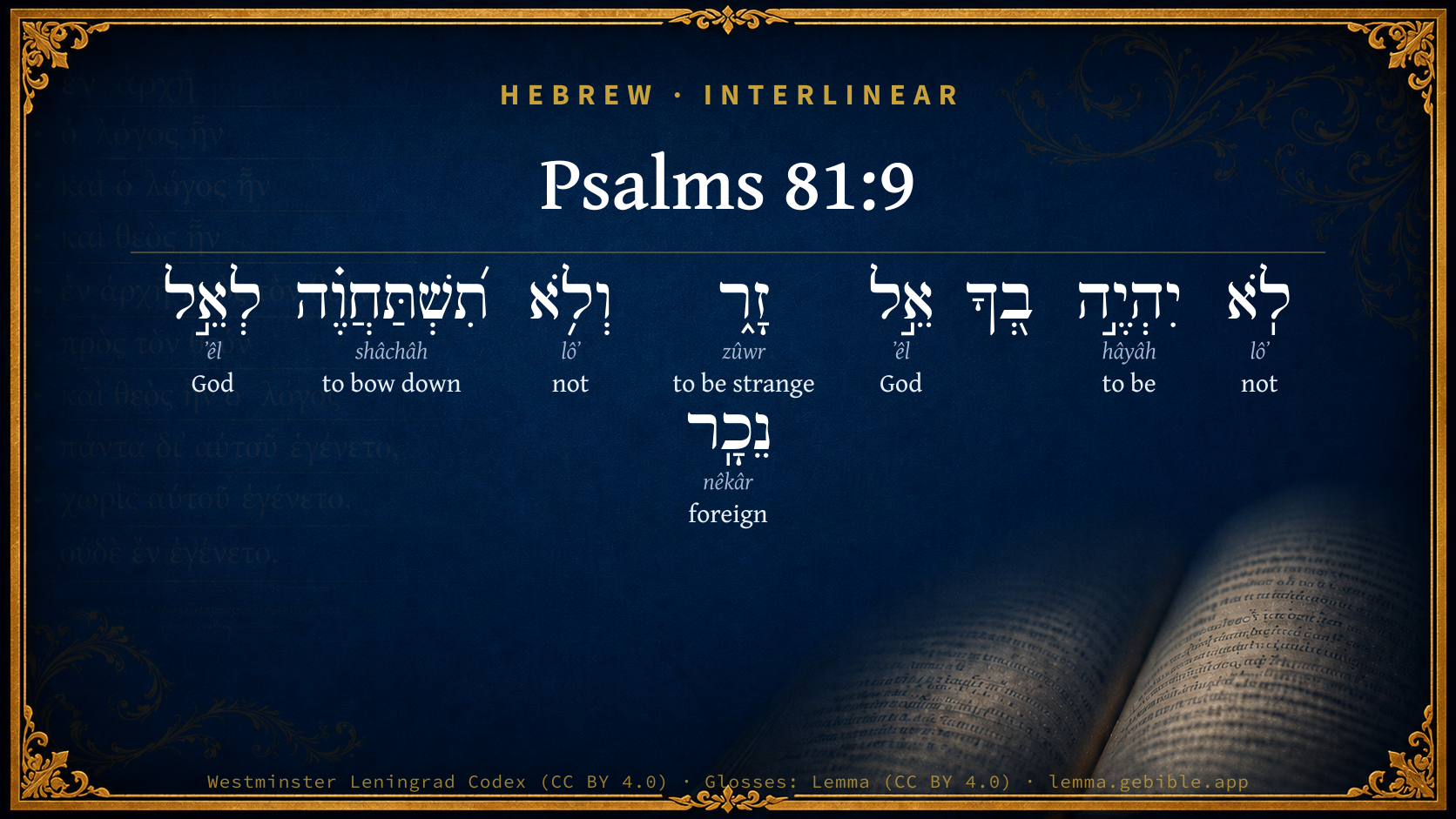
Psalms 81:9

Hebrew (Westminster Leningrad Codex) Psalms 81:9 appears in the Hebrew Old Testament. The text above is from the Westminster Leningrad Codex. Each word links to its Strong’s number, a concise gloss, and parsing drawn from the Open Scriptures Hebrew Bible morphology. Click any word for its full Brown-Driver-Briggs (BDB) entry.
Download image
Cite this verse

Psalms 81:9 (World English Bible). Public Domain. Lemma interlinear Bible study tool, https://lemma.gebible.app/v/psalms/81/9.

Show BibTeX & RIS
BibTeX
RIS
English Translation
There shall be no strange god in you, Neither shall you worship any foreign god.
World English Bible · Public Domain
Download a study sheet

One document with this verse’s original text, its word-by-word gloss line, the meaning frame, cross-references with their text, attributed commentary, and full source and license credits — printable, and it pastes into notes with its structure intact.

This verse Autodidact and up

Study sheet (.html) Plain text (.txt)

A passage Seminary Student

Up to 50 verses in one chapter. A passage sheet keeps up to 6 commentary sources and 12 cross-references per verse, in the order this page ranks them, and says so on the sheet whenever that leaves anything out. Ask for a single verse and you get the Autodidact verse sheet above.

Everything on this page stays free to read, with no account — the sheet is a download of what is already on screen, not access to it.

Want to remove ads? Support Godless Engineer
Compare translations 3

The same verse in 3 English versions, stacked beneath the original-language interlinear above. Click any original word for its lexicon entry.

Each is an independent rendering of the whole verse — the interlinear is not word-aligned to these translations.

Highlighted words mark where these versions differ — a whole-verse word diff, not a word-by-word alignment.

  • World English Bible Public Domain
    There shall be no strange god in you, Neither shall you worship any foreign god.
  • King James Version Public Domain
    There shall no strange god be in thee; neither shalt thou worship any strange god.
  • unfoldingWord Literal Text CC BY-SA 4.0
    There shall not be a strange god among you, and you shall not bow down to a god of foreignness.

unfoldingWord Literal Text — © unfoldingWord, licensed CC BY-SA 4.0. Word-aligned USFM3 via Door43 (git.door43.org/unfoldingWord/en_ult).

Versions to compare (up to 4)

3 of 4 selected

Show all 18 translations

Every available English version of this verse, each an independent rendering of the whole verse.

  • World English Bible Public Domain
    There shall be no strange god in you, Neither shall you worship any foreign god.
  • Berean Standard Bible Public Domain
    There must be no strange god among you, nor shall you bow to a foreign god.
  • Majority Standard Bible Public Domain
    There must be no strange god among you, nor shall you bow to a foreign god.
  • King James Version Public Domain
    There shall no strange god be in thee; neither shalt thou worship any strange god.
  • American Standard Version (1901) Public Domain
    There shall no strange god be in thee; Neither shalt thou worship any foreign god.
  • Revised Version (1885) Public Domain
    There shall no strange god be in thee; neither shalt thou worship any strange god.
  • Geneva Bible (1599) Public Domain
    Let there bee no strange god in thee, neither worship thou any strange god.
  • Douay-Rheims (1899) Public Domain
    Hear, O my people, and I will testify to thee: O Israel, if thou wilt hearken to me,
  • Young's Literal Translation Public Domain
    There is not in thee a strange god, And thou bowest not thyself to a strange god.
  • Literal Standard Version CC BY-SA 4.0
    There is not in you a strange god, || And you do not bow yourself to a strange god.
  • Unlocked Literal Bible CC BY-SA 4.0
    There must be no foreign god among you; you must not worship any foreign god.
  • unfoldingWord Literal Text CC BY-SA 4.0
    There shall not be a strange god among you, and you shall not bow down to a god of foreignness.
  • Darby Bible Public Domain
    There shall no strange ùgod be in thee, neither shalt thou worship any foreign ùgod.
  • World Messianic Bible Public Domain
    There shall be no strange god in you, neither shall you worship any foreign god.
  • Webster's Bible Public Domain
    \\81:8\\Hear, O my people, and I will testify to thee; O Israel, if thou wilt hearken to me;
  • Free Bible Version CC BY-SA 4.0
    There must not be a strange god among you; you must never bow down to foreign gods and worship them.
  • Bible in Basic English Public Domain
    There is to be no strange god among you; you are not to give worship to any other god.
  • JPS Tanakh (1917) Public Domain
    (81-10) There shall no strange god be in thee; neither shalt thou worship any foreign god.

Literal Standard Version (2020), Covenant Press — licensed CC BY-SA 4.0. Text via the HelloAO Bible API (eBible.org). Unlocked Literal Bible (unfoldingWord) — licensed CC BY-SA 4.0. Text via the HelloAO Bible API (eBible.org). unfoldingWord Literal Text — © unfoldingWord, licensed CC BY-SA 4.0. Word-aligned USFM3 via Door43 (git.door43.org/unfoldingWord/en_ult). Free Bible Version, Dr. Jonathan Gallagher — licensed CC BY-SA 4.0. Text via the HelloAO Bible API (eBible.org).

Word by word

More ways to search: Search by grammar → Find every occurrence → Compare this word →

Practice this passage: Drill this verse → Learn its vocabulary →

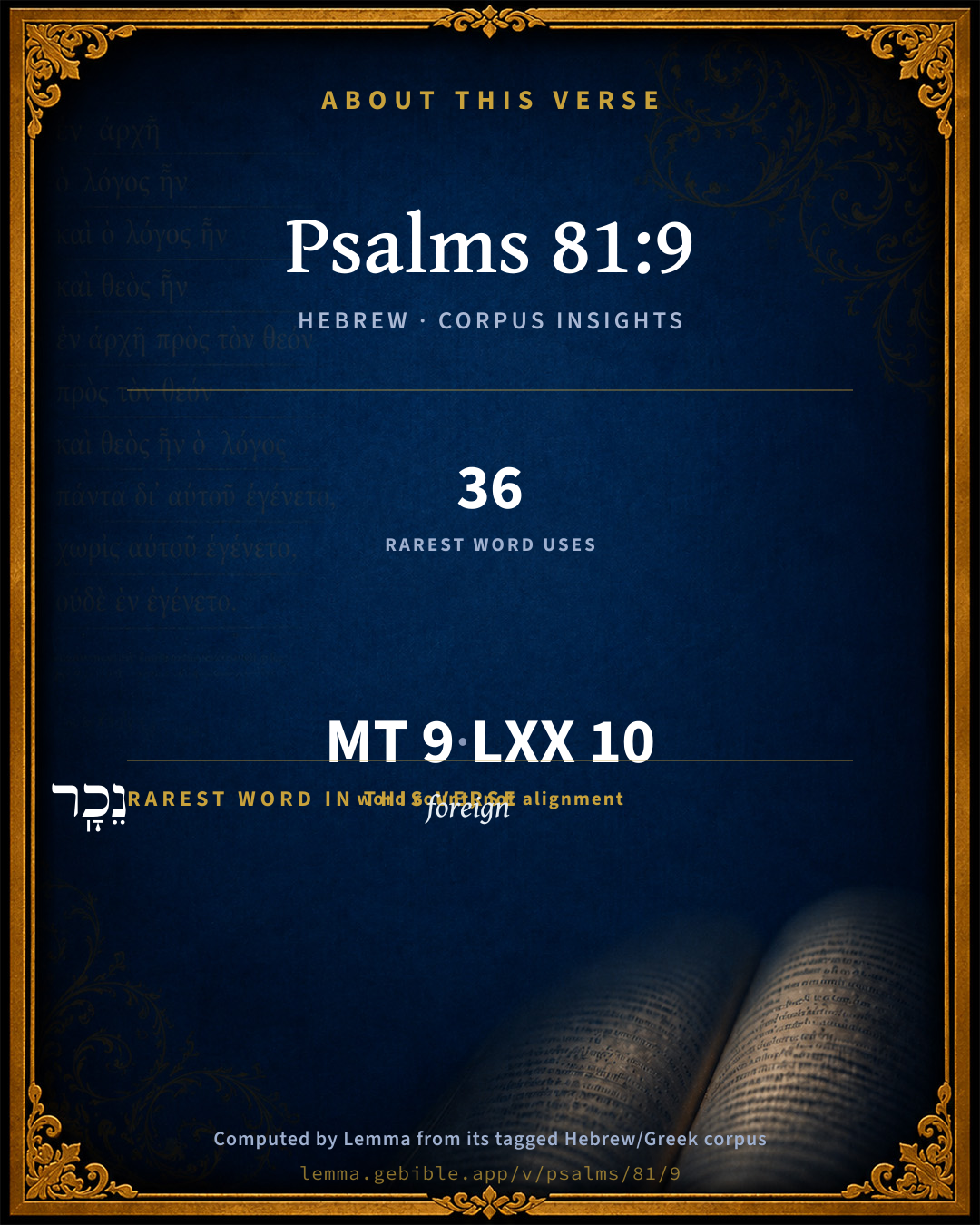
About this verse

These counts appear in no published source. They are computed here, from the morphology-tagged text and Lemma’s own curated glosses. What Lemma adds →

9
words
6
distinct lemmas
Wisdom
section

Shared distinctive vocabulary

נֵכָֽר foreign H5236 occurs in 35 verses of the Hebrew Bible. Also found in:

Grammatical profile

  • 2 verbs
  • 3 nouns
  • 1 adjective
  • 1 preposition
  • 2 particles

Verb forms

  • יִהְיֶ֣ה Qal · Imperfect
  • תִ֝שְׁתַּחֲוֶ֗ה Hishtaphel · Imperfect

Repetition

Words recur within this verse — often emphatic in Hebrew:

  • אֵ֣ל God H410 ×2
  • לֹֽא not H3808 ×2

Hebrew & Septuagint length

In English translation the verse runs 15 words from the Hebrew and 15 from the Septuagint (LXX English) — the same length.

A rough comparison of the two English renderings, which tokenize alike — not a word-level alignment.

Word counts can differ between the Hebrew and the Greek without any difference in meaning — e.g. the Hebrew direct-object marker אֵת has no separate Greek word, and Greek often adds the article ὁ.

In the original languages it is 9 Hebrew tokens and 10 Greek tokens — but the two are counted differently (Hebrew bundles its prefixes and suffixes into one token; the Greek is in lemma form), so that isn’t a like-for-like length.

Cross-references

7

Topical passages linked to Psalms 81:9 in the Treasury of Scripture Knowledge — connected by theme and wording, ordered by reader-vote popularity; previews shown in the World English Bible.

  • Isaiah 43:12 I have declared, and I have saved, and I have shown; and there was no strange [god] among you: therefore you are my witnesses, says Yahweh, and I am God.
  • Deuteronomy 32:12 Yahweh alone did lead him, There was no foreign god with him.
  • 1 Corinthians 8:5–6 For though there are things that are called "gods," whether in the heavens or on earth; as there are many "gods" and many "lords;"
  • Exodus 20:3–5 You shall have no other gods before me.
  • Deuteronomy 6:14 You shall not go after other gods, of the gods of the peoples who are round about you;
  • Malachi 2:11 Judah has dealt treacherously, and an abomination is committed in Israel and in Jerusalem; for Judah has profaned the holiness of Yahweh which he loves, and has married the daughter of a foreign god.
  • Psalms 44:20 If we have forgotten the name of our God, Or spread forth our hands to a strange god;

Cross-references courtesy of OpenBible.info (CC BY 4.0).

Hebrew and Greek witnesses Masoretic Hebrew ↔ Greek Septuagint

The same verse in the two great witnesses to the Old Testament, shown verse-for-verse.

You’re reading Greek Psalm 80 (Hebrew Psalm 81). The Septuagint counts the superscription, so verse numbers can differ from the Hebrew — chapter-level alignment, not verse-by-verse. Numbering follows Rahlfs.

These are two independent witnesses, not word-aligned to each other, and the Septuagint is shown in lemma (dictionary) form.

Hebrew Psalms 81:9 Masoretic · Westminster Leningrad Codex

לֹֽא יִהְיֶ֣ה בְ֭ךָ אֵ֣ל זָ֑ר וְלֹ֥א תִ֝שְׁתַּחֲוֶ֗ה לְאֵ֣ל נֵכָֽר

There shall be no strange god in you, Neither shall you worship any foreign god.

World English Bible · Public Domain

Greek LXX Greek Psalm 80:9 Septuagint · lemma form

ἀκούω λαός ἐγώ καί διαμαρτύρομαι σύ ἰσραήλ ἐάν ἀκούω ἐγώ

there shall be no new god in you; neither shall you worship a strange god.

LXX2012 (modern English Septuagint) · Public Domain

Hebrew: Westminster Leningrad Codex (CC BY 4.0). Greek: Septuagint (public domain); English from LXX2012 (modern English Septuagint) (Public Domain). How the Septuagint differs from the Hebrew →

Commentary

Notes on Psalms 81:9 from classic Christian and Jewish commentators (each source and its license shown beneath its notes). The classic Christian expositions comment on the surrounding passage and are grouped to its opening verse, so a note may address several verses; the Jewish commentaries on the Tanakh (Rashi and others) are per-verse, so they appear only where the commentator wrote on this verse.

Lemma curates 59 commentaries, every one of them public domain or Creative Commons licensed, each selected and text-cleaned for this edition rather than reprinted as found. About our sources →

Trapp's Complete Commentary

John Trapp

Psa 81:9 There shall no strange god be in thee; neither shalt thou worship any strange god.

Ver. 9. There shall no strange god] This is the first and chief commandment, wherein all the rest are contained, saith Luther.

John Trapp, A Commentary or Exposition upon All the Books of the Old and New Testament (1647–1656) — public domain. Text from a community e-Sword module.

J. A. Alexander on Psalms

Joseph Addison Alexander

10. (Psa 81:9) There shall not be in thee a strange god, and thou shalt not worship a foreign god. The divine name here used is the one denoting power. "Thou shalt acknowledge no Almighty but the true one." The prohibitory futures have a stronger sense than that expressed in some translations, let there be no strange god in thee, i. e. in the midst of thee, among you. A strange god, a god who is an alien to Jehovah and to Israel. Worship, literally bow down or prostrate thyself. A foreign god, a god of strangeness, or belonging to foreign parts, in other words, a heathen deity. See above, on Ps. 18:44, 45. The specific reason here implied is that expressed in Deut. xxxii. 12. The general principle is the same that is propounded in the first commandment (Exo 20:3, Deu 5:7).

Joseph Addison Alexander, The Psalms Translated and Explained (1850) — public domain. Text from a community e-Sword module.

John Calvin's Commentaries

9 Let there be no strange god in thee. Here there is propounded the leading article of the covenant, and almost the whole sum of it, which is, that God alone must have the pre-eminence. Some may prefer this explanation: O Israel! if thou wilt hearken to me, there is nothing which I more strictly require or demand from thee than that thou shouldst be contented with me alone, and that thou shouldst not seek after strange gods: and of this opinion I am far from disapproving. God by this language undoubtedly confirms the truth which he so frequently inculcates elsewhere in the law and the prophets, that he is so jealous a God as not to allow another to be a partaker of the honor to which he alone is entitled. But at the same time he teaches us that true religious worship begins with obedience. The order which Moses observes is different, Exodus 20:2, 4, and Deuteronomy 5:6, 8. In these passages God sets out with declaring that he is the God of Israel; and then he forbids them to make for themselves any new gods. But here the prohibition is put first, and then the reason of it is subjoined, which is, that the people ought to be abundantly satisfied with the God who had purchased them to be his people. Perhaps also he sets this in the front to prepare the way for his obtaining the throne of their hearts. He would first withdraw the people from superstitions, as these must necessarily be plucked up and cleared away before true religion can take root in our hearts.

John Calvin's Commentaries (1540-1563) — public domain. Text from the Calvin Translation Society English edition (1840s-50s) via the Christian Classics Ethereal Library (ccel.org). Calvin's coverage is partial (roughly two-thirds of the Bible); uncommented books and verses are honest gaps, never fabricated. The 19th-century editor's footnotes and remarks are omitted so the notes are faithfully Calvin's own voice.

Ellicott's Commentary for English Readers

(9) Open . . .—A condensed statement of God’s gracious promise (Deu_7:12-13; Deu_8:7; Deu_8:9; Deu_11:13; Deu_11:16, &c). It is said to have been a custom in Persia, that when the king wishes to do a visitor especial honour he desires him to open his mouth wide, and the king then-crams it full of sweetmeats, and sometimes even with jewels. And to this day it is a mark of politeness in Orientals to tear off the daintiest bits of meat for a guest, and either lay them before him, or put them in his mouth. (See Thomson, Land and Book, p. 127.)

A Bible Commentary for English Readers, edited by Charles John Ellicott (1878–1897) — public domain. Text from a community e-Sword module.

The Cambridge Bible for Schools and Colleges

gen. ed. J. J. S. Perowne

9. no strange god] Cp. Psa_44:20; Deu_32:16.

any strange god] Any alien god. Cp. Deu_32:12. Absolute frdelity to Jehovah was the fundamental principle of the Sinaitic covenant, embodied in the first ‘word’ of the Decalogue.

The Cambridge Bible for Schools and Colleges (gen. ed. J. J. S. Perowne; Cambridge University Press, 1878–1918) — public domain. Text from a community e-Sword module.

John Gill's Exposition

There shall no strange god be in thee,.... Or in the midst of thee, owned and worshipped as God; or in thine heart, for whatever engrosses the affection, or a man puts his trust and confidence in, that he makes his god, and is a strange one: thus, if any friend or relation, father or mother, wife or children, are loved more than God, they are set up as such in his place; thus the epicure, that seeks the gratification of his carnal lusts, makes his belly his god; and the covetous man his money, in which he trusts, and therefore is called an idolater; and the self-righteous man his righteousness, on which he depends for salvation: hence we read of idols set up in the heart, from which they are disengaged in conversion, and kept from, Eze 14:7.

neither shall thou worship any strange god; only the Lord God is to be worshipped, Mat 28:19 and there is but one God; though this is to be understood not to the exclusion of the Son and Spirit, who are with the Father the one God, and to be worshipped equally with him, and are; see Mat 28:19.

John Gill's Exposition of the Whole Bible (1746–1763) — public domain (CC PDM 1.0). Text via the HelloAO Bible API.

Albert Barnes' Notes on the Bible

There shall no strange god be in thee - Worshipped by thee; or recognized and regarded as a god. This was a condition of his favor and friendship. Compare Deu 32:12; Isa 43:12. The word here rendered “strange” - זר zār - has reference to one of a foreign nation; and the meaning is, that they were not to worship or adore the gods that were worshipped by foreigners. This was a fundamental law of the Hebrew commonwealth.

Neither shalt thou worship any strange god - The Hebrew word here is different - נכר nêkâr - but means substantially the same thing. The allusion is to gods worshipped by foreign nations.

Albert Barnes' Notes on the Bible (1834–1885) — public domain. Text from a community e-Sword/MySword module.

Matthew Poole's English Annotations

Thou shalt renounce all false gods and worship, and worship me only.

Matthew Poole's English Annotations on the Holy Bible (1683–1685) — public domain. Text from a community e-Sword/MySword module.

The Treasury of David

Charles H. Spurgeon

Ver. 9. There shall no strange god be in thee. No alien god is to be tolerated in Israel's tents.

Neither shalt thou worship any strange god. Where false gods are, their worship is sure to follow. Man is so desperate an idolater that the image is always a strong temptation: while the nests are there the birds will be eager to return. No other god had done anything for the Jews, and therefore they had no reason for paying homage to any other. To us the same argument will apply. We owe all to the God and Father of our Lord Jesus Christ: the world, the flesh, the devil, none of these have been of any service to us; they are aliens, foreigners, enemies, and it is not for us to bow down before them. "Little children keep yourselves from idols, "is our Lord's voice to us, and by the power of his Spirit we would cast out every false god from our hearts.

None.

Charles H. Spurgeon's The Treasury of David (1869–1885) — public domain. Psalms only. Text from a community e-Sword/MySword module.

Whedon's Commentary on the Bible

Daniel D. Whedon

9. No strange god—Thus the psalmist strikes the fundamental doctrine of their dispensation. It has the Sinaitic ring of Exo_20:1-7. This had been, before the exile, their point of departure from the religion of Moses. After that date they never fell into formal idolatry; but their after national sin was ritualism and indifference.

Worship—The same word as “bow down.” Exo_20:5

Daniel D. Whedon (gen. ed.), Commentary on the Old and New Testaments (1874–1909) — public domain. Text from a community e-Sword module.

The Pulpit Commentary

There shall no strange god be in thee; neither shalt thou worship any strange god. (comp; Exo_20:3 Deu_5:7) Such worship had evidently begun, and required to be forbidden afresh.

The sole Object of worship.

This verse recalls to mind the second recitation of the Decalogue in Deuteronomy 5. "In ver. 9 the keynote of the revelation of the Law from Sinai is struck; the fundamental command which opens the Decalogue demanded fidelity to Jehovah, and forbade idol worship as the sin of sins." The claim of Jehovah on the Israelites needs to be precisely described. God, as El, was very generally, perhaps universally, known. But men went wrong, in relation to him, when they began to make representations of him. Then two things happened:

(1) different representations became fixed to different localities and countries; and

(2) the representations came to be worshipped, rather than the spiritual Being whom they represented. Israel was selected, as a nation, to preserve for the world the imperilled primary truth of the unity and spirituality of God. So two things are firmly asserted as the basis of God"s revelation of his will to Israel

I GOD IS THE ONE GOD OF THE WHOLE EARTH. "Hear, O Israel, the Lord thy God is one Lord." "The God of the whole earth shall he be called." There are no such things as "strange gods." An idol is a "nothing," a "vanity." God is God alone. See the importance of this for Israel. Looking on the nations around them, they might imagine that the gods of the nations were doing better for them than Jehovah was doing for his people, and so they might be tempted to join service to these strange gods with service to Jehovah. So they must learn that God was really the God of all nations; the one and only true God. In view of our work among the heathen, we still must hold fast this primary and fundamental truth there is but one God; and he is as truly the God of the heathen as of the civilized and the Christianized.

II GOD IS THE ONE OBJECT OF HUMAN WORSHIP. Man must worship. He feels dependent. He must look out of himself for some one on whom to lean. He must be sure that be on whom he leans is absolutely trustworthy. There never can be more than one absolutely trustworthy Being. If right ideas be attached to God, we must feel that there can only be one God. He must be the perfect realization of our highest conceptions; and therefore our admiration and our dependence will unite to make him the sole Object of worship. He who knows God wants to worship no other. R.T.

The Pulpit Commentary (1880–1919), ed. H.D.M. Spence-Jones & Joseph S. Exell — public domain. Text from a community e-Sword module.

Rashi

Rabbi Shlomo Yitzchaki (Rashi)

Hearken, My people Since I did all this for you, it is fitting for you to hearken to Me.

Rashi on the Tanakh — English translations: “The Judaica Press complete Tanach with Rashi, translated by A. J. Rosenberg” (CC BY 4.0); “Pentateuch with Rashi's commentary by M. Rosenbaum and A.M. Silbermann, 1929-1934” (public domain); “The Metsudah Tanach series, Lakewood, N.J” (CC BY 4.0); and “The Book of Joshua, Metsudah Publications, 1997” (CC BY 4.0). Text via Sefaria.

Lesson kit

Teaching starters — assembled from the data on this page, not authored interpretation. Every prompt links to the verse data it draws on. Edit before teaching.

Psalms, in the Wisdom, opens this verse with 9 words (6 distinct Hebrew lemmas). Its most distinctive word is nêkâr (“foreign”). A historical commentator’s framing appears above. Read the whole chapter for the surrounding context.

Discussion questions

  1. The word nêkâr carries the sense “foreign.” How does it shape the verse?
  2. Genesis 17:12 shares the word «foreign» with this verse. How do the two illuminate each other?
  3. “God” occurs 2× in this one verse. What is the effect of the repetition?
  4. These translations render this verse differently; the difference is in the English rendering, not the original. What questions does that raise?
  5. The verb «יִהְיֶ֣ה» is Qal Imperfect. How does its form color the action?
  6. Reading how Trapp's Complete Commentary and J. A. Alexander on Psalms read this verse, where do the two commentators agree and where do they part?

Things to notice

Reading settings

Reading text

Shown beneath each verse's original-language words.

Old Testament
Old Testament edition

Read the OT as the Masoretic Hebrew (MT) or the Greek Septuagint (LXX).

English shown for the Greek Septuagint (in the Hebrew ↔ Greek comparison).

Comparing translations? Open the Compare panel on any verse page to stack up to four side by side.