
Zechariah 14:16

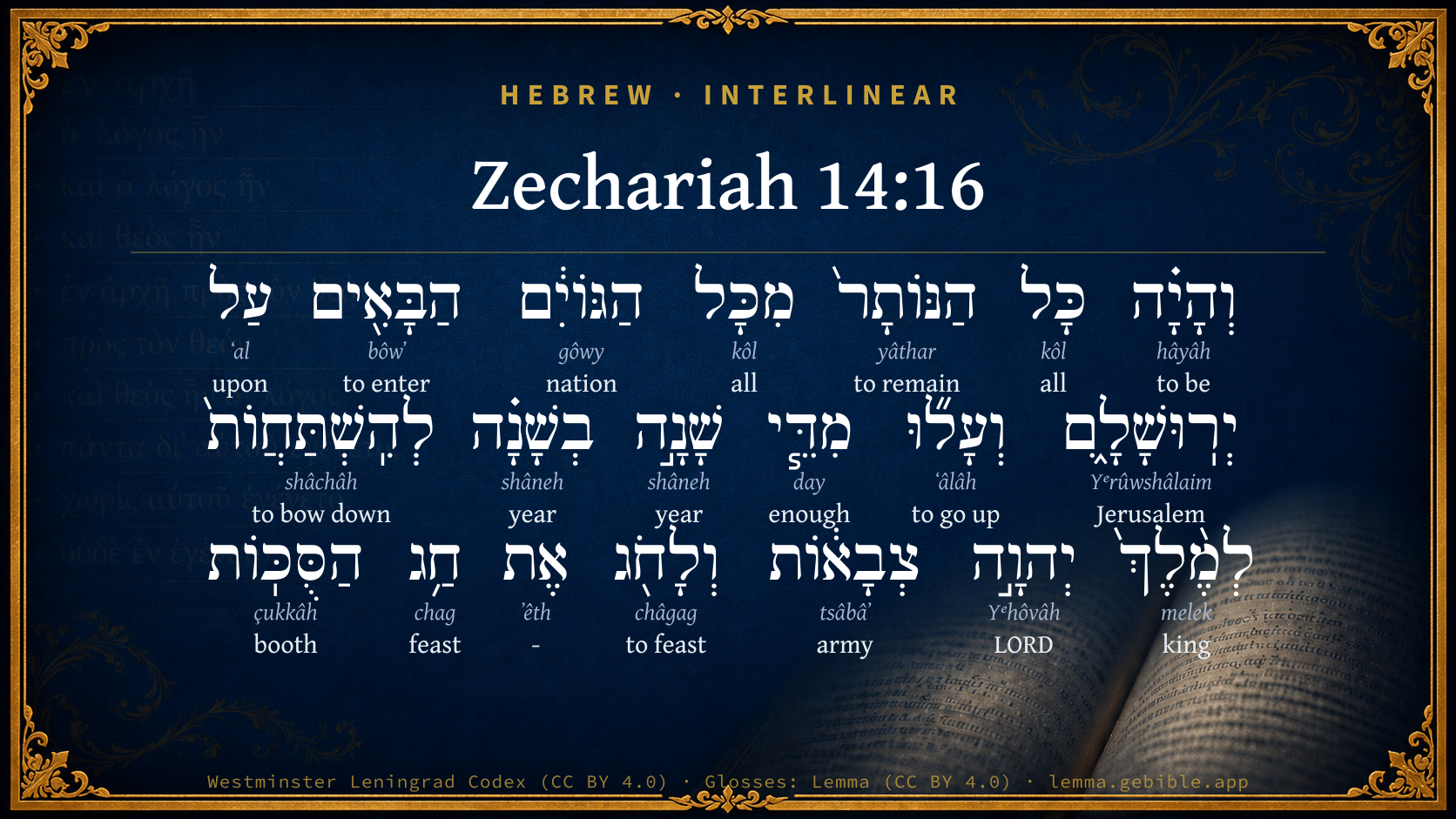
Hebrew (Westminster Leningrad Codex) Zechariah 14:16 appears in the Hebrew Old Testament. The text above is from the Westminster Leningrad Codex. Each word links to its Strong’s number, a concise gloss, and parsing drawn from the Open Scriptures Hebrew Bible morphology. Click any word for its full Brown-Driver-Briggs (BDB) entry.
Download image
Cite this verse

Zechariah 14:16 (World English Bible). Public Domain. Lemma interlinear Bible study tool, https://lemma.gebible.app/v/zechariah/14/16.

Show BibTeX & RIS
BibTeX
RIS
English Translation
It will happen that everyone who is left of all the nations that came against Jerusalem will go up from year to year to worship the King, Yahweh of Hosts, and to keep the feast of tents.
World English Bible · Public Domain
Download a study sheet

One document with this verse’s original text, its word-by-word gloss line, the meaning frame, cross-references with their text, attributed commentary, and full source and license credits — printable, and it pastes into notes with its structure intact.

This verse Autodidact and up

Study sheet (.html) Plain text (.txt)

A passage Seminary Student

Up to 50 verses in one chapter. A passage sheet keeps up to 6 commentary sources and 12 cross-references per verse, in the order this page ranks them, and says so on the sheet whenever that leaves anything out. Ask for a single verse and you get the Autodidact verse sheet above.

Everything on this page stays free to read, with no account — the sheet is a download of what is already on screen, not access to it.

Want to remove ads? Support Godless Engineer
Compare translations 3

The same verse in 3 English versions, stacked beneath the original-language interlinear above. Click any original word for its lexicon entry.

Each is an independent rendering of the whole verse — the interlinear is not word-aligned to these translations.

Highlighted words mark where these versions differ — a whole-verse word diff, not a word-by-word alignment.

  • World English Bible Public Domain
    It will happen that everyone who is left of all the nations that came against Jerusalem will go up from year to year to worship the King, Yahweh of Hosts, and to keep the feast of tents.
  • King James Version Public Domain
    And it shall come to pass, that every one that is left of all the nations which came against Jerusalem shall even go up from year to year to worship the King, the LORD of hosts, and to keep the feast of tabernacles.
  • unfoldingWord Literal Text CC BY-SA 4.0
    Then it will happen all who remain in those nations that came against Jerusalem will instead go up from year to year to worship the king, Yahweh of hosts, and to keep the Festival of Shelters.

unfoldingWord Literal Text — © unfoldingWord, licensed CC BY-SA 4.0. Word-aligned USFM3 via Door43 (git.door43.org/unfoldingWord/en_ult).

Versions to compare (up to 4)

3 of 4 selected

Show all 18 translations

Every available English version of this verse, each an independent rendering of the whole verse.

  • World English Bible Public Domain
    It will happen that everyone who is left of all the nations that came against Jerusalem will go up from year to year to worship the King, Yahweh of Hosts, and to keep the feast of tents.
  • Berean Standard Bible Public Domain
    Then all the survivors from the nations that came against Jerusalem will go up year after year to worship the King, the LORD of Hosts, and to celebrate the Feast of Tabernacles.
  • Majority Standard Bible Public Domain
    Then all the survivors from the nations that came against Jerusalem will go up year after year to worship the King, the LORD of Hosts, and to celebrate the Feast of Tabernacles.
  • King James Version Public Domain
    And it shall come to pass, that every one that is left of all the nations which came against Jerusalem shall even go up from year to year to worship the King, the LORD of hosts, and to keep the feast of tabernacles.
  • American Standard Version (1901) Public Domain
    And it shall come to pass, that every one that is left of all the nations that came against Jerusalem shall go up from year to year to worship the King, Jehovah of hosts, and to keep the feast of tabernacles.
  • Revised Version (1885) Public Domain
    And it shall come to pass, that every one that is left of all the nations which came against Jerusalem shall go up from year to year to worship the King, the LORD of hosts, and to keep the feast of tabernacles.
  • Geneva Bible (1599) Public Domain
    But it shall come to passe that euery one that is left of all the nations, which came against Ierusalem, shall goe vp from yere to yere to worship the King the Lord of hostes, and to keepe the feast of Tabernacles.
  • Douay-Rheims (1899) Public Domain
    And all they that shall be left of all nations that came against Jerusalem, shall go up from year to year, to adore the King, the Lord of hosts, and to keep the feast of tabernacles.
  • Young's Literal Translation Public Domain
    And it hath come to pass, Every one who hath been left of all the nations, Who are coming in against Jerusalem, They have also gone up from year to year, To bow themselves to the King, Jehovah of Hosts, And to celebrate the feast of the booths.
  • Literal Standard Version CC BY-SA 4.0
    And it has come to pass, || Everyone who has been left of all the nations, || Who are coming in against Jerusalem, || They have also gone up from year to year, || To bow themselves to the King, YHWH of Hosts, || And to celebrate the Celebration of the Shelters.
  • Unlocked Literal Bible CC BY-SA 4.0
    Then it will happen that all who remain in those nations that came against Jerusalem will instead go up from year to year to worship the king, Yahweh of hosts, and to keep the Festival of Shelters.
  • unfoldingWord Literal Text CC BY-SA 4.0
    Then it will happen all who remain in those nations that came against Jerusalem will instead go up from year to year to worship the king, Yahweh of hosts, and to keep the Festival of Shelters.
  • Darby Bible Public Domain
    And it shall come to pass, that all that are left of all the nations which came against Jerusalem shall go up from year to year to worship the King, Jehovah of hosts, and to celebrate the feast of tabernacles.
  • World Messianic Bible Public Domain
    It will happen that everyone who is left of all the nations that came against Jerusalem will go up from year to year to worship the King, the LORD of Hosts, and to keep the feast of booths.
  • Webster's Bible Public Domain
    And it shall come to pass, that every one that is left of all the nations which came against Jerusalem shall even go up from year to year to worship the King, the LORD of hosts, and to keep the feast of tabernacles.
  • Free Bible Version CC BY-SA 4.0
    After this every one of the survivors from the nations that attacked Jerusalem will go there to worship the King, the Lord Almighty, and to celebrate the Festival of Shelters.
  • Bible in Basic English Public Domain
    And it will come about that everyone who is still living, of all those nations who came against Jerusalem, will go up from year to year to give worship to the King, the Lord of armies, and to keep the feast of tents.
  • JPS Tanakh (1917) Public Domain
    And it shall come to pass, that every one that is left of all the nations that came against Jerusalem shall go up from year to year to worship the King, the LORD of hosts, and to keep the feast of tabernacles.

Literal Standard Version (2020), Covenant Press — licensed CC BY-SA 4.0. Text via the HelloAO Bible API (eBible.org). Unlocked Literal Bible (unfoldingWord) — licensed CC BY-SA 4.0. Text via the HelloAO Bible API (eBible.org). unfoldingWord Literal Text — © unfoldingWord, licensed CC BY-SA 4.0. Word-aligned USFM3 via Door43 (git.door43.org/unfoldingWord/en_ult). Free Bible Version, Dr. Jonathan Gallagher — licensed CC BY-SA 4.0. Text via the HelloAO Bible API (eBible.org).

Word by word

More ways to search: Search by grammar → Find every occurrence → Compare this word →

Practice this passage: Drill this verse → Learn its vocabulary →

וְלָחֹ֖ג
châgag
H2287
“and · to feast”
Conjunction + Preposition + Verb, Qal, Infinitive Construct
Part of Speech
Conjunction + Preposition + Verb
Stem
Qal
Form
Infinitive Construct
Full BDB Definition

Origin: a primitive root [compare H2283 , H2328 ]

TWOT: 602

to hold a feast, hold a festival, make pilgrimage, keep a pilgrim-feast, celebrate, dance, stagger - (Qal) - to keep a pilgrim-feast - to reel
  1. וְהָיָ֗ה hâyâh H1961 “and · to be” Conjunction + Verb, Qal, Sequential Perfect, 3rd Person, Masculine, Singular
  2. כָּל kôl H3605 “all of” Noun, Common, Masculine, Singular, Construct
  3. הַנּוֹתָר֙ yâthar H3498 “the · remaining” Particle, Definite Article + Verb, Niphal, Participle Active, Masculine, Singular, Absolute
  4. מִכָּל kôl H3605 “from · all of” Preposition + Noun, Common, Masculine, Singular, Construct
  5. הַגּוֹיִ֔ם gôwy H1471 “the · nations” Particle, Definite Article + Noun, Common, Masculine, Plural, Absolute
  6. הַבָּאִ֖ים bôwʼ H935 “the · entering” Particle, Definite Article + Verb, Qal, Participle Active, Masculine, Plural, Absolute
  7. עַל ʻal H5921 “upon” Preposition
  8. יְרֽוּשָׁלִָ֑ם Yᵉrûwshâlaim H3389 “Jerusalem” Noun, Proper
  9. וְעָל֞וּ ʻâlâh H5927 “and · to go up” Conjunction + Verb, Qal, Sequential Perfect, 3rd Person, Common, Plural
  10. מִדֵּ֧י day H1767 “from · enough of” Preposition + Noun, Common, Masculine, Singular, Construct
  11. שָׁנָ֣ה shâneh H8141 “year” Noun, Common, Feminine, Singular, Absolute
  12. בְשָׁנָ֗ה shâneh H8141 “in/at · year” Preposition + Noun, Common, Feminine, Singular, Absolute
  13. לְהִֽשְׁתַּחֲוֺת֙ shâchâh H7812 “to bow down” Preposition + Verb, Hithpael, Infinitive Construct
  14. לְמֶ֨לֶךְ֙ melek H4428 “to/for · king” Preposition + Noun, Common, Masculine, Singular, Absolute
  15. יְהוָ֣ה Yᵉhôvâh H3068 “LORD” Noun, Proper
  16. צְבָא֔וֹת tsâbâʼ H6635 “armies” Noun, Common, Both, Plural, Absolute
  17. אֶת ʼêth H853 “-” Particle, Direct Object
  18. חַ֥ג chag H2282 “feast of” Noun, Common, Masculine, Singular, Construct
  19. הַסֻּכּֽוֹת çukkâh H5521 “the · booths” Particle, Definite Article + Noun, Common, Feminine, Plural, Absolute

About this verse

These counts appear in no published source. They are computed here, from the morphology-tagged text and Lemma’s own curated glosses. What Lemma adds →

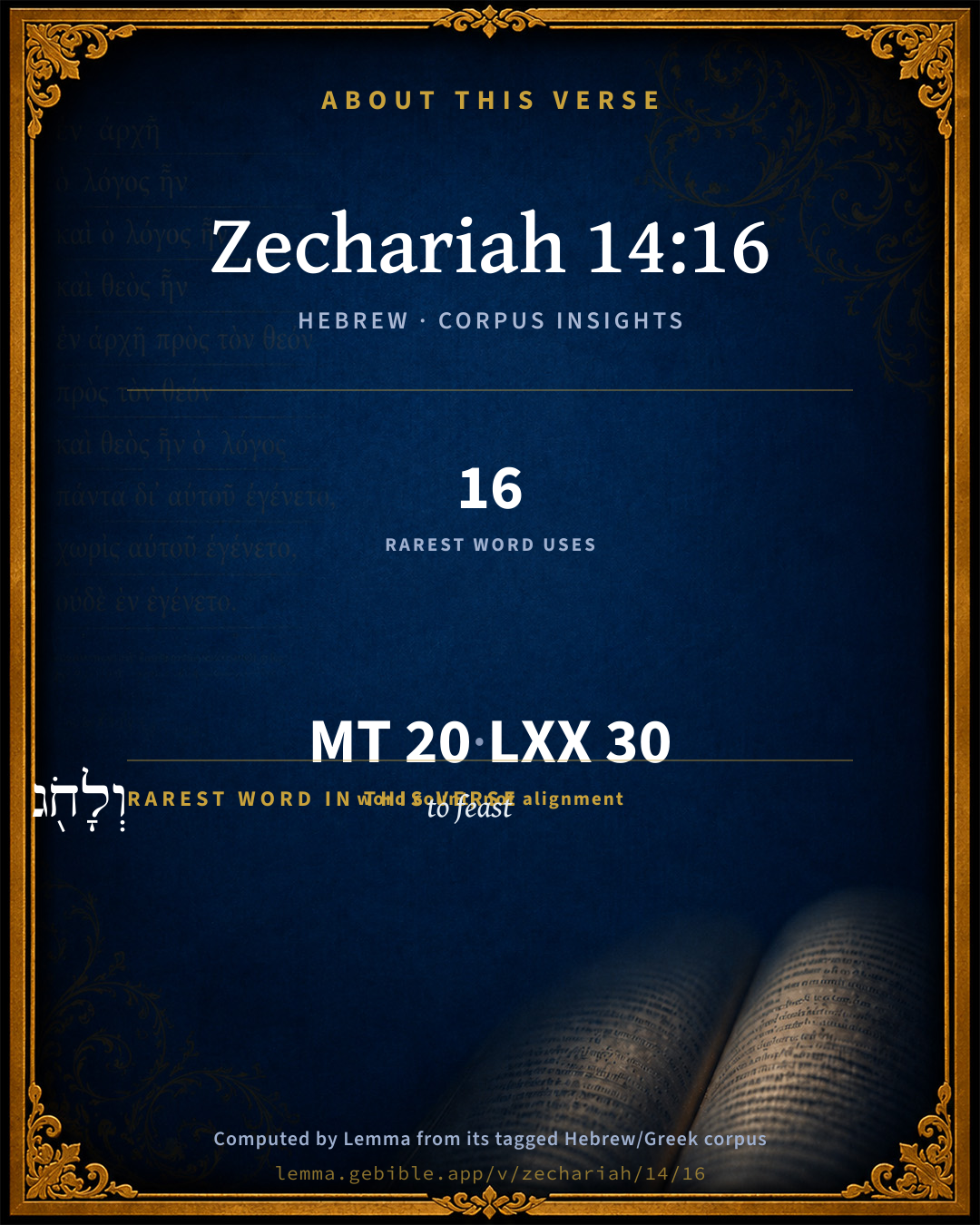
20
words
18
distinct lemmas
Prophets
section

Notable vocabulary

The rarest word here is וְלָחֹ֖ג to feast H2287 — appearing just 16 times in the whole Hebrew Bible.

Shared distinctive vocabulary

וְלָחֹ֖ג to feast H2287 occurs in 14 verses of the Hebrew Bible. Also found in:

Grammatical profile

  • 6 verbs
  • 12 nouns
  • 1 preposition
  • 1 particle

Verb forms

  • וְהָיָ֗ה Qal · Sequential Perfect
  • הַנּוֹתָר֙ Niphal · Participle Active
  • הַבָּאִ֖ים Qal · Participle Active
  • וְעָל֞וּ Qal · Sequential Perfect
  • לְהִֽשְׁתַּחֲוֺת֙ Hithpael · Infinitive Construct
  • וְלָחֹ֖ג Qal · Infinitive Construct

Repetition

Words recur within this verse — often emphatic in Hebrew:

  • כָּל all H3605 ×2
  • שָׁנָ֣ה year H8141 ×2

Hebrew & Septuagint length

In English translation the verse runs 37 words from the Hebrew and 39 from the Septuagint (LXX English) — closely comparable.

A rough comparison of the two English renderings, which tokenize alike — not a word-level alignment.

Word counts can differ between the Hebrew and the Greek without any difference in meaning — e.g. the Hebrew direct-object marker אֵת has no separate Greek word, and Greek often adds the article ὁ.

In the original languages it is 20 Hebrew tokens and 30 Greek tokens — but the two are counted differently (Hebrew bundles its prefixes and suffixes into one token; the Greek is in lemma form), so that isn’t a like-for-like length.

Cross-references

36

Topical passages linked to Zechariah 14:16 in the Treasury of Scripture Knowledge — connected by theme and wording, ordered by reader-vote popularity; previews shown in the World English Bible.

  • Isaiah 66:23 It shall happen, that from one new moon to another, and from one Sabbath to another, shall all flesh come to worship before me, says Yahweh.
  • Zechariah 14:17–19 It will be, that whoever of all the families of the earth doesn't go up to Jerusalem to worship the King, Yahweh of Hosts, on them there will be no rain.
  • Isaiah 60:6–9 The multitude of camels shall cover you, the dromedaries of Midian and Ephah; all they from Sheba shall come; they shall bring gold and frankincense, and shall proclaim the praises of Yahweh.
  • Isaiah 66:18–21 For I [know] their works and their thoughts: [the time] comes, that I will gather all nations and languages; and they shall come, and shall see my glory.
  • Zechariah 8:20–23 Thus says Yahweh of Hosts: "Many peoples, and the inhabitants of many cities will yet come;
  • Deuteronomy 31:10–13 Moses commanded them, saying, At the end of [every] seven years, in the set time of the year of release, in the feast of tents,
  • Joel 2:32 It will happen that whoever will call on the name of Yahweh shall be saved; For in Mount Zion and in Jerusalem there will be those who escape, As Yahweh has said, And among the remnant, those whom Yahweh calls.
  • John 1:49 Nathanael answered him, "Rabbi, you are the Son of God! You are King of Israel!"
  • John 7:37–39 Now on the last and greatest day of the feast, Jesus stood and cried out, "If anyone is thirsty, let him come to me and drink!
  • Leviticus 23:33–36 Yahweh spoke to Moses, saying,
  • Leviticus 23:39–43 "'So on the fifteenth day of the seventh month, when you have gathered in the fruits of the land, you shall keep the feast of Yahweh seven days: on the first day shall be a solemn rest, and on the eighth day shall be a solemn rest.
  • Numbers 29:12–38 On the fifteenth day of the seventh month you shall have a holy convocation; you shall do no servile work, and you shall keep a feast to Yahweh seven days:
  • Deuteronomy 16:13–16 You shall keep the feast of tents seven days, after that you have gathered in from your threshing floor and from your winepress:
  • 2 Chronicles 7:8–10 So Solomon held the feast at that time seven days, and all Israel with him, a very great assembly, from the entrance of Hamath to the brook of Egypt.
  • 2 Chronicles 8:13 even as the duty of every day required, offering according to the commandment of Moses, on the Sabbaths, and on the new moons, and on the set feasts, three times in the year, [even] in the feast of unleavened bread, and in the feast of weeks, and in the feast of tents.
  • Ezra 3:4 They kept the feast of tents, as it is written, and [offered] the daily burnt offerings by number, according to the ordinance, as the duty of every day required;
  • Nehemiah 8:14–18 They found written in the law, how that Yahweh had commanded by Moses, that the children of Israel should dwell in booths in the feast of the seventh month;
  • Psalms 24:7–10 Lift up your heads, you gates; Be lifted up, you everlasting doors: The King of glory will come in.
  • Isaiah 6:5 Then I said, "Woe is me! For I am undone, because I am a man of unclean lips, and I dwell in the midst of a people of unclean lips: for my eyes have seen the King, Yahweh of Hosts!"
  • Jeremiah 46:18 As I live, says the King, whose name is Yahweh of Hosts, surely like Tabor among the mountains, and like Carmel by the sea, so shall he come.
  • Jeremiah 48:15 Moab is laid waste, and they are gone up into his cities, and his chosen young men are gone down to the slaughter, says the King, whose name is Yahweh of Hosts.
  • Jeremiah 51:57 I will make drunk her princes and her wise men, her governors and her deputies, and her mighty men; and they shall sleep a perpetual sleep, and not wake up, says the King, whose name is Yahweh of Hosts.
  • Hosea 12:9 "But I am Yahweh your God from the land of Egypt. I will yet again make you to dwell in tents, As in the days of the solemn feast.
  • Zechariah 9:7 I will take away his blood out of his mouth, And his abominations from between his teeth; And he also will be a remnant for our God; And he will be as a chieftain in Judah, And Ekron as a Jebusite.
  • Malachi 1:14 "But the deceiver is cursed, who has in his flock a male, and vows, and sacrifices to the Lord a blemished thing; for I am a great King," says Yahweh of hosts, "and my name is awesome among the nations."
  • Luke 19:38 saying, "Blessed is the King who comes in the name of the Lord! Peace in heaven, and glory in the highest!"
  • John 7:2 Now the feast of the Jews, the Feast of Booths, was at hand.
  • Acts 15:17 That the rest of men may seek after the Lord; All the Gentiles who are called by my name, Says the Lord, who does all these things.
  • Romans 9:23–24 and that he might make known the riches of his glory on vessels of mercy, which he prepared beforehand for glory,
  • Romans 11:5 Even so then at this present time also there is a remnant according to the election of grace.
  • Romans 11:16 If the first fruit is holy, so is the lump. If the root is holy, so are the branches.
  • Romans 11:26 and so all Israel will be saved. Even as it is written, "There will come out of Zion the Deliverer, And he will turn away ungodliness from Jacob.
  • Revelation 11:13 In that day there was a great earthquake, and a tenth of the city fell. Seven thousand people were killed in the earthquake, and the rest were terrified, and gave glory to the God of heaven.
  • Revelation 19:16 He has on his garment and on his thigh a name written, "KING OF KINGS, AND LORD OF LORDS."
  • Philippians 2:9–11 Therefore God also highly exalted him, and gave to him the name which is above every name;
  • Revelation 11:15–17 The seventh angel sounded, and great voices in heaven followed, saying, "The kingdom of the world has become the Kingdom of our Lord, and of his Christ. He will reign forever and ever!"

Cross-references courtesy of OpenBible.info (CC BY 4.0).

Hebrew and Greek witnesses Masoretic Hebrew ↔ Greek Septuagint

The same verse in the two great witnesses to the Old Testament, shown verse-for-verse.

These are two independent witnesses, not word-aligned to each other, and the Septuagint is shown in lemma (dictionary) form.

Hebrew Zechariah 14:16 Masoretic · Westminster Leningrad Codex

וְהָיָ֗ה כָּל הַנּוֹתָר֙ מִכָּל הַגּוֹיִ֔ם הַבָּאִ֖ים עַל יְרֽוּשָׁלִָ֑ם וְעָל֞וּ מִדֵּ֧י שָׁנָ֣ה בְשָׁנָ֗ה לְהִֽשְׁתַּחֲוֺת֙ לְמֶ֨לֶךְ֙ יְהוָ֣ה צְבָא֔וֹת וְלָחֹ֖ג אֶת חַ֥ג הַסֻּכּֽוֹת

It will happen that everyone who is left of all the nations that came against Jerusalem will go up from year to year to worship the King, Yahweh of Hosts, and to keep the feast of tents.

World English Bible · Public Domain

Greek LXX Zechariah 14:16 Septuagint · lemma form

καί εἰμί ὅσος ἐάν καταλείπω ἐκ πᾶς ὁ ἔθνος ὁ ἔρχομαι ἐπί ἰερουσαλήμ καί ἀναβαίνω κατά ἐνιαυτός ὁ προςκυνέω ὁ βασιλεύς κύριος παντοκράτωρ καί ὁ ἑορτάζω ὁ ἑορτή ὁ σκηνοπηγία

And it shall come to pass, that whoever shall be left of all the nations that came against Jerusalem, shall even come up every year to worship the king, the Lord Almighty, and to keep the feast of tabernacles.

LXX2012 (modern English Septuagint) · Public Domain

Hebrew: Westminster Leningrad Codex (CC BY 4.0). Greek: Septuagint (public domain); English from LXX2012 (modern English Septuagint) (Public Domain). How the Septuagint differs from the Hebrew →

Targum (Aramaic paraphrase)

1

The Targum is the ancient Jewish Aramaic paraphrase of the Hebrew Scriptures — an interpretive translation, not the Hebrew text itself. Onkelos (literal) and Pseudo-Jonathan (expansive) render the Torah, and Jonathan the Prophets. Coverage is partial: where no permissively-licensed English translation exists for a verse, only the Aramaic is shown. This is verse-level text, not a word-by-word alignment to the Hebrew.

  1. Targum Jonathan Prophets (Joshua–Malachi)
    וִיהֵי כָּל דְיִשְׁתָּאֵר מִכָּל עַמְמַיָא דְמִתְכַּנְשִׁין וְאָתָן עַל יְרוּשְׁלֵם יִסְקוּן בִּזְמַן שְׁנָא בִּשְׁנָא לְמִסְגֵיד קֳדָם מְלַךְ עַלְמַיָא יְיָ צְבָאוֹת וּלְמֵחַג יַת חַגָא דִמְטָלַיָא:

    (no public-domain English translation for this verse)

    Targum Jonathan — Aramaic: “Mikraot Gedolot” (public domain). English: “Sefaria Community Translation” (CC0 1.0 (public-domain dedication)); “London "Chaldee Paraphrase," 1871” (public domain). Text via Sefaria.

Commentary

Notes on Zechariah 14:16 from classic Christian and Jewish commentators (each source and its license shown beneath its notes). The classic Christian expositions comment on the surrounding passage and are grouped to its opening verse, so a note may address several verses; the Jewish commentaries on the Tanakh (Rashi and others) are per-verse, so they appear only where the commentator wrote on this verse.

Lemma curates 59 commentaries, every one of them public domain or Creative Commons licensed, each selected and text-cleaned for this edition rather than reprinted as found. About our sources →

Matthew Henry's Commentary

Three things are here foretold: -

I. That a gospel-way of worship being set up in the church there shall be a great resort to it and a general attendance upon it. Those that were left of the enemies of religion shall be so sensible of the mercy of God to them in their narrow escape that they shall apply themselves to the worship of the God of Israel, and pay their homage to him, Zac 14:16. Those that were not consumed shall be converted, and this makes their deliverance a mercy indeed, a double mercy. It is a great change that the grace of God makes upon them; those that had come against Jerusalem, finding their attempts vain and fruitless, shall become as much her admirers as ever they had been her adversaries, and shall come to Jerusalem to worship there, and go in concurrence with those whom they had gone contrary to. Note, As some of Christ's foes shall be made his footstool, so others of them shall be made his friends; and, when the principle of enmity is slain in them, their former acts of hostility are pardoned to them, and their services are admitted and accepted, as though they had never fought against Jerusalem. They shall go up to worship at Jerusalem, because that was the place which God had chosen, and there the temple was, which was a type of Christ and his mediation. Converting grace sets us right, 1. In the object of our worship. They shall no longer worship the Molochs and Baals, the kings and lords, that the Gentiles worship, the creatures of their own imagination, but the King, the Lord of hosts, the everlasting King, the King of kings, the sovereign Lord of all. 2. In the ordinances of worship, those which God himself has appointed. Gospel-worship is here represented by the keeping of the feast of tabernacles, for the sake of those two great graces which were in a special manner acted and signified in that feast - contempt of the world, and joy in God, Neh 8:17. The life of a good Christian is a constant feast of tabernacles, and, in all acts of devotion, we must retire from the world and rejoice in the Lord, must worship as in that feast. 3. In the Mediator of our worship; we must go to Christ our temple with all our offerings, for in him only our spiritual sacrifices are acceptable to God, Pe1 2:5. If we rest in ourselves, we come short of pleasing God; we must go up to him, and mention his righteousness only. 4. In the time of it; we must be constant. They shall go up from year to year, at the times appointed for this solemn feast. Every day of a Christian's life is a day of the feast of tabernacles, and every Lord's day especially (that is the great day of the feast); and therefore every day we must worship the Lord of hosts and every Lord's day with a peculiar solemnity.

II. That those who neglect the duties of gospel-worship shall be reckoned with for their neglect. God will compel them to come and worship before him, by suspending his favours from those that keep not his ordinances: Upon them there shall be no rain, Zac 14:17. Some understand it figuratively; the rain of heavenly doctrine shall be withheld, and of the heavenly grace, which should accompany that doctrine. God will command the clouds that they rain no rain upon them. Note, It is a righteous thing with God to withhold the blessings of grace from those that do not attend the means of grace, to deny the green pastures to those that attend not the shepherd's tents. Or we may take it literally: On them there shall be no rain, to make their ground fruitful. Note, The gifts of common providence are justly denied to those that neglect and despise instituted ordinances. Those that neglected to build the temple were punished with the want of rain (Hag 2:17), and so were those that neglected to attend there when it was built. If we be barren and unfruitful towards God, justly is the earth made so to us. Many are crossed, and go backward, in their affairs, and this is at the bottom of it - they do not keep close to the worship of God as they should; they go off from God, and then he walks contrary to them. If we omit or postpone the duties he expects from us, it is just with him to deny the favours we expect from him. But what shall be done to the defaulters of the land of Egypt, to whom the threatening of the want of rain is no threatening, for they have no rain at any time; they need none; they desire none; the river Nilus is to them instead of the clouds of heaven, waters their land, and makes it fruitful, so that what is a punishment to others is none to them? Zac 14:18, Zac 14:19. It is threatened that if the family of Egypt go not up, that have no rain, yet God will find out a way to meet with them, for there shall be, in effect, the same plague wherewith other nations are smitten for their neglect. God can, and often did, restrain the overflowing of the river, which was equivalent to the shutting up of the clouds; or if the river did its part, and rose as high as it used to do, God had other ways of bringing famine upon them, and destroying the fruits of their ground, as he did by several of the ten plagues of Egypt, so that this (that is, the same) shall be the punishment of Egypt that is the punishment of other nations who come not up to keep the feast of tabernacles. Note, Those who think themselves least indebted to, and depending on, the mercy of heaven, cannot therefore think themselves guarded against the justice of Heaven. It does not follow that those who can live without rain can therefore live without God; for not the heavens only, but all other creatures, are that to us that God makes them to be, and no more; nor can any man's way of living enable him to set light by the judgments of God. This shall be the punishment - margin, This shall be the sin of Egypt, and the sin of all nations, that come not up to keep the feast of tabernacles. The same word signifies both sin and the punishment of sin, so close and inseparable is the connexion between them (as Gen 4:7), and sin is often its own punishment. Note, Omissions are sins, and we must come into judgment for them; those contract guilt that go not up to worship at the times appointed, as they have opportunity; and it is a sin that is its own punishment, for those who forsake the duty forfeit the privilege of communion with God.

III. That those who perform the duties of gospel-worship shall have grace to adorn their profession by the duties of a gospel-conversation too. This is promised (Zac 14:20, Zac 14:21), and it is necessary to the completing of the beauty and happiness of the church. In general, all shall be holiness to the Lord.

1. The name and character of holiness shall not be so confined as formerly. Holiness to the Lord had been written only upon the high priest's forehead, but now it shall not be so appropriated. All Christians shall be living temples, and spiritual priests, dedicated to the honour of God and employed in his service.

2. Real holiness shall be more diffused than it had been, because there shall be more powerful means of sanctification, more excellent rules, more cogent arguments, and brighter patterns of holiness, and because there shall be a more plentiful effusion of the Spirit of holiness and sanctification, after Christ's ascension than ever before.

(1.) There shall be holiness introduced into common things; and those things shall be devoted to God that seemed very foreign. [1.] The furniture of their horses shall be consecrated to God. "Upon the bells of the horses shall be engraven Holiness to the Lord, or upon the bridles of the horses (so the margin) or the trappings. The horses used in war shall no longer be used against God and his people, as they have been, but for him and them. Even their wars shall be holy wars, their troopers serving under God's banner. Their great men, who ride in state with a pompous retinue, shall reckon it their greatest ornament to honour God with their honours. Holiness to the Lord shall be written on the harness of their chariot-horses, as great men have sometimes their coat of arms with their motto painted on their coaches; every gentleman shall take the high priest's motto for his, and glory in it, and make it a memento to himself not to do any thing unworthy of it. Travellers shall have it upon their bridles, with which they guide their horses, as those who desire always to be put in mind of it, by having it continually before them, and to guide themselves in all their motions by this rule. The bells of the horses, which are designed to quicken them in their journey and to give notice of their approach, shall have Holiness to the Lord upon them," to signify that this is that which we ought to be influenced by ourselves, and make profession of to others, wherever we go. [2.] The furniture of their houses too shall be consecrated to God, to be employed in his service. First, The furniture of the priests' houses, or apartments adjoining to the house of the Lord. The common drinking cups they used shall be like the bowls before the altar, that were used either to receive the blood of the sacrifices or to present the wine and oil in, which were for the drink-offerings. The vessels which they used for their own tables shall be used in such a religious manner, with such sobriety and temperance, such devotedness to the glory of God, and such a mixture of pious thoughts and expressions, that their meals shall look like sacrifices; they shall eat and drink, not to themselves, but to him that spreads their tables and fills their cups. And thus, in ministers' families especially, should common actions be done after a godly sort, however they are done in other families. Secondly, The furniture of other houses, those of the common people: "Every pot in Jerusalem and in Judah shall be holiness to the Lord. The pots in which they boil their meat, the cups out of which they drink their wine (Jer 35:5), in these God's good creatures shall never be abused to excess, nor that made the food and fuel of lust which should be oil to the wheels of obedience," as had formerly been, when all tables were full of vomit and filthiness, Isa 28:8. "What they eat and drink out of these shall nourish their bodies for the service of God; and out of these they shall give liberally for the relief of the poor;" then are they Holiness to the Lord, as the merchandise and the hire of the converted Tyrians are said to be (Isa 23:18); for both in our gettings and in our spendings we must have an eye to the will of God as our rule and the glory of God as our end. Thirdly, When there shall be such an abundance of real holiness people shall not be nice and curious about ceremonial holiness: "Those that sacrifice shall come and take of these common vessels, and seethe their sacrifices therein, making no distinction between them and the bowls before the altar." In gospel-times the true worshippers shall worship God in spirit and in truth, and neither in this mountain nor yet at Jerusalem, Joh 4:21. One place shall be as acceptable to God as another (I will that men pray every where); and one vessel shall be as acceptable as another. Little regard shall be had to the circumstance, provided there be nothing indecent or disorderly, while the substance is religiously preserved and adhered to. Some think it intimates that there should be greater numbers of sacrifices offered than the vessels of the sanctuary would serve for; but, rather than any should be turned back or deferred. they shall make no difficulty at all of using common vessels, as the Levites in a case of necessity helped the priests to kill the sacrifices, Ch2 29:34.

(2.) There shall be no unholiness introduced into their sacred things, to corrupt them: In that day there shall be no more the Canaanite in the house of the Lord of hosts. Some read it, There shall be no more the merchant, for so a Canaanite sometimes signifies; and they think it was fulfilled when Christ once and again drove the buyers and sellers out of the temple. Or though those that were Canaanites, strangers and foreigners, shall be brought into the house of the Lord, yet they shall cease to be Canaanites; they shall have nothing of the spirit or disposition of Canaanites in them. Or it intimates that though in gospel-times people should grow indifferent as to holy vessels, yet they should be very strict in church-discipline, and careful not to admit the profane to special ordinances, but to separate between the precious and the vile, between Israelites and Canaanites. Yet this will not have its full accomplishment short of the heavenly Jerusalem, that house of the Lord of hosts, into which no unclean thing shall enter; for at the end of time, and not before, Christ shall gather out of his kingdom every thing that offends, and the tares and wheat shall be perfectly and eternally separated.

Matthew Henry's Commentary on the Whole Bible (1708–1710) — public domain (CC PDM 1.0). Text via the HelloAO Bible API.

The Cambridge Bible for Schools and Colleges

gen. ed. J. J. S. Perowne

16. the feast of tabernacles] The Jews had been required to appear three times in the year before God at His sanctuary. Of the Gentile nations, distant as they are and scattered over the face of the earth, only one such appearance is required. Various reasons have been suggested why, out of the three great festivals, the feast of tabernacles is selected: because it fell in autumn when travelling is most convenient; because, as a thanksgiving festival for the fruits of the earth, it was one in which all nations might more readily take part; or (which is more probable), because it was the last and greatest festival of the Jewish year, gathering up into itself, as it were, the year’s worship, and at the same time typifying the ingathering of all nations into the Church of God. Comp. Rev_7:9.

“From every clime they come

To see thy beauty, and to share thy joy,

O Sion! an assembly such as earth

Saw never, such as heav’n stoops down to see.”

16–19. The Homage of the Residue of the Nations

The deliverance of Israel and judgments on her enemies shall have a converting influence on the residue of the Gentiles, who shall become worshippers of Jehovah, and keep the Feast of Tabernacles every year at Jerusalem, Zec_14:16. From any nation that refuses so to worship rain shall be withheld as a punishment, Zec_14:17. Egypt, the ancient foe of Israel, shall be liable to the same punishment, Zec_14:18, which shall fall upon all nations that neglect the feast, Zec_14:19.

The Cambridge Bible for Schools and Colleges (gen. ed. J. J. S. Perowne; Cambridge University Press, 1878–1918) — public domain. Text from a community e-Sword module.

Trapp's Complete Commentary

John Trapp

Zec 14:16 And it shall come to pass, [that] every one that is left of all the nations which came against Jerusalem shall even go up from year to year to worship the King, the LORD of hosts, and to keep the feast of tabernacles.

Ver. 16. Every one that is left of all the nations] i.e. That hath escaped the plague, Zec 14:12, and is beaten into a better mind, as those Huns, that, vanquished by the Christians, concluded that Christ was the true God, and became his subjects. God had promised before to subvert the Church’s enemies, but here to convert them, which is far better. And it shall appear to be so, as conversion cannot be hidden: you cannot turn a bell but it will make a sound, and report its own motion. See Gal 1:23.

For they shall even go up] sc. To the temple, which stood upon mount Moriah.

To worship the King, the Lord of hosts] To send a lamb (or a homage penny) to the Lord of the whole earth, Isa 16:1.

And to keep the feast of tabernacles] In a due manner, which had not been rightly done (a marvellous thing) all along during the reign of David, Solomon, and all those succeeding reformers, till about these times, as appears, Neh 8:16-18. The sense of this text is, that the converted Gentiles shall join with the Jews in the sincere service of God, according to his will, and not according to their own brains and fancies; that they shall worship him with the same rites, in the same places and assemblies which they do; that Jehovah may be one, and his name one among them, as Zec 14:9, that there may be no more Jew and Gentile, Barbarian or Scythian, bond or free, but Christ may be all, and in all, Col 3:11. That those two sticks being joined into one, Eze 37:16, all Israel may be saved, Rom 11:26, and raised as from the dead, Zec 14:16, the Gentiles also may have their part in the same resurrection. All this is here set forth in such terms and under such types as were then most in request; as of going up to the temple, keeping the feast of tabernacles, &c., all which expressions are parabolic, symbolic, and enigmatic; framed to the capacity of the Jews, much addicted to these legal rites and shadows, then in use, but now done away, Col 2:17 Heb 10:1; whatever the Jews conclude from this text for their continuance under Messiah’s kingdom. Christians have their feasts on holy days too, 1Co 5:8, yea, their feast of tabernacles in a mystical sense, 1Pe 2:11 Heb 11:1; Heb 11:9.

John Trapp, A Commentary or Exposition upon All the Books of the Old and New Testament (1647–1656) — public domain. Text from a community e-Sword module.

The Biblical Illustrator

Joseph S. Exell

Zec_14:16

Shall go up from year to year to worship the King.

The genius and inner heart of Christianity

1. It brings us into the possession of a new life. We are Christians, not because we avow a certain creed, or conform to certain outward exercises; but because we have received the life, the Eternal Life, which was with the Father, and was manifested to us in Jesus. And is it possible to restrict the manifestations of life? Is not God's life always the same in its abundant and infinite variety? So surely the life of God in the soul should, and must, express itself in all the outgoings of our existence,--in speech, act, movement--equally on the six days as the one day; as much in the kitchen, or the shop, as the Church. If you are possessed by the life of the Holy One, it will as certainly appear as the idiosyncrasy of your character, which underlies, moulds, and fashions your every gesture.

2. Christianity is consecration to Christ. It may be questioned if we have a right to call ourselves Christians unless we regard Him as our Judge, our Lawgiver, and our King, and are deliberately obeying and serving Him. But if we are going to reserve our religion to certain days, places, and actions, we necessarily exclude Him from all that is not contained within the fences we erect. What right have we to suppose that our Master Christ will be satisfied with an arrangement which asks Him to accept a part for the whole, a composition for the entire debt?

3. The needs of the world demand an entire and unbroken religious life. The world does not see us in our religious exercises, whether in our private retirement or our public worship. It has no idea, therefore, of the anguish of our penitence, the earnestness of our desires for a right and noble life, the persistency of our endeavours. And if we do not give evidence of our religion in dealing with matters that the men of the world understand, they will naturally and rightly consider that religion is an unpractical dream, the child of superstition and emotion. We should, therefore, refuse to maintain the false distinction between things that arc sacred, and those that are secular. (F. B. Meyer, B.A.)

The public worship of Jehovah

I. It is a duty binding on all people. The feast of tabernacles was meant to keep them in mind that, amidst their abundant harvests, and well-cared-for fields and vineyards, that as in the desert, so still it was God who gave the increase. It was therefore a festival most suitable for all the nations to join in, by way of acknowledging that Jehovah was the God of Nature throughout the earth, however various might be the aspects of nature with which they were familiar. Besides, there can be little doubt that by the time of Zechariah, and probably long before, this feast had become a kind of symbol of the ingathering of the nations (Joh_4:35).

Dr. Dods. Whilst the thousands neglect public worship, not a few argue against it, they say it is uncalled for and unnecessary. In reply to this we state, where there is genuine religion--

1. Public worship is a natural development. The Being we love most we crave an opportunity for extolling, we want that all shall know His merits.

2. Public worship is a happy development. What delights the soul so much as to hear others praise the object we love the most? This at once gratifies the religious instinct and the social love.

3. Public worship is a beneficent development. There is nothing that tends so much to quicken and ennoble souls as worship, and nothing gives such a vital interest in one soul for another, as public worship.

II. Its neglect exposes to terrible calamities.

1. The greatness of the punishment. Upon them shall be no rain. Now the absence of rain involves every temporal evil you can think of, famine, pestilence, loss of physical enjoyment, loss of health, loss of life.

2. The fitness of the punishment.

(1) To the offence. The withholding of the rain.

(2) To the offender. The idea of not having rain would not, perhaps, terrify the Egyptians, for they had the Nile. Hence a plague is threatened to them. The punishment here was to come because of the neglect of public worship. And this is punished by--

(a) Loss of the highest spiritual enjoyments.

(b) Hereafter, by the reproaching of conscience, and the banishment from all good. (Homilist.)

The worship of God a duty and a privilege

Though it is generally admitted that Zechariah is the most obscure of all the minor prophets, yet there were two topics on which we may safely affirm that he was as luminous, or more so, than the rest. The first respected the public worship of God. He and Haggai were conspicuously active in urging the Jews, on their return from their captivity, to rebuild their temple; and when the sanctuary was erected, we find him not only administering to the tribes themselves, but to the strangers and foreigners who had mixed themselves up with them to frequent the house of God, lest renewed judgment should break forth upon them to their injury and ruin.

I. Press it upon you as a duty and privilege.

1. It is founded in the relation in which we stand to God. He is our Creator, Preserver, Benefactor; He is our Father. We are the families of Israel here addressed; and has not God dealt fraternally with you as His children? Show your filial gratitude, etc.

2. It is suggested by the appointment of Divine ordinances.

3. It is enforced by the commands and exhortations of the sacred Scriptures. The books of Exodus, Leviticus, Deuteronomy, and Joshua issued these precepts. They are echoed by the prophets (Psa_95:1-4; Psa_95:7; Psa_100:2-5).

4. It is recommended by the example of the best of men who ever lived. We are to be followers of all those who through faith, etc., and ought we not to copy them in this feature? Read the histories of Moses--Joshua--Nehemiah--of the prophets and apostles--or select one conspicuous example, David; what was his principal wish? One thing have I, etc. What his chief affliction? The sparrow, etc. What his chief joy? I was glad, etc. What his prayer for others? O send out Thy light, etc. This was his testimony, this his appeal--Lord, I have loved the habitation. They continued daily in the temple, etc.

5. It is urged upon us by the advantages connected with its observance. It is the house of God which He has promised to keep with His especial presence. Of Zion He says, This is My rest; here will I dwell, etc. It is through His institutions that light, grace, and comfort are imparted to His Church.

II. To show you the consequences of the neglect of that worship which God requires. Even upon them there shall be no rain. No doubt there was a literal meaning attached to this menace. But we must not satisfy ourselves with this comment. In making a spiritual application of this part of the text, observe that rain is often employed as a metaphor to denote the abundant communication of spiritual blessings--thus, the coming of the Messiah, and the bestowments of His grace; the influences of the Spirit; the instructions and consolations of the Word of God. My doctrine shall drop as the rain. (Evangelical Preacher.)

The Biblical Illustrator, edited by Joseph S. Exell (c. 1880s–1900s) — public domain. Text from a community e-Sword module.

Joseph Benson's Commentary

Zec 14:16. And every one that is left of all the nations — Such as escape the fore-mentioned strokes of divine judgment, and are by mercy preserved; of all the nations which came against Jerusalem — That is, many among all these nations shall consider God’s hand, repent, and submit to his law. Such a change shall the grace of God, sanctifying his judgments, make upon them. Of Christ’s foes, as some shall be made his footstool, so others shall be made his friends; and when the principle of enmity is slain in them, their former acts of hostility are pardoned to them, and their services are accepted as though they had never fought against Jerusalem. Shall even go up to worship, and keep the feast of tabernacles — That is, they shall join in the solemn acts of Christian worship. The prophets, as we have repeatedly had occasion to observe in the course of these notes, often describe, the state of the gospel by the usages of their own times. The feast of tabernacles, being kept in remembrance of God’s conducting and preserving the Israelites forty years in the wilderness, and afterward bringing them into the promised land, was observed with extraordinary expressions of rejoicing. Here this one solemn festival is, by a figure, put for all the days consecrated to God for holy worship; and that very properly, because of those two great graces which were, in a special manner, signified and required in that feast, namely, contempt of the world and joy in God, Neh 8:17. The life of a true Christian is a constant feast of tabernacles, and in all our acts of devotion we must retire from the world and rejoice in the Lord, or worship as the truly pious did in that feast.

Joseph Benson's Commentary on the Old and New Testaments (1811–1818) — public domain. Text from a community e-Sword module.

Keil & Delitzsch

C. F. Keil & F. Delitzsch

Conversion of the heathen. - Zac 14:16. "And it will come to pass, that every remnant of all the nations which came against Jerusalem will go up year by year to worship the King Jehovah of hosts, and to keep the feast of tabernacles. Zac 14:17. And it will come to pass, that whoever of the families of the earth does not go up to Jerusalem to worship the King Jehovah of hosts, upon them there will be no rain. Zac 14:18. And if the family of Egypt go not up, and come not, then also not upon them; there will be (upon them) the plague with which Jehovah will plague all nations which do not go up to keep the feast of tabernacles. Zac 14:19. This will be the sin of Egypt, and the sin of all the nations, which do not go up to keep the feast of tabernacles." The heathen will not be all destroyed by the judgment; but a portion of them will be converted. This portion is called "the whole remnant of those who marched against Jerusalem" (בּוא על as in Zac 12:9). It will turn to the worship of the Lord. The construction in Zac 14:16 is anacolouthic: כּל־הנּותר, with its further definition, is placed at the head absolutely, whilst the predicate is attached in the form of an apodosis with ועלוּ. The entrance of the heathen into the kingdom of God is depicted under the figure of the festal journeys to the sanctuary of Jehovah, which had to be repeated year by year. Of the feasts which they will keep there every year (on מדּי, see Delitzsch on Isa 66:23), the feast of tabernacles is mentioned, not because it occurred in the autumn, and the autumn was the best time for travelling (Theod. Mops., Theodoret, Grot., Ros.), or because it was the greatest feast of rejoicing kept by the Jews, or for any other outward reason, but simply on account of its internal significance, which we must not seek for, however, as Koehler does, in its agrarian importance as a feast of thanksgiving for the termination of the harvest, and of the gathering in of the fruit; but rather in its historical allusion as a feast of thanksgiving for the gracious protection of Israel in its wanderings through the desert, and its introduction into the promised land with its abundance of glorious blessings, whereby it foreshadowed the blessedness to be enjoyed in the kingdom of God (see my bibl. Archologie, i. p. 414ff.). This feast will be kept by the heathen who have come to believe in the living God, to thank the Lord for His grace, that He has brought them out of the wanderings of this life into the blessedness of His kingdom of peace. With this view of the significance of the feast of tabernacles, it is also possible to harmonize the punishment threatened in Zac 14:17 for neglecting to keep this feast, - namely, that the rain will not be (come) upon the families of the nations which absent themselves from this feast. For rain is an individualizing expression denoting the blessing of God generally, and is mentioned here with reference to the fact, that without rain the fruits of the land, on the enjoyment of which our happiness depends, will not flourish. The meaning of the threat is, therefore, that those families which do not come to worship the Lord, will be punished by Him with the withdrawal of the blessings of His grace. The Egyptians are mentioned again, by way of example, as those upon whom the punishment will fall. So far as the construction of this verse is concerned, ולע באה is added to strengthen תעלה and לא עליהם contains the apodosis to the conditional clause introduced with אם, to which יהיה הגּשׁם is easily supplied from Zac 14:17. The positive clause which follows is then appended as an asyndeton: It (the fact that the rain does not come) will be the plague, etc. The prophet mentions Egypt especially, not because of the fact in natural history, that this land owes its fertility not to the rain, but to the overflowing of the Nile, - a notion which has given rise to the most forced interpretations; but as the nation which showed the greatest hostility to Jehovah and His people in the olden time, and for the purpose of showing that this nation was also to attain to a full participation in the blessings of salvation bestowed upon Israel (cf. Isa 19:19.). In Zac 14:19 this thought is rounded off by way of conclusion. זאת, this, namely the fact that no rain falls, will be the sin of Egypt, etc. חטּאת, the sin, including its consequences, or in its effects, as in Num 32:23, etc. Moreover, we must not infer from the way in which this is carried out in Zac 14:17-19, that at the time of the completion of the kingdom of God there will still be heathen, who will abstain from the worship of the true God; but the thought is simply this: there will then be no more room for heathenism within the sphere of the kingdom of God. To this there is appended the thought, in Zac 14:20, Zac 14:21, that everything unholy will then be removed from that kingdom.

Keil & Delitzsch — Biblical Commentary on the Old Testament (1861–1891) — public domain (CC PDM 1.0). Text via the HelloAO Bible API. (Old Testament only.)

Tyndale Open Study Notes

Tyndale Open Resources

14:16 enemies . . . will . . . worship the King: Another reversal will occur on the day of the Lord (cp. Phil 2:8-11). • The annual Festival of Shelters marked the beginning of the fall harvest season and commemorated Israel’s wilderness experience after the exodus from Egypt (see Exod 23:14-19; Lev 23:33-43; Num 29:12-40; Deut 16:13-17). The festival gave the worshiping community an opportunity to thank God for his provision. It encouraged social concern for the disadvantaged and reliance on God as pilgrims in this world. Thanksgiving will characterize worship in the messianic era (see Isa 51:3; Jer 33:11).

Tyndale Open Study Notes — © Tyndale Open Resources, licensed CC BY-SA 4.0. Text via the HelloAO Bible API.

Jamieson, Fausset & Brown

Robert Jamieson, A. R. Fausset & David Brown

every one . . . left-- (Isa 66:19, Isa 66:23). God will conquer all the foes of the Church, Some He will destroy; others He will bring into willing subjection.

from year to year--literally, "from the sufficiency of a year in a year."

feast of tabernacles--The other two great yearly feasts, passover and pentecost, are not specified, because, their antitypes having come, the types are done away with. But the feast of tabernacles will be commemorative of the Jews' sojourn, not merely forty years in the wilderness, but for almost two thousand years of their dispersion. So it was kept on their return from the Babylonian dispersion (Neh 8:14-17). It was the feast on which Jesus made His triumphal entry into Jerusalem (Mat 21:8); a pledge of His return to His capital to reign (compare Lev 23:34, Lev 23:39-40, Lev 23:42; Rev 7:9; Rev 21:3). A feast of peculiar joy (Psa 118:15; Hos 12:9). The feast on which Jesus gave the invitation to the living waters of salvation ("Hosanna," save us now, was the cry, Mat 21:9; compare Psa 118:25-26) (Joh 7:2, Joh 7:37). To the Gentiles, too, it will be significant of perfected salvation after past wanderings in a moral wilderness, as it originally commemorated the ingathering of the harvest. The seedtime of tears shall then have issued in the harvest of joy [MOORE]. "All the nations" could not possibly in person go up to the feast, but they may do so by representatives.

Jamieson, Fausset & Brown — Commentary Critical and Explanatory on the Whole Bible (1871) — public domain (CC PDM 1.0). Text via the HelloAO Bible API.

Adam Clarke's Commentary

Verse 16. Shall even go up from year to year] The Jews had three grand original festivals, which characterized different epochs in their history, viz.: -

1. The feast of the passover, in commemoration of their departure from Egypt.

2. The feast of pentecost, in commemoration of the giving of the law upon Mount Sinai.

3. The feast of tabernacles, in commemoration of their wandering forty years in the wilderness.

This last feast is very properly brought in here to point out the final restoration of the Jews, and their establishment in the light and liberty of the Gospel of Christ, after their long wandering in vice and error.

Adam Clarke's Commentary on the Bible (1810–1826) — public domain. Text from a community e-Sword/MySword module.

John Calvin's Commentaries

Zechariah here advances farther, — that those who shall have escaped the ruin of which he had spoken shall be so humbled that they would of their own accord submit to God. He said before, that God would take vengeance and destroy all the enemies of his Church; but the promise here is still more valuable, — that he would turn the hearts of those who escaped punishment, so that without any constraint they would become obedient; for come, he says, shall they every year to worship God in his temple. Then the sum of what is said is this, that God would subdue all the enemies of his Church, and in two ways, for some he would destroy, and he would humble others, so as to make them willing servants and ready of themselves to obey his authority. It shall be then that every one who shall remain of all the nations which came against Jerusalem, shall ascend to supplicate God, or humbly to worship God.

If the time be inquired, I answer, that whenever the Prophets speak of the conversion of the nations, they are wont to speak always in general terms; but that this is an hyperbolical language, and that still there is nothing unreasonable in this excess, for surely it was a wonderful work of God when a great number from the nations became subject to him. We indeed know, that the name of the people of Israel was universally hated, so that their religion was disliked by almost the whole world. It was then a thing incredible when Zechariah said, that men from all countries would be so changed as to worship the true God of Israel. But many Churches we know were everywhere formed in the world, and men without number professed God’s name, and undertook his yoke, and embraced that religion which before had been despised by them, and which indeed they had persecuted with the greatest hatred. It is therefore no wonder that the Prophet should say, that the remnant who escaped the sword of vengeance would at length become the willing servants of God. But we ought to notice, as I have said, the mode of speaking commonly adopted by the Prophets, for, in order to amplify the grace of God, they speak in general terms, though what they say ought to be confined to the elect alone.

Ascend, he says, shall every one from year to year. Zechariah speaks here also according to the apprehensions of the people. Festivals, we know, were appointed by God; the Israelites ascended at least three times a year unto the temple, but as this was too hard and difficult for the miserable exiles to do, who had been scattered through all countries, those influenced by zeal for religion were wont to descend unto Jerusalem once a year. To this custom of the law the Prophet now alludes, as though he had said, “God indeed spares some, yet they will at length come to his service without any constraint, and submit to the God of Israel.” But he speaks, as I have said, according to the rites of the law; and of this mode of speaking we have often reminded you: I shall therefore pass by the subject, but some additional remarks shall be made at the end of this chapter. Ascend then shall every one to supplicate the king, Jehovah of hosts; that is, that they might confess the only true God to be king: for he has regard to the Prophecy which we considered yesterday, when he said that the only true God would be king. So also in this place, confirming the former truth he says, that they who had before furiously assailed the Church would become the worshipers of God, for they would understand him to be the king of the whole world. But the remainder shall be deferred to another time.

John Calvin's Commentaries (1540-1563) — public domain. Text from the Calvin Translation Society English edition (1840s-50s) via the Christian Classics Ethereal Library (ccel.org). Calvin's coverage is partial (roughly two-thirds of the Bible); uncommented books and verses are honest gaps, never fabricated. The 19th-century editor's footnotes and remarks are omitted so the notes are faithfully Calvin's own voice.

Ellicott's Commentary for English Readers

(16) Go up . . . to worship.—The judgment on the nation is to be remedial. The result of it is to be that they will earnestly embrace the worship of the one only true God. “The Feast of Tabernacles” (lasting from the 15th to the 22nd of Tishri) is called par excellence “The Feast.” The chief object in its observance is, from a material point of view, the thanksgiving for the in gathering of the harvest and vintage. On the 21st (called Hosha’na Rabba) the Jews always pray that the coming year may not be one of drought. It is most appropriate, then, that the prophet should represent the nations of the earth as joining the Jews in keeping their festival, which is that on which the Lord is especially praised as the beneficent God of nature. This prophecy is, of course, not to be taken literally. The prophet is merely foretelling in Old Testament language the future in gathering of the nations. Our Lord refers to the gathering of people into the kingdom of heaven as a harvesting (Joh_4:35).

A Bible Commentary for English Readers, edited by Charles John Ellicott (1878–1897) — public domain. Text from a community e-Sword module.

John Gill's Exposition

And it shall come to pass,.... After the plague on man and beast is over:

that everyone that is left of all the nations which come against Jerusalem; these are the remnant, according to the election of grace, who will have been among the enemies of Christ and his people, but preserved when others will be destroyed; and they will not only be frightened at the general destruction, but will be truly converted, and give glory to the God of heaven, Rev 11:13, these

shall even go up from year to year to worship the King, the Lord of hosts; the King Messiah, as Aben Ezra and Abendana on the place observe; the same with the King overall the earth, Zac 14:9 who is Lord of hosts, of all the armies in heaven, that will have followed him, at this time, and is to be worshipped by angels and men; he is equal with God, the Creator of both, the Redeemer of men, and King of saints; and to worship him shall the above persons preserved and called go up to Jerusalem, the church of God, year by year, that is, constantly:

and to keep the feast of tabernacles; not literally, but spiritually; for, as all the Jewish feasts have been long since abolished, having had their accomplishment in Christ, not one of them will ever be revived in the latter day. This feast was originally kept in commemoration of the Israelites dwelling in tents in the wilderness, and was typical of Christ's incarnation, who was made flesh, and tabernacled among us; so that to keep this feast is no other than to believe in Christ as come in the flesh, and in the faith of this to attend to the Gospel feast of the word and ordinances; and whereas this feast was observed by drawing water with expressions of joy, this may respect the pouring forth of the Spirit in the last day, and that spiritual joy saints will then be filled with; to which may be added, that palm tree branches used to be carried in their hands at the time of that feast; and so the keeping of it now may denote the victory that will be obtained over the beast and his image, which palm tree branches are a token of; and this will issue in the personal reign of Christ, when the tabernacle of God shall be with men.

John Gill's Exposition of the Whole Bible (1746–1763) — public domain (CC PDM 1.0). Text via the HelloAO Bible API.

Albert Barnes' Notes on the Bible

Every one that is left of the nations - God so gives the repentance, even through His visitations, that, in proportion to the largeness of the rebellion and the visitation upon it, shall be the largeness of the conversion. “Jerusalem shall be trodden down of the Gentiles, until the times of the Gentiles shall be fulfilled” Luk 21:24. And Paul, “Blindness in part is happened to Israel, until the fullness of the Gentiles shall be come in; and so all Israel shall be saved” Rom 11:25-26. Hitherto prophets had spoken of a “remnant” of Jacob, who should “return to the mighty God” Isa 10:21, and should be saved; now, upon this universal rebellion of the pagan. He foretells the conversion of a remnant of the pagan also.

Shall even go up from year to year to worship the King, the Lord of hosts - There is a harmony between the rebellion and the repentance. The converted shall go to worship God there, where they had striven to exterminate His worshipers. The prophet could only speak of the Gospel under the image of the law. “The Feast of Tabernacles” has its counterpart, not, like the Pascha or the Pentecost, in any single feast, but in the whole life of the Gospel. It was a thanksgiving for past deliverance; it was a picture of their pilgrim-life from the passage of the Red Sea, until the parting of the Jordan opened to them the entrance to their temporary rest in Canaan (see at greater length Hos 12:9, vol. i. p. 122). Jerome: “In that vast, wide, terrible wilderness, where was no village, house, town, cave, it made itself tents, wherein to sojourn with wives and children, avoiding by day the burning sun, by night damp and cold and hurt from dew; and it was ‘a statute forever in their generations; ye shall dwell in booths seven days; all, that are Israelites born, shall dwell in booths, that your generations may know, that I made the children of Israel to dwell in booths, when I brought them out of the land of Egypt’ Lev 23:41-43.”

Lap.: “Much more truly do Christians keep the feast of tabernacles, not once in the year only, but continually, unceasingly. This is, what Peter admonisheth, ‘Dearly beloved, I beseech you, as strangers and pilgrims, abstain from fleshly lusts’ 1Pe 2:11. And Paul often teacheth that we, like Abraham, are strangers on earth, but ‘citizens’ of heaven ‘with the saints, and of the household of God’ Eph 2:19. ‘Faith,’ he says, ‘is the substance of things hoped for, the evidence of things not seen. By faith Abraham sojourned in the land of promise as in a strange country, dwelling in tabernacles with Isaac and Jacob, the heirs with him of the same promise; for he looked for a city which hath foundations, whose builder and maker is God’ Heb 11:1, Heb 11:9-10.” Jerome: “As long as we are in progress, in the course and militant, we dwell in tabernacles, striving with all our mind to pass from the tabernacles to the firm and lasting dwelling-place of the house of God. Whence, also holy David said, ‘I am a stranger with Thee and a sojourner, as all my fathers were’ Psa 39:12. So speaketh he, who is still in Egypt and yet placed in the world. But he who goeth forth out of Egypt, and entereth a desert from vices, holdeth his way and says in the Psalm, ‘I will pass through to the place of the tabernacle of the Wonderful unto the house of God’ (Psa 41:5, Vulgate). Whence, also he says elsewhere, ‘How amiable are Thy dwellings. Thou Lord of hosts; my soul longeth, yea, even fainteth for the courts of the Lord’ and a little after, ‘Blessed are they who dwell in thy house, they shall be alway praising Thee’ Psa 41:4. ‘The voice of rejoicing and salvation is in the tabernacles of the righteous’ Psa 118:15. ‘One thing have I desired of the Lord, that will I seek after; that I may dwell in the house of the Lord all the days of my life, to behold the beauty of the Lord and to enquire in His temple’ Psa 27:4.

Whoso dwelleth in such tabernacles, and hastes to go from the tabernacles to the court, and from the court to the house, and from the house to the temple of the Lord, ought to celebrate the feast of Tabernacles etc.” It symbolizes how, (Dionysius), “in the New Testament, Christians, being delivered through Christ from the slavery to sin and satan, and sojourning in this vale of misery, by making progress in virtues go up to the home of the heavenly paradise, the door of glory being open by the merit of the Lord’s Passion, and so the faithful of Christ celebrate the feast of tabernacles; and, after the destruction of antichrist, they will celebrate it the more devoutly, as there will then be among them a fuller fervor of faith.”

Albert Barnes' Notes on the Bible (1834–1885) — public domain. Text from a community e-Sword/MySword module.

Haydock's Catholic Bible Commentary

Left. That is, many of them that persecuted the Church shall be converted to its faith and communion, (Challoner) particularly after Constantine. (Calmet) --- Tabernacles. This feast was kept by the Jews, in memory of their sojourning forty years in the desert, in their way to the land of promise. And in the spiritual sense, is duly kept by all such Christians as in their earthly pilgrimage are continually advancing towards their true home, the heavenly Jerusalem, by the help of the sacraments and sacrifice of the Church. And they that neglect this, must not look for the kind showers of divine grace to give fruitfulness to their souls. (Challoner) --- Out of the Church there is no salvation. (Calmet) --- Other things may be obtained. (St. Cyprian) (Haydock) --- The converts shall celebrate the Christian festivals, and merit great rewards, while infidels shall remain barren and devoid of eternal happiness. (Worthington) --- We have no solemnity of tabernacles; but Gentiles keep the Epiphany in thanksgiving for their vocation to God’s admirable light, 1 Peter ii. 9. (Calmet)

George Leo Haydock (1774–1849), Haydock's Catholic Family Bible and Commentary, 1859 edition — public domain. Excludes Psalms (Douay-Rheims chapter numbering differs from Protestant) and Deuterocanonical books (Catholic canon only).

Matthew Poole's English Annotations

Every one that is left; such as escape the stroke, and are by mercy reserved, very many of them, among all the nations, shall consider God’s hand, repent, and submit themselves to his law; they shall, (as many did,) on sight of God’s hand for the church, and against the church’s enemies, convert, become proselytes and Christians.

Shall even go up from year to year to worship: by a ceremonial phrase and usage, which shadowed out a better worship, the prophet foretells, the constant zeal and care the converted Gentiles should have to worship the Lord.

To keep the feast of tabernacles; one solemn festival, by a figure, put for all the days consecrated to God for holy worship, and this perhaps with an eye to Christ’s tabernacling with us, and may point to the Christian sabbath.

Matthew Poole's English Annotations on the Holy Bible (1683–1685) — public domain. Text from a community e-Sword/MySword module.

Whedon's Commentary on the Bible

Daniel D. Whedon

16. Every one that is left — Few, if any, will escape from the catastrophe described in Zec_14:12-15, but since the judgment is expected to fall before Jerusalem the noncombatants at home will be spared. These will see the hand of God in the disaster that befalls their armies; they will recognize his supremacy, and will render homage to him as their King and God. The conversion of the nations is pictured under the figure of annual pilgrimages to the temple.

From year to year — Three times a year all males among the Jews were required to appear before Jehovah (Deu_16:16; compare Exo_23:17; Exo_34:23). For the converts from the more distant lands one such pilgrimage appears to have been considered sufficient.

Feast of tabernacles — One of the three occasions mentioned in Deu_16:16. Various reasons have been suggested why this rather than one of the others is selected here. The more important are: (1) The feast of tabernacles came in autumn, when traveling is most pleasant and convenient. (2) It was primarily an agricultural feast, celebrated at the close of the harvest season; in it all the nations of the earth might join to give thanks for the blessings of nature. (3) It was the last and most joyful of all the great festivals in the year, gathering up into itself, as it were, the year’s worship. (4) It more than any other would typify the ingathering of the nations into the kingdom of God. Which of these explanations is correct, of whether or not there is any special reason for mentioning the feast of tabernacles, it is difficult to say.

Daniel D. Whedon (gen. ed.), Commentary on the Old and New Testaments (1874–1909) — public domain. Text from a community e-Sword module.

The Pulpit Commentary

Vers. 16-19. Warned by these manifestations of God"s power, the residue of the heathen shall be converted, and shall join with the Hebrews in the regular worship of Jehovah.

Every one that is left. All the heathen that attacked the holy city shall not be destroyed; the remnant saved small become subjects of the Divine kingdom. Shall go up. This is the usual phrase for going to Jerusalem for the purpose of worship. (comp. Isa_2:2, 3 Mic_4:2 Luk_2:42Jo Luk_7:8) The prophet here and in the following clause speaks as a Jew to Jews, who knew and observed only the prescribed form of worship. It is evident that the announcement could never be literally fulfilled; the Gentile world could never come yearly to pay their devotions at Jerusalem. The prediction can only signify that under Messiah"s reign the Gentiles shall be converted to true religion and worship God in regular, orderly fashion, the prophet intimating this in terms derived from the old dispensation, which had the Divine sanction. The Feast of Tabernacles. The Israelites were required to appear before the Lord three times in the year (Exo_23:17 Deu_16:16) at the festivals of the Passover, Pentecost, and Tabernacles. But the Gentiles are here required to present themselves only once. The Feast of Tabernacles is chosen for this occasion owing to its peculiar character and tile associations connected with it. It commemorated not only the ingathering of the harvest, but also Israel"s sojourn in the wilderness and tide Divine protection there accorded to them, and their entrance into tide promised land; it was therefore a fitting symbol of the rescue of the Gentiles from the devil"s kingdom, and their entry into the Church of God, where they enjoyed the blessings of God"s grace and protection. It was also a more catholic feast, in one sense, titan the Passover or Pentecost, not being so distinctively Jewish, but one which all nations could keep in gratitude to the Giver of material benefits. We must remember, also, that it was at this feast that our Lord cried, (Joh_7:37) "If any man thirst, let him come unto me, and drink," and likewise he declared himself to be "the Light of the world", (Joh_8:12) wishing us, it may be, to understand that this feast was the one we should need to keep, being the one which specially sets him forth as the Sustainer and Guide through life"s pilgrimage.

Vers. 16-21. The great harvest home.

The Feast of Tabernacles had a threefold reference. It was a memorial of the past, it was a service of thanksgiving, and it was also foreshadowing of the better things to come. Well, therefore, may the prophet make it a symbol of the glory of the latter days, when under Messiah"s reign the fulness of the Gentiles should be brought in, and all Israel should be saved. The glowing and beautiful picture may represent the great harvest home of the world.

I UNITY OF WORSHIP. No more many gods, but one. No more hostile sects and parties, but the holy Catholic Church of the living God. At last the old promise is fulfilled. (Num_14:21)

II JOYFULNESS OF SERVICE. The Spirit of Christ reigns. Love and joy and peace are in all hearts. From all lands and peoples come the songs of praise and the services of thanksgiving to the Father of lights, and the Giver of every good and perfect gift.

III SANCTITY OF LIFE. Society is purified. Every life is consecrated to God. There is no need any more for the law of ordinances, for all things are cleansed. "Holiness" is the law everywhere.

1. Common life.

2. Domestic life.

3. Religious life.

"Ah! when shall all men"s good Be each man"s rule, and universal peace Lie like a shaft of light across the land, And like a lane of beams athwart the sea, Thro" all the circle of the golden year? F.

Vers. 16-19. The public worship of Jehovah.

"And it shall come to pass," etc. Two remarks are suggested here concerning the public worship of Jehovah.

I IT IS A DUTY BINDING ON ALL PEOPLE. "And it shall come to pass, that every one that is left of all the nations which came against Jerusalem shall even go up from year to year to worship the King, the Lord of hosts, and to keep the Feast of Tabernacles." "Keil thinks the Feast of Tabernacles is mentioned because it was a feast of thanksgiving for the gracious protection of Israel, in its wanderings through the desert, and its introduction into the land flowing with milk and honey, whereby it foreshadows the blessedness to be enjoyed in the kingdom of God. but in rejecting Koehler"s observation that there is a reference to the feast as a harvest thanksgiving, he overlooks the fact that, if this harvest reference is not recognized, the punishment threatened in the next verse, the absence of rain, loses its appropriateness. The Feast of Tabernacles was meant to keep them in mind, amidst their abundant harvests, and well cared-for fields and vineyards, that as in the desert so still it was God who gave the increase. It was therefore a festival most suitable for all the nations to join in, by way of acknowledging that Jehovah was the God of nature throughout the earth, however various might be the aspects of nature with which they were familiar. Besides, there can be little doubt that by the time of Zechariah, and probably long before, this feast had become a kind of symbol of the ingathering of the nations" (Joh_4:35) (Dr. Dods). Whilst the thousands neglect public worship, not a few argue against it, they say it is uncalled for and unnecessary. In reply to this, we state, where there is genuine religion:

1. Public worship is a natural development. The being we love most we crave an opportunity for extolling; we want that all shall know his merits. If we are really religious, we love God supremely, and is it not natural to declare our affection in the presence of our fellow men?

2. Public worship is a happy development. What delights the soul so much as to hear others praise the object we love the most? This at once gratifies the religious instinct and the social love. Every true worshipper in the great congregation can say it is a good thing to give praise it is a happy thing.

3. Public worship is a beneficent development. There is nothing that tends so much to quicken and ennoble souls as worship, and nothing gives such a vital interest in one soul for another as public worship. In genuine public worship there is a close coming together of souls, an interblending of the deepest thoughts and the purest sympathies, a kind of spiritual amalgamation. "We should, therefore, not forsake the assembling of ourselves together.

II ITS NEGLECT EXPOSES TO TERRIBLE CALAMITIES. "And it shall be, that whoso will not come up of all the families of the earth unto Jerusalem to worship the King, the Lord of hosts, even upon them shall be no rain. And if the family of Egypt go not up, and come not, that have no rain; there shall be the plague, wherewith the Lord will smite the heathen that come not up to keep the Feast of Tabernacles. This shall be the punishment of Egypt, and the punishment of all nations that come not up to keep the Feast of Tabernacles." Two things are to be observed here.

1. The greatness of the punishment. "Upon them shall be no rain." Now, the absence of rain involves every temporal evil you can think of famine, pestilence, loss of physical enjoyment, loss of health, loss of life.

2. The fitness of the punishment.

(1) To the offence. "The withholding of the rain," says Dr. Dods," was not only one of the ways by which idolatry and apostasy were punished under the theocracy, but it was the appropriate punishment of those who refused to acknowledge Jehovah as the Giver of the harvest. This suiting of punishment to offence is a marked characteristic of God"s government, and should probably be more used in education than it is (e.g. by secluding for a time, from all intercourse with his companions, the boy who has told a lie, and so on). Dante has largely utilized the principle in his great poem. In his vision of the realms of punishment he saw tyrants immersed in blood; gluttons exposed in all their pampered softness to a sleety tempest of cold, discoloured, stinking bail; the proud bending forever under heavy burdens; schismatics, who have rent the Church, themselves cleft asunder; those who had pried into the future, and professed prophetic foresight, with faces reversed, unable to see their own way

(2) To the offender. The idea of not having rain would not, perhaps, terrify the Egyptians, for they had the Nile, which supplied them with abundance of water. Hence a plague is threatened to them, and no word to them was more terrible than the word "plague." They had not forgotten the ten plagues inflicted on them in the time of Moses. It was a land of plagues. Thus God punishes. But mark, the punishment was to come because of the neglect of public worship, and the neglect of public worship is punished:

(a) Now; by the loss of the highest spiritual enjoyments.

(b) Hereafter; by the reproaching of conscience and the banishment from all good. D.T.

The Pulpit Commentary (1880–1919), ed. H.D.M. Spence-Jones & Joseph S. Exell — public domain. Text from a community e-Sword module.

John Wesley's Explanatory Notes

That is left - That escapes the stroke. To worship - By a ceremonial usage which shadowed out a better worship, the prophet foretells the constant zeal of the converted Gentiles to worship the Lord. The feast of tabernacles - One solemn festival is by a figure, put for all the days consecrated to God for holy worship.

John Wesley, Explanatory Notes Upon the Whole Bible (1754–1765) — public domain. Text via the GEBible commentary corpus.

unfoldingWord translationNotes

Door43 World Missions Community

General Information:

These verses continue the description of the final war for the city of Jerusalem and of how God will save her.

that came against Jerusalem

Here "came against" is an idiom. AT: "that attacked Jerusalem" (See: Idiom)

will instead go up from year to year

"will instead go to Jerusalem every year"

the Festival of Shelters

"the Festival of Tabernacles" or "the Festival of Booths" or "the Festival of Tents"

A plague from Yahweh will attack the nations

Causing people to suffer from a plague is spoken of as if the plague would attack the people like an army. AT: "Yahweh will cause a plague among the people of the nations" (See: Metaphor)

translationWords

nation

worship

king

festival

Yahweh of hosts

earth

Egypt

plague

unfoldingWord translationNotes — © Distant Shores Media and the Door43 World Missions Community, licensed CC BY-SA 4.0. Source: git.door43.org/Door43/en_tn.

Rashi

Rabbi Shlomo Yitzchaki (Rashi)

the festival of Tabernacle As our Sages explained in tractate Avodah Zarah (3a): I have an easy commandment named Sukkah, as is stated in the first halachic discussion.

Rashi on the Tanakh — English translations: “The Judaica Press complete Tanach with Rashi, translated by A. J. Rosenberg” (CC BY 4.0); “Pentateuch with Rashi's commentary by M. Rosenbaum and A.M. Silbermann, 1929-1934” (public domain); “The Metsudah Tanach series, Lakewood, N.J” (CC BY 4.0); and “The Book of Joshua, Metsudah Publications, 1997” (CC BY 4.0). Text via Sefaria.

Lesson kit

Teaching starters — assembled from the data on this page, not authored interpretation. Every prompt links to the verse data it draws on. Edit before teaching.

Zechariah, in the Prophets, opens this verse with 20 words (18 distinct Hebrew lemmas). Its most distinctive word is châgag (“to feast”). A historical commentator’s framing appears above. Read the whole chapter for the surrounding context.

Discussion questions

  1. The word châgag carries the sense “to feast.” How does it shape the verse?
  2. How does Exodus 5:1, which shares the word «to feast», read alongside this verse?
  3. What does the repetition of “all” (2× in this one verse) do in this verse?
  4. The translations on this page render this verse differently — a whole-verse word diff, not a word-by-word alignment. What might account for the different wordings?
  5. «וְהָיָ֗ה» is a Qal Sequential Perfect verb. How does that grammatical form shape the action described?
  6. Compare how Matthew Henry's Commentary and The Cambridge Bible for Schools and Colleges read this verse. Where do they agree or differ?

Things to notice

Reading settings

Reading text

Shown beneath each verse's original-language words.

Old Testament
Old Testament edition

Read the OT as the Masoretic Hebrew (MT) or the Greek Septuagint (LXX).

English shown for the Greek Septuagint (in the Hebrew ↔ Greek comparison).

Comparing translations? Open the Compare panel on any verse page to stack up to four side by side.