
Proverbs 12:25

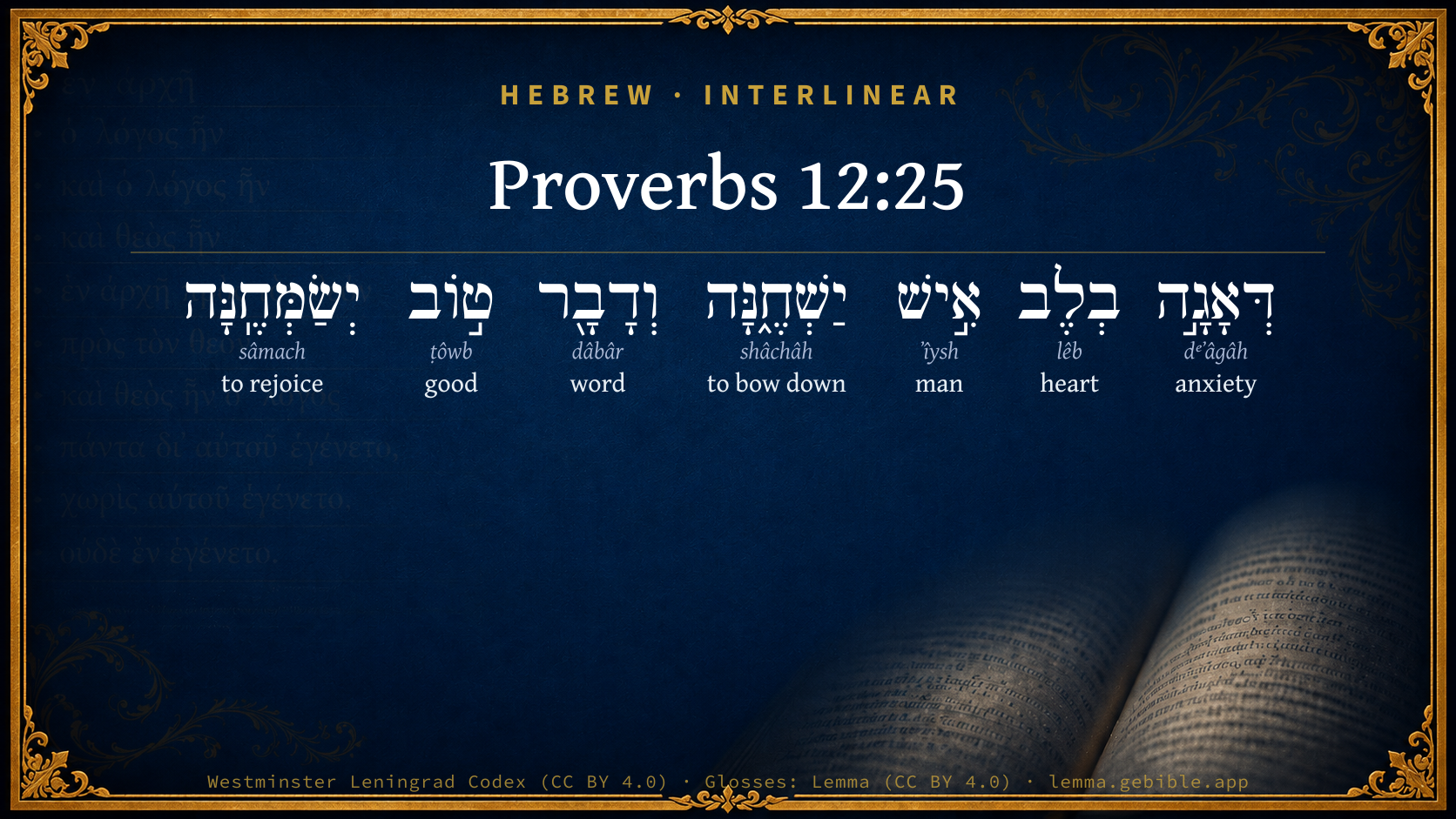
Hebrew (Westminster Leningrad Codex) Proverbs 12:25 appears in the Hebrew Old Testament. The text above is from the Westminster Leningrad Codex. Each word links to its Strong’s number, a concise gloss, and parsing drawn from the Open Scriptures Hebrew Bible morphology. Click any word for its full Brown-Driver-Briggs (BDB) entry.
Download image
Cite this verse

Proverbs 12:25 (World English Bible). Public Domain. Lemma interlinear Bible study tool, https://lemma.gebible.app/v/proverbs/12/25.

Show BibTeX & RIS
BibTeX
RIS
English Translation
Anxiety in a man's heart weighs it down, But a kind word makes it glad.
World English Bible · Public Domain
Download a study sheet

One document with this verse’s original text, its word-by-word gloss line, the meaning frame, cross-references with their text, attributed commentary, and full source and license credits — printable, and it pastes into notes with its structure intact.

This verse Autodidact and up

Study sheet (.html) Plain text (.txt)

A passage Seminary Student

Up to 50 verses in one chapter. A passage sheet keeps up to 6 commentary sources and 12 cross-references per verse, in the order this page ranks them, and says so on the sheet whenever that leaves anything out. Ask for a single verse and you get the Autodidact verse sheet above.

Everything on this page stays free to read, with no account — the sheet is a download of what is already on screen, not access to it.

Want to remove ads? Support Godless Engineer
Compare translations 3

The same verse in 3 English versions, stacked beneath the original-language interlinear above. Click any original word for its lexicon entry.

Each is an independent rendering of the whole verse — the interlinear is not word-aligned to these translations.

Highlighted words mark where these versions differ — a whole-verse word diff, not a word-by-word alignment.

  • World English Bible Public Domain
    Anxiety in a man's heart weighs it down, But a kind word makes it glad.
  • King James Version Public Domain
    Heaviness in the heart of man maketh it stoop: but a good word maketh it glad.
  • unfoldingWord Literal Text CC BY-SA 4.0
    Concern in the heart of a man weighs it down, but a good word gladdens it.

unfoldingWord Literal Text — © unfoldingWord, licensed CC BY-SA 4.0. Word-aligned USFM3 via Door43 (git.door43.org/unfoldingWord/en_ult).

Versions to compare (up to 4)

3 of 4 selected

Show all 18 translations

Every available English version of this verse, each an independent rendering of the whole verse.

  • World English Bible Public Domain
    Anxiety in a man's heart weighs it down, But a kind word makes it glad.
  • Berean Standard Bible Public Domain
    Anxiety weighs down the heart of a man, but a good word cheers it up.
  • Majority Standard Bible Public Domain
    Anxiety weighs down the heart of a man, but a good word cheers it up.
  • King James Version Public Domain
    Heaviness in the heart of man maketh it stoop: but a good word maketh it glad.
  • American Standard Version (1901) Public Domain
    Heaviness in the heart of a man maketh it stoop; But a good word maketh it glad.
  • Revised Version (1885) Public Domain
    Heaviness in the heart of a man maketh it stoop; but a good word maketh it glad.
  • Geneva Bible (1599) Public Domain
    Heauines in the heart of man doeth bring it downe: but a good worde reioyceth it.
  • Douay-Rheims (1899) Public Domain
    Grief in the heart of a man shall bring him low, but with a good word he shall be made glad.
  • Young's Literal Translation Public Domain
    Sorrow in the heart of a man boweth down, And a good word maketh him glad.
  • Literal Standard Version CC BY-SA 4.0
    Sorrow in the heart of a man bows down, || And a good word makes him glad.
  • Unlocked Literal Bible CC BY-SA 4.0
    Anxiety in the heart of a person weighs him down, but a good word makes him glad.
  • unfoldingWord Literal Text CC BY-SA 4.0
    Concern in the heart of a man weighs it down, but a good word gladdens it.
  • Darby Bible Public Domain
    Heaviness in the heart of man maketh it stoop; but a good word maketh it glad.
  • World Messianic Bible Public Domain
    Anxiety in a man’s heart weighs it down, but a kind word makes it glad.
  • Webster's Bible Public Domain
    Heaviness in the heart of man depresseth it: but a good word maketh it glad.
  • Free Bible Version CC BY-SA 4.0
    If you're anxious, you're weighed down, but an encouraging word will cheer you up.
  • Bible in Basic English Public Domain
    Care in the heart of a man makes it weighted down, but a good word makes it glad.
  • JPS Tanakh (1917) Public Domain
    Care in the heart of a man boweth it down; but a good word maketh it glad.

Literal Standard Version (2020), Covenant Press — licensed CC BY-SA 4.0. Text via the HelloAO Bible API (eBible.org). Unlocked Literal Bible (unfoldingWord) — licensed CC BY-SA 4.0. Text via the HelloAO Bible API (eBible.org). unfoldingWord Literal Text — © unfoldingWord, licensed CC BY-SA 4.0. Word-aligned USFM3 via Door43 (git.door43.org/unfoldingWord/en_ult). Free Bible Version, Dr. Jonathan Gallagher — licensed CC BY-SA 4.0. Text via the HelloAO Bible API (eBible.org).

Word by word

More ways to search: Search by grammar → Find every occurrence → Compare this word →

Practice this passage: Drill this verse → Learn its vocabulary →

About this verse

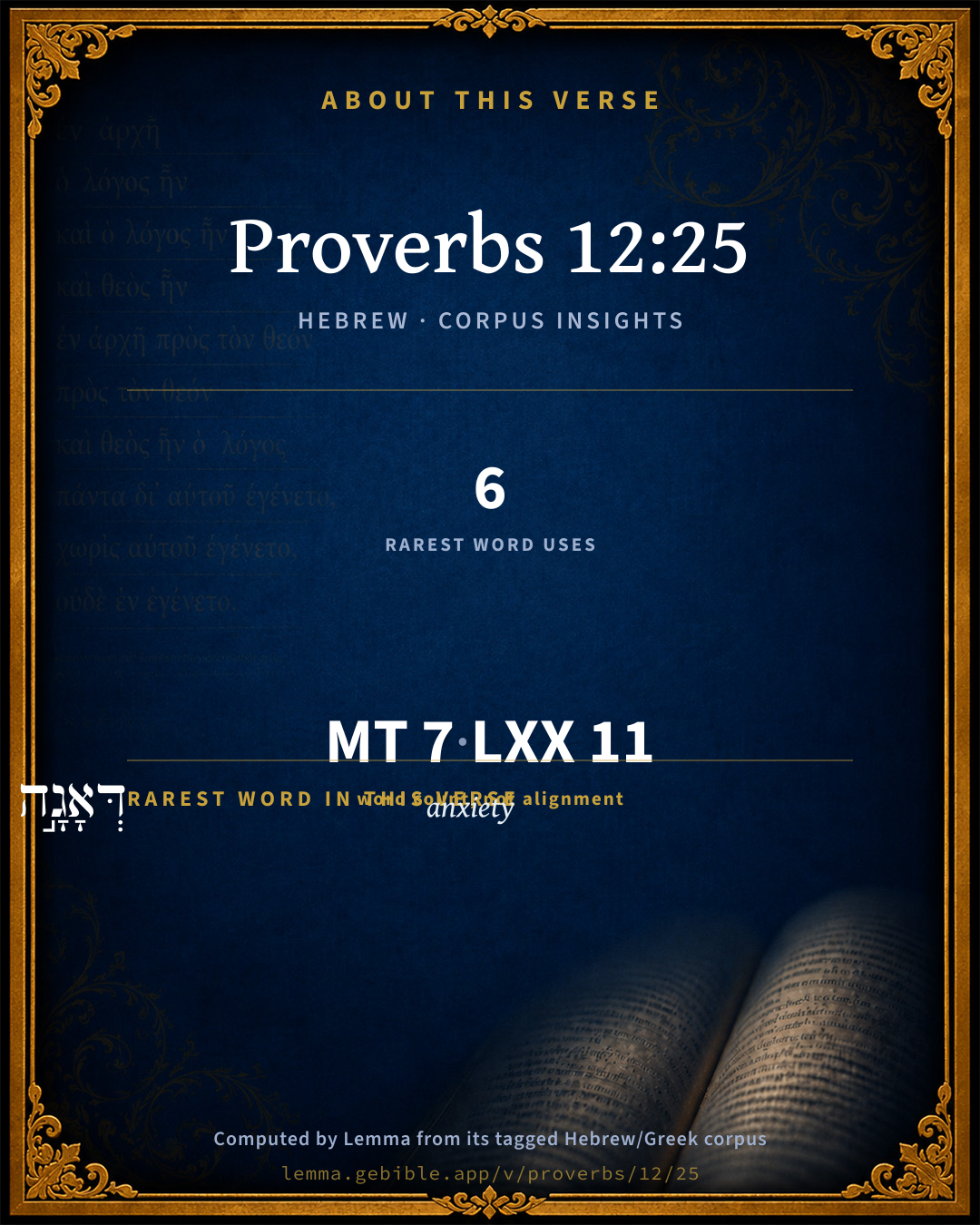
These counts appear in no published source. They are computed here, from the morphology-tagged text and Lemma’s own curated glosses. What Lemma adds →

7
words
7
distinct lemmas
Wisdom
section

Notable vocabulary

The rarest word here is דְּאָגָ֣ה anxiety H1674 — appearing just 6 times in the whole Hebrew Bible.

Shared distinctive vocabulary

דְּאָגָ֣ה anxiety H1674 occurs in 6 verses of the Hebrew Bible. Also found in:

Grammatical profile

  • 2 verbs
  • 4 nouns
  • 1 adjective

Verb forms

  • יַשְׁחֶ֑נָּה Hiphil · Imperfect
  • יְשַׂמְּחֶֽנָּה Piel · Imperfect

Hebrew & Septuagint length

In English translation the verse runs 15 words from the Hebrew and 16 from the Septuagint (LXX English) — closely comparable.

A rough comparison of the two English renderings, which tokenize alike — not a word-level alignment.

Word counts can differ between the Hebrew and the Greek without any difference in meaning — e.g. the Hebrew direct-object marker אֵת has no separate Greek word, and Greek often adds the article ὁ.

In the original languages it is 7 Hebrew tokens and 11 Greek tokens — but the two are counted differently (Hebrew bundles its prefixes and suffixes into one token; the Greek is in lemma form), so that isn’t a like-for-like length.

Cross-references

17

Topical passages linked to Proverbs 12:25 in the Treasury of Scripture Knowledge — connected by theme and wording, ordered by reader-vote popularity; previews shown in the World English Bible.

  • Proverbs 16:24 Pleasant words are a honeycomb, Sweet to the soul, and health to the bones.
  • Proverbs 15:13 A glad heart makes a cheerful face; But an aching heart breaks the spirit.
  • Proverbs 17:22 A cheerful heart makes good medicine, But a crushed spirit dries up the bones.
  • Isaiah 50:4 The Lord Yahweh has given me the tongue of those who are taught, that I may know how to sustain with words him who is weary: he wakens morning by morning, he wakens my ear to hear as those who are taught.
  • Proverbs 15:23 Joy comes to a man with the reply of his mouth. How good is a word at the right time!
  • Psalms 42:11 Why are you in despair, my soul? Why are you disturbed within me? Hope in God! For I shall still praise him, The saving help of my countenance, and my God.
  • Proverbs 12:18 There is one who speaks rashly like the piercing of a sword, But the tongue of the wise heals.
  • Proverbs 27:9 Perfume and incense bring joy to the heart; So does earnest counsel from a man's friend.
  • Zechariah 1:13 Yahweh answered the angel who talked with me with kind and comforting words.
  • Proverbs 18:14 A man's spirit will sustain him in sickness, But a crushed spirit, who can bear?
  • Proverbs 25:11 A word fitly spoken Is like apples of gold in settings of silver.
  • Psalms 38:6 I am pained and bowed down greatly. I go mourning all day long.
  • Proverbs 14:10 The heart knows its own bitterness and joy; He will not share these with a stranger.
  • Mark 14:33–34 He took with him Peter, James, and John, and began to be greatly troubled and distressed.
  • 2 Corinthians 2:4–7 For out of much affliction and anguish of heart I wrote to you with many tears, not that you should be made sorry, but that you might know the love that I have so abundantly for you.
  • Nehemiah 2:1–2 It happened in the month Nisan, in the twentieth year of Artaxerxes the king, when wine was before him, that I took up the wine, and gave it to the king. Now I had not been [before] sad in his presence.
  • Proverbs 15:15 All the days of the afflicted are wretched, But one who has a cheerful heart enjoys a continual feast.

Cross-references courtesy of OpenBible.info (CC BY 4.0).

Hebrew and Greek witnesses Masoretic Hebrew ↔ Greek Septuagint

The same verse in the two great witnesses to the Old Testament, shown verse-for-verse.

These are two independent witnesses, not word-aligned to each other, and the Septuagint is shown in lemma (dictionary) form.

Hebrew Proverbs 12:25 Masoretic · Westminster Leningrad Codex

דְּאָגָ֣ה בְלֶב אִ֣ישׁ יַשְׁחֶ֑נָּה וְדָבָ֖ר ט֣וֹב יְשַׂמְּחֶֽנָּה

Anxiety in a man's heart weighs it down, But a kind word makes it glad.

World English Bible · Public Domain

Greek LXX Proverbs 12:25 Septuagint · lemma form

φοβερός λόγος καρδία ταράσσω ἀνήρ δίκαιος ἀγγελία δέ ἀγαθός εὐφραίνω αὐτός

A terrible word troubles the heart of a righteous man; but a good message rejoices him.

LXX2012 (modern English Septuagint) · Public Domain

On this verse, John Gill's Exposition discusses the Septuagint’s reading. Read the note in Commentary ↓

Hebrew: Westminster Leningrad Codex (CC BY 4.0). Greek: Septuagint (public domain); English from LXX2012 (modern English Septuagint) (Public Domain). How the Septuagint differs from the Hebrew →

Commentary

Notes on Proverbs 12:25 from classic Christian and Jewish commentators (each source and its license shown beneath its notes). The classic Christian expositions comment on the surrounding passage and are grouped to its opening verse, so a note may address several verses; the Jewish commentaries on the Tanakh (Rashi and others) are per-verse, so they appear only where the commentator wrote on this verse.

Lemma curates 59 commentaries, every one of them public domain or Creative Commons licensed, each selected and text-cleaned for this edition rather than reprinted as found. About our sources →

Trapp's Complete Commentary

John Trapp

Pro 12:25 Heaviness in the heart of man maketh it stoop: but a good word maketh it glad.

Ver. 25. Heaviness in the heart of a man maketh it stoop.] Grief is like lead to the soul, - heavy and cold; it sinks downward, and carries the soul with it; Aιφα γαρ εν κακοτητι βροτοι καταγηρασκουσι. {a} How decrepit was David grown with much grief at seventy years of age. The like we may say of Jacob, who "attained not to the days of the years of the life of his fathers," {Gen 47:9} as being a man of many sorrows. And this, some think, was the reason that our Saviour Christ, at little past thirty, was reckoned to be toward fifty. {Joh 8:57} He was "the man that had seen affliction by the rod of God’s wrath." {Lam 3:1}

But a good word maketh it glad.] Such as was that of our Saviour to the poor paralytic, "Son, be of good cheer, thy sins are forgiven thee." The promises are called a "good word." {Jer 29:10} So David found them; {Psa 119:92} medicine for the soul {b} - more truly so called than the library at Alexandria; cordials of comfort, "breasts of consolation"; {Isa 66:11} "wells of salvation"; {Isa 12:3} μαλακτικα miserarium, - as Plato said of wine and music; - that which mitigates man’s miseries; and without which wine, music, merry company, &c., will prove but miserable comforters, and at the best, but the devil’s anodynes.

{a} Homer, Odyss., i. Man’s mind is like the stone Tyrrhenus, which, so long as it is whole, swimmeth, but being once broken sinketh.

{b} η της ψυχης ιατρεια.

John Trapp, A Commentary or Exposition upon All the Books of the Old and New Testament (1647–1656) — public domain. Text from a community e-Sword module.

The Biblical Illustrator

Joseph S. Exell

Pro_12:25

Heaviness in the heart of man maketh it stoop: but a good word maketh it glad.

The saddening and the succouring

I. The saddening in life. There is a soul-crushing sadness here.

1. Personal affliction that maketh the heart stoop.

2. Social affliction that maketh the heart stoop.

II. The succouring in life. A good word maketh it glad.

1. What are good words?

(1) True words;

(2) kind words;

(3) suitable words.

2. Where are good words? The gospel is that word. Words about providence, about pardon, about resurrection. Words to comfort us in all our tribulations. (Urijah R. Thomas.)

The sin of brooding

There is a necessity that we should be in heaviness through manifold temptations; but we must beware lest by giving free scope to anxious and melancholy thoughts, our hearts should sink in us like a stone, and our souls become altogether unfit to relish the comforts or perform the services of life. Sadness of the countenance makes the heart better, but despondency of heart disqualifies men for thanking and praising God, for serving their generation, and for hearing the burdens of life. Life itself becomes burdensome, and is often shortened, by excessive grief. There is nothing that claims our grief so much as sin, and yet there may be an excess of sorrow for sin which exposes men to the devil, and drives them into his arms. Are you grieved in your minds? Remember that it is sinful and dangerous to brood perpetually over your sorrows. (G. Lawson.)

A cheering word

The celebrated Dr. R. W. Dale, of Birmingham, used to be fond of relating how he was cheered once by a poor womans earnest words. He was feeling dejected and as if all his strength was gone, when, passing through a street in Birmingham, he met a decently dressed stranger, laden with parcels, who stopped and said, God bless you, Dr. Dale! Her face was unknown to him, and he answered, Thank you. What is your name? Never mind my name, was the response; but if you only knew how you have made me feel hundreds of times, and what a happy home you have given me! God bless you! Then she was lost in the crowd, but she had encouraged a man whose books are in every library, and whose name is dear to the universal Church. (Sunday Companion.)

The Biblical Illustrator, edited by Joseph S. Exell (c. 1880s–1900s) — public domain. Text from a community e-Sword module.

Joseph Benson's Commentary

Pro 12:25. Heaviness in the heart of man maketh it stoop — Anxious cares and grief depress the spirit of a man, and disable him from exerting himself with any vigour in fulfilling his duty in his place and station, and from bearing with fortitude the sufferings to which he is exposed, in the course of divine providence; but a good word maketh it glad — A compassionate and encouraging word, from a friend or minister, affords him relief and comfort, and enables him to go on his way with tranquillity and peace if not also with joy.

Joseph Benson's Commentary on the Old and New Testaments (1811–1818) — public domain. Text from a community e-Sword module.

The Preacher's Complete Homiletical Commentary

Joseph S. Exell (gen. ed.)

MAIN HOMILETICS OF Pro_12:25

HEAVINESS OF HEART AND ITS CURE

I. The causes of “heaviness of heart” are many and various. It may arise,

1. From great bodily pain. The human mind and the human body act and re-act upon each other. The mind or spirit may be made heavy by physical pain, as the body may be brought under the dominion of disease by mental suffering. It is only when a more powerful influence comes into operation that pain of body is prevented from exercising a depressing influence upon the spirit. In the case of Job we have an instance of severe bodily suffering, weighing down a spirit that had borne other most terrible calamities without being overcome (Job 7). In the case of Stephen, and many others, we see intense bodily suffering exercising no depressing influence upon the man, because he is lifted above it by supernatural interposition. Where this special grace is not given pain of body will make the heart “to stoop”—that is, it will disqualify the man for duty by depriving him of hope and courage, and will leave him more or less passive in the hands of circumstances.

2. Heaviness of heart is often caused by bringing the future into the present. The man that has every day to carry a heavy burden upon his shoulders will find that an attempt to carry the load of two days at once will weigh down his body beyond all his power to rise and stand upright. He must not try to carry more than the load of to-day, if he is to do anything at all. So is it with the spirit of a man if he goes out to meet the cares and difficulties of to-morrow, while he is bearing and battling with those of to-day. The weight of the present is as much as he can carry, his heart must “stoop,” if he dwells upon the possible or certain trials of the future. The right way to bear burdens is to take the advice of One who Himself was a burden-bearer. “Take therefore no thought (no anxious care) for the morrow; for the morrow shall take thought for the things of itself. Sufficient unto the day is the evil thereof. There are many other burdens which make the heart to stoop, we will mention but one more.

3. A consciousness of unpardoned guilt. There is no burden so heavy to bear as this. Guilt makes the spirit feel as if the hand of God’s displeasure was sinking the soul lower and lower. The language of Scripture is very vivid in describing the feelings of man in such a case. “When I kept silence my bones waxed old, through my roaring all the day long.” “Mine iniquities are gone over mine head; as a heavy burden, they are too heavy for me.” “Mine iniquities have taken hold upon me, so that I am not able to look up,” etc. (Psa_22:3; Psa_38:4; Psa_40:12).

II. The human heart can be uplifted by seasonable words. “A good word maketh it glad.” Such words sometimes take the form of a promise of help. A man bowed down by disease is made glad by the word of the physician, which assures him that his malady can be cured. The debtor who feels himself hopelessly involved is made glad by the promise of one who engages to meet his debts. The man who is bowed down under a sense of guilt is lifted out of his heaviness by the promises of a forgiving God. In all these cases the worth of the word depends upon the character of him who utters them. It is a “good word” if it is not only a cheering word, but a reliable word—if the promise is uttered by one whom we know would not promise what he was unable to perform. It is this certainty which makes every promise of God so good a word to the soul. And when a man’s heaviness of heart arises from a source which is beyond the power of human help, there is no greater service that a friend can do him than to remind him of some “good word” of the Heavenly Father which is suitable to his case.

OUTLINES AND SUGGESTIVE COMMENTS

Not “heaviness,” but “anxiety.” This last is the fashion of most griefs. We are bound to conquer it. The determined man (see comments on Pro_12:24) is just the character to do it. “Anxiety” discredits faith. “A good word,” and such words are plenty in this very book, should gladden it, as the expression is; or, as a freer translation, “cheer it away.” It is a sin for men to be dejected. It is a great folly, too; for it broods over half their lives. Our passage tells all this, and tells the mode to dissipate it. It was the mode of Christ when he quelled the foul fiend. The sword of the Spirit is the “word” of God (Eph_6:17).—Miller.

There is nothing that claims our grief so much as sin, and yet there may be an excess of sorrow for sin, which exposes men to the devil and drives them into his arms.—Lawson.

A single good or favourable word will remove despondency; and that word, “Son, be of good cheer, thy sins are forgiven thee,” will instantly remove despair.—A. Clarke.

The Preacher's Complete Homiletical Commentary (gen. ed. Joseph S. Exell; Funk & Wagnalls, c. 1892) — public domain (pre-1929). A full-Bible homiletical/sermon-outline anthology covering 65 of 66 books (2 John is absent from the source module). Text from a community e-Sword module.

Geneva Bible (1599)

Geneva Bible translators

That is, words of comfort, or, a cheerful mind which is declared by his words, rejoiceth a man, as a covetous mind killeth him.

Geneva Bible (1599) marginal notes — public domain. Text via Bolls.life.

Matthew Henry's Commentary

Here is, 1. The cause and consequence of melancholy. It is heaviness in the heart; it is a load of care, and fear, and sorrow, upon the spirits, depressing them, and disabling them to exert themselves with any vigour on what is to be done or fortitude in what is to borne; it makes them stoop, prostrates and sinks them. Those that are thus oppressed can neither do the duty nor take the comfort of any relation, condition, or conversation. Those therefore that are inclined to it should watch and pray against it. 2. The cure of it: A good word from God, applied by faith, makes it glad; such a word is that (says one of the rabbin), Cast thy burden upon the Lord, and he shall sustain thee; the good word of God, particularly the gospel, is designed to make the hearts glad that are weary and heavy-laden, Mat 11:28. Ministers are to be helpers of this joy.

Matthew Henry's Commentary on the Whole Bible (1708–1710) — public domain (CC PDM 1.0). Text via the HelloAO Bible API.

Jamieson, Fausset & Brown

Robert Jamieson, A. R. Fausset & David Brown

a good word--one of comfort.

Jamieson, Fausset & Brown — Commentary Critical and Explanatory on the Whole Bible (1871) — public domain (CC PDM 1.0). Text via the HelloAO Bible API.

Adam Clarke's Commentary

Verse 25. Heaviness in the heart of a man maketh it stoop] Sorrow of heart, hopeless love, or a sense of God's displeasure-these prostrate the man, and he becomes a child before them.

But a good word maketh it glad.] A single good or favourable word will remove despondency; and that word, "Son, be of good cheer, thy sins are forgiven thee," will instantly remove despair.

Adam Clarke's Commentary on the Bible (1810–1826) — public domain. Text from a community e-Sword/MySword module.

Ellicott's Commentary for English Readers

(25) Heaviness in the heart of man maketh it stoop.—But, as this is not favourable to the spiritual life, we have warnings against excessive anxiety (Mat_6:34), and exhortations to cast all our care upon God (1Pe_5:7; Psa_37:5) as a religious duty, that trusting in Him, and so having from Him the “peace which the world cannot give,” our hearts may be “set to obey” His commandments.

A Bible Commentary for English Readers, edited by Charles John Ellicott (1878–1897) — public domain. Text from a community e-Sword module.

The Cambridge Bible for Schools and Colleges

gen. ed. J. J. S. Perowne

25. In spite of grammatical anomalies, the rendering of this verse in A.V. and R.V. is to be retained.

The Cambridge Bible for Schools and Colleges (gen. ed. J. J. S. Perowne; Cambridge University Press, 1878–1918) — public domain. Text from a community e-Sword module.

John Gill's Exposition

Heaviness in the heart of man maketh it stoop,.... Either an anxious care and solicitude about living in the world, as the word (m) signifies; when it seizes a man's spirits, it depresses them, and keeps them down: or a fear and dread of adversity, or sorrow and grief, on account of some calamity and distress; when it gets into a man's heart, it sinks and bows it down, that it cannot take any pleasure or comfort in anything. The Septuagint and Arabic versions render it, a "terrible word troubles the heart of a just man"; or "troubles the heart of man", as the Syriac version; the Targum is,

"a word of fear in the heart of man causes fear:''

such is the law, which is a word of terror; which speaks terrible things to men; fills the mind with terror; works wrath in the conscience, and induces a spirit of bondage to fear; bows and keeps under the spirits of men, through a fearful looking for of judgment and fiery indignation;

but a good word maketh it glad; a comforting, cheering, and encouraging word from any friend, that compassionates their distressed case; this lifts up the heart and inspires it with joy; so a word in season, spoken by a Gospel minister, raises up a soul that is bowed down, and gives it comfort and joy: such a good word is the Gospel itself; it is good news from a far country, which is like cold water to a thirsty soul, very refreshing and reviving. The Septuagint and Arabic versions here render it, "a good message", and such the Gospel is; which, when brought to the heart of a poor sinner, depressed with the terrors of the law, causes joy in it; such is the word of peace, pardon, righteousness, and eternal life by Christ; such is the word that he himself spoke, Mat 9:2. Kimchi instances in Psa 55:22.

(m) "solicitudo", Tigurine version, Montanus, Piscator, Michaelis; "solicitudo anxia", Mercerus, Gejerus; "solicita anxietas", Junius & Tremellius; "anxietatem", Schultens.

John Gill's Exposition of the Whole Bible (1746–1763) — public domain (CC PDM 1.0). Text via the HelloAO Bible API.

Haydock's Catholic Bible Commentary

Grief. Septuagint, "a fearful speech troubleth the heart of a (just) man." (Grabe) (Haydock)

George Leo Haydock (1774–1849), Haydock's Catholic Family Bible and Commentary, 1859 edition — public domain. Excludes Psalms (Douay-Rheims chapter numbering differs from Protestant) and Deuterocanonical books (Catholic canon only).

Matthew Poole's English Annotations

A compassionate or encouraging word from a friend or minister.

Matthew Poole's English Annotations on the Holy Bible (1683–1685) — public domain. Text from a community e-Sword/MySword module.

Whedon's Commentary on the Bible

Daniel D. Whedon

25. Heaviness in the heart — Trouble, anxiety, sorrow.

Maketh it stoop — Bows it down, as if oppressed by a burden.

A good word — A kind or cheering word. Some grammatical anomalies are noticed here by the critics, but they do not affect the sense. On latter clause compare Pro_25:11; Isa_50:4; Zec_1:13; 2Co_2:4-7.

Daniel D. Whedon (gen. ed.), Commentary on the Old and New Testaments (1874–1909) — public domain. Text from a community e-Sword module.

The Pulpit Commentary

Heaviness carein the heart of man maketh it stoop. (Pro_15:13 Pro_17:22) Care brings dejection and despair; hence the Christian is bidden to beware of excessive anxiety, and not to perplex himself with solicitude for the future. (Mat_6:34 1Pe_5:7)

A good word maketh it glad. Luphn gagov . "A word of kindness grief"s keen smart can heal. Septuagint, "A word of terror disturbs the heart of a (righteous) man, but a good message will gladden him." The "word of terror" may be an unjust censure, or evil tidings. Says a Servian proverb, "Give me a comrade who will weep with me; one who will laugh I can easily find.

Depression and comfort.

I DEPRESSION IS COMMON.

II TROUBLE AFFECTS THE HEART. When we use the word "discouragement" we point to a state that is both bodily and psychical. The action of the heart is lowered, and there is less energy to act and to endure.

III THE IMMEDIATE EFFECT OF SYMPATHY. The kindly word, and all that it expresses of love and fellow feeling on the part of our friend, quickens the pulse, and restores, as by magic, the tone of the mind. J.

The Pulpit Commentary (1880–1919), ed. H.D.M. Spence-Jones & Joseph S. Exell — public domain. Text from a community e-Sword module.

John Wesley's Explanatory Notes

A good word - A compassionate or encouraging word.

John Wesley, Explanatory Notes Upon the Whole Bible (1754–1765) — public domain. Text via the GEBible commentary corpus.

Keil & Delitzsch

C. F. Keil & F. Delitzsch

25 Trouble in the heart of a man boweth it down,

And a friendly word maketh it glad.

The twofold anomaly that דּאגה is construed as masc. and לב as fem. renders the text doubtful, but the lxx, Syr., Targum, which introduce another subject, φοβερὸς λόγος (דּבר מדאיג?), do not improve it; Theodotion's is preferable, who translates μέριμνα ἐν καρδίᾳ ἀνδρὸς κατίσχει αὐτόν, and thus reads ישׁחנּוּ. But the rhyme is thereby lost. As כּבוד, Gen 49:6, so also may לב be used as fem., for one thereby thinks on נפשׁ; the plur. לבּות (לבבות), according to which in Eze 16:30 we find the sing. לבּה, may also conform to this. And ישׁחנה as pred. to דאגה follows the scheme Pro 2:10, perhaps not without attractional co-operation after the scheme קשׁת גברים חתים, Sa1 2:4. השׁחה, from שׁחה, occurs only here; but השׁח, from שׁחח, occurs only twice. דּבר טוב designates in the book of Joshua and in Kings (Kg1 8:56) the divine promise; here it is of the same meaning as Kg1 12:7 : an appeasing word. Who has not in himself had this experience, how such a word of friendly encouragement from a sympathizing heart cheers the sorrowful soul, and, if only for a time, changes its sorrow into the joy of confidence and of hope!

Keil & Delitzsch — Biblical Commentary on the Old Testament (1861–1891) — public domain (CC PDM 1.0). Text via the HelloAO Bible API. (Old Testament only.)

Bridges on Proverbs

Charles Bridges

Heaviness in heart is a palsy, that maketh it stoop, as under an intolerable burden. (Gen 37:33-35 ; Gen 42:38 .) And gladdening indeed is a good word of sympathy and comfort! (Neh 1:4, with Neh 2:1-8 .) ’This maxim therefore points out an easy and cheerful way of being useful.’†1 Here we realize the precious efficacy of the Gospel. How full is it of these good words! Is it distress for sin? "Come unto me, all ye that labour and are heavy laden; and I will give you rest." (Mat 11:28 .) Is it the pressure of affliction? How good is the word, "that speaketh unto us as unto children;" warning us neither to "despise, nor to faint, under the chastening of the Lord!" (Heb 12:5 .) Is it despondency? Oft is the good word repeated — "Fear not." (Isa 41:10, Isa 41:14 ; Isa 43:1 .) Know we not the voice — "It is I; be not afraid"? (Mat 14:27 .) Human sympathy may give temporary relief. But ’that was the grace, softer than oil, sweeter than roses, which flows from the Savior’s lips into the sinner’s wounds; and being poured into the contrite heart, not only heals, but blesses it, yea, and marks it out for eternal blessedness. Oh! how sweet is the voice of pardon to a soul groaning under the burden of sin!’†2 David, but for these good words, "would have perished in his affliction." (Psa 119:92 .) What beside made glad the jailor’s stooping heart? (Act 16:28-34 .) Precious indeed is the privilege, to strengthen the weak hands "with a good word of God" (Isa 35:3-4 ); to take the chair by the mourner’s side, and "comfort him with the same comfort, wherewith we ourselves are comforted of God." (2Co 1:4 .) Precious is the ministry of the gospel, commissioned with the gladdening word to the heavy of heart. (Job 33:23-26 . Isa 40:1-2 .) Yet more precious the office of the Beloved Savior, "gifted with the tongue of the learned," and filled with the unction of the Spirit, for the express purpose of "comforting them that mourn." (Isa 50:4 . Isa 61:1-2 .) How tenderly did he perform this office, let his last sermon testify. (John 14. — 16.) See then the provision for joy, so rich, so free, so ready. Beware "lest Satan should get advantage" by a brooding spirit. (2Co 2:7 .) Think on thy obligation and thy privilege to "rejoice in the Lord." (Php 3:1 ; Php 4:4 .)

Footnotes:

†1 Scott.

†2 Leighton’s Meditations on Psa 130:4 .

Charles Bridges, An Exposition of the Book of Proverbs (1846) — public domain. Text from a community e-Sword module.

Kretzmann's Popular Commentary

Paul E. Kretzmann

v. 25. Heaviness in the heart of man maketh it stoop, it is readily bowed down by trouble and grief; but a good word maketh it glad, so that he straightens up from his grief and gains new courage.

Paul E. Kretzmann, Popular Commentary of the Bible (1921–1924) — public domain. Text from a community e-Sword module.

unfoldingWord translationNotes

Door43 World Missions Community

Anxiety

uneasy feeling of fear or dread, worry

weighs him down

"Weighing down" represents the idea of putting a very heavy load on a person so he cannot move freely. This phrase means to make a person sad or depressed. AT: "causes him to become sad or depressed" (See: Metaphor)

but a good word makes him glad

The abstract noun "word" can be stated as the verb "speak." AT: "but when others speak kindly to him, he is cheerful again" (See: Abstract Nouns)

translationWords

heart

word

evil

unfoldingWord translationNotes — © Distant Shores Media and the Door43 World Missions Community, licensed CC BY-SA 4.0. Source: git.door43.org/Door43/en_tn.

Rashi

Rabbi Shlomo Yitzchaki (Rashi)

If there is concern in a man’s heart, let him cast it down Let him divert his attention from it.

and a good word will make it cheerful Let him engage in the Torah which will cause the concern in his heart to rejoice and save him therefrom. And according to the one who says, “he should tell it to others,” this is [the meaning of] the end of the verse: And a good word with which his friend consoles him will cause the concern to rejoice.

Rashi on the Tanakh — English translations: “The Judaica Press complete Tanach with Rashi, translated by A. J. Rosenberg” (CC BY 4.0); “Pentateuch with Rashi's commentary by M. Rosenbaum and A.M. Silbermann, 1929-1934” (public domain); “The Metsudah Tanach series, Lakewood, N.J” (CC BY 4.0); and “The Book of Joshua, Metsudah Publications, 1997” (CC BY 4.0). Text via Sefaria.

Lesson kit

Teaching starters — assembled from the data on this page, not authored interpretation. Every prompt links to the verse data it draws on. Edit before teaching.

Proverbs, in the Wisdom, opens this verse with 7 words (7 distinct Hebrew lemmas). Its most distinctive word is dᵉʼâgâh (“anxiety”). A historical commentator’s framing appears above. Read the whole chapter for the surrounding context.

Discussion questions

  1. How does “anxiety” (dᵉʼâgâh) shape what this verse is saying?
  2. How does Joshua 22:24, which shares the word «anxiety», read alongside this verse?
  3. The translations on this page render this verse differently — a whole-verse word diff, not a word-by-word alignment. What might account for the different wordings?
  4. «יַשְׁחֶ֑נָּה» is a Hiphil Imperfect verb. How does that grammatical form shape the action described?
  5. Compare how Trapp's Complete Commentary and The Biblical Illustrator read this verse. Where do they agree or differ?

Things to notice

Reading settings

Reading text

Shown beneath each verse's original-language words.

Old Testament
Old Testament edition

Read the OT as the Masoretic Hebrew (MT) or the Greek Septuagint (LXX).

English shown for the Greek Septuagint (in the Hebrew ↔ Greek comparison).

Comparing translations? Open the Compare panel on any verse page to stack up to four side by side.