2 Chronicles 24:17

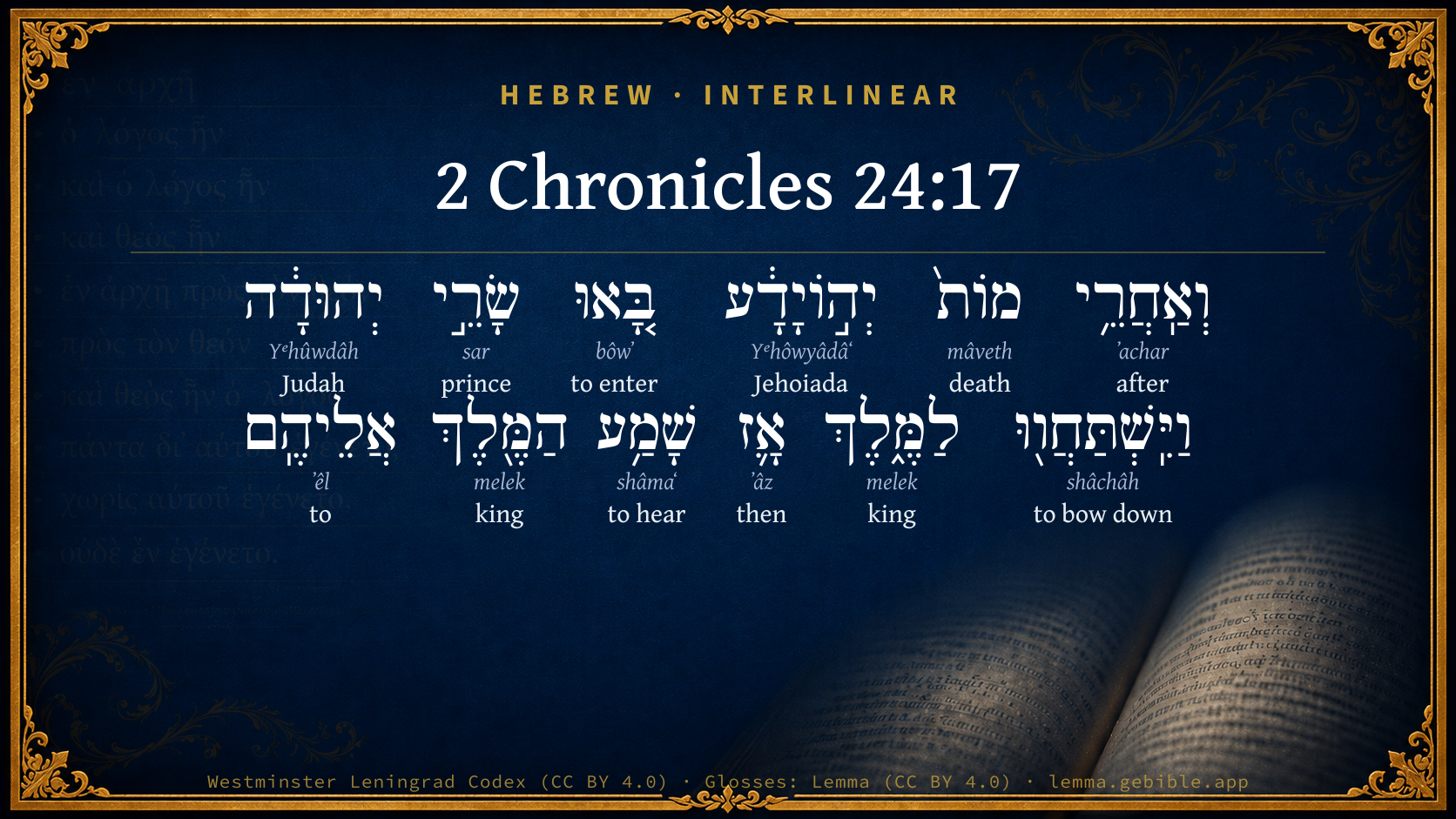
Hebrew (Westminster Leningrad Codex) 2 Chronicles 24:17 appears in the Hebrew Old Testament. The text above is from the Westminster Leningrad Codex. Each word links to its Strong’s number, a concise gloss, and parsing drawn from the Open Scriptures Hebrew Bible morphology. Click any word for its full Brown-Driver-Briggs (BDB) entry.
Download image
Cite this verse

2 Chronicles 24:17 (World English Bible). Public Domain. Lemma interlinear Bible study tool, https://lemma.gebible.app/v/2-chronicles/24/17.

Show BibTeX & RIS
BibTeX
RIS
English Translation
Now after the death of Jehoiada came the princes of Judah, and made obeisance to the king. Then the king listened to them.
World English Bible · Public Domain
Download a study sheet

One document with this verse’s original text, its word-by-word gloss line, the meaning frame, cross-references with their text, attributed commentary, and full source and license credits — printable, and it pastes into notes with its structure intact.

This verse Autodidact and up

Study sheet (.html) Plain text (.txt)

A passage Seminary Student

Up to 50 verses in one chapter. A passage sheet keeps up to 6 commentary sources and 12 cross-references per verse, in the order this page ranks them, and says so on the sheet whenever that leaves anything out. Ask for a single verse and you get the Autodidact verse sheet above.

Everything on this page stays free to read, with no account — the sheet is a download of what is already on screen, not access to it.

Want to remove ads? Support Godless Engineer
Compare translations 3

The same verse in 3 English versions, stacked beneath the original-language interlinear above. Click any original word for its lexicon entry.

Each is an independent rendering of the whole verse — the interlinear is not word-aligned to these translations.

Highlighted words mark where these versions differ — a whole-verse word diff, not a word-by-word alignment.

  • World English Bible Public Domain
    Now after the death of Jehoiada came the princes of Judah, and made obeisance to the king. Then the king listened to them.
  • King James Version Public Domain
    Now after the death of Jehoiada came the princes of Judah, and made obeisance to the king. Then the king hearkened unto them.
  • unfoldingWord Literal Text CC BY-SA 4.0
    And after the death of Jehoiada, the chiefs of Judah came and bowed down to the king. Then the king listened to them.

unfoldingWord Literal Text — © unfoldingWord, licensed CC BY-SA 4.0. Word-aligned USFM3 via Door43 (git.door43.org/unfoldingWord/en_ult).

Versions to compare (up to 4)

3 of 4 selected

Show all 18 translations

Every available English version of this verse, each an independent rendering of the whole verse.

  • World English Bible Public Domain
    Now after the death of Jehoiada came the princes of Judah, and made obeisance to the king. Then the king listened to them.
  • Berean Standard Bible Public Domain
    After the death of Jehoiada, however, the officials of Judah came and paid homage to the king, and he listened to them.
  • Majority Standard Bible Public Domain
    After the death of Jehoiada, however, the officials of Judah came and paid homage to the king, and he listened to them.
  • King James Version Public Domain
    Now after the death of Jehoiada came the princes of Judah, and made obeisance to the king. Then the king hearkened unto them.
  • American Standard Version (1901) Public Domain
    Now after the death of Jehoiada came the princes of Judah, and made obeisance to the king. Then the king hearkened unto them.
  • Revised Version (1885) Public Domain
    Now after the death of Jehoiada came the princes of Judah, and made obeisance to the king. Then the king hearkened unto them.
  • Geneva Bible (1599) Public Domain
    And after the death of Iehoiada, came the princes of Iudah, and did reuerence to the King, and the King hearkened vnto them.
  • Douay-Rheims (1899) Public Domain
    And after the death of Joiada, the princes of Juda went in, and worshipped the king: and he was soothed by their services and hearkened to them.
  • Young's Literal Translation Public Domain
    And after the death of Jehoiada come in have heads of Judah, and bow themselves to the king; then hath the king hearkened unto them,
  • Literal Standard Version CC BY-SA 4.0
    And after the death of Jehoiada, heads of Judah have come in, and bow themselves to the king; then the king has listened to them,
  • Unlocked Literal Bible CC BY-SA 4.0
    Now after the death of Jehoiada, the leaders of Judah came and did honor to the king. Then the king listened to them.
  • unfoldingWord Literal Text CC BY-SA 4.0
    And after the death of Jehoiada, the chiefs of Judah came and bowed down to the king. Then the king listened to them.
  • Darby Bible Public Domain
    And after the death of Jehoiada the princes of Judah came and made obeisance to the king; then the king hearkened to them.
  • World Messianic Bible Public Domain
    Now after the death of Jehoiada, the princes of Judah came and bowed down to the king. Then the king listened to them.
  • Webster's Bible Public Domain
    Now after the death of Jehoiada came the princes of Judah, and made obeisance to the king. Then the king hearkened to them.
  • Free Bible Version CC BY-SA 4.0
    But after the death of Jehoiada, the leaders of Judah came to swear their loyalty to the king, and he listened to their advice.
  • Bible in Basic English Public Domain
    Now after the death of Jehoiada, the chiefs of Judah came and went down on their faces before the king. Then the king gave ear to them.
  • JPS Tanakh (1917) Public Domain
    Now after the death of Jehoiada came the princes of Judah, and prostrated themselves before the king. Then the king hearkened unto them.

Literal Standard Version (2020), Covenant Press — licensed CC BY-SA 4.0. Text via the HelloAO Bible API (eBible.org). Unlocked Literal Bible (unfoldingWord) — licensed CC BY-SA 4.0. Text via the HelloAO Bible API (eBible.org). unfoldingWord Literal Text — © unfoldingWord, licensed CC BY-SA 4.0. Word-aligned USFM3 via Door43 (git.door43.org/unfoldingWord/en_ult). Free Bible Version, Dr. Jonathan Gallagher — licensed CC BY-SA 4.0. Text via the HelloAO Bible API (eBible.org).

Word by word

More ways to search: Search by grammar → Find every occurrence → Compare this word →

Practice this passage: Drill this verse → Learn its vocabulary →

יְה֣וֹיָדָ֔ע
Yᵉhôwyâdâʻ
H3077
“Jehoiada”
Noun, Proper
Part of Speech
Noun
Type
Proper
Full BDB Definition

Origin: from H3068 and H3045

TWOT: None

Jehoiada = "Jehovah knows" - father of Benaiah, David's mighty warrior - leader of the priests who joined David at Hebron - high priest at the time of Athaliah's usurpation of the throne of Judah; hid Joash, the king's son, for six years and eventually replaced him on the throne of Judah - second priest, or sagan, to Seraiah the high priest
  1. וְאַֽחֲרֵ֥י ʼachar H310 “and · after” Conjunction + Preposition
  2. מוֹת֙ mâveth H4194 “death of” Noun, Common, Masculine, Singular, Construct
  3. בָּ֚אוּ bôwʼ H935 “to enter” Verb, Qal, Perfect, 3rd Person, Common, Plural
  4. שָׂרֵ֣י sar H8269 “princes of” Noun, Common, Masculine, Plural, Construct
  5. יְהוּדָ֔ה Yᵉhûwdâh H3063 “Judah” Noun, Proper
  6. וַיִּֽשְׁתַּחֲו֖וּ shâchâh H7812 “and · to bow down” Conjunction + Verb, Hithpael, Sequential Imperfect, 3rd Person, Masculine, Plural
  7. לַמֶּ֑לֶךְ melek H4428 “to/for the · king” Preposition, Determined + Noun, Common, Masculine, Singular, Absolute
  8. אָ֛ז ʼâz H227 “then” Adverb
  9. שָׁמַ֥ע shâmaʻ H8085 “to hear” Verb, Qal, Perfect, 3rd Person, Masculine, Singular
  10. הַמֶּ֖לֶךְ melek H4428 “the · king” Particle, Definite Article + Noun, Common, Masculine, Singular, Absolute
  11. אֲלֵיהֶֽם ʼêl H413 “to · them” Preposition + Suffix, Personal, 3rd Person, Masculine, Plural

About this verse

These counts appear in no published source. They are computed here, from the morphology-tagged text and Lemma’s own curated glosses. What Lemma adds →

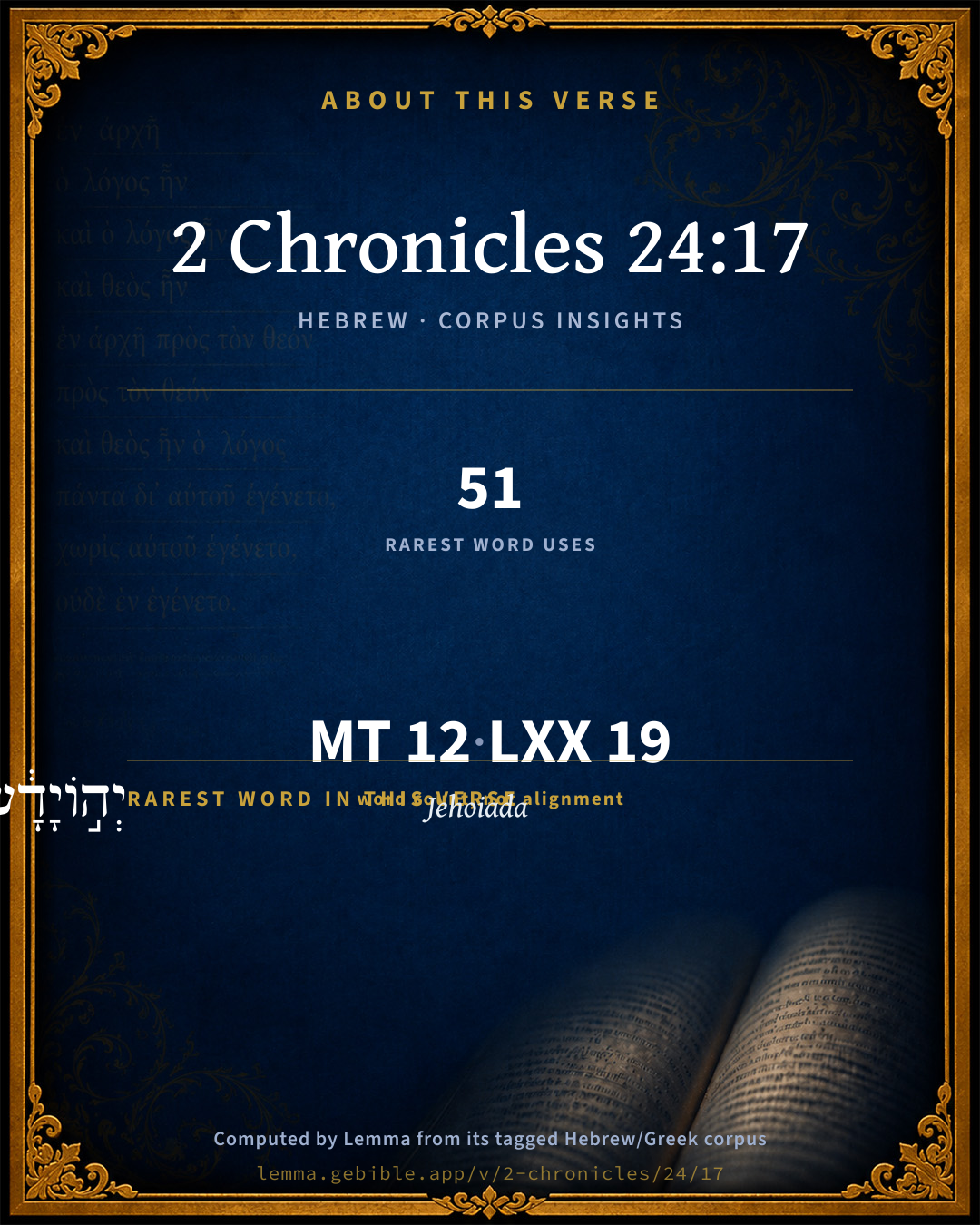
12
words
11
distinct lemmas
Historical
section

Shared distinctive vocabulary

יְה֣וֹיָדָ֔ע Jehoiada H3077 occurs in 48 verses of the Hebrew Bible. Also found in:

Grammatical profile

  • 3 verbs
  • 6 nouns
  • 2 prepositions
  • 1 adverb

Verb forms

  • בָּ֚אוּ Qal · Perfect
  • וַיִּֽשְׁתַּחֲו֖וּ Hithpael · Sequential Imperfect
  • שָׁמַ֥ע Qal · Perfect

Repetition

A word recurs within this verse — often emphatic in Hebrew:

  • לַמֶּ֑לֶךְ king H4428 ×2

Hebrew & Septuagint length

In English translation the verse runs 23 words from the Hebrew and 29 from the Septuagint (LXX English) — closely comparable.

A rough comparison of the two English renderings, which tokenize alike — not a word-level alignment.

Word counts can differ between the Hebrew and the Greek without any difference in meaning — e.g. the Hebrew direct-object marker אֵת has no separate Greek word, and Greek often adds the article ὁ.

In the original languages it is 12 Hebrew tokens and 19 Greek tokens — but the two are counted differently (Hebrew bundles its prefixes and suffixes into one token; the Greek is in lemma form), so that isn’t a like-for-like length.

Cross-references

12

Topical passages linked to 2 Chronicles 24:17 in the Treasury of Scripture Knowledge — connected by theme and wording, ordered by reader-vote popularity; previews shown in the World English Bible.

  • Deuteronomy 31:27 For I know your rebellion, and your stiff neck: behold, while I am yet alive with you this day, you have been rebellious against Yahweh; and how much more after my death?
  • 2 Chronicles 10:8–10 But he forsook the counsel of the old men which they had given him, and took counsel with the young men who had grown up with him, who stood before him.
  • 2 Chronicles 22:3–4 He also walked in the ways of the house of Ahab; for his mother was his counselor to do wickedly.
  • Proverbs 7:21–23 With persuasive words, she led him astray. With the flattering of her lips, she seduced him.
  • Proverbs 20:19 He who goes about as a tale-bearer reveals secrets; Therefore don't keep company with him who opens wide his lips.
  • Proverbs 26:8 As one who binds a stone in a sling, So is he who gives honor to a fool.
  • Proverbs 26:28 A lying tongue hates those it hurts; And a flattering mouth works ruin.
  • Proverbs 29:5 A man who flatters his neighbor, Spreads a net for his feet.
  • Proverbs 29:12 If a ruler listens to lies, All of his officials are wicked.
  • Daniel 11:32 Such as do wickedly against the covenant shall he pervert by flatteries; but the people who know their God shall be strong, and do [exploits].
  • Acts 20:29–30 For I know that after my departure, vicious wolves will enter in among you, not sparing the flock.
  • 2 Peter 1:15 Yes, I will make every effort that you may always be able to remember these things even after my departure.

Cross-references courtesy of OpenBible.info (CC BY 4.0).

Hebrew and Greek witnesses Masoretic Hebrew ↔ Greek Septuagint

The same verse in the two great witnesses to the Old Testament, shown verse-for-verse.

These are two independent witnesses, not word-aligned to each other, and the Septuagint is shown in lemma (dictionary) form.

Hebrew 2 Chronicles 24:17 Masoretic · Westminster Leningrad Codex

וְאַֽחֲרֵ֥י מוֹת֙ יְה֣וֹיָדָ֔ע בָּ֚אוּ שָׂרֵ֣י יְהוּדָ֔ה וַיִּֽשְׁתַּחֲו֖וּ לַמֶּ֑לֶךְ אָ֛ז שָׁמַ֥ע הַמֶּ֖לֶךְ אֲלֵיהֶֽם

Now after the death of Jehoiada came the princes of Judah, and made obeisance to the king. Then the king listened to them.

World English Bible · Public Domain

Greek LXX 2 Chronicles 24:17 Septuagint · lemma form

καί γίγνομαι μετά ὁ τελευτή ιωδαε εἰςἔρχομαι ὁ ἄρχων ἰουδά καί προςκυνέω ὁ βασιλεύς τότε ἐπιἀκούω αὐτός ὁ βασιλεύς

And it came to pass after the death of Jodae, that the princes of Juda went in, and did obeisance to the king. Then the king listened to them.

LXX2012 (modern English Septuagint) · Public Domain

Hebrew: Westminster Leningrad Codex (CC BY 4.0). Greek: Septuagint (public domain); English from LXX2012 (modern English Septuagint) (Public Domain). How the Septuagint differs from the Hebrew →

Commentary

Notes on 2 Chronicles 24:17 from classic Christian and Jewish commentators (each source and its license shown beneath its notes). The classic Christian expositions comment on the surrounding passage and are grouped to its opening verse, so a note may address several verses; the Jewish commentaries on the Tanakh (Rashi and others) are per-verse, so they appear only where the commentator wrote on this verse.

Lemma curates 59 commentaries, every one of them public domain or Creative Commons licensed, each selected and text-cleaned for this edition rather than reprinted as found. About our sources →

Jamieson, Fausset & Brown

Robert Jamieson, A. R. Fausset & David Brown

JOASH FALLS INTO IDOLATRY. (Ch2 24:17-22)

Now came the princes of Judah, and make obeisance to the king--Hitherto, while Joash occupied the throne, his uncle had held the reins of sovereign power, and by his excellent counsels had directed the young king to such measures as were calculated to promote both the civil and religious interests of the country. The fervent piety, practical wisdom, and inflexible firmness of that sage counsellor exerted immense influence over all classes. But now that the helm of the state-ship was no longer steered by the sound head and firm hand of the venerable high priest, the real merits of Joash's administration appear; and for want of good and enlightened principle, as well as, perhaps, of natural energy of character, he allowed himself to be borne onward in a course which soon wrecked the vessel upon hidden rocks.

the king hearkened unto them, &c.--They were secretly attached to idolatry, and their elevated rank affords sad proof how extensively and deeply the nation had become corrupted during the reigns of Jehoram, Ahaziah, and Athaliah. With strong professions of allegiance they humbly requested that they might not be subjected to the continued necessity of frequent and expensive journeys to Jerusalem, but allowed the privilege their fathers had enjoyed of worshipping God in high places at home. They framed their petition in this plausible and least offensive manner, well knowing that, if excused attendance at the temple, they might--without risk of discovery or disturbance--indulge their tastes in the observance of any private rites they pleased. The weak-minded king granted their petition; and the consequence was, that when they left the house of the Lord God of their fathers, they soon "served groves and idols."

Jamieson, Fausset & Brown — Commentary Critical and Explanatory on the Whole Bible (1871) — public domain (CC PDM 1.0). Text via the HelloAO Bible API.

Trapp's Complete Commentary

John Trapp

2Ch 24:17 Now after the death of Jehoiada came the princes of Judah, and made obeisance to the king. Then the king hearkened unto them.

Ver. 17. Came the princes of Judah, and made obeisance to the king.] Rabbi Solomon saith that they persuaded him that he was more than a man, and gave him divine honours: but this is not likely. In most fawning and flattering manner did these court parasites present themselves before him, suavia potius quam sana consilia atque remedia illi propinantes, persuading him that during the days of Jehoiada he had been a king without a kingdom, a lord without a dominion, a subject to his subjects, &c.: that he should do well to take knowledge of his great power, and to show it by granting to every man a liberty to worship God as he list, and where he best liketh, not tied to the temple, but doing his devotions in other places besides, as high places, groves, &c.

And the king hearkened unto them.] As fair words make fools fain, and princes’ minds are easily altered for the worse, quando non deligunt quos diligant, sed consiliarios adhibent parasitos, sputa illorum instar canum lingentes, &c., when they give ear to flatterers.

John Trapp, A Commentary or Exposition upon All the Books of the Old and New Testament (1647–1656) — public domain. Text from a community e-Sword module.

Geneva Bible (1599)

Geneva Bible translators

Which were flatterers, and knew now that the king was destitute of him who did watch over him as a father, and therefore brought him to most vile idolatry.

Geneva Bible (1599) marginal notes — public domain. Text via Bolls.life.

Adam Clarke's Commentary

Verse 17. The princes of Judah - made obeisance to the king] I believe the Targum has given the true sense of this verse: "After the death of Jehoiada, the great men of Judah came and adored King Joash, and seduced him; and then the king received from them their idols."

Adam Clarke's Commentary on the Bible (1810–1826) — public domain. Text from a community e-Sword/MySword module.

Ellicott's Commentary for English Readers

(17) Came the princes . . . and made obeisance to the king.—As asking a boon. What their petition was is evident from the context (2Ch_24:18). They sought the royal sanction of the idolatrous forms of worship, after which they hankered.

Then the king hearkened unto them.—Comp. the influence of the young nobles with Rehoboam, 2Ch_10:8.

A Bible Commentary for English Readers, edited by Charles John Ellicott (1878–1897) — public domain. Text from a community e-Sword module.

The Cambridge Bible for Schools and Colleges

gen. ed. J. J. S. Perowne

17. made obeisance] Obeisance foreshadowed a request; cp. 1Ki_1:16.

The Cambridge Bible for Schools and Colleges (gen. ed. J. J. S. Perowne; Cambridge University Press, 1878–1918) — public domain. Text from a community e-Sword module.

John Gill's Exposition

Yet he sent prophets to them, to bring them again unto the Lord,.... To reprove them for their sin, to warn them of their danger, to exhort them to their duty, and endeavour to restore them, and reduce them to the obedience and worship, of God; such was his clemency, goodness, and condescension to them, before he executed his wrath upon them:

and they testified against them; against their sins, and declared what would befall them, and called heaven and earth to witness for God and against them:

but they would not give ear: to their reproofs, admonitions, cautions, and exhortations, but went on in their own ways.

John Gill's Exposition of the Whole Bible (1746–1763) — public domain (CC PDM 1.0). Text via the HelloAO Bible API.

Albert Barnes' Notes on the Bible

The nobles had taken part in the revolution which placed Joash on the throne 2Ch 23:2, 2Ch 23:13, 2Ch 23:20, but probably on political rather than on religious grounds. They might dislike the rule of a woman and a foreigner without participating in the zeal of Jehoiada for purity of religion. They now petitioned for a toleration of idolatry, not for a return to the condition of things which prevailed under Athaliah. No doubt they carried a considerable party with them; but the temple-worship continued, as appears from the history of Zechariah 2Ch 24:20. Nor is the king taxed personally with idolatry.

Albert Barnes' Notes on the Bible (1834–1885) — public domain. Text from a community e-Sword/MySword module.

Haydock's Catholic Bible Commentary

Worshipped. Heb. "bowed down to the king, and he hearkened to them." H. --- The Jews say that the princes flattered him with the title of god, as he had been educated in the temple. Estius --- But this is improbable. C. --- They petitioned for leave to re-establish the worship of Baal, (M.) and paid greater honours to the king than were becoming. D.

George Leo Haydock (1774–1849), Haydock's Catholic Family Bible and Commentary, 1859 edition — public domain. Excludes Psalms (Douay-Rheims chapter numbering differs from Protestant) and Deuterocanonical books (Catholic canon only).

Matthew Poole's English Annotations

Made obeisance to the king; in that posture presenting their requests to him, that they might not be confined to unnecessary and troublesome journeys in coming to Jerusalem to worship, but might have the liberty which their forefathers enjoyed of worshipping God in the high places; which liberty, when once they had obtained, they knew they could then worship idols without observation or disturbance, which was the thing at which they aimed. And for the prevention of such abuses, God obliged all to worship him in one place.

Matthew Poole's English Annotations on the Holy Bible (1683–1685) — public domain. Text from a community e-Sword/MySword module.

Whedon's Commentary on the Bible

Daniel D. Whedon

17. The princes of Judah — Whether these were the same who assisted in the overthrow of Athaliah, or a younger class of men, we have no means of knowing. Probably, however, they were the sons of those who helped Joash to the throne, and had grown tired of Jehoiada’s rigid observance of the law, and wished for a change.

Daniel D. Whedon (gen. ed.), Commentary on the Old and New Testaments (1874–1909) — public domain. Text from a community e-Sword module.

The Pulpit Commentary

The princes. These turned aside from the better part they had performed. (2Ch_23:13, 2Ch_23:20) Made obeisance; Hebrew, Wwj. This is the word that is used of the sheaves of the brethren of Joseph bowing down, according to his dream, to his sheaf; it is also the repeatedly used word of the worship paid to Jehovah the true God, and to idols and false gods. The word occurs nearly two hundred times. The obeisance of these princes, therefore, on this occasion lacked nothing of the most pronounced character, and the worst species of flattery gained its disastrous ends. Joash must have been now about thirty-six years of age; he was seven years old when he began to reign, he had reigned twenty-three years before the restoring of the temple, (2Ki_12:6) and a few years had elapsed since. The words of the princes, to which Joash hearkened, are not supplied by the parallel, which indeed at once proceeds to speak of the threatening attitude of the Syrian king Hazael, and of how Joash bought him off. Our next verse, however, shows to what end those words tended.

Vers. 17-25.

Sad successive stages.

With the seventeenth verse of this chapter there commences a very painful record. From one who had been so mercifully spared, so admirably trained, so bountifully blessed, as was King Joash, much better things might have been expected. It is the melancholy story of rapid degeneracy, and a miserable and dishonourable end.

I DEPARTURE FROM THE LIVING GOD. Not being "rooted and grounded" in reverence and in attachment to Jehovah, as soon as the directing and sustaining hand of Jehoiada was missed, Joash gave heed to the evil counsel of the reactionary "princes of Judah" and "left the house of the Lord." The young may be habituated to sacred services, and they may be brought up in the practice of good behaviour, but if they have not fully and firmly attached themselves to the Divine Lord whose praises they have been singing and whose will they have been respecting, their piety will not endure. "Being let go," being released, as they must be in time, from the human restraints that hold them to the right course, they follow the bent of worldly inclination; it may be that they yield to the solicitation of unholy passion; but they decline from the path of Christian worship and godly service. It is a melancholy sight for the angels of God, and for all earnest human souls, to witness that of a man who knows what is best, who has stood face to face with Christ, who has often worshipped in his house, and perhaps sat at his table, declining to lower paths, "going after Baal," letting another power than that of his gracious Lord rule his heart and occupy his life.

II RESENTMENT AT THE DIVINE REBUKE. The true and honoured servant of the Lord, Jehoiada, was well succeeded by a faithful son, Zechariah. He did his work right nobly, and testified against the apostasy of the king and court. But the monarch, in the haughtiness of his heart, resented the rebuke of the Lord"s prophet, and only aggravated his offence by persecution and even murder (vers. 20, 21). Thus sin slopes down, and at some points with sad and startling rapidity. When God"s rebuke is heard, coming through the voice of one of his ministers, or coming in his Divine providence; and when that rebuke, instead of being heeded and obeyed, is resented by the rebellious spirit, then there ensues a very rapid spiritual decline. Men go "from bad to worse," from indifference or forgetfulness to hostility, from doubt to disbelief, from laxity to licentiousness, from wrongness of attitude to iniquity in action. To resent the rebuke of the Lord is to inflict upon ourselves the most serious, and too often a mortal, injury.

III THE PENALTY OF DISOBEDIENCE. In the case of Joash, it was:

1. Humiliating defeat in battle (vers. 23, 24).

2. Bodily sufferings (ver. 25).

3. A violent and miserable death (ver. 25).

4. Dishonour after death (ver. 25).

In the case of the spiritual transgressor now, the penalty that has to be feared is:

1. Grave and grievous spiritual decline.

2. The serious displeasure of the Divine Master.

3. The loss of the esteem of the truest and best human friends.

4. Condemnation in the day of judgment. C.

HOMILIES BY T. WHITELAW Vers. 1-3. The early years of Joash.

I HIS PARENTAGE.

1. His father. Jehoabaz, Ahaziah, or Azariah (2Ch_21:17; 2Ch_22:1, 2Ch_22:6) Jehoram"s youngest son, who ascended the throne on his father"s death, reigned one year, was slain by Jehu, (2Ch_22:9) and buried in Jerusalem with his fathers in the city of David, because, though himself bad, he was a good man"s son. (2Ch_22:9)

2. His mother. Zibiah of Beersheba, concerning whom nothing is known. Perhaps beautiful, as her name "Gazelle" may suggest; considering who her husband was, it will not be safe to say she was good, though the place she came from once had an aroma of piety about it. (Gen_21:33)

II HIS REIGN.

1. Early begun. When seven years old. Such early promotion would not have been safe for the kingdom (Ecc_10:16) or good for himself had Jehoiada not been beside him as counsellor of his inexperience, and, in fact, as virtual ruler.

2. Long continued. Forty years. Shorter by fifteen than that of Manasseh, (2Ch_33:1) his occupation of the throne was only one year shorter than that of Ass, (2Ch_16:13) and as long as that of Solomon. (2Ch_9:30)

III HIS CHARACTER.

1. Promising. "He did that which was right in the sight of the Lord." But:

2. Imperfect. "The high places were not taken away; the people still sacrificed and burnt incense in the high places". (2Ki_12:3) And:

3. Unstable. He behaved well only so long as Jehoiada lived to counsel, and perhaps restrain him.

IV HIS MARRIAGES. "Jehoiada took for him two wives," one of whom was Jehoaddan of Jerusalem. (2Ch_25:1) Perhaps:

1. Good policy, to ensure a succession to the throne. But:

2. Bad morality, and against the Law of God, though recommended by a pious priest, and sanctioned by the example of godly kings. Joash"s subsequent declension may have been in part due to this.

Learn:

1. That early greatness is not always accompanied by early goodness.

2. That many begin to run well in youth who nevertheless decline in after-years.

3. That religious education is not sufficient in itself to overcome the force of inbred corruption.

4. That permanence is an indispensable quality in all moral and spiritualexcellence.

5. That all the opinions of a good man are not necessarily good.

6. That good men sometimes occasion sin in others. W.

Vers. 17-22.

The downward career of a king.

I JOASH"S TEMPTATION. (Ver. 17.)

1. When it came. "After Jehoiada"s death,", when the weakling king, having lost his counsellor, was left to the guidance of his own vain heart and foolish understanding. Temptations mostly assail men in their moments of weakness. Eve was probably assaulted in the absence of Adam; (Gen_3:1) David, certainly, in the absence of Nathan; (2Sa_11:2) Job, when enfeebled through affliction; (Job_2:9) Peter, when deprived of strength through over-confidence. (Joh_13:27) The devil is too wary a warrior to besiege a heart when at its strongest.

2. How it looked.

(1) Extremely pleasing; flattering to his vanity and satisfying to his pride. "The princes of Judah came, and made obeisance to him.

(2) Perfectly harmless. What they asked may be assumed to have been liberty to worship the Asherim and the idols (ver. 18); not that the king should do so, though secretly they may have hoped he would, but merely that toleration should be granted to them. Tempters seldom show all their hands at once; if they did, their temptations would fail. (Pro_1:17) To the tempted also evil courses commonly appear safe when first embarked upon; though afterwards their tree characters are discovered, when too late.

3. How it fared. It prospered. Joash, poor fool! swallowed the bait. "He hearkened unto them," because either he wanted courage to refuse, or desired, in return for their flattery, to please them. (Dan_11:32)

II JUDAH"S DECLENSION. (Ver. 18.)

1. The princes. These "left the house of the Lord God of their fathers," i.e. abandoned the worship of Jehovah, of which the temple was the centre, and embraced the abominable superstitions of the northern kingdom and of the preceding reigns in Judah. On the worship of the Asherim and idols, see. (2Ch_14:3) (homily)

1. The people. The language of the Chronicler (ver. 18), as well as of Zechariah (ver. 20), implies that Judah and Jerusalem, in their people as well as princes, had transgressed; and, indeed, it is hardly likely that the

2. princes would have ventured upon this step had they not been able to count upon the sympathy, if not the direct support, of the community.

3. The king. Though "not stated that Joash himself worshipped idols" (Bertheau), and though, perhaps, at first he did not, it is too apparent, from the moral deterioration he suffered, as well as from the judgment he endured, that his offence was more than "not strictly maintaining the worship of Jehovah" (Bertheau).

III JEHOVAH"S CORRECTION. (Ver. 19.)

1. Its instruments. The prophets; in particular, Zechariah the son perhaps grandson (Eadie, Ebrard, Lange, Morison) of Jehoiada (ver. 20), called also Barachias. (Mat_23:35) The prophets, of whom many have appeared in this book Nathan, (2Ch_9:29) Ahijah, (2Ch_10:15) Azariah, (2Ch_15:1) Hanani, (2Ch_16:7) Micaiah, (2Ch_18:8) Jehu, (2Ch_19:2) Jahaziel, (2Ch_20:14) Elijah (2Ch_21:12) were the recognized medium of communication between God and the people. The prophets at this time sent to testify for Jehovah against the people are not named, with one exception; which may suggest that one may be an honoured, true, and faithful servant of God in Church or state, and may render important services to both without having his name chronicled on the registers of time.

2. its tenor. A testimony against the nation, in terms similar to those of Zechariah. Their idol-worship was:

(1) A direct transgression of Jehovah"s commandments (Exo_20:3-5, 23 23:13; Lev_26:1, Lev_26:30; Deu_4:15-19 Deu_27:15)

(2) An express violation of the covenant into which they had entered with Jehovah. (2Ch_23:16)

(3) A fatal obstacle to their prosperity, whether national or individual (Num_14:41; Deu_28:29; Psa_1:3, Psa_1:4, Psa_16:4; Jon_2:8)

(4) A sure sign of their abandonment by God (2Ch_12:5 2Ch_15:2; Deu_31:16, Deu_31:17; Jos_24:20; 1Ch_28:9)

3. Its reception. "They would not give ear." Unwilling to obey, they would not listen. The truth was unpalatable, and hence they rejected it. They loved the darkness rather than the light, because their deeds were evil (Joh_3:19) they hated the truth, because it condemned them (Psa_50:17; Amo_5:10)

IV ZECHARIAH"S ASSASSINATION. (Ver. 20.) A deed of:

1. Atrocious inhumanity. Murdered by his countrymen, the princes of Judah, in some sort his near kinsmen, considering that he himself was a collateral descendant of the royal line, his mother having been Ahaziah"s sister. (2Ch_22:11)

2. Revolting cruelty. Stoned with stones. Lapidation, a peculiarly Jewish form of punishment, is described in the Mishna. "The condemned, if a man, was led naked to the place of torture, but a woman was allowed to retain her clothes. The offender was always taken out of the city All that was necessary was that the place should be in a valley, or foss, with steep banks, from the top of which one of the witnesses threw the accused down. If he fails on his back and is killed, well and good; if not, another witness throws a stone on his chest. The first stones were cast at the head, so as to hasten death and shorten the sufferings of the victim. There were no regular executioners. In the time of the kings, the sovereigns appointed men to carry out the sentence" (Stapfer, "Palestine in the Time of Christ," pp. 112, 113; cf. Keil"s "Archaologie," This terrible mode of executing capital punishment the Law reserved for aggravated offences (Lev_20:2, 27 24:14; Num_15:35) in particular for practising and enticing to idolatry. (Deu_13:10 Deu_18:5) Victims of stoning were, in Old Testament times, Achan, (Jos_7:25) Naboth, (1Ki_21:13) Hadoram, (2Ch_10:18) Zechariah; in New Testament times, Stephen, (Act_7:58) Paul, (Act_14:19) and (perhaps) Antipas. (Rev_2:13)

3. Gross profanity. Murdered in the court of Jehovah"s house, "between the sanctuary and the altar", (Mat_23:35) always regarded as an aggravation of the original crime, (Lam_2:10) and a special form of defilement. (Eze_9:7) Jehoiada would not shed there the blood of Joash"s grandmother; (2Ch_23:14) Joash did not hesitate to spill there the blood of Jehoiada"s son.

4. Horrible impiety. Murdered, although a prophet of Jehovah; (1Ki_19:10) murdered, because he told them the truth; (cf. Joh_8:40) murdered by men themselves guilty of death and deserving to be stoned (see above); murdered in Jehovah"s house and before his altar, in defiance of his Law and contempt for his religion.

5. Monstrous ingratitude. Murdered "at the king"s commandment;" done to death by a man to whom his father (or grandfather) had given life, education, a crown, a kingdom, a reformed religion, a settled country. (2Ch_22:11-12; 2Ch_23:1-21) The vocabulary of vituperation has been exhausted to set forth the wickedness, odiousness, and loathsomeness of this vice. It has been likened to "a sharp-toothed vulture," "a marble-hearted fiend, more hideous than the sea-monster;" it has been spoken of as "the most detestable act" a person can commit, a vice more abominable "than lying, vainness, babbling, drunkenness;" a monster whose tooth is keener than the winter wind. Nor is it too much to say that, amongst this hideous crew of God-forsaken wretches, Joash stands pre-eminent. A creature as mean anti despicable the earth surely is seldom called on to support and nourish.

6. Unavoidable avengement. Zechariah himself, feeling this, ere his eyes closed and his lips became silent in death, uttered a prayer or invocation, "The Lord look upon it, and require it," in reality a prediction which soon became a history. Contrast the prayer of Stephen for his murderers. (Act_7:60) Zechariah the murdered prophet, and Stephen the martyred deacon, each embodied and illustrated the spirit of the dispensation under which he lived; that under which Zechariah lived, a dispensation

(1) of law and penalty,

(2) of wrath and condemnation;

that under which Stephen flourished, a dispensation

(1) of grace and mercy, and

(2) of forgiveness and justification. (2Co_3:7-11)

LESSONS.

1. The danger of listening to flattery; it makes men, even kings, foolish.

2. The duty of resisting the first approaches of temptation. Obsta principiis.

3. The downward course of sin Facilis descensus Averno (Virgil, "AEneid," 6:126).

4. The folly of forsaking God; it can only end in being forsaken by God.

5. The courage needed to be a true servant of God in any age. He whowould speak for God will often require to speak against man.

6. The surest evidence of original and innate depravity is the fact that mendo not naturally care for, but rather dislike, and are averse to, God"s Word.

7. The certainty that they who will live godly must suffer persecution.God"s witnesses are often slain. (Rev_11:7)

8. The baseness of ingratitude towards God; inferred from that ofingratitude towards man.

9. The contrast between the Law and the gospel; illustrated by Zechariah"s imprecation and Stephen"s invocation. 10. The certainty of Divine retribution: God will avenge his saints. W. (Luk_18:7, Luk_18:8)

The Pulpit Commentary (1880–1919), ed. H.D.M. Spence-Jones & Joseph S. Exell — public domain. Text from a community e-Sword module.

John Wesley's Explanatory Notes

Made obeisance - In that posture presenting their requests to him, that they might not be confined to troublesome journeys to Jerusalem, but might have the liberty, which their fore-fathers enjoyed, os worshipping God in the high-places. This liberty once obtained, they knew they could worship idols without disturbance: which was the thing at which they aimed. And for the prevention of such abuses, God obliged all to worship him in one place.

John Wesley, Explanatory Notes Upon the Whole Bible (1754–1765) — public domain. Text via the GEBible commentary corpus.

MacLaren's Expositions of Holy Scripture

Alexander MacLaren

2 Chronicles

JOASH

2Ch 24:2, 2Ch 24:7.

Here we have the tragedy of a soul. Joash begins life well and for the greater part of it remains faithful to his conscience and to his duty, and then, when outward circumstances change, he casts all behind him, forgets the past and commits moral suicide. It is the sad old story, a bright commencement, an early promise all scattered to the winds. It is a strange story, too. This seven-year-old king had been saved when his father had been killed, and that true daughter of Jezebel, as well by nature as by blood, Athaliah, had murdered all his brothers and sisters, and made herself queen. He had been saved by the courage of a woman who might worthily stand by the side of Deborah and other Jewish heroines. By this woman, who was his aunt, he was hidden and brought up in the Temple until, whilst yet a mere boy, he came to the throne, the High Priest Jehoiada, the husband of his aunt, being his guardian during his nonage. He reigns well till the lad of seven becomes a mature man of thirty or thereabouts, and then Jehoiada dies, full of years and honours, and they fitly lay him among the kings of Judah, a worthy resting-place for one who had ‘done good in Israel.’ And now the weakling on the throne is left alone without the strong arm to guide him and keep him right, and we read that ‘the princes of Judah came and made obeisance to him.’ They take him on his weak side, and I dare say Jehoiada had been too true and too noble to do that, and though we are not told what means they took to flatter and coax him, we see very plainly what they were conspiring to do, for we read that ‘they left the house of the Lord their God, the God of their fathers, and served groves and idols,’ the groves here mentioned being symbols of Ashtaroth the goddess of the Sidonians. And so all the past is wiped out and Joash takes his place amongst the apostates. The story has solemn lessons.

I. Note the change from loyal adhesion to apostasy.

The strong man on whom Joash used to lean was away, and the poor, weak king went just where the wicked princes led him. It was probably out of sheer imbecility that he passed from the worship of God to the acknowledgment and service of idols.

The first point that I would insist upon is a well-worn and familiar one, as I am well aware, but I urge it upon you, and especially upon the younger portion of my audience. It is this, that there is no telling the amount of mischief that pure weakness of character may lead into. The worst men we come across in the Bible are not those who begin with a deliberate intention of doing evil. They are weak creatures, ‘reeds shaken by the wind,’ who have no power of resisting the force of circumstances. It is a truth which every one’s experience confirms, that the mother of all possible badness is weakness, and that, not only as Milton’s Satan puts it, ‘To be weak is to be miserable,’ but that weakness is wickedness sooner or later. The man who does not bar the doors and windows of his senses and his soul against temptation, is sure to make shipwreck of his life and in the end to become ‘a fool.’ There is so much wickedness lying round us in this world that any man who lets himself be shaped and coloured by that with which he comes in contact, is sure to go to the bad in the long run. Where a man lays himself open to the accidents of time and circumstances, the majority of these influences will be contrary to what is right and good. Therefore, he must gather himself together and learn to say ‘No!’ There is no foretelling the profound abysses into which a ‘good, easy’ nature, with plenty of high and pure impulses, perhaps, but which are written in water, may fall. ‘Thou, therefore, young man! be strong in the grace that is in Christ Jesus.’ Learn to say No! or else you will be sure to say Yes! in the wrong place, and then down you will go, like this Joash whose goodness depended on Jehoiada, and when he died, all the virtue that had characterised this life hitherto was laid with him in the dust.

Let us learn from this story in the next place, how little power of continuance there is in a merely traditional religion. Many of you call yourselves Christian people mainly because other people do the same. It is customary to respect and regard Christianity. You have been brought up in the midst of it. Our country is always considered a Christian land, and so, naturally, you tacitly accept the truth of a religion which is so influential. The lowest phase of this attitude is that which seeks some advantage from a church connection, like the foolish man in the Old Testament who thought he would do well because he had a Levite for his priest. Religion is the most personal thing about a man. To become a Christian is the most personal act one can perform. It is a thing that a man has to do for himself, and however friends and guides may help us in other matters, in trials and perplexities and difficulties, by their sympathy and experience, they are useless here. A man has here to act as if there were no other beings in the universe but a solitary God and himself, and unless we have ourselves done that act in the depths of our own personality, we have not done it at all. If you young people are good, just because you have pious parents who make you go to church or chapel on a Sunday, and keep you out of mischief during the week, your goodness is a sham. One great result of personal Christianity is to make a minister, a teacher, a guide, superfluous, and when such an one becomes so, his work has been successful and not till then. Unless you put forth for yourself the hand of faith and for yourself yield up the devotion and love of your own heart, your religion is nought.

However much active effort about the outside of religion there may be, it is of itself useless. It is without bottom and without reality. Here we have Joash busy with the externals of worship and actually deceiving himself thereby. It was a great deal easier to make that chest for contributions to a Temple Repairing Fund, and to get it well filled, and to patch up the house of the Lord, than for him to get down on his knees and pray, and he may have thought that to be busy about the house of God was to be devout. So it may be with many Sunday-school teachers and Church workers. Their religion may be as merely superficial and as little personal as this man’s was. It is not for me to say so about A, B, or C. It is for you to ask of yourselves if it is so as to you. But I do say that there is nothing that masks his own soul from a man more than setting him to do something for Christianity and God’s Church, while in his inmost self he has not yet yielded himself to God.

I look around and I see the devil slaying his thousands by setting them to work in Christian associations and leaving them no time to think about their own Christianity. My brother! if the cap fits, go home and put it on.

We see in Joash’s life for how long a time a man may go on in this self-delusion of external and barren service and never know it. Joash came to the throne at the age of seven. Up till that age he had lived in the Temple in concealment. Until he was one and thirty he went on in a steady, upright course, never knowing that there was anything hollow in his life. Apparently, Jehoiada’s long life of one hundred and thirty years extended over the greater part of Joash’s reign, during most of which he had Jehoiada to direct him and keep him right, and all this tragedy comes at the tag end of it.

So he went on apparently all right, like a tree that has become quite hollow, till during some storm it is blown down and falls with a crash, and it is seen that for years it has been only the skin of a tree, bark outside, and inside-emptiness.

II. We come now to the second stage in the later life of Joash: His resistance to the divine pleading.

‘And they left the house of the Lord God of their fathers, and served groves and idols, and wrath came upon Judah and Jerusalem for their trespass, yet He sent prophets to them to bring them again unto the Lord.’ He sent with endless pity, with long-suffering patience. He would not be put away, and as they increased the distance between Him and them, He increased His energies to bring them back. But they lifted themselves up, Joash and his princes, and with that strange, awful power of resisting the attraction of the divine pleading, and hardening their hearts against the divine patience-’they would not.’ And then comes the affecting episode of the death of the high priest Zechariah, who had succeeded to his father’s place and likewise to his heroism, and who, with the Spirit of God upon him, stands up and pointing out his wickedness, rebukes the fallen monarch for his apostasy. Joash, doubtless stung to the quick by Zechariah’s just reproaches, allowed the truculent princes to slay him in the court of the Temple, even between the very shrine and the altar.

What a picture we have here of the divine love which follows every wanderer with its pleadings and beseechings! It came to this man through the lips of a prophet. It comes to us all in daily blessings, sometimes in messages, like these poor words of mine. God will not let us ruin ourselves without pleading with us and wooing us to love Him and cling to Him. ‘He rises up early’ and daily sends us His messages, sometimes rebukes and voices in our conscience, sometimes sunset glows and starry heavens lifting our thoughts above this low earth, sometimes sorrows that are meant to ‘drive us to His breast,’ and above all, the ‘Gospel of our salvation’ in Christ, ever, in such a land as ours, sounding in our ears.

Still further, we see in Joash what a strange, awful strength of obstinate resistance, a character weak as regards its resistance to man, can put forth against God. He never attempted to say ‘No!’ to the princes of Judah, but he could say it again and again to his Father in heaven. He could not but yield to the temptations which were level with his eyes, and this poor creature, easily swayed by human allurements and influences, could gather himself together, standing, as it were, on his little pin point, and say to God, ‘Thou dost call and I refuse.’ What a paradox, and yet repetitions of it are sitting in these pews, only half aware that it is about them that I am speaking!

The ever-deepening evil which began with forsaking the house of the Lord and serving Ashtaroth, ends with Joash steeping his hands in blood. The murder of Zechariah was beyond the common count of crimes, for it was a foul desecration of the Temple, an act of the blackest ingratitude to the man who had saved his infant life, and put him on the throne, an outrage on the claims of family connections, for Joash and Zechariah were probably blood relations. My brother! once get your foot upon that steep incline of evil, once forsake the path of what is good and right and true, and you are very much like a climber who misses his footing up among the mountain peaks, and down he slides till he reaches the edge of the precipice and then in an instant is dashed to pieces at the bottom. Once put your foot on that slippery slope and you know not where you may fall to.

III. Last comes the final scene: The retribution.

We have that picture of Zechariah, solemnly lifting up his eyes to heaven and committing his cause to God. ‘The Lord look upon it and require it,’ says the martyr priest in the spirit of the old Law. The dying appeal was soon answered in the invasion of the Syrian army, a comparatively small company, into whose hands the Lord delivered a very great host of the Israelites. The defeat was complete, and possibly Joash’s ‘great diseases,’ of which the narrative speaks, refer to wounds received in the fight. The end soon comes, for two of his servants, neither of them Hebrews, one being the son of an Ammonitess and the other the son of a Moabitess, who were truer to his religion than he had been, and resolved to revenge Zechariah’s death, entered the room, of the wounded king in the fortress whither he had retired to hide himself after the fight, and ‘slew him on his bed.’ Imagine the grim scene-the two men stealing in, the sick man there on the bed helpless, the short ghastly struggle and the swift end. What an end for a life with such a beginning!

Now I am not going to dwell on this retribution, inflicted on Joash, or on that which comes to us if we are like him, through a loud-voiced conscience, and a memory which, though it may be dulled and hushed to sleep at present, is sure to wake some day here or yonder. But I beseech you to ask yourselves what your outlook is. ‘Be not deceived, God is not mocked; for whatsoever a man soweth that shall he also reap.’ Is that all? Zechariah said, ‘The Lord look upon it and require it.’ The great doctrine of retribution is true for ever. Yes; but our Zechariah lifts up his eyes to heaven and he says, ‘Father! forgive them, for they know not what they do.’ And so, dear brother! you and I, trusting to that dear Lord, may have all our apostasy forgiven, and be brought near by the blood of Christ. Let us say with the Apostle Peter, ‘Lord, to whom shall we go but to Thee? Thou hast the words of eternal life.’

Alexander MacLaren, Expositions of Holy Scripture (1904–1910) — public domain. Text from a community e-Sword module.

unfoldingWord translationNotes

Door43 World Missions Community

did honor to the king

"gave honor to King Joash" or "honored the king"

Then the king listened to them

The following verse indicates that they wanted the king to serve idols instead of Yahweh, and he agreed. AT: "Then they persuaded the king to do what they wanted" (See: Assumed Knowledge and Implicit Information)

God's anger came on Judah and Jerusalem

God's anger is spoken of as something that covered over Judah and Jerusalem. Here the words "Judah" and "Jerusalem" are metonyms for the people who lived there. AT: "God became very angry with the people of Judah and Jerusalem" (See: Metaphor and Metonymy)

this wrongdoing of theirs

"their sin"

Yet he sent

Here the word "yet" indicates a contrast between God's anger and his sending of the prophets to give them a chance to repent and avoid judgment.

to himself, Yahweh

The reflexive pronoun emphasizes that Yahweh was the one to whom they should turn. (See: Reflexive Pronouns)

they refused to listen

"the people refused to obey"

translationWords

Judah

honor

king

forsake

God

worship

Asherah

false god

false god

anger

prophet

testimony

unfoldingWord translationNotes — © Distant Shores Media and the Door43 World Missions Community, licensed CC BY-SA 4.0. Source: git.door43.org/Door43/en_tn.

Lesson kit

Teaching starters — assembled from the data on this page, not authored interpretation. Every prompt links to the verse data it draws on. Edit before teaching.

2 Chronicles, in the Historical, opens this verse with 12 words (11 distinct Hebrew lemmas). Its most distinctive word is Yᵉhôwyâdâʻ (“Jehoiada”). A historical commentator’s framing appears above. Read the whole chapter for the surrounding context.

Discussion questions

  1. The word Yᵉhôwyâdâʻ carries the sense “Jehoiada.” How does it shape the verse?
  2. 2 Samuel 8:18 shares the word «Jehoiada» with this verse. How do the two illuminate each other?
  3. “king” occurs 2× in this one verse. What is the effect of the repetition?
  4. The translations on this page render this verse differently — a whole-verse word diff, not a word-by-word alignment. What might account for the different wordings?
  5. The verb «בָּ֚אוּ» is Qal Perfect. How does its form color the action?
  6. Reading how Jamieson, Fausset & Brown and Trapp's Complete Commentary read this verse, where do the two commentators agree and where do they part?

Things to notice

Reading settings

Reading text

Shown beneath each verse's original-language words.

Old Testament
Old Testament edition

Read the OT as the Masoretic Hebrew (MT) or the Greek Septuagint (LXX).

English shown for the Greek Septuagint (in the Hebrew ↔ Greek comparison).

Comparing translations? Open the Compare panel on any verse page to stack up to four side by side.