
Psalms 66:4

Hebrew (Westminster Leningrad Codex) Psalms 66:4 appears in the Hebrew Old Testament. The text above is from the Westminster Leningrad Codex. Each word links to its Strong’s number, a concise gloss, and parsing drawn from the Open Scriptures Hebrew Bible morphology. Click any word for its full Brown-Driver-Briggs (BDB) entry.
Download image
Cite this verse

Psalms 66:4 (World English Bible). Public Domain. Lemma interlinear Bible study tool, https://lemma.gebible.app/v/psalms/66/4.

Show BibTeX & RIS
BibTeX
RIS
English Translation
All the earth will worship you, And will sing to you; They will sing to your name." Selah.
World English Bible · Public Domain
Download a study sheet

One document with this verse’s original text, its word-by-word gloss line, the meaning frame, cross-references with their text, attributed commentary, and full source and license credits — printable, and it pastes into notes with its structure intact.

This verse Autodidact and up

Study sheet (.html) Plain text (.txt)

A passage Seminary Student

Up to 50 verses in one chapter. A passage sheet keeps up to 6 commentary sources and 12 cross-references per verse, in the order this page ranks them, and says so on the sheet whenever that leaves anything out. Ask for a single verse and you get the Autodidact verse sheet above.

Everything on this page stays free to read, with no account — the sheet is a download of what is already on screen, not access to it.

Want to remove ads? Support Godless Engineer
Compare translations 3

The same verse in 3 English versions, stacked beneath the original-language interlinear above. Click any original word for its lexicon entry.

Each is an independent rendering of the whole verse — the interlinear is not word-aligned to these translations.

Highlighted words mark where these versions differ — a whole-verse word diff, not a word-by-word alignment.

  • World English Bible Public Domain
    All the earth will worship you, And will sing to you; They will sing to your name." Selah.
  • King James Version Public Domain
    All the earth shall worship thee, and shall sing unto thee; they shall sing to thy name. Selah.
  • unfoldingWord Literal Text CC BY-SA 4.0
    All of the earth bows down to you and makes music to you; they make music your name.” Selah

unfoldingWord Literal Text — © unfoldingWord, licensed CC BY-SA 4.0. Word-aligned USFM3 via Door43 (git.door43.org/unfoldingWord/en_ult).

Versions to compare (up to 4)

3 of 4 selected

Show all 18 translations

Every available English version of this verse, each an independent rendering of the whole verse.

  • World English Bible Public Domain
    All the earth will worship you, And will sing to you; They will sing to your name." Selah.
  • Berean Standard Bible Public Domain
    All the earth bows down to You; they sing praise to You; they sing praise to Your name.” Selah
  • Majority Standard Bible Public Domain
    All the earth bows down to You; they sing praise to You; they sing praise to Your name.” Selah
  • King James Version Public Domain
    All the earth shall worship thee, and shall sing unto thee; they shall sing to thy name. Selah.
  • American Standard Version (1901) Public Domain
    All the earth shall worship thee, And shall sing unto thee; They shall sing to thy name. Selah
  • Revised Version (1885) Public Domain
    All the earth shall worship thee, and shall sing unto thee; they shall sing to thy name. Selah
  • Geneva Bible (1599) Public Domain
    All the worlde shall worship thee, and sing vnto thee, euen sing of thy Name. Selah.
  • Douay-Rheims (1899) Public Domain
    Let all the earth adore thee, and sing to thee: let it sing a psalm to thy name.
  • Young's Literal Translation Public Domain
    All the earth do bow to Thee, They sing praise to Thee, they praise Thy name.' Selah.
  • Literal Standard Version CC BY-SA 4.0
    All the earth bows to You, || They sing praise to You, they praise Your Name.” Selah.
  • Unlocked Literal Bible CC BY-SA 4.0
    All the earth will worship you and will sing to you; they will sing to your name.” Selah
  • unfoldingWord Literal Text CC BY-SA 4.0
    All of the earth bows down to you and makes music to you; they make music your name.” Selah
  • Darby Bible Public Domain
    All the earth shall worship thee, and sing psalms unto thee: they shall sing forth thy name. Selah.
  • World Messianic Bible Public Domain
    All the earth will worship you, and will sing to you; they will sing to your name.” Selah.
  • Webster's Bible Public Domain
    All the earth shall worship thee, and shall sing to thee; they shall sing to thy name. Selah.
  • Free Bible Version CC BY-SA 4.0
    Everyone on earth worships you, singing your praises—singing praises because of who you are.” Selah.
  • Bible in Basic English Public Domain
    Let all the earth give you worship, and make songs to you; let them make songs to your name. (Selah.)
  • JPS Tanakh (1917) Public Domain
    All the earth shall worship Thee, and shall sing praises unto Thee; they shall sing praises to Thy name.' Selah

Literal Standard Version (2020), Covenant Press — licensed CC BY-SA 4.0. Text via the HelloAO Bible API (eBible.org). Unlocked Literal Bible (unfoldingWord) — licensed CC BY-SA 4.0. Text via the HelloAO Bible API (eBible.org). unfoldingWord Literal Text — © unfoldingWord, licensed CC BY-SA 4.0. Word-aligned USFM3 via Door43 (git.door43.org/unfoldingWord/en_ult). Free Bible Version, Dr. Jonathan Gallagher — licensed CC BY-SA 4.0. Text via the HelloAO Bible API (eBible.org).

Word by word

More ways to search: Search by grammar → Find every occurrence → Compare this word →

Practice this passage: Drill this verse → Learn its vocabulary →

וִֽיזַמְּרוּ
zâmar
H2167
“and · to sing”
Conjunction + Verb, Piel, Imperfect, 3rd Person, Masculine, Plural
Part of Speech
Conjunction + Verb
Stem
Piel
Form
Imperfect
Person
3rd Person
Gender
Masculine
Number
Plural
Full BDB Definition

Origin: a primitive root [perhaps ident. with H2168 through the idea of striking with the fingers]

TWOT: 558

to sing, sing praise, make music - (Piel) - to make music, sing - to play a musical instrument
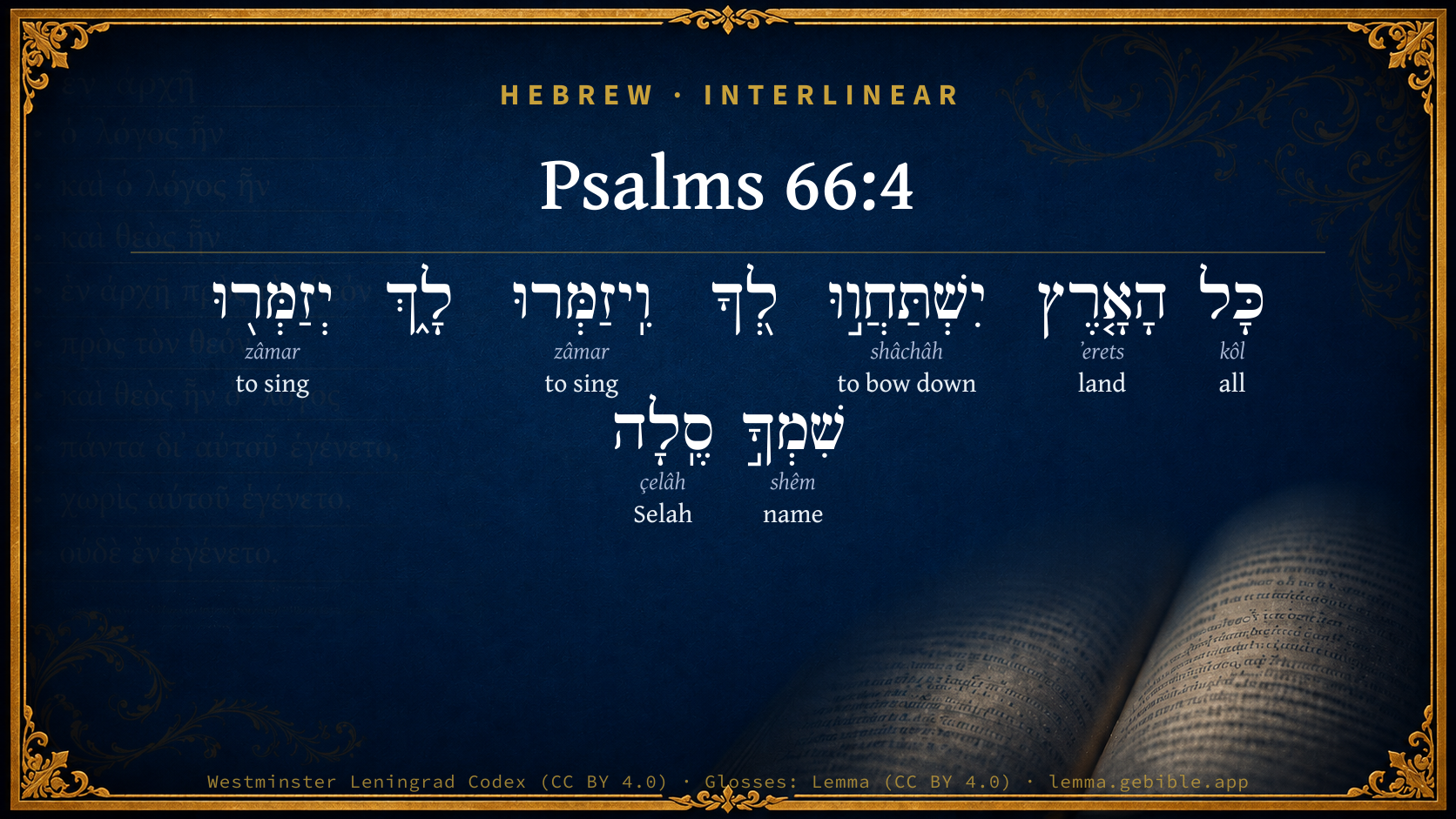
  1. כָּל kôl H3605 “all of” Noun, Common, Masculine, Singular, Construct
  2. הָאָ֤רֶץ ʼerets H776 “the · land” Particle, Definite Article + Noun, Common, Both, Singular, Absolute
  3. יִשְׁתַּחֲו֣וּ shâchâh H7812 “to bow down” Verb, Hishtaphel, Imperfect, 3rd Person, Masculine, Plural
  4. יְזַמְּר֖וּ zâmar H2167 “to sing” Verb, Piel, Imperfect, 3rd Person, Masculine, Plural
  5. שִׁמְךָ֣ shêm H8034 “name · your” Noun, Common, Masculine, Singular, Construct + Suffix, Personal, 2nd Person, Masculine, Singular
  6. סֶֽלָה çelâh H5542 “Selah” Particle, Interjection

About this verse

These counts appear in no published source. They are computed here, from the morphology-tagged text and Lemma’s own curated glosses. What Lemma adds →

9
words
6
distinct lemmas
Wisdom
section

Shared distinctive vocabulary

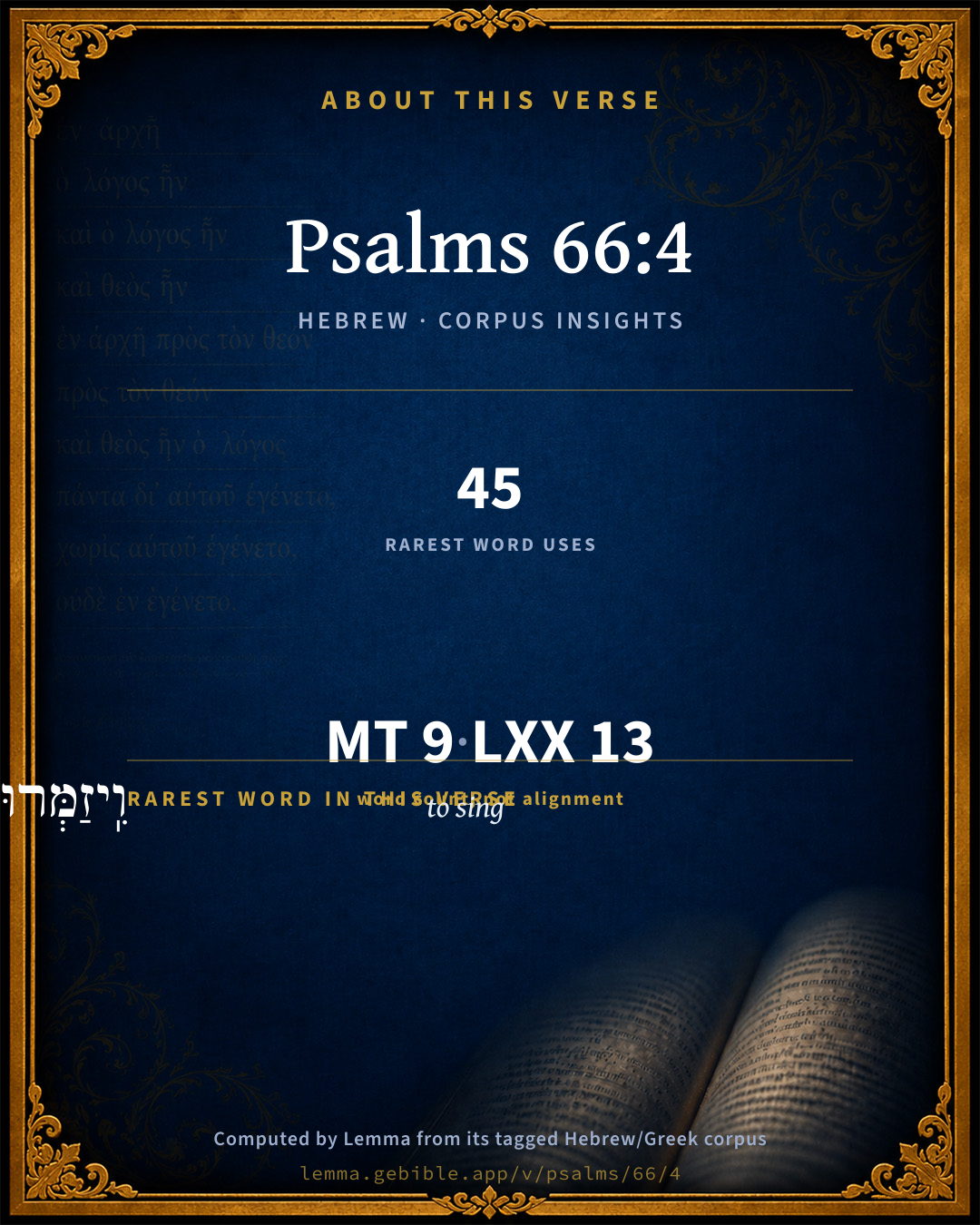
וִֽיזַמְּרוּ to sing H2167 occurs in 41 verses of the Hebrew Bible. Also found in:

Grammatical profile

  • 3 verbs
  • 3 nouns
  • 2 prepositions
  • 1 particle

Verb forms

  • יִשְׁתַּחֲו֣וּ Hishtaphel · Imperfect
  • וִֽיזַמְּרוּ Piel · Imperfect
  • יְזַמְּר֖וּ Piel · Imperfect

Repetition

A word recurs within this verse — often emphatic in Hebrew:

  • וִֽיזַמְּרוּ to sing H2167 ×2

Hebrew & Septuagint length

In English translation the verse runs 18 words from the Hebrew and 17 from the Septuagint (LXX English) — closely comparable.

A rough comparison of the two English renderings, which tokenize alike — not a word-level alignment.

Word counts can differ between the Hebrew and the Greek without any difference in meaning — e.g. the Hebrew direct-object marker אֵת has no separate Greek word, and Greek often adds the article ὁ.

In the original languages it is 9 Hebrew tokens and 13 Greek tokens — but the two are counted differently (Hebrew bundles its prefixes and suffixes into one token; the Greek is in lemma form), so that isn’t a like-for-like length.

Cross-references

12

Topical passages linked to Psalms 66:4 in the Treasury of Scripture Knowledge — connected by theme and wording, ordered by reader-vote popularity; previews shown in the World English Bible.

  • Psalms 22:27 All the ends of the earth shall remember and turn to Yahweh. All the relatives of the nations shall worship before you.
  • Psalms 117:1 Praise Yahweh, all you nations! Extol him, all you peoples!
  • Psalms 96:1–2 Sing to Yahweh a new song! Sing to Yahweh, all the earth.
  • Malachi 1:11 For from the rising of the sun even to the going down of the same, my name is great among the nations, and in every place incense will be offered to my name, and a pure offering: for my name is great among the nations," says Yahweh of Hosts.
  • Revelation 15:4 Who wouldn't fear you, Lord, And glorify your name? For you only are holy. For all the nations will come and worship before you. For your righteous acts have been revealed."
  • Daniel 7:14 There was given him dominion, and glory, and a kingdom, that all the peoples, nations, and languages should serve him: his dominion is an everlasting dominion, which shall not pass away, and his kingdom that which shall not be destroyed.
  • Isaiah 2:2–4 It shall happen in the latter days, that the mountain of Yahweh's house shall be established on the top of the mountains, And shall be raised above the hills; And all nations shall flow to it.
  • Isaiah 42:10–12 Sing to Yahweh a new song, and his praise from the end of the earth; you who go down to the sea, and all that is therein, the isles, and the inhabitants of it.
  • Psalms 65:5 By awesome deeds of righteousness, you answer us, God of our salvation. You who are the hope of all the ends of the earth, Of those who are far away on the sea;
  • Psalms 67:2–3 That your way may be known on earth, And your salvation among all nations,
  • Isaiah 11:9 They shall not hurt nor destroy in all my holy mountain; for the earth shall be full of the knowledge of Yahweh, as the waters cover the sea.
  • Isaiah 49:22–23 Thus says the Lord Yahweh, Behold, I will lift up my hand to the nations, and set up my ensign to the peoples; and they shall bring your sons in their bosom, and your daughters shall be carried on their shoulders.

Cross-references courtesy of OpenBible.info (CC BY 4.0).

Hebrew and Greek witnesses Masoretic Hebrew ↔ Greek Septuagint

The same verse in the two great witnesses to the Old Testament, shown verse-for-verse.

You’re reading Greek Psalm 65 (Hebrew Psalm 66). The Septuagint counts the superscription, so verse numbers can differ from the Hebrew — chapter-level alignment, not verse-by-verse. Numbering follows Rahlfs.

These are two independent witnesses, not word-aligned to each other, and the Septuagint is shown in lemma (dictionary) form.

Hebrew Psalms 66:4 Masoretic · Westminster Leningrad Codex

כָּל הָאָ֤רֶץ יִשְׁתַּחֲו֣וּ לְ֭ךָ וִֽיזַמְּרוּ לָ֑ךְ יְזַמְּר֖וּ שִׁמְךָ֣ סֶֽלָה

All the earth will worship you, And will sing to you; They will sing to your name." Selah.

World English Bible · Public Domain

Greek LXX Greek Psalm 65:4 Septuagint · lemma form

πᾶς ὁ γῆ προςκυνέω σύ καί ψάλω σύ ψάλω ὁ ὄνομα σύ διάψαλμα

Let all the earth worship you, and sing to you; let them sing to your name. Pause.

LXX2012 (modern English Septuagint) · Public Domain

Hebrew: Westminster Leningrad Codex (CC BY 4.0). Greek: Septuagint (public domain); English from LXX2012 (modern English Septuagint) (Public Domain). How the Septuagint differs from the Hebrew →

Commentary

Notes on Psalms 66:4 from classic Christian and Jewish commentators (each source and its license shown beneath its notes). The classic Christian expositions comment on the surrounding passage and are grouped to its opening verse, so a note may address several verses; the Jewish commentaries on the Tanakh (Rashi and others) are per-verse, so they appear only where the commentator wrote on this verse.

Lemma curates 59 commentaries, every one of them public domain or Creative Commons licensed, each selected and text-cleaned for this edition rather than reprinted as found. About our sources →

Trapp's Complete Commentary

John Trapp

Psa 66:4 All the earth shall worship thee, and shall sing unto thee; they shall sing [to] thy name. Selah.

Ver. 4. All the earth shall worship thee] Heb. they shall bow down to thee, stoop to thy government, submit to the sceptre of thy kingdom; they shall become the kingdoms of our Lord Jesus Christ. O dieculam illam! O mora! Christe veni.

Selah] Let that thy kingdom come; come speedily, come in our days, as the modern Jews pray daily (Bimherah, Beiamenu).

John Trapp, A Commentary or Exposition upon All the Books of the Old and New Testament (1647–1656) — public domain. Text from a community e-Sword module.

The Biblical Illustrator

Joseph S. Exell

Psa_66:4-7

All the earth shall worship Thee, and shall sing unto Thee.

The worlds conversion

I. The glorious and auspicious prospect which is here opened to our view. All the earth shall worship Jehovah, and shall sing unto His name.

II. All objections to the fulfilment of this declaration are triumphantly repelled. The politicians of this world tell you plainly that your object can never be accomplished. The world is against you. The carnal mind, which is enmity against God, is against you. The glorious Gospel of the grace of God must come in contact with much that is contrary to its own nature. I am fully aware, too, that Satan, the god of this world, has long kept the minds of men in subjection to his vassalage, and held his captives in an almost universal submission. But with all these appalling circumstances put in array, and leaving you room to put in a thousand more, I see something in my text which excites you to go forward, in sure and certain hope of complete and glorious victory. Come, and instead of looking on the works of men, till your hearts grow feeble, and your hands hang down, come and see the works of God. Here are two grounds of encouragement--

1. The consideration of what God has done for His ancient Church, in fulfilling His promises, and in overcoming her foes; and--

2. What He will yet do for His Church, in fulfilling all for which He has encouraged you to hope. Consider these things; and declare if God has spoken anything which He has not fulfilled. (J. Stewart, D. D.)

Worship

It is a mans duty to worship God; therefore--

I. Man can attain a true knowledge of God. Not, indeed, if left unaided. The instinct which prompts the heart to bow down before an invisible Power is one of the last to disappear in the ruin of our nature. In the absence of everything else which gives dignity to human life it still survives. The first idea of God is awakened by the words and acts of our fellow-men, but when the idea is once ours, we can verify and ennoble it for ourselves. It has been maintained that man cannot have any real knowledge of what God is; that there are impregnable barriers to every attempt of the human soul to attain the real truth about the Divine attributes. But if I am informed that the world is ruled by a Being whose attributes are infinite, but what they are we cannot learn, nor what are the principles of His government, except that the highest human morality we are capable of conceiving does not sanction them; convince me of it, and I will bear my fate as I may. But when I am told that I must believe this, and at the same time call the Being by the names which express and affirm the highest human morality, I say in plain terms that I will not. Whatever power such a Being may have over me, He shall not compel me to worship Him. As a Christian, as a Christian minister, I take my stand with those strong words of the philosopher against the theologian. Language has no meaning save the ordinary ones for the words, just, merciful, good; and if they do not mean this when applied to God, why do we use the words? Worship becomes impossible on such a theory. If the soul is to worship God, it must know what God is.

II. God finds satisfaction and delight in human worship. If I speak to Him, it is because I believe He listens. His heart is moved in response to ours. As I sat a Sunday or two ago on the sea-shore, and thought of the thirty millions of people around whom the waters on which I looked were softly and gently rolling, I had present to my mind the twenty or thirty thousand assemblies which were met that morning in the depths of manufacturing towns, to which the Sunday had brought a brighter, clearer sky, and a welcome interruption of toil; in ancient cities, which have been famous through all the stormy years of our countrys history; in scattered villages, where the life becomes more animated rather than more still on the weekly day of rest. I thought of venerable cathedrals, where vast and solemn spaces were filled with the music of ancient chants and exulting anthems, and the mighty harmonies of majestic organs, and of rude, unshapely buildings on the edge of lovely commons, and amongst the poorest and most wretched courts and streets of our populous districts, where, with loud cries and noisy hymns, poor labouring men whose hearts God had touched, were violently and passionately imploring His pardon, or thanking Him for deliverance from sin. I felt that at that moment the gates of heaven were thrown wide open as for some high festival, that before the day was over thousands of my countrymen would be regenerated by the Spirit of God, and receive from Gods own lips absolution from all sin; and that tens of thousands would be baptized afresh with the Holy Ghost and with fire, and be gentler in their words, kinder in their deeds, purer in their thoughts all the week through as the result of that days worship. I thought of all these, and I was thankful and glad. (R. W. Dale, D. D.)

The Biblical Illustrator, edited by Joseph S. Exell (c. 1880s–1900s) — public domain. Text from a community e-Sword module.

Joseph Benson's Commentary

Psa 66:4. All the earth shall worship thee, &c. — Many people of divers nations shall be so affected with thy stupendous works, that they shall worship and praise thee for them, and all the people shall have just cause to do so; and the time will come when all nations will actually do so, namely, in the days of the Messiah.

Joseph Benson's Commentary on the Old and New Testaments (1811–1818) — public domain. Text from a community e-Sword module.

J. A. Alexander on Psalms

Joseph Addison Alexander

4. (Psa 66:4) All the earth shall worship thee and sing to thee; they shall sing thy name. Selah. Here again the verbs are plural, shewing that all the earth is to be taken in a collective sense, as meaning all lands, or all the dwellers upon earth. See above, on ver. 1. Worship thee, bow or prostrate themselves before thee, as an act both of civil and religious homage. See above, on Psa 5:7. They shall not only sing to thee, but sing thy name, i.e. not only celebrate thy being but thy manifested nature, theattributes revealed by thy previous works. This anticipation of universal homage to Jehovah is in strict accordance with the whole spirit and design of the Mosaic dispensation.

Joseph Addison Alexander, The Psalms Translated and Explained (1850) — public domain. Text from a community e-Sword module.

Adam Clarke's Commentary

Verse 4. All the earth] The whole land shall worship thee. There shall no more an idol be found among the tribes of Israel. This was literally true. After the Babylonish captivity the Israelites never relapsed into idolatry.

Selah.] Remark it: this is a well attested truth.

Adam Clarke's Commentary on the Bible (1810–1826) — public domain. Text from a community e-Sword/MySword module.

John Calvin's Commentaries

4. All the earth shall worship thee. The Psalmist had good reason for insisting upon this one point again and again. Though all tongues were tuned to the praise of God, they never could adequately extol it; and yet such are the negligence and the perversity of men, that they will scarcely lift one feeble note in celebration of a theme which should command their united strength and might. We have another prediction here, of a time being to come when God would be worshipped, not only by the Jews, a small section of the human family, but by all the nations which would be eventually brought under his government. And we are not to consider that he refers to such a worship as would be constrained, and only not withheld, because resistance might be dangerous, but to the sincere homage of the heart — they shall sing unto thee! they shall sing unto thy name Praise is the best of all sacrifices, (as we are told, Psalm 50:14, 23) and the true evidence of godliness.

John Calvin's Commentaries (1540-1563) — public domain. Text from the Calvin Translation Society English edition (1840s-50s) via the Christian Classics Ethereal Library (ccel.org). Calvin's coverage is partial (roughly two-thirds of the Bible); uncommented books and verses are honest gaps, never fabricated. The 19th-century editor's footnotes and remarks are omitted so the notes are faithfully Calvin's own voice.

The Cambridge Bible for Schools and Colleges

gen. ed. J. J. S. Perowne

4. All the earth shall worship thee and hymn thee,

Yea, hymn thy name.

This verse is part of the address to God put into the mouth of the nations.

The Cambridge Bible for Schools and Colleges (gen. ed. J. J. S. Perowne; Cambridge University Press, 1878–1918) — public domain. Text from a community e-Sword module.

John Gill's Exposition

All the earth shall worship thee,.... The Messiah, who is equal with God; the Creator of men; the Redeemer of his people; the Head of the church, and King of saints; their Lord, and therefore to be worshipped; with internal worship, in the exercise of faith, hope, and love; and with external worship, in the word and ordinances, by prayer and praise, public and private. This universal worship, that will be yielded him, will be in the latter day; which shows that this psalm respects those times, when Christ shall be King over all the earth, and his name, worship, and religion, one, Zac 14:9;

and shall sing unto thee; the song of Moses and the Lamb, the Lamb's new song, the song of redeeming grace; which none but the redeemed ever can sing aright, Rev 14:3;

they shall sing to thy name; or, "they shall", or "let them sing thy name" (x); thou shall be the subject of their song; thy person, offices, kingdom, grace, and glory: or they shall sing to the honour of thy name, as in Psa 66:2.

Selah; on this word; see Gill on Psa 3:2.

(x) "cantent nomen tuum", Gejerus; "cantabunt nomen tuum", Michaelis.

John Gill's Exposition of the Whole Bible (1746–1763) — public domain (CC PDM 1.0). Text via the HelloAO Bible API.

Albert Barnes' Notes on the Bible

All the earth shall worship thee - That is, all the inhabitants of the world will bow down before thee, or render thee homage. The time will come when thy right to reign will be universally acknowledged, or when thou wilt everywhere be adored as the true God. This is in accordance with all the statements in the Bible. See the notes at Psa 22:27; Compare the notes at Isa 45:23; notes at Rom 14:11.

And shall sing unto thee - Shall celebrate thy praises. “To thy name.” To thee.

Albert Barnes' Notes on the Bible (1834–1885) — public domain. Text from a community e-Sword/MySword module.

Matthew Poole's English Annotations

Many people of divers nations shall be so affected with thy stupendous works, that they shall worship and praise thee for them, and all people shall do so, and shall have just cause to do so; and the time will come when all nations will actually do so, to wit, in the days of the Messias.

Matthew Poole's English Annotations on the Holy Bible (1683–1685) — public domain. Text from a community e-Sword/MySword module.

The Treasury of David

Charles H. Spurgeon

Ver. 4. All the earth shall worship thee, and shall sing unto thee. All men must even now prostrate themselves before thee, but a time will come when they shall do this cheerfully; to the worship of fear shall be added the singing of love. What a change shall have taken place when singing shall displace sighing, and music shall thrust out misery!

They shall sing to thy name. The nature and works of God will be the theme of earth's universal song, and he himself shall be the object of the joyful adoration of our emancipated race. Acceptable worship not only praises God as the mysterious Lord, but it is rendered fragrant by some measure of knowledge of his name or character. God would not be worshipped as an unknown God, nor have it said of his people, "Ye worship ye know not what." May the knowledge of the Lord soon cover the earth, that so the universality of intelligent worship may be possible: such a consummation was evidently expected by the writer of this Psalm; and, indeed, throughout all Old Testament writings, there are intimations of the future general spread of the worship of God. It was an instance of wilful ignorance and bigotry when the Jews raged against the preaching of the gospel to the Gentiles. Perverted Judaism may be exclusive, but the religion of Moses, and David, and Isaiah was not so.

Selah. A little pause for holy expectation is well inserted after so great a prophecy, and the uplifting of the heart is also a seasonable direction. No meditation can be more joyous that excited by the prospect of a world reconciled to its Creator.

None.

Ver. 4.

I. Who? All the earth.

1. All, collectively, all classes and tribes.

2. All numerically.

3. All harmoniously. II. What? Shall worship and sing.

1. Humiliation; then,

2. Exultation. III. When? Shall, &c. Denotes

1. Futurity.

2. Certainty. God has spoken it. All things are tending towards it. G. R.

Psalms 66:5*

Charles H. Spurgeon's The Treasury of David (1869–1885) — public domain. Psalms only. Text from a community e-Sword/MySword module.

Whedon's Commentary on the Bible

Daniel D. Whedon

4. Shall worship thee—Shall prostrate themselves, as in Psa_72:11, whether in forced submission from the overawing prevalence of divine truth or from loving obedience is not stated.

Daniel D. Whedon (gen. ed.), Commentary on the Old and New Testaments (1874–1909) — public domain. Text from a community e-Sword module.

The Pulpit Commentary

All the earth shall worship thee, and shall sing unto thee; they shall sing to thy Name (see above, ver. 1, and compare the passages quoted in the comment ad loc.). Dr. Kay notes that "the universality of the Church is clearly contemplated" in all the psalms from Ps 65 to Ps 68.

The Pulpit Commentary (1880–1919), ed. H.D.M. Spence-Jones & Joseph S. Exell — public domain. Text from a community e-Sword module.

Lesson kit

Teaching starters — assembled from the data on this page, not authored interpretation. Every prompt links to the verse data it draws on. Edit before teaching.

Psalms, in the Wisdom, opens this verse with 9 words (6 distinct Hebrew lemmas). Its most distinctive word is zâmar (“to sing”). A historical commentator’s framing appears above. Read the whole chapter for the surrounding context.

Discussion questions

  1. What does “to sing” (zâmar) contribute to the verse as a whole?
  2. Judges 5:3 shares the word «to sing» with this verse. How do the two illuminate each other?
  3. “to sing” occurs 2× in this one verse. What is the effect of the repetition?
  4. The translations on this page render this verse differently — a whole-verse word diff, not a word-by-word alignment. What might account for the different wordings?
  5. The verb «יִשְׁתַּחֲו֣וּ» is Hishtaphel Imperfect. How does its form color the action?
  6. Reading how Trapp's Complete Commentary and The Biblical Illustrator read this verse, where do the two commentators agree and where do they part?

Things to notice

Reading settings

Reading text

Shown beneath each verse's original-language words.

Old Testament
Old Testament edition

Read the OT as the Masoretic Hebrew (MT) or the Greek Septuagint (LXX).

English shown for the Greek Septuagint (in the Hebrew ↔ Greek comparison).

Comparing translations? Open the Compare panel on any verse page to stack up to four side by side.