
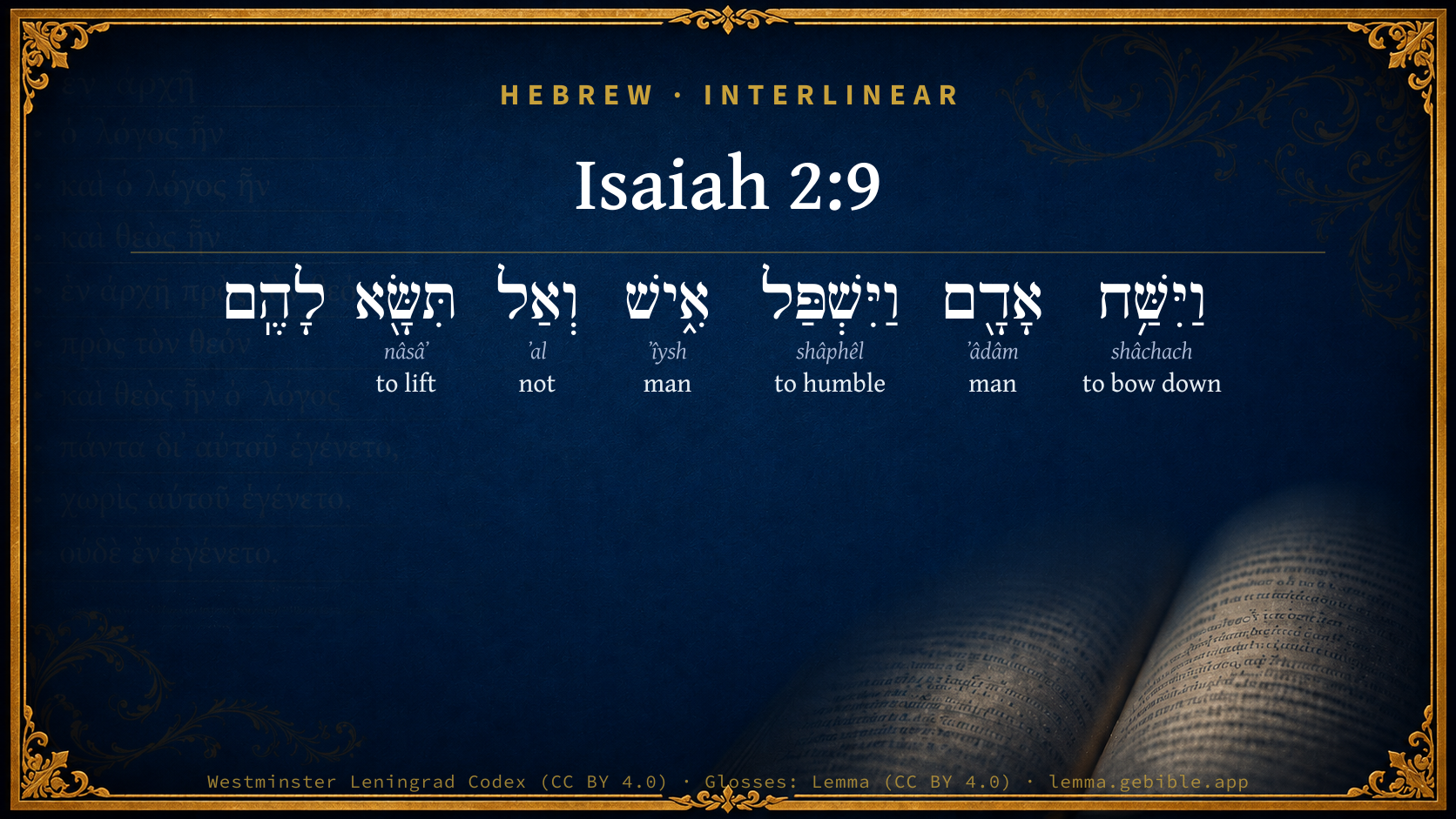
Isaiah 2:9

Hebrew (Westminster Leningrad Codex) Isaiah 2:9 appears in the Hebrew Old Testament. The text above is from the Westminster Leningrad Codex. Each word links to its Strong’s number, a concise gloss, and parsing drawn from the Open Scriptures Hebrew Bible morphology. Click any word for its full Brown-Driver-Briggs (BDB) entry.
Download image
Cite this verse

Isaiah 2:9 (World English Bible). Public Domain. Lemma interlinear Bible study tool, https://lemma.gebible.app/v/isaiah/2/9.

Show BibTeX & RIS
BibTeX
RIS
English Translation
Man is brought low, And mankind is humbled; Therefore don't forgive them.
World English Bible · Public Domain
Download a study sheet

One document with this verse’s original text, its word-by-word gloss line, the meaning frame, cross-references with their text, attributed commentary, and full source and license credits — printable, and it pastes into notes with its structure intact.

This verse Autodidact and up

Study sheet (.html) Plain text (.txt)

A passage Seminary Student

Up to 50 verses in one chapter. A passage sheet keeps up to 6 commentary sources and 12 cross-references per verse, in the order this page ranks them, and says so on the sheet whenever that leaves anything out. Ask for a single verse and you get the Autodidact verse sheet above.

Everything on this page stays free to read, with no account — the sheet is a download of what is already on screen, not access to it.

Want to remove ads? Support Godless Engineer
Compare translations 3

The same verse in 3 English versions, stacked beneath the original-language interlinear above. Click any original word for its lexicon entry.

Each is an independent rendering of the whole verse — the interlinear is not word-aligned to these translations.

Highlighted words mark where these versions differ — a whole-verse word diff, not a word-by-word alignment.

  • World English Bible Public Domain
    Man is brought low, And mankind is humbled; Therefore don't forgive them.
  • King James Version Public Domain
    And the mean man boweth down, and the great man humbleth himself: therefore forgive them not.
  • unfoldingWord Literal Text CC BY-SA 4.0
    And a human is humbled, and a man becomes low, but may you not lift them up.

unfoldingWord Literal Text — © unfoldingWord, licensed CC BY-SA 4.0. Word-aligned USFM3 via Door43 (git.door43.org/unfoldingWord/en_ult).

Versions to compare (up to 4)

3 of 4 selected

Show all 18 translations

Every available English version of this verse, each an independent rendering of the whole verse.

  • World English Bible Public Domain
    Man is brought low, And mankind is humbled; Therefore don't forgive them.
  • Berean Standard Bible Public Domain
    So mankind is brought low, and man is humbled—do not forgive them!
  • Majority Standard Bible Public Domain
    So mankind is brought low, and man is humbled—do not forgive them!
  • King James Version Public Domain
    And the mean man boweth down, and the great man humbleth himself: therefore forgive them not.
  • American Standard Version (1901) Public Domain
    And the mean man is bowed down, and the great man is brought low: therefore forgive them not.
  • Revised Version (1885) Public Domain
    And the mean man is bowed down, and the great man is brought low; therefore forgive them not.
  • Geneva Bible (1599) Public Domain
    And a man bowed himselfe, and a man humbled himselfe: therefore spare them not.
  • Douay-Rheims (1899) Public Domain
    And man hath bowed himself down, and man hath been debased: therefore forgive them not.
  • Young's Literal Translation Public Domain
    And the low boweth down, and the high is humbled, And Thou acceptest them not.
  • Literal Standard Version CC BY-SA 4.0
    And the low bows down, and the high is humbled, || And You do not accept them.
  • Unlocked Literal Bible CC BY-SA 4.0
    The people will be bowed down, and individuals will fall down; therefore do not raise them up.
  • unfoldingWord Literal Text CC BY-SA 4.0
    And a human is humbled, and a man becomes low, but may you not lift them up.
  • Darby Bible Public Domain
    And the mean man shall be bowed down, and the great man shall be brought low: and do not thou forgive them!
  • World Messianic Bible Public Domain
    Man is brought low, and mankind is humbled; therefore don’t forgive them.
  • Webster's Bible Public Domain
    And the mean man boweth down, and the great man humbleth himself: therefore forgive them not.
  • Free Bible Version CC BY-SA 4.0
    These people will be brought down and humiliated—Lord, don't forgive them!
  • Bible in Basic English Public Domain
    And the poor man's head is bent, and the great man goes down on his face: for this cause there will be no forgiveness for their sin.
  • JPS Tanakh (1917) Public Domain
    And man boweth down, and man lowereth himself; and Thou canst not bear with them.

Literal Standard Version (2020), Covenant Press — licensed CC BY-SA 4.0. Text via the HelloAO Bible API (eBible.org). Unlocked Literal Bible (unfoldingWord) — licensed CC BY-SA 4.0. Text via the HelloAO Bible API (eBible.org). unfoldingWord Literal Text — © unfoldingWord, licensed CC BY-SA 4.0. Word-aligned USFM3 via Door43 (git.door43.org/unfoldingWord/en_ult). Free Bible Version, Dr. Jonathan Gallagher — licensed CC BY-SA 4.0. Text via the HelloAO Bible API (eBible.org).

Word by word

More ways to search: Search by grammar → Find every occurrence → Compare this word →

Practice this passage: Drill this verse → Learn its vocabulary →

וַיִּשַּׁ֥ח
shâchach
H7817
“and · to bow down”
Conjunction + Verb, Niphal, Sequential Imperfect, 3rd Person, Masculine, Singular
Part of Speech
Conjunction + Verb
Stem
Niphal
Form
Sequential Imperfect
Person
3rd Person
Gender
Masculine
Number
Singular
Full BDB Definition

Origin: a primitive root

TWOT: 2361

to bow, crouch, bow down, be bowed down - (Qal) - to be bowed down, be prostrated, be humbled - to bow (in homage) - to bow (of mourner) - to crouch (of wild beast in lair) - (Niphal) to be prostrated, be humbled, be reduced, be weakened, proceed humbly, be bowed down - (Hiphil) to prostrate, lay low, bow down - (Hithpolel) to be cast down, be despairing
  1. אָדָ֖ם ʼâdâm H120 “man” Noun, Common, Masculine, Singular, Absolute
  2. וַיִּשְׁפַּל shâphêl H8213 “and · to humble” Conjunction + Verb, Qal, Sequential Imperfect, 3rd Person, Masculine, Singular
  3. אִ֑ישׁ ʼîysh H376 “man” Noun, Common, Masculine, Singular, Absolute
  4. וְאַל ʼal H408 “and · not” Conjunction + Particle, Negative
  5. תִּשָּׂ֖א nâsâʼ H5375 “to lift” Verb, Qal, Jussive, 2nd Person, Masculine, Singular

About this verse

These counts appear in no published source. They are computed here, from the morphology-tagged text and Lemma’s own curated glosses. What Lemma adds →

7
words
6
distinct lemmas
Prophets
section

Notable vocabulary

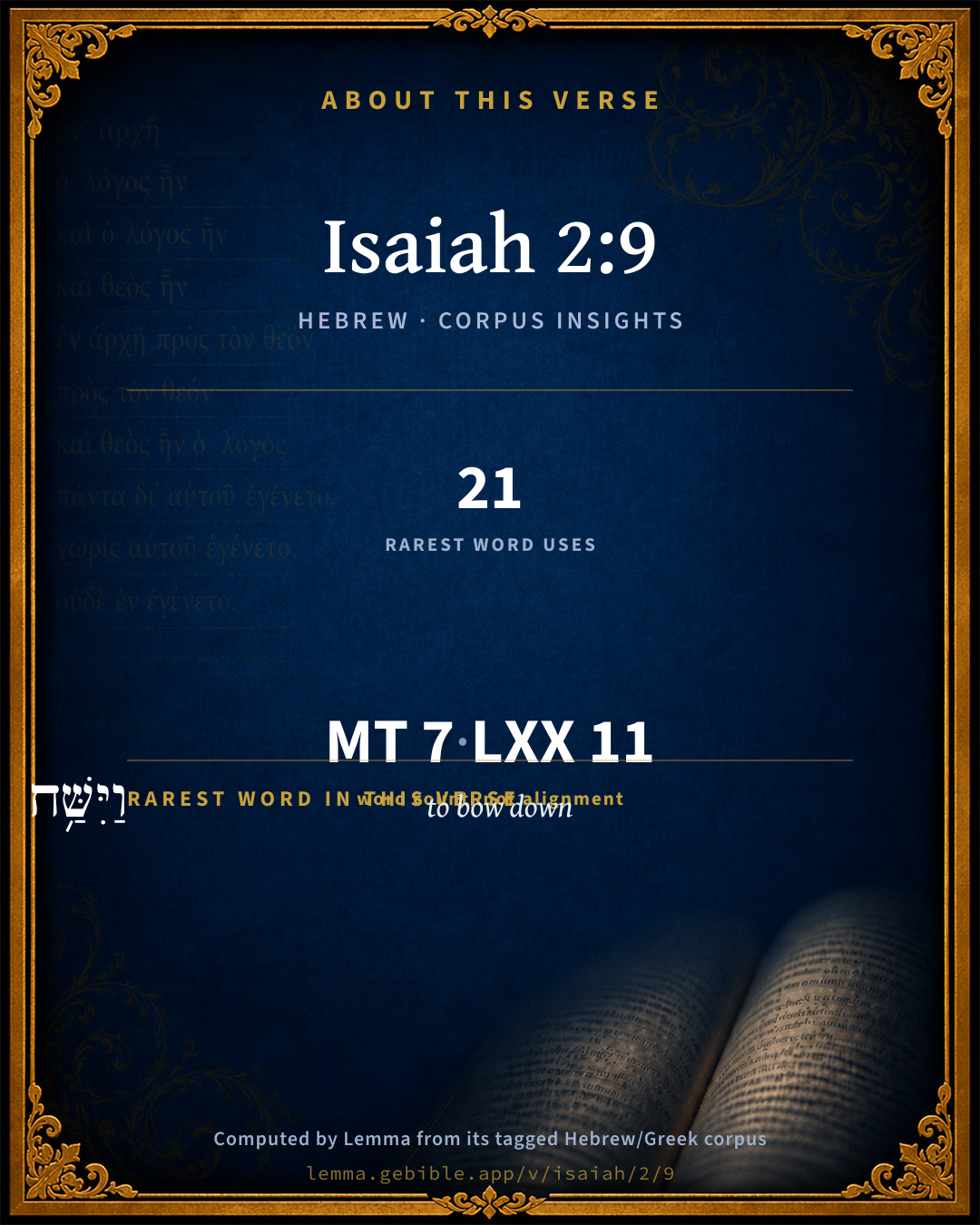
The rarest word here is וַיִּשַּׁ֥ח to bow down H7817 — appearing just 21 times in the whole Hebrew Bible.

Shared distinctive vocabulary

וַיִּשַּׁ֥ח to bow down H7817 occurs in 21 verses of the Hebrew Bible. Also found in:

Grammatical profile

  • 3 verbs
  • 2 nouns
  • 1 preposition
  • 1 particle

Verb forms

  • וַיִּשַּׁ֥ח Niphal · Sequential Imperfect
  • וַיִּשְׁפַּל Qal · Sequential Imperfect
  • תִּשָּׂ֖א Qal · Jussive

Hebrew & Septuagint length

In English translation the verse runs 12 words from the Hebrew and 18 from the Septuagint (LXX English) — the Septuagint runs noticeably longer here. See the side-by-side →

A rough comparison of the two English renderings, which tokenize alike — not a word-level alignment.

Word counts can differ between the Hebrew and the Greek without any difference in meaning — e.g. the Hebrew direct-object marker אֵת has no separate Greek word, and Greek often adds the article ὁ.

In the original languages it is 7 Hebrew tokens and 11 Greek tokens — but the two are counted differently (Hebrew bundles its prefixes and suffixes into one token; the Greek is in lemma form), so that isn’t a like-for-like length.

Cross-references

14

Topical passages linked to Isaiah 2:9 in the Treasury of Scripture Knowledge — connected by theme and wording, ordered by reader-vote popularity; previews shown in the World English Bible.

  • Isaiah 5:15 So man is brought low, Mankind is humbled, And the eyes of the arrogant ones are humbled;
  • Joshua 24:19 Joshua said to the people, You can't serve Yahweh; for he is a holy God; he is a jealous God; he will not forgive your disobedience nor your sins.
  • Nehemiah 4:5 and don't cover their iniquity, and don't let their sin be blotted out from before you; for they have provoked [you] to anger before the builders.
  • Isaiah 27:11 When the boughs of it are withered, they shall be broken off; the women shall come, and set them on fire; for it is a people of no understanding: therefore he who made them will not have compassion on them, and he who formed them will show them no favor.
  • Jeremiah 18:23 Yet, Yahweh, you know all their counsel against me to kill me; don't forgive their iniquity, neither blot out their sin from your sight; but let them be overthrown before you; deal you with them in the time of your anger.
  • Mark 3:29 but whoever may blaspheme against the Holy Spirit never has forgiveness, but is guilty of an eternal sin"
  • Romans 3:23 for all have sinned, and fall short of the glory of God;
  • Psalms 49:2 Both low and high, Rich and poor together.
  • Psalms 62:9 Surely men of low degree are just a breath, And men of high degree are a lie. In the balances they will go up. They are together lighter than a breath.
  • Isaiah 57:9 You went to the king with oil, and did increase your perfumes, and did send your ambassadors far off, and did debase yourself even to Sheol.
  • Colossians 2:23 Which things indeed appear like wisdom in self-imposed worship, and humility, and severity to the body; but aren't of any value against the indulgence of the flesh.
  • Jeremiah 5:4–5 Then I said, Surely these are poor; they are foolish; for they don't know the way of Yahweh, nor the law of their God:
  • Colossians 2:18 Let no one rob you of your prize by a voluntary humility and worshipping of the angels, dwelling in the things which he has not seen, vainly puffed up by his fleshly mind,
  • Revelation 6:15–17 The kings of the earth, the princes, the commanding officers, the rich, the strong, and every slave and free person, hid themselves in the caves and in the rocks of the mountains.

Cross-references courtesy of OpenBible.info (CC BY 4.0).

Hebrew and Greek witnesses Masoretic Hebrew ↔ Greek Septuagint

The same verse in the two great witnesses to the Old Testament, shown verse-for-verse.

Here the Septuagint runs noticeably longer than the Hebrew — LXX2012 (modern English Septuagint) 18 words vs World English Bible 12. A rough length comparison of the two English translations, not a word-level alignment — read both below.

These are two independent witnesses, not word-aligned to each other, and the Septuagint is shown in lemma (dictionary) form.

Hebrew Isaiah 2:9 Masoretic · Westminster Leningrad Codex

וַיִּשַּׁ֥ח אָדָ֖ם וַיִּשְׁפַּל אִ֑ישׁ וְאַל תִּשָּׂ֖א לָהֶֽם

Man is brought low, And mankind is humbled; Therefore don't forgive them.

World English Bible · Public Domain

Greek LXX Isaiah 2:9 Septuagint · lemma form

καί κύπτω ἄνθρωπος καί ταπεινόω ἀνήρ καί οὐ μή ἀναἵημι αὐτός

And the mean man bowed down, and the great man was humbled: and I will not pardon them.

LXX2012 (modern English Septuagint) · Public Domain

On this verse, Haydock's Catholic Bible Commentary discusses the Septuagint’s reading. Read the note in Commentary ↓

Hebrew: Westminster Leningrad Codex (CC BY 4.0). Greek: Septuagint (public domain); English from LXX2012 (modern English Septuagint) (Public Domain). How the Septuagint differs from the Hebrew →

Targum (Aramaic paraphrase)

1

The Targum is the ancient Jewish Aramaic paraphrase of the Hebrew Scriptures — an interpretive translation, not the Hebrew text itself. Onkelos (literal) and Pseudo-Jonathan (expansive) render the Torah, and Jonathan the Prophets. Coverage is partial: where no permissively-licensed English translation exists for a verse, only the Aramaic is shown. This is verse-level text, not a word-by-word alignment to the Hebrew.

  1. Targum Jonathan Prophets (Joshua–Malachi)
    וְיִמְאַךְ אֱנָשָׁא וַיֶחֱלַשׁ תְּקוֹף גַבְרִין וְלָא תִשְׁבּוֹק לְהוֹן:

    The common man shall be humbled, and the strength of the great men shall become weak; and Thou shalt not pardon them.

    Targum Jonathan — Aramaic: “Mikraot Gedolot” (public domain). English: “Sefaria Community Translation” (CC0 1.0 (public-domain dedication)); “London "Chaldee Paraphrase," 1871” (public domain). Text via Sefaria.

Commentary

Notes on Isaiah 2:9 from classic Christian and Jewish commentators (each source and its license shown beneath its notes). The classic Christian expositions comment on the surrounding passage and are grouped to its opening verse, so a note may address several verses; the Jewish commentaries on the Tanakh (Rashi and others) are per-verse, so they appear only where the commentator wrote on this verse.

Lemma curates 59 commentaries, every one of them public domain or Creative Commons licensed, each selected and text-cleaned for this edition rather than reprinted as found. About our sources →

Trapp's Complete Commentary

John Trapp

Isa 2:9 And the mean man boweth down, and the great man humbleth himself: therefore forgive them not.

Ver. 9. And the mean man boweth down.] There is a general conspiracy, and they are altogether become abominable. Lords and lowlies, kings and captives, all sorts were idolaters. Some render it, "Shall be brought down, and shall be humbled." God loveth to retaliate, to abate and abase man’s pride, by pulling down whatsoever height or strength they confide in.

Therefore forgive them not.] A pious prayer doubtless, proceeding from true zeal, which is an extreme heat of all the affections for God’s glory. Ut pius sit in Deum, durus sit in proximum, saith Oecolampadius. Like another Elias he maketh intercession to God against Israel, {Rom 11:2} whom he saw to be incorrigible, and their sin to be irremissible, their judgment unavoidable.

John Trapp, A Commentary or Exposition upon All the Books of the Old and New Testament (1647–1656) — public domain. Text from a community e-Sword module.

The Biblical Illustrator

Joseph S. Exell

Isa_2:9

The mean man

The mean man

Mean there does not mean selfish or stingy, but the man between two extremes, the mean, average, ordinary man.

The mean man and the great man are both bowing--what are they bowing to? Something beneath them; they have lost the sense of their dignity, and they have forgotten that they are kings, and now they are bowing down to things that they ought to control. (J. H. Jowett, M. A.)

The Biblical Illustrator, edited by Joseph S. Exell (c. 1880s–1900s) — public domain. Text from a community e-Sword module.

unfoldingWord translationNotes

Door43 World Missions Community

General Information:

In Isa 2:9 Isaiah finishes speaking to Yahweh. In Isa 2:10-11 Isaiah speaks to the people of Judah. Both times he speaks in the form of a poem. (See: Parallelism)

The people will be bowed down, and individuals will fall down

Here being low to the ground represents people who are completely humiliated because they realize all they trusted in is worthless, and they can do nothing to help themselves. This can be stated in active form. AT: "God will make the people ashamed, and they will realize that all they trusted in is worthless" (See: Metaphor and Active or Passive)

The people

human beings, as opposed to animals

individuals

"each person"

do not raise them up

The words "raise them up" are a metaphor for Yahweh forgiving the people. AT: "do not forgive them" (See: Metaphor)

Go into the rocky places

Possible meanings are the people should go into 1) caves on steep hillsides or 2) places where there are many large rocks among which to hide.

hide in the ground

Possible meanings are that the people should hide 1) in natural holes in the ground or 2) in pits that they dig in the ground.

from the terror of Yahweh

Here the abstract noun "terror" can be expressed by the verb "terrifying." AT: "to get away from Yahweh's terrifying presence" or "from Yahweh because you will be extremely afraid of him" (See: Abstract Nouns)

the glory of his majesty

"the great beauty and power he has as king" or "his royal splendor." See how you translated this in Isaiah 2:10.

The lofty gaze of man will be brought low

"Yahweh will bring down the lofty gaze of man." A man with a "lofty gaze" is looking above everyone to show them that he is better than they are. Here all people are guilty of thinking they are better than Yahweh, and the way they look at those who worship Yahweh, is a metonym for their pride. AT: "Yahweh will make ashamed all people because they think they are better than he is" (See: Metaphor and Metonymy)

the pride of men will be brought down

"The pride of men" here is a metonym for proud people, and being "brought down" is a metaphor for being humbled or ashamed. This can be stated in active form. AT: "Yahweh will bring down proud men" or "Yahweh will make proud people ashamed of themselves" (See: Metonymy and Metaphor and Active or Passive)

Yahweh alone will be exalted

This can be stated in active form. AT: "people will praise only Yahweh" (See: Active or Passive)

on that day

This is an idiom. AT: "on the day that Yahweh judges everyone" (See: Idiom)

translationWords

bow

terror

glory

majesty

proud

exalt

day of the Lord

unfoldingWord translationNotes — © Distant Shores Media and the Door43 World Missions Community, licensed CC BY-SA 4.0. Source: git.door43.org/Door43/en_tn.

Geneva Bible (1599)

Geneva Bible translators

He noteth the nature of the idolaters, which are never satisfied in their superstitions.

Thus the Prophet spake, being inflamed with the zeal of God’s glory, and that he might fear them with God’s judgment.

Geneva Bible (1599) marginal notes — public domain. Text via Bolls.life.

Jamieson, Fausset & Brown

Robert Jamieson, A. R. Fausset & David Brown

mean--in rank: not morally base: opposed to "the great man." The former is in Hebrew, Adam, the latter, ish.

boweth--namely, to idols. All ranks were idolaters.

forgive . . . not--a threat expressed by an imperative. Isaiah so identifies himself with God's will, that he prays for that which he knows God purposes. So Rev 18:6.

Jamieson, Fausset & Brown — Commentary Critical and Explanatory on the Whole Bible (1871) — public domain (CC PDM 1.0). Text via the HelloAO Bible API.

Adam Clarke's Commentary

Verse 9. Boweth down - "Shall be bowed down"] This has reference to the preceding verse. They bowed themselves down to their idols, therefore shall they be bowed down and brought low under the avenging hand of God.

Therefore forgive them not.] "And thou wilt not forgive them." - L.

Adam Clarke's Commentary on the Bible (1810–1826) — public domain. Text from a community e-Sword/MySword module.

Ellicott's Commentary for English Readers

(9) And the mean man boweth down.—The English gives adequately the significance of the two words for “man”—in Hebrew, adam and îsh. The Authorised Version applies the words to the prostrations of the worshippers of idols, whether of low or high degree; others refer them to the punishment of that idolatry: The mean man must be bowed down . . . the great man must be humbled.

Therefore forgive them not.—As a prayer the words find a parallel in Psa_69:27; Psa_109:14, but the rendering adopted by Cheyne and others, And thou canst not forgive them, is perhaps preferable. The sin is treated as “a sin unto death,” for which it is vain to pray (Isa_22:14).

A Bible Commentary for English Readers, edited by Charles John Ellicott (1878–1897) — public domain. Text from a community e-Sword module.

The Cambridge Bible for Schools and Colleges

gen. ed. J. J. S. Perowne

9. boweth down … humbleth himself] If this be the right translation, the reference must be to the degradation of human dignity involved in idolatry and superstition, a thought not unworthy of Isaiah. It is more probable, however (see ch. Isa_5:15), that the words refer to the judgment at hand, which is as certain as if it had already taken place. So R.V. is bowed down … is brought low. The verbs may be understood either in a reflexive or a passive sense.

mean man … great man] In the original the contrast is expressed by two words for “man,” corresponding to homo and vir in Latin, Mensch and Mann in German, &c. Sometimes, as here, the distinction is emphasised so as to mark a contrast (Psa_49:2).

therefore forgive them not] Or, and thou canst (or wilt) not forgive them. The verbal form employed in the Heb. (jussive) properly expresses the will or desire of the speaker (as E.V.), but in negative sentences it “sometimes expresses merely the subjective feeling and sympathy of the speaker with the act” (Davidson, Synt. § 128, R. 2).

The Cambridge Bible for Schools and Colleges (gen. ed. J. J. S. Perowne; Cambridge University Press, 1878–1918) — public domain. Text from a community e-Sword module.

John Gill's Exposition

And the mean man boweth down, and the great man humbleth himself,.... Both high and low, rich and poor, bow down unto, humble themselves before, and worship idols made by the hands of men: the words for the "mean man" and "the great man" are and "Adam" and "Ish"; and which are also interpreted by Jarchi of little or mean men, and of princes and mighty ones:

therefore forgive them not; their sins of soothsaying, covetousness, and idolatry; and such that worship the beast and his image shall not be forgiven, but drink of the wine of divine wrath, and be tormented with fire for ever and ever, Rev 14:9. These are either the words of the prophet to the Lord representing the church, and imprecating evils on antichristian worshippers; or of the angel to the Christian powers, exhorting them not to spare Babylon, Rev 18:6 some refer these words to the mean and great men bowing down and humbling themselves, and read them in connection with them thus, "and lifts not up unto them"; that is, the head or soul; so Aben Ezra, who also observes, that the word "earth" may be wanting, and supplied thus, "and the earth shall not bear them"; they shall be destroyed from off it, both the idols and the worshippers of them. See Psa 10:16.

John Gill's Exposition of the Whole Bible (1746–1763) — public domain (CC PDM 1.0). Text via the HelloAO Bible API.

Albert Barnes' Notes on the Bible

And the mean man - That is, the man in humble life, the poor, the low in rank - for this is all that the Hebrew word here - אדם 'âdâm - implies. The distinction between the two words here used - אדם 'âdâm as denoting a man of humble rank, and אישׁ 'ı̂ysh as denoting one of elevated rank - is one that constantly occurs in the Scriptures. Our word “mean” conveys an idea of moral baseness and degradation, which is not implied in the Hebrew.

Boweth down - That is, before idols. Some commentators, however, have understood this of bowing down in “affliction,” but the other is probably the true interpretation.

And the great man - The men in elevated rank in life. The expressions together mean the same as “all ranks of people.” It was a common or universal thing. No rank was exempt from the prevailing idolatry.

Therefore forgive them not - The Hebrew is “future” - להם ואל־תשׂא ve'al-tis'â' lâhem. Thou wilt not “bear” for them; that is, thou wilt not bear away their sins (by an atonement), or ‘thou wilt not forgive them;’ - but agreeable to a common Hebrew construction, it has the force of the imperative. It involves a “threatening” of the prophet, in the form of an address to God ‘So great is their sin, that thou, Lord, wilt not pardon them.’ The prophet then proceeds, in the following verses, to denounce the certainty and severity of the judgment that was coming upon them.

Albert Barnes' Notes on the Bible (1834–1885) — public domain. Text from a community e-Sword/MySword module.

Haydock's Catholic Bible Commentary

Forgive. Septuagint, "I will not dismiss them." Hebrew, "and thou hast not pardoned them."

George Leo Haydock (1774–1849), Haydock's Catholic Family Bible and Commentary, 1859 edition — public domain. Excludes Psalms (Douay-Rheims chapter numbering differs from Protestant) and Deuterocanonical books (Catholic canon only).

Matthew Poole's English Annotations

The mean man boweth down, and the great man humbleth himself; men of all ranks fall down and worship idols.

Forgive them not; cut off these incorrigible idolaters. Such an imprecation is not strange, considering the heinousness and inexcusableness of the crime, the singular condition of the prophets, who spake such things not from any disorderly passion, but by Divine inspiration, and from a fervent zeal for God’s glory, which ever was and ought to be dearer to them than all the interests of men, and from a pious care and fear lest others should be infected by their counsel or example. Yet the words may be taken as a prediction, Thou wilt not forgive them; by this I know thou hast determined utterly to destroy them; for the Hebrew particle al is sometimes taken only for a simple denial, as Psa 121:3; Pro 12:28.

Matthew Poole's English Annotations on the Holy Bible (1683–1685) — public domain. Text from a community e-Sword/MySword module.

Whedon's Commentary on the Bible

Daniel D. Whedon

9. Mean man… great man — All classes, both common people and the upper ranks, were involved in this kind of idolatry — that is, in harbouring household penates and the like.

Boweth down… humbleth himself — Most commentators believe these expressions to refer both to bowing in worship to idols, and to the punishment following.

Forgive them not — Not necessarily a wish of the prophet, except so far as he desired the proper vindication of the rights of Jehovah. The Hebrew tense is future; hence it amounts to a prediction: Thou wilt not forgive them. See note on Isa_1:24.

Daniel D. Whedon (gen. ed.), Commentary on the Old and New Testaments (1874–1909) — public domain. Text from a community e-Sword module.

The Pulpit Commentary

And the mean man boweth down, etc. So Ewald and Kay; but most other commentators render, "Therefore shall the mean man be bowed down, and the great man brought low, and thou shalt not or, "canst not forgive them" (Rosenm Lowth, Gcsenius, Knobel, Cheyne). The transition from narrative to threatening comes best at the beginning of the verse.

The Pulpit Commentary (1880–1919), ed. H.D.M. Spence-Jones & Joseph S. Exell — public domain. Text from a community e-Sword module.

John Wesley's Explanatory Notes

The great man - Men of all ranks fall down and worship idols.

John Wesley, Explanatory Notes Upon the Whole Bible (1754–1765) — public domain. Text via the GEBible commentary corpus.

Keil & Delitzsch

C. F. Keil & F. Delitzsch

It was a state ripe for judgment, from which, therefore, the prophet could at once proceed, without any further preparation, to the proclamation of judgment itself."Thus, then, men are bowed down, and lords are brought low; and forgive them - no, that Thou wilt not." The consecutive futures depict the judgment, as one which would follow by inward necessity from the worldly and ungodly glory of the existing state of things. The future is frequently used in this way (for example, in Isa 9:7.). It was a judgment by which small and great, i.e., the people in all its classes, were brought down from their false eminence. "Men" and "lords" (âdâm and ish, as in Isa 5:15; Psa 49:3, and Pro 8:4, and like άνθρωπος and ανήρ in the Attic dialect), i.e., men who were lost in the crowd, and men who rose above it - all of them the judgment would throw down to the ground, and that without mercy (Rev 6:15). The prophet expresses the conviction (al as in Kg2 6:27), that on this occasion God neither could nor would take away the sin by forgiving it. There was nothing left for them, therefore, but to carry out the command of the prophet in Isa 2:10 : "Creep into the rock, and bury thyself in the dust, before the terrible look of Jehovah, and before the glory of His majesty." The glorious nation would hide itself most ignominiously, when the only true glory of Jehovah, which had been rejected by it, was manifested in judgment. They would conceal themselves in holes of the rocks, as if before a hostile army (Jdg 6:2; Sa1 13:6; Sa1 14:11), and bury themselves with their faces in the sand, as if before the fatal simōm of the desert, that they might not have to bear this intolerable sight. And when Jehovah manifested Himself in this way in the fiery glance of judgment, the result summed up in Isa 2:11 must follow: "The people's eyes of haughtiness are humbled, and the pride of their lords is bowed down; and Jehovah, He only, stands exalted in that day." The result of the process of judgment is expressed in perfects: nisgab is the third pers. praet., not the participle: Jehovah "is exalted," i.e., shows Himself as exalted, whilst the haughty conduct of the people is brought down (shâphel is a verb, not an adjective; it is construed in the singular by attraction, and either refers to âdâm, man or people: Ges. 148, 1; or what is more probable, to the logical unity of the compound notion which is taken as subject, the constr. ad synesin s. sensum: Thiersch, 118), and the pride of the lords is bowed down (shach = shâchach, Job 9:13). The first strophe of the proclamation of judgment appended to the prophetic saying in Isa 2:2-4 is here brought to a close. The second strophe reaches to Isa 2:17, where Isa 2:11 is repeated as a concluding verse.

Keil & Delitzsch — Biblical Commentary on the Old Testament (1861–1891) — public domain (CC PDM 1.0). Text via the HelloAO Bible API. (Old Testament only.)

J. A. Alexander on Isaiah

Joseph Addison Alexander

Here the Prophet passes from the sin to its punishment, or rather simultaneously alludes to both, the verbs in the first clause being naturally applicable as well to voluntary humiliation in sin as to compulsory humiliation in punishment, while the verb in the last clause would suggest of course to a Jewish reader the twofold idea of pardoning and lifting up. They who bowed themselves to idols should be bowed down by the mighty hand of God, instead of being raised up from their willful self-abasement by the pardon of their sins. The relative futures denote not only succession in time but the relation of cause and effect. “And so” (by this means, for this reason) “the mean man” (not in the modern but the old sense of inferior, low in rank) “is bowed down, and the great man is brought low, and do not Thou (O Lord) forgive them.” This prayer, for such it is, may be understood as expressing, not so much the Prophet’s own desire, as the certainty of the event, arising from the righteousness of God.

Joseph Addison Alexander, The Prophecies of Isaiah (1846–1847; New York: Scribner, 1870–1878) — public domain. Text from a community e-Sword module.

Rashi

Rabbi Shlomo Yitzchaki (Rashi)

And man has become bowed down [This refers to] inferior [men].

and man has become humble [This refers to] great [men], heroes, and warriors.

and You shall not forgive them The prophet says to the Holy One, blessed be He: And I know that you shall not forgive them from punishing them.

Rashi on the Tanakh — English translations: “The Judaica Press complete Tanach with Rashi, translated by A. J. Rosenberg” (CC BY 4.0); “Pentateuch with Rashi's commentary by M. Rosenbaum and A.M. Silbermann, 1929-1934” (public domain); “The Metsudah Tanach series, Lakewood, N.J” (CC BY 4.0); and “The Book of Joshua, Metsudah Publications, 1997” (CC BY 4.0). Text via Sefaria.

Ibn Ezra

Rabbi Abraham ibn Ezra

וישה And boweth down. Niphal of שחח; comp. וימס ‘And it was melted’ (Jos. 7:5) Niphal of מסס. Their acts degraded them.

ואל תשא להם According to some—the ת being the sign for the second person, and referring to God—and thou forgive them not. I am, however, of opinion that the passage has the following meaning: Not one of them dares to lift up his head or soul, because the context requires a phrase similar to And the man humbles himself; or that the word ארץ ‘ the earth ’ is to be supplied: And the earth is not able to bear them (comp. Gen. 13:6). The Grammarian, who asserts that אַל is only found with a command, is mistaken; comp. אל־מות, where there is no death (Prov. 12:28)

Ibn Ezra on the Tanakh — English translations: “Sefaria Community Translation” (CC0 1.0 (public-domain dedication)); “Yalkut, Sifsei Chachomim Chumash, Metsudah Publications, 2009” (CC BY 4.0); and “Commentary of Ibn Ezra on Isaiah - trans. by M. Friedlander, 1873” (public domain). Text via Sefaria.

Lesson kit

Teaching starters — assembled from the data on this page, not authored interpretation. Every prompt links to the verse data it draws on. Edit before teaching.

Isaiah, in the Prophets, opens this verse with 7 words (6 distinct Hebrew lemmas). Its most distinctive word is shâchach (“to bow down”). The Greek Septuagint runs longer here. A historical commentator’s framing appears above. Read the whole chapter for the surrounding context.

Discussion questions

  1. How does “to bow down” (shâchach) shape what this verse is saying?
  2. Job 9:13 shares the word «to bow down» with this verse. How do the two illuminate each other?
  3. Compared with the Hebrew, the Septuagint runs longer here. What questions does that raise?
  4. The translations on this page render this verse differently — a whole-verse word diff, not a word-by-word alignment. What might account for the different wordings?
  5. The verb «וַיִּשַּׁ֥ח» is Niphal Sequential Imperfect. How does its form color the action?
  6. Reading how Trapp's Complete Commentary and The Biblical Illustrator read this verse, where do the two commentators agree and where do they part?

Things to notice

Reading settings

Reading text

Shown beneath each verse's original-language words.

Old Testament
Old Testament edition

Read the OT as the Masoretic Hebrew (MT) or the Greek Septuagint (LXX).

English shown for the Greek Septuagint (in the Hebrew ↔ Greek comparison).

Comparing translations? Open the Compare panel on any verse page to stack up to four side by side.