
Exodus 34:8

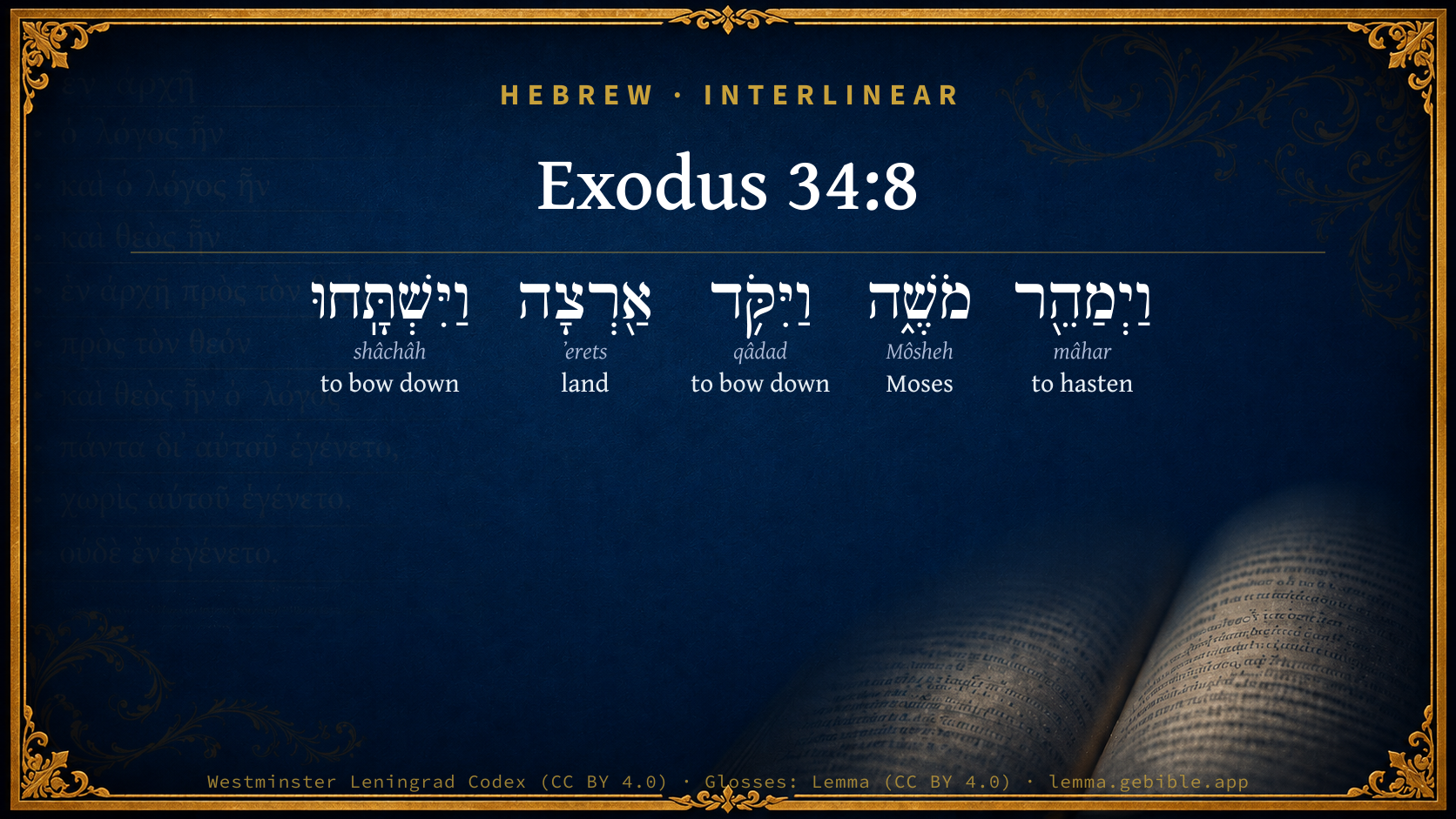
Hebrew (Westminster Leningrad Codex) Exodus 34:8 appears in the Hebrew Old Testament. The text above is from the Westminster Leningrad Codex. Each word links to its Strong’s number, a concise gloss, and parsing drawn from the Open Scriptures Hebrew Bible morphology. Click any word for its full Brown-Driver-Briggs (BDB) entry.
Download image
Cite this verse

Exodus 34:8 (World English Bible). Public Domain. Lemma interlinear Bible study tool, https://lemma.gebible.app/v/exodus/34/8.

Show BibTeX & RIS
BibTeX
RIS
English Translation
Moses hurried and bowed his head toward the earth, and worshiped.
World English Bible · Public Domain
Download a study sheet

One document with this verse’s original text, its word-by-word gloss line, the meaning frame, cross-references with their text, attributed commentary, and full source and license credits — printable, and it pastes into notes with its structure intact.

This verse Autodidact and up

Study sheet (.html) Plain text (.txt)

A passage Seminary Student

Up to 50 verses in one chapter. A passage sheet keeps up to 6 commentary sources and 12 cross-references per verse, in the order this page ranks them, and says so on the sheet whenever that leaves anything out. Ask for a single verse and you get the Autodidact verse sheet above.

Everything on this page stays free to read, with no account — the sheet is a download of what is already on screen, not access to it.

Want to remove ads? Support Godless Engineer
Compare translations 3

The same verse in 3 English versions, stacked beneath the original-language interlinear above. Click any original word for its lexicon entry.

Each is an independent rendering of the whole verse — the interlinear is not word-aligned to these translations.

Highlighted words mark where these versions differ — a whole-verse word diff, not a word-by-word alignment.

  • World English Bible Public Domain
    Moses hurried and bowed his head toward the earth, and worshiped.
  • King James Version Public Domain
    And Moses made haste, and bowed his head toward the earth, and worshipped.
  • unfoldingWord Literal Text CC BY-SA 4.0
    And Moses hurried and bowed to the ground and prostrated himself.

unfoldingWord Literal Text — © unfoldingWord, licensed CC BY-SA 4.0. Word-aligned USFM3 via Door43 (git.door43.org/unfoldingWord/en_ult).

Versions to compare (up to 4)

3 of 4 selected

Show all 18 translations

Every available English version of this verse, each an independent rendering of the whole verse.

  • World English Bible Public Domain
    Moses hurried and bowed his head toward the earth, and worshiped.
  • Berean Standard Bible Public Domain
    Moses immediately bowed down to the ground and worshiped.
  • Majority Standard Bible Public Domain
    Moses immediately bowed down to the ground and worshiped.
  • King James Version Public Domain
    And Moses made haste, and bowed his head toward the earth, and worshipped.
  • American Standard Version (1901) Public Domain
    And Moses made haste, and bowed his head toward the earth, and worshipped.
  • Revised Version (1885) Public Domain
    And Moses made haste, and bowed his head toward the earth, and worshipped.
  • Geneva Bible (1599) Public Domain
    Then Moses made haste and bowed him selfe to the earth, and worshipped,
  • Douay-Rheims (1899) Public Domain
    And Moses making haste, bowed down prostrate unto the earth, and adoring,
  • Young's Literal Translation Public Domain
    And Moses hasteth, and boweth to the earth, and doth obeisance,
  • Literal Standard Version CC BY-SA 4.0
    And Moses hurries, and bows to the earth, and pays respect,
  • Unlocked Literal Bible CC BY-SA 4.0
    Moses quickly bowed his head to the ground and worshiped.
  • unfoldingWord Literal Text CC BY-SA 4.0
    And Moses hurried and bowed to the ground and prostrated himself.
  • Darby Bible Public Domain
    And Moses made haste, and bowed his head to the earth and worshipped,
  • World Messianic Bible Public Domain
    Moses hurried and bowed his head toward the earth, and worshiped.
  • Webster's Bible Public Domain
    And Moses made haste, and bowed his head towards the earth, and worshiped.
  • Free Bible Version CC BY-SA 4.0
    Moses quickly bowed down to the ground, and worshiped.
  • Bible in Basic English Public Domain
    Then Moses quickly went down on his face in worship.
  • JPS Tanakh (1917) Public Domain
    And Moses made haste, and bowed his head toward the earth, and worshipped.

Literal Standard Version (2020), Covenant Press — licensed CC BY-SA 4.0. Text via the HelloAO Bible API (eBible.org). Unlocked Literal Bible (unfoldingWord) — licensed CC BY-SA 4.0. Text via the HelloAO Bible API (eBible.org). unfoldingWord Literal Text — © unfoldingWord, licensed CC BY-SA 4.0. Word-aligned USFM3 via Door43 (git.door43.org/unfoldingWord/en_ult). Free Bible Version, Dr. Jonathan Gallagher — licensed CC BY-SA 4.0. Text via the HelloAO Bible API (eBible.org).

Word by word

More ways to search: Search by grammar → Find every occurrence → Compare this word →

Practice this passage: Drill this verse → Learn its vocabulary →

About this verse

These counts appear in no published source. They are computed here, from the morphology-tagged text and Lemma’s own curated glosses. What Lemma adds →

5
words
5
distinct lemmas
Pentateuch
section

Notable vocabulary

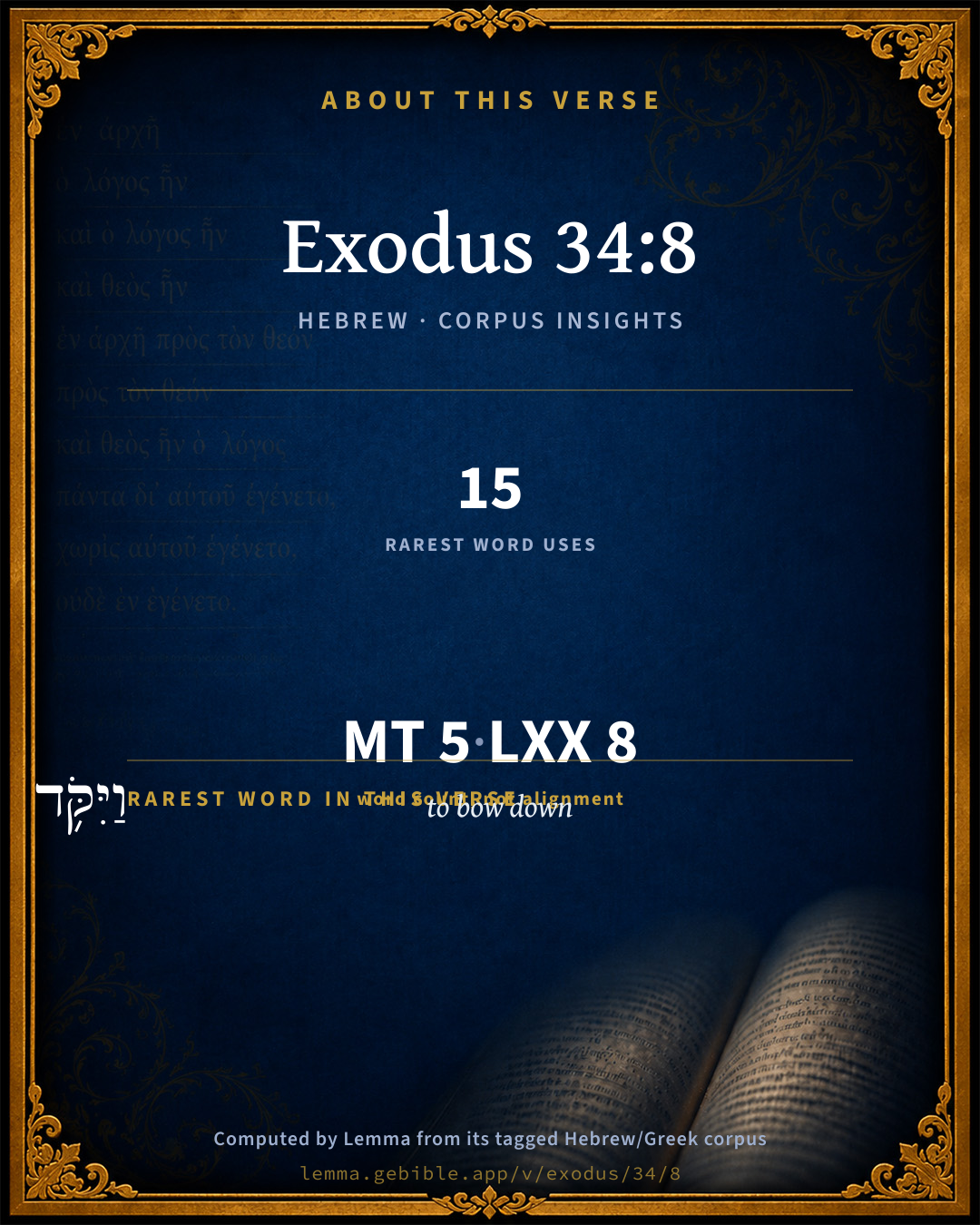
The rarest word here is וַיִּקֹּ֥ד to bow down H6915 — appearing just 15 times in the whole Hebrew Bible.

Shared distinctive vocabulary

וַיִּקֹּ֥ד to bow down H6915 occurs in 15 verses of the Hebrew Bible. Also found in:

Grammatical profile

  • 3 verbs
  • 2 nouns

Verb forms

  • וַיְמַהֵ֖ר Piel · Sequential Imperfect
  • וַיִּקֹּ֥ד Qal · Sequential Imperfect
  • וַיִּשְׁתָּֽחוּ Hithpael · Sequential Imperfect

Hebrew & Septuagint length

In English translation the verse runs 11 words from the Hebrew and 10 from the Septuagint (LXX English) — closely comparable.

A rough comparison of the two English renderings, which tokenize alike — not a word-level alignment.

Word counts can differ between the Hebrew and the Greek without any difference in meaning — e.g. the Hebrew direct-object marker אֵת has no separate Greek word, and Greek often adds the article ὁ.

In the original languages it is 5 Hebrew tokens and 8 Greek tokens — but the two are counted differently (Hebrew bundles its prefixes and suffixes into one token; the Greek is in lemma form), so that isn’t a like-for-like length.

Cross-references

3

Topical passages linked to Exodus 34:8 in the Treasury of Scripture Knowledge — connected by theme and wording, ordered by reader-vote popularity; previews shown in the World English Bible.

  • Exodus 4:31 The people believed, and when they heard that Yahweh had visited the children of Israel, and that he had seen their affliction, then they bowed their heads and worshiped.
  • Genesis 17:3 Abram fell on his face. God talked with him, saying,
  • 2 Chronicles 20:18 Jehoshaphat bowed his head with his face to the ground; and all Judah and the inhabitants of Jerusalem fell down before Yahweh, worshipping Yahweh.

Cross-references courtesy of OpenBible.info (CC BY 4.0).

Hebrew and Greek witnesses Masoretic Hebrew ↔ Greek Septuagint

The same verse in the two great witnesses to the Old Testament, shown verse-for-verse.

These are two independent witnesses, not word-aligned to each other, and the Septuagint is shown in lemma (dictionary) form.

Hebrew Exodus 34:8 Masoretic · Westminster Leningrad Codex

וַיְמַהֵ֖ר מֹשֶׁ֑ה וַיִּקֹּ֥ד אַ֖רְצָה וַיִּשְׁתָּֽחוּ

Moses hurried and bowed his head toward the earth, and worshiped.

World English Bible · Public Domain

Greek LXX Exodus 34:8 Septuagint · lemma form

καί σπεύδω μωυσῆς κύπτω ἐπί ὁ γῆ προςκυνέω

And Moses hasted, and bowed to the earth and worshipped;

LXX2012 (modern English Septuagint) · Public Domain

Hebrew: Westminster Leningrad Codex (CC BY 4.0). Greek: Septuagint (public domain); English from LXX2012 (modern English Septuagint) (Public Domain). How the Septuagint differs from the Hebrew →

Targum (Aramaic paraphrase)

2

The Targum is the ancient Jewish Aramaic paraphrase of the Hebrew Scriptures — an interpretive translation, not the Hebrew text itself. Onkelos (literal) and Pseudo-Jonathan (expansive) render the Torah, and Jonathan the Prophets. Coverage is partial: where no permissively-licensed English translation exists for a verse, only the Aramaic is shown. This is verse-level text, not a word-by-word alignment to the Hebrew.

  1. Targum Onkelos Torah (Genesis–Deuteronomy)
    וְאוֹחִי משֶׁה וּכְרַע עַל אַרְעָא וּסְגִיד:

    (no public-domain English translation for this verse)

    Targum Onkelos — Aramaic: “Onkelos Genesis” (public domain); “Onkelos Exodus” (public domain); “Onkelos Leviticus” (public domain); “Onkelos Numbers” (public domain); “Onkelos Deuteronomy” (public domain). English: “Sefaria Community Translation” (CC0 1.0 (public-domain dedication)); “J.W. Etheridge. The Targums of Onkelos and Jonathan Ben Uzziel on the Pentateuch. London: Longmans, Green, 1862” (public domain). Text via Sefaria.

  2. Targum Pseudo-Jonathan Torah (Genesis–Deuteronomy)
    וְאוֹחִי משֶׁה וְגָחַן עַל אַרְעָא וּסְגִיד

    And Mosheh made haste and bowed himself upon the earth and worshipped.

    Targum Pseudo-Jonathan — Aramaic: “Targum Jonathan on Genesis” (public domain); “Targum Jonathan on Exodus” (public domain); “Targum Jonathan on Leviticus” (public domain); “Targum Jonathan on Numbers” (public domain); “Targum Jonathan on Deuteronomy” (public domain). English: “The Targum of Jonathan ben Uzziel, trans. J. W. Etheridge, London, 1862” (public domain). Text via Sefaria.

Commentary

Notes on Exodus 34:8 from classic Christian and Jewish commentators (each source and its license shown beneath its notes). The classic Christian expositions comment on the surrounding passage and are grouped to its opening verse, so a note may address several verses; the Jewish commentaries on the Tanakh (Rashi and others) are per-verse, so they appear only where the commentator wrote on this verse.

Lemma curates 59 commentaries, every one of them public domain or Creative Commons licensed, each selected and text-cleaned for this edition rather than reprinted as found. About our sources →

Trapp's Complete Commentary

John Trapp

Exo 34:8 And Moses made haste, and bowed his head toward the earth, and worshipped.

Ver. 8. And Moses made haste.] It was time for him. The more any man sees of God, the lower he falls in his own eyes: as he that hath looked intently upon the sun, sees little when he looks down again.

John Trapp, A Commentary or Exposition upon All the Books of the Old and New Testament (1647–1656) — public domain. Text from a community e-Sword module.

Joseph Benson's Commentary

Exo 34:8. And Moses made haste and bowed his head — Thus he expressed his humble reverence and adoration of God’s glory, together with his joy in this discovery God had made of himself, and his thankfulness for it. Then likewise he expressed his holy submission to the will of God, made known in this declaration, subscribing to his justice as well as mercy, and putting himself and his people Israel under the government of such a God as Jehovah had now proclaimed himself to be. Let this God be our God for ever and ever!

Joseph Benson's Commentary on the Old and New Testaments (1811–1818) — public domain. Text from a community e-Sword module.

The Preacher's Complete Homiletical Commentary

Joseph S. Exell (gen. ed.)

MAIN HOMILETICS OF THE PARAGRAPH.—Exo_34:8-9

GOD’S PRESENCE WITH HIS PEOPLE

The revelation of the Divine name was almost too much for Moses, it was so unmerited. He was lost in wonder and adoration at the Divine condescension, Exo_34:8. Recovering himself, however, and emboldened by this gracious proclamation, he, in the true spirit of believing and triumphant prayer, supplicated God’s actual presence among His people. This is not the only instance in which past favours have been the basis for future expectations (Gen_18:23-33; Psa_116:12). The text teaches us—

I. That God’s presence with His people is secured by mediation. His presence with Israel was secured by the intercession of Moses; His presence with His Church is secured by the intercession of Jesus Christ. The whole of John 17 is based upon this.

II. That God’s presence is importuned because of the obstinacy of His people. “A stiff-necked people.” One would have thought that would have been an argument for vengeance. But no, Old and New Testaments alike base upon man’s failings a reason why God should visit him (Joh_3:16; Mat_9:13; Rom_5:8). The reason is obvious, God alone is equal to the task of subduing sinners and bringing them into obedience to Himself.

III. That God’s presence is supplicated to fulfil God’s promises.

1. God had promised to pardon. God’s presence was requisite for this, because the Divine pardon is not merely an erasure of sin from God’s book, but an erasure of sin from man’s heart. Forgiveness is not merely a fact in the moral universe of which man may or may not be conscious; but a fact in man’s spiritual nature which he enjoys, and of which he has irrefragable proofs. God Himself must come near and transform the sinner into the saint.

2. God had promised that Israel should be His inheritance. This could only be effected by God’s going amongst them and taking them. What boundless comfort does the double argument give! “God, in the person of His Son, has come amongst us, therefore we are His inheritance. Man is His inheritance, therefore He is with us always even unto the end of the world.”

In conclusion—i. God having blessed us is a reason for our expectation of future blessings. Compare the past, present, and future tenses of Psa_23:2. God having blessed us in the past should be the basis of our expectation that He will manifest Himself to us. iii. This Divine presence should be the incentive to, and power of, personal purity and consecration.—J. W. Burn.

ILLUSTRATIONS

BY

REV. WILLIAM ADAMSON

Law-Lights! Exo_34:1-35. Pressense says, that whatever opinions men may hold as to the integrity of that primitive witness, all must own that it contains pages in which one beholds, as it were, the reflection of the lustre which caused Moses’s face to shine when he held converse with God. It has ever been the pious mind which has through the eyes beheld the chain of revelation and the long series of Divine manifestations gradually unwind themselves. Just as they that watch for the morning gaze out from the height of the tower, longing with inexpressible desire for the approach of dawn; so does religious consciousness cast glances of fire upon the horizon as she looks out for the Divine Sunrise. The whole of the Old Testament pants and throbs with this Divine yearning, and it also shows us the finger of God writing in the heart of man the great preparation for the Gospel. The angels ever

“Draw strength from gazing on its glance,

Though none its meaning fathom may;

The Word’s unwithered countenance

Is bright as at Mount Sinai’s day.”

—Goëthe.

Grace-Memories! Exo_34:8. Moses could never forget those moments spent in the clefts of the rock, while he beheld the grace of God’s glory, after the insufferable glories of the law on Sinai. What Christian, who has felt the terrors of the law producing deep conviction in his conscience, and who has found peace, ever forgets that blissful moment when, hiding in the cleft side of Jesus, he beheld the glory of God’s grace, and heard His voice, “Thy sins are forgiven thee.” As the rebellious subject, who has stood before his offended monarch, marked the dread frown gathered on his royal brow, and listened to the solemn proclamation of the laws of the state, is filled with deep, unutterable joy as he sees the radiant smile of love glowing on that face, and as he hears the forgiving declaration, “Thy offence is blotted out by a merciful sovereign,” the pardoned and restored subject can never lose sight of that scene—of the radiant smile. The proclamation would be written on the tablets of his memory in ineffaceable characters.

“For the King Himself in His tender grace,

Hath shown me the brightness of His face;

And who shall pine for a glow-worm light,

When the sun goes forth in his giant might?”

—Havergal.

The Preacher's Complete Homiletical Commentary (gen. ed. Joseph S. Exell; Funk & Wagnalls, c. 1892) — public domain (pre-1929). A full-Bible homiletical/sermon-outline anthology covering 65 of 66 books (2 John is absent from the source module). Text from a community e-Sword module.

Tyndale Open Study Notes

Tyndale Open Resources

34:8-9 Since the Lord had already twice promised to go with them (33:14, 17), this renewed request seems to show a lack of faith. It may also be that God’s presence had driven home to Moses how absolutely holy God is and how very different he is from this stubborn and rebellious people. Here Moses took his request a step further and asked God to travel with the people and make them his own special possession (see 19:5-6). Moses asked for the complete restoration of the relationship.

Tyndale Open Study Notes — © Tyndale Open Resources, licensed CC BY-SA 4.0. Text via the HelloAO Bible API.

Jamieson, Fausset & Brown

Robert Jamieson, A. R. Fausset & David Brown

Moses bowed . . . and worshipped--In the East, people bow the head to royalty, and are silent when it passes by, while in the West, they take off their hats and shout.

Jamieson, Fausset & Brown — Commentary Critical and Explanatory on the Whole Bible (1871) — public domain (CC PDM 1.0). Text via the HelloAO Bible API.

Ellicott's Commentary for English Readers

(8) Moses made haste, and bowed his head.—As the Divine glory passed before him, Moses bowed his head in adoration, worshipping God, and not daring to look until the glory had gone by. It is thus seen that with his ardent desire to look into the things of God he combined the highest and deepest reverence.

A Bible Commentary for English Readers, edited by Charles John Ellicott (1878–1897) — public domain. Text from a community e-Sword module.

The Cambridge Bible for Schools and Colleges

gen. ed. J. J. S. Perowne

8. Moses now reverently does obeisance (cf. Exo_4:31, Exo_12:27).

The Cambridge Bible for Schools and Colleges (gen. ed. J. J. S. Perowne; Cambridge University Press, 1878–1918) — public domain. Text from a community e-Sword module.

John Gill's Exposition

And Moses made haste,.... Perceiving the voice ceased, and the Lord was passing on, lest he should be gone, and he lose the favourable opportunity he had:

and bowed his head toward the earth, and worshipped; threw himself prostrate upon it, and in the most humble manner put up his requests to God, which are expressed in the following verse; he gladly laid hold on this opportunity to use his interest with God for the people of Israel, and to improve the proclamation of grace and mercy, in the forgiveness of sins, now made; which encouraged his faith and hope to draw nigh with a holy boldness, and use freedom with him, and yet with an awe of his majesty, with reverence and godly fear.

John Gill's Exposition of the Whole Bible (1746–1763) — public domain (CC PDM 1.0). Text via the HelloAO Bible API.

The Pulpit Commentary

Moses made haste and bowed his head. Worshipping the glory that had passed by, and accepting the gracious words addressed to him.

The Pulpit Commentary (1880–1919), ed. H.D.M. Spence-Jones & Joseph S. Exell — public domain. Text from a community e-Sword module.

John Wesley's Explanatory Notes

And Moses made haste, and bowed his head - Thus he expressed his humble reverence and adoration of God's glory, together with his joy in this discovery God had made of himself, and his thankfulness for it. Then likewise he expressed his holy submission to the will of God made known in this declaration, subscribing to his justice as well as mercy, and putting himself and his people Israel under the government of such a God as Jehovah had now proclaimed himself to be. Let this God be our God forever and ever!

John Wesley, Explanatory Notes Upon the Whole Bible (1754–1765) — public domain. Text via the GEBible commentary corpus.

unfoldingWord translationNotes

Door43 World Missions Community

If now I have found favor in your eyes

Here "found favor" is an idiom that means be approved of or that God is pleased with Moses. Here "eyes" are a metonym for sight, and sight is a metaphor representing his evaluation. See how you translated this in Exodus 33:12. AT: "Now If you are pleased with me" or "Now if you approve of me" (See: Idiom and Metonymy and Metaphor)

our iniquity and our sin

The words "iniquity" and "sin" mean basically the same thing and are combined for emphasis. AT: "all our sins" (See: Doublet)

take us as your inheritance

Something that someone possesses forever is spoken of as if it were something that they had inherited. AT: "take us as the people that you possess forever" or "accept us as the people who belong to you forever" (See: Metaphor)

translationWords

Moses

bow

worship

favor

lord

people group

stiff-necked

forgive

iniquity

sin

inherit

unfoldingWord translationNotes — © Distant Shores Media and the Door43 World Missions Community, licensed CC BY-SA 4.0. Source: git.door43.org/Door43/en_tn.

Rashi

Rabbi Shlomo Yitzchaki (Rashi)

וימהר משה, AND MOSES MADE HASTE — When Moses saw that the Shechinah passed by and heard the sound of the proclamation he immediately prostrated himself.

Rashi on the Tanakh — English translations: “The Judaica Press complete Tanach with Rashi, translated by A. J. Rosenberg” (CC BY 4.0); “Pentateuch with Rashi's commentary by M. Rosenbaum and A.M. Silbermann, 1929-1934” (public domain); “The Metsudah Tanach series, Lakewood, N.J” (CC BY 4.0); and “The Book of Joshua, Metsudah Publications, 1997” (CC BY 4.0). Text via Sefaria.

Lesson kit

Teaching starters — assembled from the data on this page, not authored interpretation. Every prompt links to the verse data it draws on. Edit before teaching.

Exodus, in the Pentateuch, opens this verse with 5 words (5 distinct Hebrew lemmas). Its most distinctive word is qâdad (“to bow down”). A historical commentator’s framing appears above. Read the whole chapter for the surrounding context.

Discussion questions

  1. What does “to bow down” (qâdad) contribute to the verse as a whole?
  2. How does Genesis 24:26, which shares the word «to bow down», read alongside this verse?
  3. These translations render this verse differently; the difference is in the English rendering, not the original. What questions does that raise?
  4. «וַיְמַהֵ֖ר» is a Piel Sequential Imperfect verb. How does that grammatical form shape the action described?
  5. Compare how Trapp's Complete Commentary and Joseph Benson's Commentary read this verse. Where do they agree or differ?

Things to notice

Reading settings

Reading text

Shown beneath each verse's original-language words.

Old Testament
Old Testament edition

Read the OT as the Masoretic Hebrew (MT) or the Greek Septuagint (LXX).

English shown for the Greek Septuagint (in the Hebrew ↔ Greek comparison).

Comparing translations? Open the Compare panel on any verse page to stack up to four side by side.