2 Samuel 18:21

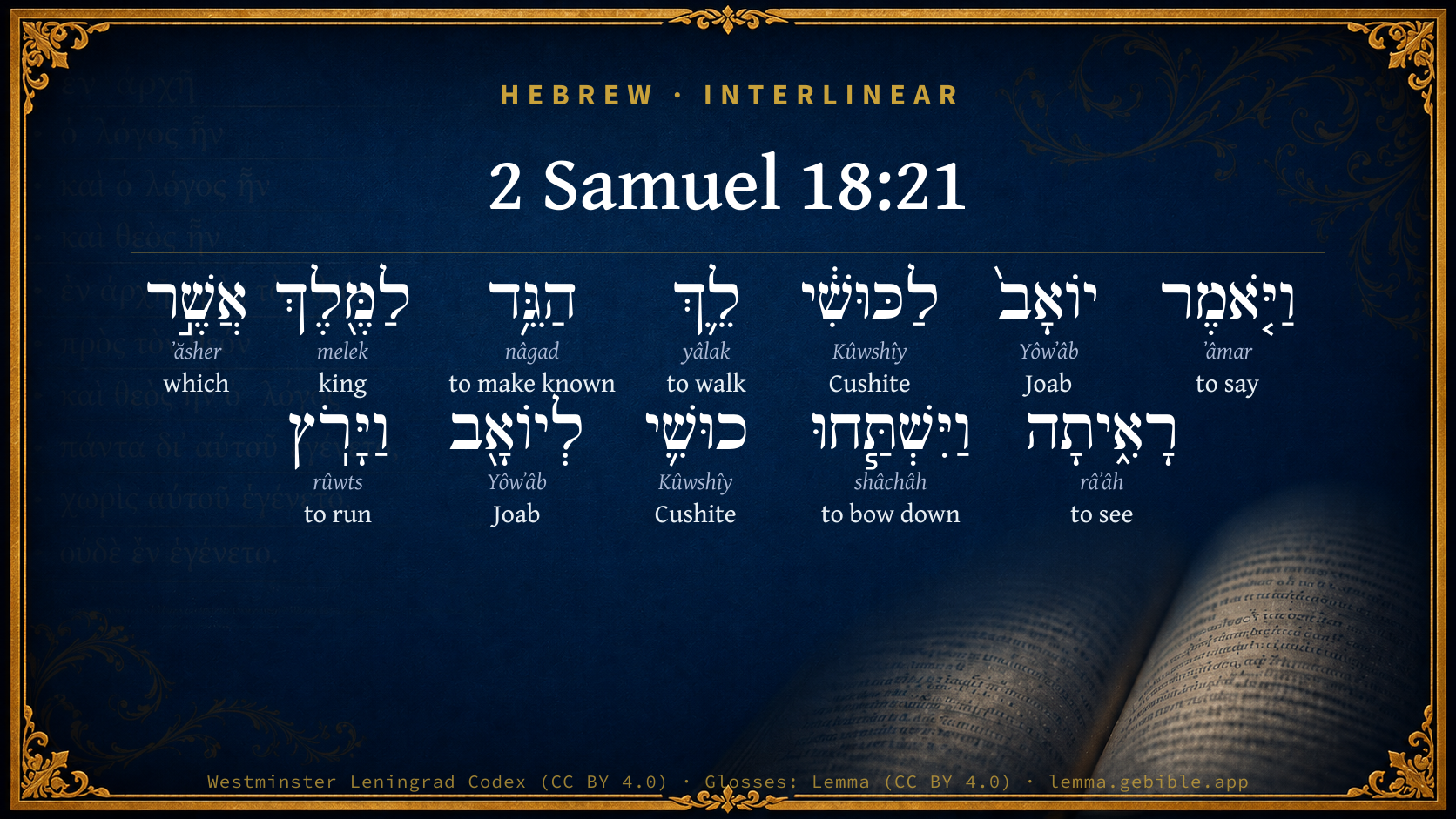
Hebrew (Westminster Leningrad Codex) 2 Samuel 18:21 appears in the Hebrew Old Testament. The text above is from the Westminster Leningrad Codex. Each word links to its Strong’s number, a concise gloss, and parsing drawn from the Open Scriptures Hebrew Bible morphology. Click any word for its full Brown-Driver-Briggs (BDB) entry.
Download image
Cite this verse

2 Samuel 18:21 (World English Bible). Public Domain. Lemma interlinear Bible study tool, https://lemma.gebible.app/v/2-samuel/18/21.

Show BibTeX & RIS
BibTeX
RIS
English Translation
Then said Joab to the Cushite, Go, tell the king what you have seen. The Cushite bowed himself to Joab, and ran.
World English Bible · Public Domain
Highlights
  • 1 first appearance in the Hebrew Bible
Full analysis ↓
Download a study sheet

One document with this verse’s original text, its word-by-word gloss line, the meaning frame, cross-references with their text, attributed commentary, and full source and license credits — printable, and it pastes into notes with its structure intact.

This verse Autodidact and up

Study sheet (.html) Plain text (.txt)

A passage Seminary Student

Up to 50 verses in one chapter. A passage sheet keeps up to 6 commentary sources and 12 cross-references per verse, in the order this page ranks them, and says so on the sheet whenever that leaves anything out. Ask for a single verse and you get the Autodidact verse sheet above.

Everything on this page stays free to read, with no account — the sheet is a download of what is already on screen, not access to it.

Want to remove ads? Support Godless Engineer
Compare translations 3

The same verse in 3 English versions, stacked beneath the original-language interlinear above. Click any original word for its lexicon entry.

Each is an independent rendering of the whole verse — the interlinear is not word-aligned to these translations.

Highlighted words mark where these versions differ — a whole-verse word diff, not a word-by-word alignment.

  • World English Bible Public Domain
    Then said Joab to the Cushite, Go, tell the king what you have seen. The Cushite bowed himself to Joab, and ran.
  • King James Version Public Domain
    Then said Joab to Cushy, Go tell the king what thou hast seen. And Cushy bowed himself unto Joab, and ran.
  • unfoldingWord Literal Text CC BY-SA 4.0
    Then Joab said to the Cushite, “Go, declare to the king what you have seen.” And the Cushite prostrated himself to Joab, then he ran.

unfoldingWord Literal Text — © unfoldingWord, licensed CC BY-SA 4.0. Word-aligned USFM3 via Door43 (git.door43.org/unfoldingWord/en_ult).

Versions to compare (up to 4)

3 of 4 selected

Show all 18 translations

Every available English version of this verse, each an independent rendering of the whole verse.

  • World English Bible Public Domain
    Then said Joab to the Cushite, Go, tell the king what you have seen. The Cushite bowed himself to Joab, and ran.
  • Berean Standard Bible Public Domain
    So Joab said to a Cushite, “Go, tell the king what you have seen.” The Cushite bowed to Joab and took off running.
  • Majority Standard Bible Public Domain
    So Joab said to a Cushite, “Go, tell the king what you have seen.” The Cushite bowed to Joab and took off running.
  • King James Version Public Domain
    Then said Joab to Cushy, Go tell the king what thou hast seen. And Cushy bowed himself unto Joab, and ran.
  • American Standard Version (1901) Public Domain
    Then said Joab to the Cushite, Go, tell the king what thou hast seen. And the Cushite bowed himself unto Joab, and ran.
  • Revised Version (1885) Public Domain
    Then said Joab to the Cushite, Go tell the king what thou hast seen. And the Cushite bowed himself unto Joab, and ran.
  • Geneva Bible (1599) Public Domain
    Then said Ioab to Cushi, Goe, tel the king, what thou hast seene. And Cushi bowed himselfe vnto Ioab, and ran.
  • Douay-Rheims (1899) Public Domain
    And Joab said to Chusai: Go, and tell the king what thou hast seen. Chusai bowed down to Joab, and ran.
  • Young's Literal Translation Public Domain
    And Joab saith to Cushi, `Go, declare to the king that which thou hast seen;' and Cushi boweth himself to Joab, and runneth.
  • Literal Standard Version CC BY-SA 4.0
    And Joab says to Cushi, “Go, declare to the king that which you have seen”; and Cushi bows himself to Joab, and runs.
  • Unlocked Literal Bible CC BY-SA 4.0
    Then Joab said to a Cushite, “Go, tell the king what you have seen.” The Cushite bowed down to Joab, and ran.
  • unfoldingWord Literal Text CC BY-SA 4.0
    Then Joab said to the Cushite, “Go, declare to the king what you have seen.” And the Cushite prostrated himself to Joab, then he ran.
  • Darby Bible Public Domain
    Then said Joab to the Cushite, Go, tell the king what thou hast seen. And the Cushite bowed himself to Joab, and ran.
  • World Messianic Bible Public Domain
    Then Joab said to the Cushite, “Go, tell the king what you have seen!” The Cushite bowed himself to Joab, and ran.
  • Webster's Bible Public Domain
    Then said Joab to Cushi, Go, tell the king what thou hast seen. And Cushi bowed himself to Joab, and ran.
  • Free Bible Version CC BY-SA 4.0
    So Joab said to a man from Ethiopia, “Go and tell the king what you have seen.” He bowed to Joab and ran off.
  • Bible in Basic English Public Domain
    Then Joab said to the Cushite, Go and give the king word of what you have seen. And the Cushite, making a sign of respect to Joab, went off running.
  • JPS Tanakh (1917) Public Domain
    Then said Joab to the Cushite: 'Go tell the king what thou hast seen.' And the Cushite bowed down unto Joab, and ran.

Literal Standard Version (2020), Covenant Press — licensed CC BY-SA 4.0. Text via the HelloAO Bible API (eBible.org). Unlocked Literal Bible (unfoldingWord) — licensed CC BY-SA 4.0. Text via the HelloAO Bible API (eBible.org). unfoldingWord Literal Text — © unfoldingWord, licensed CC BY-SA 4.0. Word-aligned USFM3 via Door43 (git.door43.org/unfoldingWord/en_ult). Free Bible Version, Dr. Jonathan Gallagher — licensed CC BY-SA 4.0. Text via the HelloAO Bible API (eBible.org).

Word by word

More ways to search: Search by grammar → Find every occurrence → Compare this word →

Practice this passage: Drill this verse → Learn its vocabulary →

לַכּוּשִׁ֔י
Kûwshîy
H3569
“to/for the · Cushite”
Preposition, Determined + Noun, Gentilic, Masculine, Singular, Absolute
Part of Speech
Preposition + Noun
Type
Gentilic
Gender
Masculine
Number
Singular
State
Absolute
Full BDB Definition

Origin: patronymically from H3568

TWOT: 969a

Cushi or Ethiopian = see Cushan " their blackness" - one of the descendants of Cush the grandson of Noah through Ham and a member of that nation or people - one of Joab's couriers - (TWOT) Ethiopian
  1. וַיֹּ֤אמֶר ʼâmar H559 “and · to say” Conjunction + Verb, Qal, Sequential Imperfect, 3rd Person, Masculine, Singular
  2. יוֹאָב֙ Yôwʼâb H3097 “Joab” Noun, Proper
  3. לֵ֛ךְ yâlak H3212 “walk” Verb, Qal, Imperative, 2nd Person, Masculine, Singular
  4. הַגֵּ֥ד nâgad H5046 “make known” Verb, Hiphil, Imperative, 2nd Person, Masculine, Singular
  5. לַמֶּ֖לֶךְ melek H4428 “to/for the · king” Preposition, Determined + Noun, Common, Masculine, Singular, Absolute
  6. אֲשֶׁ֣ר ʼăsher H834 “which” Particle, Relative
  7. רָאִ֑יתָה râʼâh H7200 “to see” Verb, Qal, Perfect, 2nd Person, Masculine, Singular
  8. וַיִּשְׁתַּ֧חוּ shâchâh H7812 “and · to bow down” Conjunction + Verb, Hithpael, Sequential Imperfect, 3rd Person, Masculine, Singular
  9. כוּשִׁ֛י Kûwshîy H3569 “Cushite” Noun, Gentilic, Masculine, Singular, Absolute
  10. לְיוֹאָ֖ב Yôwʼâb H3097 “to/for · Joab” Preposition + Noun, Proper
  11. וַיָּרֹֽץ rûwts H7323 “and · to run” Conjunction + Verb, Qal, Sequential Imperfect, 3rd Person, Masculine, Singular

About this verse

These counts appear in no published source. They are computed here, from the morphology-tagged text and Lemma’s own curated glosses. What Lemma adds →

12
words
10
distinct lemmas
Historical
section

Notable vocabulary

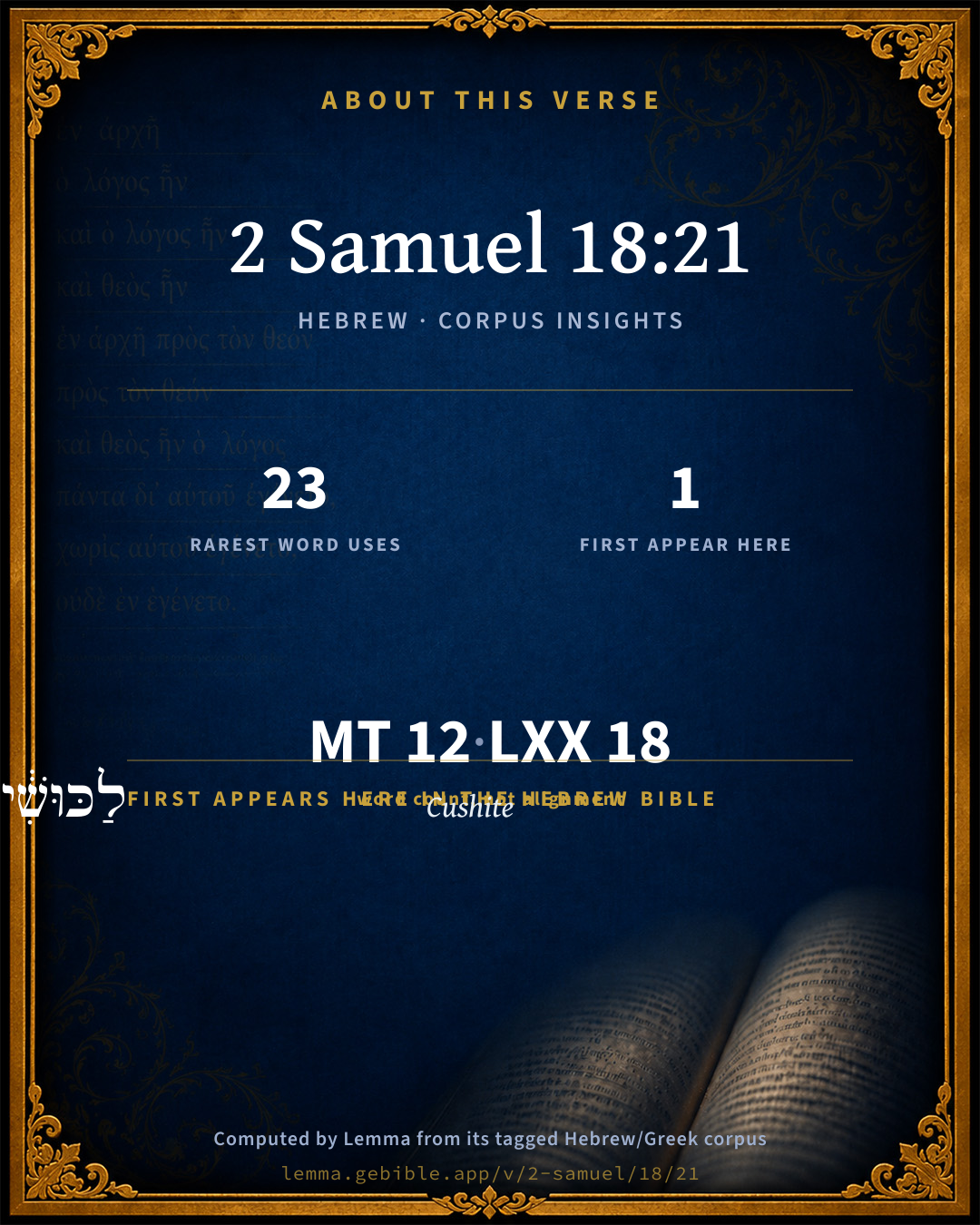
The rarest word here is לַכּוּשִׁ֔י Cushite H3569 — appearing just 23 times in the whole Hebrew Bible.

First appearance in Scripture

This word makes its first canonical appearance in the Hebrew Bible here:

  • לַכּוּשִׁ֔י Cushite H3569

Shared distinctive vocabulary

לַכּוּשִׁ֔י Cushite H3569 occurs in 19 verses of the Hebrew Bible. Also found in:

Grammatical profile

  • 6 verbs
  • 5 nouns
  • 1 particle

Verb forms

  • וַיֹּ֤אמֶר Qal · Sequential Imperfect
  • לֵ֛ךְ Qal · Imperative
  • הַגֵּ֥ד Hiphil · Imperative
  • רָאִ֑יתָה Qal · Perfect
  • וַיִּשְׁתַּ֧חוּ Hithpael · Sequential Imperfect
  • וַיָּרֹֽץ Qal · Sequential Imperfect

Repetition

Words recur within this verse — often emphatic in Hebrew:

  • יוֹאָב֙ Joab H3097 ×2
  • לַכּוּשִׁ֔י Cushite H3569 ×2

Hebrew & Septuagint length

In English translation the verse runs 22 words from the Hebrew and 24 from the Septuagint (LXX English) — closely comparable.

A rough comparison of the two English renderings, which tokenize alike — not a word-level alignment.

Word counts can differ between the Hebrew and the Greek without any difference in meaning — e.g. the Hebrew direct-object marker אֵת has no separate Greek word, and Greek often adds the article ὁ.

In the original languages it is 12 Hebrew tokens and 18 Greek tokens — but the two are counted differently (Hebrew bundles its prefixes and suffixes into one token; the Greek is in lemma form), so that isn’t a like-for-like length.

Hebrew and Greek witnesses Masoretic Hebrew ↔ Greek Septuagint

The same verse in the two great witnesses to the Old Testament, shown verse-for-verse.

These are two independent witnesses, not word-aligned to each other, and the Septuagint is shown in lemma (dictionary) form.

Hebrew 2 Samuel 18:21 Masoretic · Westminster Leningrad Codex

וַיֹּ֤אמֶר יוֹאָב֙ לַכּוּשִׁ֔י לֵ֛ךְ הַגֵּ֥ד לַמֶּ֖לֶךְ אֲשֶׁ֣ר רָאִ֑יתָה וַיִּשְׁתַּ֧חוּ כוּשִׁ֛י לְיוֹאָ֖ב וַיָּרֹֽץ

Then said Joab to the Cushite, Go, tell the king what you have seen. The Cushite bowed himself to Joab, and ran.

World English Bible · Public Domain

Greek LXX 2 Samuel 18:21 Septuagint · lemma form

καί εἶπον ιωαβ ὁ χουσι βαδίζω ἀναἀγγέλλω ὁ βασιλεύς ὅσος ὁράω καί προςκυνέω χουσι ὁ ιωαβ καί ἐκἔρχομαι

And Joab said to Chusi, Go, report to the king all that you have seen. And Chusi did obeisance to Joab, and went out.

LXX2012 (modern English Septuagint) · Public Domain

Hebrew: Westminster Leningrad Codex (CC BY 4.0). Greek: Septuagint (public domain); English from LXX2012 (modern English Septuagint) (Public Domain). How the Septuagint differs from the Hebrew →

Targum (Aramaic paraphrase)

1

The Targum is the ancient Jewish Aramaic paraphrase of the Hebrew Scriptures — an interpretive translation, not the Hebrew text itself. Onkelos (literal) and Pseudo-Jonathan (expansive) render the Torah, and Jonathan the Prophets. Coverage is partial: where no permissively-licensed English translation exists for a verse, only the Aramaic is shown. This is verse-level text, not a word-by-word alignment to the Hebrew.

  1. Targum Jonathan Prophets (Joshua–Malachi)
    וַאֲמַר יוֹאָב לְכוּשִׁי אֱזֵיל חַוֵי לְמַלְכָּא דַחֲזֵיתָא וּסְגִיד כּוּשִׁי לְיוֹאָב וּרְהַט:

    (no public-domain English translation for this verse)

    Targum Jonathan — Aramaic: “Mikraot Gedolot” (public domain). English: “Sefaria Community Translation” (CC0 1.0 (public-domain dedication)); “London "Chaldee Paraphrase," 1871” (public domain). Text via Sefaria.

Commentary

Notes on 2 Samuel 18:21 from classic Christian and Jewish commentators (each source and its license shown beneath its notes). The classic Christian expositions comment on the surrounding passage and are grouped to its opening verse, so a note may address several verses; the Jewish commentaries on the Tanakh (Rashi and others) are per-verse, so they appear only where the commentator wrote on this verse.

Lemma curates 59 commentaries, every one of them public domain or Creative Commons licensed, each selected and text-cleaned for this edition rather than reprinted as found. About our sources →

Trapp's Complete Commentary

John Trapp

2Sa 18:21 Then said Joab to Cushi, Go tell the king what thou hast seen. And Cushi bowed himself unto Joab, and ran.

Ver. 21. Then said Joab to Cushi.] {a} Cuidam Aethiopi; so Tremellius rendereth it; to a certain blackamoor, some slave that belonged to David’s house, {2Sa 18:31} whose acceptance before the king Joab did not so much regard; and, because of his blackness, he might be the fitter messenger of such doleful tidings, as he knew it would be to David.

{a} Non est nomen proprium. - Vat.

John Trapp, A Commentary or Exposition upon All the Books of the Old and New Testament (1647–1656) — public domain. Text from a community e-Sword module.

Tyndale Open Study Notes

Tyndale Open Resources

18:21 a man from Ethiopia: Joab thought it would be better to send a foreigner to tell the king of Absalom’s death. If David overreacted, the loss of a foreigner was not as critical as the loss of a priest’s son.

Tyndale Open Study Notes — © Tyndale Open Resources, licensed CC BY-SA 4.0. Text via the HelloAO Bible API.

Adam Clarke's Commentary

Verse 21. Tell the king what thou hast seen] At this time the death of Absalom was not publicly known; but Joab had given Cushi private information of it. This Ahimaaz had not, for he could not tell the king whether Absalom were dead. To this Joab seems to refer, 2Sa 18:22: "Thou hast no tidings ready."

Adam Clarke's Commentary on the Bible (1810–1826) — public domain. Text from a community e-Sword/MySword module.

Ellicott's Commentary for English Readers

(21) Cushi.—Rather, the Cushite, probably an Ethiopian slave in Joab’s service, for whose falling under the king’s displeasure he had little care.

A Bible Commentary for English Readers, edited by Charles John Ellicott (1878–1897) — public domain. Text from a community e-Sword module.

The Cambridge Bible for Schools and Colleges

gen. ed. J. J. S. Perowne

21. Cushi] Rather, the Cushite, an Ethiopian slave in Joab’s service, who would have little to lose by the king’s displeasure.

The Cambridge Bible for Schools and Colleges (gen. ed. J. J. S. Perowne; Cambridge University Press, 1878–1918) — public domain. Text from a community e-Sword module.

John Gill's Exposition

Then said Joab to Cushi,.... The Ethiopian, or blackamoor; who either was an Ethiopian by birth and proselyted, or he was an Israelite of a black complexion, and therefore so called; and was judged a proper person by the general to carry such dismal news to the king, as he knew it would be. Some Jewish writers (a) take him to be the same with Cush the Benjaminite, in the title of the seventh psalm, Psa 7:1; and that he is the same that told Joab he saw Absalom hanging in an oak, and declared that, if a thousand shekels of silver were offered him, he would not have put forth his hand against him, Sa2 18:10; though some think this was one of the ten young men that waited on Joab, and by his orders slew Absalom; but it would have been dangerous for one of these to have carried the tidings, had he been known by David to have done it:

go tell the king what thou hast seen: by which it should seem that he was present when Absalom was killed:

and Cushi bowed himself unto Joab; in reverence to him as his general, and in thankfulness for sending him on this errand:

and ran; as fast as he could.

(a) Pirke Eliezer, c. 53.

John Gill's Exposition of the Whole Bible (1746–1763) — public domain (CC PDM 1.0). Text via the HelloAO Bible API.

Albert Barnes' Notes on the Bible

Cushi - “The Cushite,” a foreign slave, perhaps of Joab’s, whom he did not scruple to expose to David’s anger. If, however, it is a name, it must be rendered “Haccushi.” In the title to Ps. 7, “Cush, the Benjamite,” cannot mean this Cushi, since the contents of the Psalm are not suitable to this occasion.

Albert Barnes' Notes on the Bible (1834–1885) — public domain. Text from a community e-Sword/MySword module.

Haydock's Catholic Bible Commentary

Chusi: perhaps, of Ethiopian extraction. (Grotius)

George Leo Haydock (1774–1849), Haydock's Catholic Family Bible and Commentary, 1859 edition — public domain. Excludes Psalms (Douay-Rheims chapter numbering differs from Protestant) and Deuterocanonical books (Catholic canon only).

Matthew Poole's English Annotations

To Cushi, or, to an Ethiopian; so he might be by birth, and yet by profession an Israelite.

Matthew Poole's English Annotations on the Holy Bible (1683–1685) — public domain. Text from a community e-Sword/MySword module.

Whedon's Commentary on the Bible

Daniel D. Whedon

21. Cushi — Supposed by some to have been an Ethiopian slave in the service of Joab.

What thou hast seen — He was probably among those ten young men (2Sa_18:15) that smote Absalom.

Daniel D. Whedon (gen. ed.), Commentary on the Old and New Testaments (1874–1909) — public domain. Text from a community e-Sword module.

The Pulpit Commentary

Cushi. This is not a proper name, but signifies that he was an Ethiopian, that is, a negro slave in Joab"s service. Joab was unwilling to expose Ahimaaz to me king"s displeasure, and we gather from ver. 27 that the sending of a person of low rank would be understood to signify evil tidings. The bearer of good news received a present, and therefore the passing over all Joab"s personal friends to send a slave was proof that the message was not expected to bring the bearer honour or reward. And Joab was quite right in supposing that David would be more displeased at his son"s death than pleased at the victory.

The Pulpit Commentary (1880–1919), ed. H.D.M. Spence-Jones & Joseph S. Exell — public domain. Text from a community e-Sword module.

Keil & Delitzsch

C. F. Keil & F. Delitzsch

Joab therefore entrusted the Cushite with the duty of conveying to David the announcement of what had occurred. It cannot be decided with certainty whether הכּוּשׁי or Cushi is the proper name of an Israelite, or whether it signifies the "Cushite," i.e., a descendant of Cush. The form of the name rather favours the latter view, in which case it would suggest the idea of a Moorish slave in the service of Joab.

Keil & Delitzsch — Biblical Commentary on the Old Testament (1861–1891) — public domain (CC PDM 1.0). Text via the HelloAO Bible API. (Old Testament only.)

unfoldingWord translationNotes

Door43 World Missions Community

tell the king what you have seen

Joab is telling him to go and tell the king about the news of the battle.

translationWords

Cush

bow

reward

unfoldingWord translationNotes — © Distant Shores Media and the Door43 World Missions Community, licensed CC BY-SA 4.0. Source: git.door43.org/Door43/en_tn.

Lesson kit

Teaching starters — assembled from the data on this page, not authored interpretation. Every prompt links to the verse data it draws on. Edit before teaching.

2 Samuel, in the Historical, opens this verse with 12 words (10 distinct Hebrew lemmas). Its most distinctive word is Kûwshîy (“Cushite”). A historical commentator’s framing appears above. Read the whole chapter for the surrounding context.

Discussion questions

  1. What does “Cushite” (Kûwshîy) contribute to the verse as a whole?
  2. This is the first place “Cushite” appears in Scripture (first appears here). What does its debut here establish?
  3. How does 2 Samuel 18:22, which shares the word «Cushite», read alongside this verse?
  4. What does the repetition of “Joab” (2× in this one verse) do in this verse?
  5. These translations render this verse differently. What is at stake in choosing one wording over another?
  6. «וַיֹּ֤אמֶר» is a Qal Sequential Imperfect verb. How does that grammatical form shape the action described?
  7. Compare how Trapp's Complete Commentary and Tyndale Open Study Notes read this verse. Where do they agree or differ?

Things to notice

Reading settings

Reading text

Shown beneath each verse's original-language words.

Old Testament
Old Testament edition

Read the OT as the Masoretic Hebrew (MT) or the Greek Septuagint (LXX).

English shown for the Greek Septuagint (in the Hebrew ↔ Greek comparison).

Comparing translations? Open the Compare panel on any verse page to stack up to four side by side.