Numbers 25:2

Hebrew (Westminster Leningrad Codex) Numbers 25:2 appears in the Hebrew Old Testament. The text above is from the Westminster Leningrad Codex. Each word links to its Strong’s number, a concise gloss, and parsing drawn from the Open Scriptures Hebrew Bible morphology. Click any word for its full Brown-Driver-Briggs (BDB) entry.
Download image
Cite this verse

Numbers 25:2 (World English Bible). Public Domain. Lemma interlinear Bible study tool, https://lemma.gebible.app/v/numbers/25/2.

Show BibTeX & RIS
BibTeX
RIS
English Translation
for they called the people to the sacrifices of their gods; and the people ate, and bowed down to their gods.
World English Bible · Public Domain
Download a study sheet

One document with this verse’s original text, its word-by-word gloss line, the meaning frame, cross-references with their text, attributed commentary, and full source and license credits — printable, and it pastes into notes with its structure intact.

This verse Autodidact and up

Study sheet (.html) Plain text (.txt)

A passage Seminary Student

Up to 50 verses in one chapter. A passage sheet keeps up to 6 commentary sources and 12 cross-references per verse, in the order this page ranks them, and says so on the sheet whenever that leaves anything out. Ask for a single verse and you get the Autodidact verse sheet above.

Everything on this page stays free to read, with no account — the sheet is a download of what is already on screen, not access to it.

Want to remove ads? Support Godless Engineer
Compare translations 3

The same verse in 3 English versions, stacked beneath the original-language interlinear above. Click any original word for its lexicon entry.

Each is an independent rendering of the whole verse — the interlinear is not word-aligned to these translations.

Highlighted words mark where these versions differ — a whole-verse word diff, not a word-by-word alignment.

  • World English Bible Public Domain
    for they called the people to the sacrifices of their gods; and the people ate, and bowed down to their gods.
  • King James Version Public Domain
    And they called the people unto the sacrifices of their gods: and the people did eat, and bowed down to their gods.
  • unfoldingWord Literal Text CC BY-SA 4.0
    and they called the people to the sacrifices of their gods, and the people ate, and they worshipped their gods.

unfoldingWord Literal Text — © unfoldingWord, licensed CC BY-SA 4.0. Word-aligned USFM3 via Door43 (git.door43.org/unfoldingWord/en_ult).

Versions to compare (up to 4)

3 of 4 selected

Show all 18 translations

Every available English version of this verse, each an independent rendering of the whole verse.

  • World English Bible Public Domain
    for they called the people to the sacrifices of their gods; and the people ate, and bowed down to their gods.
  • Berean Standard Bible Public Domain
    who also invited them to the sacrifices for their gods. And the people ate and bowed down to these gods.
  • Majority Standard Bible Public Domain
    who also invited them to the sacrifices for their gods. And the people ate and bowed down to these gods.
  • King James Version Public Domain
    And they called the people unto the sacrifices of their gods: and the people did eat, and bowed down to their gods.
  • American Standard Version (1901) Public Domain
    for they called the people unto the sacrifices of their gods; and the people did eat, and bowed down to their gods.
  • Revised Version (1885) Public Domain
    for they called the people unto the sacrifices of their gods; and the people did eat, and bowed down to their gods.
  • Geneva Bible (1599) Public Domain
    Which called the people vnto the sacrifice of their gods, and the people ate, and bowed downe to their gods.
  • Douay-Rheims (1899) Public Domain
    Who called them to their sacrifices. And they ate of them, and adored their gods.
  • Young's Literal Translation Public Domain
    and they call for the people to the sacrifices of their gods, and the people eat, and bow themselves to their gods,
  • Literal Standard Version CC BY-SA 4.0
    and they call for the people to the sacrifices of their gods, and the people eat and bow themselves to their gods,
  • Unlocked Literal Bible CC BY-SA 4.0
    for the Moabites had invited the people to the sacrifices to their gods. So the people ate and bowed down to Moabite gods.
  • unfoldingWord Literal Text CC BY-SA 4.0
    and they called the people to the sacrifices of their gods, and the people ate, and they worshipped their gods.
  • Darby Bible Public Domain
    And they invited the people to the sacrifices of their gods; and the people ate, and bowed down to their gods.
  • World Messianic Bible Public Domain
    for they called the people to the sacrifices of their gods. The people ate and bowed down to their gods.
  • Webster's Bible Public Domain
    And they called the people to the sacrifices of their gods: and the people ate, and bowed down to their gods.
  • Free Bible Version CC BY-SA 4.0
    who invited them to the sacrifices made to their gods. The Israelites ate the pagan meals and bowed down before these gods.
  • Bible in Basic English Public Domain
    For they sent for the people to be present at the offerings made to their gods; and the people took part in their feasts and gave honour to their gods.
  • JPS Tanakh (1917) Public Domain
    And they called the people unto the sacrifices of their gods; and the people did eat, and bowed down to their gods.

Literal Standard Version (2020), Covenant Press — licensed CC BY-SA 4.0. Text via the HelloAO Bible API (eBible.org). Unlocked Literal Bible (unfoldingWord) — licensed CC BY-SA 4.0. Text via the HelloAO Bible API (eBible.org). unfoldingWord Literal Text — © unfoldingWord, licensed CC BY-SA 4.0. Word-aligned USFM3 via Door43 (git.door43.org/unfoldingWord/en_ult). Free Bible Version, Dr. Jonathan Gallagher — licensed CC BY-SA 4.0. Text via the HelloAO Bible API (eBible.org).

Word by word

More ways to search: Search by grammar → Find every occurrence → Compare this word →

Practice this passage: Drill this verse → Learn its vocabulary →

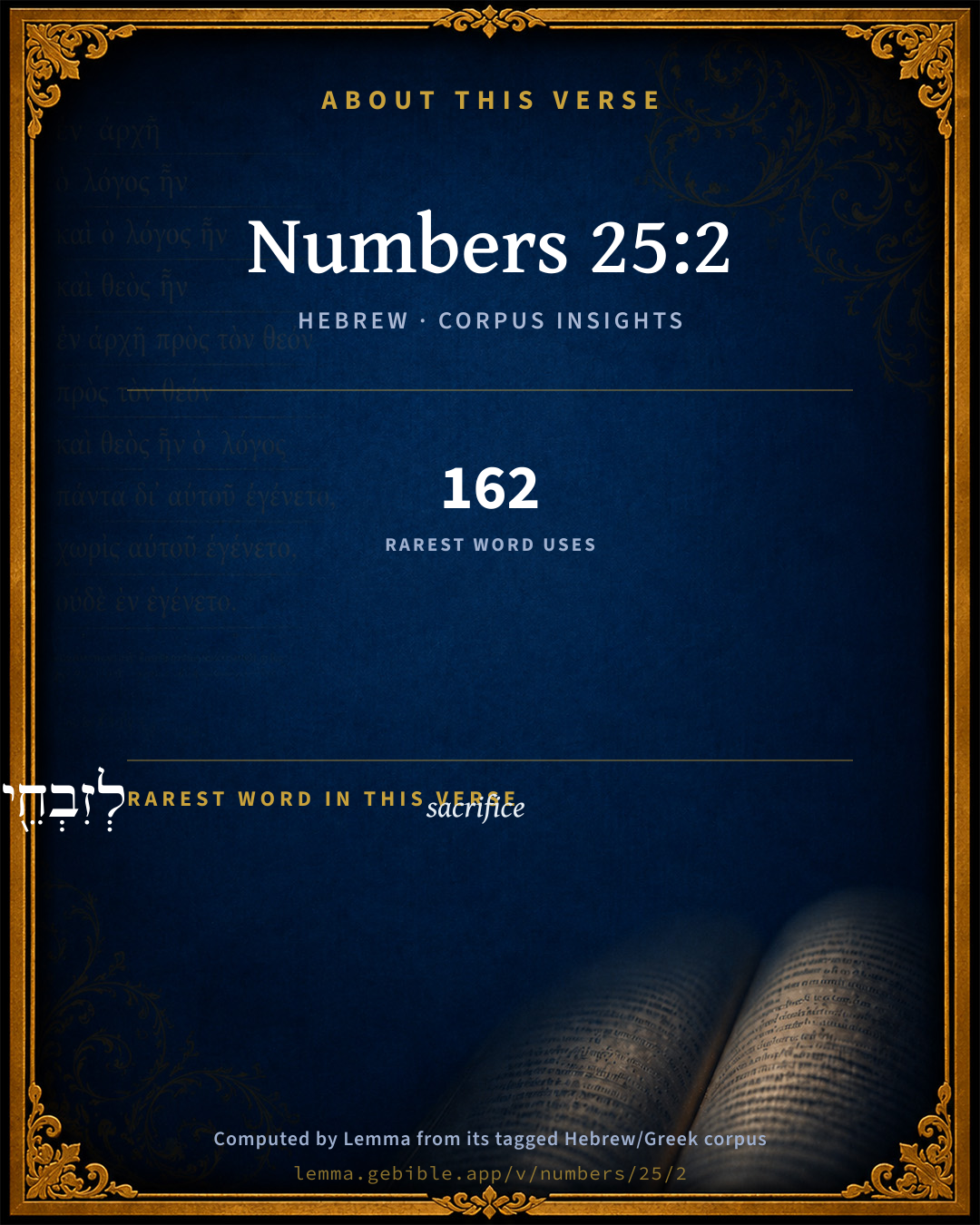
לְזִבְחֵ֖י
zebach
H2077
“to/for · sacrifices of”
Preposition + Noun, Common, Masculine, Plural, Construct
Part of Speech
Preposition + Noun
Type
Common
Gender
Masculine
Number
Plural
State
Construct
Full BDB Definition

Origin: from H2076

TWOT: 525a

sacrifice - sacrifices of righteousness - sacrifices of strife - sacrifices to dead things - the covenant sacrifice - the passover - annual sacrifice - thank offering
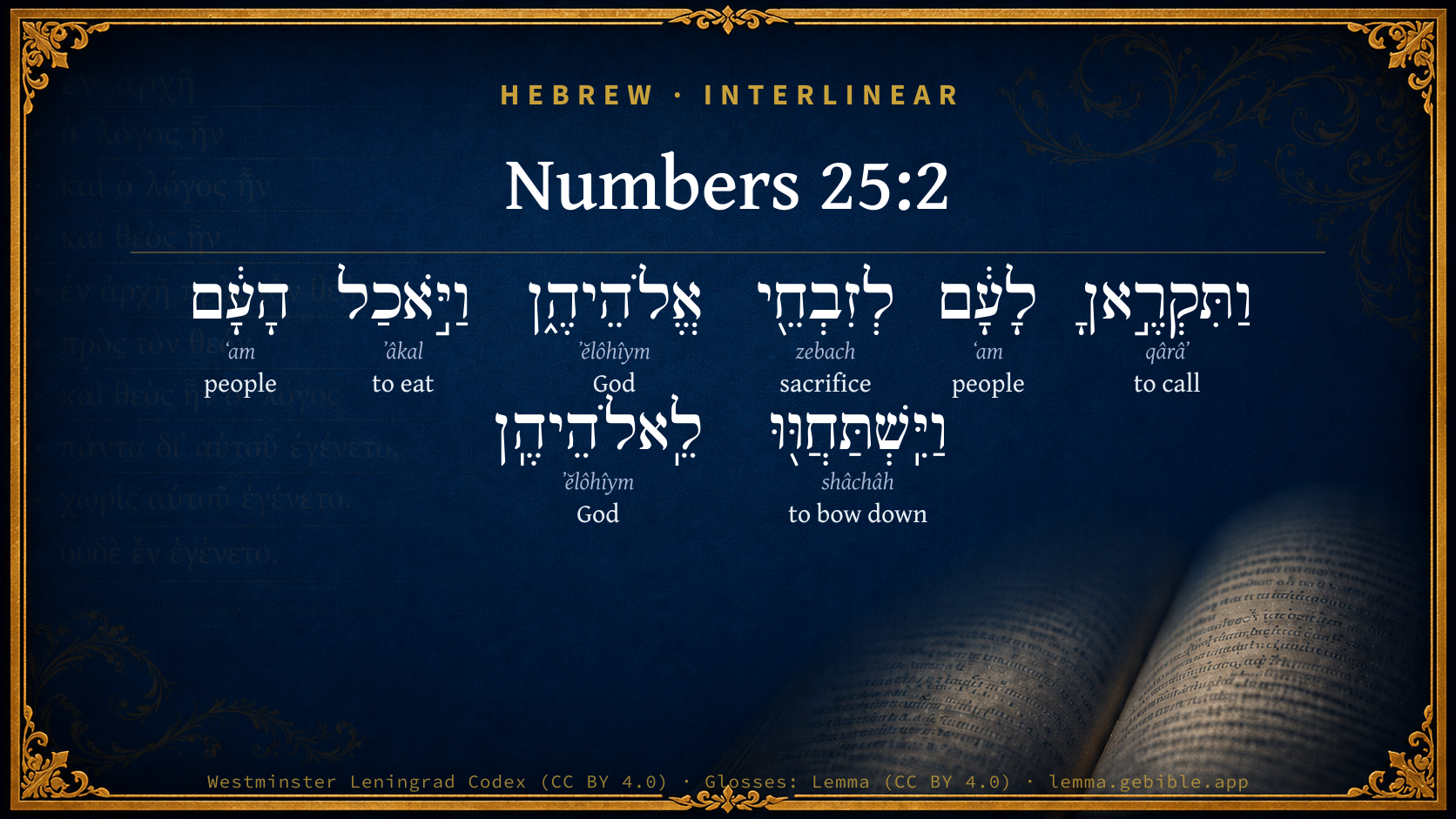
  1. וַתִּקְרֶ֣אןָ qârâʼ H7121 “and · to call” Conjunction + Verb, Qal, Sequential Imperfect, 3rd Person, Feminine, Plural
  2. לָעָ֔ם ʻam H5971 “to/for the · people” Preposition, Determined + Noun, Common, Masculine, Singular, Absolute
  3. אֱלֹהֵיהֶ֑ן ʼĕlôhîym H430 “God(s) · their” Noun, Common, Masculine, Plural, Construct + Suffix, Personal, 3rd Person, Feminine, Plural
  4. וַיֹּ֣אכַל ʼâkal H398 “and · to eat” Conjunction + Verb, Qal, Sequential Imperfect, 3rd Person, Masculine, Singular
  5. הָעָ֔ם ʻam H5971 “the · people” Particle, Definite Article + Noun, Common, Masculine, Singular, Absolute
  6. וַיִּֽשְׁתַּחֲוּ֖וּ shâchâh H7812 “and · to bow down” Conjunction + Verb, Hishtaphel, Sequential Imperfect, 3rd Person, Masculine, Plural
  7. לֵֽאלֹהֵיהֶֽן ʼĕlôhîym H430 “to/for · God(s) · their” Preposition + Noun, Common, Masculine, Plural, Construct + Suffix, Personal, 3rd Person, Feminine, Plural

About this verse

These counts appear in no published source. They are computed here, from the morphology-tagged text and Lemma’s own curated glosses. What Lemma adds →

8
words
6
distinct lemmas
Pentateuch
section

Grammatical profile

  • 3 verbs
  • 5 nouns

Verb forms

  • וַתִּקְרֶ֣אןָ Qal · Sequential Imperfect
  • וַיֹּ֣אכַל Qal · Sequential Imperfect
  • וַיִּֽשְׁתַּחֲוּ֖וּ Hishtaphel · Sequential Imperfect

Repetition

Words recur within this verse — often emphatic in Hebrew:

  • לָעָ֔ם people H5971 ×2
  • אֱלֹהֵיהֶ֑ן God H430 ×2

Hebrew & Septuagint length

In English translation the verse runs 21 words from the Hebrew and 21 from the Septuagint (LXX English) — the same length.

A rough comparison of the two English renderings, which tokenize alike — not a word-level alignment.

Word counts can differ between the Hebrew and the Greek without any difference in meaning — e.g. the Hebrew direct-object marker אֵת has no separate Greek word, and Greek often adds the article ὁ.

Cross-references

15

Topical passages linked to Numbers 25:2 in the Treasury of Scripture Knowledge — connected by theme and wording, ordered by reader-vote popularity; previews shown in the World English Bible.

  • 1 Corinthians 10:20 But I say that the things which the Gentiles sacrifice, they sacrifice to demons, and not to God, and I don't desire that you would have communion with demons.
  • Exodus 20:5 you shall not bow yourself down to them, nor serve them, for I, Yahweh your God, am a jealous God, visiting the iniquity of the fathers on the children, on the third and on the fourth generation of those who hate me,
  • Exodus 34:15–16 Don't make a covenant with the inhabitants of the land, lest they play the prostitute after their gods, and sacrifice to their gods, and one call you and you eat of his sacrifice;
  • Psalms 106:28 They joined themselves also to Baal Peor, And ate the sacrifices of the dead.
  • Hosea 9:10 I found Israel like grapes in the wilderness. I saw your fathers as the first ripe in the fig tree at its first season; But they came to Baal Peor, and consecrated themselves to the shameful thing, And became abominable like that which they loved.
  • Joshua 22:17 Is the iniquity of Peor too little for us, from which we have not cleansed ourselves to this day, although there came a plague on the congregation of Yahweh,
  • 1 Kings 11:1–8 Now king Solomon loved many foreign women, together with the daughter of Pharaoh, women of the Moabites, Ammonites, Edomites, Sidonians, and Hittites;
  • Revelation 2:14 But I have a few things against you, because you have there some who hold the teaching of Balaam, who taught Balak to throw a stumbling block before the children of Israel, to eat things sacrificed to idols, and to commit sexual immorality.
  • Exodus 23:24 You shall not bow down to their gods, nor serve them, nor follow their practices, but you shall utterly overthrow them and demolish their pillars.
  • Deuteronomy 32:38 Which ate the fat of their sacrifices, And drank the wine of their drink-offering? Let them rise up and help you, Let them be your protection.
  • Joshua 23:7 that you not come among these nations, these that remain among you; neither make mention of the name of their gods, nor cause to swear [by them], neither serve them, nor bow down yourselves to them;
  • Joshua 23:16 When you disobey the covenant of Yahweh your God, which he commanded you, and go and serve other gods, and bow down yourselves to them; then will the anger of Yahweh be kindled against you, and you shall perish quickly from off the good land which he has given to you.
  • 1 Kings 19:18 Yet will I leave [me] seven thousand in Israel, all the knees which have not bowed to Baal, and every mouth which has not kissed him.
  • 1 Corinthians 10:27–28 But if one of those who don't believe invites you to a meal, and you are inclined to go, eat whatever is set before you, asking no questions for the sake of conscience.
  • 2 Corinthians 6:16–17 What agreement has a temple of God with idols? For you are a temple of the living God. Even as God said, "I will dwell in them, and walk in them; and I will be their God, and they will be my people."

Cross-references courtesy of OpenBible.info (CC BY 4.0).

Hebrew and Greek witnesses Masoretic Hebrew ↔ Greek Septuagint

The same verse in the two great witnesses to the Old Testament, shown verse-for-verse.

These are two independent witnesses, not word-aligned to each other, and the Septuagint is shown in lemma (dictionary) form.

Hebrew Numbers 25:2 Masoretic · Westminster Leningrad Codex

וַתִּקְרֶ֣אןָ לָעָ֔ם לְזִבְחֵ֖י אֱלֹהֵיהֶ֑ן וַיֹּ֣אכַל הָעָ֔ם וַיִּֽשְׁתַּחֲוּ֖וּ לֵֽאלֹהֵיהֶֽן

for they called the people to the sacrifices of their gods; and the people ate, and bowed down to their gods.

World English Bible · Public Domain

Greek LXX Numbers 25:2 Septuagint · lemma form

καί καλέω αὐτός ἐπί ὁ θυσία ὁ εἴδωλον αὐτός καί ἐσθίω ὁ λαός ὁ θυσία αὐτός καί προςκυνέω ὁ εἴδωλον αὐτός

And they called them to the sacrifices of their idols; and the people ate of their sacrifices, and worshipped their idols.

LXX2012 (modern English Septuagint) · Public Domain

Hebrew: Westminster Leningrad Codex (CC BY 4.0). Greek: Septuagint (public domain); English from LXX2012 (modern English Septuagint) (Public Domain). How the Septuagint differs from the Hebrew →

Targum (Aramaic paraphrase)

2

The Targum is the ancient Jewish Aramaic paraphrase of the Hebrew Scriptures — an interpretive translation, not the Hebrew text itself. Onkelos (literal) and Pseudo-Jonathan (expansive) render the Torah, and Jonathan the Prophets. Coverage is partial: where no permissively-licensed English translation exists for a verse, only the Aramaic is shown. This is verse-level text, not a word-by-word alignment to the Hebrew.

  1. Targum Onkelos Torah (Genesis–Deuteronomy)
    וּקְרָאָן לְעַמָא לְדִבְחֵי טַעֲוַתְהוֹן וַאֲכַל עַמָא וּסְגִידוּ לְטַעֲוַתְהוֹן

    (no public-domain English translation for this verse)

    Targum Onkelos — Aramaic: “Onkelos Genesis” (public domain); “Onkelos Exodus” (public domain); “Onkelos Leviticus” (public domain); “Onkelos Numbers” (public domain); “Onkelos Deuteronomy” (public domain). English: “Sefaria Community Translation” (CC0 1.0 (public-domain dedication)); “J.W. Etheridge. The Targums of Onkelos and Jonathan Ben Uzziel on the Pentateuch. London: Longmans, Green, 1862” (public domain). Text via Sefaria.

  2. Targum Pseudo-Jonathan Torah (Genesis–Deuteronomy)
    וּקְרָאָה לְעַמָא לְדִבְחֵי טַעֲוַותְהוֹן וְאָכְלִין עַמָא בְּמַרְזְחֵיהוֹן וְסָגְדִין לְטַעֲוַותְהוֹן

    And they invited the people to the sacrifices of their idols; and the people ate in their feasts, and bowed themselves to their idols.

    Targum Pseudo-Jonathan — Aramaic: “Targum Jonathan on Genesis” (public domain); “Targum Jonathan on Exodus” (public domain); “Targum Jonathan on Leviticus” (public domain); “Targum Jonathan on Numbers” (public domain); “Targum Jonathan on Deuteronomy” (public domain). English: “The Targum of Jonathan ben Uzziel, trans. J. W. Etheridge, London, 1862” (public domain). Text via Sefaria.

Commentary

Notes on Numbers 25:2 from classic Christian and Jewish commentators (each source and its license shown beneath its notes). The classic Christian expositions comment on the surrounding passage and are grouped to its opening verse, so a note may address several verses; the Jewish commentaries on the Tanakh (Rashi and others) are per-verse, so they appear only where the commentator wrote on this verse.

Lemma curates 59 commentaries, every one of them public domain or Creative Commons licensed, each selected and text-cleaned for this edition rather than reprinted as found. About our sources →

Trapp's Complete Commentary

John Trapp

Num 25:2 And they called the people unto the sacrifices of their gods: and the people did eat, and bowed down to their gods.

Ver. 2. Unto the sacrifices of their gods.] Unto their idol feasts; for Sine cerere et libero friget Venus. Gluttony is the gallery that lechery walketh through.

And bowed down to their gods.] Nemo repente fit turpissimus: by degrees they were drawn to open idolatry. If a man’s foot slip into the mouth of hell, it is a miracle if he stop ere he come to the bottom. Principiis obsta. Dally not with the devil; sin is very insinuative; and the old serpent, if he once get in his head, will quickly wind in his whole body.

John Trapp, A Commentary or Exposition upon All the Books of the Old and New Testament (1647–1656) — public domain. Text from a community e-Sword module.

Joseph Benson's Commentary

Num 25:2. They called — The Moabites, being now neighbours to the Israelites, and finding themselves unable to effect their design by war and divination, fell another way to work, by contracting familiarity with them, and, perceiving their evil inclinations, they, that is, their daughters, invited them unto the sacrifices — Unto the feasts which were made of their parts of the sacrifices, after the manner of the Jews and Gentiles too, the participation whereof was reckoned a participation in the worship of that God to whom the sacrifices were offered. Of their gods — Of their god Baal-peor, the plural Elohim being here used, as commonly it is for one God.

Joseph Benson's Commentary on the Old and New Testaments (1811–1818) — public domain. Text from a community e-Sword module.

Tyndale Open Study Notes

Tyndale Open Resources

25:2 The Israelites participated in worship feasts associated with the gods of Moab (see Ps 106:28).

Tyndale Open Study Notes — © Tyndale Open Resources, licensed CC BY-SA 4.0. Text via the HelloAO Bible API.

Ellicott's Commentary for English Readers

(2) And they called the people . . . —The Moabitish women invited the Israelites to their sacrificial feasts, which were celebrated in honour of Baal-peor, who was worshipped in the city of Beth-peor (Deu_3:29). He is supposed to be identical with Chemosh, the Moabitish god of war.

A Bible Commentary for English Readers, edited by Charles John Ellicott (1878–1897) — public domain. Text from a community e-Sword module.

The Cambridge Bible for Schools and Colleges

gen. ed. J. J. S. Perowne

2. for they called] and they called. The writer relates that the Israelites first came into immoral relations with the women, and then that the women, very naturally, invited them to join in their local religious festivities.

The Cambridge Bible for Schools and Colleges (gen. ed. J. J. S. Perowne; Cambridge University Press, 1878–1918) — public domain. Text from a community e-Sword module.

John Gill's Exposition

And they called the people unto the sacrifices of their gods,.... That is, the daughters of Moab and Midian, with whom the children of Israel carried on an unlawful correspondence, invited them, their gallants, to come and partake of the feasts which attended the sacrifices of their idols; for part of what was offered to idols a feast was kept with, to which great numbers were invited, and which was observed with all the circumstances of joy and pleasure imaginable, and which was very ensnaring, especially to young people; and the children of Israel being so much enamoured with the beauty of the Moabitish women, and so strong were their lusts and passions, that they could not refuse the invitation:

and the people did eat: of the things sacrificed to idols, and so became guilty of idolatry, even by so doing, and then when they had eaten and drank, and were merry, they were led on to other acts of idolatry:

and bowed down to their gods: which was a plain and open act of idolatry, whereby they testified their faith in their divinity, their reverence of them, and their homage and obedience to them: Jarchi says, when the evil concupiscence or lust was strong in them, and they solicited the daughters of Moab to hearken to them, and comply with them, they used to take the image of Peor out of their bosom, and said, worship this, signifying that on that condition they would gratify them; and thus whoredom led them on to idolatry, and they committed the one for the sake of being indulged in the other.

John Gill's Exposition of the Whole Bible (1746–1763) — public domain (CC PDM 1.0). Text via the HelloAO Bible API.

Albert Barnes' Notes on the Bible

And they called - i. e., “the daughters of Moab called.”

Albert Barnes' Notes on the Bible (1834–1885) — public domain. Text from a community e-Sword/MySword module.

Matthew Poole's English Annotations

They called the people: this may be noted, either,

1. As the consequent of their whoredom, an invitation to further society in their sacred feasts; or rather,

2. As the cause or occasion of their whoredom, the Hebrew vau here signifying for, as it oft doth. The Moabites being now neighbours to the Israelites, and finding themselves unable to effect their design against Israel by war and witchcraft, they now fell another way to work, by contracting familiarity with them; and perceiving their evil and lustful inclinations, they, i.e. their daughters, last mentioned, invited them to their feasts.

Unto the sacrifices, i.e. unto the feasts which were made of their parts of their sacrifices, after the manner of the Jews and Gentiles too, the participation whereof was reckoned a participation in the worship of that god to whom the sacrifices were offered, 1Co 10:18, and therefore was forbidden to the Israelites when such feasts and sacrifices belonged to a false god, Exo 34:15. Yet this was a less and more modest kind of idolatry, and therefore is fitly used to usher in what was more gross and impious.

Of their gods, i.e. of their god, Baal-peor, the plural elohim being here used, as commonly it is, for one god.

Bowed down; which properly notes the outward act of worship, which here consisting in or being accompanied with filthy serious, may either signify or connote them.

To their gods; before their gods, or, to the honour and worship of their gods.

Matthew Poole's English Annotations on the Holy Bible (1683–1685) — public domain. Text from a community e-Sword/MySword module.

The Pulpit Commentary

And they called, i.e., the women of Moab, encouraged to do so by the licentious intercourse which had sprung up. Without such encouragement it is difficult to suppose that they would have ventured on such a step. And the people did eat. Gluttony added its seductions to lust. No doubt this generation were as weary of the manna and as eager for other and heavier food as their fathers had been. (see on Num_11:4 Num_21:5)

The Pulpit Commentary (1880–1919), ed. H.D.M. Spence-Jones & Joseph S. Exell — public domain. Text from a community e-Sword module.

John Wesley's Explanatory Notes

They - The Moabites being now neighbours to the Israelites, and finding themselves unable to effect their design by war and witchcraft, fell another way to work, by contracting familiarity with them, and, perceiving their evil inclinations, they, that is, their daughters, invited them. Unto the sacrifices - Unto the feasts which were made of their parts of the sacrifices, after the manner of the Jews and Gentiles too, the participation whereof, was reckoned a participation in the worship of that God to whom the sacrifices were offered. Of their gods - Of their God, Baal-peor, the plural Elohim being here used, as commonly it is, for one God.

John Wesley, Explanatory Notes Upon the Whole Bible (1754–1765) — public domain. Text via the GEBible commentary corpus.

Rashi

Rabbi Shlomo Yitzchaki (Rashi)

וישתחוו לאלהיהן AND THEY PROSTRATED THEMSELVES BEFORE THEIR GODS — When anyone’s passions overpowered him and he said to her, “Submit to me”, she took out for him an image of Peor from her bosom, saying to him, “First prostrate yourself before this" (Midrash Tanchuma, Balak 18).

Rashi on the Tanakh — English translations: “The Judaica Press complete Tanach with Rashi, translated by A. J. Rosenberg” (CC BY 4.0); “Pentateuch with Rashi's commentary by M. Rosenbaum and A.M. Silbermann, 1929-1934” (public domain); “The Metsudah Tanach series, Lakewood, N.J” (CC BY 4.0); and “The Book of Joshua, Metsudah Publications, 1997” (CC BY 4.0). Text via Sefaria.

Lesson kit

Teaching starters — assembled from the data on this page, not authored interpretation. Every prompt links to the verse data it draws on. Edit before teaching.

Numbers, in the Pentateuch, opens this verse with 8 words (6 distinct Hebrew lemmas). Its most distinctive word is zebach (“sacrifice”). A historical commentator’s framing appears above. Read the whole chapter for the surrounding context.

Discussion questions

  1. The word zebach carries the sense “sacrifice.” How does it shape the verse?
  2. How does 1 Corinthians 10:20, which shares this passage’s theme, read alongside this verse?
  3. What does the repetition of “people” (2× in this one verse) do in this verse?
  4. These translations render this verse differently. What is at stake in choosing one wording over another?
  5. «וַתִּקְרֶ֣אןָ» is a Qal Sequential Imperfect verb. How does that grammatical form shape the action described?
  6. Compare how Trapp's Complete Commentary and Joseph Benson's Commentary read this verse. Where do they agree or differ?

Things to notice

  • These translations choose different wording for 6 words in this verse.
  • “people” occurs 2× in this single verse.
  • 6 distinct Hebrew lemmas span 8 words in this verse.

Reading settings

Reading text

Shown beneath each verse's original-language words.

Old Testament
Old Testament edition

Read the OT as the Masoretic Hebrew (MT) or the Greek Septuagint (LXX).

English shown for the Greek Septuagint (in the Hebrew ↔ Greek comparison).

Comparing translations? Open the Compare panel on any verse page to stack up to four side by side.