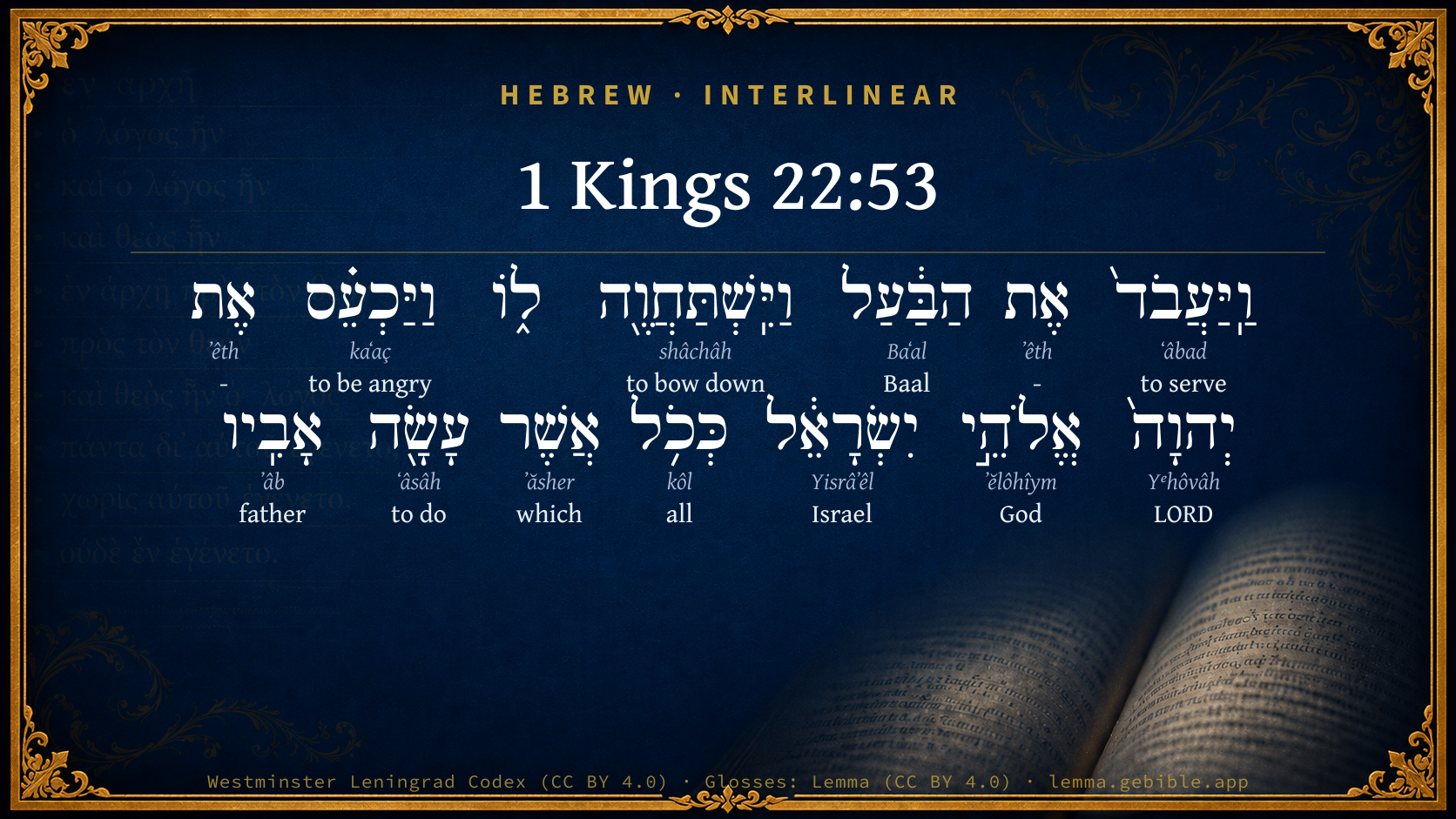
1 Kings 22:53

Hebrew (Westminster Leningrad Codex) 1 Kings 22:53 appears in the Hebrew Old Testament. The text above is from the Westminster Leningrad Codex. Each word links to its Strong’s number, a concise gloss, and parsing drawn from the Open Scriptures Hebrew Bible morphology. Click any word for its full Brown-Driver-Briggs (BDB) entry.
Download image
Cite this verse

1 Kings 22:53 (World English Bible). Public Domain. Lemma interlinear Bible study tool, https://lemma.gebible.app/v/1-kings/22/53.

Show BibTeX & RIS
BibTeX
RIS
English Translation
He served Baal, and worshiped him, and provoked to anger Yahweh, the God of Israel, according to all that his father had done.
World English Bible · Public Domain
Download a study sheet

One document with this verse’s original text, its word-by-word gloss line, the meaning frame, cross-references with their text, attributed commentary, and full source and license credits — printable, and it pastes into notes with its structure intact.

This verse Autodidact and up

Study sheet (.html) Plain text (.txt)

A passage Seminary Student

Up to 50 verses in one chapter. A passage sheet keeps up to 6 commentary sources and 12 cross-references per verse, in the order this page ranks them, and says so on the sheet whenever that leaves anything out. Ask for a single verse and you get the Autodidact verse sheet above.

Everything on this page stays free to read, with no account — the sheet is a download of what is already on screen, not access to it.

Want to remove ads? Support Godless Engineer
Compare translations 3

The same verse in 3 English versions, stacked beneath the original-language interlinear above. Click any original word for its lexicon entry.

Each is an independent rendering of the whole verse — the interlinear is not word-aligned to these translations.

Highlighted words mark where these versions differ — a whole-verse word diff, not a word-by-word alignment.

  • World English Bible Public Domain
    He served Baal, and worshiped him, and provoked to anger Yahweh, the God of Israel, according to all that his father had done.
  • King James Version Public Domain
    For he served Baal, and worshipped him, and provoked to anger the LORD God of Israel, according to all that his father had done.
  • unfoldingWord Literal Text CC BY-SA 4.0
    And he served Baal, and he bowed down to him. And he provoked Yahweh, the God of Israel, according to all that his father had done.

unfoldingWord Literal Text — © unfoldingWord, licensed CC BY-SA 4.0. Word-aligned USFM3 via Door43 (git.door43.org/unfoldingWord/en_ult).

Versions to compare (up to 4)

3 of 4 selected

Show all 18 translations

Every available English version of this verse, each an independent rendering of the whole verse.

  • World English Bible Public Domain
    He served Baal, and worshiped him, and provoked to anger Yahweh, the God of Israel, according to all that his father had done.
  • Berean Standard Bible Public Domain
    Ahaziah served and worshiped Baal, provoking the LORD, the God of Israel, to anger, just as his father had done.
  • Majority Standard Bible Public Domain
    Ahaziah served and worshiped Baal, provoking the LORD, the God of Israel, to anger, just as his father had done.
  • King James Version Public Domain
    For he served Baal, and worshipped him, and provoked to anger the LORD God of Israel, according to all that his father had done.
  • American Standard Version (1901) Public Domain
    And he served Baal, and worshipped him, and provoked to anger Jehovah, the God of Israel, according to all that his father had done.
  • Revised Version (1885) Public Domain
    And he served Baal, and worshipped him, and provoked to anger the LORD, the God of Israel, according to all that his father had done.
  • Geneva Bible (1599) Public Domain
    For he serued Baal and worshipped him, and prouoked the Lord God of Israel vnto wrath, according vnto all that his father had done.
  • Douay-Rheims (1899) Public Domain
    And he did evil in the sight of the Lord, and walked in the way of his father and his mother, and in the way of Jeroboam the son of Nabat, who made Israel to sin.
  • Young's Literal Translation Public Domain
    and serveth the Baal, and boweth himself to it, and provoketh Jehovah, God of Israel, according to all that his father had done.
  • Literal Standard Version CC BY-SA 4.0
    and serves the Ba‘al, and bows himself to it, and provokes YHWH, God of Israel, according to all that his father had done.
  • Unlocked Literal Bible CC BY-SA 4.0
    He served Baal and worshiped him and so he provoked Yahweh, the God of Israel, to anger, just as his father had done.
  • unfoldingWord Literal Text CC BY-SA 4.0
    And he served Baal, and he bowed down to him. And he provoked Yahweh, the God of Israel, according to all that his father had done.
  • Darby Bible Public Domain
    And he served Baal, and worshipped him, and provoked Jehovah the God of Israel to anger, according to all that his father had done.
  • World Messianic Bible Public Domain
    He served Baal and worshiped him, and provoked the LORD, the God of Israel, to anger in all the ways that his father had done so.
  • Webster's Bible Public Domain
    \\22:52\\And he did evil in the sight of the LORD, and walked in the way of his father, and in the way of his mother, and in the way of Jeroboam the son of Nebat, who made Israel to sin:
  • Free Bible Version CC BY-SA 4.0
    He served Baal and worshiped him, and angered the Lord, the God of Israel, just as his father had.
  • Bible in Basic English Public Domain
    He was a servant and worshipper of Baal, moving the Lord, the God of Israel, to wrath, as his father had done.
  • JPS Tanakh (1917) Public Domain
    (22-54) And he served Baal, and worshipped him, and provoked the LORD, the God of Israel, according to all that his father had done.

Literal Standard Version (2020), Covenant Press — licensed CC BY-SA 4.0. Text via the HelloAO Bible API (eBible.org). Unlocked Literal Bible (unfoldingWord) — licensed CC BY-SA 4.0. Text via the HelloAO Bible API (eBible.org). unfoldingWord Literal Text — © unfoldingWord, licensed CC BY-SA 4.0. Word-aligned USFM3 via Door43 (git.door43.org/unfoldingWord/en_ult). Free Bible Version, Dr. Jonathan Gallagher — licensed CC BY-SA 4.0. Text via the HelloAO Bible API (eBible.org).

Word by word

More ways to search: Search by grammar → Find every occurrence → Compare this word →

Practice this passage: Drill this verse → Learn its vocabulary →

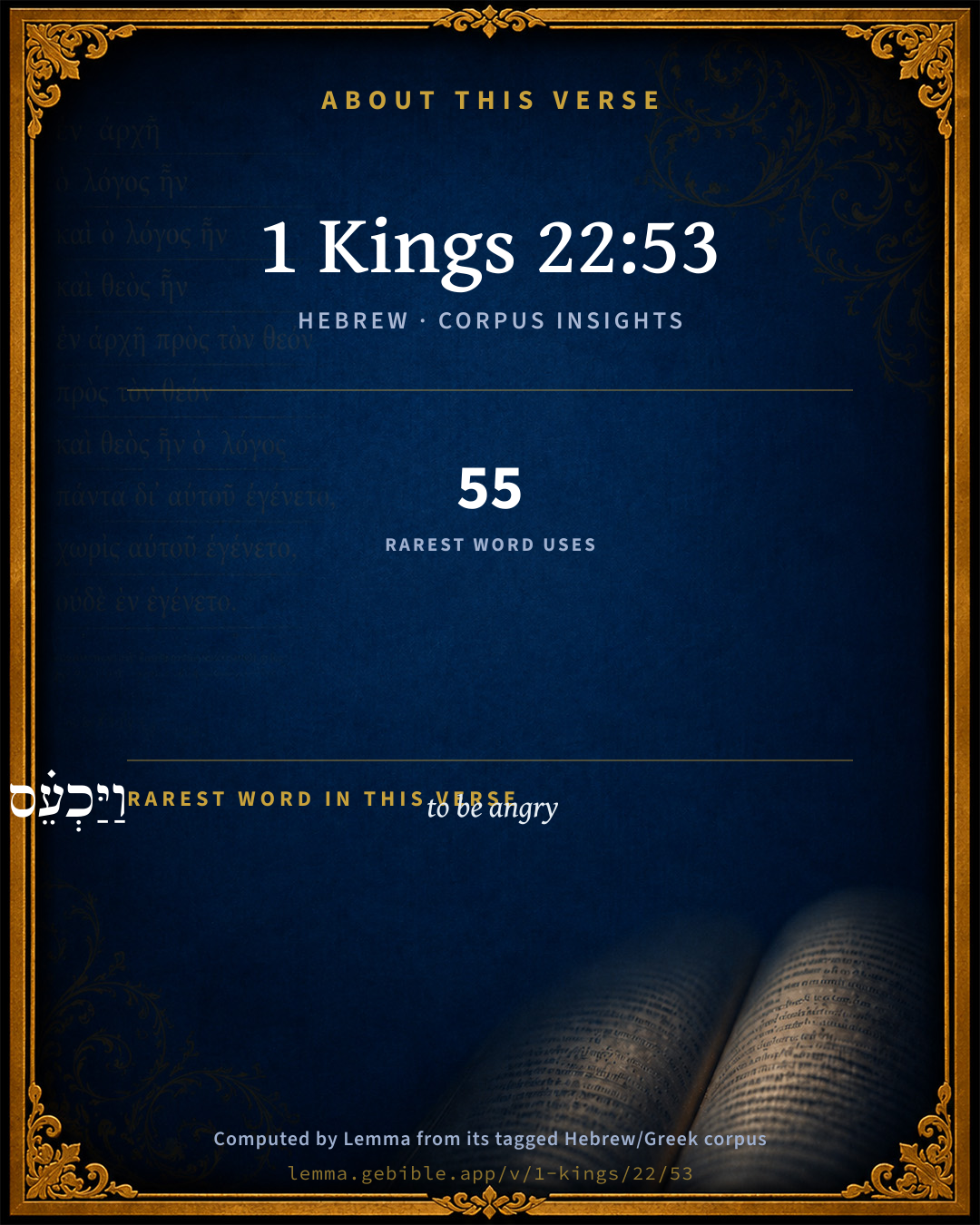
וַיַּכְעֵ֗ס
kaʻaç
H3707
“and · to be angry”
Conjunction + Verb, Hiphil, Sequential Imperfect, 3rd Person, Masculine, Singular
Part of Speech
Conjunction + Verb
Stem
Hiphil
Form
Sequential Imperfect
Person
3rd Person
Gender
Masculine
Number
Singular
Full BDB Definition

Origin: a primitive root

TWOT: 1016

to be angry, be vexed, be indignant, be wroth, be grieved, provoke to anger and wrath - (Qal) - to be vexed, be indignant - to be angry - (Piel) to provoke to anger - (Hiphil) - to vex - to vex, provoke to anger
  1. וַֽיַּעֲבֹד֙ ʻâbad H5647 “and · to serve” Conjunction + Verb, Qal, Sequential Imperfect, 3rd Person, Masculine, Singular
  2. אֶת ʼêth H853 “-” Particle, Direct Object
  3. הַבַּ֔עַל Baʻal H1168 “the · Baal” Particle, Definite Article + Noun, Proper
  4. וַיִּֽשְׁתַּחֲוֶ֖ה shâchâh H7812 “and · to bow down” Conjunction + Verb, Hishtaphel, Sequential Imperfect, 3rd Person, Masculine, Singular
  5. אֶת ʼêth H853 “-” Particle, Direct Object
  6. יְהוָה֙ Yᵉhôvâh H3068 “LORD” Noun, Proper
  7. אֱלֹהֵ֣י ʼĕlôhîym H430 “God(s) of” Noun, Common, Masculine, Plural, Construct
  8. יִשְׂרָאֵ֔ל Yisrâʼêl H3478 “Israel” Noun, Proper
  9. כְּכֹ֥ל kôl H3605 “like/as · all” Preposition + Noun, Common, Masculine, Singular, Absolute
  10. אֲשֶׁר ʼăsher H834 “which” Particle, Relative
  11. עָשָׂ֖ה ʻâsâh H6213 “to do” Verb, Qal, Perfect, 3rd Person, Masculine, Singular
  12. אָבִֽיו ʼâb H1 “father · his” Noun, Common, Masculine, Singular, Construct + Suffix, Personal, 3rd Person, Masculine, Singular

About this verse

These counts appear in no published source. They are computed here, from the morphology-tagged text and Lemma’s own curated glosses. What Lemma adds →

14
words
12
distinct lemmas
Historical
section

Shared distinctive vocabulary

וַיַּכְעֵ֗ס to be angry H3707 occurs in 53 verses of the Hebrew Bible. Also found in:

Grammatical profile

  • 4 verbs
  • 6 nouns
  • 1 preposition
  • 3 particles

Verb forms

  • וַֽיַּעֲבֹד֙ Qal · Sequential Imperfect
  • וַיִּֽשְׁתַּחֲוֶ֖ה Hishtaphel · Sequential Imperfect
  • וַיַּכְעֵ֗ס Hiphil · Sequential Imperfect
  • עָשָׂ֖ה Qal · Perfect

Hebrew & Septuagint length

In English translation the verse runs 23 words from the Hebrew and 48 from the Septuagint (LXX English) — the Septuagint runs noticeably longer here. See the side-by-side →

A rough comparison of the two English renderings, which tokenize alike — not a word-level alignment.

Word counts can differ between the Hebrew and the Greek without any difference in meaning — e.g. the Hebrew direct-object marker אֵת has no separate Greek word, and Greek often adds the article ὁ.

Cross-references

10

Topical passages linked to 1 Kings 22:53 in the Treasury of Scripture Knowledge — connected by theme and wording, ordered by reader-vote popularity; previews shown in the World English Bible.

  • 1 Kings 16:30–32 Ahab the son of Omri did that which was evil in the sight of Yahweh above all that were before him.
  • Judges 2:1–11 The angel of Yahweh came up from Gilgal to Bochim. He said, I made you to go up out of Egypt, and have brought you to the land which I swore to your fathers; and I said, I will never break my covenant with you:
  • 1 Kings 16:7 Moreover by the prophet Jehu the son of Hanani came the word of Yahweh against Baasha, and against his house, both because of all the evil that he did in the sight of Yahweh, to provoke him to anger with the work of his hands, in being like the house of Jeroboam, and because he struck him.
  • 1 Kings 21:29 See you how Ahab humbles himself before me? because he humbles himself before me, I will not bring the evil in his days; but in his son's days will I bring the evil on his house.
  • 2 Kings 1:2 Ahaziah fell down through the lattice in his upper chamber that was in Samaria, and was sick: and he sent messengers, and said to them, Go, inquire of Baal Zebub, the god of Ekron, whether I shall recover of this sickness.
  • 2 Kings 3:2 He did that which was evil in the sight of Yahweh, but not like his father, and like his mother; for he put away the pillar of Baal that his father had made.
  • Psalms 106:29 Thus they provoked him to anger with their deeds. The plague broke in on them.
  • Isaiah 65:3 a people who provoke me to my face continually, sacrificing in gardens, and burning incense on bricks;
  • Ezekiel 8:3 He put forth the form of a hand, and took me by a lock of my head; and the Spirit lifted me up between earth and the sky, and brought me in the visions of God to Jerusalem, to the door of the gate of the inner [court] that looks toward the north; where was the seat of the image of jealousy, which provokes to jealousy.
  • Ezekiel 18:14–18 Now, behold, if he fathers a son, who sees all his father's sins, which he has done, and fears, and does not such like;

Cross-references courtesy of OpenBible.info (CC BY 4.0).

Hebrew and Greek witnesses Masoretic Hebrew ↔ Greek Septuagint

The same verse in the two great witnesses to the Old Testament, shown verse-for-verse.

Here the Septuagint runs noticeably longer than the Hebrew — LXX2012 (modern English Septuagint) 48 words vs World English Bible 23. A rough length comparison of the two English translations, not a word-level alignment — read both below.

These are two independent witnesses, not word-aligned to each other, and the Septuagint is shown in lemma (dictionary) form.

Hebrew 1 Kings 22:53 Masoretic · Westminster Leningrad Codex

וַֽיַּעֲבֹד֙ אֶת הַבַּ֔עַל וַיִּֽשְׁתַּחֲוֶ֖ה ל֑וֹ וַיַּכְעֵ֗ס אֶת יְהוָה֙ אֱלֹהֵ֣י יִשְׂרָאֵ֔ל כְּכֹ֥ל אֲשֶׁר עָשָׂ֖ה אָבִֽיו

He served Baal, and worshiped him, and provoked to anger Yahweh, the God of Israel, according to all that his father had done.

World English Bible · Public Domain

Greek LXX 1 Kings 22:53 Septuagint · lemma form

καί ποιέω ὁ πονηρός ἐναντίον κύριος καί πορεύομαι ἐν ὁδός αχααβ ὁ πατήρ αὐτός καί ἐν ὁδός ιεζαβελ ὁ μήτηρ αὐτός καί ἐν ὁ ἁμαρτία οἶκος ιεροβοαμ υἱός ναβατ ὅς ἐκἁμαρτάνω ὁ ἰσραήλ

And he did that which was evil in the sight of the Lord, and walked in the way of Achaab his father, and in the way of Jezabel his mother, and in the sins of the house of Jeroboam the son of Nabat, who caused Israel to sin.

LXX2012 (modern English Septuagint) · Public Domain

On this verse, The Cambridge Bible for Schools and Colleges discusses the Septuagint’s reading. Read the note in Commentary ↓

Hebrew: Westminster Leningrad Codex (CC BY 4.0). Greek: Septuagint (public domain); English from LXX2012 (modern English Septuagint) (Public Domain). How the Septuagint differs from the Hebrew →

Targum (Aramaic paraphrase)

1

The Targum is the ancient Jewish Aramaic paraphrase of the Hebrew Scriptures — an interpretive translation, not the Hebrew text itself. Onkelos (literal) and Pseudo-Jonathan (expansive) render the Torah, and Jonathan the Prophets. Coverage is partial: where no permissively-licensed English translation exists for a verse, only the Aramaic is shown. This is verse-level text, not a word-by-word alignment to the Hebrew.

  1. Targum Jonathan Prophets (Joshua–Malachi)
    וַעֲבַד דְבִישׁ קֳדָם יְיָ וַאֲזַל בְּאוֹרַח אֲבוּהִי וּבְאוֹרַח אִמֵיהּ וּבְאוֹרַח יָרָבְעָם בַּר נְבָט דְחַיֵב יַת יִשְׂרָאֵל:

    (no public-domain English translation for this verse)

    Targum Jonathan — Aramaic: “Mikraot Gedolot” (public domain). English: “Sefaria Community Translation” (CC0 1.0 (public-domain dedication)); “London "Chaldee Paraphrase," 1871” (public domain). Text via Sefaria.

Commentary

Notes on 1 Kings 22:53 from classic Christian and Jewish commentators (each source and its license shown beneath its notes). The classic Christian expositions comment on the surrounding passage and are grouped to its opening verse, so a note may address several verses; the Jewish commentaries on the Tanakh (Rashi and others) are per-verse, so they appear only where the commentator wrote on this verse.

Lemma curates 59 commentaries, every one of them public domain or Creative Commons licensed, each selected and text-cleaned for this edition rather than reprinted as found. About our sources →

Trapp's Complete Commentary

John Trapp

1Ki 22:53 For he served Baal, and worshipped him, and provoked to anger the LORD God of Israel, according to all that his father had done.

Ver. 53. According to all, &c.] An ill egg of an ill bird, as they said of one of the first Roman emperors.

John Trapp, A Commentary or Exposition upon All the Books of the Old and New Testament (1647–1656) — public domain. Text from a community e-Sword module.

Geneva Bible (1599)

Geneva Bible translators

Or, in all points as his father did.

Geneva Bible (1599) marginal notes — public domain. Text via Bolls.life.

The Cambridge Bible for Schools and Colleges

gen. ed. J. J. S. Perowne

53. for [R.V. And] he served Baal] This is an additional count in his wickedness, not an explanation of what is contained in the verse before. Hence the change. The LXX., instead of ‘according to all that his fathe[9]

[9] Lumby, J. R. (1886). The First Book of the Kings, with Introduction and Notes. The Cambridge Bible for Schools and Colleges (109–242). Cambridge: Cambridge University Press.

The Cambridge Bible for Schools and Colleges (gen. ed. J. J. S. Perowne; Cambridge University Press, 1878–1918) — public domain. Text from a community e-Sword module.

John Gill's Exposition

For he served Baal, and worshipped him,.... That is, Ahaziah served him, as his father had done, and his mother still did:

and provoked to anger the Lord God of Israel, according to all that his father had done; of which there is an instance in the first chapter of the following book; for falling through a lattice, and becoming sick upon it, he quickly died, having sent messengers to inquire of the god of Ekron whether he should die or not.

John Gill's Exposition of the Whole Bible (1746–1763) — public domain (CC PDM 1.0). Text via the HelloAO Bible API.

The Pulpit Commentary

For he served Baal, and worshipped him, and provoked to anger or vexed the Lord God of Israel, according to all that his father had done. The termination of this book at this point could hardly be more arbitrary if it had been made by accident. These verses are closely connected with 2 Kings ch. 1. The division here obscures the connexion between the sin of Ahaziah and the judgments which it provoked.

The Pulpit Commentary (1880–1919), ed. H.D.M. Spence-Jones & Joseph S. Exell — public domain. Text from a community e-Sword module.

John Wesley's Explanatory Notes

His father, &c. - Most unhappy parents, that thus help to damn their own children's souls!

John Wesley, Explanatory Notes Upon the Whole Bible (1754–1765) — public domain. Text via the GEBible commentary corpus.

Lesson kit

Teaching starters — assembled from the data on this page, not authored interpretation. Every prompt links to the verse data it draws on. Edit before teaching.

1 Kings, in the Historical, opens this verse with 14 words (12 distinct Hebrew lemmas). Its most distinctive word is kaʻaç (“to be angry”). The Greek Septuagint runs longer here. A historical commentator’s framing appears above. Read the whole chapter for the surrounding context.

Discussion questions

  1. The word kaʻaç carries the sense “to be angry.” How does it shape the verse?
  2. How does Deuteronomy 4:25, which shares the word «to be angry», read alongside this verse?
  3. The Septuagint runs longer here than the Hebrew. What might account for the difference?
  4. These translations render this verse differently; the difference is in the English rendering, not the original. What questions does that raise?
  5. «וַֽיַּעֲבֹד֙» is a Qal Sequential Imperfect verb. How does that grammatical form shape the action described?
  6. Compare how Trapp's Complete Commentary and Geneva Bible (1599) read this verse. Where do they agree or differ?

Things to notice

Reading settings

Reading text

Shown beneath each verse's original-language words.

Old Testament
Old Testament edition

Read the OT as the Masoretic Hebrew (MT) or the Greek Septuagint (LXX).

English shown for the Greek Septuagint (in the Hebrew ↔ Greek comparison).

Comparing translations? Open the Compare panel on any verse page to stack up to four side by side.