
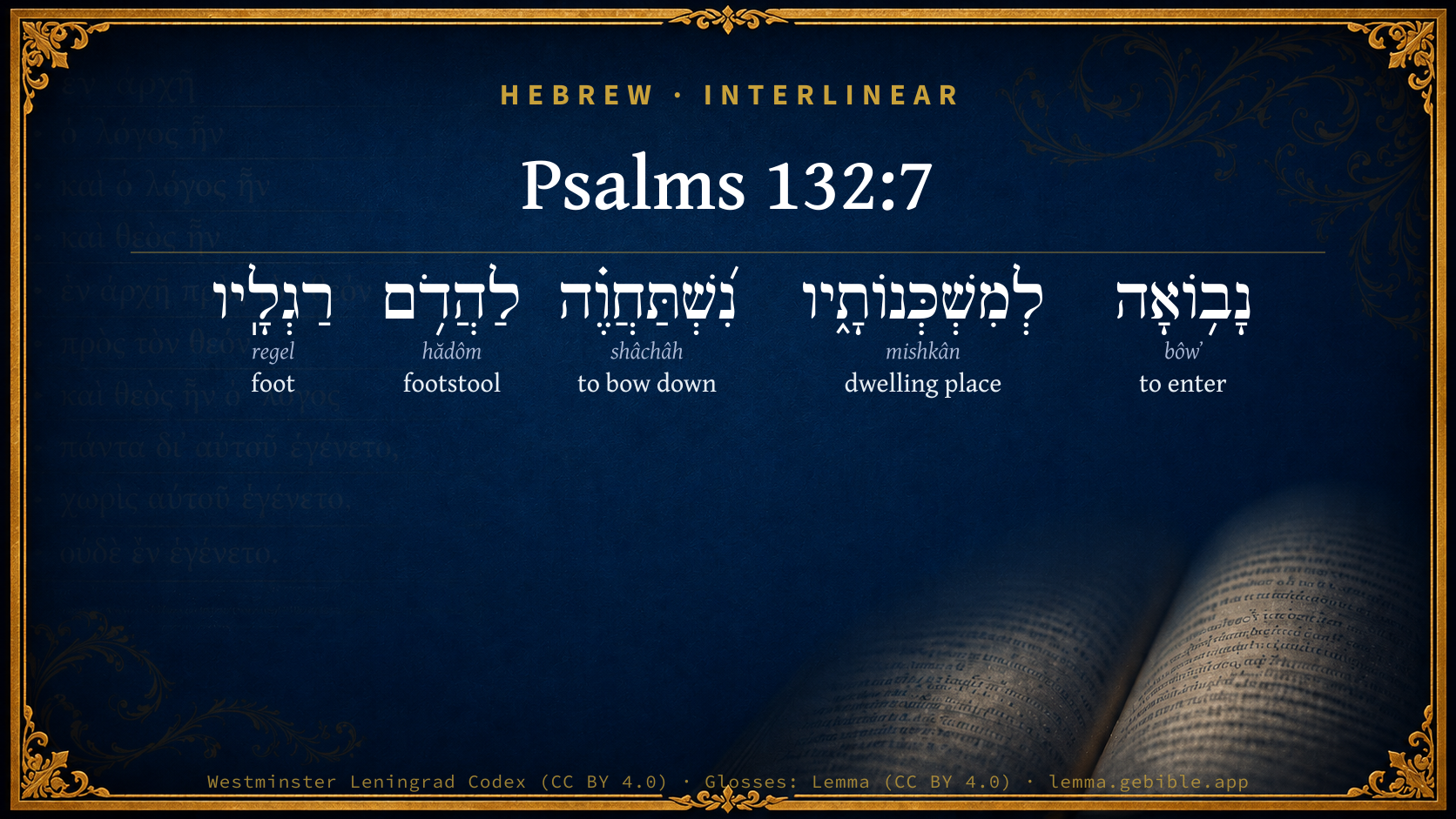
Psalms 132:7

Hebrew (Westminster Leningrad Codex) Psalms 132:7 appears in the Hebrew Old Testament. The text above is from the Westminster Leningrad Codex. Each word links to its Strong’s number, a concise gloss, and parsing drawn from the Open Scriptures Hebrew Bible morphology. Click any word for its full Brown-Driver-Briggs (BDB) entry.
Download image
Cite this verse

Psalms 132:7 (World English Bible). Public Domain. Lemma interlinear Bible study tool, https://lemma.gebible.app/v/psalms/132/7.

Show BibTeX & RIS
BibTeX
RIS
English Translation
"We will go into his dwelling place. We will worship at his footstool.
World English Bible · Public Domain
Download a study sheet

One document with this verse’s original text, its word-by-word gloss line, the meaning frame, cross-references with their text, attributed commentary, and full source and license credits — printable, and it pastes into notes with its structure intact.

This verse Autodidact and up

Study sheet (.html) Plain text (.txt)

A passage Seminary Student

Up to 50 verses in one chapter. A passage sheet keeps up to 6 commentary sources and 12 cross-references per verse, in the order this page ranks them, and says so on the sheet whenever that leaves anything out. Ask for a single verse and you get the Autodidact verse sheet above.

Everything on this page stays free to read, with no account — the sheet is a download of what is already on screen, not access to it.

Want to remove ads? Support Godless Engineer
Compare translations 3

The same verse in 3 English versions, stacked beneath the original-language interlinear above. Click any original word for its lexicon entry.

Each is an independent rendering of the whole verse — the interlinear is not word-aligned to these translations.

Highlighted words mark where these versions differ — a whole-verse word diff, not a word-by-word alignment.

  • World English Bible Public Domain
    "We will go into his dwelling place. We will worship at his footstool.
  • King James Version Public Domain
    We will go into his tabernacles: we will worship at his footstool.
  • unfoldingWord Literal Text CC BY-SA 4.0
    “Let us go to his dwellings; let us bow down at the footstool of his feet.”

unfoldingWord Literal Text — © unfoldingWord, licensed CC BY-SA 4.0. Word-aligned USFM3 via Door43 (git.door43.org/unfoldingWord/en_ult).

Versions to compare (up to 4)

3 of 4 selected

Show all 17 translations

Every available English version of this verse, each an independent rendering of the whole verse.

  • World English Bible Public Domain
    "We will go into his dwelling place. We will worship at his footstool.
  • Berean Standard Bible Public Domain
    Let us go to His dwelling place; let us worship at His footstool.
  • Majority Standard Bible Public Domain
    Let us go to His dwelling place; let us worship at His footstool.
  • King James Version Public Domain
    We will go into his tabernacles: we will worship at his footstool.
  • American Standard Version (1901) Public Domain
    We will go into his tabernacles; We will worship at his footstool.
  • Revised Version (1885) Public Domain
    We will go into his tabernacles; we will worship at his footstool.
  • Geneva Bible (1599) Public Domain
    We will enter into his Tabernacles, and worship before his footestoole.
  • Young's Literal Translation Public Domain
    We come in to His tabernacles, We bow ourselves at His footstool.
  • Literal Standard Version CC BY-SA 4.0
    We come into His dwelling places, || We bow ourselves at His footstool.
  • Unlocked Literal Bible CC BY-SA 4.0
    We will go into God's tabernacle; we will worship at his footstool.
  • unfoldingWord Literal Text CC BY-SA 4.0
    “Let us go to his dwellings; let us bow down at the footstool of his feet.”
  • Darby Bible Public Domain
    Let us go into his habitations, let us worship at his footstool.
  • World Messianic Bible Public Domain
    “We will go into his dwelling place. We will worship at his footstool.”
  • Webster's Bible Public Domain
    We will go into his tabernacles: we will worship at his footstool.
  • Free Bible Version CC BY-SA 4.0
    Let's go to the place where the Lord lives and bow down at his feet in worship.
  • Bible in Basic English Public Domain
    Let us go into his tent; let us give worship at his feet.
  • JPS Tanakh (1917) Public Domain
    Let us go into His dwelling-place; let us worship at His footstool.

Literal Standard Version (2020), Covenant Press — licensed CC BY-SA 4.0. Text via the HelloAO Bible API (eBible.org). Unlocked Literal Bible (unfoldingWord) — licensed CC BY-SA 4.0. Text via the HelloAO Bible API (eBible.org). unfoldingWord Literal Text — © unfoldingWord, licensed CC BY-SA 4.0. Word-aligned USFM3 via Door43 (git.door43.org/unfoldingWord/en_ult). Free Bible Version, Dr. Jonathan Gallagher — licensed CC BY-SA 4.0. Text via the HelloAO Bible API (eBible.org).

Word by word

More ways to search: Search by grammar → Find every occurrence → Compare this word →

Practice this passage: Drill this verse → Learn its vocabulary →

About this verse

These counts appear in no published source. They are computed here, from the morphology-tagged text and Lemma’s own curated glosses. What Lemma adds →

5
words
5
distinct lemmas
Wisdom
section

Notable vocabulary

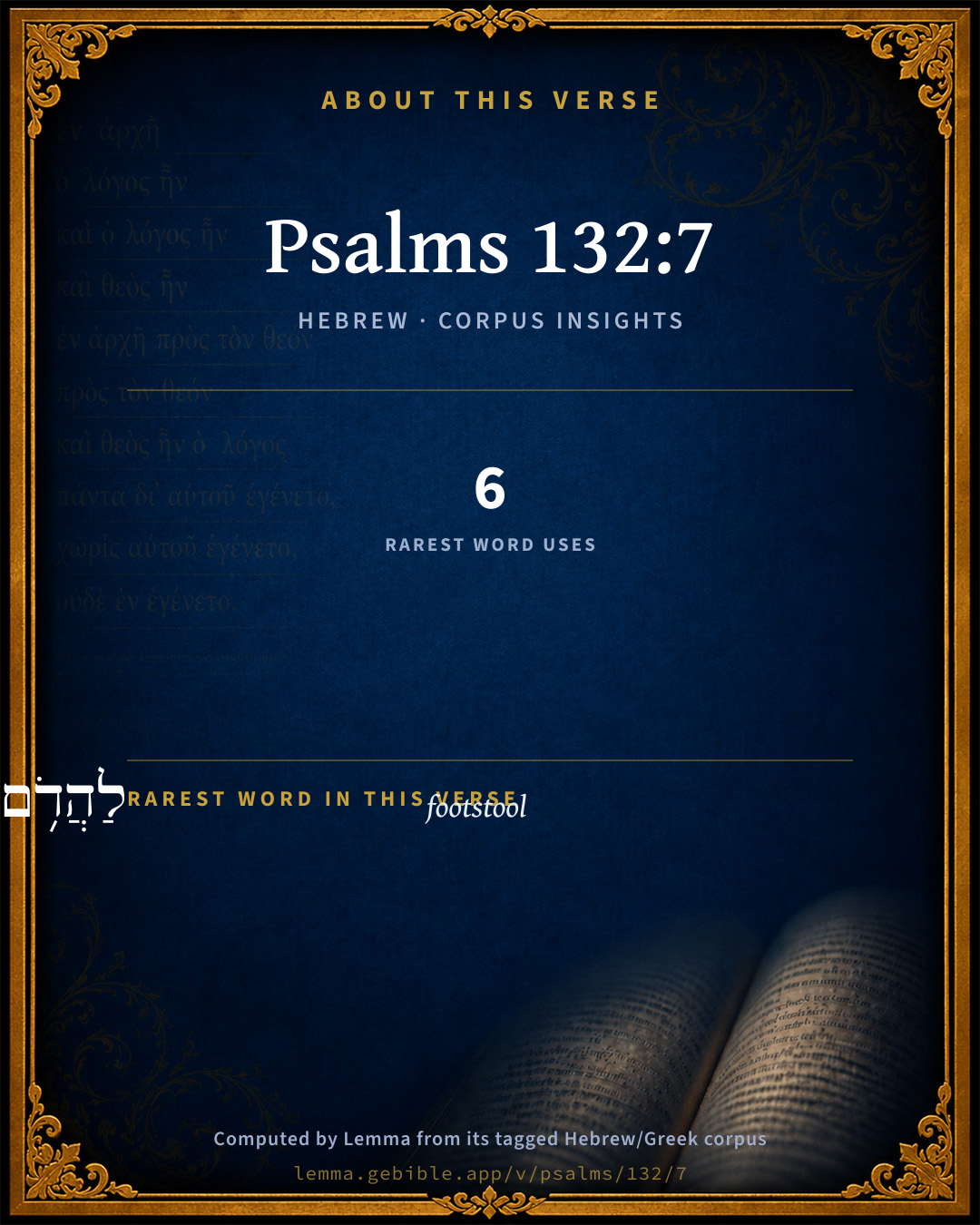
The rarest word here is לַהֲדֹ֥ם footstool H1916 — appearing just 6 times in the whole Hebrew Bible.

Shared distinctive vocabulary

לַהֲדֹ֥ם footstool H1916 occurs in 6 verses of the Hebrew Bible. Also found in:

Grammatical profile

  • 2 verbs
  • 3 nouns

Verb forms

  • נָב֥וֹאָה Qal · Cohortative
  • נִ֝שְׁתַּחֲוֶ֗ה Hishtaphel · Cohortative

Hebrew & Septuagint length

In English translation the verse runs 13 words from the Hebrew and 16 from the Septuagint (LXX English) — closely comparable.

A rough comparison of the two English renderings, which tokenize alike — not a word-level alignment.

Word counts can differ between the Hebrew and the Greek without any difference in meaning — e.g. the Hebrew direct-object marker אֵת has no separate Greek word, and Greek often adds the article ὁ.

Cross-references

9

Topical passages linked to Psalms 132:7 in the Treasury of Scripture Knowledge — connected by theme and wording, ordered by reader-vote popularity; previews shown in the World English Bible.

  • Psalms 99:5 Exalt Yahweh our God. Worship at his footstool. He is Holy!
  • Psalms 5:7 But as for me, in the abundance of your loving kindness I will come into your house: I will bow toward your holy temple in reverence of you.
  • Lamentations 2:1 How has the Lord covered the daughter of Zion with a cloud in his anger! He has cast down from heaven to the earth the beauty of Israel, And hasn't remembered his footstool in the day of his anger.
  • Psalms 95:6 Oh come, let's worship and bow down. Let's kneel before Yahweh, our Maker,
  • Psalms 118:19 Open to me the gates of righteousness. I will enter into them. I will give thanks to Yah.
  • Psalms 122:1 I was glad when they said to me, "Let's go to Yahweh's house!"
  • Psalms 66:13–14 I will come into your temple with burnt offerings. I will pay my vows to you,
  • Isaiah 2:3 Many peoples shall go and say, "Come, let's go up to the mountain of Yahweh, To the house of the God of Jacob; And he will teach us of his ways, And we will walk in his paths. For out of Zion the law shall go forth, And the word of Yahweh from Jerusalem.
  • Psalms 99:9 Exalt Yahweh, our God. Worship at his holy hill, For Yahweh, our God, is holy!

Cross-references courtesy of OpenBible.info (CC BY 4.0).

Hebrew and Greek witnesses Masoretic Hebrew ↔ Greek Septuagint

The same verse in the two great witnesses to the Old Testament, shown verse-for-verse.

You’re reading Greek Psalm 131 (Hebrew Psalm 132). The Septuagint counts the superscription, so verse numbers can differ from the Hebrew — chapter-level alignment, not verse-by-verse. Numbering follows Rahlfs.

These are two independent witnesses, not word-aligned to each other, and the Septuagint is shown in lemma (dictionary) form.

Hebrew Psalms 132:7 Masoretic · Westminster Leningrad Codex

נָב֥וֹאָה לְמִשְׁכְּנוֹתָ֑יו נִ֝שְׁתַּחֲוֶ֗ה לַהֲדֹ֥ם רַגְלָֽיו

"We will go into his dwelling place. We will worship at his footstool.

World English Bible · Public Domain

Greek LXX Greek Psalm 131:7 Septuagint · lemma form

εἰςἔρχομαι εἰς ὁ σκήνωμα αὐτός προςκυνέω εἰς ὁ τόπος ὅς ἵστημι ὁ πούς αὐτός

Let us enter into his tabernacles: let us worship at the place where his feet stood.

LXX2012 (modern English Septuagint) · Public Domain

Hebrew: Westminster Leningrad Codex (CC BY 4.0). Greek: Septuagint (public domain); English from LXX2012 (modern English Septuagint) (Public Domain). How the Septuagint differs from the Hebrew →

Commentary

Notes on Psalms 132:7 from classic Christian and Jewish commentators (each source and its license shown beneath its notes). The classic Christian expositions comment on the surrounding passage and are grouped to its opening verse, so a note may address several verses; the Jewish commentaries on the Tanakh (Rashi and others) are per-verse, so they appear only where the commentator wrote on this verse.

Lemma curates 59 commentaries, every one of them public domain or Creative Commons licensed, each selected and text-cleaned for this edition rather than reprinted as found. About our sources →

Trapp's Complete Commentary

John Trapp

Psa 132:7 We will go into his tabernacles: we will worship at his footstool.

Ver. 7. We will go into his tabernacles] We will cheerfully and unanimously frequent his public worship, in the place he hath pitched upon (called his gates, and his courts, Psa 100:4), saying as Psa 132:8-10 : επου τω θεω, follow God, was the rule among the very heathens.

We will worship at his footstool] i.e. At his ark, where he uttered oracles and wrought miracles, &c., which yet was but his footstool, to lift his people heavenward, Christward, who was the truth of that type, the ark, the mercy seat.

John Trapp, A Commentary or Exposition upon All the Books of the Old and New Testament (1647–1656) — public domain. Text from a community e-Sword module.

The Biblical Illustrator

Joseph S. Exell

Psa_132:7-9

We will go into His tabernacles.

The devout worshippers resolution and ardent prayer

I. His resolution.

1. Attendance at the house of God. Not merely as a duty, but as a delight.

2. Devotion in the house of God. To worship in spirit and in truth; to meet with God in His holy temple.

II. His prayer.

1. For the manifested presence of the Saviour.

2. For the sanctification of Gods ministering servants.

3. For the abundant joy of Gods faithful people. (J. G. Breay, B. A.)

Public worship

I. Its reasonableness. It is true that God is a spirit, and they that worship Him should worship Him in spirit and in truth. It is true that private worship should be regularly observed; and it is true that, without the homage of the heart, no external ceremony can be of any avail. But still it is surely reasonable that our feelings should be expressed in words, and that these words should not be uttered in secret alone. Has God gifted us with the power of speech, and should not this faculty be employed in the worship of the Giver? Has He blessed us with social capacities, and should we not return His kindness by meeting in these capacities, for the purpose of promoting His glory? Is it not regarded as greater honour to even an earthly benefactor, and a stronger proof of our attachment to Him, to speak of His praise to others, than simply to confine this feeling to our own bosoms? In like manner do we testify our love and gratitude to God by public expressions of worship to Him, while we incur blame by neglecting the opportunities that offer for this purpose. Besides, there are certain blessings we receive of a public nature, and which, therefore, ought to receive a public confession. There are certain wants which we need supplied, of a public description, and the supply of which ought, therefore, to be petitioned for, in our public capacity.

II. Its advantages.

1. God regards with delight His humble worshippers.

2. This duty is full of the most rational delight to the soul of man. Worship is the noblest exercise under heaven.

3. Worship has a tendency to excite us to the more faithful discharge of duty in general, to improve the various graces of the Christian life.

4. How well calculated, too, is the house of God for begetting in the bosoms of men proper sentiments with regard to themselves! It humbles the pride of the great; it fills with contentment the poor. It levels for a time the difference which the distinction of ranks makes in society.

5. It is a means of our preparation for heaven. (R. Macnair.)

Gods house and worshippers

I. Men should approach Gods house in a holy frame of mind. They should put off the garments spotted by the flesh, and put on the clean linen of the saints; they should wash their hands in innocency, and their consciences in the blood of the Lamb before they enter this habitation of God, and draw near to His holy place.

II. Men should offer within it holy worship; and this worship should consist of an unblemished sacrifice and a pure oblation.

III. Men should carry away with them the spirit of their worship, in order to influence their lives. True religion, says an old and quaint divine, is no way a gargleism, only to wash the tongue and mouth to speak good words; it must root in the heart, and then fructify in the life, else it will not cleanse the whole man. (G. F. Fessey, M. A.)

On the sanctuary

If, with half the interest which their temporal concerns excite, men would reflect upon the nature of public worship, its reasonableness and advantages, they would, with one mind, perceive it to be a duty which they cannot excusably nor safely neglect.

I. Consider yourselves in your social capacity. Free men from the restraints of religion, and leave them to the passions of nature, and the world will soon be converted into a scene of wickedness, debasement, and misery. But how is a general sentiment of religion to be preserved? Doubtless, one of the best means is the consecration of a part of our time to the holy purpose of recognizing the sovereignty of the Deity, and learning His will. Besides, it is the natural tendency of this duty be civilize the manners and the affections. Ideas of subordination are cherished, when all feel that they are accountable to a superior power. Mutual regard and fidelity are promoted when all assemble together as brethren, before one common Parent, with sentiments of humility and hope.

II. Consider yourselves in your relation to God. It results from our moral capacity that the glory of this Being, who hath given us existence, and so highly endowed and exalted us, should be the supreme object of our live. Now, He is glorified by our virtuous demeanour in His world, and by our private bosom acknowledgments of Him as our Lord and benefactor; but He is more especially and suitably glorified by us when we unite together to offer Him, in the presence of each other and the universe, the devout homage of our hearts and lips. This is the greatest tribute we can bring Him; a tribute which nature dictates and reason recommends.

III. Consider the demands of the religion you profess. What was the conduct of our blessed Lord with respect to public worship? For our example, His custom was to go into the synagogue every Sabbath day. What was the practice of the primitive Church; the happy few who had been often with Him, and knew His will? (Act_2:42). What are the express or implied precepts of the Gospel upon this subject? (Heb_10:25). Why, indeed, did our Lord ordain holy mysteries, which are social in their nature, very forms of public worship? Why did He appoint a ministry in His Church, and promise to be with this ministry, even unto the end of the world? Are not these expressions of His will that His disciples should assemble together, to preach, and hear His Word, and to worship the Father in spirit and in truth? (Bishop Dehon.)

The Biblical Illustrator, edited by Joseph S. Exell (c. 1880s–1900s) — public domain. Text from a community e-Sword module.

Joseph Benson's Commentary

Psa 132:7. We will go into his tabernacles — Seeing the ark is now fixed in a certain place, we will go to it more generally and constantly than formerly we did. We will worship at his footstool — As subjects and supplicants, prostrating ourselves, with humble reverence, before the Divine Majesty, which we too much neglected to do for want of such a place of solemn, public worship, in the days of Saul.

Joseph Benson's Commentary on the Old and New Testaments (1811–1818) — public domain. Text from a community e-Sword module.

J. A. Alexander on Psalms

Joseph Addison Alexander

7. (Psa 132:7) Let us come to his dwellings; let us bow down to his footstool. Another step is here taken in reviewing the history of the sanctuary and of David's zeal for it. These are such words as might have been spoken at the public and solemn introduction of the ark into Jerusalem. As if it had been said, the ark of God has long been lost or out of sight, but now that a dwelling is provided for it on mount Zion, let us come, etc. Without any material change of sense, the future form may be retained, and the paragogic augment understood to express a strong determination. Now that the ark is established on mount Zion, we will come, etc. With respect to the representation of the ark as the footstool of Jehovah, and the act of bowing down to it, see above on Psa 99:5.

Joseph Addison Alexander, The Psalms Translated and Explained (1850) — public domain. Text from a community e-Sword module.

John Calvin's Commentaries

7. We will go into his habitations. Here he dictates to all the Lord’s people a common form of mutual exhortation to the duty of going up to the place which had been pointed out by the Angel. The clearer the intimation God may have given of his will, the more alacrity should we show in obeying it. Accordingly, the Psalmist intimates that now when the people had ascertained beyond all doubt the place of God’s choice, they should admit of no procrastination, and show all the more alacrity as God was calling them more closely, and with a more privileged familiarity, to himself, now that he had selected a certain place of rest amongst them. He thus passes a virtual condemnation upon the lukewarmness of those whose zeal does not increase in proportion to the measure of revelation which they enjoy. Habitations are spoken of in the plural number, and this it may be (though we may doubt whether the Psalmist had such minute distinctions in his eye) because there was in the temple an inner sanctuary, a middle apartment, and then the court. It is of more importance to attend to the epithet which follows, where the Psalmist calls the Ark of the Covenant God’s footstool, to intimate that the sanctuary could never contain the immensity of God’s essence, as men were apt absurdly to imagine. The mere outward temple with all its majesty being no more than his footstool, his people were called upon to look upwards to the heavens and fix their contemplations with due reverence upon God himself. We know that they were prohibited from forming any low and carnal view of him. Elsewhere, it is true, we find it called “God’s face,” (Psalm 28:8,) to confirm the faith of the people in looking to this divine symbol which was set before them. Both ideas are brought out very distinctly in the passage before us, that, on the one hand, it is mere superstition to suppose God confined to the temple, and that, on the other hand, the external symbols are not without their use in the Church — that, in short, we should improve these as helps to our faith, but not rest in them. While God dwells in heaven, and is above all heavens, we must avail ourselves of helps in rising to the knowledge of him; and in giving us symbols of his presence, he sets, as it were, his feet upon the earth, and suffers us to touch them. It is thus that the Holy Spirit condescends for our profit, and in accommodation to our infirmity, raising our thoughts to heavenly and divine things by these worldly elements. In reference to this passage, we are called to notice the amazing ignorance of the Second Council of Nice, in which these worthy weak Fathers “Boni paterculi.” — Lat.

John Calvin's Commentaries (1540-1563) — public domain. Text from the Calvin Translation Society English edition (1840s-50s) via the Christian Classics Ethereal Library (ccel.org). Calvin's coverage is partial (roughly two-thirds of the Bible); uncommented books and verses are honest gaps, never fabricated. The 19th-century editor's footnotes and remarks are omitted so the notes are faithfully Calvin's own voice.

Ellicott's Commentary for English Readers

(7) We will.—Let us go, &c

Tabernacles.—Better, habitation, as in Psa_132:5, where the same word is used. The plural occurs also in Psa_84:1. These words do not, as the last verse, recall an incident of the past, but express the determination of the present. The result of David’s project is that the present generation have a place of worship. It does not detract from this explanation to refer the psalm to post-exile times, and to the second Temple, since the fact of the existence of a temple at any time could be poetically ascribed to David.

His footstool.—See on Psa_99:5.

A Bible Commentary for English Readers, edited by Charles John Ellicott (1878–1897) — public domain. Text from a community e-Sword module.

The Cambridge Bible for Schools and Colleges

gen. ed. J. J. S. Perowne

7. Let us go into his dwelling place,

Let us worship at the footstool of his feet.

This is the mutual exhortation of the Israelites to come and worship in the ‘dwelling place’ (Psa_132:5) which David had resolved to prepare, before the Ark. Jehovah’s footstool may mean His sanctuary, as in Psa_99:5; but here more probably, as in 1Ch_28:2, the Ark is meant. As He is enthroned upon the Cherubim, the Ark beneath them is His footstool. This verse anticipates, for the next verse implies that the translation of the Ark has not yet been effected.

The Cambridge Bible for Schools and Colleges (gen. ed. J. J. S. Perowne; Cambridge University Press, 1878–1918) — public domain. Text from a community e-Sword module.

John Gill's Exposition

Let thy priests be clothed with righteousness,.... In Ch2 6:41; it is, "with salvation", as in Psa 132:16. Either the ministers of the word; who may be said to be clothed with righteousness when they perform their work righteously, and faithfully dispense the word, keep back nothing that is profitable, and administer the ordinances according to the rules of Christ; and when their lives and conversations are agreeable to the Gospel they preach; see Job 29:14; or else all true believers; who are priests as well as kings unto God; and who are clothed with the robe of Christ's righteousness; and with the internal graces of the Spirit, the new man created in righteousness and true holiness; and with conversation garments, becoming the Gospel, and their profession of it;

and let thy saints shout for joy; the Levites; thy Holy Ones, as the Targum; so Kimchi, Arama, and others; the singers in the temple: but rather the Lord's sanctified ones, true believers under the Gospel dispensation, are meant; who shout for joy, and have reason so to do, at the incarnation of Christ, at his ascension to heaven, at the Gospel preached by his ministers, and at the robe of righteousness with which they are clothed. In Ch2 6:41 it is, "rejoice in goodness"; in the goodness of the Lord; in the good things bestowed on them, or promised to them.

John Gill's Exposition of the Whole Bible (1746–1763) — public domain (CC PDM 1.0). Text via the HelloAO Bible API.

Albert Barnes' Notes on the Bible

We will go into his tabernacles - His tents, or the fixed resting place prepared for the ark. This is evidently language supposed to have been used on bringing up the ark into its place in Jerusalem: language such as they may be supposed to have sung or recited on that occasion.

We will worship at his footstool - See the notes at Psa 99:5. The meaning is, the footstool of God: let us bow humbly at his feet. The language denotes profound adoration. It expresses the feelings of those who bare the ark to its assigned place.

Albert Barnes' Notes on the Bible (1834–1885) — public domain. Text from a community e-Sword/MySword module.

Matthew Poole's English Annotations

We will go; seeing the ark is now fixed in a certain place, we will go to it more generally and constantly than formerly we did.

Into his tabernacles; into his tabernacle or temple, the plural number put for the singular, as Psa 43:3; 46:4, &c.

At his footstool; either the temple; or rather the ark, so called 1Ch 28:2; Lam 2:1, because God is oft said to sit between the cherubims, which were above the ark.

Matthew Poole's English Annotations on the Holy Bible (1683–1685) — public domain. Text from a community e-Sword/MySword module.

The Treasury of David

Charles H. Spurgeon

Ver. 7. We will go into his tabernacles. Having found the place where he dwells we will hasten thereto. He has many dwellings in one in the various courts of his house, and each of these shall receive the reverence due: in each the priest shall offer for us the appointed service; and our hearts shall go where our bodies may not enter. David is not alone, he is represented as having sought for the ark with others, for so the word "we" implies; and now they are glad to attend him in his pilgrimage to the chosen shrine, saying, "We found it, we will go." Because these are the Lord's courts we will resort to them. We will worship at his footstool. The best ordered earthly house can be no more than the footstool of so great a King. His ark can only reveal the glories of his feet, according to his promise that he will make the place of his feet glorious: yet thither will we hasten with joy, in glad companionship, and there will we adorn him. Where Jehovah is, there shall he be worshipped. It is well not only to go to the Lord's house, but to worship there: we do but profane his tabernacles if we enter them for any other purpose.

Before leaving this verse let us note the ascent of this Psalm of degrees"We heard...we found...we will go...we will worship."

Ver. 7. We will go...we will worship. Note their agreement and joint consent, which is visible in the pronoun "we": "We will go." "We" taketh in a whole nation, a whole people, the whole world, and maketh them one. "We" maketh a commonwealth; and "we" maketh a church. We go up to the house of the Lord together, and we hope to go to heaven together. Note their alacrity and cheerfulness in going. Their long absence rendered the object more glorious. For, what we love and want, we love the more and desire the more earnestly. When Hezekiah, having been "sick unto death", had a longer lease of life granted him, he asketh the question, "What is the sign" (not, that I shall live, but) "that I shall go up to the house of the Lord?" Isa 38:1-22. Love is on the wing, cheerful to meet its object; yea, it reacheth it at a distance, arid is united to it while it is afar off..."We will go." We long to be there. We will hasten our pace. We will break through all difficulties in the way. Condensed from Anthony Farinclen.

Ver. 7. (first clause.) Tabernacles are spoken of in the plural number, and this it may be (though we may doubt whether the Psalmist had such minute distinctions in his eye) because there was in the Temple an inner sanctuary, a middle apartment, and then the court. It is of more importance to attend to the epithet which follows, where the Psalmist calls the Ark of the Covenant God's footstool, to intimate that the sanctuary could never contain the immensity of God's essence, as men were apt absurdly to imagine. The mere outward Temple with all its majesty being no more than his footstool, his people were called upon to look upwards to the heavens, and fix their contemplations with due reverence upon God himself. John Calvin.

Ver. 7. The Lord's "footstool" here mentioned was either the Ark of the Testimony itself, or the place at least where it stood, called Debir, or the Holy of Holies, towards which the Jews in their temple used to worship. The very next words argue so much: "Arise, O LORD, into thy rest; thou, and the ark of thy strength"; and it is plain out of 1Ch 28:2, where David saith concerning his purpose to have built God an house, "I had in mine heart to build an house of rest for the ark of the covenant of the Lord, and for the footstool of our God", where the conjunction and is exegetical, and the same with that is. According to this expression the prophet Jeremy also, in the beginning of the second of his Lamentations, bewaileth that "the Lord had cast down the beauty of Israel" (that is, his glorious Temple), "and remembered not his footstool"(that is, the Ark of the Covenant), "in the day of his wrath"; as Isa 60:7 64:11 Ps 96:6.

That this is the true and genuine meaning of this phrase of worshipping the Lord towards his footstool, besides the confessed custom of the time, is evidently confirmed by a parallel expression of this worshipping posture (Ps 28:2): "Hear the voice of my supplications when I cry unto thee, when I lift up mine hands Kvdq rybd-la towards thy holy oracle":that is, towards the Most Holy place where the ark stood, and from whence God gave his answers. For that rybd Debir, which is here translated "oracle" was the Sanctum Sanctorum or Most Holy place, is clear out of the sixth and eighth chapters of the First Book of Kings; where in the former we read (Ps 132:19) that "Solomon prepared the oracle or Debir, to set the ark of the covenant of the Lord there": in the latter (Ps 132:6), that "the priests brought in the ark of the covenant of the Lord unto his place, into the oracle of the house, to the most holy place, even under the wings of the cherubims." Wherefore the authors of the translation used in our Liturgy rendered this passage of the Psalm, "When I hold up my hands toward the mercy seat of thy holy temple"; namely, having respect to the meaning thereof. Thus you see that one of the two must needs be this scabellum pedum, or "footstool" of God, either the ark or mercy seat itself, or the adytum Templi, the Most Holy place, where it stood. For that it is not the whole Temple at large (though it might be so called), but some thing or part of those that are within it the first Words of my text ("We will go into his tabernacles") do argue. If, then, it be the ark (whose cover was that which we call the mercy seat), it seems to have been so called in respect of God's sitting upon the cherubims, under which the ark lay, as it were his footstool: whence sometimes it is described, "The ark of the covenant of the Lord of Hosts, which sitteth upon the cherubims": 1Sa 4:4. If the ark, with the cover thereof (the mercyseat), be considered as God's throne, then the place thereof, the Debir, may not unfitly be termed his "footstool." Or, lastly, if we consider heaven to be the throne of God, as indeed it is, then whatsoever place or monument of presence he hath here on earth is in true esteem no more than his "footstool." Joseph Mede, 1586-1638.

Ver. 7.

1. The Place: "His tabernacles."

a) Built for God.

b) Accepted by God: present everywhere, he is especially present here.

2. The Attendance: "We will go", etc. There God is present to meet us, and there we should be present to meet him.

3. The Design:

a) For adoration.

b) For self consecration: "We will worship at his footstool." G. R.

Psalms 132:8*

Charles H. Spurgeon's The Treasury of David (1869–1885) — public domain. Psalms only. Text from a community e-Sword/MySword module.

Whedon's Commentary on the Bible

Daniel D. Whedon

7. Tabernacles—Apartments and courts of the tent pitched on Zion for the public convocation of the people, (see on Psa_84:1,) or else, by ensilage, the plural is put for the singular.

Daniel D. Whedon (gen. ed.), Commentary on the Old and New Testaments (1874–1909) — public domain. Text from a community e-Sword module.

The Pulpit Commentary

We will go into his tabernacles: we will worship at his footstool. The transfer is regarded as accomplished, and the worship as reestablished, which had been intermitted while the ark was at Kirjath-jearim.

God"s footstool.

Worship at his footstool." By the footstool" is meant the cover of the ark, on which the Shechinah-light was regarded as resting. Round the top of the ark ran a crown or wreath of pure gold, and upon it was the mercy-seat, of the same dimensions as the ark, made, not of wood overlaid with gold, but entirely of pure gold. At either end of the mercy-seat rose two golden cherubim, with outspread wings, and faces turned towards each other, and eyes bent downwards, as though the Shechinah-glory were too dazzling to look fully upon. It would appear to be a special idea of David"s, for in his last address to his people he said, "As for me, I had in mine heart to build a house of rest for the ark of the covenant of the Lord, and for the footstool of our God". (1Ch_28:2) The Eastern idea of a footstool to a throne is seen in Solomon"s ivory throne. "There were six steps to the throne, with a footstool of gold". (2Ch_9:18) The man who offered homage, or presented a petition, might approach no nearer to the king than his footstool. In a more general sense heaven is said to be God"s throne, and the earth his footstool; then anywhere on earth is a fitting place for offering our worship. (see Isa 66:1Jo Isa 4:20-24)

I WORSHIPPING AT GOD"S FOOTSTOOL SUGGESTS THE DIVINE CONDESCENSION. He lets us come into his presence, and even to come so near to him, so directly into personal communion with him, as is indicated by approaching his footstool. But he permits no presumption, no irreverence. And it is well to remember that, if Christianity permits of familiarity with God, it must never be other than a holy familiarity. The Christian must keep at the footstool. The surprise at the Divine condescension in permitting us to come so near as this is well indicated in 1Ki_8:27 Isa_66:1, Isa_66:2.

II WORSHIPPING AT GOD"S FOOTSTOOL SUGGESTS THE MOOD OF THE WORSHIPPERS, A royal presence is always affecting, and a man who enters it is always set upon securing the best preparations and attitudes. There is lacking from much of our worship and prayer that sense of coming to a King who is so glorious that we may not get nearer to him than his footstool. The proper mood for the Divine presence may be elaborately unfolded and illustrated. We only suggest that the proper mood is a holy blending of humility and confidence the humility that says, "I dare not," with the confidence that says, "I may. R.T.

The Pulpit Commentary (1880–1919), ed. H.D.M. Spence-Jones & Joseph S. Exell — public domain. Text from a community e-Sword module.

John Wesley's Explanatory Notes

Tabernacles - Into his temple. Footstool - The ark, is often said to sit between the cherubim, which were above the ark.

John Wesley, Explanatory Notes Upon the Whole Bible (1754–1765) — public domain. Text via the GEBible commentary corpus.

Rashi

Rabbi Shlomo Yitzchaki (Rashi)

Let us come there to His Tabernacles.

Rashi on the Tanakh — English translations: “The Judaica Press complete Tanach with Rashi, translated by A. J. Rosenberg” (CC BY 4.0); “Pentateuch with Rashi's commentary by M. Rosenbaum and A.M. Silbermann, 1929-1934” (public domain); “The Metsudah Tanach series, Lakewood, N.J” (CC BY 4.0); and “The Book of Joshua, Metsudah Publications, 1997” (CC BY 4.0). Text via Sefaria.

Lesson kit

Teaching starters — assembled from the data on this page, not authored interpretation. Every prompt links to the verse data it draws on. Edit before teaching.

Psalms, in the Wisdom, opens this verse with 5 words (5 distinct Hebrew lemmas). Its most distinctive word is hădôm (“footstool”). A historical commentator’s framing appears above. Read the whole chapter for the surrounding context.

Discussion questions

  1. How does “footstool” (hădôm) shape what this verse is saying?
  2. How does 1 Chronicles 28:2, which shares the word «footstool», read alongside this verse?
  3. The translations on this page render this verse differently — a whole-verse word diff, not a word-by-word alignment. What might account for the different wordings?
  4. «נָב֥וֹאָה» is a Qal Cohortative verb. How does that grammatical form shape the action described?
  5. Compare how Trapp's Complete Commentary and The Biblical Illustrator read this verse. Where do they agree or differ?

Things to notice

Reading settings

Reading text

Shown beneath each verse's original-language words.

Old Testament
Old Testament edition

Read the OT as the Masoretic Hebrew (MT) or the Greek Septuagint (LXX).

English shown for the Greek Septuagint (in the Hebrew ↔ Greek comparison).

Comparing translations? Open the Compare panel on any verse page to stack up to four side by side.