Deuteronomy 29:26

Hebrew (Westminster Leningrad Codex) Deuteronomy 29:26 appears in the Hebrew Old Testament. The text above is from the Westminster Leningrad Codex. Each word links to its Strong’s number, a concise gloss, and parsing drawn from the Open Scriptures Hebrew Bible morphology. Click any word for its full Brown-Driver-Briggs (BDB) entry.
Download image
Cite this verse

Deuteronomy 29:26 (World English Bible). Public Domain. Lemma interlinear Bible study tool, https://lemma.gebible.app/v/deuteronomy/29/26.

Show BibTeX & RIS
BibTeX
RIS
English Translation
and went and served other gods, and worshiped them, gods that they didn't know, and that he had not given to them:
World English Bible · Public Domain
Download a study sheet

One document with this verse’s original text, its word-by-word gloss line, the meaning frame, cross-references with their text, attributed commentary, and full source and license credits — printable, and it pastes into notes with its structure intact.

This verse Autodidact and up

Study sheet (.html) Plain text (.txt)

A passage Seminary Student

Up to 50 verses in one chapter. A passage sheet keeps up to 6 commentary sources and 12 cross-references per verse, in the order this page ranks them, and says so on the sheet whenever that leaves anything out. Ask for a single verse and you get the Autodidact verse sheet above.

Everything on this page stays free to read, with no account — the sheet is a download of what is already on screen, not access to it.

Want to remove ads? Support Godless Engineer
Compare translations 3

The same verse in 3 English versions, stacked beneath the original-language interlinear above. Click any original word for its lexicon entry.

Each is an independent rendering of the whole verse — the interlinear is not word-aligned to these translations.

Highlighted words mark where these versions differ — a whole-verse word diff, not a word-by-word alignment.

  • World English Bible Public Domain
    and went and served other gods, and worshiped them, gods that they didn't know, and that he had not given to them:
  • King James Version Public Domain
    For they went and served other gods, and worshipped them, gods whom they knew not, and whom he had not given unto them:
  • unfoldingWord Literal Text CC BY-SA 4.0
    and they went and served other gods and bowed down to them, gods that they had not known, and they had no portion of.

unfoldingWord Literal Text — © unfoldingWord, licensed CC BY-SA 4.0. Word-aligned USFM3 via Door43 (git.door43.org/unfoldingWord/en_ult).

Versions to compare (up to 4)

3 of 4 selected

Show all 18 translations

Every available English version of this verse, each an independent rendering of the whole verse.

  • World English Bible Public Domain
    and went and served other gods, and worshiped them, gods that they didn't know, and that he had not given to them:
  • Berean Standard Bible Public Domain
    They went and served other gods, and they worshiped gods they had not known—gods that the LORD had not given to them.
  • Majority Standard Bible Public Domain
    They went and served other gods, and they worshiped gods they had not known—gods that the LORD had not given to them.
  • King James Version Public Domain
    For they went and served other gods, and worshipped them, gods whom they knew not, and whom he had not given unto them:
  • American Standard Version (1901) Public Domain
    and went and served other gods, and worshipped them, gods that they knew not, and that he had not given unto them:
  • Revised Version (1885) Public Domain
    and went and served other gods, and worshipped them, gods whom they knew not, and whom he had not given unto them:
  • Geneva Bible (1599) Public Domain
    And went and serued other gods and worshipped them: euen gods which they knewe not, and which had giuen them nothing,
  • Douay-Rheims (1899) Public Domain
    And they have served strange gods, and adored them, whom they knew not, and for whom they had not been assigned:
  • Young's Literal Translation Public Domain
    and they go and serve other gods, and bow themselves to them -- gods which they have not known, and which He hath not apportioned to them;
  • Literal Standard Version CC BY-SA 4.0
    and they go and serve other gods, and bow themselves to them—gods which they have not known, and which He has not apportioned to them;
  • Unlocked Literal Bible CC BY-SA 4.0
    and because they went and served other gods and bowed down to them, gods that they had not known and that he had not given to them.
  • unfoldingWord Literal Text CC BY-SA 4.0
    and they went and served other gods and bowed down to them, gods that they had not known, and they had no portion of.
  • Darby Bible Public Domain
    and they went and served other gods, and bowed down to them, gods whom they knew not, and whom he had not assigned to them.
  • World Messianic Bible Public Domain
    and went and served other gods and worshiped them, gods that they didn’t know and that he had not given to them.
  • Webster's Bible Public Domain
    For they went and served other gods, and worshiped them, gods which they knew not, and which he had not given to them:
  • Free Bible Version CC BY-SA 4.0
    They went off and worshiped other gods, bowing down to gods they'd never heard of—gods that the Lord had not given to them.
  • Bible in Basic English Public Domain
    And they went after other gods and gave them worship, gods who were strange to them, and whom he had not given them:
  • JPS Tanakh (1917) Public Domain
    (29-25) and went and served other gods, and worshipped them, gods that they knew not, and that He had not allotted unto them;

Literal Standard Version (2020), Covenant Press — licensed CC BY-SA 4.0. Text via the HelloAO Bible API (eBible.org). Unlocked Literal Bible (unfoldingWord) — licensed CC BY-SA 4.0. Text via the HelloAO Bible API (eBible.org). unfoldingWord Literal Text — © unfoldingWord, licensed CC BY-SA 4.0. Word-aligned USFM3 via Door43 (git.door43.org/unfoldingWord/en_ult). Free Bible Version, Dr. Jonathan Gallagher — licensed CC BY-SA 4.0. Text via the HelloAO Bible API (eBible.org).

Word by word

More ways to search: Search by grammar → Find every occurrence → Compare this word →

Practice this passage: Drill this verse → Learn its vocabulary →

חָלַ֖ק
châlaq
H2505
“to divide”
Verb, Qal, Perfect, 3rd Person, Masculine, Singular
Part of Speech
Verb
Stem
Qal
Form
Perfect
Person
3rd Person
Gender
Masculine
Number
Singular
Full BDB Definition

Origin: a primitive root

TWOT: 669

to divide, share, plunder, allot, apportion, assign - (Qal) - to divide, apportion - to assign, distribute - to assign, impart - to share - to divide up, plunder - (Niphal) - to divide oneself - to be divided - to assign, distribute - (Piel) - to divide, apportion - to assign, distribute - to scatter - (Pual) to be divided - (Hiphil) to receive a portion or part - (Hithpael) to divide among themselves - to be smooth, slippery, deceitful - (Qal) to be smooth, slippery - (Hiphil) - to be smooth - to flatter
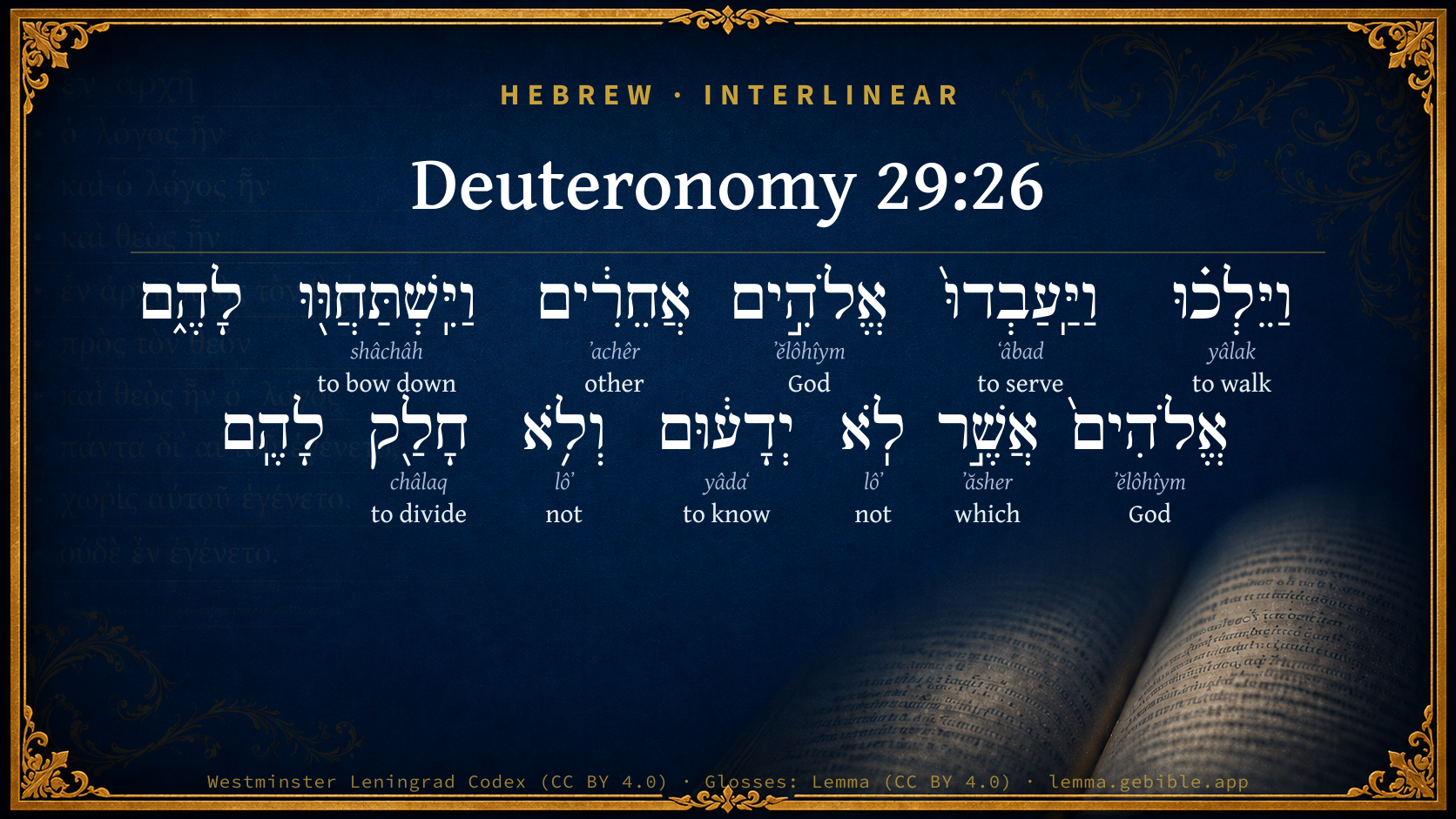
  1. וַיֵּלְכ֗וּ yâlak H3212 “and · to walk” Conjunction + Verb, Qal, Sequential Imperfect, 3rd Person, Masculine, Plural
  2. וַיַּֽעַבְדוּ֙ ʻâbad H5647 “and · to serve” Conjunction + Verb, Qal, Sequential Imperfect, 3rd Person, Masculine, Plural
  3. אֱלֹהִ֣ים ʼĕlôhîym H430 “God(s)” Noun, Common, Masculine, Plural, Absolute
  4. אֲחֵרִ֔ים ʼachêr H312 “other” Adjective, Adjective, Masculine, Plural, Absolute
  5. וַיִּֽשְׁתַּחֲוּ֖וּ shâchâh H7812 “and · to bow down” Conjunction + Verb, Hishtaphel, Sequential Imperfect, 3rd Person, Masculine, Plural
  6. אֱלֹהִים֙ ʼĕlôhîym H430 “God(s)” Noun, Common, Masculine, Plural, Absolute
  7. אֲשֶׁ֣ר ʼăsher H834 “which” Particle, Relative
  8. לֹֽא lôʼ H3808 “not” Particle, Negative
  9. יְדָע֔וּם yâdaʻ H3045 “to know · them” Verb, Qal, Perfect, 3rd Person, Common, Plural + Suffix, Personal, 3rd Person, Masculine, Plural
  10. וְלֹ֥א lôʼ H3808 “and · not” Conjunction + Particle, Negative

About this verse

These counts appear in no published source. They are computed here, from the morphology-tagged text and Lemma’s own curated glosses. What Lemma adds →

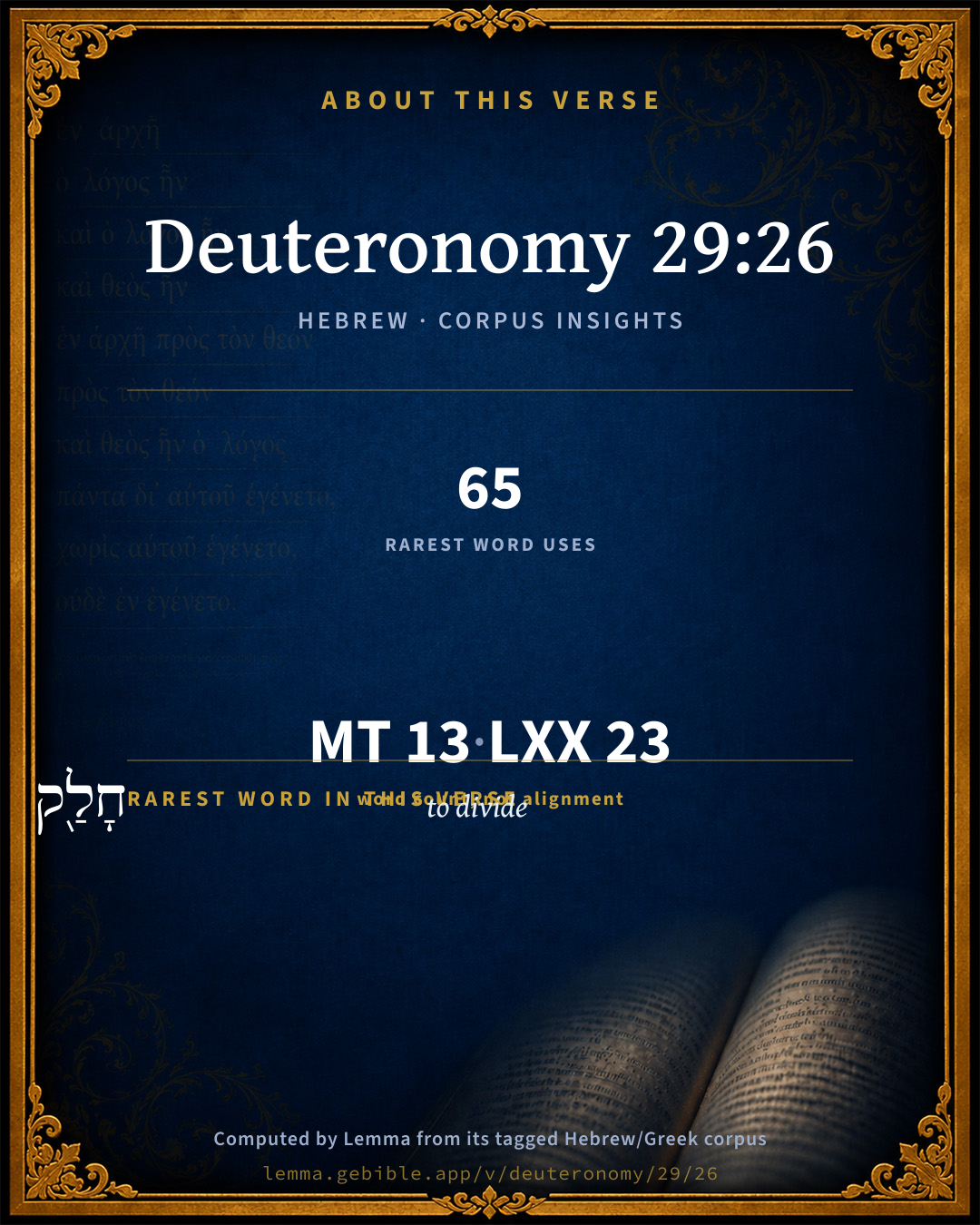
13
words
9
distinct lemmas
Pentateuch
section

Grammatical profile

  • 5 verbs
  • 2 nouns
  • 1 adjective
  • 2 prepositions
  • 3 particles

Verb forms

  • וַיֵּלְכ֗וּ Qal · Sequential Imperfect
  • וַיַּֽעַבְדוּ֙ Qal · Sequential Imperfect
  • וַיִּֽשְׁתַּחֲוּ֖וּ Hishtaphel · Sequential Imperfect
  • יְדָע֔וּם Qal · Perfect
  • חָלַ֖ק Qal · Perfect

Repetition

Words recur within this verse — often emphatic in Hebrew:

  • אֱלֹהִ֣ים God H430 ×2
  • לֹֽא not H3808 ×2

Hebrew & Septuagint length

In English translation the verse runs 22 words from the Hebrew and 18 from the Septuagint (LXX English) — closely comparable.

A rough comparison of the two English renderings, which tokenize alike — not a word-level alignment.

Word counts can differ between the Hebrew and the Greek without any difference in meaning — e.g. the Hebrew direct-object marker אֵת has no separate Greek word, and Greek often adds the article ὁ.

In the original languages it is 13 Hebrew tokens and 23 Greek tokens — but the two are counted differently (Hebrew bundles its prefixes and suffixes into one token; the Greek is in lemma form), so that isn’t a like-for-like length.

Cross-references

7

Topical passages linked to Deuteronomy 29:26 in the Treasury of Scripture Knowledge — connected by theme and wording, ordered by reader-vote popularity; previews shown in the World English Bible.

  • Deuteronomy 28:64 Yahweh will scatter you among all peoples, from the one end of the earth even to the other end of the earth; and there you shall serve other gods, which you have not known, you nor your fathers, even wood and stone.
  • Judges 2:12–13 and they forsook Yahweh, the God of their fathers, who brought them out of the land of Egypt, and followed other gods, of the gods of the peoples who were round about them, and bowed themselves down to them: and they provoked Yahweh to anger.
  • Judges 5:8 They chose new gods; Then was war in the gates: Was there a shield or spear seen Among forty thousand in Israel?
  • 2 Kings 17:7–18 It was so, because the children of Israel had sinned against Yahweh their God, who brought them up out of the land of Egypt from under the hand of Pharaoh king of Egypt, and had feared other gods,
  • 2 Chronicles 36:12–17 and he did that which was evil in the sight of Yahweh his God; he didn't humble himself before Jeremiah the prophet [speaking] from the mouth of Yahweh.
  • Jeremiah 19:3–13 and say, Hear you the word of Yahweh, kings of Judah, and inhabitants of Jerusalem: thus says Yahweh of Hosts, the God of Israel, Behold, I will bring evil on this place, which whoever hears, his ears shall tingle.
  • Jeremiah 44:2–6 Thus says Yahweh of Hosts, the God of Israel: You have seen all the evil that I have brought on Jerusalem, and on all the cities of Judah; and, behold, this day they are a desolation, and no man dwells therein,

Cross-references courtesy of OpenBible.info (CC BY 4.0).

Hebrew and Greek witnesses Masoretic Hebrew ↔ Greek Septuagint

The same verse in the two great witnesses to the Old Testament, shown verse-for-verse.

These are two independent witnesses, not word-aligned to each other, and the Septuagint is shown in lemma (dictionary) form.

Hebrew Deuteronomy 29:26 Masoretic · Westminster Leningrad Codex

וַיֵּלְכ֗וּ וַיַּֽעַבְדוּ֙ אֱלֹהִ֣ים אֲחֵרִ֔ים וַיִּֽשְׁתַּחֲוּ֖וּ לָהֶ֑ם אֱלֹהִים֙ אֲשֶׁ֣ר לֹֽא יְדָע֔וּם וְלֹ֥א חָלַ֖ק לָהֶֽם

and went and served other gods, and worshiped them, gods that they didn't know, and that he had not given to them:

World English Bible · Public Domain

Greek LXX Deuteronomy 29:26 Septuagint · lemma form

καί ὀργίζω θυμός κύριος ἐπί ὁ γῆ ἐκεῖνος ἐπιἄγω ἐπί αὐτός κατά πᾶς ὁ κατάρα ὁ γράφω ἐν ὁ βιβλίον ὁ νόμος οὗτος

and they went and served other gods, which they knew not, neither did he assign them to them.

LXX2012 (modern English Septuagint) · Public Domain

On this verse, Haydock's Catholic Bible Commentary discusses the Septuagint’s reading. Read the note in Commentary ↓

Hebrew: Westminster Leningrad Codex (CC BY 4.0). Greek: Septuagint (public domain); English from LXX2012 (modern English Septuagint) (Public Domain). How the Septuagint differs from the Hebrew →

Targum (Aramaic paraphrase)

2

The Targum is the ancient Jewish Aramaic paraphrase of the Hebrew Scriptures — an interpretive translation, not the Hebrew text itself. Onkelos (literal) and Pseudo-Jonathan (expansive) render the Torah, and Jonathan the Prophets. Coverage is partial: where no permissively-licensed English translation exists for a verse, only the Aramaic is shown. This is verse-level text, not a word-by-word alignment to the Hebrew.

  1. Targum Onkelos Torah (Genesis–Deuteronomy)
    וּתְקֵף רָגְזָא דַיְיָ בְּאַרְעָא הַהִיא לְאַיְתָאָה עֲלַהּ יָת כָּל לְוָטַיָא דִכְתִיבִין בְּסִפְרָא הָדֵין

    (no public-domain English translation for this verse)

    Targum Onkelos — Aramaic: “Onkelos Genesis” (public domain); “Onkelos Exodus” (public domain); “Onkelos Leviticus” (public domain); “Onkelos Numbers” (public domain); “Onkelos Deuteronomy” (public domain). English: “Sefaria Community Translation” (CC0 1.0 (public-domain dedication)); “J.W. Etheridge. The Targums of Onkelos and Jonathan Ben Uzziel on the Pentateuch. London: Longmans, Green, 1862” (public domain). Text via Sefaria.

  2. Targum Pseudo-Jonathan Torah (Genesis–Deuteronomy)
    וּתְקֵיף רוּגְזָא דַיְיָ בְּאַרְעָא הַהִיא לְאַיְתַיָא עֲלָהּ יַת כָּל לְוָוטַיָא דִכְתִיבִין בְּסִפְרָא הָדֵין

    And the anger of the Lord waxed strong against this land, to bring upon it all the curses written in this book.

    Targum Pseudo-Jonathan — Aramaic: “Targum Jonathan on Genesis” (public domain); “Targum Jonathan on Exodus” (public domain); “Targum Jonathan on Leviticus” (public domain); “Targum Jonathan on Numbers” (public domain); “Targum Jonathan on Deuteronomy” (public domain). English: “The Targum of Jonathan ben Uzziel, trans. J. W. Etheridge, London, 1862” (public domain). Text via Sefaria.

Commentary

Notes on Deuteronomy 29:26 from classic Christian and Jewish commentators (each source and its license shown beneath its notes). The classic Christian expositions comment on the surrounding passage and are grouped to its opening verse, so a note may address several verses; the Jewish commentaries on the Tanakh (Rashi and others) are per-verse, so they appear only where the commentator wrote on this verse.

Lemma curates 59 commentaries, every one of them public domain or Creative Commons licensed, each selected and text-cleaned for this edition rather than reprinted as found. About our sources →

Trapp's Complete Commentary

John Trapp

Deu 29:26 For they went and served other gods, and worshipped them, gods whom they knew not, and [whom] he had not given unto them:

Ver. 26. And whom he had not given unto them.] Or, Who had not given to them any portion. For "Can the vanities of the Gentiles give rain? or can the heavens give showers?" {Jer 14:22} As Saul said, "Can the son of Jesse give you vineyards and olive-yards?" &c. {1Sa 22:7} So may God say to apostates, Can the world do for you as I can?

John Trapp, A Commentary or Exposition upon All the Books of the Old and New Testament (1647–1656) — public domain. Text from a community e-Sword module.

Joseph Benson's Commentary

Deu 29:26. Whom he had not given — For their worship, but had divided unto all nations, for their use and service. So he speaks here of the sun, and moon, and stars, which were the principal gods worshipped by the neighbouring nations.

Joseph Benson's Commentary on the Old and New Testaments (1811–1818) — public domain. Text from a community e-Sword module.

Geneva Bible (1599)

Geneva Bible translators

Or, which had not given them a land to possess.

Geneva Bible (1599) marginal notes — public domain. Text via Bolls.life.

Adam Clarke's Commentary

Verse 26. Gods - whom he had not given unto them] This is an unhappy translation. Houbigant renders the original words ולו חלק להם velo chalak lahem, et quibuscum nulla eis societas, "And with whom they had no society;" and falls unmercifully on Le Clerc because he had translated it, From whom they had received no benefits. I must differ from both these great men, because I think they differ from the text. חלק chalak signifies a portion, lot, inheritance, and God is frequently represented in Scripture as the portion or inheritance of his people. Here, therefore, I think the original should be rendered, And there was no portion to them, that is, the gods they served could neither supply their wants nor save their souls - they were no portion.

Adam Clarke's Commentary on the Bible (1810–1826) — public domain. Text from a community e-Sword/MySword module.

Ellicott's Commentary for English Readers

(26) Whom he had not given.—The latter clause may be a change from plural to singular. “They went and served other gods, gods whom they knew not, and none of whom gave them any portion.”

A Bible Commentary for English Readers, edited by Charles John Ellicott (1878–1897) — public domain. Text from a community e-Sword module.

The Cambridge Bible for Schools and Colleges

gen. ed. J. J. S. Perowne

26. went and served] See Deu_29:18; on whom they knew not cp. Deu_8:3; Deu_8:16, Deu_11:28; on given or allotted see note on Deu_4:19.

The Cambridge Bible for Schools and Colleges (gen. ed. J. J. S. Perowne; Cambridge University Press, 1878–1918) — public domain. Text from a community e-Sword module.

John Gill's Exposition

And the anger of the Lord was kindled against this land,.... For this their idolatry and base ingratitude:

to bring upon it all the curses that are written in this book; in this book of Deuteronomy, and particularly Deu 28:16; see Dan 9:11.

John Gill's Exposition of the Whole Bible (1746–1763) — public domain (CC PDM 1.0). Text via the HelloAO Bible API.

Haydock's Catholic Bible Commentary

Knew not, as their gods. (Menochius) --- Indeed the gods of the heathens, were for the most part more recent than the days of Abraham, or of Moses, and only newly come up; (chap. xxxii. 17,) which was a sufficient proof that they were not gods. (Haydock) --- Assigned. It seems, as if God had in a manner abandoned other nations to the dominion of idols, while he chose Israel for his peculiar people. Hence, if they followed another god, they were to be treated as rebels. Hebrew may have another sense, "and from whom they have received nothing," Chaldean and Syriac. (Calmet) --- Septuagint, "gods to whom they were not faithful, (or whom they did not believe) and whom I did not appoint for them." Even while the people pretended to follow the worship of idols, they could surely place no confidence in them, knowing that they were either mere creatures, or even the work of their own hands. (Haydock)

George Leo Haydock (1774–1849), Haydock's Catholic Family Bible and Commentary, 1859 edition — public domain. Excludes Psalms (Douay-Rheims chapter numbering differs from Protestant) and Deuterocanonical books (Catholic canon only).

Matthew Poole's English Annotations

i.e. Whom God had not given or divided to them, as their portion, or for their worship, but hath divided them unto all nations, as it is said, Deu 4:19, not for their worship, but for their use and service. So he speaks here of the sun and moon and stars, which were the principal gods worshipped by the neighbouring nations. Or, to whom none hath given this, i.e. that they should be worshipped, or, to whom no worship belongs. So this is an argument against idolatry. Or,

who had not given unto them, to wit, any thing: it is an ellipsis of the accusative, which is very frequent: gods known to them by no benefits received from them, as they had from their God, whom therefore it was the greater folly and ingratitude to forsake.

Matthew Poole's English Annotations on the Holy Bible (1683–1685) — public domain. Text from a community e-Sword/MySword module.

The Pulpit Commentary

Gods... whom he had not given unto them. (cf. Deu_4:19)

The Pulpit Commentary (1880–1919), ed. H.D.M. Spence-Jones & Joseph S. Exell — public domain. Text from a community e-Sword module.

John Wesley's Explanatory Notes

Whom God had not given to them - For their worship, but hath divided them unto all nations, for their use and service. So he speaks here of the sun and moon and stars, which were the principal gods worshipped by the neighbouring nations.

John Wesley, Explanatory Notes Upon the Whole Bible (1754–1765) — public domain. Text via the GEBible commentary corpus.

Keil & Delitzsch

C. F. Keil & F. Delitzsch

"Gods which God had not assigned them" (vid., Deu 4:19). "All the curses," etc., are the curses contained in Deut 28:15-68; Lev 26:14-38. - Those who give the answer close their address in Deu 29:29 with an expression of pious submission and solemn admonition. "That which is hidden belongs to the Lord our God (is His affair), and that which is revealed belongs to us and our children for ever, to do (that we may do) all the words of this law." That which is revealed includes the law with its promises and threats; consequently that which is hidden can only refer to the mode in which God will carry out in the future His counsel and will, which He has revealed in the law, and complete His work of salvation notwithstanding the apostasy of the people.

(Note: What the puncta extraordinaria above (ע)ד וּלבנינוּ לנוּ mean, is uncertain. Hiller's conjecture is the most probable, "that they are intended to indicate a various reading, formed by the omission of eleven consonants, and the transposition of the rest עולם והנגדלות (at magnalia saeculi sunt);" whereas there is no foundation for Lightfoot's notion, that "they served as a warning, that we should not wish to pry with curiosity into the secret things of God, but should be content with His revealed will," - a notion which rests upon the supposition that the points are inspired.)

Keil & Delitzsch — Biblical Commentary on the Old Testament (1861–1891) — public domain (CC PDM 1.0). Text via the HelloAO Bible API. (Old Testament only.)

Lesson kit

Teaching starters — assembled from the data on this page, not authored interpretation. Every prompt links to the verse data it draws on. Edit before teaching.

Deuteronomy, in the Pentateuch, opens this verse with 13 words (9 distinct Hebrew lemmas). Its most distinctive word is châlaq (“to divide”). A historical commentator’s framing appears above. Read the whole chapter for the surrounding context.

Discussion questions

  1. The word châlaq carries the sense “to divide.” How does it shape the verse?
  2. Deuteronomy 28:64 shares this passage’s theme. How do the two illuminate each other?
  3. “God” occurs 2× in this one verse. What is the effect of the repetition?
  4. The translations on this page render this verse differently — a whole-verse word diff, not a word-by-word alignment. What might account for the different wordings?
  5. The verb «וַיֵּלְכ֗וּ» is Qal Sequential Imperfect. How does its form color the action?
  6. Reading how Trapp's Complete Commentary and Joseph Benson's Commentary read this verse, where do the two commentators agree and where do they part?

Things to notice

Reading settings

Reading text

Shown beneath each verse's original-language words.

Old Testament
Old Testament edition

Read the OT as the Masoretic Hebrew (MT) or the Greek Septuagint (LXX).

English shown for the Greek Septuagint (in the Hebrew ↔ Greek comparison).

Comparing translations? Open the Compare panel on any verse page to stack up to four side by side.