
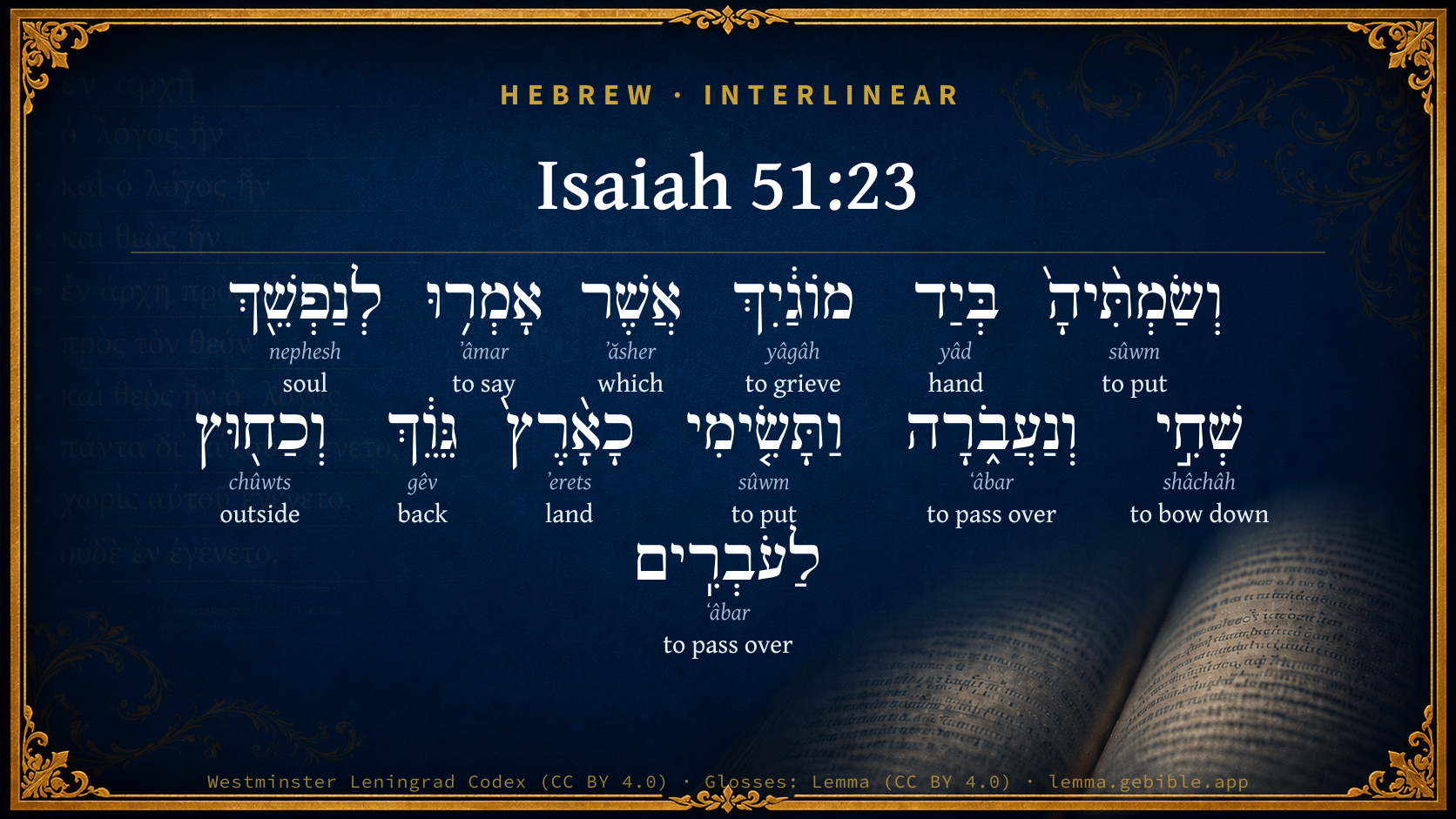
Isaiah 51:23

Hebrew (Westminster Leningrad Codex) Isaiah 51:23 appears in the Hebrew Old Testament. The text above is from the Westminster Leningrad Codex. Each word links to its Strong’s number, a concise gloss, and parsing drawn from the Open Scriptures Hebrew Bible morphology. Click any word for its full Brown-Driver-Briggs (BDB) entry.
Download image
Cite this verse

Isaiah 51:23 (World English Bible). Public Domain. Lemma interlinear Bible study tool, https://lemma.gebible.app/v/isaiah/51/23.

Show BibTeX & RIS
BibTeX
RIS
English Translation
and I will put it into the hand of those who afflict you, who have said to your soul, Bow down, that we may go over; and you have laid your back as the ground, and as the street, to those who go over.
World English Bible · Public Domain
Download a study sheet

One document with this verse’s original text, its word-by-word gloss line, the meaning frame, cross-references with their text, attributed commentary, and full source and license credits — printable, and it pastes into notes with its structure intact.

This verse Autodidact and up

Study sheet (.html) Plain text (.txt)

A passage Seminary Student

Up to 50 verses in one chapter. A passage sheet keeps up to 6 commentary sources and 12 cross-references per verse, in the order this page ranks them, and says so on the sheet whenever that leaves anything out. Ask for a single verse and you get the Autodidact verse sheet above.

Everything on this page stays free to read, with no account — the sheet is a download of what is already on screen, not access to it.

Want to remove ads? Support Godless Engineer
Compare translations 3

The same verse in 3 English versions, stacked beneath the original-language interlinear above. Click any original word for its lexicon entry.

Each is an independent rendering of the whole verse — the interlinear is not word-aligned to these translations.

Highlighted words mark where these versions differ — a whole-verse word diff, not a word-by-word alignment.

  • World English Bible Public Domain
    and I will put it into the hand of those who afflict you, who have said to your soul, Bow down, that we may go over; and you have laid your back as the ground, and as the street, to those who go over.
  • King James Version Public Domain
    But I will put it into the hand of them that afflict thee; which have said to thy soul, Bow down, that we may go over: and thou hast laid thy body as the ground, and as the street, to them that went over.
  • unfoldingWord Literal Text CC BY-SA 4.0
    And I will put it in the hand of the ones grieving you, who said to your soul, ‘Lie prostrate, that we may pass over.’ And you made your back like the earth, and like the street, for the ones passing over.”

unfoldingWord Literal Text — © unfoldingWord, licensed CC BY-SA 4.0. Word-aligned USFM3 via Door43 (git.door43.org/unfoldingWord/en_ult).

Versions to compare (up to 4)

3 of 4 selected

Show all 18 translations

Every available English version of this verse, each an independent rendering of the whole verse.

  • World English Bible Public Domain
    and I will put it into the hand of those who afflict you, who have said to your soul, Bow down, that we may go over; and you have laid your back as the ground, and as the street, to those who go over.
  • Berean Standard Bible Public Domain
    I will place it in the hands of your tormentors, who told you: ‘Lie down, so we can walk over you,’ so that you made your back like the ground, like a street to be traversed.”
  • Majority Standard Bible Public Domain
    I will place it in the hands of your tormentors, who told you: ‘Lie down, so we can walk over you,’ so that you made your back like the ground, like a street to be traversed.”
  • King James Version Public Domain
    But I will put it into the hand of them that afflict thee; which have said to thy soul, Bow down, that we may go over: and thou hast laid thy body as the ground, and as the street, to them that went over.
  • American Standard Version (1901) Public Domain
    and I will put it into the hand of them that afflict thee, that have said to thy soul, Bow down, that we may go over; and thou hast laid thy back as the ground, and as the street, to them that go over.
  • Revised Version (1885) Public Domain
    and I will put it into the hand of them that afflict thee; which have said to thy soul, Bow down, that we may go over: and thou hast laid thy back as the ground, and as the street, to them that go over.
  • Geneva Bible (1599) Public Domain
    But I will put it into their hande that spoile thee: which haue said to thy soule, Bowe downe, that wee may goe ouer, and thou hast layde thy bodie as the grounde, and as the streete to them that went ouer.
  • Douay-Rheims (1899) Public Domain
    And I will put it in the hand of them that have oppressed thee, and have said to thy soul: Bow down, that we may go over: and thou hast laid thy body as the ground, and as a way to them that went over.
  • Young's Literal Translation Public Domain
    And I have put it into the hand of those afflicting thee, Who have said to thy soul, Bow down, and we pass over, And thou makest as the earth thy body, And as the street to those passing by!'
  • Literal Standard Version CC BY-SA 4.0
    And I have put it into the hand of those afflicting you, || Who have said to your soul, || Bow down, and we pass over, || And you make your body as the earth, || And as the street to those passing by!”
  • Unlocked Literal Bible CC BY-SA 4.0
    I will put it into the hand of your tormentors, those who have said to you, 'Lie down, that we may walk over you'; you made your back like the ground and like the street for them to walk on.”
  • unfoldingWord Literal Text CC BY-SA 4.0
    And I will put it in the hand of the ones grieving you, who said to your soul, ‘Lie prostrate, that we may pass over.’ And you made your back like the earth, and like the street, for the ones passing over.”
  • Darby Bible Public Domain
    and I will put it into the hand of them that afflict thee; who have said to thy soul, Bow down, that we may go over; and thou hast laid thy body as the ground, and as the street to them that went over.
  • World Messianic Bible Public Domain
    I will put it into the hand of those who afflict you, who have said to your soul, ‘Bow down, that we may walk over you;’ and you have laid your back as the ground, like a street to those who walk over.”
  • Webster's Bible Public Domain
    But I will put it into the hand of them that afflict thee; who have said to thy soul, Prostrate thyself, that we may go over: and thou hast laid thy body as the ground, and as the street, to them that went over.
  • Free Bible Version CC BY-SA 4.0
    Instead I will give that cup to the people who tormented you, to those who said to you, “Lie facedown so we can walk all over you.” You had to make your backs like the ground, like a street to be walked on.
  • Bible in Basic English Public Domain
    And I will put it into the hand of your cruel masters, and of those whose yoke has been hard on you; who have said to your soul, Down on your face! so that we may go over you: and you have given your backs like the earth, even like the street, for them to go over.
  • JPS Tanakh (1917) Public Domain
    And I will put it into the hand of them that afflict thee; that have said to thy soul: 'Bow down, that we may go over'; and thou hast laid thy back as the ground, and as the street, to them that go over.

Literal Standard Version (2020), Covenant Press — licensed CC BY-SA 4.0. Text via the HelloAO Bible API (eBible.org). Unlocked Literal Bible (unfoldingWord) — licensed CC BY-SA 4.0. Text via the HelloAO Bible API (eBible.org). unfoldingWord Literal Text — © unfoldingWord, licensed CC BY-SA 4.0. Word-aligned USFM3 via Door43 (git.door43.org/unfoldingWord/en_ult). Free Bible Version, Dr. Jonathan Gallagher — licensed CC BY-SA 4.0. Text via the HelloAO Bible API (eBible.org).

Word by word

More ways to search: Search by grammar → Find every occurrence → Compare this word →

Practice this passage: Drill this verse → Learn its vocabulary →

גֵּוֵ֔ךְ
gêv
H1460
“back · your”
Noun, Common, Masculine, Singular, Construct + Suffix, Personal, 2nd Person, Feminine, Singular
Part of Speech
Noun
Type
Common
Gender
Masculine
Number
Singular
State
Construct
Full BDB Definition

Origin: from H1342 [corresponding to H1354 ]

TWOT: 326b

the back, back, midst
  1. וְשַׂמְתִּ֨יהָ֙ sûwm H7760 “and · to put · her” Conjunction + Verb, Qal, Sequential Perfect, 1st Person, Common, Singular + Suffix, Personal, 3rd Person, Feminine, Singular
  2. בְּיַד yâd H3027 “in/at · hand of” Preposition + Noun, Common, Both, Singular, Construct
  3. מוֹגַ֔יִךְ yâgâh H3013 “grieving · you” Verb, Hiphil, Participle Active, Masculine, Plural, Construct + Suffix, Personal, 2nd Person, Feminine, Singular
  4. אֲשֶׁר ʼăsher H834 “which” Particle, Relative
  5. אָמְר֥וּ ʼâmar H559 “to say” Verb, Qal, Perfect, 3rd Person, Common, Plural
  6. לְנַפְשֵׁ֖ךְ nephesh H5315 “to/for · soul · your” Preposition + Noun, Common, Both, Singular, Construct + Suffix, Personal, 2nd Person, Feminine, Singular
  7. שְׁחִ֣י shâchâh H7812 “bow down” Verb, Qal, Imperative, 2nd Person, Feminine, Singular
  8. וְנַעֲבֹ֑רָה ʻâbar H5674 “and · to pass over” Conjunction + Verb, Qal, Cohortative, 1st Person, Common, Plural
  9. וַתָּשִׂ֤ימִי sûwm H7760 “and · to put” Conjunction + Verb, Qal, Sequential Imperfect, 2nd Person, Feminine, Singular
  10. כָאָ֨רֶץ֙ ʼerets H776 “like/as the · land” Preposition, Determined + Noun, Common, Both, Singular, Absolute
  11. וְכַח֖וּץ chûwts H2351 “and · like/as the · outside” Conjunction + Preposition, Determined + Noun, Common, Masculine, Singular, Absolute
  12. לַעֹבְרִֽים ʻâbar H5674 “to/for the · passing over” Preposition, Determined + Verb, Qal, Participle Active, Masculine, Plural, Absolute

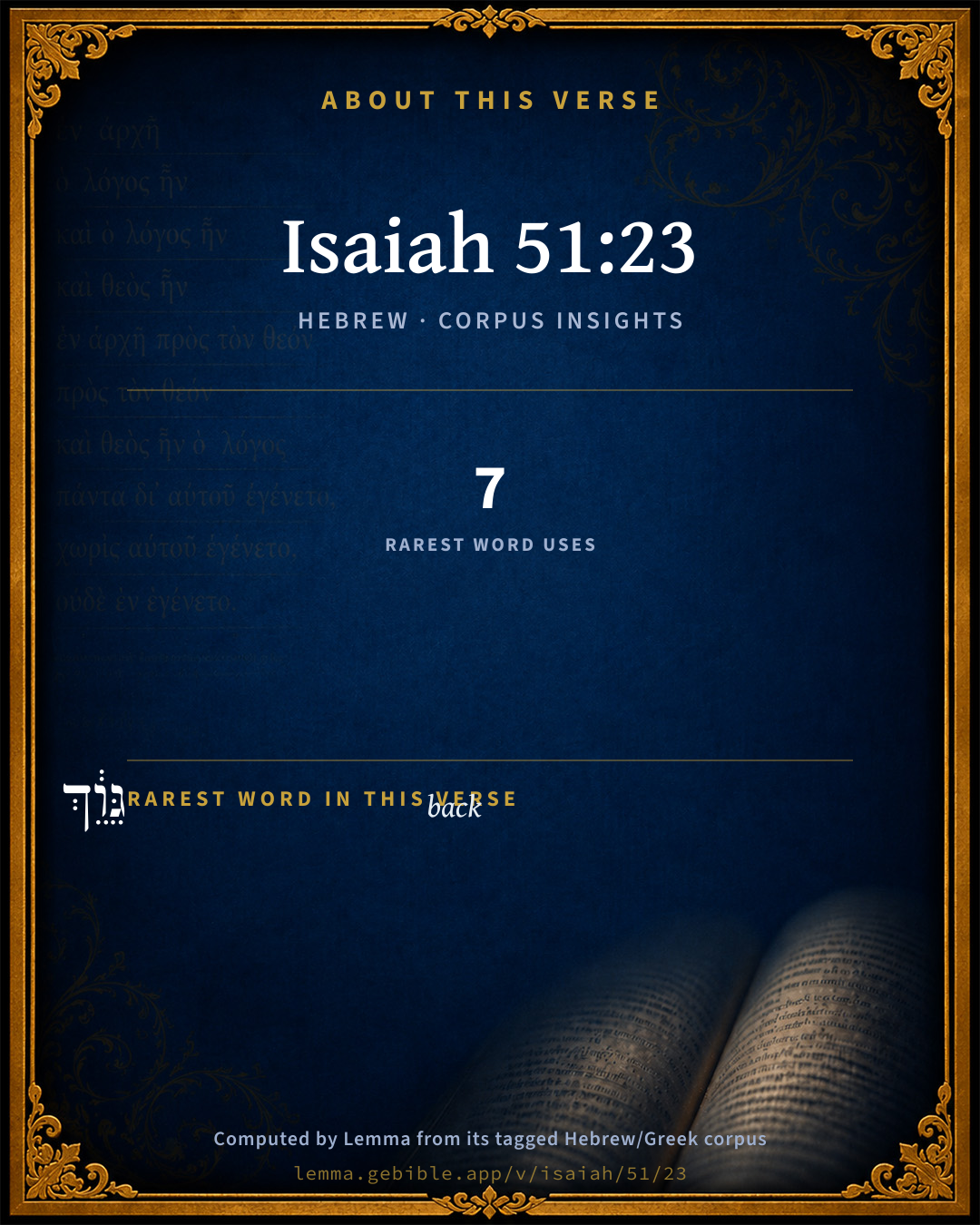
About this verse

These counts appear in no published source. They are computed here, from the morphology-tagged text and Lemma’s own curated glosses. What Lemma adds →

13
words
11
distinct lemmas
Prophets
section

Notable vocabulary

The rarest word here is גֵּוֵ֔ךְ back H1460 — appearing just 7 times in the whole Hebrew Bible.

Shared distinctive vocabulary

גֵּוֵ֔ךְ back H1460 occurs in 7 verses of the Hebrew Bible. Also found in:

Grammatical profile

  • 7 verbs
  • 5 nouns
  • 1 particle

Verb forms

  • וְשַׂמְתִּ֨יהָ֙ Qal · Sequential Perfect
  • מוֹגַ֔יִךְ Hiphil · Participle Active
  • אָמְר֥וּ Qal · Perfect
  • שְׁחִ֣י Qal · Imperative
  • וְנַעֲבֹ֑רָה Qal · Cohortative
  • וַתָּשִׂ֤ימִי Qal · Sequential Imperfect
  • לַעֹבְרִֽים Qal · Participle Active

Repetition

Words recur within this verse — often emphatic in Hebrew:

  • וְשַׂמְתִּ֨יהָ֙ to put H7760 ×2
  • וְנַעֲבֹ֑רָה to pass over H5674 ×2

Hebrew & Septuagint length

In English translation the verse runs 44 words from the Hebrew and 44 from the Septuagint (LXX English) — the same length.

A rough comparison of the two English renderings, which tokenize alike — not a word-level alignment.

Word counts can differ between the Hebrew and the Greek without any difference in meaning — e.g. the Hebrew direct-object marker אֵת has no separate Greek word, and Greek often adds the article ὁ.

Cross-references

11

Topical passages linked to Isaiah 51:23 in the Treasury of Scripture Knowledge — connected by theme and wording, ordered by reader-vote popularity; previews shown in the World English Bible.

  • Joshua 10:24 It happened, when they brought forth those kings to Joshua, that Joshua called for all the men of Israel, and said to the chiefs of the men of war who went with him, Come near, put your feet on the necks of these kings. They came near, and put their feet on the necks of them.
  • Zechariah 12:2 "Behold, I will make Jerusalem a cup of reeling to all the surrounding peoples, and on Judah also will it be in the siege against Jerusalem.
  • Psalms 65:11–12 You crown the year with your bounty. Your carts overflow with abundance.
  • Proverbs 11:8 A righteous person is delivered out of trouble, And the wicked takes his place.
  • Proverbs 21:18 The wicked is a ransom for the righteous; The treacherous for the upright.
  • Isaiah 49:25–26 But thus says Yahweh, Even the captives of the mighty shall be taken away, and the prey of the terrible shall be delivered; for I will contend with him who contends with you, and I will save your children.
  • Jeremiah 25:15–29 For thus says Yahweh, the God of Israel, to me: take this cup of the wine of wrath at my hand, and cause all the nations, to whom I send you, to drink it.
  • Revelation 11:2 Leave out the court which is outside of the temple, and don't measure it, for it has been given to the gentiles. They will tread the holy city under foot for forty-two months.
  • Revelation 13:16–17 He causes all, the small and the great, the rich and the poor, and the free and the slave, to be given marks on their right hands, or on their foreheads;
  • Revelation 17:6–8 I saw the woman drunken with the blood of the saints, and with the blood of the martyrs of Jesus. When I saw her, I wondered with great amazement.
  • Revelation 17:18 The woman whom you saw is the great city, which reigns over the kings of the earth."

Cross-references courtesy of OpenBible.info (CC BY 4.0).

Hebrew and Greek witnesses Masoretic Hebrew ↔ Greek Septuagint

The same verse in the two great witnesses to the Old Testament, shown verse-for-verse.

These are two independent witnesses, not word-aligned to each other, and the Septuagint is shown in lemma (dictionary) form.

Hebrew Isaiah 51:23 Masoretic · Westminster Leningrad Codex

וְשַׂמְתִּ֨יהָ֙ בְּיַד מוֹגַ֔יִךְ אֲשֶׁר אָמְר֥וּ לְנַפְשֵׁ֖ךְ שְׁחִ֣י וְנַעֲבֹ֑רָה וַתָּשִׂ֤ימִי כָאָ֨רֶץ֙ גֵּוֵ֔ךְ וְכַח֖וּץ לַעֹבְרִֽים

and I will put it into the hand of those who afflict you, who have said to your soul, Bow down, that we may go over; and you have laid your back as the ground, and as the street, to those who go over.

World English Bible · Public Domain

Greek LXX Isaiah 51:23 Septuagint · lemma form

καί ἐνβάλλω αὐτός εἰς ὁ χείρ ὁ ἀδικέω σύ καί ὁ ταπεινόω σύ ὅς εἶπον ὁ ψυχή σύ κύπτω ἵνα παραἔρχομαι καί τίθημι ἴσος ὁ γῆ ὁ μετάφρενον σύ ἔξω ὁ παραπορεύομαι

And I will give it into the hands of them that injured you, and them that afflicted you; who said to your soul, Bow down, that we may pass over: and you did level your body with the ground to them passing by without.

LXX2012 (modern English Septuagint) · Public Domain

On this verse, Adam Clarke's Commentary discusses the Septuagint’s reading. Read the note in Commentary ↓

Hebrew: Westminster Leningrad Codex (CC BY 4.0). Greek: Septuagint (public domain); English from LXX2012 (modern English Septuagint) (Public Domain). How the Septuagint differs from the Hebrew →

Targum (Aramaic paraphrase)

1

The Targum is the ancient Jewish Aramaic paraphrase of the Hebrew Scriptures — an interpretive translation, not the Hebrew text itself. Onkelos (literal) and Pseudo-Jonathan (expansive) render the Torah, and Jonathan the Prophets. Coverage is partial: where no permissively-licensed English translation exists for a verse, only the Aramaic is shown. This is verse-level text, not a word-by-word alignment to the Hebrew.

  1. Targum Jonathan Prophets (Joshua–Malachi)
    וְאֶמְסְרִינָהּ בְּיַד דַהֲווֹ מוֹנָן לִיךְ דַהֲווֹ אָמְרִין לְנַפְשֵׁיךְ אַמְאִיכִי וְנֶעְדֵי וְאַמְאֵיכְתְּ כְּאַרְעָא יְקָרִיךְ וַהֲוֵית כְּשׁוּק לְעָדָן:

    But I will deliver it into the hand of them that afflict thee: which have said to thee, Bow down that we may go over; and thou hast humbled thy glory as the ground, and thou becamest like the street to them that passed by.

    Targum Jonathan — Aramaic: “Mikraot Gedolot” (public domain). English: “Sefaria Community Translation” (CC0 1.0 (public-domain dedication)); “London "Chaldee Paraphrase," 1871” (public domain). Text via Sefaria.

Commentary

Notes on Isaiah 51:23 from classic Christian and Jewish commentators (each source and its license shown beneath its notes). The classic Christian expositions comment on the surrounding passage and are grouped to its opening verse, so a note may address several verses; the Jewish commentaries on the Tanakh (Rashi and others) are per-verse, so they appear only where the commentator wrote on this verse.

Lemma curates 59 commentaries, every one of them public domain or Creative Commons licensed, each selected and text-cleaned for this edition rather than reprinted as found. About our sources →

Trapp's Complete Commentary

John Trapp

Isa 51:23 But I will put it into the hand of them that afflict thee; which have said to thy soul, Bow down, that we may go over: and thou hast laid thy body as the ground, and as the street, to them that went over.

Ver. 23. But I will put it into the hand of them that afflict thee.] Who shall drink it not to drunkenness only, as thou hast done, but unto madness. {Jer 25:10} Belshazzar and his Babylonians did so; the revenging hand of God was afterwards upon Antiochus, Vespasian, and his children; Antichristians drink of the wine of God’s wrath. {Rev 14:10}

Bow down.] This passage setteth forth their extreme cruelty and thrasonical insolence. But the case shall be altered. {Rev 3:9}

John Trapp, A Commentary or Exposition upon All the Books of the Old and New Testament (1647–1656) — public domain. Text from a community e-Sword module.

Tyndale Open Study Notes

Tyndale Open Resources

51:23 The tormentors were the Babylonians who brought about destruction, war, and famine (51:19).

Tyndale Open Study Notes — © Tyndale Open Resources, licensed CC BY-SA 4.0. Text via the HelloAO Bible API.

Jamieson, Fausset & Brown

Robert Jamieson, A. R. Fausset & David Brown

(Isa 49:26; Jer 25:15-29; Zac 12:2).

Bow down that . . . go over--Conquerors often literally trod on the necks of conquered kings, as Sapor of Persia did to the Roman emperor Valerian (Jos 10:24; Psa 18:40; Psa 66:11-12).

Zion long in bondage (Isa 51:17-20) is called to put on beautiful garments appropriate to its future prosperity.

Next: Isaiah Chapter 52

Jamieson, Fausset & Brown — Commentary Critical and Explanatory on the Whole Bible (1871) — public domain (CC PDM 1.0). Text via the HelloAO Bible API.

Adam Clarke's Commentary

Verse 23. Them that afflict thee - "Them who oppress thee"] The Septuagint, Chaldee, Syriac, and Vulgate appear to have read מוניך monayich, as in Isa 40:26." - SECKER.

Which have said to thy soul, Bow down - "Who say to thee, Bow down thy body"] A very strong and most expressive description of the insolent pride of eastern conquerors; which, though it may seem greatly exaggerated, yet hardly exceeds the strict truth. An example has already been given of it in the note, See Clarke on Isa 49:23. I will here add one or two more. "Joshua called for all the men of Israel; and said unto the captains of the men of war that went with him, Come near, put your feet upon the necks of these kings," Jos 10:24. "Adonibezek said, Threescore and ten kings, having their thumbs and their great toes cut off, gathered their meat under my table: As I have done, so hath God requited me," Jdg 1:7. The Emperor Valerianus, being through treachery taken prisoner by Sapor king of Persia, was treated by him as the basest and most abject slave: for the Persian monarch commanded the unhappy Roman to bow himself down, and offer him his back, on which he set his foot, in order to mount his chariot or horse whenever he had occasion. - LACTANTIUS, De Mort. Persec. cap. v. AUREL. VICTOR. Epitome, cap. xxxii. - L.

Adam Clarke's Commentary on the Bible (1810–1826) — public domain. Text from a community e-Sword/MySword module.

Ellicott's Commentary for English Readers

(23) Thou hast laid thy body . . .—The image is startlingly bold; but our word “prostration,” as applied to the condition of a people, embodies precisely the same thought. (Comp. Psa_129:3.) The previous words paint the last humiliation of Eastern conquest (Jos_10:24).

A Bible Commentary for English Readers, edited by Charles John Ellicott (1878–1897) — public domain. Text from a community e-Sword module.

The Cambridge Bible for Schools and Colleges

gen. ed. J. J. S. Perowne

23. them that afflict thee] thy tormentors. The word occurs three times in the Lamentations (Lam_1:5; Lam_1:12, Lam_3:32).

to thy soul] i.e. “to thyself,” although without special emphasis (cf. Psa_3:2; Psa_11:1).

Bow down, that we may go over] The figure is taken from the Eastern custom of treading or even riding on the backs of conquered enemies. Comp. Lane’s account of the Mohammedan ceremony of the Dooseh or “Treading,” as he witnessed it at Cairo in 1834; when the Sheikh of the Saadîyeh dervishes, mounted on horseback, rode over the prostrate bodies of a large number of dervishes. (See Manners and Customs of the Modern Egyptians, pp. 417 f., 432 f. [Ed. 1890].)

and thou hast laid &c.] so that thou madest thy back as the earth. Gesenius cites in illustration an Arabic proverb: “To him who pleases me, I will be earth.”

The Cambridge Bible for Schools and Colleges (gen. ed. J. J. S. Perowne; Cambridge University Press, 1878–1918) — public domain. Text from a community e-Sword module.

John Gill's Exposition

And I will put it into the hand of them that afflict me,.... As the Lord did to literal Babylon, Jer 25:15, so will he do to mystical Babylon; he will retaliate upon her all the evils she has done to others, and destroy them that destroyed the earth; see Rev 11:18,

which have said to thy soul, bow down, that we may go over; who not only afflicted the bodies, but tyrannized over the souls and consciences of men; obliging them to a compliance with their idolatrous practices, to bow down and worship the beast, and his image; and thereby acknowledge subjection to the see of Rome, and its authority over them: the allusion seems to be the custom of the eastern kings trampling upon the necks of their conquered enemies, Jos 10:24, and the pope of Rome has, in a literal sense, trampled upon the necks even of kings and emperors.

And thou hast laid thy body as the ground, and as the street, to them that went over; which expresses the low estate of the church of Christ, or holy city, while trodden under foot by the Gentiles during the reign of antichrist, Rev 11:2, and may also denote the sneaking outward compliance of some through the force of persecution, when they did not cordially embrace, nor with conscience, and from their heart, submit to the authority of the church of Rome; but though the people of God are represented in such a low and grovelling condition, yet they shall arise out of it, and come into a very flourishing one, as the next chapter shows.

Next: Isaiah Chapter 52

John Gill's Exposition of the Whole Bible (1746–1763) — public domain (CC PDM 1.0). Text via the HelloAO Bible API.

Albert Barnes' Notes on the Bible

But I will put it into the hand of them that afflict thee - The nations that have made war upon thee, and that have reduced thee to bondage, particularly the Babylonians. The calamities which the Jews had suffered, God would transfer to their foes.

Which have said to thy soul, Bow down, that we may go over - This is a striking description of the pride of eastern conquerors. It was not uncommon for conquerors actually to put their feet on the necks of conquered kings, and tread them in the dust. Thus in Jos 10:24, ‘Joshua called for all the men of Israel, and said unto the captains of the men of war that went with them, Come near, put your feet upon the necks of these kings.’ So David says, ‘Thou has given me the necks of mine enemies’ Psa 18:40. ‘The emperor Valerianus being through treachery taken prisoner by Sapor king of Persia, was treated by him as the basest and most abject slave, for the Persian monarch commanded the unhappy Roman to bow himself down and offer him his back, on which he set his foot in order to mount his chariot, or his horse, whenever he had occasion.’ (Lactantius, as quoted by Lowth) Mr. Lane (Modern Egyptians, vol. i. p. 199) describes an annual ceremony which may serve to illustrate this passage: ‘A considerable number of Durweeshes, says he (I am sure there were not less than sixty, but I could not count their number), laid themselves down upon the ground, side by side, as close as possible to each other, having their backs upward, having their legs extended, and their arms placed together beneath their foreheads.

When the Sheikh approached, his horse hesitated several minutes to step upon the back of the first prostrate man; but being pulled and urged on behind, he at length stepped upon them: and then without apparent fear, ambled with a high pace over them all, led by two persons, who ran over the prostrate men, one sometimes treading on the feet, and the other on the heads. Not one of the men thus trampled on by the horse seemed to be hurt; but each the moment that the animal had passed over him, jumped up and followed the Sheikh. Each of them received two treads from the horse, one from one of his fore-legs, and a second from a hind-leg.’ It seems probable that this is a relic of an ancient usage alluded to in the Bible, in which captives were made to lie down on the ground, and the conqueror rode insultingly over them.

Thou hast laid thy body as the ground - That is, you were utterly humbled and prostrated (compare Psa 66:11-12). From all this, however, the promise is, that they should be rescued and delivered. The account of their deliverance is contained in the following chapter Isa 52:1-12; and the assurance of rescue is there made more cheering and glorious by directing the eye forward to the coming of the Messiah Isa 52:13-15; Isa 53:1-12, and to the glorious results which would follow from his advent (Isa 54:1). These chapters are all connected, and they should be read continuously. Material injury is done to the sense by the manner in which the division is made, if indeed any division should have been made at all.

Albert Barnes' Notes on the Bible (1834–1885) — public domain. Text from a community e-Sword/MySword module.

Haydock's Catholic Bible Commentary

Over. This inhumanity was not uncommon, Josue x. 24., and Psalm cix. 1.

George Leo Haydock (1774–1849), Haydock's Catholic Family Bible and Commentary, 1859 edition — public domain. Excludes Psalms (Douay-Rheims chapter numbering differs from Protestant) and Deuterocanonical books (Catholic canon only).

Matthew Poole's English Annotations

Bow down, that we may go over; lie down upon the ground, that we may trample upon thee, as conquerors. used to do upon their conquered enemies. See Jos 10:24; Psa 110:1.

Matthew Poole's English Annotations on the Holy Bible (1683–1685) — public domain. Text from a community e-Sword/MySword module.

Whedon's Commentary on the Bible

Daniel D. Whedon

23. Bow down, that we may go over — This refers to ancient captives, and in some cases subjects, lying closely packed face downward, and the conquering foe or tyrant monarch riding with a cavalcade of horses, treading on legs, backs, shoulders, and heads, as over a bridge, to denote absolute humiliation. See Alexander and Barnes on this verse. Here a figure of that practice is doubtless employed, but the actual thing ofttimes occurred anciently, and sometimes occurs in oriental life at the present day.

Daniel D. Whedon (gen. ed.), Commentary on the Old and New Testaments (1874–1909) — public domain. Text from a community e-Sword module.

The Pulpit Commentary

I will put it into the hand of them that afflict thee. Babylon, the oppressor of Judah, shall in her turn be made to drink of the cup of which Judah had so long drunk, and shall suffer nearly the same woes which she had inflicted. Meanwhile, Judah should cease to drink of the cup, and have "a time of refreshing." Bow down, that we may go over; i.e. "submit yourselves to the uttermost, that we may put upon you the most extreme indignity." The metaphor is drawn from the actual practise of conquerors, who made captive kings prostrate themselves, and placed their feet upon their necks, or otherwise trampled upon them (see Jos_10:24; and comp. "Ancient hierarchies," vol. 3: p. 7).

Divine judgment on persecutors.

"Thou hast laid thy body as the ground, and as the street, to them that went over." This is a figure for the last humiliation of an Eastern conquest. Joshua called his captains, and even his soldiers, to put their feet upon the necks of the conquered kings. (Jos_10:24) Matthew Arnold"s note on this verse is as follows: "A trait of the humiliation of the conquered and the insolence of the conqueror in Eastern kingdoms. So it is related that when Sapor, King of Persia, got on horseback, the Roman Emperor Valerian had to kneel down, and make his back a step for him." Henderson, quoting from Ibn Batuta, says that "when the negroes who appeared before the black sultan at Mall, in Nigritia, fell down, they laid bare their backs, and covered their heads with dust, as tokens of the most profound submission." Further illustration may be found in the Eastern custom called the doseh, which is still prevalent, or only very recently extinct. Dervishes lay themselves down side by side on the ground, backs upward, legs extended, and their arms placed together beneath their foreheads. Over these the sheikh on horseback rides. The assurance made is that the enemies and persecutors of Israel, and notably Babylon, should be made to drink of the same bitter cup that they had made Israel drink so deeply. And Babylon had to taste the bitterness of captivity. Very striking facts are narrated concerning the Divine retributions which persecutors have suffered, and though some may be but imaginative creations under impressions of what ought to be, there are sufficient cases that are strictly historical to convince us that, in this sphere, "though hand join in hand, the wicked do not go unpunished;" and not infrequently what is known as "poetical justice" is meted out to them even in this life. If the persecutor should escape the retribution, the judgment comes upon his fame. After-generations say worse things of persecutors than of any of the ancestors. They live in the execration of the ages. Yet the persecutor can never permanently harm the Church. Its conquest is,well assured, and that conquest involves the judgment, humiliation, and degradation of the persecutors, who shall have measured to them what they meted out to others; for "our God is known by the judgments which he executeth. R.T.

The Pulpit Commentary (1880–1919), ed. H.D.M. Spence-Jones & Joseph S. Exell — public domain. Text from a community e-Sword module.

John Wesley's Explanatory Notes

Go over - That we may trample upon thee.

John Wesley, Explanatory Notes Upon the Whole Bible (1754–1765) — public domain. Text via the GEBible commentary corpus.

J. A. Alexander on Isaiah

Joseph Addison Alexander

“And put it into the hand of those that afflicted thee, that said to thy soul, Bow down and we will (or that we may) pass over; and thou didst lay thy back as the ground and as the street for the passengers.” ‘To thy soul’ always implies a strong and commonly a painful affection of the mind in the object of address. ‘He said to thy soul’ is then equivalent to saying, ‘who distressed thy soul by saying’. The last clause is commonly explained as a proverbial or at least a metaphorical description of extreme humiliation, although history affords instances of literal humiliation in this form. Such is the treatment of Valerian by Sapor, as described by Lactantius and Aurelius Victor; with which may be compared the conduct of Sesostris to his royal captives, as described by Diodorus, and that of Pope Alexander III to the Emperor Frederic, as recorded by the Italian historians. For scriptural parallels see Jos 10:24 and Jdg 1:7. If we had any right or reason to restrict this prediction to a single period or event, the most obvious would be the humiliation of the Chaldees, who are threatened with the cup of God’s wrath in Jer 25:26.

Joseph Addison Alexander, The Prophecies of Isaiah (1846–1847; New York: Scribner, 1870–1878) — public domain. Text from a community e-Sword module.

unfoldingWord translationNotes

Door43 World Missions Community

General Information:

Yahweh continues speaking to the people of Israel.

I will put it into the hand of your tormentors

This speaks of Yahweh punishing their enemies as if he were going to force them to drink from the cup filled with his anger. (See: Metaphor)

I will put it into the hand of your tormentors

It is implied that by putting the cup of his anger in their hand Yahweh will be forcing them to drink what is in the cup. AT: "I will force your tormentors to drink from the wine of the bowl of my anger" (See: Assumed Knowledge and Implicit Information)

your tormentors

The word "tormentors" may be expressed with a verb. AT: "those who have tormented you" or "those who have caused you to suffer"

you made your back like the ground and like the street for them to walk on

This compares the way their enemies walked on their back to the way people walk on the street. AT: "you lay in the streets so your enemies could walk on your backs" (See: Simile)

translationWords

hand

unfoldingWord translationNotes — © Distant Shores Media and the Door43 World Missions Community, licensed CC BY-SA 4.0. Source: git.door43.org/Door43/en_tn.

Rashi

Rabbi Shlomo Yitzchaki (Rashi)

those who cause you to wander Heb. מוֹגַיִךְ. Those who cause you to wander and those who cause you to move. Comp. (I Sam. 14:16) “And the multitude was wandering (נָמוֹג),” krosler in O.F.

Bend down and let us cross on your back.

Rashi on the Tanakh — English translations: “The Judaica Press complete Tanach with Rashi, translated by A. J. Rosenberg” (CC BY 4.0); “Pentateuch with Rashi's commentary by M. Rosenbaum and A.M. Silbermann, 1929-1934” (public domain); “The Metsudah Tanach series, Lakewood, N.J” (CC BY 4.0); and “The Book of Joshua, Metsudah Publications, 1997” (CC BY 4.0). Text via Sefaria.

Ibn Ezra

Rabbi Abraham ibn Ezra

מוגיך That afflict thee. Comp. יגון trouble. It is Hiphil of יגה. Comp. הוגה He hath afflicted (Lam. 1:12).

Bow down, that is, make thyself low, that we may go over thee.

And as the street, etc. Repetition of the same idea.

Ibn Ezra on the Tanakh — English translations: “Sefaria Community Translation” (CC0 1.0 (public-domain dedication)); “Yalkut, Sifsei Chachomim Chumash, Metsudah Publications, 2009” (CC BY 4.0); and “Commentary of Ibn Ezra on Isaiah - trans. by M. Friedlander, 1873” (public domain). Text via Sefaria.

Lesson kit

Teaching starters — assembled from the data on this page, not authored interpretation. Every prompt links to the verse data it draws on. Edit before teaching.

Isaiah, in the Prophets, opens this verse with 13 words (11 distinct Hebrew lemmas). Its most distinctive word is gêv (“back”). A historical commentator’s framing appears above. Read the whole chapter for the surrounding context.

Discussion questions

  1. What does “back” (gêv) contribute to the verse as a whole?
  2. Job 30:5 shares the word «back» with this verse. How do the two illuminate each other?
  3. “to put” occurs 2× in this one verse. What is the effect of the repetition?
  4. The translations on this page render this verse differently — a whole-verse word diff, not a word-by-word alignment. What might account for the different wordings?
  5. The verb «וְשַׂמְתִּ֨יהָ֙» is Qal Sequential Perfect. How does its form color the action?
  6. Reading how Trapp's Complete Commentary and Tyndale Open Study Notes read this verse, where do the two commentators agree and where do they part?

Things to notice

Reading settings

Reading text

Shown beneath each verse's original-language words.

Old Testament
Old Testament edition

Read the OT as the Masoretic Hebrew (MT) or the Greek Septuagint (LXX).

English shown for the Greek Septuagint (in the Hebrew ↔ Greek comparison).

Comparing translations? Open the Compare panel on any verse page to stack up to four side by side.