
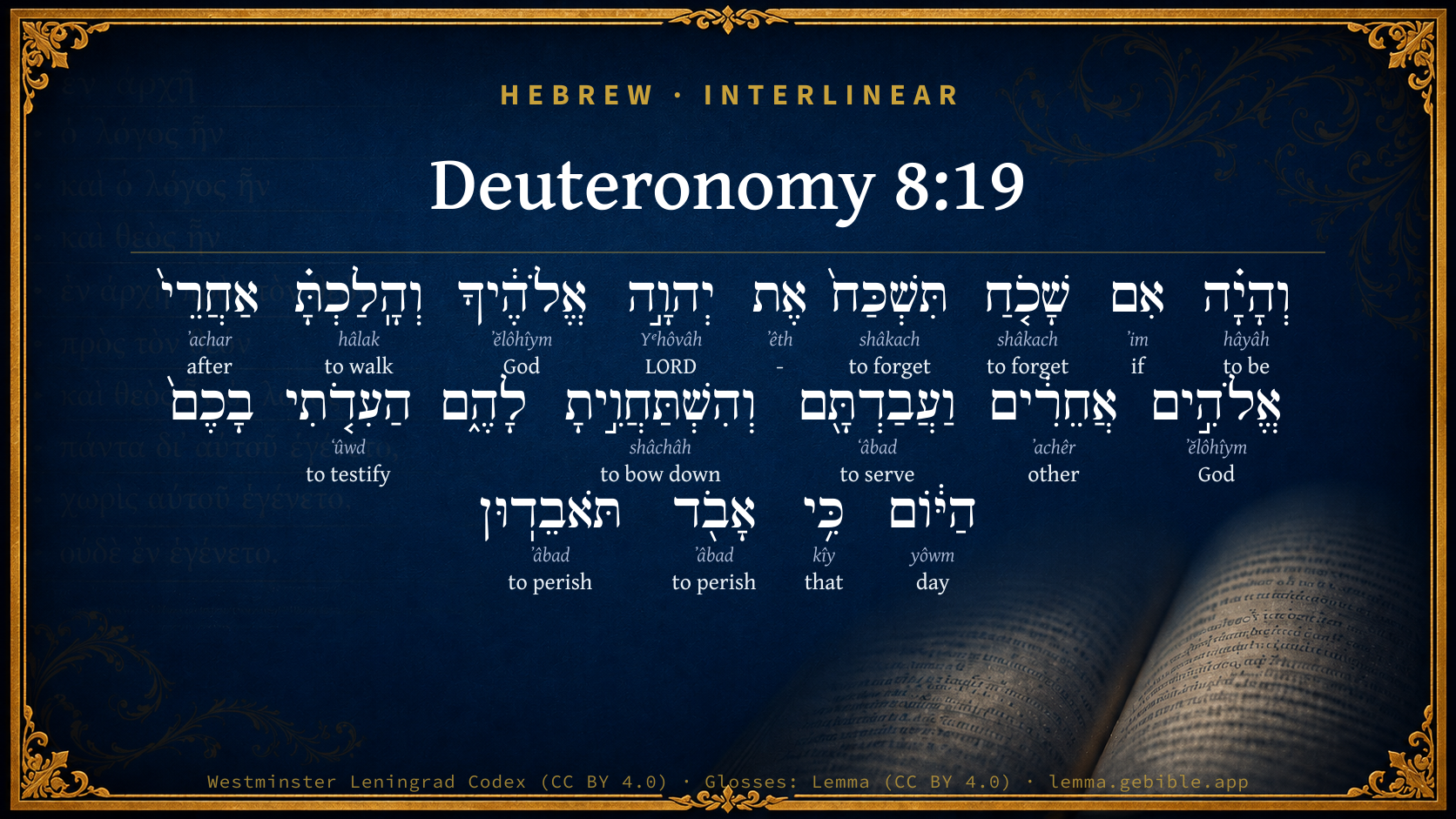
Deuteronomy 8:19

Hebrew (Westminster Leningrad Codex) Deuteronomy 8:19 appears in the Hebrew Old Testament. The text above is from the Westminster Leningrad Codex. Each word links to its Strong’s number, a concise gloss, and parsing drawn from the Open Scriptures Hebrew Bible morphology. Click any word for its full Brown-Driver-Briggs (BDB) entry.
Download image
Cite this verse

Deuteronomy 8:19 (World English Bible). Public Domain. Lemma interlinear Bible study tool, https://lemma.gebible.app/v/deuteronomy/8/19.

Show BibTeX & RIS
BibTeX
RIS
English Translation
It shall be, if you shall forget Yahweh your God, and walk after other gods, and serve them, and worship them, I testify against you this day that you shall surely perish.
World English Bible · Public Domain
Download a study sheet

One document with this verse’s original text, its word-by-word gloss line, the meaning frame, cross-references with their text, attributed commentary, and full source and license credits — printable, and it pastes into notes with its structure intact.

This verse Autodidact and up

Study sheet (.html) Plain text (.txt)

A passage Seminary Student

Up to 50 verses in one chapter. A passage sheet keeps up to 6 commentary sources and 12 cross-references per verse, in the order this page ranks them, and says so on the sheet whenever that leaves anything out. Ask for a single verse and you get the Autodidact verse sheet above.

Everything on this page stays free to read, with no account — the sheet is a download of what is already on screen, not access to it.

Want to remove ads? Support Godless Engineer
Compare translations 3

The same verse in 3 English versions, stacked beneath the original-language interlinear above. Click any original word for its lexicon entry.

Each is an independent rendering of the whole verse — the interlinear is not word-aligned to these translations.

Highlighted words mark where these versions differ — a whole-verse word diff, not a word-by-word alignment.

  • World English Bible Public Domain
    It shall be, if you shall forget Yahweh your God, and walk after other gods, and serve them, and worship them, I testify against you this day that you shall surely perish.
  • King James Version Public Domain
    And it shall be, if thou do at all forget the LORD thy God, and walk after other gods, and serve them, and worship them, I testify against you this day that ye shall surely perish.
  • unfoldingWord Literal Text CC BY-SA 4.0
    And it will happen, if forgetting, you forget Yahweh your God and walk after other gods and serve them and bow down to them, I testify against you today that perishing, you will perish.

unfoldingWord Literal Text — © unfoldingWord, licensed CC BY-SA 4.0. Word-aligned USFM3 via Door43 (git.door43.org/unfoldingWord/en_ult).

Versions to compare (up to 4)

3 of 4 selected

Show all 18 translations

Every available English version of this verse, each an independent rendering of the whole verse.

  • World English Bible Public Domain
    It shall be, if you shall forget Yahweh your God, and walk after other gods, and serve them, and worship them, I testify against you this day that you shall surely perish.
  • Berean Standard Bible Public Domain
    If you ever forget the LORD your God and go after other gods to worship and bow down to them, I testify against you today that you will surely perish.
  • Majority Standard Bible Public Domain
    If you ever forget the LORD your God and go after other gods to worship and bow down to them, I testify against you today that you will surely perish.
  • King James Version Public Domain
    And it shall be, if thou do at all forget the LORD thy God, and walk after other gods, and serve them, and worship them, I testify against you this day that ye shall surely perish.
  • American Standard Version (1901) Public Domain
    And it shall be, if thou shalt forget Jehovah thy God, and walk after other gods, and serve them, and worship them, I testify against you this day that ye shall surely perish.
  • Revised Version (1885) Public Domain
    And it shall be, if thou shalt forget the LORD thy God, and walk after other gods, and serve them, and worship them, I testify against you this day that ye shall surely perish.
  • Geneva Bible (1599) Public Domain
    And if thou forget the Lord thy God, and walke after other gods, and serue them, and worship them, I testifie vnto you this day that ye shall surely perish.
  • Douay-Rheims (1899) Public Domain
    But if thou forget the Lord thy God, and follow strange gods, and serve and adore them: behold now I foretell thee that thou shalt utterly perish.
  • Young's Literal Translation Public Domain
    `And it hath been -- if thou really forget Jehovah thy God, and hast gone after other gods, and served them, and bowed thyself to them, I have testified against you to-day that ye do utterly perish;
  • Literal Standard Version CC BY-SA 4.0
    And it has been, if you really forget your God YHWH, and have gone after other gods, and served them, and bowed yourself to them, I have testified against you today that you utterly perish.
  • Unlocked Literal Bible CC BY-SA 4.0
    It will happen that, if you will forget Yahweh your God and walk after other gods, worship them, and reverence them, I testify against you today that you will surely perish.
  • unfoldingWord Literal Text CC BY-SA 4.0
    And it will happen, if forgetting, you forget Yahweh your God and walk after other gods and serve them and bow down to them, I testify against you today that perishing, you will perish.
  • Darby Bible Public Domain
    And it shall be, if thou do at all forget Jehovah thy God, and go after other gods, and serve them, and bow down to them, I testify against you this day that ye shall utterly perish.
  • World Messianic Bible Public Domain
    It shall be, if you shall forget the LORD your God, and walk after other gods, and serve them and worship them, I testify against you today that you shall surely perish.
  • Webster's Bible Public Domain
    And it shall be, if thou shalt at all forget the LORD thy God, and walk after other gods, and serve them, and worship them, I testify against you this day that ye shall surely perish.
  • Free Bible Version CC BY-SA 4.0
    If you ever forget the Lord your God, and run after other gods, worshiping and bowing down to them, I assure you right now that you will definitely die!
  • Bible in Basic English Public Domain
    And it is certain that if at any time you are turned away from the Lord your God, and go after other gods, to be their servants and to give them worship, destruction will overtake you.
  • JPS Tanakh (1917) Public Domain
    And it shall be, if thou shalt forget the LORD thy God, and walk after other gods, and serve them, and worship them, I forewarn you this day that ye shall surely perish.

Literal Standard Version (2020), Covenant Press — licensed CC BY-SA 4.0. Text via the HelloAO Bible API (eBible.org). Unlocked Literal Bible (unfoldingWord) — licensed CC BY-SA 4.0. Text via the HelloAO Bible API (eBible.org). unfoldingWord Literal Text — © unfoldingWord, licensed CC BY-SA 4.0. Word-aligned USFM3 via Door43 (git.door43.org/unfoldingWord/en_ult). Free Bible Version, Dr. Jonathan Gallagher — licensed CC BY-SA 4.0. Text via the HelloAO Bible API (eBible.org).

Word by word

More ways to search: Search by grammar → Find every occurrence → Compare this word →

Practice this passage: Drill this verse → Learn its vocabulary →

הַעִדֹ֤תִי
ʻûwd
H5749
“to testify”
Verb, Hiphil, Perfect, 1st Person, Common, Singular
Part of Speech
Verb
Stem
Hiphil
Form
Perfect
Person
1st Person
Gender
Common
Number
Singular
Full BDB Definition

Origin: a primitive root

TWOT: 1576 , 1576d

to return, repeat, go about, do again - (Piel) to surround, go round and round - (Pilel) to restore, relieve - (Hithpalel) to be restored - to bear witness - (Qal) to bear witness, say again and again - (Hiphil) - to testify, bear witness - to cause to testify, take or call as witness, invoke - to protest, affirm solemnly, warn, exhort or enjoin solemnly, admonish, charge - (Hophal) to protest, give warning
  1. וְהָיָ֗ה hâyâh H1961 “and · to be” Conjunction + Verb, Qal, Sequential Perfect, 3rd Person, Masculine, Singular
  2. אִם ʼim H518 “if” Conjunction
  3. שָׁכֹ֤חַ shâkach H7911 “to forget” Verb, Qal, Infinitive Absolute
  4. תִּשְׁכַּח֙ shâkach H7911 “to forget” Verb, Qal, Imperfect, 2nd Person, Masculine, Singular
  5. אֶת ʼêth H853 “-” Particle, Direct Object
  6. יְהוָ֣ה Yᵉhôvâh H3068 “LORD” Noun, Proper
  7. אֱלֹהֶ֔יךָ ʼĕlôhîym H430 “God(s) · your” Noun, Common, Masculine, Plural, Construct + Suffix, Personal, 2nd Person, Masculine, Singular
  8. וְהָֽלַכְתָּ֗ hâlak H1980 “and · to walk” Conjunction + Verb, Qal, Sequential Perfect, 2nd Person, Masculine, Singular
  9. אַחֲרֵי֙ ʼachar H310 “after” Preposition
  10. אֱלֹהִ֣ים ʼĕlôhîym H430 “God(s)” Noun, Common, Masculine, Plural, Absolute
  11. אֲחֵרִ֔ים ʼachêr H312 “other” Adjective, Adjective, Masculine, Plural, Absolute
  12. וַעֲבַדְתָּ֖ם ʻâbad H5647 “and · to serve · them” Conjunction + Verb, Qal, Sequential Perfect, 2nd Person, Masculine, Singular + Suffix, Personal, 3rd Person, Masculine, Plural
  13. וְהִשְׁתַּחֲוִ֣יתָ shâchâh H7812 “and · to bow down” Conjunction + Verb, Hishtaphel, Sequential Perfect, 2nd Person, Masculine, Singular
  14. הַיּ֔וֹם yôwm H3117 “the · day” Particle, Definite Article + Noun, Common, Masculine, Singular, Absolute
  15. כִּ֥י kîy H3588 “that” Conjunction
  16. אָבֹ֖ד ʼâbad H6 “to perish” Verb, Qal, Infinitive Absolute
  17. תֹּאבֵדֽוּן ʼâbad H6 “to perish” Verb, Qal, Imperfect, 2nd Person, Masculine, Plural + Suffix, n

About this verse

These counts appear in no published source. They are computed here, from the morphology-tagged text and Lemma’s own curated glosses. What Lemma adds →

20
words
15
distinct lemmas
Pentateuch
section

Shared distinctive vocabulary

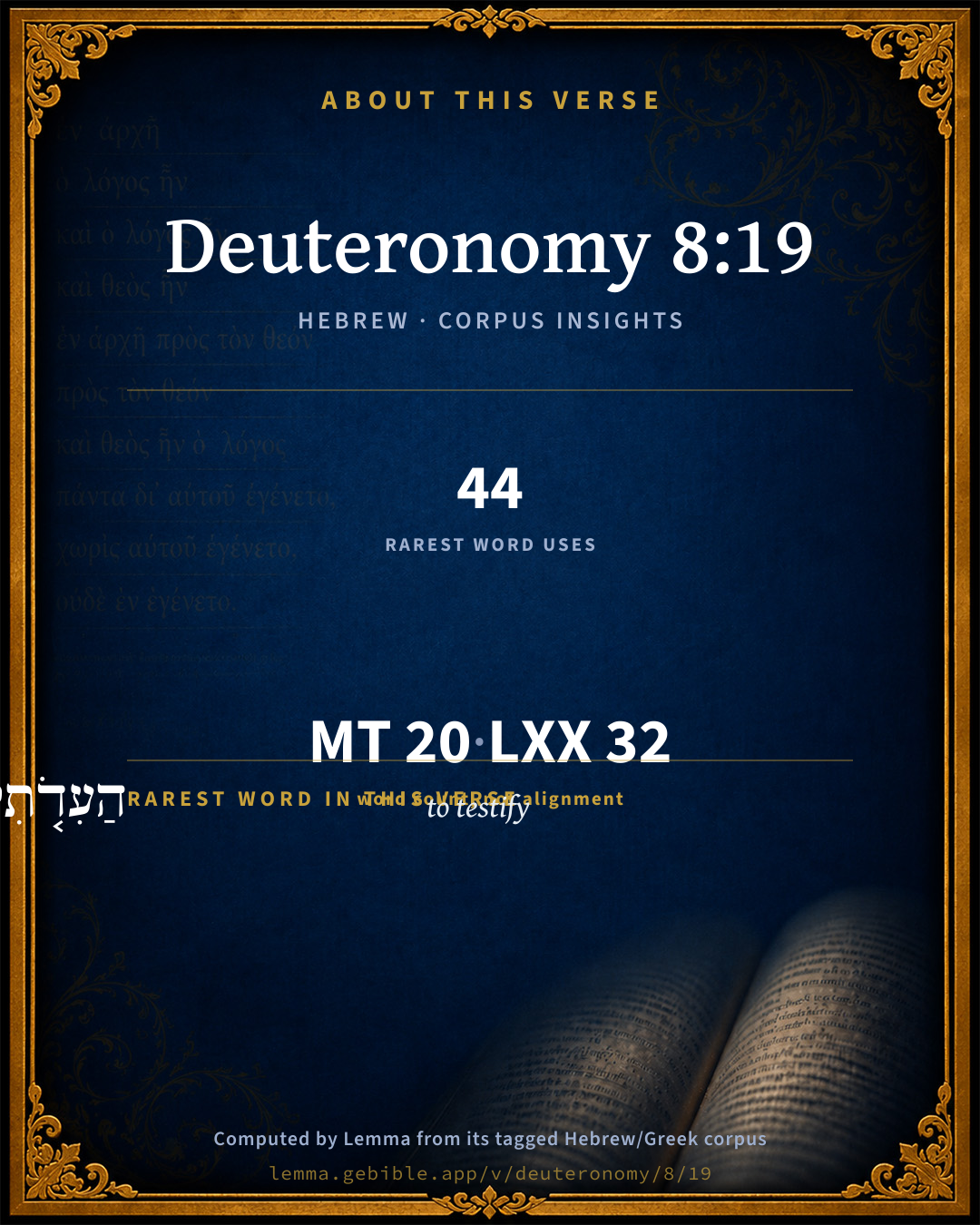
הַעִדֹ֤תִי to testify H5749 occurs in 40 verses of the Hebrew Bible. Also found in:

Grammatical profile

  • 9 verbs
  • 4 nouns
  • 1 adjective
  • 3 prepositions
  • 2 conjunctions
  • 1 particle

Verb forms

  • וְהָיָ֗ה Qal · Sequential Perfect
  • שָׁכֹ֤חַ Qal · Infinitive Absolute
  • תִּשְׁכַּח֙ Qal · Imperfect
  • וְהָֽלַכְתָּ֗ Qal · Sequential Perfect
  • וַעֲבַדְתָּ֖ם Qal · Sequential Perfect
  • וְהִשְׁתַּחֲוִ֣יתָ Hishtaphel · Sequential Perfect
  • הַעִדֹ֤תִי Hiphil · Perfect
  • אָבֹ֖ד Qal · Infinitive Absolute
  • תֹּאבֵדֽוּן Qal · Imperfect

Repetition

Words recur within this verse — often emphatic in Hebrew:

  • שָׁכֹ֤חַ to forget H7911 ×2
  • אֱלֹהֶ֔יךָ God H430 ×2
  • אָבֹ֖ד to perish H6 ×2

Hebrew & Septuagint length

In English translation the verse runs 32 words from the Hebrew and 44 from the Septuagint (LXX English) — closely comparable.

A rough comparison of the two English renderings, which tokenize alike — not a word-level alignment.

Word counts can differ between the Hebrew and the Greek without any difference in meaning — e.g. the Hebrew direct-object marker אֵת has no separate Greek word, and Greek often adds the article ὁ.

In the original languages it is 20 Hebrew tokens and 32 Greek tokens — but the two are counted differently (Hebrew bundles its prefixes and suffixes into one token; the Greek is in lemma form), so that isn’t a like-for-like length.

Cross-references

13

Topical passages linked to Deuteronomy 8:19 in the Treasury of Scripture Knowledge — connected by theme and wording, ordered by reader-vote popularity; previews shown in the World English Bible.

  • Deuteronomy 4:26 I call heaven and earth to witness against you this day, that you shall soon utterly perish from off the land whereunto you go over the Jordan to possess it; you shall not prolong your days on it, but shall utterly be destroyed.
  • Deuteronomy 29:25–28 Then men shall say, Because they forsook the covenant of Yahweh, the God of their fathers, which he made with them when he brought them forth out of the land of Egypt,
  • Deuteronomy 30:18–19 I denounce to you this day, that you shall surely perish; you shall not prolong your days in the land, where you pass over the Jordan to go in to possess it.
  • Joshua 23:13 know for a certainty that Yahweh your God will no more drive these nations from out of your sight; but they shall be a snare and a trap to you, and a scourge in your sides, and thorns in your eyes, until you perish from off this good land which Yahweh your God has given you.
  • 1 Samuel 12:25 But if you shall still do wickedly, you shall be consumed, both you and your king."
  • Daniel 9:2 in the first year of his reign I, Daniel, understood by the books the number of the years about which the word of Yahweh came to Jeremiah the prophet, for the accomplishing of the desolations of Jerusalem, even seventy years.
  • Amos 3:2 "You only have I chosen of all the families of the earth. Therefore I will punish you for all of your sins."
  • Zephaniah 1:18 Neither their silver nor their gold will be able to deliver them in the day of Yahweh's wrath, but the whole land will be devoured by the fire of his jealousy; for he will make an end, yes, a terrible end, of all those who dwell in the land.
  • Zephaniah 3:6 I have cut off nations. Their battlements are desolate. I have made their streets waste, so that no one passes by. Their cities are destroyed, so that there is no man, so that there is no inhabitant.
  • Luke 12:47–48 That servant, who knew his lord's will, and didn't prepare, nor do what he wanted, will be beaten with many stripes,
  • Luke 13:3 I tell you, no, but, unless you repent, you will all perish in the same way.
  • Luke 13:5 I tell you, no, but, unless you repent, you will all perish in the same way."
  • Deuteronomy 28:58–68 If you will not observe to do all the words of this law that are written in this book, that you may fear this glorious and fearful name, YAHWEH YOUR GOD;

Cross-references courtesy of OpenBible.info (CC BY 4.0).

Hebrew and Greek witnesses Masoretic Hebrew ↔ Greek Septuagint

The same verse in the two great witnesses to the Old Testament, shown verse-for-verse.

These are two independent witnesses, not word-aligned to each other, and the Septuagint is shown in lemma (dictionary) form.

Hebrew Deuteronomy 8:19 Masoretic · Westminster Leningrad Codex

וְהָיָ֗ה אִם שָׁכֹ֤חַ תִּשְׁכַּח֙ אֶת יְהוָ֣ה אֱלֹהֶ֔יךָ וְהָֽלַכְתָּ֗ אַחֲרֵי֙ אֱלֹהִ֣ים אֲחֵרִ֔ים וַעֲבַדְתָּ֖ם וְהִשְׁתַּחֲוִ֣יתָ לָהֶ֑ם הַעִדֹ֤תִי בָכֶם֙ הַיּ֔וֹם כִּ֥י אָבֹ֖ד תֹּאבֵדֽוּן

It shall be, if you shall forget Yahweh your God, and walk after other gods, and serve them, and worship them, I testify against you this day that you shall surely perish.

World English Bible · Public Domain

Greek LXX Deuteronomy 8:19 Septuagint · lemma form

καί εἰμί ἐάν λήθη ἐπιλανθάνω κύριος ὁ θεός σύ καί πορεύομαι ὀπίσω θεός ἕτερος καί λατρεύω αὐτός καί προςκυνέω αὐτός διαμαρτύρομαι σύ σήμερον ὁ τε οὐρανός καί ὁ γῆ ὅτι ἀπώλεια ἀποὀλλύω

And it shall come to pass if you do at all forget the Lord your God, and should go after other gods, and serve them, and worship them, I call heaven and earth to witness against you this day, that you⌃ shall surely perish.

LXX2012 (modern English Septuagint) · Public Domain

On this verse, The Cambridge Bible for Schools and Colleges discusses the Septuagint’s reading. Read the note in Commentary ↓

Hebrew: Westminster Leningrad Codex (CC BY 4.0). Greek: Septuagint (public domain); English from LXX2012 (modern English Septuagint) (Public Domain). How the Septuagint differs from the Hebrew →

Targum (Aramaic paraphrase)

2

The Targum is the ancient Jewish Aramaic paraphrase of the Hebrew Scriptures — an interpretive translation, not the Hebrew text itself. Onkelos (literal) and Pseudo-Jonathan (expansive) render the Torah, and Jonathan the Prophets. Coverage is partial: where no permissively-licensed English translation exists for a verse, only the Aramaic is shown. This is verse-level text, not a word-by-word alignment to the Hebrew.

  1. Targum Onkelos Torah (Genesis–Deuteronomy)
    וִיהֵי אִם מִנְשָׁאָה תִנְשֵׁי יָת דַחַלְתָּא דַיְיָ אֱלָהָךְ וּתְהַךְ בָּתַר טַעְוַת עַמְמַיָא וְתִפְלְחִנוּן וְתִסְגוּד לְהוֹן אַסְהֵדִית בְּכוֹן יוֹמָא דֵין אֲרֵי מֵיבַד תֵּיבְדוּן

    (no public-domain English translation for this verse)

    Targum Onkelos — Aramaic: “Onkelos Genesis” (public domain); “Onkelos Exodus” (public domain); “Onkelos Leviticus” (public domain); “Onkelos Numbers” (public domain); “Onkelos Deuteronomy” (public domain). English: “Sefaria Community Translation” (CC0 1.0 (public-domain dedication)); “J.W. Etheridge. The Targums of Onkelos and Jonathan Ben Uzziel on the Pentateuch. London: Longmans, Green, 1862” (public domain). Text via Sefaria.

  2. Targum Pseudo-Jonathan Torah (Genesis–Deuteronomy)
    וִיהֵי אִין מִנְשָׁא תִּינְשָׁא יַת דַּחַלְתָּא דַיְיָ אֱלָהָכוֹן וּתְהָכוּן בָּתַר טַעֲוַות עַמְמַיָא וְתִפְלְחִינוּן וְתִסְגְּדוּן לְהוֹן אַסְהָדִית עֲלֵיכוֹן יוֹמָא דֵין אֲרוּם מֵיבַד תֵּיבְדוּן

    For it shall be that if you forget the fear of the Lord your God, and go after the idols of the Gentiles, to serve and worship them, I testify against you this day, you will surely perish;

    Targum Pseudo-Jonathan — Aramaic: “Targum Jonathan on Genesis” (public domain); “Targum Jonathan on Exodus” (public domain); “Targum Jonathan on Leviticus” (public domain); “Targum Jonathan on Numbers” (public domain); “Targum Jonathan on Deuteronomy” (public domain). English: “The Targum of Jonathan ben Uzziel, trans. J. W. Etheridge, London, 1862” (public domain). Text via Sefaria.

Commentary

Notes on Deuteronomy 8:19 from classic Christian and Jewish commentators (each source and its license shown beneath its notes). The classic Christian expositions comment on the surrounding passage and are grouped to its opening verse, so a note may address several verses; the Jewish commentaries on the Tanakh (Rashi and others) are per-verse, so they appear only where the commentator wrote on this verse.

Lemma curates 59 commentaries, every one of them public domain or Creative Commons licensed, each selected and text-cleaned for this edition rather than reprinted as found. About our sources →

Trapp's Complete Commentary

John Trapp

Deu 8:19 And it shall be, if thou do at all forget the LORD thy God, and walk after other gods, and serve them, and worship them, I testify against you this day that ye shall surely perish.

Ver. 19. Ye shall surely perish.] Idolatry is a land desolating sin. {Jdg 5:8}

John Trapp, A Commentary or Exposition upon All the Books of the Old and New Testament (1647–1656) — public domain. Text from a community e-Sword module.

The Biblical Illustrator

Joseph S. Exell

Deu_8:19-20

If thou do at all forget the Lord.

Forgetfulness of God, destruction to the Soul

I. What is that forgetfulness of god of which the present effects on our moral and religious character are so highly injurious, and of which the future consequences in regard to our eternal prospects are so dreadfully fatal.

1. If any persons can rise up and lie down, go out and come in, day after day, and week after week, with scarcely a transient thought of Him whose hand has sustained them, whose long-suffering has borne with them, and whose bountiful goodness has supplied their various wants, those persons are clearly chargeable with forgetfulness of the Lord their God.

2. The same guilt must also lie at our door, if we are habitually unmindful of the attributes of God; and, particularly, of His omnipresence.

3. The same may justly be said of him who allows himself to think of his Creator under a different character from that in which He has revealed Himself to mankind in His holy Word.

II. The fearful doom which is denounced in the words of the text against those who are guilty of the sins there forbidden. The expression, to perish, when used in the Scriptures in a judicial sense, to describe the punishment of sin, does not mean the suffering of temporal death only--it further signifies the spiritual death of mans immortal part. (C. Townsend, M. A.)

A caution against forgetfulness of God

I. Men are liable to forget god.

1. We infer our liability to forget God, from the mysteriousness of His nature.

2. We infer our liability to forget God, from the moral dislike we have to Him.

3. We infer our liability to forget God, from the facts that fall under our notice.

4. We infer our liability to forget God, from the testimonies of the Scriptures (Psa_10:4; Psa_14:1-3; Job_21:14-15; Rom_1:28).

II. Forgetfulness of god is an evil against which we should be peculiarly on our guard. This is the intimation in the text, and the reasons on which it is founded are--

1. They who forget God must necessarily remain ignorant of Him.

2. They who forget God must necessarily disobey Him.

3. They who forget God must necessarily prove ungrateful to Him.

4. They who forget God must necessarily be punished by Him (Psa_9:17; Jdg_3:7-8).

III. Means should be used for the avoidance of this heinous crime. This is the object of the charge: Beware that thou forget not, etc.

1. Serious consideration should be exercised on all the things that belong unto our peace.

2. Fervent and unremitting prayer should be offered up to God for a change of heart.

3. We should constantly avoid those things which tend to exclude God from our thoughts.

4. Let us use all the means which tend to turn our thoughts towards God. Let us associate with the pious--frequent religious ordinances--read Gods most holy Word--contemplate death, judgment, and eternity. In conclusion--

(1) Inquire, Do we forget God? This may serve as a discriminating mark of moral character. Christians love to think of God--sinners strive to forget Him.

(2) Exhort those who forget God to consider their folly, their ingratitude, and their danger. (Sketches of Four Hundred Sermons.)

Gratitude and ingratitude toward God

Such a passage belongs to the prophetico-historical order. The warnings are repeated with added force in chap. 28. The experience of Israel brings this general lesson, that the thought of the Divine goodness should lead men to show thankful gratitude to God, and to offer Him a willing service. Notice--

I. The reasonableness of rendering a grateful service to god.

1. In the case of Israel the propriety for such a grateful service is clearly seen. All men owe obedience to God; but we should expect a highly favoured people like Israel to render it in a high degree. Israel had been brought from slavery to freedom, and were promised and received as their inheritance a land most highly favoured.

2. Above all, the system of moral law and social order, and the Divine rule of the theocracy elevated them far above surrounding nations. In view of it all, there was reason that the people should yield to God a grateful service.

3. If the Israelites had reason for this, much more we. What was Britain when Imperial Rome held sway? What is it now, when Rome and many another proud dominion are but names? Do we not owe our higher light and liberty to the truth and freedom of the Gospel? As a nation we owe our God thankful gratitude and service.

4. As individual members of a great Christian people we owe gratitude to God. Contrast our condition with the savage tribes discovered by a Livingstone or Stanley; with the higher yet still idolatrous and superstitious Hindu; with a cannibal of the race so graphically described by a John G. Paten or the semi-barbarous Chinaman with his history reaching far into the past ages before our own began, but who yet has not risen above the grossest superstition and a most materialistic idea of existence. Contrast our blessings alike bestowed on cottage and palace, with the darkness that prevails among the peoples, and reason will be found for the exercise of grateful service.

II. The sin of ingratitude.

1. The passage warns us against the danger of receiving and enjoying the gifts at the risk of forgetting the Divine Giver; all thought and energy are not to be applied to the acquisition of more and more of the gifts of this life to use them for our own use, etc.

2. Into this sin Israel fell. They became practical materialists. Even after the return from Babylon their enthusiasm for Gods work soon faded (Hag_1:1-15). So was it in our Lords day; and the ingratitude was then heightened by hypocrisy (Mat_21:33-46; Mat_23:26-39). Self and their own ease and glory were to them in reality, first; loving service toward God shown in works of love to their fellow men was far from them.

3. Is not this the spirit of too many in our time? There is a perpetual striving after the gains and pleasures of time, not that they may better serve God and become better men and women, but that they may have more of ease, more of the passing fleeting joys of this brief existence. This feature is seen in every class of the community. The socialistic schemes of the toiling millions are simply attempts to gain the kingdom of the material. But material possessions gained and received without due thankfulness to God and endeavours in His service, turn to dust and ashes in the using. Whereas if received with thankful hearts and used in His service, they may be transmuted and transformed into spiritual treasures, eternally enduring.

III. The effect of cultivating the spirit of gratitude or its opposite on material and individual life.

1. When a nation, in its government and institutions, publicly acknowledges its indebtedness to God, and makes public profession of loyalty to Him, God shall add to its blessings. Examples are not wanting.

2. So with individuals. God may not send material wealth, etc. But He will give them reasons for the joyful assurance that He is with them, and of the certainty of His promises. Hope for time, and assured hope for eternity. The effect will be closer communion and more consecrated service.

3. Far other is the effect of forgetting God whilst receiving His gifts. Remember how it was with Israel (Isa_1:3; Mat_23:38-39). Hardness of heart, material living, God-forgetfulness, idolatry--these were the steps of descent. Nothing so tends to harden the heart and quench the spiritual life than God-forgetfulness and ingratitude in using the Divine gifts. There are still too many who reap luxuriant fields without due gratitude to Him who sent sunshine and rain, etc., who attribute their success, wealth, etc., to their own skill and industry, who add possession to possession without one thought of using them beyond the narrow circle of their own lives.

4. The Divine rule is the only safe one: Seek ye first the kingdom of God, etc. (Mat_6:33). Let the soul be right with God through forgiveness, etc., in Christ, then we shall be guided to seek and enabled to find what is best for our mortal life, and will best avail us in thankfully doing our Heavenly Masters work. (Wm. Frank Scott.)

.

The Biblical Illustrator, edited by Joseph S. Exell (c. 1880s–1900s) — public domain. Text from a community e-Sword module.

Geneva Bible (1599)

Geneva Bible translators

Or, take to witness the heaven and the earth, as Deut. 4:26.

Geneva Bible (1599) marginal notes — public domain. Text via Bolls.life.

The Cambridge Bible for Schools and Colleges

gen. ed. J. J. S. Perowne

19. I testify against you] Here begins the Pl.: the phrase is found only with Pl. passages, here, Deu_4:26, Deu_30:19, Deu_32:46, cp. Deu_31:26; Deu_31:28; elsewhere only in Jer_11:7; Jer_42:19.

ye shall surely perish] Only here, Deu_4:26, Deu_30:18 all Pl.

19, 20. The change from the Sg. to the Pl. address (substantially so in Sam. and LXX) suggests that an expanding hand has been at work in these verses; and the suggestion is confirmed by the fact that the leading phrases in them are found elsewhere only with the Pl. Further, the destruction of the nation seems regarded as imminent.

The Cambridge Bible for Schools and Colleges (gen. ed. J. J. S. Perowne; Cambridge University Press, 1878–1918) — public domain. Text from a community e-Sword module.

John Gill's Exposition

As the nations which the Lord destroyeth before your face, so shall ye perish,.... Be cut off by the sword, or cast out as they were, the same sins, particularly idolatry, being committed by them. This is to be understood of the seven nations of the land of Canaan, which the Lord would be gradually destroying when Israel came into the possession of their land; and they might righteously expect the same treatment, should they be guilty of the same sins:

because ye would not be obedient to the voice of the Lord your God; expressed in his law, especially in the two first precepts of it, which require the worship of one God, and forbid the worshipping of idols; or to the Word of the Lord, as the Targum of Jonathan, Christ, the essential Word, in whom the name of the Lord was, and whose voice Israel was to obey, Exo 23:20.

Next: Deuteronomy Chapter 9

John Gill's Exposition of the Whole Bible (1746–1763) — public domain (CC PDM 1.0). Text via the HelloAO Bible API.

Haydock's Catholic Bible Commentary

Thee. Hebrew, "I attest this day against you, (Septuagint add heaven and earth,) that you shall," &c. God had already forbidden the worship of strange gods, Exodus xx. 3. He now threatens to punish the transgressors most severely. All nations have deemed it criminal to abandon the religion of their ancestors, unless when there is evident proofs of its absurdity, as was the case when so many embraced the doctrine of Jesus Christ, for which they were so cruelly persecuted. The Athenians would not suffer a word to be spoken against their gods; (Josephus, contra Apion ii.) and Cicero (Leg. ii.) lays down this as a law, "Let no one have gods to himself, nor any new ones: let him not adore, even in private, strange gods; unless they have been publicly acknowledged." (Calmet)

George Leo Haydock (1774–1849), Haydock's Catholic Family Bible and Commentary, 1859 edition — public domain. Excludes Psalms (Douay-Rheims chapter numbering differs from Protestant) and Deuterocanonical books (Catholic canon only).

Whedon's Commentary on the Bible

Daniel D. Whedon

19, 20. Surely perish — Again Moses seeks to deepen the impression which his admonitions may make by warning the people of the fate that will overtake them if they are disobedient.

Daniel D. Whedon (gen. ed.), Commentary on the Old and New Testaments (1874–1909) — public domain. Text from a community e-Sword module.

The Pulpit Commentary

Vers. 19, 20. Moses enforces his counsel by reminding them again that only destruction awaited them should they forget the Lord their God and apostatize from him. (cf. Deu_4:25, etc.; Deu_6:14)

Vers. 19, 20. See Homiletics: (De 28)

The Pulpit Commentary (1880–1919), ed. H.D.M. Spence-Jones & Joseph S. Exell — public domain. Text from a community e-Sword module.

Keil & Delitzsch

C. F. Keil & F. Delitzsch

To strengthen his admonition, Moses pointed again in conclusion, as he had already done in Deu 6:14 (cf. Deu 4:25.), to the destruction which would come upon Israel through apostasy from its God.

Keil & Delitzsch — Biblical Commentary on the Old Testament (1861–1891) — public domain (CC PDM 1.0). Text via the HelloAO Bible API. (Old Testament only.)

Sforno

Rabbi Ovadia Sforno

When and if you forget. This wil happen when you credit your success to your own actions, and do not bless Hashem for it.

You will surely be destroyed. From both this world and the World to Come.

Sforno on the Tanakh — English translation: “Yalkut, Sifsei Chachomim Chumash, Metsudah Publications, 2009” (CC BY 4.0). Text via Sefaria.

Lesson kit

Teaching starters — assembled from the data on this page, not authored interpretation. Every prompt links to the verse data it draws on. Edit before teaching.

Deuteronomy, in the Pentateuch, opens this verse with 20 words (15 distinct Hebrew lemmas). Its most distinctive word is ʻûwd (“to testify”). A historical commentator’s framing appears above. Read the whole chapter for the surrounding context.

Discussion questions

  1. What does “to testify” (ʻûwd) contribute to the verse as a whole?
  2. How does Genesis 43:3, which shares the word «to testify», read alongside this verse?
  3. What does the repetition of “to forget” (2× in this one verse) do in this verse?
  4. These translations render this verse differently. What is at stake in choosing one wording over another?
  5. «וְהָיָ֗ה» is a Qal Sequential Perfect verb. How does that grammatical form shape the action described?
  6. Compare how Trapp's Complete Commentary and The Biblical Illustrator read this verse. Where do they agree or differ?

Things to notice

Reading settings

Reading text

Shown beneath each verse's original-language words.

Old Testament
Old Testament edition

Read the OT as the Masoretic Hebrew (MT) or the Greek Septuagint (LXX).

English shown for the Greek Septuagint (in the Hebrew ↔ Greek comparison).

Comparing translations? Open the Compare panel on any verse page to stack up to four side by side.