
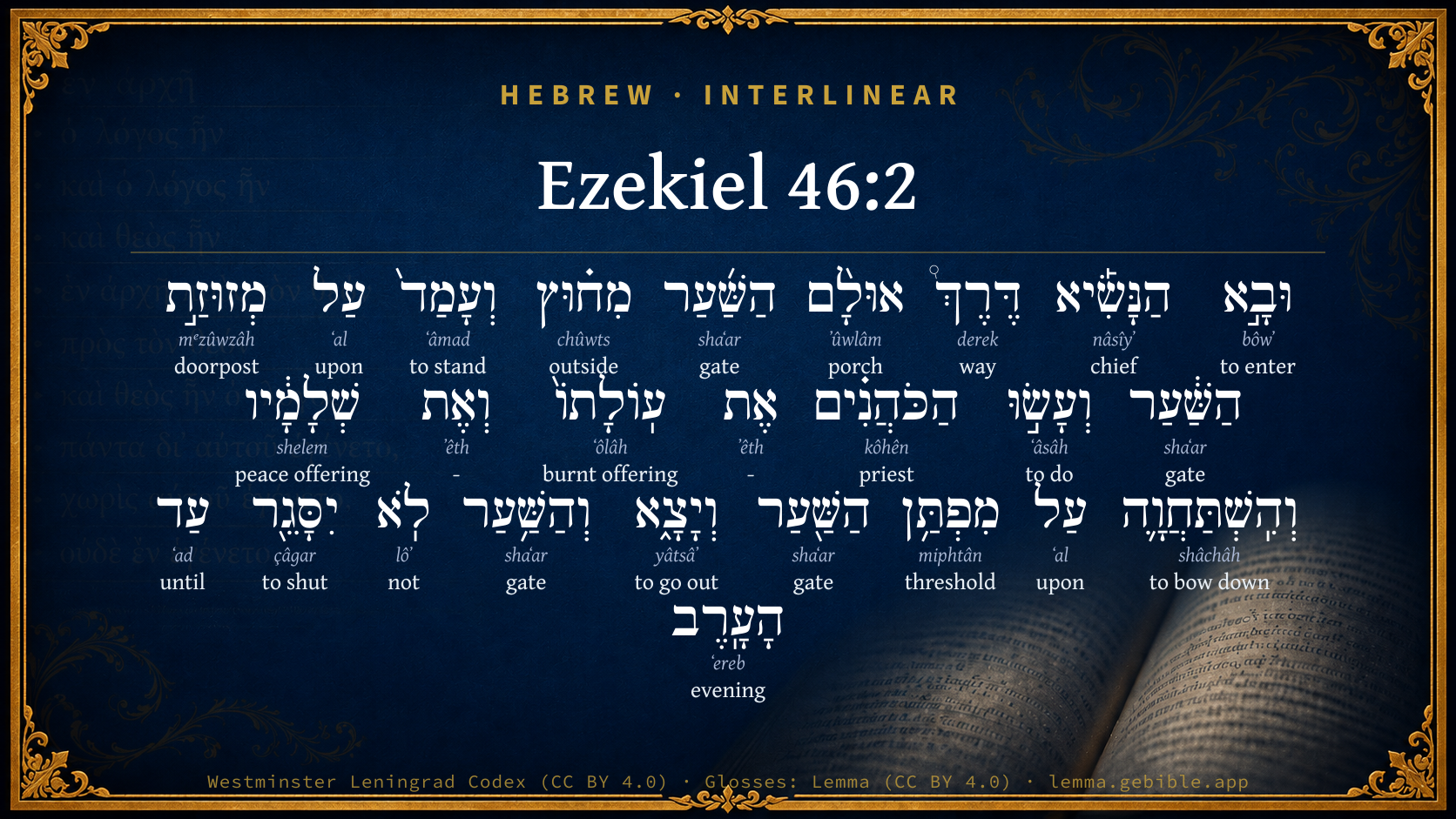
Ezekiel 46:2

Hebrew (Westminster Leningrad Codex) Ezekiel 46:2 appears in the Hebrew Old Testament. The text above is from the Westminster Leningrad Codex. Each word links to its Strong’s number, a concise gloss, and parsing drawn from the Open Scriptures Hebrew Bible morphology. Click any word for its full Brown-Driver-Briggs (BDB) entry.
Download image
Cite this verse

Ezekiel 46:2 (World English Bible). Public Domain. Lemma interlinear Bible study tool, https://lemma.gebible.app/v/ezekiel/46/2.

Show BibTeX & RIS
BibTeX
RIS
English Translation
The prince shall enter by the way of the porch of the gate outside, and shall stand by the post of the gate; and the priests shall prepare his burnt-offering and his peace-offerings, and he shall worship at the threshold of the gate: then he shall go forth; but the gate shall not be shut until the evening.
World English Bible · Public Domain
Download a study sheet

One document with this verse’s original text, its word-by-word gloss line, the meaning frame, cross-references with their text, attributed commentary, and full source and license credits — printable, and it pastes into notes with its structure intact.

This verse Autodidact and up

Study sheet (.html) Plain text (.txt)

A passage Seminary Student

Up to 50 verses in one chapter. A passage sheet keeps up to 6 commentary sources and 12 cross-references per verse, in the order this page ranks them, and says so on the sheet whenever that leaves anything out. Ask for a single verse and you get the Autodidact verse sheet above.

Everything on this page stays free to read, with no account — the sheet is a download of what is already on screen, not access to it.

Want to remove ads? Support Godless Engineer
Compare translations 3

The same verse in 3 English versions, stacked beneath the original-language interlinear above. Click any original word for its lexicon entry.

Each is an independent rendering of the whole verse — the interlinear is not word-aligned to these translations.

Highlighted words mark where these versions differ — a whole-verse word diff, not a word-by-word alignment.

  • World English Bible Public Domain
    The prince shall enter by the way of the porch of the gate outside, and shall stand by the post of the gate; and the priests shall prepare his burnt-offering and his peace-offerings, and he shall worship at the threshold of the gate: then he shall go forth; but the gate shall not be shut until the evening.
  • King James Version Public Domain
    And the prince shall enter by the way of the porch of that gate without, and shall stand by the post of the gate, and the priests shall prepare his burnt offering and his peace offerings, and he shall worship at the threshold of the gate: then he shall go forth; but the gate shall not be shut until the evening.
  • unfoldingWord Literal Text CC BY-SA 4.0
    The prince will enter the outer courtyard by the way of the gate and its portico from outside, and he will stand before the doorposts of the inner gate while the priests perform his burnt offering and peace offering. Then he will worship at the threshold of the inner gate and go out, but the gate will not be shut until evening.

unfoldingWord Literal Text — © unfoldingWord, licensed CC BY-SA 4.0. Word-aligned USFM3 via Door43 (git.door43.org/unfoldingWord/en_ult).

Versions to compare (up to 4)

3 of 4 selected

Show all 18 translations

Every available English version of this verse, each an independent rendering of the whole verse.

  • World English Bible Public Domain
    The prince shall enter by the way of the porch of the gate outside, and shall stand by the post of the gate; and the priests shall prepare his burnt-offering and his peace-offerings, and he shall worship at the threshold of the gate: then he shall go forth; but the gate shall not be shut until the evening.
  • Berean Standard Bible Public Domain
    The prince is to enter from the outside through the portico of the gateway and stand by the gatepost, while the priests sacrifice his burnt offerings and peace offerings. He is to bow in worship at the threshold of the gate and then depart, but the gate must not be shut until evening.
  • Majority Standard Bible Public Domain
    The prince is to enter from the outside through the portico of the gateway and stand by the gatepost, while the priests sacrifice his burnt offerings and peace offerings. He is to bow in worship at the threshold of the gate and then depart, but the gate must not be shut until evening.
  • King James Version Public Domain
    And the prince shall enter by the way of the porch of that gate without, and shall stand by the post of the gate, and the priests shall prepare his burnt offering and his peace offerings, and he shall worship at the threshold of the gate: then he shall go forth; but the gate shall not be shut until the evening.
  • American Standard Version (1901) Public Domain
    And the prince shall enter by the way of the porch of the gate without, and shall stand by the post of the gate; and the priests shall prepare his burnt-offering and his peace-offerings, and he shall worship at the threshold of the gate: then he shall go forth; but the gate shall not be shut until the evening.
  • Revised Version (1885) Public Domain
    And the prince shall enter by the way of the porch of the gate without, and shall stand by the post of the gate, and the priests shall prepare his burnt offering and his peace offerings, and he shall worship at the threshold of the gate; then he shall go forth: but the gate shall not be shut until the evening.
  • Geneva Bible (1599) Public Domain
    And the prince shall enter by the way of the porch of that gate without, and shall stande by the post of the gate, and the Priests shall make his burnt offring, and his peace offrings, and he shall worship at the threshold of the gate: after, he shall go foorth, but the gate shall not be shut till the euening.
  • Douay-Rheims (1899) Public Domain
    And the prince shall enter by the way of the porch of the gate from without, and he shall stand at the threshold of the gate: and the priests shall offer his holocaust, and his peace offerings: and he shall adore upon the threshold of the gate, and shall go out: but the gate shall not be shut till the evening.
  • Young's Literal Translation Public Domain
    and come in hath the prince the way of the porch of the gate at the outside, and he hath stood by the post of the gate, and the priests have made his burnt-offering, and his peace-offerings, and he hath bowed himself by the opening of the gate, and hath gone forth, and the gate is not shut till the evening.
  • Literal Standard Version CC BY-SA 4.0
    and the prince has come in the way of the porch of the gate from the outside, and he has stood by the post of the gate, and the priests have made his burnt-offering, and his peace-offerings, and he has bowed himself by the opening of the gate, and has gone forth, and the gate is not shut until the evening.
  • Unlocked Literal Bible CC BY-SA 4.0
    The prince will enter the outer courtyard by the way of the gate and its portico from outside, and he will stand before the doorposts of the inner gate while the priests perform his burnt offering and peace offering. Then he will worship at the threshold of the inner gate and go out, but the gate will not be shut until evening.
  • unfoldingWord Literal Text CC BY-SA 4.0
    The prince will enter the outer courtyard by the way of the gate and its portico from outside, and he will stand before the doorposts of the inner gate while the priests perform his burnt offering and peace offering. Then he will worship at the threshold of the inner gate and go out, but the gate will not be shut until evening.
  • Darby Bible Public Domain
    And the prince shall enter by the way of the porch of [that] gate from without, and shall stand by the post of the gate, and the priests shall offer his burnt-offering and his peace-offerings, and he shall worship at the threshold of the gate, and shall go forth: but the gate shall not be shut until the evening.
  • World Messianic Bible Public Domain
    The prince shall enter by the way of the porch of the gate outside, and shall stand by the post of the gate; and the priests shall prepare his burnt offering and his peace offerings, and he shall worship at the threshold of the gate. Then he shall go out, but the gate shall not be shut until the evening.
  • Webster's Bible Public Domain
    And the prince shall enter by the way of the porch of that gate without, and shall stand by the post of the gate, and the priest shall prepare his burnt-offering and his peace-offerings, and he shall worship at the threshhold of the gate: then he shall go forth; but the gate shall not be shut until the evening.
  • Free Bible Version CC BY-SA 4.0
    The prince must come through the gateway porch from outside and he will stand by the gatepost, and the priests will sacrifice his burnt offerings and peace offerings. He is to bow in respect at the gate's threshold of the gate and leave, but the gate is not to be shut until evening.
  • Bible in Basic English Public Domain
    And the ruler is to go in through the covered way of the outer doorway outside, and take his place by the pillar of the doorway, and the priests will make his burned offering and his peace-offerings and he will give worship at the doorstep of the doorway; then he will go out, and the door will not be shut till the evening.
  • JPS Tanakh (1917) Public Domain
    And the prince shall enter by the way of the porch of the gate without, and shall stand by the post of the gate, and the priests shall prepare his burnt-offering and his peace-offerings, and he shall worship at the threshold of the gate; then he shall go forth; but the gate shall not be shut until the evening.

Literal Standard Version (2020), Covenant Press — licensed CC BY-SA 4.0. Text via the HelloAO Bible API (eBible.org). Unlocked Literal Bible (unfoldingWord) — licensed CC BY-SA 4.0. Text via the HelloAO Bible API (eBible.org). unfoldingWord Literal Text — © unfoldingWord, licensed CC BY-SA 4.0. Word-aligned USFM3 via Door43 (git.door43.org/unfoldingWord/en_ult). Free Bible Version, Dr. Jonathan Gallagher — licensed CC BY-SA 4.0. Text via the HelloAO Bible API (eBible.org).

Word by word

More ways to search: Search by grammar → Find every occurrence → Compare this word →

Practice this passage: Drill this verse → Learn its vocabulary →

מִפְתַּ֥ן
miphtân
H4670
“threshold of”
Noun, Common, Masculine, Singular, Construct
Part of Speech
Noun
Type
Common
Gender
Masculine
Number
Singular
State
Construct
Full BDB Definition

Origin: from the same as H6620

TWOT: 1858b

threshold
  1. וּבָ֣א bôwʼ H935 “and · to enter” Conjunction + Verb, Qal, Sequential Perfect, 3rd Person, Masculine, Singular
  2. הַנָּשִׂ֡יא nâsîyʼ H5387 “the · chief” Particle, Definite Article + Noun, Common, Masculine, Singular, Absolute
  3. דֶּרֶךְ֩ derek H1870 “way of” Noun, Common, Both, Singular, Construct
  4. אוּלָ֨ם ʼûwlâm H197 “porch of” Noun, Common, Masculine, Singular, Construct
  5. הַשַּׁ֜עַר shaʻar H8179 “the · gate” Particle, Definite Article + Noun, Common, Masculine, Singular, Absolute
  6. מִח֗וּץ chûwts H2351 “from · outside” Preposition + Noun, Common, Masculine, Singular, Absolute
  7. וְעָמַד֙ ʻâmad H5975 “and · to stand” Conjunction + Verb, Qal, Sequential Perfect, 3rd Person, Masculine, Singular
  8. עַל ʻal H5921 “upon” Preposition
  9. מְזוּזַ֣ת mᵉzûwzâh H4201 “doorpost of” Noun, Common, Feminine, Singular, Construct
  10. הַשַּׁ֔עַר shaʻar H8179 “the · gate” Particle, Definite Article + Noun, Common, Masculine, Singular, Absolute
  11. וְעָשׂ֣וּ ʻâsâh H6213 “and · to do” Conjunction + Verb, Qal, Sequential Perfect, 3rd Person, Common, Plural
  12. הַכֹּהֲנִ֗ים kôhên H3548 “the · priests” Particle, Definite Article + Noun, Common, Masculine, Plural, Absolute
  13. אֶת ʼêth H853 “-” Particle, Direct Object
  14. עֽוֹלָתוֹ֙ ʻôlâh H5930 “burnt offering · his” Noun, Common, Feminine, Singular, Construct + Suffix, Personal, 3rd Person, Masculine, Singular
  15. וְאֶת ʼêth H853 “and · -” Conjunction + Particle, Direct Object
  16. שְׁלָמָ֔יו shelem H8002 “peace offerings · his” Noun, Common, Masculine, Plural, Construct + Suffix, Personal, 3rd Person, Masculine, Singular
  17. וְהִֽשְׁתַּחֲוָ֛ה shâchâh H7812 “and · to bow down” Conjunction + Verb, Hishtaphel, Sequential Perfect, 3rd Person, Masculine, Singular
  18. עַל ʻal H5921 “upon” Preposition
  19. הַשַּׁ֖עַר shaʻar H8179 “the · gate” Particle, Definite Article + Noun, Common, Masculine, Singular, Absolute
  20. וְיָצָ֑א yâtsâʼ H3318 “and · to go out” Conjunction + Verb, Qal, Sequential Perfect, 3rd Person, Masculine, Singular
  21. וְהַשַּׁ֥עַר shaʻar H8179 “and · the · gate” Conjunction + Particle, Definite Article + Noun, Common, Masculine, Singular, Absolute
  22. לֹֽא lôʼ H3808 “not” Particle, Negative
  23. יִסָּגֵ֖ר çâgar H5462 “to shut” Verb, Niphal, Imperfect, 3rd Person, Masculine, Singular
  24. עַד ʻad H5704 “until” Preposition
  25. הָעָֽרֶב ʻereb H6153 “the · evening” Particle, Definite Article + Noun, Common, Masculine, Singular, Absolute

About this verse

These counts appear in no published source. They are computed here, from the morphology-tagged text and Lemma’s own curated glosses. What Lemma adds →

26
words
21
distinct lemmas
Prophets
section

Notable vocabulary

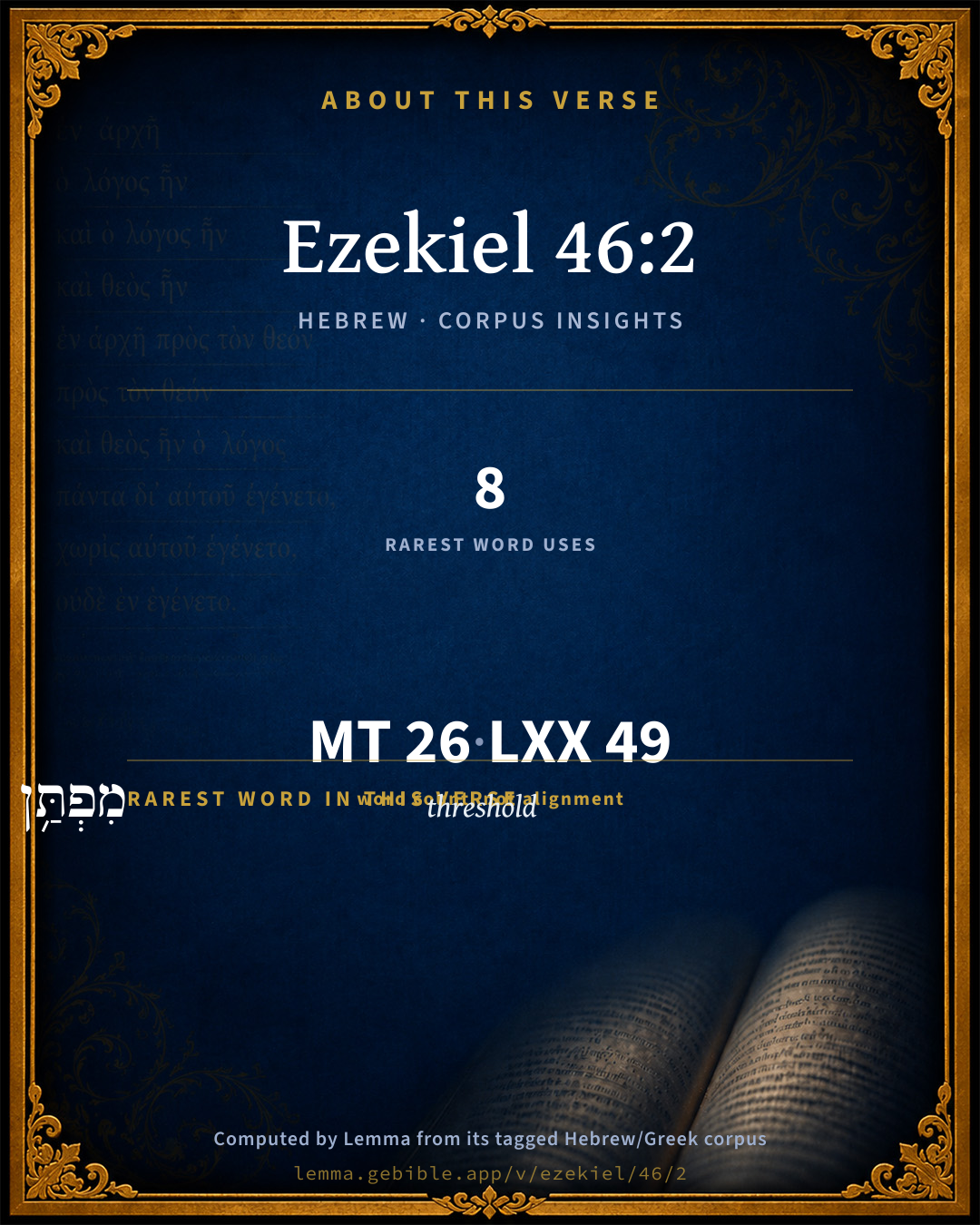
The rarest word here is מִפְתַּ֥ן threshold H4670 — appearing just 8 times in the whole Hebrew Bible.

Shared distinctive vocabulary

מִפְתַּ֥ן threshold H4670 occurs in 8 verses of the Hebrew Bible. Also found in:

Grammatical profile

  • 6 verbs
  • 14 nouns
  • 3 prepositions
  • 3 particles

Verb forms

  • וּבָ֣א Qal · Sequential Perfect
  • וְעָמַד֙ Qal · Sequential Perfect
  • וְעָשׂ֣וּ Qal · Sequential Perfect
  • וְהִֽשְׁתַּחֲוָ֛ה Hishtaphel · Sequential Perfect
  • וְיָצָ֑א Qal · Sequential Perfect
  • יִסָּגֵ֖ר Niphal · Imperfect

Repetition

Words recur within this verse — often emphatic in Hebrew:

  • הַשַּׁ֜עַר gate H8179 ×4
  • עַל upon H5921 ×2

Hebrew & Septuagint length

In English translation the verse runs 58 words from the Hebrew and 60 from the Septuagint (LXX English) — closely comparable.

A rough comparison of the two English renderings, which tokenize alike — not a word-level alignment.

Word counts can differ between the Hebrew and the Greek without any difference in meaning — e.g. the Hebrew direct-object marker אֵת has no separate Greek word, and Greek often adds the article ὁ.

In the original languages it is 26 Hebrew tokens and 49 Greek tokens — but the two are counted differently (Hebrew bundles its prefixes and suffixes into one token; the Greek is in lemma form), so that isn’t a like-for-like length.

Cross-references

15

Topical passages linked to Ezekiel 46:2 in the Treasury of Scripture Knowledge — connected by theme and wording, ordered by reader-vote popularity; previews shown in the World English Bible.

  • Ezekiel 44:3 As for the prince, he shall sit therein as prince to eat bread before Yahweh; he shall enter by the way of the porch of the gate, and shall go out by the way of the same.
  • Ezekiel 46:8 When the prince shall enter, he shall go in by the way of the porch of the gate, and he shall go forth by the way of it.
  • 1 Kings 8:22–23 Solomon stood before the altar of Yahweh in the presence of all the assembly of Israel, and spread forth his hands toward heaven;
  • 1 Chronicles 17:16 Then David the king went in, and sat before Yahweh; and he said, Who am I, Yahweh God, and what is my house, that you have brought me thus far?
  • 1 Chronicles 29:10–12 Therefore David blessed Yahweh before all the assembly; and David said, You are blessed, Yahweh, the God of Israel our father, forever and ever.
  • 2 Chronicles 6:13 (for Solomon had made a brazen scaffold, five cubits long, and five cubits broad, and three cubits high, and had set it in the midst of the court; and on it he stood, and kneeled down on his knees before all the assembly of Israel, and spread forth his hands toward heaven;)
  • 2 Chronicles 23:13 and she looked, and, behold, the king stood by his pillar at the entrance, and the captains and the trumpets by the king; and all the people of the land rejoiced, and blew trumpets; the singers also [played] on instruments of music, and led the singing of praise. Then Athaliah tore her clothes, and said, Treason! treason!
  • 2 Chronicles 29:29 When they had made an end of offering, the king and all who were present with him bowed themselves and worshiped.
  • 2 Chronicles 34:31 The king stood in his place, and made a covenant before Yahweh, to walk after Yahweh, and to keep his commandments, and his testimonies, and his statutes, with all his heart, and with all his soul, to perform the words of the covenant that were written in this book.
  • Ezekiel 45:19 The priest shall take of the blood of the sin-offering, and put it on the door-posts of the house, and on the four corners of the ledge of the altar, and on the posts of the gate of the inner court.
  • Ezekiel 46:12 When the prince shall prepare a freewill-offering, a burnt offering or peace-offerings as a freewill-offering to Yahweh, one shall open for him the gate that looks toward the east; and he shall prepare his burnt offering and his peace-offerings, as he does on the Sabbath day: then he shall go forth; and after his going forth one shall shut the gate.
  • Matthew 26:39 He went forward a little, fell on his face, and prayed, saying, "My Father, if it is possible, let this cup pass away from me; nevertheless, not what I desire, but what you desire."
  • John 10:1–3 "Most assuredly, I tell you, one who doesn't enter by the door into the sheep fold, but climbs up some other way, the same is a thief and a robber.
  • Colossians 1:28 whom we proclaim, admonishing every man and teaching every man in all wisdom, that we may present every man perfect in Christ Jesus;
  • Hebrews 5:7–8 He, in the days of his flesh, having offered up prayers and petitions with strong crying and tears to him who was able to save him from death, and having been heard for his godly fear,

Cross-references courtesy of OpenBible.info (CC BY 4.0).

Hebrew and Greek witnesses Masoretic Hebrew ↔ Greek Septuagint

The same verse in the two great witnesses to the Old Testament, shown verse-for-verse.

These are two independent witnesses, not word-aligned to each other, and the Septuagint is shown in lemma (dictionary) form.

Hebrew Ezekiel 46:2 Masoretic · Westminster Leningrad Codex

וּבָ֣א הַנָּשִׂ֡יא דֶּרֶךְ֩ אוּלָ֨ם הַשַּׁ֜עַר מִח֗וּץ וְעָמַד֙ עַל מְזוּזַ֣ת הַשַּׁ֔עַר וְעָשׂ֣וּ הַכֹּהֲנִ֗ים אֶת עֽוֹלָתוֹ֙ וְאֶת שְׁלָמָ֔יו וְהִֽשְׁתַּחֲוָ֛ה עַל מִפְתַּ֥ן הַשַּׁ֖עַר וְיָצָ֑א וְהַשַּׁ֥עַר לֹֽא יִסָּגֵ֖ר עַד הָעָֽרֶב

The prince shall enter by the way of the porch of the gate outside, and shall stand by the post of the gate; and the priests shall prepare his burnt-offering and his peace-offerings, and he shall worship at the threshold of the gate: then he shall go forth; but the gate shall not be shut until the evening.

World English Bible · Public Domain

Greek LXX Ezekiel 46:2 Septuagint · lemma form

καί εἰςἔρχομαι ὁ ἀποἡγέομαι κατά ὁ ὁδός ὁ αιλαμ ὁ πύλη ὁ ἔξωθεν καί ἵστημι ἐπί ὁ πρόθυρον ὁ πύλη καί ποιέω ὁ ἱερεύς ὁ ὁλοκαύτωμα αὐτός καί ὁ ὁ σωτήριον αὐτός καί προςκυνέω ἐπί ὁ πρόθυρον ὁ πύλη καί ἐκἔρχομαι καί ὁ πύλη οὐ μή κλείω ἕως ἑσπέρα

And the prince shall enter by the way of the porch of the inner gate, and shall stand at the entrance of the gate, and the priests shall prepare his whole burnt offerings and his peace-offerings, and he shall worship at the entrance of the gate: then shall he come forth; but the gate shall not be shut till evening.

LXX2012 (modern English Septuagint) · Public Domain

Hebrew: Westminster Leningrad Codex (CC BY 4.0). Greek: Septuagint (public domain); English from LXX2012 (modern English Septuagint) (Public Domain). How the Septuagint differs from the Hebrew →

Targum (Aramaic paraphrase)

1

The Targum is the ancient Jewish Aramaic paraphrase of the Hebrew Scriptures — an interpretive translation, not the Hebrew text itself. Onkelos (literal) and Pseudo-Jonathan (expansive) render the Torah, and Jonathan the Prophets. Coverage is partial: where no permissively-licensed English translation exists for a verse, only the Aramaic is shown. This is verse-level text, not a word-by-word alignment to the Hebrew.

  1. Targum Jonathan Prophets (Joshua–Malachi)
    וְיֵעוֹל רַבָּא בְּאוֹרַח אוּלַמָא דְתַרְעָא מִלְבָרָא וִיקוּם עַל סְקוּפַת תַּרְעָא וְיַעְבְּדוּן כַּהֲנַיָא יַת עֲלָתֵיהּ וְיַת נִכְסַת קוּדְשֵׁיהּ וְיִסְגוֹד עַל סְקוֹפַת תַּרְעָא וְיִפּוֹק וְתַרְעָא לָא יִתְאָחִיד עַד רַמְשָׁא:

    (no public-domain English translation for this verse)

    Targum Jonathan — Aramaic: “Mikraot Gedolot” (public domain). English: “Sefaria Community Translation” (CC0 1.0 (public-domain dedication)); “London "Chaldee Paraphrase," 1871” (public domain). Text via Sefaria.

Commentary

Notes on Ezekiel 46:2 from classic Christian and Jewish commentators (each source and its license shown beneath its notes). The classic Christian expositions comment on the surrounding passage and are grouped to its opening verse, so a note may address several verses; the Jewish commentaries on the Tanakh (Rashi and others) are per-verse, so they appear only where the commentator wrote on this verse.

Lemma curates 59 commentaries, every one of them public domain or Creative Commons licensed, each selected and text-cleaned for this edition rather than reprinted as found. About our sources →

Trapp's Complete Commentary

John Trapp

Eze 46:2 And the prince shall enter by the way of the porch of [that] gate without, and shall stand by the post of the gate, and the priests shall prepare his burnt offering and his peace offerings, and he shall worship at the threshold of the gate: then he shall go forth; but the gate shall not be shut until the evening.

Ver. 2. And shall stand by the post of the gate.] Waiting at the posts of the gates of wisdom. {Pro 8:34} Constantine the Great stood up constantly at the time of God’s public worship for honour sake. So did our Edward VI.

Then he shall go forth.] And the people come in, {Eze 46:3} whose souls are as precious to God as his.

But the gate shall not be shut until the evening.] The gate is open till the evening; be ready therefore. When the bridegroom is once gone in, the gate is shut, and fools excluded. {Mat 25:10-12}

John Trapp, A Commentary or Exposition upon All the Books of the Old and New Testament (1647–1656) — public domain. Text from a community e-Sword module.

Joseph Benson's Commentary

Eze 46:2-3. The prince shall enter by the way of the porch of that gate without — The prince shall go through the outer gate of that court, and so pass to the inner gate, where he may see the whole service performed at the altar. And shall stand by the post of the gate — That is, by the entrance of the gate, where there was a seat prepared for him: see note on Eze 44:2. And the priests shall prepare his burnt-offering — Or, offer his burnt-offering, as the original word often signifies. And he shall worship at the threshold of the gate — By bowing his head, bowing down his face to the ground, or falling down upon the ground, as the posture of divine worship is elsewhere described. But the gate shall not be shut until the evening — Because the people were to pay their solemn worship in the same place, as is prescribed in the following verse. Likewise the people shall worship at the door of this gate — Here the inner porch of the east gate is assigned for their station, who came to present themselves before the Lord upon the solemn festivals, and they were to come no further into the inner court.

Joseph Benson's Commentary on the Old and New Testaments (1811–1818) — public domain. Text from a community e-Sword module.

Tyndale Open Study Notes

Tyndale Open Resources

46:2 The prince would have the unique privilege of going through the eastern gateway to the inner courtyard as far as the entry room to worship. This symbolized that God regarded him as more significant than the common people, but that he was still not fit to stand in God’s presence apart from mediation by the priests.

Tyndale Open Study Notes — © Tyndale Open Resources, licensed CC BY-SA 4.0. Text via the HelloAO Bible API.

Ellicott's Commentary for English Readers

(2) Stand by the post of the gate.—The prince shall enter the sanctuary by the east gate of the outer court, pass through that court to the inner gate, and “worship at the threshold of the gate” immediately adjoining the inner court, while the priests make ready his sacrifices. But he is not to enter the inner court, or to assume any priestly functions. Afterwards he is to go forth by the same way (Eze_46:8, and Eze_44:3), and the gate stands open until evening, though no one else is to enter thereby.

A Bible Commentary for English Readers, edited by Charles John Ellicott (1878–1897) — public domain. Text from a community e-Sword module.

The Cambridge Bible for Schools and Colleges

gen. ed. J. J. S. Perowne

2. porch of that gate without] porch of the gate without. It is difficult to decide whether “without” describes porch or gate. If porch, then the porch of the inner gate is meant, which lay “without,” i.e. towards the outer court (Eze_40:31; Eze_40:34; Eze_40:37). If “without” refers to gate, then the porch of the outer gate is meant. In the latter case the prince would cross the outer court from the porch of the outer gate and enter the inner gate, cf. Eze_44:3. Neither is it certain whether the “posts” and “threshold” are those at the outer end of the inner gate, or those at the end opening into the inner court. The technical “threshold” lay at the inner end, inasmuch as the inner gate was the outer gate reversed (Eze_40:6). It is possible that the prince was allowed to enter the inner gateway and advance to the inner end of it so as to have a full view of the operations of the priests at the altar, without, however, being permitted to set his foot in the inner court. In this case “porch” would be that of the inner gate (as A.V.).

The Cambridge Bible for Schools and Colleges (gen. ed. J. J. S. Perowne; Cambridge University Press, 1878–1918) — public domain. Text from a community e-Sword module.

John Gill's Exposition

And the prince shall enter by the way of the porch of that gate without,.... That is, by the way of the porch of the eastern gate, even the outermost gate of the porch; for, as every gate had a porch, so every porch had two gates, one at one end, and the other at the other; now this was the outermost gate of the porch, which looked to the outward court, and not that which led into the inner:

and shall stand by the post of the gate; this denotes the presence of Christ, the Prince with his people waiting at Wisdom's gate, and watching at the posts of her door. The allusion seems to be to the king's pillar in the temple, where he used to stand, Ch2 23:13. Some understand this of Christ's incarnation, of his entrance into the world, and his standing before his Father, and praying for his people, as he did in the garden, and a little before his death, as recorded Joh 17:1.

and the priests shall prepare his burnt offerings, and his peace offerings; that is, shall offer them. The meaning is, that the ministers shall preach Christ and him crucified, who, by his sacrifice, has made atonement for sin, and peace for his people; though some interpret this of the concern the priests had in the crucifixion and death of Christ:

and he shall worship at the threshold of the gate; of the other gate that led into the inner court, and where he could see all that was done in it: or bow (i); which it is observed he did, when he fell prostrate in the garden, and when he expired on the cross, and was at the threshold of the gate of heaven launching into eternity: worship and adoration, or bowing, be ascribed to Christ as man; see Joh 4:22,

then shall he go forth; out of this world to his Father, and be seen no more, until the restitution of all things; though this and the preceding may be understood of Christ's mystical worshipping; or of his people, who are one with him; and of their departure from public worship, when it is over:

but the gate shall not be shut until the evening; of the sabbath, or new moon; or the evening of the world, the second coming of Christ; the Gospel ministry and ordinances will continue till then, and no longer; and this is owing to his powerful and prevalent intercession in heaven, whither he is gone then the door will be shut, and not before, Mat 25:10.

(i) "incurvaverit se", Junius & Tremellius, Polanus; "incurvato se", Piscator.

John Gill's Exposition of the Whole Bible (1746–1763) — public domain (CC PDM 1.0). Text via the HelloAO Bible API.

Albert Barnes' Notes on the Bible

In the time of Solomon, priest, king, and people each took his due part in the temple-service. Of the later kings some forsook Yahweh for false gods, some encroached upon the prerogative of the priest. Now all should be set right. The prince occupies a position analogous to that of Solomon 2Ch 6:12-13, standing in front of the porch of the eastern gate of the inner court, and at the head of his people to lead their worship, while the priests are sacrificing before him.

Albert Barnes' Notes on the Bible (1834–1885) — public domain. Text from a community e-Sword/MySword module.

Haydock's Catholic Bible Commentary

Prince. After the captivity, although the race of David continued in Salathiel, Zorobabel, &c., yet they had not the state of kings. Hence Christians, R. David and other Jews, understand this of the Messias and the rites of his Church, with a literal allusion to the old law. (Worthington) --- Without, not proceeding into the court of the priests, chap. xliv. 2.

George Leo Haydock (1774–1849), Haydock's Catholic Family Bible and Commentary, 1859 edition — public domain. Excludes Psalms (Douay-Rheims chapter numbering differs from Protestant) and Deuterocanonical books (Catholic canon only).

Matthew Poole's English Annotations

The prince must come in at the gate which is between the court of the Jews and the court of the priests, which is here called the

gate without, or the outer gate of that court, and so go up to the gate within, which leads into the inmost court, and rose by ten, or twelve, or fifteen stairs, say some. While this solemn service was acting to make atonement for the prince, or to offer sacrifices of peace.offerings for himself, he is directed

to stand before the Lord; in other cases he might sit: the greatest should revere that God whose mercy they need and seek.

By the post; one of the inward posts, where he might best see the sacrifice offered up, but may not go into the court; none might go in but such as were, by God’s appointment, to minister before him.

The priests shall prepare: Eze 46:22-24, it is said the prince shall prepare; here the priests must prepare; but these places speak of different preparations: the prince prepared by buying, or bringing of his own the best for sacrifice; the priest prepared by receiving, bringing the sacrifice to the altar, slaying and disposing of all things according to the rule. The householder prepares, so doth his cook prepare the feast, so that each prepares what is proper to him; and so it is here, the prince prepares, but doth not sacrifice, the priest prepares, but doth not buy, or bring the sacrifices.

He shall worship; he shall bow (as the Hebrew) himself: it is a praying posture, Exo 12:27, in which duty the prince, as all others, are to attend on God, while the expiatory sacrifice is offering, while their reconciliation is to be made; and in which posture the prince is to be all the while the priest is offering, 2Ch 29:29.

At the threshold: here he took his standing in the beginning of the service, here he is when it is finished; at the inner threshold of the gate, where his eye might see enough; if his understanding were enlightened with knowledge of these mysteries, he need not approach nearer to God than his faith could now carry him while at the threshold.

Then he shall go forth; not stay to gaze or talk; but as he came to worship, so having worshipped he must return. Until the evening; till all the sacrifices were offered, and the offerers reconciled; now each offerer was to bring his offering to this gate, and there give it to the priest, and there lay his hands oil the head of the sacrifice, Lev 1:3,4.

Matthew Poole's English Annotations on the Holy Bible (1683–1685) — public domain. Text from a community e-Sword/MySword module.

The Pulpit Commentary

The reason for the opening of this inner east gate should be that the prince might enter it as far as its threshold, and stand there worshipping by the posts of the gate, while his burnt offerings and his peace offerings were being prepared by the priests, who, rather than the prince, were the proper ministers for conducting the sacrificial ceremony. The prince should reach his station at the threshold of the inner gate, by the way of the porch of that (or, the) gate without; but whether this signified that he should pass through the eastern gate of the outer court, and so advance towards the inner east gate, as Ewald, Keil, Kliefoth, and Plumptre assume, or, as Hengstenberg, Schroder, and Smend suppose, that he should enter the inner gate by the way of the porch of the gate, i.e. from the outside, from the outer court into which he had previously entered through either the north or the south outer gates, cannot be decided. In favor of the former may be urged the consideration that it seems more natural to apply xWhmi to the outer gate than to the outer court, since no, one could enter the inner gate except from the outer court, unless he were already in the inner court; but in favor of the latter is

(1) the stringent character of the language in Eze_44:1-3, which expressly declares that the outer east gate should not be opened, and that no man should enter in by it, thus scarcely admitting of an exception; and

(2) the statement in vers. 9, 10 of the present chapter, that in the "appointed feasts" the prince and the people alike should enter the outer court either by the north or the south gate, since, if any of these "feasts" fell upon a sabbath, this regulation would not be practicable, if the prince and the people were required to enter by different doors. The question, however, in itself is immaterial. The points of importance are that the prince should worship in the porch of the inner gate, and that, on finishing his worship, he should retire, and that the gate should not be shut; until the evening.

HOMILIES BY W. CLARKSON Vers. 2, 3, 10. Distinction and equality in the kingdom of God.

We have here a distinction drawn between one citizen and all the rest. The prince was to enter by the way of the porch of the east gate and stand by the post of the gate, "at the porch of the inner court," while the people were to stand at a distance, at the outer gate (vers. 2, 3); yet on other occasions the prince and the people together were to enter in and to go forth together without regard to social distinction (ver. 10). We are thus invited to consider that, in the coming kingdom, of which this whole vision was prophetic, there were to be both distinction and equality. And we have both.

I DISTINCTION WITHIN THE KINGDOM. In the gospel of Jesus Christ there are:

1. Higher posts in the Church to be occupied by a few; there have been (or are) apostles, prophets, evangelists, pastors, teachers, deacons, etc.; and there is a sense in which these have a priority of position over the ordinary members of the Church.

2. Higher order of service to be rendered by some. While every citizen of the kingdom of God has to serve by living the truth, by illustrating its essential principles in daily action in every sphere, it is given to some to commend the saving truth by powerful and persuasive utterances, or by unanswerable and imperishable literature; and yet again it is given to others to contribute still nobler service by suffering, or even dying, "for the sake of the Lord Jesus" and in confirmation of the truth . (see Act_5:41; Php_1:29; Rev_7:13, Rev_7:14)

3. Longer period of service granted to some than given to others.

(1) There are those who are called and blessed from childhood to old age, who serve Christ and his cause through all the stages of human life, with the gathered wisdom of long and varied experience.

(2) There are those who have not heard the Divine summons until the greater part of life is over, and these can only bring their wasted and rapidly declining faculties to the altar of holy service. Yet is there essential

II EQUALITY IN THE KINGDOM. Inasmuch as:

1. All must enter at the same gate. To one and all alike, however favored or however denied, Jesus Christ is the one open Door by which to come. (Joh_10:7)

1. All must advance by the same spiritual course by means of watchfulness and prayer and holy usefulness, by learning of God, by gaining from God, by working for God.

2. All must give account of the? Christian life, and the use they have made of their the opportunity. (Luk_19:12-26; 2Co_5:10)

3. All will be judged on principles of perfect equity. C. (Mat_25:20-23; Luk_12:48; 2Co_8:12)

The Pulpit Commentary (1880–1919), ed. H.D.M. Spence-Jones & Joseph S. Exell — public domain. Text from a community e-Sword module.

Rashi

Rabbi Shlomo Yitzchaki (Rashi)

by way of the vestibule of the gate without as he states above (40:31): “And its halls were to the Outer Court.” By way of the vestibule of the Gate of the Court, i.e., he shall enter by way of the Eastern Gate, which serves for entry and exit, and come to that wicket.

and he shall stand at the doorpost of the gate That small gate is the wicket.

his burnt offering and his peace offering The burnt offering for appearing in the Temple and the peace offering for celebrating the festivals; this verse refers to the festivals.

and he shall stand at the doorposts of the gate The inner gate; this is the wicket, as the master stated (Taanith 4:2): “Is it possible for a person’s sacrifice to be offered up when he is not standing over it?”

shall not be closed until the evening Now why should it not be closed?

Rashi on the Tanakh — English translations: “The Judaica Press complete Tanach with Rashi, translated by A. J. Rosenberg” (CC BY 4.0); “Pentateuch with Rashi's commentary by M. Rosenbaum and A.M. Silbermann, 1929-1934” (public domain); “The Metsudah Tanach series, Lakewood, N.J” (CC BY 4.0); and “The Book of Joshua, Metsudah Publications, 1997” (CC BY 4.0). Text via Sefaria.

Lesson kit

Teaching starters — assembled from the data on this page, not authored interpretation. Every prompt links to the verse data it draws on. Edit before teaching.

Ezekiel, in the Prophets, opens this verse with 26 words (21 distinct Hebrew lemmas). Its most distinctive word is miphtân (“threshold”). A historical commentator’s framing appears above. Read the whole chapter for the surrounding context.

Discussion questions

  1. What does “threshold” (miphtân) contribute to the verse as a whole?
  2. How does 1 Samuel 5:4, which shares the word «threshold», read alongside this verse?
  3. What does the repetition of “gate” (4× in this one verse) do in this verse?
  4. These translations render this verse differently; the difference is in the English rendering, not the original. What questions does that raise?
  5. «וּבָ֣א» is a Qal Sequential Perfect verb. How does that grammatical form shape the action described?
  6. Compare how Trapp's Complete Commentary and Joseph Benson's Commentary read this verse. Where do they agree or differ?

Things to notice

Reading settings

Reading text

Shown beneath each verse's original-language words.

Old Testament
Old Testament edition

Read the OT as the Masoretic Hebrew (MT) or the Greek Septuagint (LXX).

English shown for the Greek Septuagint (in the Hebrew ↔ Greek comparison).

Comparing translations? Open the Compare panel on any verse page to stack up to four side by side.