Job 1:20

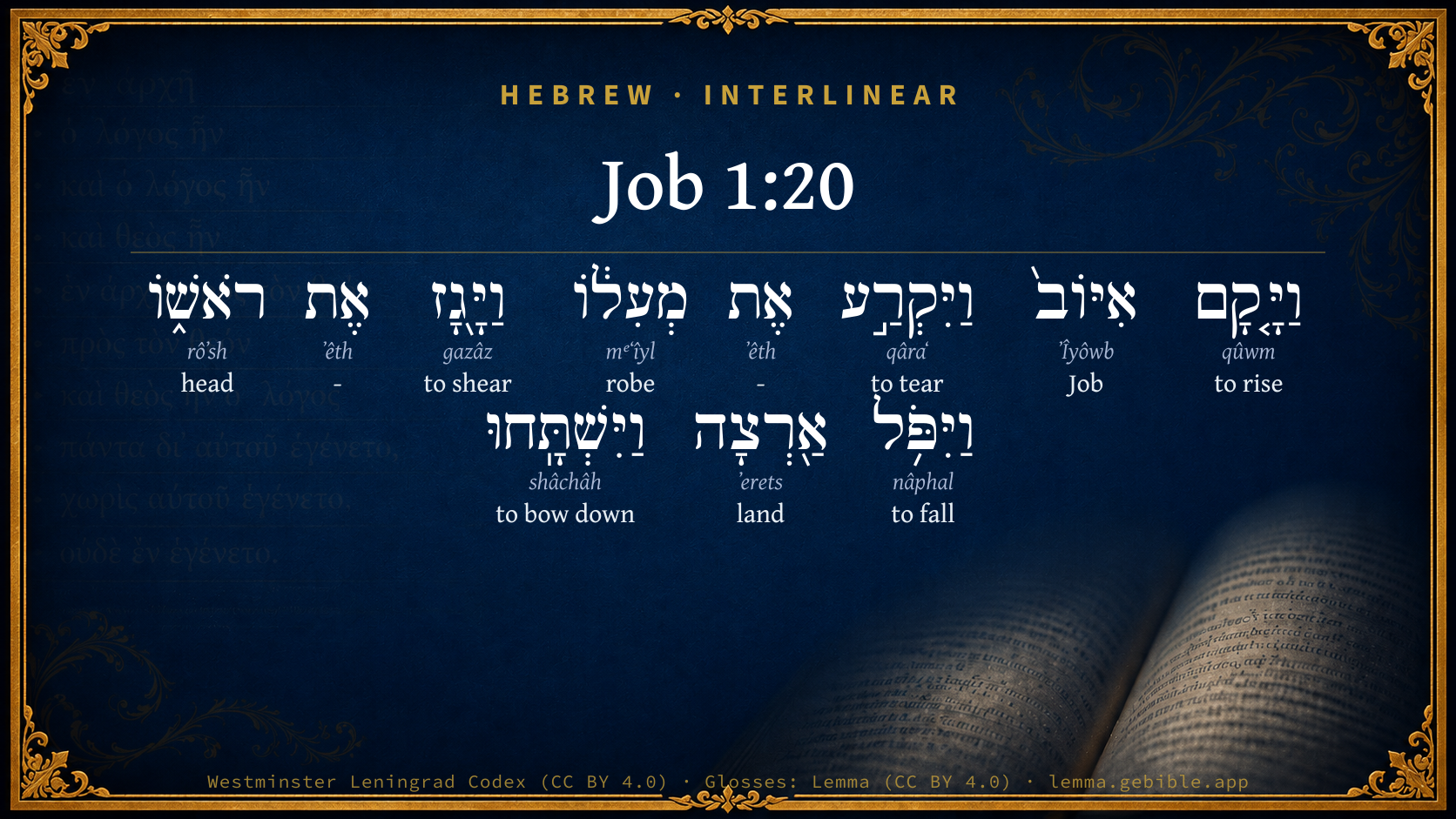
Hebrew (Westminster Leningrad Codex) Job 1:20 appears in the Hebrew Old Testament. The text above is from the Westminster Leningrad Codex. Each word links to its Strong’s number, a concise gloss, and parsing drawn from the Open Scriptures Hebrew Bible morphology. Click any word for its full Brown-Driver-Briggs (BDB) entry.
Download image
Cite this verse

Job 1:20 (World English Bible). Public Domain. Lemma interlinear Bible study tool, https://lemma.gebible.app/v/job/1/20.

Show BibTeX & RIS
BibTeX
RIS
English Translation
Then Job arose, and tore his robe, and shaved his head, and fell down on the ground, and worshiped.
World English Bible · Public Domain
Download a study sheet

One document with this verse’s original text, its word-by-word gloss line, the meaning frame, cross-references with their text, attributed commentary, and full source and license credits — printable, and it pastes into notes with its structure intact.

This verse Autodidact and up

Study sheet (.html) Plain text (.txt)

A passage Seminary Student

Up to 50 verses in one chapter. A passage sheet keeps up to 6 commentary sources and 12 cross-references per verse, in the order this page ranks them, and says so on the sheet whenever that leaves anything out. Ask for a single verse and you get the Autodidact verse sheet above.

Everything on this page stays free to read, with no account — the sheet is a download of what is already on screen, not access to it.

Want to remove ads? Support Godless Engineer
Compare translations 3

The same verse in 3 English versions, stacked beneath the original-language interlinear above. Click any original word for its lexicon entry.

Each is an independent rendering of the whole verse — the interlinear is not word-aligned to these translations.

Highlighted words mark where these versions differ — a whole-verse word diff, not a word-by-word alignment.

  • World English Bible Public Domain
    Then Job arose, and tore his robe, and shaved his head, and fell down on the ground, and worshiped.
  • King James Version Public Domain
    Then Job arose, and rent his mantle, and shaved his head, and fell down upon the ground, and worshipped,
  • unfoldingWord Literal Text CC BY-SA 4.0
    And Job arose and tore his robe and shaved his head and fell to the ground and prostrated himself.

unfoldingWord Literal Text — © unfoldingWord, licensed CC BY-SA 4.0. Word-aligned USFM3 via Door43 (git.door43.org/unfoldingWord/en_ult).

Versions to compare (up to 4)

3 of 4 selected

Show all 18 translations

Every available English version of this verse, each an independent rendering of the whole verse.

  • World English Bible Public Domain
    Then Job arose, and tore his robe, and shaved his head, and fell down on the ground, and worshiped.
  • Berean Standard Bible Public Domain
    Then Job stood up, tore his robe, and shaved his head. He fell to the ground and worshiped,
  • Majority Standard Bible Public Domain
    Then Job stood up, tore his robe, and shaved his head. He fell to the ground and worshiped,
  • King James Version Public Domain
    Then Job arose, and rent his mantle, and shaved his head, and fell down upon the ground, and worshipped,
  • American Standard Version (1901) Public Domain
    Then Job arose, and rent his robe, and shaved his head, and fell down upon the ground, and worshipped;
  • Revised Version (1885) Public Domain
    Then Job arose, and rent his mantle, and shaved his head, and fell down upon the ground, and worshipped;
  • Geneva Bible (1599) Public Domain
    Then Iob arose, and rent his garment, and shaued his head, and fel downe vpon the ground, and worshipped,
  • Douay-Rheims (1899) Public Domain
    Then Job rose up, and rent his garments, and having shaven his head fell down upon the ground and worshipped,
  • Young's Literal Translation Public Domain
    And Job riseth, and rendeth his robe, and shaveth his head, and falleth to the earth, and doth obeisance,
  • Literal Standard Version CC BY-SA 4.0
    And Job rises, and tears his robe, and shaves his head, and falls to the earth, and pays respect,
  • Unlocked Literal Bible CC BY-SA 4.0
    Then Job rose, tore his robe, shaved his head, lay facedown on the ground, and worshiped God.
  • unfoldingWord Literal Text CC BY-SA 4.0
    And Job arose and tore his robe and shaved his head and fell to the ground and prostrated himself.
  • Darby Bible Public Domain
    And Job rose up, and rent his mantle, and shaved his head, and fell down on the ground, and worshipped;
  • World Messianic Bible Public Domain
    Then Job arose, and tore his robe, and shaved his head, and fell down on the ground, and worshiped.
  • Webster's Bible Public Domain
    Then Job arose, and rent his mantle, and shaved his head, and fell upon the ground, and worshiped,
  • Free Bible Version CC BY-SA 4.0
    Then Job stood up and tore his robe. Then cut off his hair and fell to the ground in worship.
  • Bible in Basic English Public Domain
    Then Job got up, and after parting his clothing and cutting off his hair, he went down on his face to the earth, and gave worship, and said,
  • JPS Tanakh (1917) Public Domain
    Then Job arose, and rent his mantle, and shaved his head, and fell down upon the ground, and worshipped;

Literal Standard Version (2020), Covenant Press — licensed CC BY-SA 4.0. Text via the HelloAO Bible API (eBible.org). Unlocked Literal Bible (unfoldingWord) — licensed CC BY-SA 4.0. Text via the HelloAO Bible API (eBible.org). unfoldingWord Literal Text — © unfoldingWord, licensed CC BY-SA 4.0. Word-aligned USFM3 via Door43 (git.door43.org/unfoldingWord/en_ult). Free Bible Version, Dr. Jonathan Gallagher — licensed CC BY-SA 4.0. Text via the HelloAO Bible API (eBible.org).

Word by word

More ways to search: Search by grammar → Find every occurrence → Compare this word →

Practice this passage: Drill this verse → Learn its vocabulary →

וַיָּ֖גָז
gazâz
H1494
“and · to shear”
Conjunction + Verb, Qal, Sequential Imperfect, 3rd Person, Masculine, Singular
Part of Speech
Conjunction + Verb
Stem
Qal
Form
Sequential Imperfect
Person
3rd Person
Gender
Masculine
Number
Singular
Full BDB Definition

Origin: a primitive root [akin to H1468 ]

TWOT: 336

to shear, mow - (Qal) - to shear - shearer (participle) - (Niphal) to be cut off, be destroyed
  1. וַיָּ֤קָם qûwm H6965 “and · to rise” Conjunction + Verb, Qal, Sequential Imperfect, 3rd Person, Masculine, Singular
  2. אִיּוֹב֙ ʼÎyôwb H347 “Job” Noun, Proper
  3. וַיִּקְרַ֣ע qâraʻ H7167 “and · to tear” Conjunction + Verb, Qal, Sequential Imperfect, 3rd Person, Masculine, Singular
  4. אֶת ʼêth H853 “-” Particle, Direct Object
  5. מְעִל֔וֹ mᵉʻîyl H4598 “robe · his” Noun, Common, Masculine, Singular, Construct + Suffix, Personal, 3rd Person, Masculine, Singular
  6. אֶת ʼêth H853 “-” Particle, Direct Object
  7. רֹאשׁ֑וֹ rôʼsh H7218 “head · his” Noun, Common, Masculine, Singular, Construct + Suffix, Personal, 3rd Person, Masculine, Singular
  8. וַיִּפֹּ֥ל nâphal H5307 “and · to fall” Conjunction + Verb, Qal, Sequential Imperfect, 3rd Person, Masculine, Singular
  9. אַ֖רְצָה ʼerets H776 “land · toward” Noun, Common, Both, Singular, Absolute + Suffix, Demonstrative
  10. וַיִּשְׁתָּֽחוּ shâchâh H7812 “and · to bow down” Conjunction + Verb, Hithpael, Sequential Imperfect, 3rd Person, Masculine, Singular

About this verse

These counts appear in no published source. They are computed here, from the morphology-tagged text and Lemma’s own curated glosses. What Lemma adds →

11
words
10
distinct lemmas
Wisdom
section

Notable vocabulary

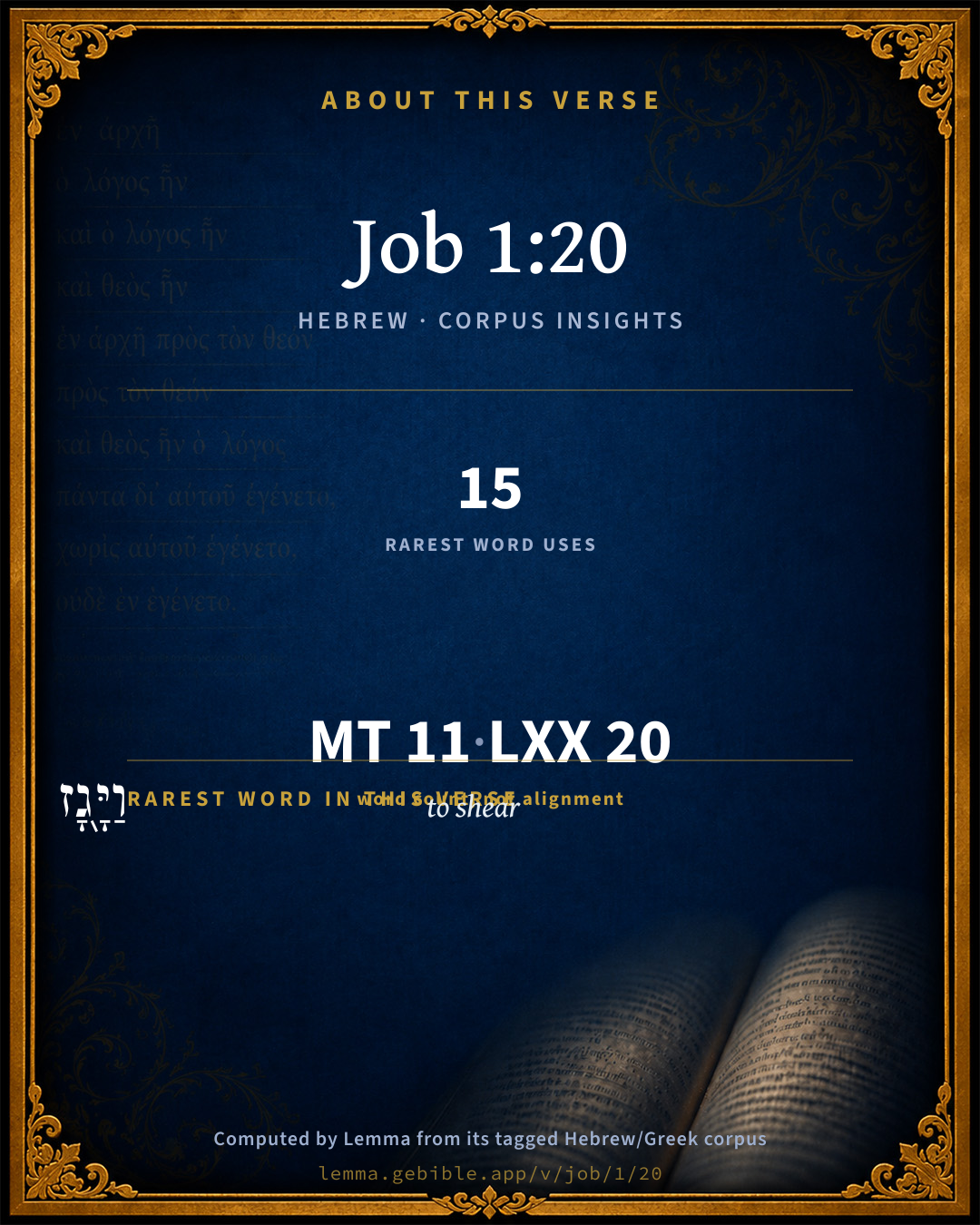
The rarest word here is וַיָּ֖גָז to shear H1494 — appearing just 15 times in the whole Hebrew Bible.

Shared distinctive vocabulary

וַיָּ֖גָז to shear H1494 occurs in 15 verses of the Hebrew Bible. Also found in:

Grammatical profile

  • 5 verbs
  • 4 nouns
  • 2 particles

Verb forms

  • וַיָּ֤קָם Qal · Sequential Imperfect
  • וַיִּקְרַ֣ע Qal · Sequential Imperfect
  • וַיָּ֖גָז Qal · Sequential Imperfect
  • וַיִּפֹּ֥ל Qal · Sequential Imperfect
  • וַיִּשְׁתָּֽחוּ Hithpael · Sequential Imperfect

Hebrew & Septuagint length

In English translation the verse runs 19 words from the Hebrew and 21 from the Septuagint (LXX English) — closely comparable.

A rough comparison of the two English renderings, which tokenize alike — not a word-level alignment.

Word counts can differ between the Hebrew and the Greek without any difference in meaning — e.g. the Hebrew direct-object marker אֵת has no separate Greek word, and Greek often adds the article ὁ.

In the original languages it is 11 Hebrew tokens and 20 Greek tokens — but the two are counted differently (Hebrew bundles its prefixes and suffixes into one token; the Greek is in lemma form), so that isn’t a like-for-like length.

Cross-references

8

Topical passages linked to Job 1:20 in the Treasury of Scripture Knowledge — connected by theme and wording, ordered by reader-vote popularity; previews shown in the World English Bible.

  • 1 Peter 5:6 Humble yourselves therefore under the mighty hand of God, that he may exalt you in due time;
  • 2 Samuel 12:16–20 David therefore begged God for the child; and David fasted, and went in, and lay all night on the earth.
  • Genesis 37:29 Reuben returned to the pit; and saw that Joseph wasn't in the pit; and he tore his clothes.
  • Genesis 37:34 Jacob tore his clothes, and put sackcloth on his loins, and mourned for his son many days.
  • Ezra 9:3 When I heard this thing, I tore my garment and my robe, and plucked off the hair of my head and of my beard, and sat down confounded.
  • Deuteronomy 9:18 I fell down before Yahweh, as at the first, forty days and forty nights; I did neither eat bread nor drink water; because of all your sin which you sinned, in doing that which was evil in the sight of Yahweh, to provoke him to anger.
  • 2 Chronicles 7:3 All the children of Israel looked on, when the fire came down, and the glory of Yahweh was on the house; and they bowed themselves with their faces to the ground on the pavement, and worshiped, and gave thanks to Yahweh, [saying], For he is good; for his loving kindness endures for ever.
  • Matthew 26:39 He went forward a little, fell on his face, and prayed, saying, "My Father, if it is possible, let this cup pass away from me; nevertheless, not what I desire, but what you desire."

Cross-references courtesy of OpenBible.info (CC BY 4.0).

Hebrew and Greek witnesses Masoretic Hebrew ↔ Greek Septuagint

The same verse in the two great witnesses to the Old Testament, shown verse-for-verse.

These are two independent witnesses, not word-aligned to each other, and the Septuagint is shown in lemma (dictionary) form.

Hebrew Job 1:20 Masoretic · Westminster Leningrad Codex

וַיָּ֤קָם אִיּוֹב֙ וַיִּקְרַ֣ע אֶת מְעִל֔וֹ וַיָּ֖גָז אֶת רֹאשׁ֑וֹ וַיִּפֹּ֥ל אַ֖רְצָה וַיִּשְׁתָּֽחוּ

Then Job arose, and tore his robe, and shaved his head, and fell down on the ground, and worshiped.

World English Bible · Public Domain

Greek LXX Job 1:20 Septuagint · lemma form

οὕτως ἀναἵστημι ιωβ διαῥήγνυμι ὁ ἱμάτιον αὐτός καί κείρω ὁ κόμη ὁ κεφαλή αὐτός καί πίπτω χαμαί προςκυνέω καί εἶπον

So Job arose, and tore his garments, and shaved the hair of his head, and fell on the earth, and worshipped,

LXX2012 (modern English Septuagint) · Public Domain

Hebrew: Westminster Leningrad Codex (CC BY 4.0). Greek: Septuagint (public domain); English from LXX2012 (modern English Septuagint) (Public Domain). How the Septuagint differs from the Hebrew →

Commentary

Notes on Job 1:20 from classic Christian and Jewish commentators (each source and its license shown beneath its notes). The classic Christian expositions comment on the surrounding passage and are grouped to its opening verse, so a note may address several verses; the Jewish commentaries on the Tanakh (Rashi and others) are per-verse, so they appear only where the commentator wrote on this verse.

Lemma curates 59 commentaries, every one of them public domain or Creative Commons licensed, each selected and text-cleaned for this edition rather than reprinted as found. About our sources →

Matthew Henry's Commentary

The devil had done all he desired leave to do against Job, to provoke him to curse God. He had touched all he had, touched it with a witness; he whom the rising sun saw the richest of all the men in the east was before night poor to a proverb. If his riches had been, as Satan insinuated, the only principle of his religion now that he had lost his riches he would certainly have lost his religion; but the account we have, in these verses, of his pious deportment under his affliction, sufficiently proved the devil a liar and Job an honest man.

I. He conducted himself like a man under his afflictions, not stupid and senseless, like a stock or stone, not unnatural and unaffected at the death of his children and servants; no (Job 1:20), he arose, and rent his mantle, and shaved his head, which were the usual expressions of great sorrow, to show that he was sensible of the hand of the Lord that had gone out against him; yet he did not break out into any indecencies, nor discover any extravagant passion. He did not faint away, but arose, as a champion to the combat; he did not, in a heat, throw off his clothes, but very gravely, in conformity to the custom of the country, rent his mantle, his cloak, or outer garment; he did not passionately tear his hair, but deliberately shaved his head. By all this it appeared that he kept his temper, and bravely maintained the possession and repose of his own soul, in the midst of all these provocations. The time when he began to show his feelings is observable; it was not till he heard of the death of his children, and then he arose, then he rent his mantle. A worldly unbelieving heart would have said, "Now that the meat is gone it is well that the mouths are gone too; now that there are no portions it is well that there are no children:" but Job knew better, and would have been thankful if Providence had spared his children, though he had little of nothing for them, for Jehovah-jireh - the Lord will provide. Some expositors, remembering that it was usual with the Jews to rend their clothes when they heard blasphemy, conjecture that Job rent his clothes in a holy indignation at the blasphemous thoughts which Satan now cast into his mind, tempting him to curse God.

II. He conducted himself like a wise and good man under his affliction, like a perfect and upright man, and one that feared God and eschewed the evil of sin more than that of outward trouble.

1. He humbled himself under the hand of God, and accommodated himself to the providences he was under, as one that knew how to want as well as how to abound. When God called to weeping and mourning he wept and mourned, rent his mantle and shaved his head; and, as one that abased himself even to the dust before God, he fell down upon the ground, in a penitent sense of sin and a patient submission to the will of God, accepting the punishment of his iniquity. Hereby he showed his sincerity; for hypocrites cry not when God binds them, Job 36:13. Hereby he prepared himself to get good by the affliction; for how can we improve the grief which we will not feel?

2. He composed himself with quieting considerations, that he might not be disturbed and put out of the possession of his own soul by these events. He reasons from the common state of human life, which he describes with application to himself: Naked came I (as others do) out of my mother's womb, and naked shall I return thither, into the lap of our common mother - the earth, as the child, when it is sick or weary, lays its head in its mother's bosom. Dust we were in our original, and to dust we return in our exit (Gen 3:19), to the earth as we were (Ecc 12:7), naked shall we return thither, whence we were taken, namely, to the clay, Job 33:6. St. Paul refers to this of Job, Ti1 6:7. We brought nothing of this world's goods into the world, but have them from others; and it is certain that we can carry nothing out, but must leave them to others. We come into the world naked, not only unarmed, but unclothed, helpless, shiftless, not so well covered and fenced as other creatures. The sin we are born in makes us naked, to our shame, in the eyes of the holy God. We go out of the world naked; the body does, though the sanctified soul goes clothed, Co2 5:3. Death strips us of all our enjoyments; clothing can neither warm nor adorn a dead body. This consideration silenced Job under all his losses. (1.) He is but where he was at first. He looks upon himself only as naked, not maimed, not wounded; he was himself still his own man, when nothing else was his own, and therefore but reduced to his first condition. Nemo tam pauper potest esse quam natus est - no one can be so poor as he was when born. - Min. Felix. If we are impoverished, we are not wronged, nor much hurt, for we are but as we were born. (2.) He is but where he must have been at last, and is only unclothed, or unloaded rather, a little sooner than he expected. If we put off our clothes before we go to bed, it is some inconvenience, but it may be the better borne when it is near bed-time.

3. He gave glory to God, and expressed himself upon this occasion with a great veneration for the divine Providence, and a meek submission to its disposals. We may well rejoice to find Job in this good frame, because this was the very thing upon which the trial of his integrity was put, though he did not know it. The devil said that he would, under his affliction, curse God; but he blessed him, and so proved himself an honest man.

(1.) He acknowledged the hand of God both in the mercies he had formerly enjoyed and in the afflictions he was now exercised with: The Lord gave, and the Lord has taken away. We must own the divine Providence, [1.] In all our comforts. God gave us our being, made us, and not we ourselves, gave us our wealth; it was not our own ingenuity or industry that enriched us, but God's blessing on our cares and endeavours. He gave us power to get wealth, not only made the creatures for us, but bestowed upon us our share. [2.] In all our crosses. The same that gave hath taken away; and may he not do what he will with his own? See how Job looks above instruments, and keeps his eye upon the first Cause. He does not say, "The Lord gave, and the Sabeans and Chaldeans have taken away; God made me rich, and the devil has made me poor;" but, "He that gave has taken;" and for that reason he is dumb, and has nothing to say, because God did it. He that gave all may take what, and when, and how much he pleases. Seneca could argue thus, Abstulit, sed et dedit - he took away, but he also gave; and Epictetus excellently (cap. 15), "When thou art deprived of any comfort, suppose a child taken away by death, or a part of thy estate lost, say not apōlesa auto - I have lost it; but apedōka - I have restored it to the right owner; but thou wilt object (says he), kakos ho aphelomenos - he is a bad man that has robbed me; to which he answers, ti de soi melei - What is it to thee by what hand he that gives remands what he gave?"

(2.) He adored God in both. When all was gone he fell down and worshipped. Note, Afflictions must not divert us from, but quicken us to, the exercises of religion. Weeping must not hinder sowing, nor hinder worshipping. He eyed not only the hand of God, but the name of God, in his afflictions, and gave glory to that: Blessed be the name of the Lord. He has still the same great and good thoughts of God that ever he had, and is as forward as ever to speak them forth to his praise; he can find in his heart to bless God even when he takes away as well as when he gives. Thus must we sing both of mercy and judgment, Psa 101:1. [1.] He blesses God for what was given, though now it was taken away. When our comforts are removed from us we must thank God that ever we had them and had them so much longer than we deserved. Nay, [2.] He adores God even in taking away, and gives him honour by a willing submission; nay, he gives him thanks for good designed him by his afflictions, for gracious supports under his afflictions, and the believing hopes he had of a happy issue at last.

Lastly, Here is the honourable testimony which the Holy Ghost gives to Job's constancy and good conduct under his afflictions. He passed his trials with applause, Job 1:22. In all this Job did not act amiss, for he did not attribute folly to God, nor in the least reflect upon his wisdom in what he had done. Discontent and impatience do in effect charge God with folly. Against the workings of these therefore Job carefully watched; and so must we, acknowledging that as God has done right, but we have done wickedly, so God has done wisely, but we have done foolishly, very foolishly. Those who not only keep their temper under crosses and provocations, but keep up good thoughts of God and sweet communion with him, whether their praise be of men or no, it will be of God, as Job's here was.

Matthew Henry's Commentary on the Whole Bible (1708–1710) — public domain (CC PDM 1.0). Text via the HelloAO Bible API.

Trapp's Complete Commentary

John Trapp

Job 1:20 Then Job arose, and rent his mantle, and shaved his head, and fell down upon the ground, and worshipped,

Ver. 20. Then Job arose, and rent his mantle] He stirred not at the three first doleful tidings, but this fourth startleth him; for he was neither a Stoic nor a stock. His strength was not the strength of stones, nor his flesh of brass, Job 6:12, that he should bear blows, and never feel pain, or make moan; that he should be silent in darkness, 1Sa 2:9, and not cry when God bound him, Job 36:11. This Stoical apathy or indolency (condemning all affections in that their wise man, who, as Cicero very well saith, as yet was never found) Jeremiah justly complaineth of, Jer 5:3, and the Peripatetics utterly disliked; teaching, that wisdom doth not remove affections, but only reduce them to a mediocrity. Job kept the mean between despising the chastening of the Lord, and fainting when rebuked by him, Heb 12:5. See my Love Tokens, pp. 37, 38, &c.

And shaved his head] In token of his very great sorrow. See Jer 7:29 Mic 1:16, "Make thee bald, and poll thee for thy delicate children; enlarge thy baldness as the eagle." {See Trapp on "Mic 1:16"} When Germanicus died, divers foreign princes shaved their beards, to show their grief (Sueton.). Plutarch telleth us that Alexander the Great, at the funeral of Hephestion, his favourite, not only shaved himself, but clipped his horses’ and mules’ hair; yea, he plucked down also the battlements of the walls of the city, that they might seem to mourn too; but this savoured of too much sullenness. How much better his Macedonians, who, being once sensible of his displeasure, laid by their arms, put on their mourning attire, came trooping to his tent, where for almost three days they remained, with loud cries, and abundance of tears, testifying their remorse for offending him, beseeching his pardon, which at last they gained. God calleth to baldness for sin, Isa 22:12, which, in other cases, was forbidden, Lev 19:27; Lev 21:5 Deu 14:1. This Job performed here; for he knew that although God afflicteth sometimes for his own glory, Joh 9:3, sometimes for trial or exercise of his people’s graces, yet sin is ever at the bottom, as the meritorious cause of what they suffer; and if he did not duly consider it before, Zophar gave him to understand that God exacted of him less than his iniquity had deserved, Job 11:6.

And fell down upon the ground] This shows that Job arose not before to this end, that, with a stout and stubborn gesture of the body, he might withstand God; but rather, that he might, with greater lowliness and humility, submit to his justice, and implore his mercy: he fell down upon the ground and worshipped, saith the text; that is, he fell upon the ground to worship. He fell not all along on the earth, as Saul did, out of despondency and despair, after that he had heard the devil preaching his funeral; he lay like an ox on the earth, in the fulness of his stature, as the original hath it, 1Sa 28:20; but, as humbling himself under the mighty hand of God, who would raise him up in due season, 1Pe 5:6, and as reverently and religiously submitting to his will. And it is probably observed, saith a late expositor, Mr Caryl, out of another, that the ancient prophets and holy men were called Nephalim procidentes, or prostrantes, that is, prostrates, or railers-down, because in their worship they usually fell down upon the earth, to humble themselves before the Lord.

John Trapp, A Commentary or Exposition upon All the Books of the Old and New Testament (1647–1656) — public domain. Text from a community e-Sword module.

The Biblical Illustrator

Joseph S. Exell

Job_1:20

And worshipped.

The grand victory

This is the grandest scene that human nature has ever presented. The world had never seen anything to compare to it. The greatest conqueror that ever won his triumph in Rome was as a pigmy beside the giant.

I. The triumph of mind over matter. Jobs soul seems to soar above what is material. Things which were seen faded from his view, and things which were not seen grew bright and distinct. The dying Stephen saw the Lord Jesus in his vision. But Job was not a dying man. He was in full strength and vigour. It is possible, then, so to triumph over that which is seen and temporal, that even in this world heaven is a reality.

II. The triumph of principle over selfishness. Principle and selfishness are always antagonistic. There is a constant warfare going on between these in the universe, in the world, in the soul. Self is too often the victor. But in Job religious principle was supreme. He rose up and worshipped! Selfish human nature would have raved and cursed. The worldly man would have cursed his luck, cursed his foes, cursed the Chaldeans, and cursed everything. There does not seem to have been any struggle in the mind of Job. He seems, by constant patience and by the unceasing habit of giving principle the first place, to have been raised almost above strife and contention. There is a time when contest ceases. Sometimes self, after a few weeks or years, obtains the mastery, and then to self the man habitually yields. But we do occasionally find cases wherein principle is victor, and then homage is paid hereafter unquestioningly to its sovereignty.

III. The triumph of religion over worldliness. The world passed out of Jobs ken as a factor in his fate. Many would have said, What a strange combination of circumstances! What a terrible coincidence! What an unlucky man! The Lord hath taken away. Here is a pattern for causalists, who look to minor details instead of to the prime Ruler of all things. This is the true sphere of religion--to east out all else from a mans life--all except God. Then, and then alone, has it triumphed over the world, and sin, and temptation.

IV. The triumph of Divine grace over the devils temptations. (Homilist.)

The humble saint under an awful rod

1. The best of men are often exercised with the sorest troubles. Job was a perfect and upright man, fearing God and eschewing evil. Those who are nearest Gods heart may smart most under His rod.

2. When things go best with us as to this world, we should look for changes. Presumption of continued prosperity is unwarrantable; for who can tell what a day may bring forth? If any man in the world had reason to promise himself a security from poverty and distress, surely it was this eminent servant of God. The Lord had blessed him with large possessions, and a numerous offspring. He could appeal to heaven as to the integrity of his conduct, that he had got his wealth without oppressing the poor or injuring his fellow creatures. Let us therefore take care how we say our mountain shall stand strong and cannot be moved, for who can tell what is in the womb of providence? This will, in a great measure, prepare us for the trial, if God should call us to it. On the other hand, we should be cautious how we sink under our burdens when the Lord is contending with us, and entertain gloomy apprehensions that deliverance is impossible. Our wisdom lies in the medium, between resting in and boasting of blessings, and limiting the power and goodness of God, as if He could not support us under trouble, or make a way for our escape.

3. The grace of God is given us, not to erase or destroy our natural passions and affections, but to correct, restrain, and purify them. Job arose, rent his mantle and shaved his head, and this before he set himself to worship. The grace of God is designed to regulate, refine, and spiritualise our natural affections, which, if left to themselves, are ready to run rote riot and excess.

4. Saints under trouble usually find that relief at the throne of grace, when pouring out their souls to God in prayer, which they meet with nowhere else.

5. Seriously to reflect on what we once were, in a state of infancy, and what we shall be when laid up in the grave, is a good means to reconcile our minds to afflictive emptying providences. Pride is the mother of discontent. Humility gives the sweetest relish to all our enjoyments, and prepares the mind with a becoming resignation to part with them at the will of our original Proprietor, who is the Sovereign Disposer of all things.

6. Good men desire to look beyond second causes to the hand of God in all their mercies and afflictions. Job mentions not a word of his own industry or care in obtaining, or of the Sabeans and Chaldeans in robbing him of his substance, but, the Lord gave, and the Lord hath taken away. Means and instruments have their influence, but it is under a Divine agency or permission. Those which are best suited to promote a desirable end will certainly miscarry without His concurrence, and the most envenomed enemies of God and His people can do no more than He is pleased to suffer.

7. Satan, the accuser of the brethren, narrowly watches the saint when oppressed with affliction, and if anything can be pleasing to a spirit so completely miserable, it would be to hear him speak unadvisedly with his lips, and charge God foolishly. It is hard work, but how very reasonable! For a saint cannot be in that situation not to have much to bless God for. More and better is always left than is taken away, such as God Himself, His unchangeable love, the glorious Redeemer, the Holy Spirit, an everlasting covenant, the blessings of redemption and sanctification, with grace and glory. And who does not see that all the sufferings and losses of this world are not worthy to be compared with any one of these, much less than with them all! (S. Wilson.)

Right behaviour in times of affliction

1. That when the hand of God is upon us, it becometh us to be sensible of it, and to be humbled under it.

2. That in times of affliction we may express our sorrows by outward gestures, by sorrowful gestures.

3. That when God afflicteth us with sufferings, we ought to afflict ourselves, to humble our souls for sin.

4. That thoughts of blasphemy against God should be cast off, and rejected with the highest indignation. (J. Caryl.)

Afflictions turned into prayers

1. A godly man will not let nature work alone, he mixes or tempers acts of grace with acts of nature.

2. Afflictions send the people of God home unto God; afflictions draw a godly man nearer unto God.

3. That the people of God turn all their afflictions into prayers, or into praises. When God is striking, then Job is praying; when God is afflicting, then Job falls to worshipping. Grace makes every condition work glory to God, as God makes every condition work good to them who have grace.

4. It becometh us to worship God in an humble manner.

5. That Divine worship is Gods peculiar. (J. Caryl.)

The Biblical Illustrator, edited by Joseph S. Exell (c. 1880s–1900s) — public domain. Text from a community e-Sword module.

Joseph Benson's Commentary

Job 1:20. Then Job arose — From his seat whereon he had been sitting in a disconsolate posture; and rent his mantle — In token of his deep sense of, and just sorrow for, the heavy hand of God upon him, and his humiliation of himself under that hand: see Gen 37:34; and shaved his head — Caused the hair of his head to be shaved or cut off, which was then a usual ceremony in mourning: of which see Ezr 9:3; Isa 15:2; Isa 22:12; Jer 7:29; Jer 41:5; Mic 1:16. And fell down upon the ground — In self-abasement, contrition, and supplication unto God; and worshipped — Instead of cursing God, which Satan said he would do, he adored him, and gave him the glory of his sovereignty, of his justice, and of his goodness also, in this most severe dispensation.

Joseph Benson's Commentary on the Old and New Testaments (1811–1818) — public domain. Text from a community e-Sword module.

Whedon's Commentary on the Bible

Daniel D. Whedon

THE TRIUMPH OF JOB, Job_1:20-22.

20. Then Job arose — Thus far he has borne unmoved the successive shocks of adverse fate. But now nature triumphs. As the tidings of the last great grief break upon him he rises, and yielding to the more tender impulses of our common nature, resigns himself to sorrow, but not one moment to suspense of faith in God.

And rent his mantle — There was no custom among the Orientals corresponding to that among ourselves, of putting on of mourning attire in token of heavy grief. They, on the contrary, instead of changing their outer dress, rent it in twain. This custom was common among the nations of antiquity. The מעל, me’hil, mantle made of linen, in later times also of cotton, was an outer garment worn by priests, kings, and the very rich, and sometimes by the daughters of kings. That of the high priest was, according to Josephus, a long vestment of a blue colour woven in one piece, but with openings for the neck and arms. (Antiquities, iii, chap. Job_7:4.) In the opinion of some, Christ, as high priest, wore a similar garment, for which the soldiers cast lots at the foot of the cross. (Joh_19:23.)

And shaved his head — This was forbidden among the Jews to the priests. (Lev_21:5.) The people were prohibited (Deu_14:1, and Lev_19:27) from rounding the corners of their heads, etc., which had, perhaps, respect to some idolatrous custom among neighbouring nations. Herodotus (ii, 36) says of the Egyptians, who “wear no hair at any other time, that when they lose a relative they let their beards and the hair of their heads grow long. Elsewhere it is customary in mourning for near relatives to cut their hair close.” The custom among the Greeks, according to Plutarch, was similar to that of the Egyptians. The shaving of his head is decisive that Job could not have been an Egyptian. This deliberate and protracted act shows in a striking manner Job’s mastery over himself and his sorrow.

Fell down upon the ground, and worshipped — (Compare 2Sa_12:20.) “That he might not show pride by his insensibility he fell down at the stroke; but that he might not estrange himself from Him who strikes, he so fell down as to worship.” — ST. GREGORY, Moralia. “He arose,” says Origen, “and at length prostrated himself. He arose for battle; he prostrated himself for peace. He arose for the perfection of victory; he prostrated himself for the reception of the crown.”

Daniel D. Whedon (gen. ed.), Commentary on the Old and New Testaments (1874–1909) — public domain. Text from a community e-Sword module.

The Preacher's Complete Homiletical Commentary

Joseph S. Exell (gen. ed.)

FIFTH PART OF INTRODUCTION—THE RESULT OF SATAN’S ATTEMPTS

I. Job’s grief (Job_1:20). “Then Job arose.” Probably found by the tidings in the usual posture of Orientals. Aroused from wonted calmness. His nature now stirred to its depths. Deeply moved, but not prostrated by his calamities.—“Rent his mantle,” or robe; long outer garment worn by men of rank (1Sa_15:27; 1Sa_18:4), and by priests (1Sa_28:14; Exo_28:13); still worn by wealthy Arabs. Rent it in token of sorrow and humiliation (Gen_37:34). Job neither too insensible to feel grief, nor too proud to acknowledge it. Piety not stoicism; sharpens rather than blunts sensibility. As little virtue in not feeling sorrow as in being overcome by it. Not to feel is to be either more or less than a man. Jesus wept. Insensibility under chastening reproved as a sin (Jer_5:3; Hos_7:9). When God afflicts us we should afflict ourselves (Jer_31:18). Grace teaches us, not to be without sorrow, but to moderate it, and to connect with it penitence and submission, faith and hope (2Co_7:11; 1Th_4:13).—“Shaved his head.” Another token of mourning (Ezr_9:3; Isa_15:2; Isa_22:12; Jer_7:29; Jer_41:5). Forbidden by the law only in certain cases and in certain forms (Lev_19:27; Lev. 31:5; Deu_14:1). Nature demands some external sign of grief, and religion does not forbid it.—“Fell down upon the ground.”

(1) In grief; so Joshua (Jos_7:6);

(2) In humiliation;

(3) In adoration. Trouble a blessing when it leads to self-abasement before God. Satan expected to see Job standing on his feet and cursing the author of his troubles.

II. His piety (Job_1:20-21). “And worshipped.” Praised God and acknowleged his sovereignty. Bowed submissivly to His will and dispensations. Instead of cursing God Job adores His justice, goodness, and holiness. Afflictions draw a godly man nearer to God instead of driving him from Him. A sign of a gracious state to be worshipping when God is chastising. The best way to bear and be benefited by trials is to take them to God. That trouble cannot but be blest which brings us to our knees. Faith calms the crushed spirit by conducting it to a God in Christ.—“And said.” Job opens his mouth, but not as Satan expected. Serious and suitable considerations to be employed under trouble. Truths suggested by religion to quiet the spirit and preserve it in patience.—“Naked came I forth,” &c. Job’s first consideration. Nothing originally ours. Man by nature destitute even of clothes for his body. The truth in the text the apostle’s argument for contentment (1Ti_6:7).—“Naked shall I return thither.” Second consideration. Earth not our home. We return to our parent dust. Reference to Gen_3:19. These words probably copied or referred to in Ecc_5:14; Ecc_12:7. Our condition in this world of less consequence as we are so soon to leave it.—Third consideration. We must leave the world naked as we entered it (1Ti_6:7). Death strips Dives of his fine linen and Lazarus of his filthy rags. Grace the only riches we can carry out of the world with us. To be stripped of earthly possessions only a question of time. “Thither,”—unto my mother’s womb, used figuratively for the earth. So the “lower parts of the earth” used for the womb (Psa_139:15). The same term sometimes used both literally and figuratively in the same sentence. So Mat_8:22.—“The Lord gave.” The language of truth and piety. Contrasted with that of pride and atheism,—“My own hand hath gotten me this wealth” (Deu_8:17). Heathens by the light of nature called God the “Giver of good things.” Power to get wealth the gift of God (Deu_8:18; Pro_10:22). “Gave,” and therefore has the right to withdraw at his pleasure. What we possess we hold only as stewards of mother’s goods (Luk_16:1-12; 1Pe_4:10.)—“The Lord hath taken away.” God’s hand in our losses as well as our gains. Divine philosophy. So Joseph Gen_45:5-8; David, Psa_39:9; Eli, 1Sa_3:18. “The Lord,”—not the Sabeans and Chaldæans, the lightning or the whirlwinds. The philosophy that rests on second causes or natural laws a philosophy falsely so called. Satan only the author of Job’s calamities as he received permission from God. The arrows God’s, whoever shoots them. Evil as well as good from God either directly or permissively (Isa_45:7; Amo_3:6). Man’s and Satan’s sin overruled by God for good; not therefore the less sinful (Act_2:23). God’s hand in trouble seen by the eye of faith, an alleviation; otherwise an aggravation.

III. The Victory

1. Positive side. Job blesses God instead of cursing Him (Job_1:21). “Blessed be the Name of the Lord.” The word chosen with reference to Satan’s charge. The same word used, but in its opposite and proper sense. Satan thus entirely defeated. Every word of Job gives the lie to his slander. Power of grace that teaches us to bless God in troubles and adversities (2Sa_15:26). No ground, even in the worst times, to murmur against God, much to bless Him. Such grounds are:

(1) Often greater love and richer blessing when He takes away than when He gives. Our greatest trials and losses often our richest mercies. “For all I bless Thee, most for the severe” [Young].—

2. In the greatest sufferings and losses the believer’s main interests are secure. The pieces of silver may be lost, the casket of jewels remains safe.

(3.) The sufferings of believers are seeds to bear precious fruit both here and hereafter (Rom_8:24; Heb_12:10-11). Believers therefore strengthened “unto all patience and long sufferings with joyfulness” (Col_1:11). True Christian piety the purest heroism. Widely different from stoical insensibility and pride. Believers weep, but bless God through their tears. Job’s blessing God must have sent an echo through the heaven of heavens. Unprecedented trials, heightened by the contrast of unprecedented prosperity, meet not merely with submission, but with blessing on the Author of both. To bless God in prosperity is only natural; to bless Him in adversity and trouble is music that fills heaven and earth with gladness. Job’s calamities appeared only to argue God against him. Mighty faith that blesses God while smiting our comforts to the ground. The grace enjoined on N. T. believers, exemplified in this O. T. saint (1Th_5:18). To bless God in our comforts the way to have them increased; to bless Him in our afflictions the way to have them removed [Augustine]. A thankful and pious spirit the true philosopher’s stone—turns all things into gold. Faith gilds our crosses and sees a silver lining in the darkest cloud.—Matter for praise under the most trying dispensations:—

(1) The past enjoyment of undeserved mercies so long continued;

(2) The present enjoyment of some mercies however few;

(3) The possession of God Himself as in Christ our God and portion;

(4) The assurance that the heaviest trials work together for our good;

(5) The hope of a better and enduring inheritance reserved for us in heaven.—“The name of the Lord,”—the Lord Himself as revealed to us in the Word. Here “Jehovah,” the everliving faithful covenant God of His people. The name here thrice repeated. Perhaps not without a mystery, like Num_7:24-27, compared with Mat_28:19; 2Co_13:14; 1Jn_5:7. The name fondly dwelt upon by the afflicted patriarch. The name of the Lord the tried believer’s sweetest consolation and strongest support. A strong tower into which the righteous runs and is sale (Pro_18:10.)

2. Negative side of victory. In all these trials Job kept from sinning (Job_1:22.) “Sinned not,” as Satan desired and declared he would. Glorious triumph of grace to keep from sinning in such circumstances. Sinned not, either by impatience or passion. Reference to the case in hand. Grace given to keep us from sin, not absolutely, but relatively and comparatively. Sin more or less in all a believer’s actions, though all his actions not sinful. Scripture written that the believer sin not (1Jn_2:1). Looking to Christ, Peter walked on the water; looking to the wind, he began to sink in it (Mat_14:28-31). The flesh or old nature in a believer must sin; the spirit or new nature in him cannot. (1Jn_3:9). A constant struggle between the spirit and the flesh (Gal_5:17). A believer’s duty and privilege to walk in the spirit, and so be kept from fulfilling the desire of the flesh (Gal_5:16). I feel and grieve, but by the grace of God I fret at nothing [John Wesley].—“Nor charged God foolishly.”

(1) Imputed no folly, injustice, or impropriety to God;

(2) Vented no foolish and impious murmurs against Him. Ascribed nothing to God unworthy of His justice, goodness, and wisdom. Entertained no dishonourable thought, uttered no murmuring word against Him. Impiety the greatest folly. To murmur against God’s dealings is as foolish as it is wicked. To misconstrue God’s character and conduct, the great sin to be guarded against under heavy trials.

The Preacher's Complete Homiletical Commentary (gen. ed. Joseph S. Exell; Funk & Wagnalls, c. 1892) — public domain (pre-1929). A full-Bible homiletical/sermon-outline anthology covering 65 of 66 books (2 John is absent from the source module). Text from a community e-Sword module.

Tyndale Open Study Notes

Tyndale Open Resources

1:20 Job tore his robe and shaved his head; both were common Near East rituals that demonstrated grief. These actions sometimes substituted for self-mutilation as a physical response to shock, horror, or bad news (2:12; Gen 37:29, 34; Judg 11:35; Jer 16:6; Ezek 7:18; Amos 8:10). • He fell to the ground, not to wail in despair, but to worship in hope (1 Pet 5:6).

Tyndale Open Study Notes — © Tyndale Open Resources, licensed CC BY-SA 4.0. Text via the HelloAO Bible API.

Geneva Bible (1599)

Geneva Bible translators

Which came not of impatience, but declareth that the children of God are not insensible like blocks, but that in their patience they feel affliction and grief of mind: yet they keep a mean herein, and rebel not against God, as the wicked do.

Geneva Bible (1599) marginal notes — public domain. Text via Bolls.life.

Jamieson, Fausset & Brown

Robert Jamieson, A. R. Fausset & David Brown

Job arose--not necessarily from sitting. Inward excitement is implied, and the beginning to do anything. He had heard the other messages calmly, but on hearing of the death of his children, then he arose; or, as EICHORN translates, he started up (Sa2 13:31). The rending of the mantle was the conventional mark of deep grief (Gen 37:34). Orientals wear a tunic or shirt, and loose pantaloons; and over these a flowing mantle (especially great persons and women). Shaving the head was also usual in grief (Jer 41:5; Mic 1:16).

Jamieson, Fausset & Brown — Commentary Critical and Explanatory on the Whole Bible (1871) — public domain (CC PDM 1.0). Text via the HelloAO Bible API.

Adam Clarke's Commentary

Verse 20. Rent his mantle] Tearing the garments, shaving or pulling off the hair of the head, throwing dust or ashes on the head, and fitting on the ground, were acts by which immoderate grief was expressed. Job must have felt the bitterness of anguish when he was told that, in addition to the loss of all his property, he was deprived of his ten children by a violent death. Had he not felt this most poignantly, he would have been unworthy of the name of man.

Worshipped] Prostrated himself; lay all along upon the ground, with his face in the dust.

Adam Clarke's Commentary on the Bible (1810–1826) — public domain. Text from a community e-Sword/MySword module.

Ellicott's Commentary for English Readers

(20) And worshipped.—Compare the conduct of David (2Sa_12:20) and of Hezekiah (2Ki_19:1). Moments of intense sorrow or trial, like moments of intense joy, force us into the immediate presence of God.

A Bible Commentary for English Readers, edited by Charles John Ellicott (1878–1897) — public domain. Text from a community e-Sword module.

The Cambridge Bible for Schools and Colleges

gen. ed. J. J. S. Perowne

20, 21. Job’s demeanour under his sorrows. As became a man of his rank Job had received the messengers sitting. When the full extent of his misery came home to him he arose and gave way to the liveliest expressions of grief. He rent his mantle, in token that his heart was rent with sorrow, as Joe_2:13 says, “Rend your heart and not your garments;” he shaved his head, putting off, in token of his mourning, every adornment, even that which nature had supplied; and he cast himself upon the ground, laying his forehead on the dust, in deepest submission before God. Grief has its rights, which religion stands by to see fulfilled, and then comes forward to hallow it and cast its peace over it.—The “mantle” (me‘eel) was not a detached garment as the word might suggest, but a tunic, the uppermost of the garments proper. It was worn by women of the higher rank, 2Sa_13:18, as well as men; was of linen or later of cotton, with arms, and reaching to the ankles. It was often either richly embroidered or perhaps made up of pieces of cloth of various colours, Gen_37:3.

The Cambridge Bible for Schools and Colleges (gen. ed. J. J. S. Perowne; Cambridge University Press, 1878–1918) — public domain. Text from a community e-Sword module.

John Gill's Exposition

Then Job arose,.... Either from table, being at dinner, as some think, in his own house; it being the time that his children were feasting in their eldest brother's house; or from the business in which he was employed, which he stopped on hearing this news; or from his seat, or chair of state in which he sat; or rather the phrase only signifies, that he at once, with strength of body, and rigour of mind, which were not lost, as often they are in such cases, went about the following things with great composure and sedateness. It is indeed generally observed, that there is an emphasis to be put on the word "then", which may be as well rendered "and", as if Job sat and heard very sedately, without any perturbation of mind, the loss of his substance; but when tidings were brought him of the death of his children, "then" he arose, as being greatly moved and distressed; but it should be observed till now there was no stop or intermission in the messengers, but before one had done speaking, another came and began to tell his story, and so there was no opportunity, as well as not the occasion, of arising and doing what follows; and which he did, not through the violence of his passion, or excess of grief, but as common and ordinary things, which were used to be done in that country for the loss of relations, and in token of mourning for them:

and rent his mantle; or "cloak" (k), as Mr. Broughton; but whether this was an outward garment, as each of these seem to be, if the same with ours, or an interior one, as some think, it is not very material to know; both were rent by Ezra upon a mournful occasion, Ezr 9:3, and it was usual to rend garments for deceased relations, or when they were thought to be so, see Gen 37:29, though some think that this was on the account of the blasphemous thoughts the devil now suggested into his mind, being solicitous to gain his point, and work upon him to curse God; upon which he rent his garment to show his resentment and indignation at the thought of it, as the Jews used to rend their garments at hearing of blasphemy; but the first sense is best:

and shaved his beard; either he himself, or his servant by his orders; and which was done among the eastern nations as a sign of mourning, see Isa 15:2 and among the Greeks, as appears from Homer (l); nor was this contrary to the law in Deu 14:1, where another baldness, not of the head, but between the eyes, is forbidden for the dead; besides this was before that law was in being, and, had it been, Job was not bound by it, being not of the Israelitish nation: some, as Jarchi, Aben Ezra, and other Jewish writers, interpret this of his plucking or tearing off the hair of his head; but this neither agrees with the sense of the word here used, which has the signification of shearing or mowing, rather than of tearing or plucking, nor with the firmness and composure of Job's mind, who betrayed not any effeminacy or weakness; and though he showed a natural affection for the loss of his substance, and children, as a man, and did not affect a stoical apathy, and brutal insensibility, yet did not give any extraordinary vent to his passion: he behaved both like a man, and a religious man; he mourned for his dead, but not to excess; he sorrowed not as those without hope, and used the common tokens of it, and rites attending it; which shows that mourning for deceased relations, if done in moderation, is not unlawful, nor complying with the rites and customs of a country, in such cases, provided they are not sinful in themselves, nor contrary to the revealed and declared will of God:

and fell down upon the ground; in veneration of God, of his holiness and justice, and as sensible of his awful hand upon him, and as being humbled under it, and patiently submitting to it; he did not stand up, and curse God to his face, as Satan said he would, but fell upon his face to the ground; he did not curse his King and his God, and look upwards, see Isa 8:21 but prostrated himself to the earth in great humility before him; besides, this may be considered as a prayer gesture, since it follows:

and worshipped; that is, God, for who else should he worship? he worshipped him internally in the exercise of faith, hope, love, humility, patience, &c. and he worshipped him externally by praising him, and praying to him, expressing himself as in the next verse: afflictions, when sanctified, humble good men, cause them to lie low in the dust, and bring them near to God, to the throne of his grace, and instead of arraigning his providence, and finding fault with his dealings, they adore his majesty, and celebrate his perfections.

(k) "pallium suum", Pagninus, Montanus, Junius & Tremellius, Piscator, Schultens; "tunicam suam", Munster, Cocceius, Schmidt, Jo. Henric. Michaelis. (l) , &c. Odyss. 4. ver. 198. & Odyss. 24. ver. 46.

John Gill's Exposition of the Whole Bible (1746–1763) — public domain (CC PDM 1.0). Text via the HelloAO Bible API.

Albert Barnes' Notes on the Bible

Then Job arose - The phrase to arise, in the Scriptures is often used in the sense of beginning to do anything. It does not necessarily imply that the person had been previously sitting; see 2Sa 13:13.

And rent his mantle - The word here rendered “mantle” מעיל me‛ı̂yl means an upper or outer garment. The dress of Orientals consists principally of an under garment or tunic - not materially differing from the “shirt” with us - except that the sleeves are wider, and under this large and loose pantaloons. Niebuhr, Reisebescreib. 1. 157. Over these garments they often throw a full and flowing mantle or robe. This is made without sleeves; it reaches down to the ankles; and when they walk or exercise it is bound around the middle with a girdle or sash. When they labor it is usually laid aside. The robe here referred ire was worn sometimes by women, 2Sa 13:18; by men of birth and rank, and by kings, 1Sa 15:27; 1Sa 18:4; 1Sa 24:5, 1Sa 24:11; by priests, 1Sa 28:14, and especially by the high priest under the ephod, Exo 28:31. See Braun de vest Sacerd. ii. 5. Schroeder de vest. muller.

Hebrew p. 267; Hartmann Ilcbraerin, iii. p. 512, and Thesau. Antiq. Sacra. by Ugolin, Tom. i. 509, iii. 74, iv. 504, viii. 90, 1000, xii. 788, xiii. 306; compare the notes at Mat 5:40, and Niebuhr, as quoted above. The custom of rending the garment as an expression of grief prevailed not only among the Jews but also among the Greeks and Romans. Livy i. 13. Suetonius, in “Jul. Caes.” 33. It prevailed also among the Persians. Curtius, B. x. c. 5, section 17. See Christian Boldich, in Thesau. Antiq. Sacra. Tom. xii. p. 145; also Tom. xiii. 551, 552, 560, xxx. 1105, 1112. In proof also that the custom prevailed among the Pagan, see Diod. Sic. Lib. i. p. 3, c. 3, respecting the Egyptians; Lib. xvii. respecting the Persians; Quin. Curt. iii. 11; Herod. Lib. iii. in Thalia, Lib. viii. in Urania, where he speaks of the Persians. So Plutarch in his life of Antony, speaking of the deep grief of Cleopatra, says, περίεῤῥηξατο τοῦς πέπλους επ ̓ αὐτῷ perierrēcato tous piplous ep' autō. Thus, Herodian, Lib. i.: καῖ ῥηξαμένη εσθῆτα kai rēcamenē esthēta. So Statius in Glaucum:

Tu mode fusus humi, lucem aversaris iniquam,

Nunc torvus pariter vestes, et pectora rumpis.

So Virgil:

Tune pins Aeneas humeris abscindere vestem,

Auxilioque vocare Deos, et tendere palmas.

Aeneid v. 685.

Demittunt mentes; it scissa veste Latinus,

Conjugis attonitus fatis, urbisque ruina,

Aeneid 12:609.

So Juvenal, Sat. x.:

ut primos edere planctus

Cassandra inciperet, scissaque Polyxena palla.

Numerous other quotations from the Classical writers, as well as from the Jewish writings, may be seen in Ugolin’s Sacerdotium Hebraicum, cap. vi. Thesau. Antiq. Sacrar. Tom. xiii. p. 550ff.

And shaved his head - This was also a common mode of expressing great sorrow. Sometimes it was done by formally cutting off the hair of the head; sometimes by plucking it violently out by the roots, and sometimes also the beard was plucked out, or cut off. The idea seems to have been that mourners should divest themselves of that which was usually deemed most ornamental; compare Jer 7:29; Isa 7:20. Lucian says that the Egyptians expressed their grief by cutting off their hair on the death of their god Apis, and the Syrians in the same manner at the death of Adonis. Olympiodorus remarks on this passage, that the people among whom long hair was regarded as an ornament, cut it off in times of mourning; but those who commonly wore short hair, suffered it on such occasions to grow long. See Rosenmuller, Morgenland, “in loc.” A full description of the customs of the Hebrews in times of mourning, and particularly of the custom of plucking out the hair, may be seen in Martin Geier, de Hebraeorum Luctu, especially in chapter viii.

Thesau. Antiq. Sacra. xxxiil. p. 147ff. The meaning here is that Job was filled with excessive grief, and that he expressed that grief in the manner that was common in his day. Nature demands that there should be “some” external expression of sorrow; and religion does not forbid it. He pays a tribute to the nature with which God has endowed him who gives an appropriate expression to sorrow; he wars against that nature who attempts to remove from his countenance, conversation, dress, and dwelling, everything that is indicative of the sorrows of his soul in a time of calamity. Jesus wept at the grave of Lazarus; and religion is not designed to make the heart insensible or incapable of grief. Piety, like every kind of virtue, always increases the susceptibility of the soul to suffering. Philosophy and sin destroy sensibility; but religion deepens it. Philosophy does it on principle - for its great object is to render the heart dead to all sensibility; sin produces the same effect naturally. The drunkard, the licentious man, and the man of avarice, are incapable of being affected by the tender scenes of life. Guilt has paralyzed their feelings and rendered tthem dead. But religion allows people to feel, and then shows its power in sustaining the soul, and in imparting its consolations to the heart that is broken and sad. It comes to dry up the tears of the mourner, not to forbid those tears to flow; to pour the balm of consolation into the heart, not to teach the heart to be unfeeling.

And fell down upon the ground - So Joshua in a time of great calamity prostrated himself upon the earth and worshipped, Jos 7:6. - The Orientals were then in the habit, as they are now, of prostrating themselves on the ground as an act of homage. Job seems to have done this partly as an expression of grief, and partly as an act of devotion - solemnly bowing before God in the time of his great trial.

And worshipped - Worshipped God. He resigned himself to his will. A pious man has nowhere else to go in trial; and he will desire to go nowhere else than to the God who has afflicted him.

Albert Barnes' Notes on the Bible (1834–1885) — public domain. Text from a community e-Sword/MySword module.

Haydock's Catholic Bible Commentary

Head. Hebrew, torn his hair, and rolled in the dust. (Bochart) (Isaias xv. 2., &c.) (Calmet) --- The fathers oppose this example to the apathy of the stoics. (St. Augustine, City of God i. 9.) (Romans i. 31.)

George Leo Haydock (1774–1849), Haydock's Catholic Family Bible and Commentary, 1859 edition — public domain. Excludes Psalms (Douay-Rheims chapter numbering differs from Protestant) and Deuterocanonical books (Catholic canon only).

Matthew Poole's English Annotations

Then Job arose from his seat, whereon he was sitting in a disconsolate posture.

Rent his mantle, to testify his deep sense of and just sorrow for the heavy hand of God upon him, and his humiliation of himself under his hand. See Gen 37:34. Shaved his head, i.e. caused the hair of his head to be shaved or cut off, which was then a usual ceremony in mourning, of which see Ezr 9:3; Isa 15:2; 22:12; Jer 7:29; 41:5; Mic 1:16.

Fell down upon the ground, in way of self-abhorrency, and humiliation, and supplication unto God.

And worshipped, to wit, God, who is expressed in the following verse, and who is the only object of religious worship. Instead of cursing God, which Satan said he would do, he adored him, and gave him the glory of his sovereignty, and of his justice, and of his goodness also, in this most severe dispensation.

Matthew Poole's English Annotations on the Holy Bible (1683–1685) — public domain. Text from a community e-Sword/MySword module.

The Pulpit Commentary

Then Job arose. Not till the last calamity was announced did Job stir. The loss of his wealth little moved him. But when he heard that his children were destroyed, all of them "at one fell swoop," then he could endure no longer, but rose from the seat on which he was sitting, and showed forth his grief. First he rent his mantle, "the outer robe worn by men of rank" (Cook) a customary sign of grief in the ancient world; (Gen_37:29, 34 44:13 1Ki_21:27 2Ki_19:1 Est 4:1Jo Est_2:13; Herod., 8:99; Livy, 1:13, etc.) then he shaved his head another less usual but still not uncommon sign of grief, forbidden under the Law of the Jews, (Lev_21:5 Deu_14:1) but widely practised by the Gentiles. (Jer_47:5 Jer_48:37; Herod., 2:36; 9:24; Plut.,"Vit. Pelop.," Q. Gurt., "Vit. Alex.," 10:5, And fell down upon the ground, and worshipped. After giving vent to his natural grief, Job made an act of adoration. Recognizing the fact that adversity, as well as prosperity comes from God, and submitting himself to the Divine will, he "worshipped." How often has his act flashed across the minds of Christians. and enabled them, in their dark hour, to imitate him, and repeat his words, "The Lord gave," etc.!

Vers. 20-22. The triumph of faith.

The trial in its great severity has fallen upon Job. His oxen and asses have been rapaciously torn away from him by the Sabeans; many of his servants have been slain with the edge of the sword; the fire of God has consumed the sheep and the shepherds who took charge of them; the camels the Chaldeans have stolen, and slain the camel-keepers; the house of the eldest son, in which Job"s sons and daughters were feasting, has been smitten by a great wind, and it has fallen, crushing the young men beneath its ruins. Could greater calamities happen to any man? This picture of desolation is complete. Surely every quality of character is tested. What call for passionate, impatient complaining! What is Job s conduct in this hour? He presents the example of the triumphant victory of faith.

I THE VICTORY OF FAITH HAS ITS FOUNDATION IN A RECOGNITION OF THE DIVINE SUPREMACY. "The Lord gave, and the Lord hath taken away." To live in the abiding acknowledgment of the Divine supremacy is the first requisite in a pure and a triumphing faith. It sees all things to be God"s. He is Lord of all. Job feared God, and he trusted in God. Fear supports faith as truly as it sanctifies love.

II THE VICTORY OF FAITH IS PROMOTED BY REVERENTIAL DEVOTION. Even the keen pangs of sorrow did not prevent Job from lowly worship. He sought the Lord in the day of his calamity, and he was helped. One allows his affliction to withdraw him from God; but he is driven to despair, for there is no helper; and the poor smitten spirit cannot stand alone. Another is driven to God, and finds a Hiding-place and Rock of defence. When we make God our Refuge, he becomes our Strength. It is foolish to forget God in the time of our need. He can help us when all other help fails. He will not see his feeble creatures come to him with lowly prayer, asking his aid with heart sincere, and yet leave them to their own resources. He who before God confesses his want gains for himself the Divine riches.

III THE VICTORY OF FAITH IS CONSISTENT WITH GREAT PAINFULNESS AND SORROW Job rent his mantle and shaved off his hair Eastern methods of representing sorrow. The great Exemplar was "exceeding sorrowful, even unto death." He also "suffered was preeminently "a Man of sorrows." The godly in all ages have been put to the proof. "It came to pass that God did tempt Abraham." This is to be said of every son of Abraham.

IV THE VICTORY OF FAITH IS THE LOWLY" BUT BECOMING TRIBUTE OF THE HUMAN HEART TO THE SUPREMACY, THE WISDOM, AND THE GOODNESS OF GOD.

V THE VICTORY OF FAITH ENSURES THE UTMOST DIVINE APPROVAL; and, as this completed history is designed to show, ends in a final reward which hides the recollection of the toil and suffering by which it is attained. The great lesson of all: "Have faith in God. R.G.

The Pulpit Commentary (1880–1919), ed. H.D.M. Spence-Jones & Joseph S. Exell — public domain. Text from a community e-Sword module.

John Wesley's Explanatory Notes

Shaved - Caused his hair to be shaved or cut off, which was then an usual ceremony in mourning. Worshipped - Instead of cursing God, which Satan said he would do, he adored him, and gave him the glory of his sovereignty, of his justice, and of his goodness also, in this most severe dispensation.

John Wesley, Explanatory Notes Upon the Whole Bible (1754–1765) — public domain. Text via the GEBible commentary corpus.

Keil & Delitzsch

C. F. Keil & F. Delitzsch

The Conduct of Job:

20, 21 Then Job arose, and rent his mantle, and shaved his head, and fell down upon the ground, and worshipped, and said, Naked came I out of my mother's womb, and naked shall I return thither: Jehovah gave, and Jehovah hath taken away; blessed be the name of Jehovah.

The first three messengers Job has heard, sitting, and in silence; but at the news of the death of his children, brought by the fourth, he can no longer overcome his grief. The intensity of his feeling is indicated by rising up (cf. Jon 3:6); his torn heart, by the rending of his mantle; the conscious loss of his dearest ones, by cutting off the hair of his head. He does not, however, act like one in despair, but, humbling himself under the mighty hand of God, falls to the ground and prostrates himself, i.e., worshipping God, so that his face touches the earth. השׁתּחוה, se prosternere, this is the gesture of adoration, προσκήνησις.

(Note: Vid., Hlemann's Abh. ber die biblische Gestaltung der Anbetung, in his Bibelstudien, Abth. 1 (1859).)

יצתי is defectively written, as Num 11:11; cf. infra, Job 32:18. The occurrence of שׁמּה here is remarkable, and may have given rise to the question of Nicodemus, Joh 3:4 : μὴ δύναται ἄνθρωπος εἰς τῆν κοιλίαν τῆς μητρὸς αὐτοῦ δεύτερον εἰσελθεῖν. The writer of Ecclesiastes (Ecc 5:14) has left out this difficult שׁמה. It means either being put back into a state of unconsciousness and seclusion from the light and turmoil of this world, similar to his former state in his mother's womb, which Hupfeld, in his Commentatio in quosdam Iobeidos locos, 1853, favours; or, since the idea of אמּי בּטן may be extended, return to the bosom of mother earth (Ew., Hirz., Schlottm., et al.), so that שׁמה is not so much retrospective as rather prospective with reference to the grave (Bttch.), which we prefer; for as the mother's bosom can be compared to the bosom of the earth (Psa 139:15), because it is of the earth, and recalls the original forming of man from the earth, so the bosom of the earth is compared to the mother's, Sir. 40:1: ἀφ ̓ ἡμέρας ἐξόδου ἐκ γαστρὸς μητρὸς ἕως ἡμέρας ἐπιταφῆς εἰς μητέρα πάντων. The writer here intentionally makes Job call God יהוה. In the dialogue portion, the name יהוה occurs only once in the mouth of Job (Job 12:9); most frequently the speakers use אלוה and שׁדי. This use of the names of God corresponds to the early use of the same in the Pentateuch, according to which שׁדי is the proper name of God in the patriarchal days, and יהוה in the later days, to which they were preparatory. The traditional view, that Elohim describes God according to the attribute of justice, Jehovah according to the attribute of mercy, is only in part correct; for even when the advent of God to judgment is announced, He is in general named Jehovah. Rather, אלהים (plur. of אלוהּ, fear), the Revered One, describes God as object; יהוה or יהוה, on the other hand, as subject. אלהים describes Him in the fulness of His glorious majesty, including also the spirits, which are round about Him; יהוה as the Absolute One. Accordingly, Job, when he says יהוה, thinks of God not only as the absolute cause of his fate, but as the Being ordering his life according to His own counsel, who is ever worthy of praise, whether in His infinite wisdom He gives or takes away. Job was not driven from God, but praised Him in the midst of suffering, even when, to human understanding and feeling, there was only occasion for anguish: he destroyed the suspicion of Satan, that he only feared God for the sake of His gifts, not for His own sake; and remained, in the midst of a fourfold temptation, the conqueror.

(Note: In Oliver Goldsmith's Vicar of Wakefield (vid., Jul. Hamberger, Gott und seine Offenbarung, S. 71), there is much that reminds one of the book of Job, especially the repeated misfortunes which befall the worthy clergyman, his submission under all, and the issue which counterbalances his misfortune. But what is copied from the book of Job appears to be only superficial, not to come from the depth of the spiritual life.)

Throughout the whole book he does not go so far as to deny God (אלהים בּרך), and thus far he does not fall into any unworthy utterances concerning His rule.

Keil & Delitzsch — Biblical Commentary on the Old Testament (1861–1891) — public domain (CC PDM 1.0). Text via the HelloAO Bible API. (Old Testament only.)

unfoldingWord translationNotes

Door43 World Missions Community

tore his robe, shaved his head

These were ritual mourning actions, symbolizing deep grief. (See: Symbolic Action)

I was naked when I came out of my mother's womb, and I will be naked when I will return there

"At my birth, I brought nothing into the world, and at my death I will return to the earth with nothing"

In all this matter

"Regarding all this that happened"

accuse God of wrongdoing

"say that God had done wrong"

translationWords

worship

God

Yahweh

name

bless

sin

accuse

unfoldingWord translationNotes — © Distant Shores Media and the Door43 World Missions Community, licensed CC BY-SA 4.0. Source: git.door43.org/Door43/en_tn.

Rashi

Rabbi Shlomo Yitzchaki (Rashi)

tore Heb. ויגז, tore out, as in (Jer. 7:29), “Tear out (גזי) your hair for your great men,” which Jonathan renders: תלישה tear out, and like (Ps. 71:6) “From my mother’s womb You pull me (גוזי),” pull me.

Rashi on the Tanakh — English translations: “The Judaica Press complete Tanach with Rashi, translated by A. J. Rosenberg” (CC BY 4.0); “Pentateuch with Rashi's commentary by M. Rosenbaum and A.M. Silbermann, 1929-1934” (public domain); “The Metsudah Tanach series, Lakewood, N.J” (CC BY 4.0); and “The Book of Joshua, Metsudah Publications, 1997” (CC BY 4.0). Text via Sefaria.

Lesson kit

Teaching starters — assembled from the data on this page, not authored interpretation. Every prompt links to the verse data it draws on. Edit before teaching.

Job, in the Wisdom, opens this verse with 11 words (10 distinct Hebrew lemmas). Its most distinctive word is gazâz (“to shear”). A historical commentator’s framing appears above. Read the whole chapter for the surrounding context.

Discussion questions

  1. What does “to shear” (gazâz) contribute to the verse as a whole?
  2. Genesis 31:19 shares the word «to shear» with this verse. How do the two illuminate each other?
  3. These translations render this verse differently; the difference is in the English rendering, not the original. What questions does that raise?
  4. The verb «וַיָּ֤קָם» is Qal Sequential Imperfect. How does its form color the action?
  5. Reading how Matthew Henry's Commentary and Trapp's Complete Commentary read this verse, where do the two commentators agree and where do they part?

Things to notice

Reading settings

Reading text

Shown beneath each verse's original-language words.

Old Testament
Old Testament edition

Read the OT as the Masoretic Hebrew (MT) or the Greek Septuagint (LXX).

English shown for the Greek Septuagint (in the Hebrew ↔ Greek comparison).

Comparing translations? Open the Compare panel on any verse page to stack up to four side by side.