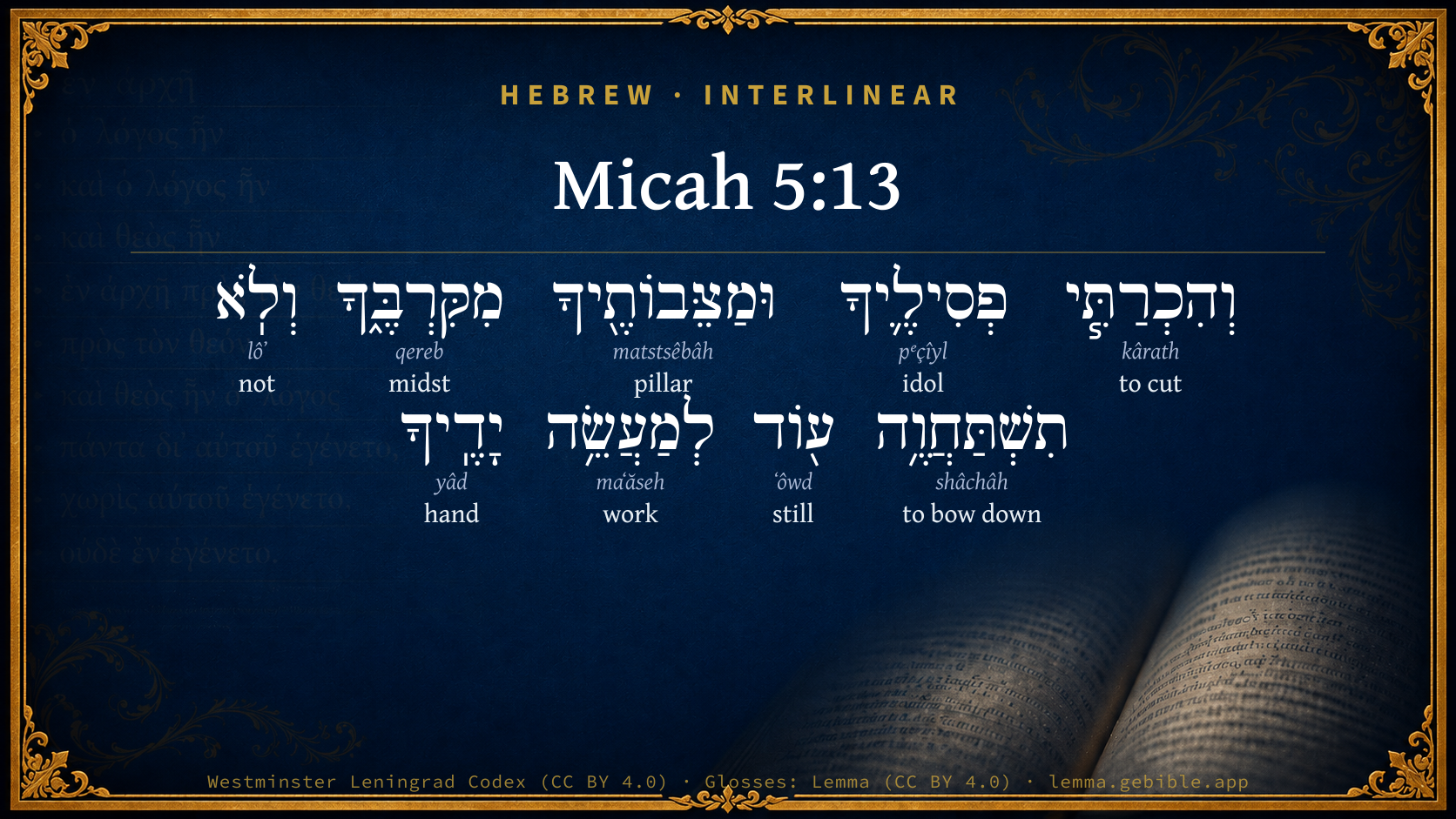
Micah 5:13

Hebrew (Westminster Leningrad Codex) Micah 5:13 appears in the Hebrew Old Testament. The text above is from the Westminster Leningrad Codex. Each word links to its Strong’s number, a concise gloss, and parsing drawn from the Open Scriptures Hebrew Bible morphology. Click any word for its full Brown-Driver-Briggs (BDB) entry.
Download image
Cite this verse

Micah 5:13 (World English Bible). Public Domain. Lemma interlinear Bible study tool, https://lemma.gebible.app/v/micah/5/13.

Show BibTeX & RIS
BibTeX
RIS
English Translation
I will cut off your engraved images and your pillars out of your midst; And you shall no more worship the work of your hands.
World English Bible · Public Domain
Download a study sheet

One document with this verse’s original text, its word-by-word gloss line, the meaning frame, cross-references with their text, attributed commentary, and full source and license credits — printable, and it pastes into notes with its structure intact.

This verse Autodidact and up

Study sheet (.html) Plain text (.txt)

A passage Seminary Student

Up to 50 verses in one chapter. A passage sheet keeps up to 6 commentary sources and 12 cross-references per verse, in the order this page ranks them, and says so on the sheet whenever that leaves anything out. Ask for a single verse and you get the Autodidact verse sheet above.

Everything on this page stays free to read, with no account — the sheet is a download of what is already on screen, not access to it.

Want to remove ads? Support Godless Engineer
Compare translations 3

The same verse in 3 English versions, stacked beneath the original-language interlinear above. Click any original word for its lexicon entry.

Each is an independent rendering of the whole verse — the interlinear is not word-aligned to these translations.

Highlighted words mark where these versions differ — a whole-verse word diff, not a word-by-word alignment.

  • World English Bible Public Domain
    I will cut off your engraved images and your pillars out of your midst; And you shall no more worship the work of your hands.
  • King James Version Public Domain
    Thy graven images also will I cut off, and thy standing images out of the midst of thee; and thou shalt no more worship the work of thine hands.
  • unfoldingWord Literal Text CC BY-SA 4.0
    And I will cut off your carved images and your stone pillars from your midst, and you will no longer bow down to the work of your hands.

unfoldingWord Literal Text — © unfoldingWord, licensed CC BY-SA 4.0. Word-aligned USFM3 via Door43 (git.door43.org/unfoldingWord/en_ult).

Versions to compare (up to 4)

3 of 4 selected

Show all 18 translations

Every available English version of this verse, each an independent rendering of the whole verse.

  • World English Bible Public Domain
    I will cut off your engraved images and your pillars out of your midst; And you shall no more worship the work of your hands.
  • Berean Standard Bible Public Domain
    I will also cut off the carved images and sacred pillars from among you, so that you will no longer bow down to the work of your own hands.
  • Majority Standard Bible Public Domain
    I will also cut off the carved images and sacred pillars from among you, so that you will no longer bow down to the work of your own hands.
  • King James Version Public Domain
    Thy graven images also will I cut off, and thy standing images out of the midst of thee; and thou shalt no more worship the work of thine hands.
  • American Standard Version (1901) Public Domain
    and I will cut off thy graven images and thy pillars out of the midst of thee; and thou shalt no more worship the work of thy hands;
  • Revised Version (1885) Public Domain
    and I will cut off thy graven images and thy pillars out of the midst of thee; and thou shalt no more worship the work of thine hands.
  • Geneva Bible (1599) Public Domain
    Thine idoles also will I cut off, and thine images out of the middes of thee: and thou shalt no more worship the woorke of thine hands.
  • Douay-Rheims (1899) Public Domain
    And I will pluck up thy groves out of the midst of thee: and will crush thy cities.
  • Young's Literal Translation Public Domain
    And I have cut off thy graven images, And thy standing-pillars out of thy midst, And thou dost not bow thyself any more To the work of thy hands.
  • Literal Standard Version CC BY-SA 4.0
    And I have cut off your carved images, || And your standing-pillars out of your midst, || And you do not bow yourself anymore || To the work of your hands.
  • Unlocked Literal Bible CC BY-SA 4.0
    I will destroy your carved figures and your stone pillars from among you. You will no longer worship the workmanship of your hands.
  • unfoldingWord Literal Text CC BY-SA 4.0
    And I will cut off your carved images and your stone pillars from your midst, and you will no longer bow down to the work of your hands.
  • Darby Bible Public Domain
    Thy graven images also will I cut off, and thy statues out of the midst of thee; and thou shalt no more bow down to the work of thy hands.
  • World Messianic Bible Public Domain
    I will cut off your engraved images and your pillars from among you; and you shall no more worship the work of your hands.
  • Webster's Bible Public Domain
    \\5:14\\And I will pluck up thy groves out of the midst of thee: so will I destroy thy cities.
  • Free Bible Version CC BY-SA 4.0
    I will smash down the idols and stone pillars that stand among you: you shall not bow down and worship idols that you make with your own hands any more.
  • Bible in Basic English Public Domain
    I will have your Asherahs pulled up from among you: and I will send destruction on your images.
  • JPS Tanakh (1917) Public Domain
    (5-12) And I will cut off thy graven images and thy pillars out of the midst of thee; and thou shalt no more worship the work of thy hands.

Literal Standard Version (2020), Covenant Press — licensed CC BY-SA 4.0. Text via the HelloAO Bible API (eBible.org). Unlocked Literal Bible (unfoldingWord) — licensed CC BY-SA 4.0. Text via the HelloAO Bible API (eBible.org). unfoldingWord Literal Text — © unfoldingWord, licensed CC BY-SA 4.0. Word-aligned USFM3 via Door43 (git.door43.org/unfoldingWord/en_ult). Free Bible Version, Dr. Jonathan Gallagher — licensed CC BY-SA 4.0. Text via the HelloAO Bible API (eBible.org).

Word by word

More ways to search: Search by grammar → Find every occurrence → Compare this word →

Practice this passage: Drill this verse → Learn its vocabulary →

פְסִילֶ֛יךָ
pᵉçîyl
H6456
“idols · your”
Noun, Common, Masculine, Plural, Construct + Suffix, Personal, 2nd Person, Masculine, Singular
Part of Speech
Noun
Type
Common
Gender
Masculine
Number
Plural
State
Construct
Full BDB Definition

Origin: from H6458

TWOT: 1788b

image, idol, graven image
  1. וְהִכְרַתִּ֧י kârath H3772 “and · to cut” Conjunction + Verb, Hiphil, Sequential Perfect, 1st Person, Common, Singular
  2. וּמַצֵּבוֹתֶ֖יךָ matstsêbâh H4676 “and · pillars · your” Conjunction + Noun, Common, Feminine, Plural, Construct + Suffix, Personal, 2nd Person, Masculine, Singular
  3. מִקִּרְבֶּ֑ךָ qereb H7130 “from · midst · your” Preposition + Noun, Common, Masculine, Singular, Construct + Suffix, Personal, 2nd Person, Masculine, Singular
  4. וְלֹֽא lôʼ H3808 “and · not” Conjunction + Particle, Negative
  5. תִשְׁתַּחֲוֶ֥ה shâchâh H7812 “to bow down” Verb, Hishtaphel, Imperfect, 2nd Person, Masculine, Singular
  6. ע֖וֹד ʻôwd H5750 “still” Adverb
  7. לְמַעֲשֵׂ֥ה maʻăseh H4639 “to/for · work of” Preposition + Noun, Common, Masculine, Singular, Construct
  8. יָדֶֽיךָ yâd H3027 “hands · your” Noun, Common, Both, Dual, Construct + Suffix, Personal, 2nd Person, Masculine, Singular

About this verse

These counts appear in no published source. They are computed here, from the morphology-tagged text and Lemma’s own curated glosses. What Lemma adds →

9
words
9
distinct lemmas
Prophets
section

Notable vocabulary

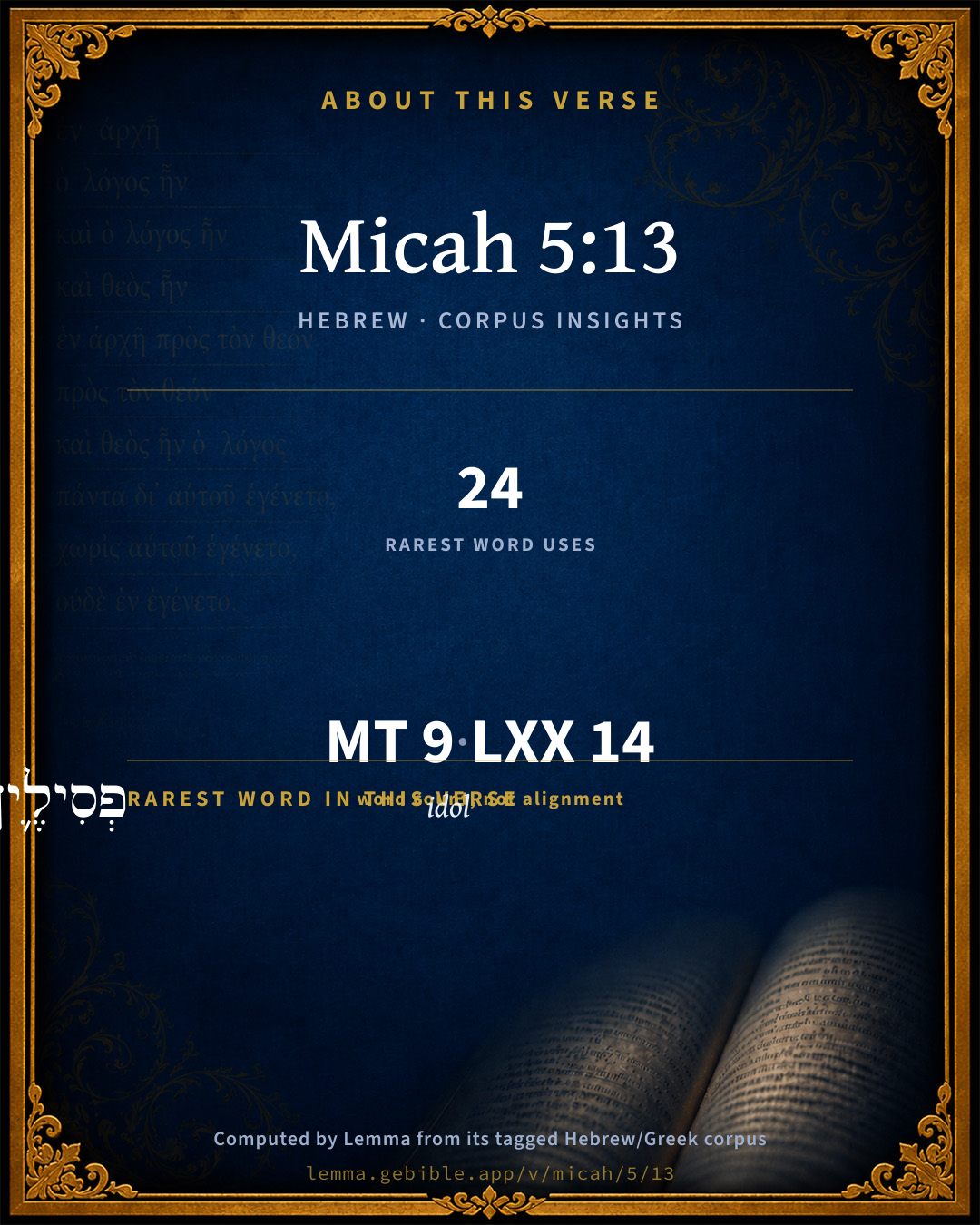
The rarest word here is פְסִילֶ֛יךָ idol H6456 — appearing just 24 times in the whole Hebrew Bible.

Shared distinctive vocabulary

פְסִילֶ֛יךָ idol H6456 occurs in 24 verses of the Hebrew Bible. Also found in:

Grammatical profile

  • 2 verbs
  • 5 nouns
  • 1 adverb
  • 1 particle

Verb forms

  • וְהִכְרַתִּ֧י Hiphil · Sequential Perfect
  • תִשְׁתַּחֲוֶ֥ה Hishtaphel · Imperfect

Hebrew & Septuagint length

In English translation the verse runs 25 words from the Hebrew and 29 from the Septuagint (LXX English) — closely comparable.

A rough comparison of the two English renderings, which tokenize alike — not a word-level alignment.

Word counts can differ between the Hebrew and the Greek without any difference in meaning — e.g. the Hebrew direct-object marker אֵת has no separate Greek word, and Greek often adds the article ὁ.

In the original languages it is 9 Hebrew tokens and 14 Greek tokens — but the two are counted differently (Hebrew bundles its prefixes and suffixes into one token; the Greek is in lemma form), so that isn’t a like-for-like length.

Cross-references

9

Topical passages linked to Micah 5:13 in the Treasury of Scripture Knowledge — connected by theme and wording, ordered by reader-vote popularity; previews shown in the World English Bible.

  • Ezekiel 6:9 Those of you that escape shall remember me among the nations where they shall be carried captive, how that I have been broken with their lewd heart, which has departed from me, and with they eyes, which play the prostitute after their idols: and they shall loathe themselves in their own sight for the evils which they have committed in all their abominations.
  • Ezekiel 36:25 I will sprinkle clean water on you, and you shall be clean: from all your filthiness, and from all your idols, will I cleanse you.
  • Isaiah 2:8 Their land also is full of idols. They worship the work of their own hands, That which their own fingers have made.
  • Isaiah 17:7–8 In that day shall men look to their Maker, and their eyes shall have respect to the Holy One of Israel.
  • Ezekiel 37:23 neither shall they defile themselves any more with their idols, nor with their detestable things, nor with any of their transgressions; but I will save them out of all their dwelling-places, in which they have sinned, and will cleanse them: so shall they be my people, and I will be their God.
  • Hosea 2:16–17 It will be in that day," says Yahweh, "That you will call me 'my husband,' And no longer call me 'my master.'
  • Hosea 14:3 Assyria can't save us. We won't ride on horses; Neither will we say any more to the work of our hands, 'Our gods!' For in you the fatherless finds mercy."
  • Hosea 14:8 Ephraim, what have I to do any more with idols? I answer, and will take care of him. I am like a green fir tree; From me your fruit is found."
  • Zechariah 13:2 It will come to pass in that day, says Yahweh of Hosts, that I will cut off the names of the idols out of the land, and they will no more be remembered; and also I will cause the prophets and the spirit of impurity to pass out of the land.

Cross-references courtesy of OpenBible.info (CC BY 4.0).

Hebrew and Greek witnesses Masoretic Hebrew ↔ Greek Septuagint

The same verse in the two great witnesses to the Old Testament, shown verse-for-verse.

These are two independent witnesses, not word-aligned to each other, and the Septuagint is shown in lemma (dictionary) form.

Hebrew Micah 5:13 Masoretic · Westminster Leningrad Codex

וְהִכְרַתִּ֧י פְסִילֶ֛יךָ וּמַצֵּבוֹתֶ֖יךָ מִקִּרְבֶּ֑ךָ וְלֹֽא תִשְׁתַּחֲוֶ֥ה ע֖וֹד לְמַעֲשֵׂ֥ה יָדֶֽיךָ

I will cut off your engraved images and your pillars out of your midst; And you shall no more worship the work of your hands.

World English Bible · Public Domain

Greek LXX Micah 5:13 Septuagint · lemma form

καί ἐκκόπτω ὁ ἄλσος σύ ἐκ μέσος σύ καί ἀπο ἀναἵζω ὁ πόλις σύ

And I will utterly destroy your graven images, and your statues out of the midst of you; and you shall never any more worship the works of your hands.

LXX2012 (modern English Septuagint) · Public Domain

On this verse, The Pulpit Commentary discusses the Septuagint’s reading. Read the note in Commentary ↓

Hebrew: Westminster Leningrad Codex (CC BY 4.0). Greek: Septuagint (public domain); English from LXX2012 (modern English Septuagint) (Public Domain). How the Septuagint differs from the Hebrew →

Targum (Aramaic paraphrase)

1

The Targum is the ancient Jewish Aramaic paraphrase of the Hebrew Scriptures — an interpretive translation, not the Hebrew text itself. Onkelos (literal) and Pseudo-Jonathan (expansive) render the Torah, and Jonathan the Prophets. Coverage is partial: where no permissively-licensed English translation exists for a verse, only the Aramaic is shown. This is verse-level text, not a word-by-word alignment to the Hebrew.

  1. Targum Jonathan Prophets (Joshua–Malachi)
    וְאַעֲקַר שְׁתִילֵי עַמְמַיָא מִבֵּינָךְ וֶאֱשֵׁיצֵי בַּעֲלֵי דְבָבָךְ:

    (no public-domain English translation for this verse)

    Targum Jonathan — Aramaic: “Mikraot Gedolot” (public domain). English: “Sefaria Community Translation” (CC0 1.0 (public-domain dedication)); “London "Chaldee Paraphrase," 1871” (public domain). Text via Sefaria.

Commentary

Notes on Micah 5:13 from classic Christian and Jewish commentators (each source and its license shown beneath its notes). The classic Christian expositions comment on the surrounding passage and are grouped to its opening verse, so a note may address several verses; the Jewish commentaries on the Tanakh (Rashi and others) are per-verse, so they appear only where the commentator wrote on this verse.

Lemma curates 59 commentaries, every one of them public domain or Creative Commons licensed, each selected and text-cleaned for this edition rather than reprinted as found. About our sources →

Trapp's Complete Commentary

John Trapp

Mic 5:13 Thy graven images also will I cut off, and thy standing images out of the midst of thee; and thou shalt no more worship the work of thine hands.

Ver. 13. Thy graven images also will I cut off] Sorcery and idolatry are fitly coupled here and elsewhere: for they commonly go together, as in the Pope and his clergy, see Rev 9:21; Rev 21:8; as also in the Canaanites, Philistines, and other heathens. True it is that the temples at Rome were without images for 170 years after it was built; that the Lacedaemonians would not endure pictures or images, lest by them they should be distracted; that the Turks and Jews both at this day do abhor Christian religion, for the abominable idolatry they see among Papists: for since the captivity of Babylon the graven images and statues have been so cut off from the Jews, that they would never be drawn to worship the work of their hands. They have a saying among them to this day, that no punishment befalleth them, wherein there is not an ounce of that golden calf they once made in the wilderness (Moses Gerand). Having paid, therefore, for their learning, they abhor idols, Rom 2:22, and count it sacrilege, as Plutarch did, to worship by images. The Papists should do so likewise; and not say, as their Vasquez (unable to answer our arguments) doth, that the second commandment belonged to the Jews only; or bring such proofs of their idolatry that the images themselves (if they were sensible) would blush to hear repeated.

John Trapp, A Commentary or Exposition upon All the Books of the Old and New Testament (1647–1656) — public domain. Text from a community e-Sword module.

Tyndale Open Study Notes

Tyndale Open Resources

5:13-14 sacred pillars . . . Asherah poles: Stones were set up as places or objects of worship; they could represent pagan deities. The Asherah poles were green poles or trees that represented the goddess Asherah and her powers of fertility. Both the stones and the trees may have had sexual implications—one male, the other female. Asherah was seen as the mother of gods and El’s (or Baal’s) consort.

Tyndale Open Study Notes — © Tyndale Open Resources, licensed CC BY-SA 4.0. Text via the HelloAO Bible API.

Jamieson, Fausset & Brown

Robert Jamieson, A. R. Fausset & David Brown

graven images . . . cut off--(Compare Isa 2:8, Isa 2:18-21; Isa 30:22; Zac 13:2).

standing images--statues.

Jamieson, Fausset & Brown — Commentary Critical and Explanatory on the Whole Bible (1871) — public domain (CC PDM 1.0). Text via the HelloAO Bible API.

Adam Clarke's Commentary

Verse 13. Thy graven images also will I cut off] Thou shalt be no more an idolatrous people.

Adam Clarke's Commentary on the Bible (1810–1826) — public domain. Text from a community e-Sword/MySword module.

John Calvin's Commentaries

He now adds, I will cut off thy graven images and thy statues from the midst of thee; and thou shalt not hereafter bend down before the works of thine hands This verse is plain and contains nothing new: for the Prophet teaches that God cannot become propitious to his Church, to keep and make her safe, until he purges her from her filth, even from idolatry and other vices, by which the worship of God was corrupted, or even entirely subverted. I will, therefore, cut off thy graven images and statues from the midst of thee We see that God anticipates us by his gratuitous goodness, not only by forgiving us, but also by calling us back, when wandering, into the right way. Since then we have deviated from the right way, and God thus withdraws his hand that it might appear that he has cast us away it is certain that we ought not only to pray him to have mercy on us, but also to ascribe to him a higher favor, inasmuch as he takes away the very impediments which separate us from him, and suffer him not to come nigh us. We hence see that God is not only inclined to pardon when men repent, but that it is his peculiar office to remove the obstacles.

This ought to be carefully noticed, that we may know that our salvation, from the first beginning, proceeds from the mere favor of God, — and that we may also learn, that all those things, of which the Papists vainly talk respecting preparations, are mere figments.

He then adds, thou shalt not bend hereafter before the work of thine hands. God expresses here the cause why he so much abominates idols, even because he sees that his honor is transferred to them: this is one thing. He further arraigns the Jews as guilty, while he makes evident their defection: for surely nothing could have been more shameful, than to take away from God his honor and worship, and to transfer them to dead things; and he says here by way of reproach, that they were the work of their hands. What can be more insane, than for men to ascribe divinity to their own inventions, or to believe that it is in the power of men to make a god from wood or stone? This is surely monstrous in the extreme. Then the Prophet by this form of speaking aggravates the sin of the people of Israel, that is, when he says that they bowed the head before the work of their oven hands.

John Calvin's Commentaries (1540-1563) — public domain. Text from the Calvin Translation Society English edition (1840s-50s) via the Christian Classics Ethereal Library (ccel.org). Calvin's coverage is partial (roughly two-thirds of the Bible); uncommented books and verses are honest gaps, never fabricated. The 19th-century editor's footnotes and remarks are omitted so the notes are faithfully Calvin's own voice.

The Cambridge Bible for Schools and Colleges

gen. ed. J. J. S. Perowne

13. Thy graven images … thy standing images] The former, images of wood or metal; the latter, stone pillars consecrated to a divinity. Comp. Lev_26:1, ‘Ye shall make you no idols nor graven image, neither rear you up a (sacred) pillar,’ Deu_16:22; Deu_27:15, Exo_23:24. The denunciation of sacred ‘pillars’ and Ashérahs is however much more emphatic in the legislation of the Pentateuch than in Micah. The latter prophet mentions them rather as constituent parts of the corrupting civilisation imported from abroad. Isaiah (a contemporary of Micah’s) actually gives his sanction to the erection of ‘pillars’ to the true God (Isah 19:19); and Hosea (also a contemporary) merely mentions the want of sacred ‘pillars’ as among the misfortunes of the captivity, concurrently with the want of king and sacrifice (Hos_3:4). This tolerant attitude of Isaiah and Micah is in perfect harmony with the Book of Genesis, which relates how Jacob set up and anointed the ‘pillar’ which marked out Bethel as a sanctuary. In fact, as long as ‘high places,’ or local sanctuaries, were tolerated, it was natural to tolerate ‘pillars’ with them, the ‘pillar’ being one of the traditional signs of a ‘high place.’ Isaiah lets the sanctuaries alone (though not, of course, the graven images, Isa_2:20, Isa_30:22), and with them the sacred ‘pillars;’ Micah begins to protest against both, but still gently, compared with the legislation of the Pentateuch (comp. on Mic_1:5).

The Cambridge Bible for Schools and Colleges (gen. ed. J. J. S. Perowne; Cambridge University Press, 1878–1918) — public domain. Text from a community e-Sword module.

John Gill's Exposition

Thy graven images also will I cut off, and thy standing images out of the midst of thee,.... The former were such as were made of wood or stone; the latter statues, such as were molten or cast, and made of gold, silver, or brass; Such as the Jews sometimes worshipped, and are now found in the apostate church of Rome; but will have no place in the Christian churches, or those so called, in the latter day. The Jews indeed have had no idols or idolatrous worship among them since the Babylonish captivity; and the prophet here speaks, not of what would be found among them, and removed at their conversion; but of what was in his time, or had been, or would be again, but should not be in future time, when they should turn to the Lord, and be like dew among the people; and so we are to understand some following passages. The Targum is,

"I will cut off the images of the people, and their statues:''

and thou shalt no more worship the work of thine hands; as not to fall down to idols and worship them, so neither to trust in carnal privileges, ceremonial rites, observances of the traditions of the elders, or any works of righteousness done by them, which they had been prone unto.

John Gill's Exposition of the Whole Bible (1746–1763) — public domain (CC PDM 1.0). Text via the HelloAO Bible API.

Haydock's Catholic Bible Commentary

CHAPTER V.

George Leo Haydock (1774–1849), Haydock's Catholic Family Bible and Commentary, 1859 edition — public domain. Excludes Psalms (Douay-Rheims chapter numbering differs from Protestant) and Deuterocanonical books (Catholic canon only).

Matthew Poole's English Annotations

Thy graven images; which were for the matter of them made of wood or stone, smoothed, and fashioned to the images, which the blind idolater thought did well represent his god.

Standing images: statues erected in places chosen for the purpose, fixed that they move not, had this different name from their posture, the matter still the same.

Out of the midst of thee, O Israel, in the type, and, O Israel, antitype: this is verified among the Jews, who to this day hate images for Divine uses, and learnt this in their captivity; and it is verified in the church of Christ, which condemns all religious use of images.

Thou shalt no more worship the work of thine hands: it was once the great sin of the Jews to worship and rely on idols; but when God shall by the Messiah redeem both his Israels, they shall no more sin thus, Hos 14:3, for they shall know he is the only true God, and there is no Saviour beside him.

Matthew Poole's English Annotations on the Holy Bible (1683–1685) — public domain. Text from a community e-Sword/MySword module.

Whedon's Commentary on the Bible

Daniel D. Whedon

13, 14. Idolatry also will come to an end. Of objects connected with the idolatrous cult three are mentioned: graven images, pillars, and the Asherim.

Graven images — Images made of stone (Mic_1:7) or wood (Deu_7:5); sometimes the term appears to refer to images of the deity in general (Isa_42:8). The attitude of the Old Testament toward these images is one of intense hostility (Hos_8:5-6; Hos_10:5; Deu_7:5, etc.).

Standing images — Better, R.V., “pillars”; Hebrews massebhah. The word is used almost exclusively of a “pillar” connected with the religious cult. It denotes the upright stone or pillar which seems to have been a regular accompaniment of Hebrew sanctuaries during the pre-exilic period. Its origin must probably be sought in an earlier stage of Semitic religion, when sacred stones were objects of worship, because it was thought that the deity inhabited the stones or was in some way attached to them. A crude, material symbolism of this sort would inevitably retard the progress toward the highest spiritual conception of the nature of Jehovah; hence the Book of Deuteronomy (Deu_7:5; Deu_12:3; Deu_16:22) condemns these pillars mercilessly. The eighth century prophets were not quite so severe; in fact, Isaiah (Isa_19:19) seems to regard the pillar a legitimate element in Jehovah worship.

Groves — Better, R.V., “Asherim.” As the “pillar” points back to primitive stone worship, so the “Asherim” appear to be a relic of primitive tree worship. The Asherah (singular) was a representation of the sacred tree where a living tree was not available; the use of the plural implies the existence of whole groves of such sacred trees or of artificial poles. “From a survey of all the passages in which the word is used it appears that the Asherah was a post or a pole, planted in the ground, like an English Maypole, beside an altar,… and venerated as a sacred symbol” (Driver). Remnants of ancient tree worship are still seen in Palestine (compare Curtiss, Primitive Semitic Religions Today, pp. 90ff.). The Old Testament attitude toward the Asherim is one of hostility; there is no passage corresponding to Isa_19:19.

So will I destroy thy cities — A similar threat is made in Mic_5:11, where it is quite natural; not so here. Some suggest that the word should be rendered “adversaries” (margin, R.V. “enemies”), giving to it a meaning which it has in Aramaic, or to change one letter, which would give the corresponding Hebrew word. If this is done, the expression would pave the way for Mic_5:15. But one would expect rather another reference to idolatry; for this reason many change the word so as to read “thy idols” (compare 2Ch_24:18, “the Asherim and the idols”).

Daniel D. Whedon (gen. ed.), Commentary on the Old and New Testaments (1874–1909) — public domain. Text from a community e-Sword module.

The Pulpit Commentary

Graven images, of stone or metal. (Lev_26:1) Standing images; Septuagint, tav sou , "thy columns;" Vulgate, statuas tuas These are stone images or pillars dedicated to false gods. (1Ki_14:23) A pillar to mark a place consecrated to the worship of the Lord was allowed. (see Gen_28:18 Gen_31:13, 45 Isa_19:17) Itwas when this custom degenerated into idolatry that it was sternly denounced. (Deu_16:22 Deu_27:15, etc.)

The Pulpit Commentary (1880–1919), ed. H.D.M. Spence-Jones & Joseph S. Exell — public domain. Text from a community e-Sword module.

John Wesley's Explanatory Notes

Graven images - This was verified among the Jews, who to this day hate images for divine uses, and learnt this in their captivity.

John Wesley, Explanatory Notes Upon the Whole Bible (1754–1765) — public domain. Text via the GEBible commentary corpus.

Rashi

Rabbi Shlomo Yitzchaki (Rashi)

and I will destroy your enemies Heb. עָרֶיךָ. Jonathan renders: And I will destroy your enemies. Similarly, (Isa. 14:21) “And fill the surface of the earth with enemies (עָרִים),” and (I Sam. 28:16) “And has become your adversary (עָרֶךָ).”

Rashi on the Tanakh — English translations: “The Judaica Press complete Tanach with Rashi, translated by A. J. Rosenberg” (CC BY 4.0); “Pentateuch with Rashi's commentary by M. Rosenbaum and A.M. Silbermann, 1929-1934” (public domain); “The Metsudah Tanach series, Lakewood, N.J” (CC BY 4.0); and “The Book of Joshua, Metsudah Publications, 1997” (CC BY 4.0). Text via Sefaria.

Lesson kit

Teaching starters — assembled from the data on this page, not authored interpretation. Every prompt links to the verse data it draws on. Edit before teaching.

Micah, in the Prophets, opens this verse with 9 words (9 distinct Hebrew lemmas). Its most distinctive word is pᵉçîyl (“idol”). A historical commentator’s framing appears above. Read the whole chapter for the surrounding context.

Discussion questions

  1. What does “idol” (pᵉçîyl) contribute to the verse as a whole?
  2. How does Deuteronomy 7:5, which shares the word «idol», read alongside this verse?
  3. These translations render this verse differently. What is at stake in choosing one wording over another?
  4. «וְהִכְרַתִּ֧י» is a Hiphil Sequential Perfect verb. How does that grammatical form shape the action described?
  5. Compare how Trapp's Complete Commentary and Tyndale Open Study Notes read this verse. Where do they agree or differ?

Things to notice

Reading settings

Reading text

Shown beneath each verse's original-language words.

Old Testament
Old Testament edition

Read the OT as the Masoretic Hebrew (MT) or the Greek Septuagint (LXX).

English shown for the Greek Septuagint (in the Hebrew ↔ Greek comparison).

Comparing translations? Open the Compare panel on any verse page to stack up to four side by side.