
1 Kings 16:31

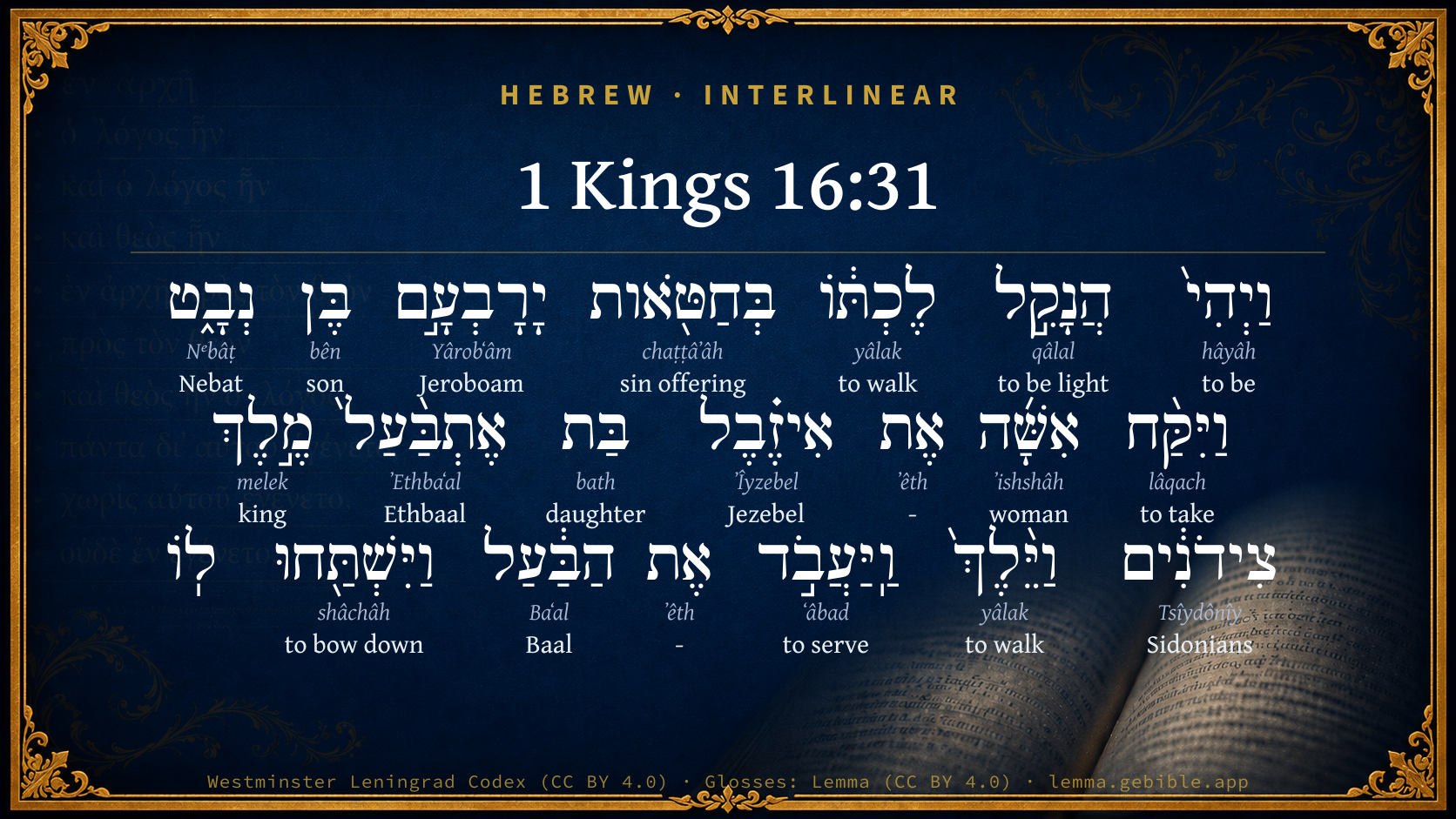
Hebrew (Westminster Leningrad Codex) 1 Kings 16:31 appears in the Hebrew Old Testament. The text above is from the Westminster Leningrad Codex. Each word links to its Strong’s number, a concise gloss, and parsing drawn from the Open Scriptures Hebrew Bible morphology. Click any word for its full Brown-Driver-Briggs (BDB) entry.
Download image
Cite this verse

1 Kings 16:31 (World English Bible). Public Domain. Lemma interlinear Bible study tool, https://lemma.gebible.app/v/1-kings/16/31.

Show BibTeX & RIS
BibTeX
RIS
English Translation
It happened, as if it had been a light thing for him to walk in the sins of Jeroboam the son of Nebat, that he took as wife Jezebel the daughter of Ethbaal king of the Sidonians, and went and served Baal, and worshiped him.
World English Bible · Public Domain
Highlights
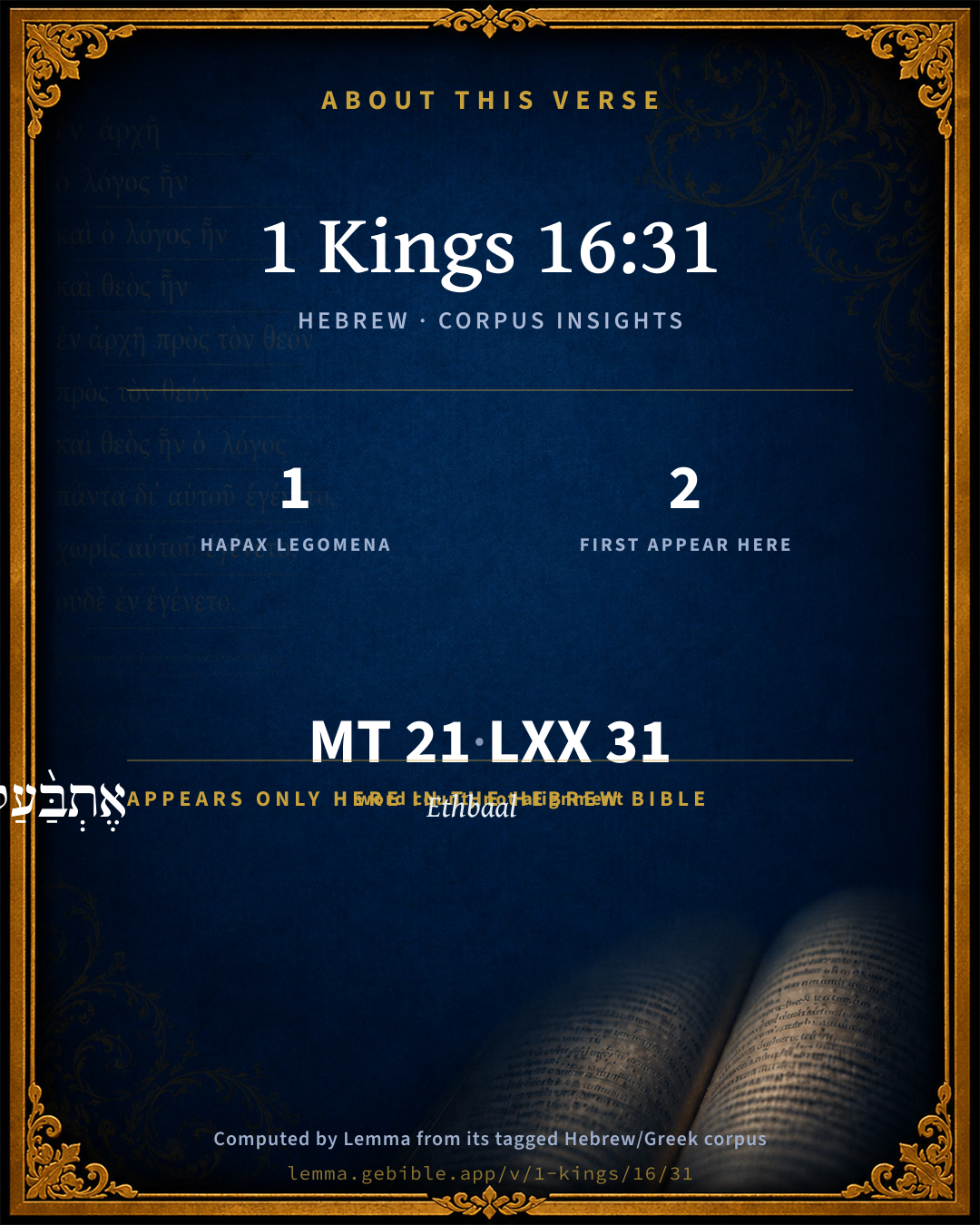
  • 1 hapax legomenon — only here in the Hebrew Bible
  • 2 first appearances in the Hebrew Bible
Full analysis ↓
Download a study sheet

One document with this verse’s original text, its word-by-word gloss line, the meaning frame, cross-references with their text, attributed commentary, and full source and license credits — printable, and it pastes into notes with its structure intact.

This verse Autodidact and up

Study sheet (.html) Plain text (.txt)

A passage Seminary Student

Up to 50 verses in one chapter. A passage sheet keeps up to 6 commentary sources and 12 cross-references per verse, in the order this page ranks them, and says so on the sheet whenever that leaves anything out. Ask for a single verse and you get the Autodidact verse sheet above.

Everything on this page stays free to read, with no account — the sheet is a download of what is already on screen, not access to it.

Want to remove ads? Support Godless Engineer
Compare translations 3

The same verse in 3 English versions, stacked beneath the original-language interlinear above. Click any original word for its lexicon entry.

Each is an independent rendering of the whole verse — the interlinear is not word-aligned to these translations.

Highlighted words mark where these versions differ — a whole-verse word diff, not a word-by-word alignment.

  • World English Bible Public Domain
    It happened, as if it had been a light thing for him to walk in the sins of Jeroboam the son of Nebat, that he took as wife Jezebel the daughter of Ethbaal king of the Sidonians, and went and served Baal, and worshiped him.
  • King James Version Public Domain
    And it came to pass, as if it had been a light thing for him to walk in the sins of Jeroboam the son of Nebat, that he took to wife Jezebel the daughter of Ethbaal king of the Zidonians, and went and served Baal, and worshipped him.
  • unfoldingWord Literal Text CC BY-SA 4.0
    And it happened (was his walking in the sins of Jeroboam, the son of Nebat, trivial?) that he took a wife, Jezebel, the daughter of Ethbaal, the king of the Sidonians. And he went and served Baal, and he bowed down to him.

unfoldingWord Literal Text — © unfoldingWord, licensed CC BY-SA 4.0. Word-aligned USFM3 via Door43 (git.door43.org/unfoldingWord/en_ult).

Versions to compare (up to 4)

3 of 4 selected

Show all 18 translations

Every available English version of this verse, each an independent rendering of the whole verse.

  • World English Bible Public Domain
    It happened, as if it had been a light thing for him to walk in the sins of Jeroboam the son of Nebat, that he took as wife Jezebel the daughter of Ethbaal king of the Sidonians, and went and served Baal, and worshiped him.
  • Berean Standard Bible Public Domain
    And as if it were not enough for him to walk in the sins of Jeroboam son of Nebat, he even married Jezebel the daughter of Ethbaal king of the Sidonians, and he then proceeded to serve and worship Baal.
  • Majority Standard Bible Public Domain
    And as if it were not enough for him to walk in the sins of Jeroboam son of Nebat, he even married Jezebel the daughter of Ethbaal king of the Sidonians, and he then proceeded to serve and worship Baal.
  • King James Version Public Domain
    And it came to pass, as if it had been a light thing for him to walk in the sins of Jeroboam the son of Nebat, that he took to wife Jezebel the daughter of Ethbaal king of the Zidonians, and went and served Baal, and worshipped him.
  • American Standard Version (1901) Public Domain
    And it came to pass, as if it had been a light thing for him to walk in the sins of Jeroboam the son of Nebat, that he took to wife Jezebel the daughter of Ethbaal king of the Sidonians, and went and served Baal, and worshipped him.
  • Revised Version (1885) Public Domain
    And it came to pass, as if it had been a light thing for him to walk in the sins of Jeroboam the son of Nebat, that he took to wife Jezebel the daughter of Ethbaal king of the Zidonians, and went and served Baal, and worshipped him.
  • Geneva Bible (1599) Public Domain
    For was it a light thing for him to walke in the sinnes of Ieroboam the sonne of Nebat, except hee tooke Iezebel also the daughter of Ethbaal King of the Zidonians to wife, and went and serued Baal, and worshipped him?
  • Douay-Rheims (1899) Public Domain
    Nor was it enough for him to walk in the sins of Jeroboam the son of Nabat: but he also took to wife Jezabel daughter of Ethbaal king of the Sidonians. And he went, and served Baal, and adored him.
  • Young's Literal Translation Public Domain
    And it cometh to pass -- hath it been light his walking in the sins of Jeroboam son of Nebat? -- then he taketh a wife, Jezebel daughter of Ethbaal, king of the Zidonians, and goeth and serveth Baal, and boweth himself to it,
  • Literal Standard Version CC BY-SA 4.0
    And it comes to pass, as if it had been trivial—his walking in the sins of Jeroboam son of Nebat—that he takes a wife, Jezebel daughter of Ethba‘al, king of the Zidonians, and goes and serves Ba‘al, and bows himself to it,
  • Unlocked Literal Bible CC BY-SA 4.0
    It was to Ahab a trivial thing to walk in the sins of Jeroboam son of Nebat, so he took as his wife Jezebel the daughter of Ethbaal, king of the Sidonians; he went and worshiped Baal and bowed down to him.
  • unfoldingWord Literal Text CC BY-SA 4.0
    And it happened (was his walking in the sins of Jeroboam, the son of Nebat, trivial?) that he took a wife, Jezebel, the daughter of Ethbaal, the king of the Sidonians. And he went and served Baal, and he bowed down to him.
  • Darby Bible Public Domain
    And it came to pass, as if it was a light thing for him to walk in the sins of Jeroboam the son of Nebat, that he took as wife Jezebel the daughter of Ethbaal king of the Zidonians; and he went and served Baal and worshipped him.
  • World Messianic Bible Public Domain
    As if it had been a light thing for him to walk in the sins of Jeroboam the son of Nebat, he took as wife Jezebel the daughter of Ethbaal king of the Sidonians, and went and served Baal and worshiped him.
  • Webster's Bible Public Domain
    And it came to pass, as if it had been a light thing for him to walk in the sins of Jeroboam the son of Nebat, that he took to wife Jezebel the daughter of Ethbaal king of the Zidonians, and went and served Baal, and worshiped him.
  • Free Bible Version CC BY-SA 4.0
    He didn't see anything to worry about in following the sins of Jeroboam, son of Nebat, and he even married Jezebel, daughter of Ethbaal, king of the Sidonians, and started to serve and worship Baal.
  • Bible in Basic English Public Domain
    And as if copying the evil ways of Jeroboam, the son of Nebat, was a small thing for him, he took as his wife Jezebel, daughter of Ethbaal, king of Zidon, and became a servant and worshipper of Baal.
  • JPS Tanakh (1917) Public Domain
    And it came to pass, as if it had been a light thing for him to walk in the sins of Jeroboam the son of Nebat, that he took to wife Jezebel the daughter of Ethbaal king of the Zidonians, and went and served Baal, and worshipped him.

Literal Standard Version (2020), Covenant Press — licensed CC BY-SA 4.0. Text via the HelloAO Bible API (eBible.org). Unlocked Literal Bible (unfoldingWord) — licensed CC BY-SA 4.0. Text via the HelloAO Bible API (eBible.org). unfoldingWord Literal Text — © unfoldingWord, licensed CC BY-SA 4.0. Word-aligned USFM3 via Door43 (git.door43.org/unfoldingWord/en_ult). Free Bible Version, Dr. Jonathan Gallagher — licensed CC BY-SA 4.0. Text via the HelloAO Bible API (eBible.org).

Word by word

More ways to search: Search by grammar → Find every occurrence → Compare this word →

Practice this passage: Drill this verse → Learn its vocabulary →

אֶתְבַּ֨עַל֙
ʼEthbaʻal
H856
“Ethbaal”
Noun, Proper
Part of Speech
Noun
Type
Proper
Full BDB Definition

Origin: from H854 and H1168

TWOT: None

Ethbaal = "with Baal" - king of Sidon, father of Jezebel
  1. וַיְהִי֙ hâyâh H1961 “and · to be” Conjunction + Verb, Qal, Sequential Imperfect, 3rd Person, Masculine, Singular
  2. הֲנָקֵ֣ל qâlal H7043 “to be light” Particle, Interrogative + Verb, Niphal, Perfect, 3rd Person, Masculine, Singular
  3. לֶכְתּ֔וֹ yâlak H3212 “to walk · him” Verb, Qal, Infinitive Construct + Suffix, Personal, 3rd Person, Masculine, Singular
  4. בְּחַטֹּ֖אות chaṭṭâʼâh H2403 “in/at · sin offerings of” Preposition + Noun, Common, Feminine, Plural, Construct
  5. יָרָבְעָ֣ם Yârobʻâm H3379 “Jeroboam” Noun, Proper
  6. בֶּן bên H1121 “son of” Noun, Common, Masculine, Singular, Construct
  7. נְבָ֑ט Nᵉbâṭ H5028 “Nebat” Noun, Proper
  8. וַיִּקַּ֨ח lâqach H3947 “and · to take” Conjunction + Verb, Qal, Sequential Imperfect, 3rd Person, Masculine, Singular
  9. אִשָּׁ֜ה ʼishshâh H802 “woman” Noun, Common, Feminine, Singular, Absolute
  10. אֶת ʼêth H853 “-” Particle, Direct Object
  11. אִיזֶ֗בֶל ʼÎyzebel H348 “Jezebel” Noun, Proper
  12. בַּת bath H1323 “daughter of” Noun, Common, Feminine, Singular, Construct
  13. מֶ֣לֶךְ melek H4428 “king of” Noun, Common, Masculine, Singular, Construct
  14. צִידֹנִ֔ים Tsîydônîy H6722 “Sidonians” Noun, Gentilic, Masculine, Plural, Absolute
  15. וַיֵּ֨לֶךְ֙ yâlak H3212 “and · to walk” Conjunction + Verb, Qal, Sequential Imperfect, 3rd Person, Masculine, Singular
  16. וַֽיַּעֲבֹ֣ד ʻâbad H5647 “and · to serve” Conjunction + Verb, Qal, Sequential Imperfect, 3rd Person, Masculine, Singular
  17. אֶת ʼêth H853 “-” Particle, Direct Object
  18. הַבַּ֔עַל Baʻal H1168 “the · Baal” Particle, Definite Article + Noun, Proper
  19. וַיִּשְׁתַּ֖חוּ shâchâh H7812 “and · to bow down” Conjunction + Verb, Hithpael, Sequential Imperfect, 3rd Person, Masculine, Singular

About this verse

These counts appear in no published source. They are computed here, from the morphology-tagged text and Lemma’s own curated glosses. What Lemma adds →

21
words
18
distinct lemmas
Historical
section

Notable vocabulary

1 hapax legomenon — a word that appears only here in the entire Hebrew Bible:

  • אֶתְבַּ֨עַל֙ Ethbaal H856

First appearance in Scripture

These words make their first canonical appearance in the Hebrew Bible here:

  • אִיזֶ֗בֶל Jezebel H348
  • אֶתְבַּ֨עַל֙ Ethbaal H856

Shared distinctive vocabulary

צִידֹנִ֔ים Sidonians H6722 occurs in 15 verses of the Hebrew Bible. Also found in:

Grammatical profile

  • 7 verbs
  • 11 nouns
  • 1 preposition
  • 2 particles

Verb forms

  • וַיְהִי֙ Qal · Sequential Imperfect
  • הֲנָקֵ֣ל Niphal · Perfect
  • לֶכְתּ֔וֹ Qal · Infinitive Construct
  • וַיִּקַּ֨ח Qal · Sequential Imperfect
  • וַיֵּ֨לֶךְ֙ Qal · Sequential Imperfect
  • וַֽיַּעֲבֹ֣ד Qal · Sequential Imperfect
  • וַיִּשְׁתַּ֖חוּ Hithpael · Sequential Imperfect

Repetition

A word recurs within this verse — often emphatic in Hebrew:

  • לֶכְתּ֔וֹ to walk H3212 ×2

Hebrew & Septuagint length

In English translation the verse runs 45 words from the Hebrew and 41 from the Septuagint (LXX English) — closely comparable.

A rough comparison of the two English renderings, which tokenize alike — not a word-level alignment.

Word counts can differ between the Hebrew and the Greek without any difference in meaning — e.g. the Hebrew direct-object marker אֵת has no separate Greek word, and Greek often adds the article ὁ.

In the original languages it is 21 Hebrew tokens and 31 Greek tokens — but the two are counted differently (Hebrew bundles its prefixes and suffixes into one token; the Greek is in lemma form), so that isn’t a like-for-like length.

Cross-references

27

Topical passages linked to 1 Kings 16:31 in the Treasury of Scripture Knowledge — connected by theme and wording, ordered by reader-vote popularity; previews shown in the World English Bible.

  • 2 Kings 17:16 They forsook all the commandments of Yahweh their God, and made them molten images, even two calves, and made an Asherah, and worshiped all the host of the sky, and served Baal.
  • 2 Kings 10:18 Jehu gathered all the people together, and said to them, Ahab served Baal a little; but Jehu will serve him much.
  • Judges 18:7 Then the five men departed, and came to Laish, and saw the people who were therein, how they lived in security, after the manner of the Sidonians, quiet and secure; for there was none in the land, possessing authority, that might put [them] to shame in anything, and they were far from the Sidonians, and had no dealings with any man.
  • Deuteronomy 7:3–4 neither shall you make marriages with them; your daughter you shall not give to his son, nor his daughter shall you take to your son.
  • Judges 2:11 The children of Israel did that which was evil in the sight of Yahweh, and served the Baals;
  • 1 Kings 21:25–26 (But there was none like Ahab, who did sell himself to do that which was evil in the sight of Yahweh, whom Jezebel his wife stirred up.
  • Genesis 6:2 that God's sons saw that men's daughters were beautiful, and they took for themselves wives of all that they chose.
  • Genesis 30:15 She said to her, "Is it a small matter that you have taken away my husband? Would you take away my son's mandrakes, also?" Rachel said, "Therefore he will lie with you tonight for your son's mandrakes."
  • Numbers 16:9 [seems it but] a small thing to you, that the God of Israel has separated you from the congregation of Israel, to bring you near to himself, to do the service of the tent of Yahweh, and to stand before the congregation to minister to them;
  • Joshua 23:12–13 Else if you do at all go back, and cleave to the remnant of these nations, even these who remain among you, and make marriages with them, and go in to them, and they to you;
  • Judges 3:7 The children of Israel did that which was evil in the sight of Yahweh, and forgot Yahweh their God, and served the Baals and the Asheroth.
  • Judges 10:6 The children of Israel again did that which was evil in the sight of Yahweh, and served the Baals, and the Ashtaroth, and the gods of Syria, and the gods of Sidon, and the gods of Moab, and the gods of the children of Ammon, and the gods of the Philistines; and they forsook Yahweh, and didn't serve him.
  • Judges 10:12 The Sidonians also, and the Amalekites, and the Maonites, did oppress you; and you cried to me, and I saved you out of their hand.
  • 1 Kings 11:1–2 Now king Solomon loved many foreign women, together with the daughter of Pharaoh, women of the Moabites, Ammonites, Edomites, Sidonians, and Hittites;
  • 1 Kings 11:4–8 For it happened, when Solomon was old, that his wives turned away his heart after other gods; and his heart was not perfect with Yahweh his God, as was the heart of David his father.
  • 1 Kings 18:4 for it was so, when Jezebel cut off the prophets of Yahweh, that Obadiah took one hundred prophets, and hid them by fifty in a cave, and fed them with bread and water.)
  • 1 Kings 18:19 Now therefore send, and gather to me all Israel to Mount Carmel, and the prophets of Baal four hundred fifty, and the prophets of the Asherah four hundred, who eat at Jezebel's table.
  • 1 Kings 19:1–2 Ahab told Jezebel all that Elijah had done, and withal how he had slain all the prophets with the sword.
  • 1 Kings 21:5–14 But Jezebel his wife came to him, and said to him, Why is your spirit so sad, that you eat no bread?
  • 2 Kings 9:30–37 When Jehu was come to Jezreel, Jezebel heard of it; and she painted her eyes, and attired her head, and looked out at the window.
  • Nehemiah 13:23–29 In those days also saw I the Jews who had married women of Ashdod, of Ammon, [and] of Moab:
  • Isaiah 7:13 He said, "Listen now, house of David: Is it not enough for you to try the patience of men, that you will try the patience of my God also?
  • Ezekiel 8:17 Then he said to me, Have you seen [this], son of man? Is it a light thing to the house of Judah that they commit the abominations which they commit here? for they have filled the land with violence, and have turned again to provoke me to anger: and, behold, they put the branch to their nose.
  • Ezekiel 16:20 Moreover you have taken your sons and your daughters, whom you have borne to me, and these have you sacrificed to them to be devoured. Were your prostitution a small matter,
  • Ezekiel 16:47 Yet have you not walked in their ways, nor done after their abominations; but, as [if that were] a very little [thing], you were more corrupt than they in all your ways.
  • Ezekiel 34:18 Seems it a small thing to you to have fed on the good pasture, but you must tread down with your feet the residue of your pasture? and to have drunk of the clear waters, but you must foul the residue with your feet?
  • Revelation 2:20 But I have this against you, that you tolerate your woman, Jezebel, who calls herself a prophetess. She teaches and seduces my servants to commit sexual immorality, and to eat things sacrificed to idols.

Cross-references courtesy of OpenBible.info (CC BY 4.0).

Hebrew and Greek witnesses Masoretic Hebrew ↔ Greek Septuagint

The same verse in the two great witnesses to the Old Testament, shown verse-for-verse.

These are two independent witnesses, not word-aligned to each other, and the Septuagint is shown in lemma (dictionary) form.

Hebrew 1 Kings 16:31 Masoretic · Westminster Leningrad Codex

וַיְהִי֙ הֲנָקֵ֣ל לֶכְתּ֔וֹ בְּחַטֹּ֖אות יָרָבְעָ֣ם בֶּן נְבָ֑ט וַיִּקַּ֨ח אִשָּׁ֜ה אֶת אִיזֶ֗בֶל בַּת אֶתְבַּ֨עַל֙ מֶ֣לֶךְ צִידֹנִ֔ים וַיֵּ֨לֶךְ֙ וַֽיַּעֲבֹ֣ד אֶת הַבַּ֔עַל וַיִּשְׁתַּ֖חוּ לֽוֹ

It happened, as if it had been a light thing for him to walk in the sins of Jeroboam the son of Nebat, that he took as wife Jezebel the daughter of Ethbaal king of the Sidonians, and went and served Baal, and worshiped him.

World English Bible · Public Domain

Greek LXX 1 Kings 16:31 Septuagint · lemma form

καί οὐ εἰμί αὐτός ἱκανός ὁ πορεύομαι ἐν ὁ ἁμαρτία ιεροβοαμ υἱός ναβατ καί λαμβάνω γυνή ὁ ιεζαβελ θυγάτηρ ιεθεβααλ βασιλεύς σιδώνιος καί πορεύομαι καί δουλεύω ὁ βααλ καί προςκυνέω αὐτός

And it was not enough for him to walk in the sins of Jeroboam the son of Nabat, but he took as wife, Jezabel the daughter of Jethebaal king of the Sidonians; and he went and served Baal, and worshipped him.

LXX2012 (modern English Septuagint) · Public Domain

Hebrew: Westminster Leningrad Codex (CC BY 4.0). Greek: Septuagint (public domain); English from LXX2012 (modern English Septuagint) (Public Domain). How the Septuagint differs from the Hebrew →

Targum (Aramaic paraphrase)

1

The Targum is the ancient Jewish Aramaic paraphrase of the Hebrew Scriptures — an interpretive translation, not the Hebrew text itself. Onkelos (literal) and Pseudo-Jonathan (expansive) render the Torah, and Jonathan the Prophets. Coverage is partial: where no permissively-licensed English translation exists for a verse, only the Aramaic is shown. This is verse-level text, not a word-by-word alignment to the Hebrew.

  1. Targum Jonathan Prophets (Joshua–Malachi)
    וַהֲוָה שִׁיט בְּעֵינוֹהִי לְמֵיזַל בְּחוֹבֵי יָרָבְעָם בַּר נְבָט וּנְסִיב אִתְּתָא יַת אִיזֶבֶל בַּת אֶתְבַּעַל מַלְכָּא דְצִידוֹן וַאֲזַל וּפְלַח יַת בַּעֲלָא וּסְגִיד לֵיהּ:

    (no public-domain English translation for this verse)

    Targum Jonathan — Aramaic: “Mikraot Gedolot” (public domain). English: “Sefaria Community Translation” (CC0 1.0 (public-domain dedication)); “London "Chaldee Paraphrase," 1871” (public domain). Text via Sefaria.

Commentary

Notes on 1 Kings 16:31 from classic Christian and Jewish commentators (each source and its license shown beneath its notes). The classic Christian expositions comment on the surrounding passage and are grouped to its opening verse, so a note may address several verses; the Jewish commentaries on the Tanakh (Rashi and others) are per-verse, so they appear only where the commentator wrote on this verse.

Lemma curates 59 commentaries, every one of them public domain or Creative Commons licensed, each selected and text-cleaned for this edition rather than reprinted as found. About our sources →

Trapp's Complete Commentary

John Trapp

1Ki 16:31 And it came to pass, as if it had been a light thing for him to walk in the sins of Jeroboam the son of Nebat, that he took to wife Jezebel the daughter of Ethbaal king of the Zidonians, and went and served Baal, and worshipped him.

Ver. 31. He took to wife Jezebel the daughter of Ethbaal.] Whom Diodorus Siculus calleth Jeobalus. The very name of this king and his daughter ending in Bel and Baal, show how greatly they were addicted to that idolatry.

John Trapp, A Commentary or Exposition upon All the Books of the Old and New Testament (1647–1656) — public domain. Text from a community e-Sword module.

Tyndale Open Study Notes

Tyndale Open Resources

16:31-33 The spiritual evaluation of Ahab is the worst yet among the kings of Israel. Later, Ahab’s evil behavior was attributed to his being “under the influence of his wife Jezebel” (21:25). Ahab and Jezebel propagated Canaanite worship rites, leading Israel further from the Lord. Added to Jeroboam’s false worship system, these sins eventually spelled disaster for Israel.

Tyndale Open Study Notes — © Tyndale Open Resources, licensed CC BY-SA 4.0. Text via the HelloAO Bible API.

Geneva Bible (1599)

Geneva Bible translators

By whose means he fell to all wicked and strange idolatry, and cruel persecution.

Geneva Bible (1599) marginal notes — public domain. Text via Bolls.life.

Adam Clarke's Commentary

Verse 31. He took to wife Jezebel] This was the head and chief of his offending; he took to wife, not only a heathen, but one whose hostility to the true religion was well known, and carried to the utmost extent.

1. She was the idolatrous daughter of an idolatrous king;

2. She practised it openly;

3. She not only countenanced it in others, but protected it, and gave its partisans honours and rewards; 4.

She used every means to persecute the true religion;

5. She was hideously cruel, and put to death the prophets and priests of God; 6.

And all this she did with the most zealous perseverance and relentless cruelty.

Notwithstanding Ahab had built a temple, and made an altar for Baal, and set up the worship of Asherah, the Sidonian Venus, which we, 1Kg 16:33, have transformed into a grove; yet so well known was the hostility of Jezebel to all good, that his marrying her was esteemed the highest pitch of vice, and an act the most provoking to God, and destructive to the prosperity of the kingdom.

Adam Clarke's Commentary on the Bible (1810–1826) — public domain. Text from a community e-Sword/MySword module.

Ellicott's Commentary for English Readers

(31) Ethbaal, king of the Zidonians.—The mention of Ethbaal, clearly the Eithobalus of Menander (see Jos. against Apion i. 18), affords another comparison of Israelite with Tyrian history. He is said to have assassinated Pheles, king of Tyre, within fifty years after the death of Hiram, and to have founded a new dynasty. He was a priest of Astarte, and it is notable that he is called, not, like Hiram, “king of Tyre,” but “king of the Sidonians,” thus reviving the older name of “the great Zidon,” which had been superseded by Tyre. His priestly origin, and possibly also this revival of the old ideas and spirit of the Phœnician race, may account for the fanatic devotion to Baal visible in Jezebel and Athaliah, which stands in marked contrast with the religious attitude of Hiram (1Ki_5:7; 2Ch_2:12). The marriage of Ahab with Jezebel was evidently the fatal turning-point in the life of a man physically brave, and possibly able as a ruler, but morally weak, impressible in turn both by good and by evil. The history shows again and again the contrast of character (which it is obvious to compare with the contrast between Shakespeare’s Macbeth and Lady Macbeth), and the almost complete supremacy of the strong relentless nature of Jezebel.

2. The Baal here referred to is, of course, the Zidonian god, worshipped as the productive principle in nature, in conjunction with Astarte, the female or receptive principle. The name itself only signifies “Lord” (in which sense, indeed, it is applied, in Hos_2:16, to Jehovah Himself), and is marked as being a mere title, by the almost invariable prefix of the article. Being, therefore, in no sense distinctive, it may be, and is, applied to the supreme god of various mythologies. Thus we find that in Scripture the plural Baalim is first used, of “the gods many and lords many” of Canaanitish worship (see Jdg_2:11; Jdg_3:7; Jdg_10:6; 1Sa_7:4); and we have traces of the same vague use in the Baal-peor of Numbers 25, the Baal-berith of Jdg_8:33; Jdg_9:4, the Baal-zebub of 2Ki_1:2-3, and in the various geographical names having the prefix Baal. The worship of the Phœnician Baal—variously represented, sometimes as the Sun, sometimes as the planet Jupiter, sometimes half-humanised as the “Tyrian Hercules”—was now, however, introduced on a great scale, with profuse magnificence of worship, connected with the Asherah (“grove”), which in this case, no doubt, represented the Phœnician Astarte, and enforced by Jezebel with a high hand, not without persecution of the prophets of the Lord. The conflict between it and the spiritual worship of Jehovah became now a conflict of life and death.

A Bible Commentary for English Readers, edited by Charles John Ellicott (1878–1897) — public domain. Text from a community e-Sword module.

The Cambridge Bible for Schools and Colleges

gen. ed. J. J. S. Perowne

31. as if it had been a light thing] i.e. He was unwarned by all the visitations which had befallen the kings before him for their worship of the calves. He went further than this and introduced the worship of a false god into the land.

he took to wife Jezebel the daughter of Ethbaal king of the Zidonians] It was perhaps the taste for building, which manifested itself both in Omri and in Ahab, that brought them into closer alliance with Zidon; but no doubt an intercourse had been kept up ever since the days of Solomon between the two nations. But this marriage of Ahab was most fatal both to Israel and Judah. The family of Jezebel were devoted to the worship of Baal and Astarte. Josephus (cont. Apion. i. 18) mentions Eithobalus (i.e. Ethbaal) as ‘the priest of Astarte’ as well as king, and Pygmalion and Dido as being contemporaries of Jezebel. There was therefore great vigour in the race, and when Jezebel became queen of Israel she ruled her husband and the nation, and established the worship to which her family was so devoted. After the death of her husband, as queen-mother, she maintained her influence in the court of her son, and through her daughter Athaliah, who was married to the son of Jehoshaphat, king of Judah, she wrought much evil in the southern kingdom and all but exterminated the royal race. The doings of Jezebel form a great part of the history till her death, which is related in 2 Kings 9. The various scenes in which she appears and the evil influence which she exercised will be best noticed as the history goes on.

went and served Baal] This was very different from the sin of Solomon who out of indulgence to his foreign wives permitted temples for their gods to be set up in his land, but himself took no share in the idolatrous worship. Jezebel had a greater and worse influence over Ahab.

The Cambridge Bible for Schools and Colleges (gen. ed. J. J. S. Perowne; Cambridge University Press, 1878–1918) — public domain. Text from a community e-Sword module.

Albert Barnes' Notes on the Bible

As if it had been a light thing for him to walk in the sins of Jeroboam - Idolatries are not exclusive. Ahab, while he detested the pure worship of Yahweh, and allowed Jezebel to put to death every “prophet of the Lord” whom she could find 1Ki 18:4, readily tolerated the continued worship of the “calves,” which had no doubt tended more and more to lose its symbolic character, and to become a thoroughly idolatrous image-worship.

Eth-baal - Identified with the Ithobalus of Menander, who reigned in Tyre, probably over all Phoenicia, within 50 years of the death of Hiram. This Ithobalus, whose name means “With him is Baal,” was originally priest of the great temple of Astarte, in Tyre. At the age of 36 he conspired against the Tyrian king, Pheles (a usurping fratricide), killed him, and seized the throne. His reign lasted 32 years, and he established a dynasty which continued on the throne at least 62 years longer. The family-tree of the house may be thus exhibited:

Lineage of Eth-Baal

Eth-baal

Badezor

Jezebel

Matgen (Belus of Virgil)

Pygmalion

Dido (founder of Carthage)

Hence, Jezebel was great-aunt to Pygmalion and his sister Dido.

Served Baal - The worship of Baal by the Phoenicians is illustrated by such names as IthoBAL, HanniBAL, etc. Abundant traces of it are found in the Phoenician monuments.

Albert Barnes' Notes on the Bible (1834–1885) — public domain. Text from a community e-Sword/MySword module.

Haydock's Catholic Bible Commentary

Jezabel, whose name is become proverbial, to designate a proud, lewd, cruel, and impious woman, Apocalypse ii. 20. Grotius compares her with Tullia, Fulvia, and Eudoxia, the respective wives of Tarquin, Anthony, and Arcadius. She was the chief promoter of all the evils of Achab’s reign. He did not insist that she should embrace the true religion, when he married her; as it is supposed former kings had done, when they espoused women who had been brought up in idolatry. (Calmet) --- He even introduced her country’s idols, and thus enhanced upon the wickedness of his predecessors. (Haycock) --- Ethbaal. Menander (following Josephus, contra Apion i.) calls him Ithobaal, and remarks that his reign was memorable for a year’s drought; probably that of three years, under Achaz, chap. xvii. 1. Ethbaal was king of Tyre, and ruled over the Sidonians likewise, chap. v. 6.

George Leo Haydock (1774–1849), Haydock's Catholic Family Bible and Commentary, 1859 edition — public domain. Excludes Psalms (Douay-Rheims chapter numbering differs from Protestant) and Deuterocanonical books (Catholic canon only).

Matthew Poole's English Annotations

As if it had been a light thing for him; as if that sin were not big enough to express his contempt of God; as if he thought it below his wit and dignity to content himself with such a vulgar fault. But the Hebrew runs thus, Was it a light thing, &c.? i.e. was this but a small sin, that therefore he needed to add more abominations? where the question, as is usual among the Hebrews, implies a strong denial; and intimates that this was no small sin, but a great crime, and might have satisfied his wicked mind without any additions. Jezebel; a woman infamous for her idolatry, and cruelty, and sorcery, and filthiness. See 1Ki 18:4; 21:8; 2Ki 9:22; Rev 2:20.

Ethbaal, called Ithobalus, or Itobalus, in heathen writers.

King of the Zidonians; so she was of a heathenish and idolatrous race, and such whom the kings and people of Israel were expressly forbidden to marry.

Baal, i.e. the idol which the Zidonians worshipped, which is thought to be Hercules, or false gods, for this name is common to all such. And this idolatry was much worse than that of the calves; because in the calves they worshipped the true God, but in these, false gods or devils, as is evident from 1Ki 18:21.

Matthew Poole's English Annotations on the Holy Bible (1683–1685) — public domain. Text from a community e-Sword/MySword module.

Whedon's Commentary on the Bible

Daniel D. Whedon

31. As if… a light thing… to walk in the sins of Jeroboam — With him “it was nothing to break the second commandment by image-worship; he would set aside the first also by introducing other gods; his little finger should fall heavier upon God’s ordinances than Jeroboam’s loins.” — Henry.

Jezebel — From which name comes the modern Isabella. This is the first recorded instance of an Israelitish king choosing his chief with from among the Canaanites, and her marriage with Ahab has well been called a turning point in the history of Israel. Her character, as portrayed in the following chapters, is an embodiment of all that is most awful and terrible in the Clytemnestra of the Greek tragedians, and in the Lady Macbeth of Shakspeare.

Ethbaal — Probably identical with Eithobalus, priest of Astarte, of whom Menander, the Ephesian, speaks in Josephus, Apion 1Ki_1:18. He assassinated Pheles, the reigning king, usurped the throne, and reigned thirty-two years. His position as priest of Astarte, whose worship was similar to that of Baal, may serve to explain the zeal which his daughter showed in introducing Phenician idolatry into the kingdom of Israel.

Zidonians — This term seems to have been used among the Hebrews with as much latitude as was the term Phenicians among the Greeks. According to 1Ki_5:6, Hiram, king of Tyre, controls the Zidonian workmen, and Josephus calls Ethbaal king of the Tyrians and Zidonians. It is probable that both Tyre and Zidon, with the adjacent towns, were often under one government.

Served Baal — As Solomon’s heathen wives turned his heart after strange gods, (1Ki_11:4,) so Ahab’s marriage with Jezebel leads him into Baal-worship. Baal was the chief male divinity among the Phenicians, as Ashtoreth was their female divinity. See on Jdg_2:13.

Daniel D. Whedon (gen. ed.), Commentary on the Old and New Testaments (1874–1909) — public domain. Text from a community e-Sword module.

The Pulpit Commentary

And it came to pass, as if it had been a light thing for him Heb. as marg. was it a light thing? Ewald (362 a) explains this to mean "because it was." But it seems better to understand, "was it such a light thing that he must needs also?" etc. to walk in the sins of Jeroboam the son of Nebat i.e., the sins of heresy and schism, that he took to wife Jezebel =" Without cohabitation," "chaste," Gesenius, who compares it with Agnes. It is hardly the original of Isabella the daughter of Ethbaal =" With Baal." The Greek form jIqobalov or Eijqwbalov, found in Jos., Ant. 8:13.1; cf. Contr. Rev_1:18, suggests as its original L"b" wOTai i.e., "with him is Baal." In either case the name well became him, for, according to Menander, (apud Jos l: 100:) he was the priest of Astarte, who gained for himself the throne of the Zidonians by the assassination of Pheles. He is further said to have reigned thirty-two years, and to have lived sixty-eight years. He would therefore be thirty-six years old at the time of his accession. It does not appear that (Keil) he was the brother of Pheles. Pheles, however, was certainly a fratricide. (Rawlinson reminds us that Jezebel was great-aunt to Pygmalion and Dido.) This statement helps to explain Jezebel"s fierce and sanguinary character, and at the same time accounts for her great devotion to the gods of her country, and for her determined efforts to establish their impure rites in her husband"s kingdom. It was only what one would expect from the child of such a parent king of the Zidonians This alliance, it is extremely probable, was made for purely political reasons, as a counterpoise against the active, ambitious, and encroaching power which had arisen in Damascene Syria. The army which had already humbled Omri (1Ki_20:34) could not fail to be a source of danger to Tyre, and went and served Baal Heb. the Baal, i.e., the lord or master; cf. oJ kuriov. The name appears among the Babylonians as Bel (Isa_46:1) Greek bhlov. Reference has already been made to the frequent recurrence of the word in different compound names, and in different parts of Palestine, as showing how widespread must have been his worship at an earlier age. We are also familiar with the word in the names Hanni bal, Hasdru bal, etc. Baal was the supreme male god of the Canaanitish races, as Ashtoreth was their great female divinity. The former was regarded, not only as the possessor, but as the generator, of all, worshipped him

The Pulpit Commentary (1880–1919), ed. H.D.M. Spence-Jones & Joseph S. Exell — public domain. Text from a community e-Sword module.

John Wesley's Explanatory Notes

A light thing - The Hebrew runs, was it a light thing,&c., that is, was this but a small sin, that therefore he needed to add more abominations? Where the question, as is usual among the Hebrew, implies a strong denial; and intimates, that this was no small sin, but a great crime; and might have satisfied his wicked mind, without any additions. Jezebel - A woman infamous for her idolatry, and cruelty, and sorcery, and filthiness. Eth-baal - Called Ithbalus, or Itobalus in heathen writers. So she was of an heathenish and idolatrous race. Such as the kings and people of Israel were expressly forbidden to marry. Baal - The idol which the Sidonians worshipped, which is thought to be Hercules. And this idolatry was much worse than that of the calves; because in the calves they worshipped the true God; but in these, false gods or devils.

John Wesley, Explanatory Notes Upon the Whole Bible (1754–1765) — public domain. Text via the GEBible commentary corpus.

unfoldingWord translationNotes

Door43 World Missions Community

It was to Ahab a trivial thing to walk in the sins of Jeroboam son of Nebat

This implies that Ahab wanted to commit worse sins. The full meaning of this statement can be made explicit. AT: "It was as if Ahab thought that walking in the sins of Jeroboam son of Nebat was not enough" (See: Assumed Knowledge and Implicit Information)

It was to Ahab a trivial thing

This is an idiom. The phrase "to Ahab" means that Ahab considered or thought something. AT: "Ahab considered it a trivial thing" or "Ahab thought that it was not enough" (See: Idiom)

a trivial thing

"an insignificant thing" or "not enough"

to walk in the sins of Jeroboam son of Nebat

Walking in Jeroboam's sins represents sinning as Jeroboam had sinned. AT: "to sin as Jeroboam son of Nebat had sinned" (See: Metaphor)

worshiped Baal and bowed down to him

These two phrases mean the same thing. The phrase "bowed down to him" describes the posture that people used in worship. (See: Parallelism)

the God of Israel

Here the word "Israel" refers to the nation of Israel, which consisted of twelve tribes.

the kings of Israel

Here the word "Israel" refers to the kingdom of Israel, which consisted of ten tribes.

translationWords

walk

sin

Jeroboam

Jezebel

Sidon

worship

Baal

bow

altar

house

Asherah

Yahweh

God

Israel

kingdom of Israel

unfoldingWord translationNotes — © Distant Shores Media and the Door43 World Missions Community, licensed CC BY-SA 4.0. Source: git.door43.org/Door43/en_tn.

Rashi

Rabbi Shlomo Yitzchaki (Rashi)

And worshiped the [idol] Baal. In addition to Yerovom’s calves.

Rashi on the Tanakh — English translations: “The Judaica Press complete Tanach with Rashi, translated by A. J. Rosenberg” (CC BY 4.0); “Pentateuch with Rashi's commentary by M. Rosenbaum and A.M. Silbermann, 1929-1934” (public domain); “The Metsudah Tanach series, Lakewood, N.J” (CC BY 4.0); and “The Book of Joshua, Metsudah Publications, 1997” (CC BY 4.0). Text via Sefaria.

Lesson kit

Teaching starters — assembled from the data on this page, not authored interpretation. Every prompt links to the verse data it draws on. Edit before teaching.

1 Kings, in the Historical, opens this verse with 21 words (18 distinct Hebrew lemmas). Its most distinctive word is ʼEthbaʻal (“Ethbaal”). A historical commentator’s framing appears above. Read the whole chapter for the surrounding context.

Discussion questions

  1. How does “Ethbaal” (ʼEthbaʻal) shape what this verse is saying?
  2. This verse holds 1 word here found nowhere else in the Hebrew Bible. What might the rare word draw attention to?
  3. 2 words here appear for the first time in Scripture. What is being introduced at this debut?
  4. Deuteronomy 3:9 shares the word «Sidonians» with this verse. How do the two illuminate each other?
  5. “to walk” occurs 2× in this one verse. What is the effect of the repetition?
  6. The translations on this page render this verse differently — a whole-verse word diff, not a word-by-word alignment. What might account for the different wordings?
  7. The verb «וַיְהִי֙» is Qal Sequential Imperfect. How does its form color the action?
  8. Reading how Trapp's Complete Commentary and Tyndale Open Study Notes read this verse, where do the two commentators agree and where do they part?

Things to notice

  • 1 word in this verse appears nowhere else in the Hebrew Bible.
  • 2 words make their first canonical appearance in Scripture here.
  • This verse counts 21 Hebrew ↔ 31 Greek words.
  • These translations choose different wording for 16 words in this verse.
  • “to walk” occurs 2× in this single verse.

Reading settings

Reading text

Shown beneath each verse's original-language words.

Old Testament
Old Testament edition

Read the OT as the Masoretic Hebrew (MT) or the Greek Septuagint (LXX).

English shown for the Greek Septuagint (in the Hebrew ↔ Greek comparison).

Comparing translations? Open the Compare panel on any verse page to stack up to four side by side.