Isaiah 46:6

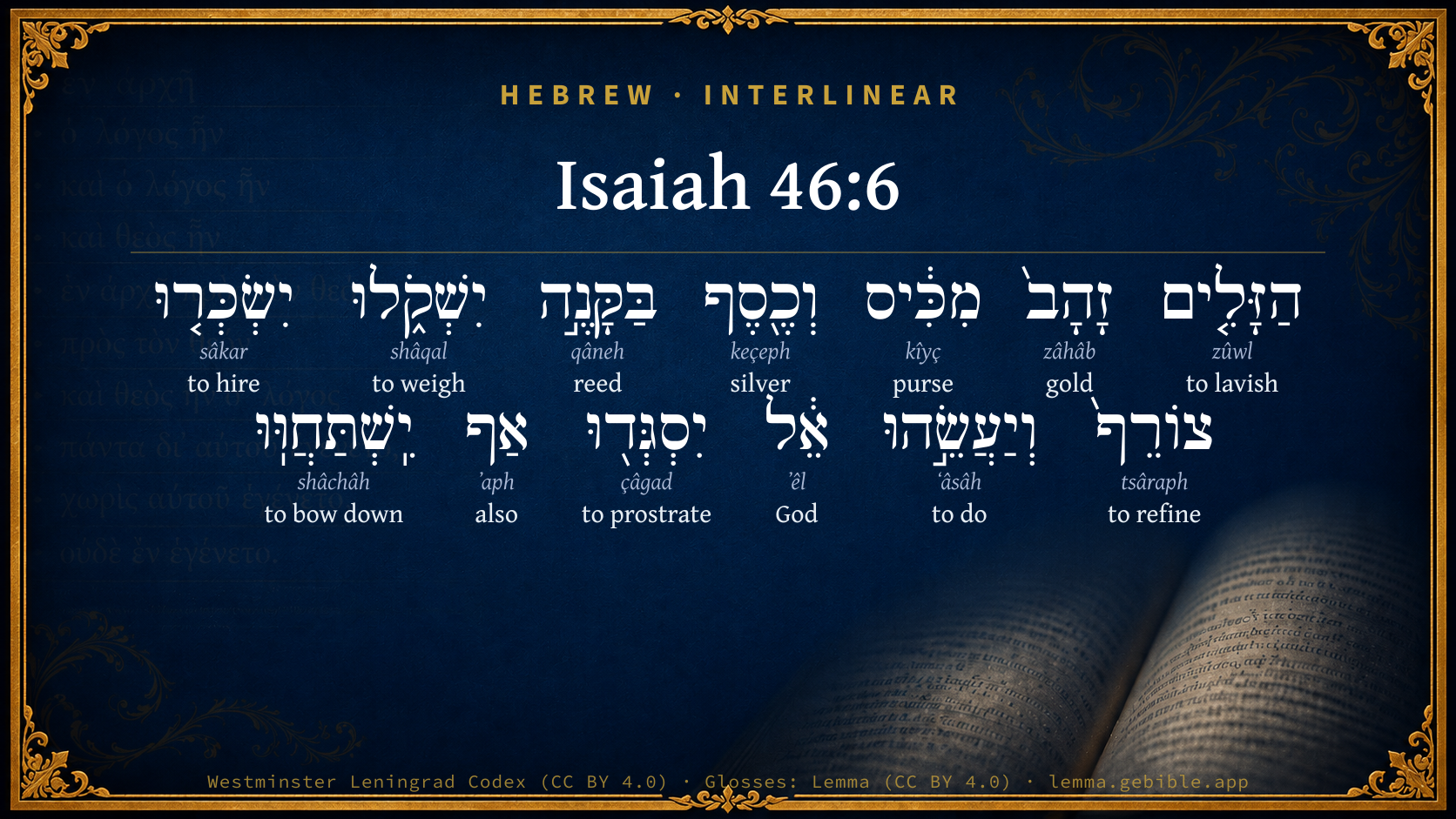
Hebrew (Westminster Leningrad Codex) Isaiah 46:6 appears in the Hebrew Old Testament. The text above is from the Westminster Leningrad Codex. Each word links to its Strong’s number, a concise gloss, and parsing drawn from the Open Scriptures Hebrew Bible morphology. Click any word for its full Brown-Driver-Briggs (BDB) entry.
Download image
Cite this verse

Isaiah 46:6 (World English Bible). Public Domain. Lemma interlinear Bible study tool, https://lemma.gebible.app/v/isaiah/46/6.

Show BibTeX & RIS
BibTeX
RIS
English Translation
Some pour out gold from the bag, and weigh silver in the balance. They hire a goldsmith, and he makes it a god. They fall down--yes, they worship.
World English Bible · Public Domain
Highlights
  • 1 first appearance in the Hebrew Bible
Full analysis ↓
Download a study sheet

One document with this verse’s original text, its word-by-word gloss line, the meaning frame, cross-references with their text, attributed commentary, and full source and license credits — printable, and it pastes into notes with its structure intact.

This verse Autodidact and up

Study sheet (.html) Plain text (.txt)

A passage Seminary Student

Up to 50 verses in one chapter. A passage sheet keeps up to 6 commentary sources and 12 cross-references per verse, in the order this page ranks them, and says so on the sheet whenever that leaves anything out. Ask for a single verse and you get the Autodidact verse sheet above.

Everything on this page stays free to read, with no account — the sheet is a download of what is already on screen, not access to it.

Want to remove ads? Support Godless Engineer
Compare translations 3

The same verse in 3 English versions, stacked beneath the original-language interlinear above. Click any original word for its lexicon entry.

Each is an independent rendering of the whole verse — the interlinear is not word-aligned to these translations.

Highlighted words mark where these versions differ — a whole-verse word diff, not a word-by-word alignment.

  • World English Bible Public Domain
    Some pour out gold from the bag, and weigh silver in the balance. They hire a goldsmith, and he makes it a god. They fall down--yes, they worship.
  • King James Version Public Domain
    They lavish gold out of the bag, and weigh silver in the balance, and hire a goldsmith; and he maketh it a god: they fall down, yea, they worship.
  • unfoldingWord Literal Text CC BY-SA 4.0
    The ones dumping gold from a bag, and they weigh silver on a scale; they hire a metalworker, and they make it a god; they bow down, indeed, they prostrate themselves.

unfoldingWord Literal Text — © unfoldingWord, licensed CC BY-SA 4.0. Word-aligned USFM3 via Door43 (git.door43.org/unfoldingWord/en_ult).

Versions to compare (up to 4)

3 of 4 selected

Show all 18 translations

Every available English version of this verse, each an independent rendering of the whole verse.

  • World English Bible Public Domain
    Some pour out gold from the bag, and weigh silver in the balance. They hire a goldsmith, and he makes it a god. They fall down--yes, they worship.
  • Berean Standard Bible Public Domain
    They pour out their bags of gold and weigh out silver on scales; they hire a goldsmith to fashion it into a god, so they can bow down and worship.
  • Majority Standard Bible Public Domain
    They pour out their bags of gold and weigh out silver on scales; they hire a goldsmith to fashion it into a god, so they can bow down and worship.
  • King James Version Public Domain
    They lavish gold out of the bag, and weigh silver in the balance, and hire a goldsmith; and he maketh it a god: they fall down, yea, they worship.
  • American Standard Version (1901) Public Domain
    Such as lavish gold out of the bag, and weigh silver in the balance, they hire a goldsmith, and he maketh it a god; they fall down, yea, they worship.
  • Revised Version (1885) Public Domain
    Such as lavish gold out of the bag, and weigh silver in the balance, they hire a goldsmith, and he maketh it a god; they fall down, yea, they worship.
  • Geneva Bible (1599) Public Domain
    They draw gold out of the bagge and weigh siluer in the balance, and hire a goldsmith to make a god of it, and they bowe downe, and worship it.
  • Douay-Rheims (1899) Public Domain
    You that contribute gold out of the bag, and weigh out silver in the scales: and hire a goldsmith to make a god: and they fall down and worship.
  • Young's Literal Translation Public Domain
    -- They are pouring out gold from a bag, And silver on the beam they weigh, They hire a refiner, and he maketh it a god, They fall down, yea, they bow themselves.
  • Literal Standard Version CC BY-SA 4.0
    They are pouring out gold from a bag, || And they weigh silver on the beam, || They hire a refiner, and he makes it a god, || They fall down, indeed, they bow themselves.
  • Unlocked Literal Bible CC BY-SA 4.0
    People pour out gold from the bag and weigh silver on the scale. They hire a metalsmith, and he makes it into a god; they bow down and worship it.
  • unfoldingWord Literal Text CC BY-SA 4.0
    The ones dumping gold from a bag, and they weigh silver on a scale; they hire a metalworker, and they make it a god; they bow down, indeed, they prostrate themselves.
  • Darby Bible Public Domain
    -- They lavish gold out of the bag, and weigh silver in the balance; they hire a goldsmith, and he maketh it a ùgod: they fall down, yea, they worship.
  • World Messianic Bible Public Domain
    Some pour out gold from the bag, and weigh silver in the balance. They hire a goldsmith, and he makes it a god. They fall down— yes, they worship.
  • Webster's Bible Public Domain
    They lavish gold out of the bag, and weigh silver in the balance, and hire a goldsmith; and he maketh it a god: they fall down, yes, they worship.
  • Free Bible Version CC BY-SA 4.0
    There are those who extravagantly tip out gold from their bags, and weigh out silver on the scales, and hire a goldsmith to make them a god they can bow down to and worship.
  • Bible in Basic English Public Domain
    As for those who take gold out of a bag, and put silver in the scales, they give payment to a gold-worker, to make it into a god; they go down on their faces and give it worship.
  • JPS Tanakh (1917) Public Domain
    Ye that lavish gold out of the bag, and weigh silver in the balance; ye that hire a goldsmith, that he make it a god, to fall down thereto, yea, to worship.

Literal Standard Version (2020), Covenant Press — licensed CC BY-SA 4.0. Text via the HelloAO Bible API (eBible.org). Unlocked Literal Bible (unfoldingWord) — licensed CC BY-SA 4.0. Text via the HelloAO Bible API (eBible.org). unfoldingWord Literal Text — © unfoldingWord, licensed CC BY-SA 4.0. Word-aligned USFM3 via Door43 (git.door43.org/unfoldingWord/en_ult). Free Bible Version, Dr. Jonathan Gallagher — licensed CC BY-SA 4.0. Text via the HelloAO Bible API (eBible.org).

Word by word

More ways to search: Search by grammar → Find every occurrence → Compare this word →

Practice this passage: Drill this verse → Learn its vocabulary →

הַזָּלִ֤ים
zûwl
H2107
“the · lavishing”
Particle, Definite Article + Verb, Qal, Participle Active, Masculine, Plural, Absolute
Part of Speech
Particle + Verb
Stem
Qal
Form
Participle Active
Gender
Masculine
Number
Plural
State
Absolute
Full BDB Definition

Origin: a primitive root [compare H2151 ]

TWOT: 538

(Qal) to pour out, lavish - (Hiphil) despise
  1. זָהָב֙ zâhâb H2091 “gold” Noun, Common, Masculine, Singular, Absolute
  2. מִכִּ֔יס kîyç H3599 “from · purse” Preposition + Noun, Common, Masculine, Singular, Absolute
  3. וְכֶ֖סֶף keçeph H3701 “and · silver” Conjunction + Noun, Common, Masculine, Singular, Absolute
  4. בַּקָּנֶ֣ה qâneh H7070 “in/at the · reed” Preposition, Determined + Noun, Common, Masculine, Singular, Absolute
  5. יִשְׁקֹ֑לוּ shâqal H8254 “to weigh” Verb, Qal, Imperfect, 3rd Person, Masculine, Plural
  6. יִשְׂכְּר֤וּ sâkar H7936 “to hire” Verb, Qal, Imperfect, 3rd Person, Masculine, Plural
  7. צוֹרֵף֙ tsâraph H6884 “refining” Verb, Qal, Participle Active, Masculine, Singular, Absolute
  8. וְיַעֲשֵׂ֣הוּ ʻâsâh H6213 “and · to do · him” Conjunction + Verb, Qal, Imperfect, 3rd Person, Masculine, Singular + Suffix, Personal, 3rd Person, Masculine, Singular
  9. אֵ֔ל ʼêl H410 “God” Noun, Common, Masculine, Singular, Absolute
  10. יִסְגְּד֖וּ çâgad H5456 “to prostrate” Verb, Qal, Imperfect, 3rd Person, Masculine, Plural
  11. אַף ʼaph H637 “also” Particle, Accusative
  12. יִֽשְׁתַּחֲוּֽוּ shâchâh H7812 “to bow down” Verb, Hishtaphel, Imperfect, 3rd Person, Masculine, Plural

About this verse

These counts appear in no published source. They are computed here, from the morphology-tagged text and Lemma’s own curated glosses. What Lemma adds →

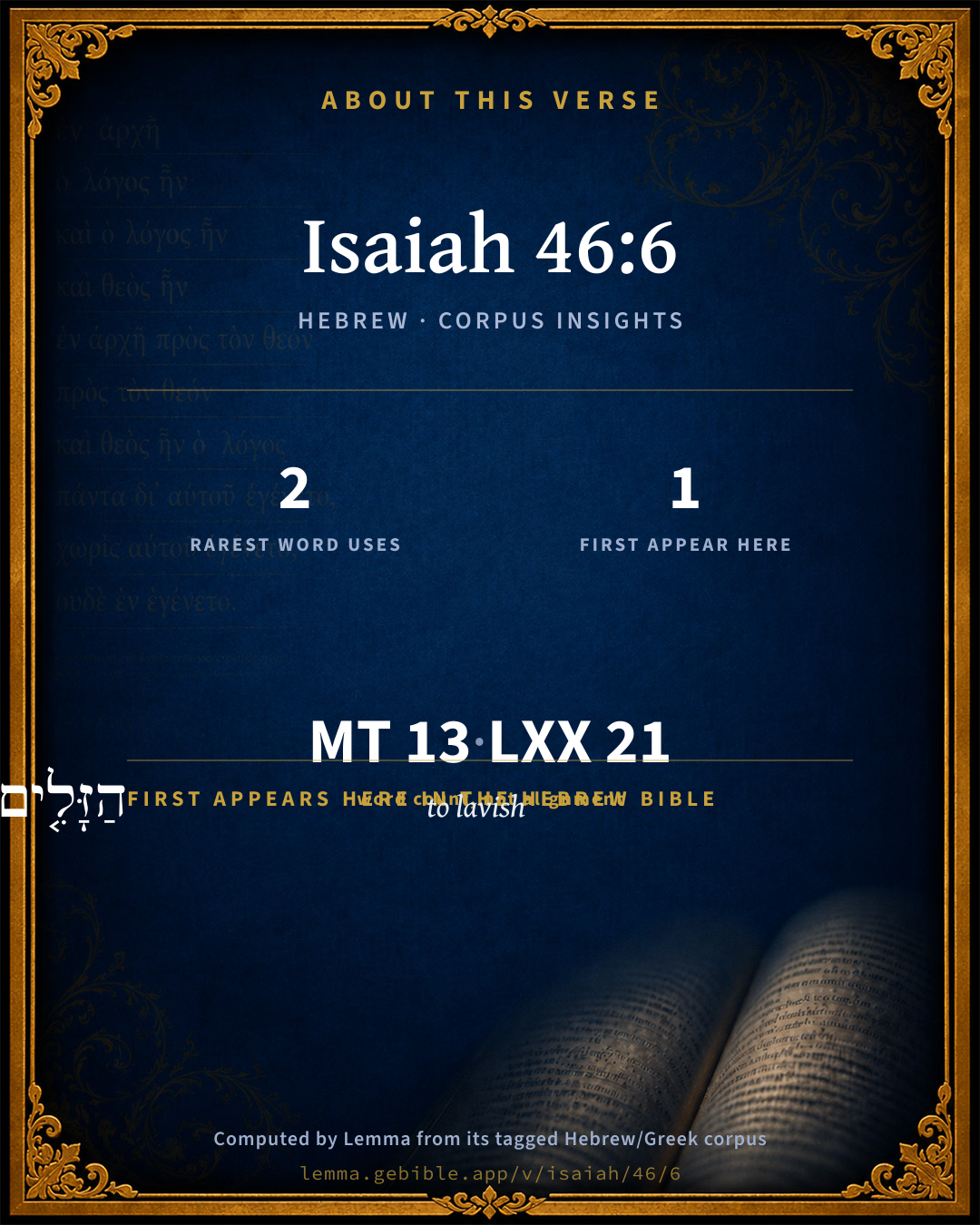
13
words
13
distinct lemmas
Prophets
section

Notable vocabulary

The rarest word here is הַזָּלִ֤ים to lavish H2107 — appearing just 2 times in the whole Hebrew Bible.

First appearance in Scripture

This word makes its first canonical appearance in the Hebrew Bible here:

  • הַזָּלִ֤ים to lavish H2107

Shared distinctive vocabulary

הַזָּלִ֤ים to lavish H2107 occurs in 2 verses of the Hebrew Bible. Also found in:

Grammatical profile

  • 7 verbs
  • 5 nouns
  • 1 particle

Verb forms

  • הַזָּלִ֤ים Qal · Participle Active
  • יִשְׁקֹ֑לוּ Qal · Imperfect
  • יִשְׂכְּר֤וּ Qal · Imperfect
  • צוֹרֵף֙ Qal · Participle Active
  • וְיַעֲשֵׂ֣הוּ Qal · Imperfect
  • יִסְגְּד֖וּ Qal · Imperfect
  • יִֽשְׁתַּחֲוּֽוּ Hishtaphel · Imperfect

Hebrew & Septuagint length

In English translation the verse runs 28 words from the Hebrew and 32 from the Septuagint (LXX English) — closely comparable.

A rough comparison of the two English renderings, which tokenize alike — not a word-level alignment.

Word counts can differ between the Hebrew and the Greek without any difference in meaning — e.g. the Hebrew direct-object marker אֵת has no separate Greek word, and Greek often adds the article ὁ.

In the original languages it is 13 Hebrew tokens and 21 Greek tokens — but the two are counted differently (Hebrew bundles its prefixes and suffixes into one token; the Greek is in lemma form), so that isn’t a like-for-like length.

Cross-references

15

Topical passages linked to Isaiah 46:6 in the Treasury of Scripture Knowledge — connected by theme and wording, ordered by reader-vote popularity; previews shown in the World English Bible.

  • Acts 17:29 Being then the offspring of God, we ought not to think that the Divine Nature is like gold, or silver, or stone, engraved by art and design of man.
  • Isaiah 40:19–20 The image, a workman has cast [it], and the goldsmith overlays it with gold, and casts [for it] silver chains.
  • Exodus 32:2–4 Aaron said to them, "Take off the golden rings, which are in the ears of your wives, of your sons, and of your daughters, and bring them to me."
  • Judges 17:3–4 He restored the eleven hundred [pieces] of silver to his mother; and his mother said, I most assuredly dedicate the silver to Yahweh from my hand for my son, to make an engraved image and a molten image: now therefore I will restore it to you.
  • 1 Kings 12:28 Whereupon the king took counsel, and made two calves of gold; and he said to them, It is too much for you to go up to Jerusalem: see your gods, Israel, which brought you up out of the land of Egypt.
  • Isaiah 2:8 Their land also is full of idols. They worship the work of their own hands, That which their own fingers have made.
  • Isaiah 44:12–19 The smith [makes] an axe, and works in the coals, and fashions it with hammers, and works it with his strong arm: yes, he is hungry, and his strength fails; he drinks no water, and is faint.
  • Jeremiah 10:3–4 For the customs of the peoples are vanity; for one cuts a tree out of the forest, the work of the hands of the workman with the axe.
  • Jeremiah 10:9 There is silver beaten into plates, which is brought from Tarshish, and gold from Uphaz, the work of the artificer and of the hands of the goldsmith; blue and purple for their clothing; they are all the work of skillful men.
  • Jeremiah 10:14 Every man is become brutish [and is] without knowledge; every goldsmith is disappointed by his engraved image; for his molten image is falsehood, and there is no breath in them.
  • Daniel 3:5–15 that whenever you hear the sound of the horn, flute, zither, lyre, harp, pipe, and all kinds of music, you fall down and worship the golden image that Nebuchadnezzar the king has set up;
  • Hosea 8:4–6 They have set up kings, but not by me. They have made princes, and I didn't approve. Of their silver and their gold they have made themselves idols, That they may be cut off.
  • Habakkuk 2:18–20 "What value does the engraved image have, that its maker has engraved it; the molten image, even the teacher of lies, that he who fashions its form trusts in it, to make mute idols?
  • Isaiah 41:6–7 They help everyone his neighbor; and [every one] says to his brother, Be of good courage.
  • Isaiah 45:20 Assemble yourselves and come; draw near together, you who have escaped from the nations: they have no knowledge who carry the wood of their engraved image, and pray to a god that can't save.

Cross-references courtesy of OpenBible.info (CC BY 4.0).

Hebrew and Greek witnesses Masoretic Hebrew ↔ Greek Septuagint

The same verse in the two great witnesses to the Old Testament, shown verse-for-verse.

These are two independent witnesses, not word-aligned to each other, and the Septuagint is shown in lemma (dictionary) form.

Hebrew Isaiah 46:6 Masoretic · Westminster Leningrad Codex

הַזָּלִ֤ים זָהָב֙ מִכִּ֔יס וְכֶ֖סֶף בַּקָּנֶ֣ה יִשְׁקֹ֑לוּ יִשְׂכְּר֤וּ צוֹרֵף֙ וְיַעֲשֵׂ֣הוּ אֵ֔ל יִסְגְּד֖וּ אַף יִֽשְׁתַּחֲוּֽוּ

Some pour out gold from the bag, and weigh silver in the balance. They hire a goldsmith, and he makes it a god. They fall down--yes, they worship.

World English Bible · Public Domain

Greek LXX Isaiah 46:6 Septuagint · lemma form

ὁ συνβάλλω χρυσίον ἐκ μαρσίππιον καί ἀργύριον ἐν ζυγός ἵστημι ἐν σταθμός καί μισθόω χρυσοχόος ποιέω χειροποίητος καί κύπτω προςκυνέω αὐτός

They that furnish gold out of a purse, and silver by weight, will weigh it in a scale, and they hire a goldsmith and make idols, and bow down, and worship them.

LXX2012 (modern English Septuagint) · Public Domain

Hebrew: Westminster Leningrad Codex (CC BY 4.0). Greek: Septuagint (public domain); English from LXX2012 (modern English Septuagint) (Public Domain). How the Septuagint differs from the Hebrew →

Targum (Aramaic paraphrase)

1

The Targum is the ancient Jewish Aramaic paraphrase of the Hebrew Scriptures — an interpretive translation, not the Hebrew text itself. Onkelos (literal) and Pseudo-Jonathan (expansive) render the Torah, and Jonathan the Prophets. Coverage is partial: where no permissively-licensed English translation exists for a verse, only the Aramaic is shown. This is verse-level text, not a word-by-word alignment to the Hebrew.

  1. Targum Jonathan Prophets (Joshua–Malachi)
    הָא עַמְמַיָא גָבָן דְהַב מִכִּיס וְכַסְפָא בְּמֹאזְנַיָא תַּקְלִין אָגְרִין קִינָאָה וְעָבֵיד לֵיהּ דַחֲלָא סָגְדִין אַף מִשְׁתַּעְבְּדִין:

    Behold, the people collect gold out of the bag, and weigh silver in the balance, and hire a goldsmith; and he maketh it a god: they fall down, yea, they do it reverence.

    Targum Jonathan — Aramaic: “Mikraot Gedolot” (public domain). English: “Sefaria Community Translation” (CC0 1.0 (public-domain dedication)); “London "Chaldee Paraphrase," 1871” (public domain). Text via Sefaria.

Commentary

Notes on Isaiah 46:6 from classic Christian and Jewish commentators (each source and its license shown beneath its notes). The classic Christian expositions comment on the surrounding passage and are grouped to its opening verse, so a note may address several verses; the Jewish commentaries on the Tanakh (Rashi and others) are per-verse, so they appear only where the commentator wrote on this verse.

Lemma curates 59 commentaries, every one of them public domain or Creative Commons licensed, each selected and text-cleaned for this edition rather than reprinted as found. About our sources →

Trapp's Complete Commentary

John Trapp

Isa 46:6 They lavish gold out of the bag, and weigh silver in the balance, [and] hire a goldsmith; and he maketh it a god: they fall down, yea, they worship.

Ver. 6. They lavish gold out of the bag.] They spare for no cost. Nebuchadnezzar did not in that vast Colossus. {Dan 3:1} Canutus bestowed upon a cross his whole annual entrado, or revenue. He also gave a hundred talents of silver and one of gold for St Augustine’s arm, which he bestowed on Coventry as a memorial of his blind zeal. The Lady of Loretto hath her churches so stuffed with vowed presents and memorials, as they are forced to hang their cloisters and churchyards with them. {a}

{a} Sandys’s Relation.

John Trapp, A Commentary or Exposition upon All the Books of the Old and New Testament (1647–1656) — public domain. Text from a community e-Sword module.

Keil & Delitzsch

C. F. Keil & F. Delitzsch

The negative answer to this question is the direct result of what precedes, but a still further proof is given in Isa 46:6, Isa 46:7. "They who pour gold out of the bag, and weigh silver with the balance, hire a goldsmith to make it into a god, that they may fall down, yea, throw themselves down. They lift it up, carry it away upon their shoulder, and set it down in its place: there it stands; from its place it does not move: men also cry to it, but it does not answer; it saves no one out of distress." There is no necessity for assuming that הזּלים is used in the place of the finite verb, as Hitzig imagines, or as equivalent to זלים הם, as Rosenmller and Gesenius suppose; but up to ישׂכּרוּ the whole is subject, and therefore ישׁקלוּ is the point at which the change into the finite verb occurs (Ges. 131, 2). The point in hazzâlı̄m is not the extravagant expenditure, as Ewald thinks, but the mean origin of the god, which commences with the pouring out of gold from a purse (zūl = zâlal, to shake, to pour out). Qâneh is the lever of the scales (κανών). The metal weighed out is given to a goldsmith, who plates the idol with the gold, and makes the ornaments for it of silver. When it is finished, they lift it up, or shoulder it (ישּׂאהוּ with a distinctive Great Telisha), carry it home, and set it down in the place which it is to have under it (תּחתּיו). There it stands firm, immoveable, and also deaf and dumb, hearing no one, answering no one, and helping no one. The subject to יצעק is any צעק. The first admonition closes here. The gods who are carried fall without being able to save themselves, whereas Israel's God carries and saves His people; He, the Incomparable, more especially in contrast with the lifeless puppets of idols.

Keil & Delitzsch — Biblical Commentary on the Old Testament (1861–1891) — public domain (CC PDM 1.0). Text via the HelloAO Bible API. (Old Testament only.)

Jamieson, Fausset & Brown

Robert Jamieson, A. R. Fausset & David Brown

(Isa 40:19-20; Isa 41:7.) They lavish gold out of their purses and spare no expense for their idol. Their profuseness shames the niggardliness of professors who worship God with what cost them nothing. Sin is always a costly service.

Jamieson, Fausset & Brown — Commentary Critical and Explanatory on the Whole Bible (1871) — public domain (CC PDM 1.0). Text via the HelloAO Bible API.

The Cambridge Bible for Schools and Colleges

gen. ed. J. J. S. Perowne

6. They lavish gold &c.] Better as an exclamation of contempt: They that pour gold etc. The gold and silver are the material out of which the images (or at least their plating) are to be made by the goldsmith (Isa_40:19) who is hired for the work. The word for balance is qâneh (reed), never elsewhere used in this sense. It probably denotes the beam of the balance.

they fall down] The same word (ṣâgad) in Isa_44:15; Isa_44:17; Isa_44:19.

6, 7. Contemptuous description of idolatry in general. Comp. especially with ch. Isa_44:9-20.

The Cambridge Bible for Schools and Colleges (gen. ed. J. J. S. Perowne; Cambridge University Press, 1878–1918) — public domain. Text from a community e-Sword module.

John Gill's Exposition

They lavish gold out of the bag,.... As if it was of no value and account; that is, the Heathen idolaters, some of them, who are excessively devoted to idolatry; these, being rich, take out their bags of gold, and give it in a very profuse manner to a workman to make a golden image for them, not caring what it cost them; such an one was that which Nebuchadnezzar made, sixty cubits high, and six broad, Dan 3:1 see an instance of profuseness this way in the Israelites themselves, Exo 32:2.

And weigh silver in the balance; or "with a reed" (o). Others, though idolaters, yet less devoted to idolatry, and more tenacious of their money, make silver do for a god, and weigh it out to the workman, that it be made of such a weight, and no more, and that they might not be cheated of their silver; or they weighed it to pay the workman for his workmanship. Money formerly was not coined and stamped, so not numbered by pieces, but weighed.

And hire a goldsmith, and he maketh it a god; a "finer" or "founder", with whom they agree for such a sum of money, and he, of the gold or silver that is put into his hands, makes a god: he casts and moulds it into such a form or shape that is agreed upon, and this is called a god; though nothing but a piece of gold or silver fashioned by art and man's device, and the work of his hands:

they fall down, yea, they worship; the god they made; both the artificer, and he that employed him, fall down upon their knees, or their faces, and pay divine worship add adoration to the idol; though the one knew it was made of his own gold or silver, and the other knew it to be the workmanship of his hands. Worshipping is more than falling down, as Ben Melech observes, and therefore it is said, yea, they worship.

(o) "in calamo", Pagninus, Montanus. The bar of the balance on which they hang the scales with threads, Ben Meleck says is called the "reed". So Vatablus.

John Gill's Exposition of the Whole Bible (1746–1763) — public domain (CC PDM 1.0). Text via the HelloAO Bible API.

Albert Barnes' Notes on the Bible

They lavish gold - The word used here means properly to shake out; and then to pour out abundantly, or in a lavish manner. It is used in connection with the idea of squandering in Deu 21:20; Pro 23:21; Pro 28:7. Here the idea is, that they spared no expense; they poured out gold as if it were vile and worthless, in order to make an idol. The design of this verse is, to show the superstition of those who were idolaters; and, particularly, how much they were willing to devote in order to maintain idol-worship.

Out of the bag - They pour their gold out of the bag, or purse, where they have kept it; that is, they lavish it freely.

And weigh silver in the balance - Perhaps the idea is here, that they used silver so lavishly that they did not wait to count it, but weighed it as they would the grosser metals. The word used here and translated ‘balance’ (קנה qâneh), means properly “cane, reed, calamus”; then a measuring reed or rod Eze 40:3, Eze 40:5; then a rod, or beam of a balance, or scales (Greek ζυγὸς zugos).

And hire a goldsmith - (See the notes at Isa 40:19-20).

And he maketh it a god - The goldsmith manufactures the gold and the silver into an image. The object of the prophet is to deride the custom of offering divine homage to a god formed in this manner (see the notes at Isa 44:9-19).

Albert Barnes' Notes on the Bible (1834–1885) — public domain. Text from a community e-Sword/MySword module.

Matthew Poole's English Annotations

Maketh it a god; let us suppose, a god made with the greatest cost and art.

Matthew Poole's English Annotations on the Holy Bible (1683–1685) — public domain. Text from a community e-Sword/MySword module.

Whedon's Commentary on the Bible

Daniel D. Whedon

6, 7. They lavish gold — A more brief but substantially similar picture to the one drawn in Isa_44:12-20. The idols of the more wealthy are here, doubtless, referred to. But costliness in worship, whether that of idols or the true God, does not in itself make it the more acceptable.

Daniel D. Whedon (gen. ed.), Commentary on the Old and New Testaments (1874–1909) — public domain. Text from a community e-Sword module.

J. A. Alexander on Isaiah

Joseph Addison Alexander

“The prodigals (or lavish ones) will weigh gold from the bag, and silver with the rod; they will hire a gilder, and he will make it a god; they will bow down, yea they will fall prostrate.” ‘From the bag’ may be explained either as meaning taken out of the purse, or in reference to the bag of weights, in which sense it is used in Deu 25:13; Mic 6:11. The word translated ‘rod’ is properly a reed, then any rod or bar, such as the shaft of a candlestick (Exo 25:31), and here the beam of a balance or the graduated rod of a steelyard. The verse has reference to the wealthier class of idol-worshippers.

Joseph Addison Alexander, The Prophecies of Isaiah (1846–1847; New York: Scribner, 1870–1878) — public domain. Text from a community e-Sword module.

Rashi

Rabbi Shlomo Yitzchaki (Rashi)

Those who let gold run from the purse Heb. הַזָּלִים, an expression of (Ps. 146:18) “Water runs (יִזְּלוּ).”

with the balance Heb. קָנֶה, the bar of a scale, called flael in O.F.

Rashi on the Tanakh — English translations: “The Judaica Press complete Tanach with Rashi, translated by A. J. Rosenberg” (CC BY 4.0); “Pentateuch with Rashi's commentary by M. Rosenbaum and A.M. Silbermann, 1929-1934” (public domain); “The Metsudah Tanach series, Lakewood, N.J” (CC BY 4.0); and “The Book of Joshua, Metsudah Publications, 1997” (CC BY 4.0). Text via Sefaria.

Ibn Ezra

Rabbi Abraham ibn Ezra

הולים They lavish gold, etc. Many compare this word with אזל is spent (1 Sam. 9:7), and assume here the elision of the first radical (א); but it is in fact hap. leg.; for אזל is intransitive. הזלים means who give. מכיס Out of the bag. The bag is a part of the balance; comp. בכיסך in thy bag (Deut. 25:13). The succeeding בקנה has a similar meaning; it is hap. leg.

Ibn Ezra on the Tanakh — English translations: “Sefaria Community Translation” (CC0 1.0 (public-domain dedication)); “Yalkut, Sifsei Chachomim Chumash, Metsudah Publications, 2009” (CC BY 4.0); and “Commentary of Ibn Ezra on Isaiah - trans. by M. Friedlander, 1873” (public domain). Text via Sefaria.

Lesson kit

Teaching starters — assembled from the data on this page, not authored interpretation. Every prompt links to the verse data it draws on. Edit before teaching.

Isaiah, in the Prophets, opens this verse with 13 words (13 distinct Hebrew lemmas). Its most distinctive word is zûwl (“to lavish”). A historical commentator’s framing appears above. Read the whole chapter for the surrounding context.

Discussion questions

  1. How does “to lavish” (zûwl) shape what this verse is saying?
  2. This is the first place “to lavish” appears in Scripture (first appears here). What does its debut here establish?
  3. How does Lamentations 1:8, which shares the word «to lavish», read alongside this verse?
  4. These translations render this verse differently. What is at stake in choosing one wording over another?
  5. «הַזָּלִ֤ים» is a Qal Participle Active verb. How does that grammatical form shape the action described?
  6. Compare how Trapp's Complete Commentary and Keil & Delitzsch read this verse. Where do they agree or differ?

Things to notice

Reading settings

Reading text

Shown beneath each verse's original-language words.

Old Testament
Old Testament edition

Read the OT as the Masoretic Hebrew (MT) or the Greek Septuagint (LXX).

English shown for the Greek Septuagint (in the Hebrew ↔ Greek comparison).

Comparing translations? Open the Compare panel on any verse page to stack up to four side by side.