Genesis 33:7

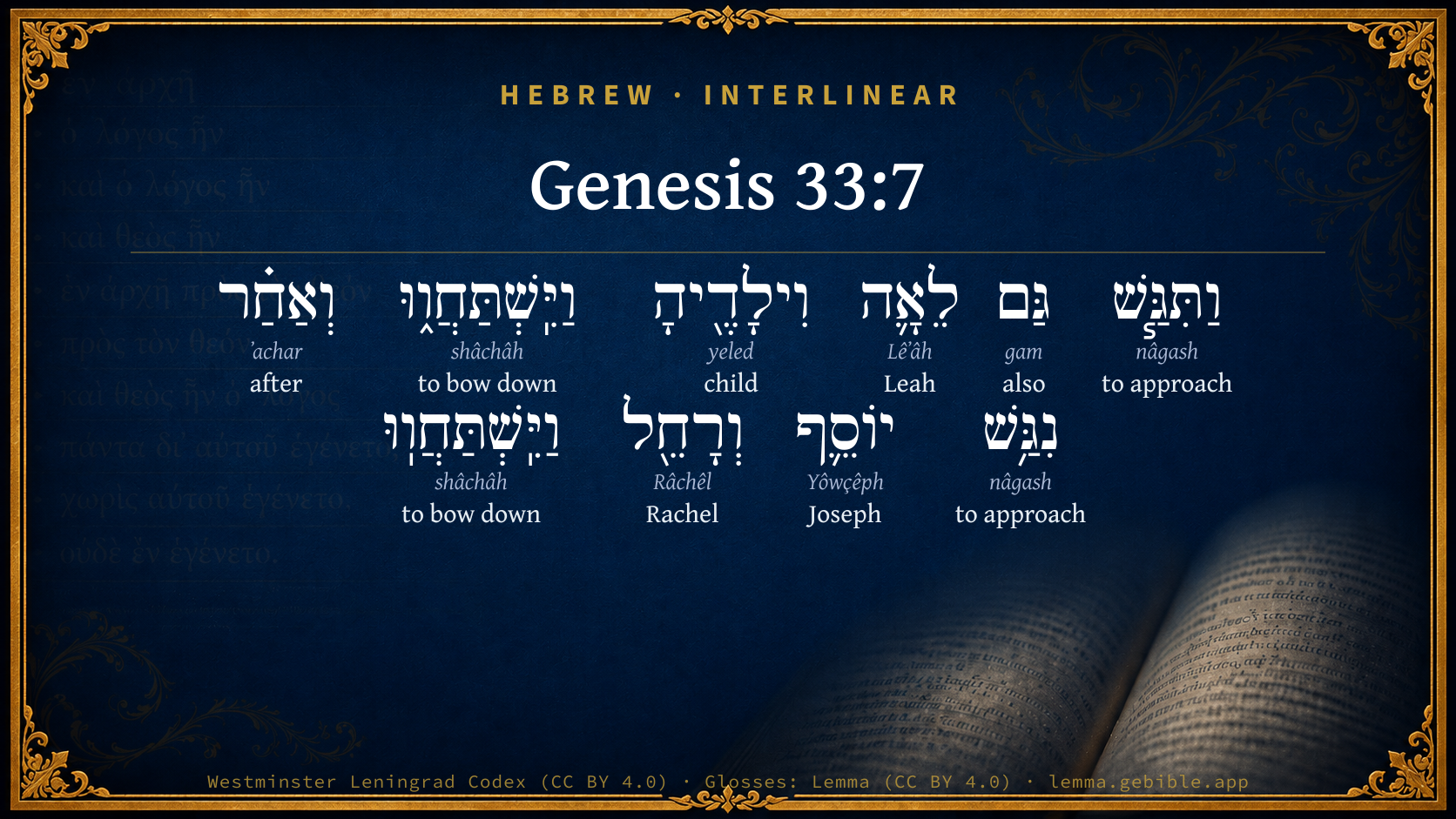
Hebrew (Westminster Leningrad Codex) Genesis 33:7 appears in the Hebrew Old Testament. The text above is from the Westminster Leningrad Codex. Each word links to its Strong’s number, a concise gloss, and parsing drawn from the Open Scriptures Hebrew Bible morphology. Click any word for its full Brown-Driver-Briggs (BDB) entry.
Download image
Cite this verse

Genesis 33:7 (World English Bible). Public Domain. Lemma interlinear Bible study tool, https://lemma.gebible.app/v/genesis/33/7.

Show BibTeX & RIS
BibTeX
RIS
English Translation
Leah also and her children came near, and bowed themselves. After them, Joseph came near with Rachel, and they bowed themselves.
World English Bible · Public Domain
Download a study sheet

One document with this verse’s original text, its word-by-word gloss line, the meaning frame, cross-references with their text, attributed commentary, and full source and license credits — printable, and it pastes into notes with its structure intact.

This verse Autodidact and up

Study sheet (.html) Plain text (.txt)

A passage Seminary Student

Up to 50 verses in one chapter. A passage sheet keeps up to 6 commentary sources and 12 cross-references per verse, in the order this page ranks them, and says so on the sheet whenever that leaves anything out. Ask for a single verse and you get the Autodidact verse sheet above.

Everything on this page stays free to read, with no account — the sheet is a download of what is already on screen, not access to it.

Want to remove ads? Support Godless Engineer
Compare translations 3

The same verse in 3 English versions, stacked beneath the original-language interlinear above. Click any original word for its lexicon entry.

Each is an independent rendering of the whole verse — the interlinear is not word-aligned to these translations.

Highlighted words mark where these versions differ — a whole-verse word diff, not a word-by-word alignment.

  • World English Bible Public Domain
    Leah also and her children came near, and bowed themselves. After them, Joseph came near with Rachel, and they bowed themselves.
  • King James Version Public Domain
    And Leah also with her children came near, and bowed themselves: and after came Joseph near and Rachel, and they bowed themselves.
  • unfoldingWord Literal Text CC BY-SA 4.0
    Then Leah also came near and her children, and they bowed down. Then after, Joseph came near and Rachel, and they bowed down.

unfoldingWord Literal Text — © unfoldingWord, licensed CC BY-SA 4.0. Word-aligned USFM3 via Door43 (git.door43.org/unfoldingWord/en_ult).

Versions to compare (up to 4)

3 of 4 selected

Show all 18 translations

Every available English version of this verse, each an independent rendering of the whole verse.

  • World English Bible Public Domain
    Leah also and her children came near, and bowed themselves. After them, Joseph came near with Rachel, and they bowed themselves.
  • Berean Standard Bible Public Domain
    Leah and her children also approached and bowed down, and then Joseph and Rachel approached and bowed down.
  • Majority Standard Bible Public Domain
    Leah and her children also approached and bowed down, and then Joseph and Rachel approached and bowed down.
  • King James Version Public Domain
    And Leah also with her children came near, and bowed themselves: and after came Joseph near and Rachel, and they bowed themselves.
  • American Standard Version (1901) Public Domain
    And Leah also and her children came near, and bowed themselves: and after came Joseph near and Rachel, and they bowed themselves.
  • Revised Version (1885) Public Domain
    And Leah also and her children came near, and bowed themselves: and after came Joseph near and Rachel, and they bowed themselves.
  • Geneva Bible (1599) Public Domain
    Leah also with her children came neere and made obeysance: and after Ioseph and Rahel drew neere, and did reuerence.
  • Douay-Rheims (1899) Public Domain
    Lia also with her children came near, and bowed down in like manner, and last of all Joseph and Rachel bowed down.
  • Young's Literal Translation Public Domain
    and Leah also draweth nigh, and her children, and they bow themselves; and afterwards Joseph hath drawn nigh with Rachel, and they bow themselves.
  • Literal Standard Version CC BY-SA 4.0
    and Leah also draws near, and her children, and they bow themselves; and afterward Joseph has drawn near with Rachel, and they bow themselves.
  • Unlocked Literal Bible CC BY-SA 4.0
    Next Leah also and her children came forward and bowed down. Finally Joseph and Rachel came forward and bowed down.
  • unfoldingWord Literal Text CC BY-SA 4.0
    Then Leah also came near and her children, and they bowed down. Then after, Joseph came near and Rachel, and they bowed down.
  • Darby Bible Public Domain
    And Leah also, with her children, drew near, and they bowed. And lastly Joseph drew near, and Rachel, and they bowed.
  • World Messianic Bible Public Domain
    Leah also and her children came near, and bowed themselves. After them, Joseph came near with Rachel, and they bowed themselves.
  • Webster's Bible Public Domain
    And Leah also with her children came near, and bowed themselves; and after came Joseph near and Rachel, and they bowed themselves.
  • Free Bible Version CC BY-SA 4.0
    Then Leah and her children came over and bowed down. Lastly Joseph and Rachel came over and bowed down.
  • Bible in Basic English Public Domain
    And Leah came near with her children, and then Joseph and Rachel, and they did the same.
  • JPS Tanakh (1917) Public Domain
    And Leah also and her children came near, and bowed down; and after came Joseph near and Rachel, and they bowed down.

Literal Standard Version (2020), Covenant Press — licensed CC BY-SA 4.0. Text via the HelloAO Bible API (eBible.org). Unlocked Literal Bible (unfoldingWord) — licensed CC BY-SA 4.0. Text via the HelloAO Bible API (eBible.org). unfoldingWord Literal Text — © unfoldingWord, licensed CC BY-SA 4.0. Word-aligned USFM3 via Door43 (git.door43.org/unfoldingWord/en_ult). Free Bible Version, Dr. Jonathan Gallagher — licensed CC BY-SA 4.0. Text via the HelloAO Bible API (eBible.org).

Word by word

More ways to search: Search by grammar → Find every occurrence → Compare this word →

Practice this passage: Drill this verse → Learn its vocabulary →

לֵאָ֛ה
Lêʼâh
H3812
“Leah”
Noun, Proper
Part of Speech
Noun
Type
Proper
Full BDB Definition

Origin: from H3811

TWOT: None

Leah = "weary" - daughter of Laban, first wife of Jacob, and mother of Reuben, Simeon, Levi, Judah, Issachar, Zebulun, and Dinah
  1. וַתִּגַּ֧שׁ nâgash H5066 “and · to approach” Conjunction + Verb, Qal, Sequential Imperfect, 3rd Person, Feminine, Singular
  2. גַּם gam H1571 “also” Particle, Accusative
  3. וִילָדֶ֖יהָ yeled H3206 “and · children · her” Conjunction + Noun, Common, Masculine, Plural, Construct + Suffix, Personal, 3rd Person, Feminine, Singular
  4. וַיִּֽשְׁתַּחֲו֑וּ shâchâh H7812 “and · to bow down” Conjunction + Verb, Hithpael, Sequential Imperfect, 3rd Person, Masculine, Plural
  5. וְאַחַ֗ר ʼachar H310 “and · after” Conjunction + Adverb
  6. נִגַּ֥שׁ nâgash H5066 “to approach” Verb, Niphal, Perfect, 3rd Person, Masculine, Singular
  7. יוֹסֵ֛ף Yôwçêph H3130 “Joseph” Noun, Proper
  8. וְרָחֵ֖ל Râchêl H7354 “and · Rachel” Conjunction + Noun, Proper
  9. וַיִּֽשְׁתַּחֲוֽוּ shâchâh H7812 “and · to bow down” Conjunction + Verb, Hithpael, Sequential Imperfect, 3rd Person, Masculine, Plural

About this verse

These counts appear in no published source. They are computed here, from the morphology-tagged text and Lemma’s own curated glosses. What Lemma adds →

10
words
8
distinct lemmas
Pentateuch
section

Shared distinctive vocabulary

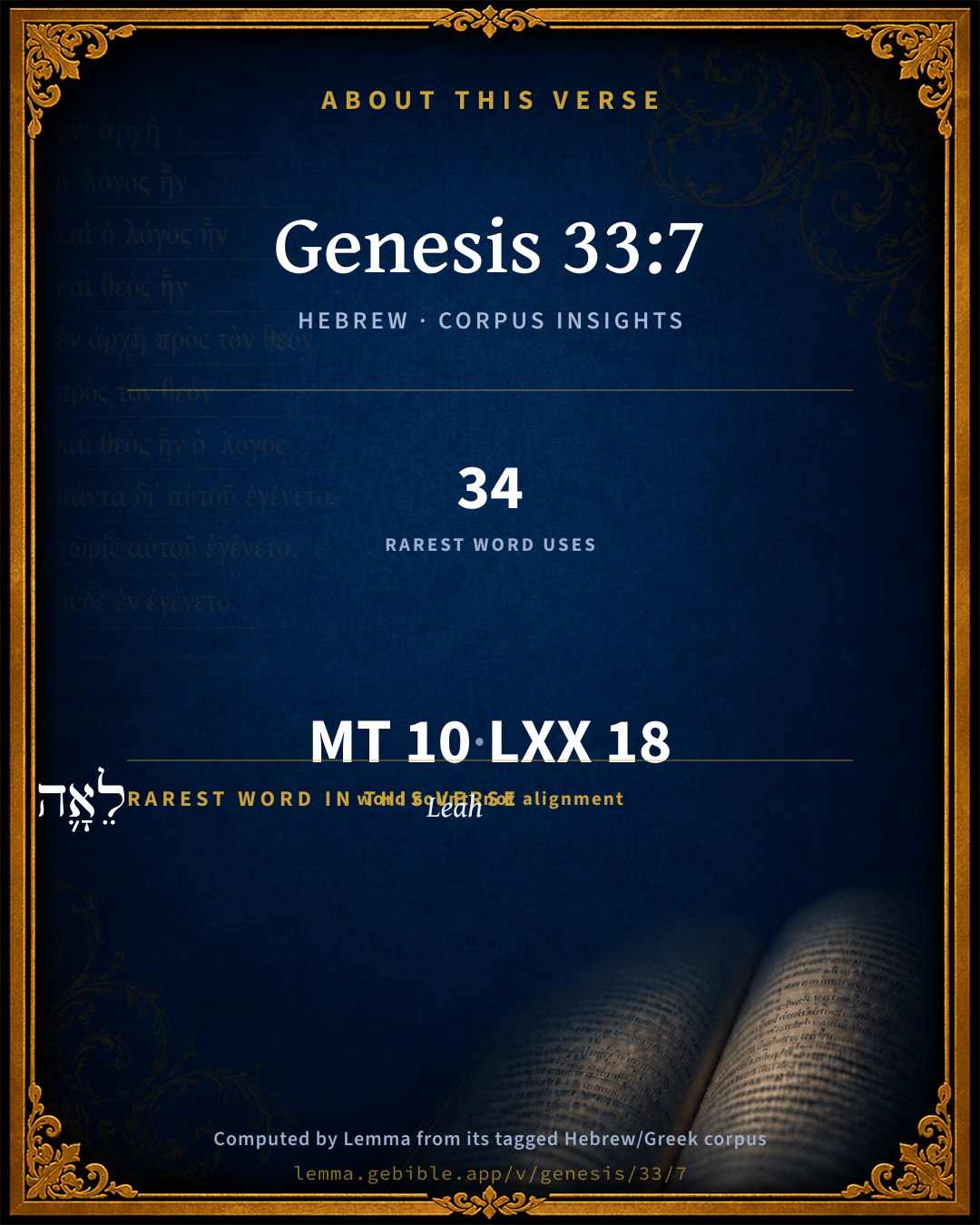
לֵאָ֛ה Leah H3812 occurs in 32 verses of the Hebrew Bible. Also found in:

Grammatical profile

  • 4 verbs
  • 4 nouns
  • 1 adverb
  • 1 particle

Verb forms

  • וַתִּגַּ֧שׁ Qal · Sequential Imperfect
  • וַיִּֽשְׁתַּחֲו֑וּ Hithpael · Sequential Imperfect
  • נִגַּ֥שׁ Niphal · Perfect
  • וַיִּֽשְׁתַּחֲוֽוּ Hithpael · Sequential Imperfect

Repetition

Words recur within this verse — often emphatic in Hebrew:

  • וַתִּגַּ֧שׁ to approach H5066 ×2
  • וַיִּֽשְׁתַּחֲו֑וּ to bow down H7812 ×2

Hebrew & Septuagint length

In English translation the verse runs 21 words from the Hebrew and 21 from the Septuagint (LXX English) — the same length.

A rough comparison of the two English renderings, which tokenize alike — not a word-level alignment.

Word counts can differ between the Hebrew and the Greek without any difference in meaning — e.g. the Hebrew direct-object marker אֵת has no separate Greek word, and Greek often adds the article ὁ.

In the original languages it is 10 Hebrew tokens and 18 Greek tokens — but the two are counted differently (Hebrew bundles its prefixes and suffixes into one token; the Greek is in lemma form), so that isn’t a like-for-like length.

Hebrew and Greek witnesses Masoretic Hebrew ↔ Greek Septuagint

The same verse in the two great witnesses to the Old Testament, shown verse-for-verse.

These are two independent witnesses, not word-aligned to each other, and the Septuagint is shown in lemma (dictionary) form.

Hebrew Genesis 33:7 Masoretic · Westminster Leningrad Codex

וַתִּגַּ֧שׁ גַּם לֵאָ֛ה וִילָדֶ֖יהָ וַיִּֽשְׁתַּחֲו֑וּ וְאַחַ֗ר נִגַּ֥שׁ יוֹסֵ֛ף וְרָחֵ֖ל וַיִּֽשְׁתַּחֲוֽוּ

Leah also and her children came near, and bowed themselves. After them, Joseph came near with Rachel, and they bowed themselves.

World English Bible · Public Domain

Greek LXX Genesis 33:7 Septuagint · lemma form

καί προςἐγγίζω λεια καί ὁ τέκνον αὐτός καί προςκυνέω καί μετά οὗτος προςἐγγίζω ραχηλ καί ιωσηφ καί προςκυνέω

And Lea and her children drew near and did reverence; and after this drew near Rachel and Joseph, and did reverence.

LXX2012 (modern English Septuagint) · Public Domain

Hebrew: Westminster Leningrad Codex (CC BY 4.0). Greek: Septuagint (public domain); English from LXX2012 (modern English Septuagint) (Public Domain). How the Septuagint differs from the Hebrew →

Targum (Aramaic paraphrase)

2

The Targum is the ancient Jewish Aramaic paraphrase of the Hebrew Scriptures — an interpretive translation, not the Hebrew text itself. Onkelos (literal) and Pseudo-Jonathan (expansive) render the Torah, and Jonathan the Prophets. Coverage is partial: where no permissively-licensed English translation exists for a verse, only the Aramaic is shown. This is verse-level text, not a word-by-word alignment to the Hebrew.

  1. Targum Onkelos Torah (Genesis–Deuteronomy)
    וּקְרִיבָא אַף לֵאָה וּבְנָהָא וּסְגִידוּ וּבָתַר כֵּן קְרֵיב יוֹסֵף וְרָחֵל וּסְגִידוּ

    (no public-domain English translation for this verse)

    Targum Onkelos — Aramaic: “Onkelos Genesis” (public domain); “Onkelos Exodus” (public domain); “Onkelos Leviticus” (public domain); “Onkelos Numbers” (public domain); “Onkelos Deuteronomy” (public domain). English: “Sefaria Community Translation” (CC0 1.0 (public-domain dedication)); “J.W. Etheridge. The Targums of Onkelos and Jonathan Ben Uzziel on the Pentateuch. London: Longmans, Green, 1862” (public domain). Text via Sefaria.

  2. Targum Pseudo-Jonathan Torah (Genesis–Deuteronomy)
    וּקְרִיבַת אוּף לֵאָה וּבְנָהָא וּגְחִינָן וּבָתַר כֵּן קָרִיב יוֹסֵף וְאִתְעַתַּד קָמֵי רָחֵל וְכַסְיָיהּ בְּקוֹמָתֵהּ וּגְחִינָן

    and Leah also approached, and her children, and bowed; and afterward Joseph came near and stood before Rahel, and hid her by his stature, and they bowed.

    Targum Pseudo-Jonathan — Aramaic: “Targum Jonathan on Genesis” (public domain); “Targum Jonathan on Exodus” (public domain); “Targum Jonathan on Leviticus” (public domain); “Targum Jonathan on Numbers” (public domain); “Targum Jonathan on Deuteronomy” (public domain). English: “The Targum of Jonathan ben Uzziel, trans. J. W. Etheridge, London, 1862” (public domain). Text via Sefaria.

Commentary

Notes on Genesis 33:7 from classic Christian and Jewish commentators (each source and its license shown beneath its notes). The classic Christian expositions comment on the surrounding passage and are grouped to its opening verse, so a note may address several verses; the Jewish commentaries on the Tanakh (Rashi and others) are per-verse, so they appear only where the commentator wrote on this verse.

Lemma curates 59 commentaries, every one of them public domain or Creative Commons licensed, each selected and text-cleaned for this edition rather than reprinted as found. About our sources →

Trapp's Complete Commentary

John Trapp

Gen 33:7 And Leah also with her children came near, and bowed themselves: and after came Joseph near and Rachel, and they bowed themselves.

Ver. 8. What meanest thou by all this drove? &c.] He met it, but had not yet accepted of it: either that he might take occasion at their meeting, more mannerly to refuse the present; or, that he might show his brotherly affection frankly and freely, not purchased or procured by any gift or present. Utrumque liberale et civile est, oblata munera modeste recusare, proesertim si grandia sint, et eadem ab instante humaniter acceptare. {a}

{a} Piscator.

John Trapp, A Commentary or Exposition upon All the Books of the Old and New Testament (1647–1656) — public domain. Text from a community e-Sword module.

Tyndale Open Study Notes

Tyndale Open Resources

33:7 Among Jacob’s sons, only Joseph is named; he was Jacob’s favorite son and the recipient of the blessing.

Tyndale Open Study Notes — © Tyndale Open Resources, licensed CC BY-SA 4.0. Text via the HelloAO Bible API.

John Gill's Exposition

And Leah also with her children came near, and bowed themselves,.... Who were in the next division or company; their children were seven, Reuben, Simeon, Levi, Judah, Issachar, Zebulun, and Dinah, six sons and one daughter:

and after came Joseph near and Rachel, and they bowed themselves; it is observed that Joseph is mentioned before his mother; it may be, because they might put him before her in the procession, for greater safety; or she might present him to Esau, being a child of little more than six years of age, and teach him how to make his obeisance to him, which she also did herself.

John Gill's Exposition of the Whole Bible (1746–1763) — public domain (CC PDM 1.0). Text via the HelloAO Bible API.

Rashi

Rabbi Shlomo Yitzchaki (Rashi)

נגש יוסף ורחל JOSEPH AND RACHEL STEPPED NEAR — In the case of all the others the mothers approached before the children, but in the case of Rachel, Joseph came in front of her. He said: “My mother is a beautiful woman: for fear that this wicked man will set his fancy on her I will stand in front of her and prevent him from gazing at her ” As a reward for this Joseph merited the blessing associated with the words עלי עין "with the eye” (Genesis Rabbah 78:10).

Rashi on the Tanakh — English translations: “The Judaica Press complete Tanach with Rashi, translated by A. J. Rosenberg” (CC BY 4.0); “Pentateuch with Rashi's commentary by M. Rosenbaum and A.M. Silbermann, 1929-1934” (public domain); “The Metsudah Tanach series, Lakewood, N.J” (CC BY 4.0); and “The Book of Joshua, Metsudah Publications, 1997” (CC BY 4.0). Text via Sefaria.

Radak

Rabbi David Kimhi (Radak)

נגש יוסף ורחל. He made Joseph approach Esau before Rachel, seeing that Rachel was so protective of him (her only child) that she made him walk in front of her where she could constantly keep her eye on him, literally keeping him between her hands. There is an aggadic explanation (quoted by Rashi) that Joseph walked in front of his mother on his own initiative because she was so attractive that he wanted to shield her from inquisitive eyes using his tall physique to shield her from such glances. The source of the Midrash cites the wordבן פורת יוסף בן פורת עלי עין, “Joseph is a noble and prominent son, a noble and prominent son already at the source (well) (Genesis 49,22)

Radak on the Tanakh — English translations: “Sefaria Community Translation” (CC0 1.0 (public-domain dedication)); “Eliyahu Munk, HaChut Hameshulash” (CC BY 4.0); “Rabbi Mike Feuer, Jerusalem Anthology” (CC BY 4.0); and “R. David Kimhi on the first book of Psalms, Translated by R.G. Finch, London, 1919” (public domain). Text via Sefaria.

Lesson kit

Teaching starters — assembled from the data on this page, not authored interpretation. Every prompt links to the verse data it draws on. Edit before teaching.

Genesis, in the Pentateuch, opens this verse with 10 words (8 distinct Hebrew lemmas). Its most distinctive word is Lêʼâh (“Leah”). A historical commentator’s framing appears above. Read the whole chapter for the surrounding context.

Discussion questions

  1. What does “Leah” (Lêʼâh) contribute to the verse as a whole?
  2. How does Genesis 29:16, which shares the word «Leah», read alongside this verse?
  3. What does the repetition of “to approach” (2× in this one verse) do in this verse?
  4. The translations on this page render this verse differently — a whole-verse word diff, not a word-by-word alignment. What might account for the different wordings?
  5. «וַתִּגַּ֧שׁ» is a Qal Sequential Imperfect verb. How does that grammatical form shape the action described?
  6. Compare how Trapp's Complete Commentary and Tyndale Open Study Notes read this verse. Where do they agree or differ?

Things to notice

Reading settings

Reading text

Shown beneath each verse's original-language words.

Old Testament
Old Testament edition

Read the OT as the Masoretic Hebrew (MT) or the Greek Septuagint (LXX).

English shown for the Greek Septuagint (in the Hebrew ↔ Greek comparison).

Comparing translations? Open the Compare panel on any verse page to stack up to four side by side.