
Exodus 11:8

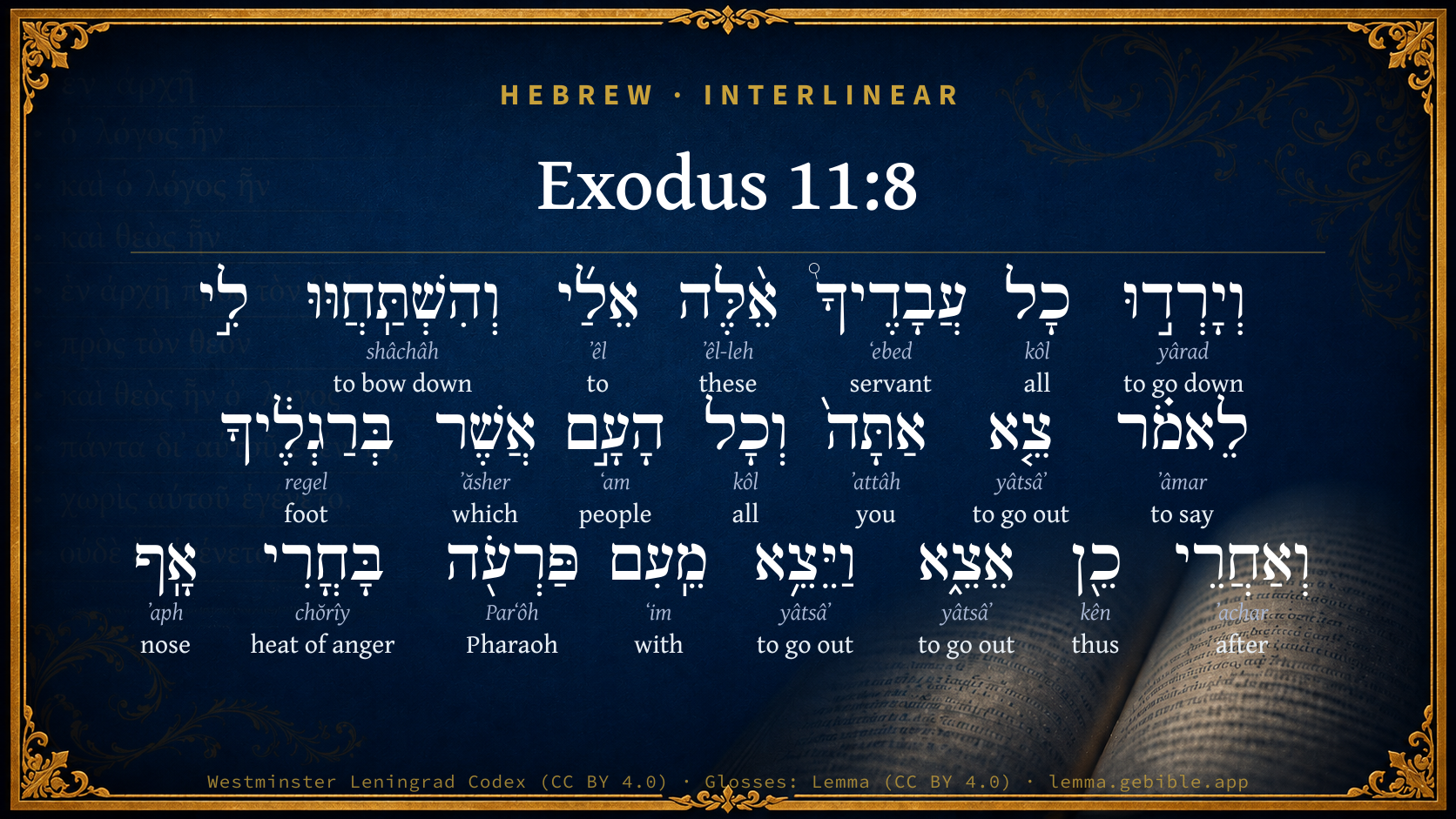
Hebrew (Westminster Leningrad Codex) Exodus 11:8 appears in the Hebrew Old Testament. The text above is from the Westminster Leningrad Codex. Each word links to its Strong’s number, a concise gloss, and parsing drawn from the Open Scriptures Hebrew Bible morphology. Click any word for its full Brown-Driver-Briggs (BDB) entry.
Download image
Cite this verse

Exodus 11:8 (World English Bible). Public Domain. Lemma interlinear Bible study tool, https://lemma.gebible.app/v/exodus/11/8.

Show BibTeX & RIS
BibTeX
RIS
English Translation
All these your servants shall come down to me, and bow down themselves to me, saying, 'Get out, and all the people who follow you; and after that I will go out.'" He went out from Pharaoh in hot anger.
World English Bible · Public Domain
Highlights
  • 1 first appearance in the Hebrew Bible
Full analysis ↓
Download a study sheet

One document with this verse’s original text, its word-by-word gloss line, the meaning frame, cross-references with their text, attributed commentary, and full source and license credits — printable, and it pastes into notes with its structure intact.

This verse Autodidact and up

Study sheet (.html) Plain text (.txt)

A passage Seminary Student

Up to 50 verses in one chapter. A passage sheet keeps up to 6 commentary sources and 12 cross-references per verse, in the order this page ranks them, and says so on the sheet whenever that leaves anything out. Ask for a single verse and you get the Autodidact verse sheet above.

Everything on this page stays free to read, with no account — the sheet is a download of what is already on screen, not access to it.

Want to remove ads? Support Godless Engineer
Compare translations 3

The same verse in 3 English versions, stacked beneath the original-language interlinear above. Click any original word for its lexicon entry.

Each is an independent rendering of the whole verse — the interlinear is not word-aligned to these translations.

Highlighted words mark where these versions differ — a whole-verse word diff, not a word-by-word alignment.

  • World English Bible Public Domain
    All these your servants shall come down to me, and bow down themselves to me, saying, 'Get out, and all the people who follow you; and after that I will go out.'" He went out from Pharaoh in hot anger.
  • King James Version Public Domain
    And all these thy servants shall come down unto me, and bow down themselves unto me, saying, Get thee out, and all the people that follow thee: and after that I will go out. And he went out from Pharaoh in a great anger.
  • unfoldingWord Literal Text CC BY-SA 4.0
    And all your servants, these will come down to me, and they will bow to me, saying, ‘Go, you and all the people who are at your feet!’ And after that I will go out.” And he went out from Pharaoh with burning of the nose.

unfoldingWord Literal Text — © unfoldingWord, licensed CC BY-SA 4.0. Word-aligned USFM3 via Door43 (git.door43.org/unfoldingWord/en_ult).

Versions to compare (up to 4)

3 of 4 selected

Show all 18 translations

Every available English version of this verse, each an independent rendering of the whole verse.

  • World English Bible Public Domain
    All these your servants shall come down to me, and bow down themselves to me, saying, 'Get out, and all the people who follow you; and after that I will go out.'" He went out from Pharaoh in hot anger.
  • Berean Standard Bible Public Domain
    And all these officials of yours will come and bow before me, saying, ‘Go, you and all the people who follow you!’ After that, I will depart.” And hot with anger, Moses left Pharaoh’s presence.
  • Majority Standard Bible Public Domain
    And all these officials of yours will come and bow before me, saying, ‘Go, you and all the people who follow you!’ After that, I will depart.” And hot with anger, Moses left Pharaoh’s presence.
  • King James Version Public Domain
    And all these thy servants shall come down unto me, and bow down themselves unto me, saying, Get thee out, and all the people that follow thee: and after that I will go out. And he went out from Pharaoh in a great anger.
  • American Standard Version (1901) Public Domain
    And all these thy servants shall come down unto me, and bow down themselves unto me, saying, Get thee out, and all the people that follow thee: and after that I will go out. And he went out from Pharaoh in hot anger.
  • Revised Version (1885) Public Domain
    And all these thy servants shall come down unto me, and bow down themselves unto me, saying, Get thee out, and all the people that follow thee: and after that I will go out. And he went out from Pharaoh in hot anger.
  • Geneva Bible (1599) Public Domain
    And all these thy seruants shall come downe vnto me, and fal before me, saying, Get thee out, and all the people that are at thy feete, and after this will I depart. So he went out from Pharaoh very angry.
  • Douay-Rheims (1899) Public Domain
    And all these thy servants shall come down to me, and shall worship me, saying: Go forth thou, and all the people that is under thee: after that we will go out.
  • Young's Literal Translation Public Domain
    and all these thy servants have come down unto me, and bowed themselves to me, saying, Go out, thou and all the people who `are' at thy feet; and afterwards I do go out;' -- and he goeth out from Pharaoh in the heat of anger.
  • Literal Standard Version CC BY-SA 4.0
    And all these servants of yours have come down to me, and bowed themselves to me, saying, Go out, you and all the people who [are] at your feet; and afterward I go out”; and he goes out from Pharaoh in the heat of anger.
  • Unlocked Literal Bible CC BY-SA 4.0
    All these servants of yours, Pharaoh, will come down to me and bow down to me. They will say, 'Go, you and all the people who follow you!' After that I will go out.” Then he went out from Pharaoh in great anger.
  • unfoldingWord Literal Text CC BY-SA 4.0
    And all your servants, these will come down to me, and they will bow to me, saying, ‘Go, you and all the people who are at your feet!’ And after that I will go out.” And he went out from Pharaoh with burning of the nose.
  • Darby Bible Public Domain
    And all these thy bondmen shall come down unto me, and bow down to me, saying, Go out, thou, and all the people that follow thee; and after that I will go out. And he went out from Pharaoh in a glowing anger.
  • World Messianic Bible Public Domain
    All these servants of yours will come down to me, and bow down themselves to me, saying, “Get out, with all the people who follow you;” and after that I will go out.’” He went out from Pharaoh in hot anger.
  • Webster's Bible Public Domain
    And all these thy servants shall come down to me, and bow down themselves to me, saying, Depart thou, and all the people that follow thee; and after that I will depart: and he went out from Pharaoh in a great anger.
  • Free Bible Version CC BY-SA 4.0
    All your officials will come to me, bowing down before me and saying, ‘Leave, and take everyone who follows you with you!’ After that I will leave.” Moses was very angry, and left Pharaoh.
  • Bible in Basic English Public Domain
    And all these your servants will come to me, going down on their faces before me and saying, Go out, and all your people with you: and after that I will go out. And he went away from Pharaoh burning with wrath.
  • JPS Tanakh (1917) Public Domain
    And all these thy servants shall come down unto me, and bow down unto me, saying: Get thee out, and all the people that follow thee; and after that I will go out.' And he went out from Pharaoh in hot anger.

Literal Standard Version (2020), Covenant Press — licensed CC BY-SA 4.0. Text via the HelloAO Bible API (eBible.org). Unlocked Literal Bible (unfoldingWord) — licensed CC BY-SA 4.0. Text via the HelloAO Bible API (eBible.org). unfoldingWord Literal Text — © unfoldingWord, licensed CC BY-SA 4.0. Word-aligned USFM3 via Door43 (git.door43.org/unfoldingWord/en_ult). Free Bible Version, Dr. Jonathan Gallagher — licensed CC BY-SA 4.0. Text via the HelloAO Bible API (eBible.org).

Word by word

More ways to search: Search by grammar → Find every occurrence → Compare this word →

Practice this passage: Drill this verse → Learn its vocabulary →

בָּחֳרִי
chŏrîy
H2750
“in/at · heat of anger of”
Preposition + Noun, Common, Masculine, Singular, Construct
Part of Speech
Preposition + Noun
Type
Common
Gender
Masculine
Number
Singular
State
Construct
Full BDB Definition

Origin: from H2734

TWOT: 736b

heat (of anger), burning (of anger)
  1. וְיָרְד֣וּ yârad H3381 “and · to go down” Conjunction + Verb, Qal, Sequential Perfect, 3rd Person, Common, Plural
  2. כָל kôl H3605 “all of” Noun, Common, Masculine, Singular, Construct
  3. עֲבָדֶיךָ֩ ʻebed H5650 “servants · your” Noun, Common, Masculine, Plural, Construct + Suffix, Personal, 2nd Person, Masculine, Singular
  4. אֵ֨לֶּה ʼêl-leh H428 “these” Pronoun, Demonstrative, Common, Plural
  5. אֵלַ֜י ʼêl H413 “to · me” Preposition + Suffix, Personal, 1st Person, Common, Singular
  6. וְהִשְׁתַּֽחֲוּוּ shâchâh H7812 “and · to bow down” Conjunction + Verb, Hishtaphel, Sequential Perfect, 3rd Person, Common, Plural
  7. לֵאמֹ֗ר ʼâmar H559 “to say” Preposition + Verb, Qal, Infinitive Construct
  8. צֵ֤א yâtsâʼ H3318 “go out” Verb, Qal, Imperative, 2nd Person, Masculine, Singular
  9. אַתָּה֙ ʼattâh H859 “you” Pronoun, Personal, 2nd Person, Masculine, Singular
  10. וְכָל kôl H3605 “and · all of” Conjunction + Noun, Common, Masculine, Singular, Construct
  11. הָעָ֣ם ʻam H5971 “the · people” Particle, Definite Article + Noun, Common, Masculine, Singular, Absolute
  12. אֲשֶׁר ʼăsher H834 “which” Particle, Relative
  13. בְּרַגְלֶ֔יךָ regel H7272 “in/at · feet · your” Preposition + Noun, Common, Feminine, Dual, Construct + Suffix, Personal, 2nd Person, Masculine, Singular
  14. וְאַחֲרֵי ʼachar H310 “and · after” Conjunction + Preposition
  15. כֵ֖ן kên H3651 “thus” Adverb
  16. אֵצֵ֑א yâtsâʼ H3318 “to go out” Verb, Qal, Imperfect, 1st Person, Common, Singular
  17. וַיֵּצֵ֥א yâtsâʼ H3318 “and · to go out” Conjunction + Verb, Qal, Sequential Imperfect, 3rd Person, Masculine, Singular
  18. מֵֽעִם ʻim H5973 “from · with” Preposition + Preposition
  19. פַּרְעֹ֖ה Parʻôh H6547 “Pharaoh” Noun, Proper
  20. אָֽף ʼaph H639 “nose” Noun, Common, Masculine, Singular, Absolute

About this verse

These counts appear in no published source. They are computed here, from the morphology-tagged text and Lemma’s own curated glosses. What Lemma adds →

22
words
18
distinct lemmas
Pentateuch
section

Notable vocabulary

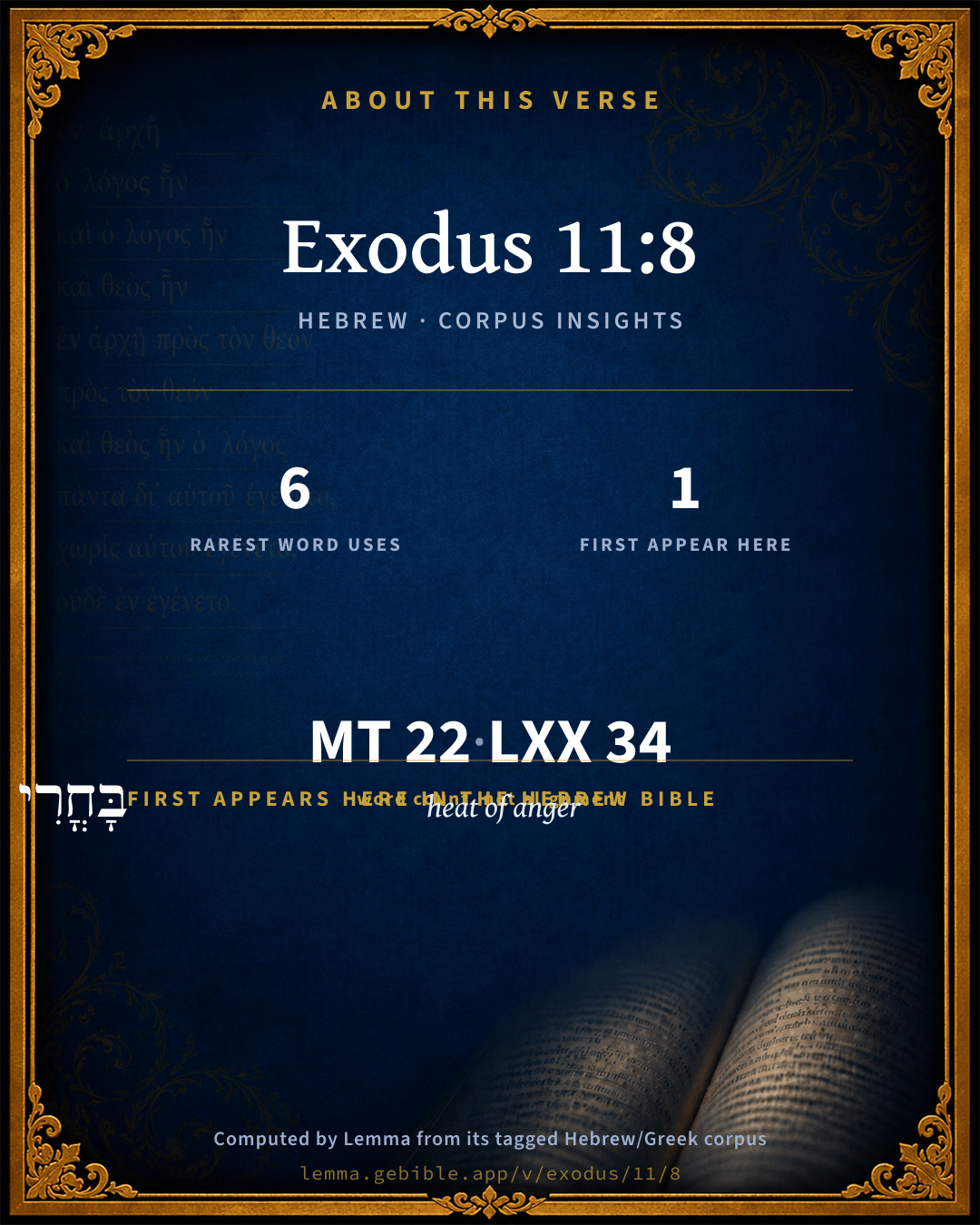
The rarest word here is בָּחֳרִי heat of anger H2750 — appearing just 6 times in the whole Hebrew Bible.

First appearance in Scripture

This word makes its first canonical appearance in the Hebrew Bible here:

  • בָּחֳרִי heat of anger H2750

Shared distinctive vocabulary

בָּחֳרִי heat of anger H2750 occurs in 6 verses of the Hebrew Bible. Also found in:

Grammatical profile

  • 6 verbs
  • 8 nouns
  • 2 pronouns
  • 4 prepositions
  • 1 adverb
  • 1 particle

Verb forms

  • וְיָרְד֣וּ Qal · Sequential Perfect
  • וְהִשְׁתַּֽחֲוּוּ Hishtaphel · Sequential Perfect
  • לֵאמֹ֗ר Qal · Infinitive Construct
  • צֵ֤א Qal · Imperative
  • אֵצֵ֑א Qal · Imperfect
  • וַיֵּצֵ֥א Qal · Sequential Imperfect

Repetition

Words recur within this verse — often emphatic in Hebrew:

  • צֵ֤א to go out H3318 ×3
  • כָל all H3605 ×2

Hebrew & Septuagint length

In English translation the verse runs 40 words from the Hebrew and 32 from the Septuagint (LXX English) — closely comparable.

A rough comparison of the two English renderings, which tokenize alike — not a word-level alignment.

Word counts can differ between the Hebrew and the Greek without any difference in meaning — e.g. the Hebrew direct-object marker אֵת has no separate Greek word, and Greek often adds the article ὁ.

In the original languages it is 22 Hebrew tokens and 34 Greek tokens — but the two are counted differently (Hebrew bundles its prefixes and suffixes into one token; the Greek is in lemma form), so that isn’t a like-for-like length.

Cross-references

15

Topical passages linked to Exodus 11:8 in the Treasury of Scripture Knowledge — connected by theme and wording, ordered by reader-vote popularity; previews shown in the World English Bible.

  • Exodus 12:31–33 He called for Moses and Aaron by night, and said, "Rise up, get out from among my people, both you and the children of Israel; and go, serve Yahweh, as you have said!
  • Ezekiel 3:14 So the Spirit lifted me up, and took me away; and I went in bitterness, in the heat of my spirit; and the hand of Yahweh was strong on me.
  • Daniel 3:19 Then was Nebuchadnezzar full of fury, and the form of his visage was changed against Shadrach, Meshach, and Abednego: [therefore] he spoke, and commanded that they should heat the furnace seven times more than it was wont to be heated.
  • Numbers 12:3 Now the man Moses was very humble, above all the men who were on the surface of the earth.
  • Deuteronomy 29:24 even all the nations shall say, Why has Yahweh done thus to this land? what means the heat of this great anger?
  • Deuteronomy 32:24 [They shall be] wasted with hunger, and devoured with burning heat Bitter destruction; The teeth of animals will I send on them, With the poison of crawling things of the dust.
  • Judges 4:10 Barak called Zebulun and Naphtali together to Kedesh; and there went up ten thousand men at his feet: and Deborah went up with him.
  • Judges 8:5 He said to the men of Succoth, Please give loaves of bread to the people who follow me; for they are faint, and I am pursuing after Zebah and Zalmunna, the kings of Midian.
  • 1 Kings 20:10 Ben Hadad sent to him, and said, The gods do so to me, and more also, if the dust of Samaria shall suffice for handfuls for all the people who follow me.
  • 2 Kings 3:9 So the king of Israel went, and the king of Judah, and the king of Edom; and they made a circuit of seven days' journey: and there was no water for the host, nor for the animals that followed them.
  • Psalms 6:1 Yahweh, don't rebuke me in your anger, Neither discipline me in your wrath.
  • Isaiah 49:23 Kings shall be your nursing fathers, and their queens your nursing mothers: they shall bow down to you with their faces to the earth, and lick the dust of your feet; and you shall know that I am Yahweh; and those who wait for me shall not be disappointed.
  • Isaiah 49:26 I will feed those who oppress you with their own flesh; and they shall be drunken with their own blood, as with sweet wine: and all flesh shall know that I, Yahweh, am your Savior, and your Redeemer, the Mighty One of Jacob.
  • Mark 3:5 When he had looked around at them with anger, being grieved at the hardening of their hearts, he said to the man, "Stretch out your hand." He stretched it out, and his hand was restored as healthy as the other.
  • Revelation 3:9 Behold, I give of the synagogue of Satan, of those who say they are Jews, and they are not, but lie. Behold, I will make them to come and worship before your feet, and to know that I have loved you.

Cross-references courtesy of OpenBible.info (CC BY 4.0).

Hebrew and Greek witnesses Masoretic Hebrew ↔ Greek Septuagint

The same verse in the two great witnesses to the Old Testament, shown verse-for-verse.

These are two independent witnesses, not word-aligned to each other, and the Septuagint is shown in lemma (dictionary) form.

Hebrew Exodus 11:8 Masoretic · Westminster Leningrad Codex

וְיָרְד֣וּ כָל עֲבָדֶיךָ֩ אֵ֨לֶּה אֵלַ֜י וְהִשְׁתַּֽחֲוּוּ לִ֣י לֵאמֹ֗ר צֵ֤א אַתָּה֙ וְכָל הָעָ֣ם אֲשֶׁר בְּרַגְלֶ֔יךָ וְאַחֲרֵי כֵ֖ן אֵצֵ֑א וַיֵּצֵ֥א מֵֽעִם פַּרְעֹ֖ה בָּחֳרִי אָֽף

All these your servants shall come down to me, and bow down themselves to me, saying, 'Get out, and all the people who follow you; and after that I will go out.'" He went out from Pharaoh in hot anger.

World English Bible · Public Domain

Greek LXX Exodus 11:8 Septuagint · lemma form

καί καταβαίνω πᾶς ὁ παῖς σύ οὗτος πρός ἐγώ καί προκυνέω ἐγώ λέγω ἐκἔρχομαι σύ καί πᾶς ὁ λαός σύ ὅς σύ ἀποἡγέομαι καί μετά οὗτος ἐκἔρχομαι ἐκἔρχομαι δέ μωυσῆς ἀπό φαραώ μετά θυμός

And all these your servants shall come down to me, and do me reverence, saying, Go forth, you and all the people over whom you preside, and afterwards I will go forth.

LXX2012 (modern English Septuagint) · Public Domain

Hebrew: Westminster Leningrad Codex (CC BY 4.0). Greek: Septuagint (public domain); English from LXX2012 (modern English Septuagint) (Public Domain). How the Septuagint differs from the Hebrew →

Targum (Aramaic paraphrase)

2

The Targum is the ancient Jewish Aramaic paraphrase of the Hebrew Scriptures — an interpretive translation, not the Hebrew text itself. Onkelos (literal) and Pseudo-Jonathan (expansive) render the Torah, and Jonathan the Prophets. Coverage is partial: where no permissively-licensed English translation exists for a verse, only the Aramaic is shown. This is verse-level text, not a word-by-word alignment to the Hebrew.

  1. Targum Onkelos Torah (Genesis–Deuteronomy)
    וְיֶחֱתוּן כָּל עַבְדָיךְ אִלֵין לְוָתִי וְיִבְעוֹן מִנִי לְמֵימָר פּוּק אַתְּ וְכָל עַמָא דִי עִמָךְ וּבָתַר כֵּן אֶפּוֹק וּנְפַק מִלְוָת פַּרְעֹה בִּתְקוֹף רְגָז:

    (no public-domain English translation for this verse)

    Targum Onkelos — Aramaic: “Onkelos Genesis” (public domain); “Onkelos Exodus” (public domain); “Onkelos Leviticus” (public domain); “Onkelos Numbers” (public domain); “Onkelos Deuteronomy” (public domain). English: “Sefaria Community Translation” (CC0 1.0 (public-domain dedication)); “J.W. Etheridge. The Targums of Onkelos and Jonathan Ben Uzziel on the Pentateuch. London: Longmans, Green, 1862” (public domain). Text via Sefaria.

  2. Targum Pseudo-Jonathan Torah (Genesis–Deuteronomy)
    וְיַחְתוּן כָּל עַבְדָּךְ אִלֵּין לְוָותִי וְיִבְעוּן מָטוּ מִינִי לְמֵימַר פּוּק אַנְתְּ וְכָל עַמָּא דְּעִמָּךְ וּמִבָּתַר כְּדֵין אֶפּוֹק וּנְפַק מִלְוַת פַּרְעה בִּתְקוֹף רְגַז

    And thou shalt send down all thy servants to me, coming and beseeching me, saying, Go forth, thou and all the people who are with thee; and afterwards I will go. And he went out from Pharoh in great anger.

    Targum Pseudo-Jonathan — Aramaic: “Targum Jonathan on Genesis” (public domain); “Targum Jonathan on Exodus” (public domain); “Targum Jonathan on Leviticus” (public domain); “Targum Jonathan on Numbers” (public domain); “Targum Jonathan on Deuteronomy” (public domain). English: “The Targum of Jonathan ben Uzziel, trans. J. W. Etheridge, London, 1862” (public domain). Text via Sefaria.

Commentary

Notes on Exodus 11:8 from classic Christian and Jewish commentators (each source and its license shown beneath its notes). The classic Christian expositions comment on the surrounding passage and are grouped to its opening verse, so a note may address several verses; the Jewish commentaries on the Tanakh (Rashi and others) are per-verse, so they appear only where the commentator wrote on this verse.

Lemma curates 59 commentaries, every one of them public domain or Creative Commons licensed, each selected and text-cleaned for this edition rather than reprinted as found. About our sources →

Trapp's Complete Commentary

John Trapp

Exo 11:8 And all these thy servants shall come down unto me, and bow down themselves unto me, saying, Get thee out, and all the people that follow thee: and after that I will go out. And he went out from Pharaoh in a great anger.

Ver. 8. In a great anger.] Heb., In heat of anger; wherewith in the cause of God he was blessedly blown up. Meekness here had been but mopishness.

John Trapp, A Commentary or Exposition upon All the Books of the Old and New Testament (1647–1656) — public domain. Text from a community e-Sword module.

Joseph Benson's Commentary

Exo 11:8. All these thy servants — Thy courtiers and great officers: The people that follow thee — That are under thy conduct and command.

When Moses had thus delivered his message, he went out from Pharaoh in great anger, though he was the meekest of all the men of the earth. Probably he expected that the very threatening of the death of the firstborn should have wrought upon Pharaoh to comply; especially he having complied so far already, and having seen how exactly all Moses’s predictions were fulfilled. But it had not that effect; his proud heart would not yield, no, not to save all the firstborn of his kingdom. Moses hereupon was provoked to a holy indignation, being grieved, as our Saviour afterward, for the hardness of his heart, Mar 3:5.

Joseph Benson's Commentary on the Old and New Testaments (1811–1818) — public domain. Text from a community e-Sword module.

Tyndale Open Study Notes

Tyndale Open Resources

11:8 Pharaoh had lost control. Moses was no longer asking; he was now in a position to dictate the terms of the Israelites’ departure from the country.

Tyndale Open Study Notes — © Tyndale Open Resources, licensed CC BY-SA 4.0. Text via the HelloAO Bible API.

Geneva Bible (1599)

Geneva Bible translators

That is, under thy power and government.

Geneva Bible (1599) marginal notes — public domain. Text via Bolls.life.

Jamieson, Fausset & Brown

Robert Jamieson, A. R. Fausset & David Brown

all these thy servants shall . . . bow down themselves unto me--This would be the effect of the universal terror; the hearts of the proudest would be humbled and do reverential homage to God, in the person of His representative.

went out . . . in a great anger--Holy and righteous indignation at the duplicity, repeated falsehood, and hardened impenitence of the king; and this strong emotion was stirred in the bosom of Moses, not at the ill reception given to himself, but the dishonor done to God (Mat 19:8; Eph 4:26).

Next: Exodus Chapter 12

Jamieson, Fausset & Brown — Commentary Critical and Explanatory on the Whole Bible (1871) — public domain (CC PDM 1.0). Text via the HelloAO Bible API.

Adam Clarke's Commentary

Verse 8. And all these thy servants shall come] A prediction of what actually took place. See Ex 12:31-33.

Adam Clarke's Commentary on the Bible (1810–1826) — public domain. Text from a community e-Sword/MySword module.

Ellicott's Commentary for English Readers

(8) All these thy servants—i.e., the high officers of the Court who were standing about Pharaoh. These grandees would come to Moses when the blow fell, and prostrate themselves before him as if he were their king, and beseech him to take his departure with all his nation. The details are given more fully and more graphically in this place than in the subsequent narrative (Exo_12:31).

In a great anger.—Heb., in heat of anger: i.e., burning with indignation. Moses had not shown this in his speech, which had been calm and dignified; but he here records what he had felt. For once his acquired “meekness” failed, and the hot natural temper of his youth blazed up. His life had been threatened—he had been ignominiously dismissed—he had been deprived of his right of audience for the future (Exo_10:28). Under such circumstances, he “did well to be angry.”

A Bible Commentary for English Readers, edited by Charles John Ellicott (1878–1897) — public domain. Text from a community e-Sword module.

The Cambridge Bible for Schools and Colleges

gen. ed. J. J. S. Perowne

8. Then the Pharaoh’s ministers themselves will come humbly to Moses, and beg him and his people to leave Egypt; cf. Exo_12:31-33.

come down] ‘from the palace, where the writer thinks of the ministers as assembled, after hearing the tidings of the calamity, and which he pictures as elevated above the surrounding city and country (cf. 2 Samuel 9, 2Ki_6:33; 2Ki_7:17)’ (Di. from Kn.).

Get thee out, &c.] simply, Go out, thou and all, &c.

that follow thee] Heb. that are at thy feet: Deu_11:10 Heb., Jdg_4:10; Jdg_8:5 Heb. al.

in hot anger] viz. on account of what the Pharaoh had said, Exo_10:27-28. The expression, as 1Sa_20:34 al.

The Cambridge Bible for Schools and Colleges (gen. ed. J. J. S. Perowne; Cambridge University Press, 1878–1918) — public domain. Text from a community e-Sword module.

John Gill's Exposition

And all these thy servants,.... Pharaoh's nobles, ministers, courtiers and counsellors, who were then in his presence, and stood about him, to whom Moses pointed:

shall come down unto me; from Pharaoh's palace, which might be built on an eminence, to the place where Moses had dwelt during the time he had been in Egypt, which might lie lower; or these should come from Zoan, or from Memphis, whichever of them was now the royal city, to the land of Goshen, which lay lower than the other part of Egypt; or it may only denote the submission of Pharaoh's, servants, that they should in the time of their distress be so humble and condescending as to come themselves to Moses, and as it follows:

and bow down themselves unto me; in the most obsequious manner, humbly entreating, and earnestly begging him:

saying, get thee out, and all the people that follow thee; or "are at thy feet" (w), that were at his beck and command, and under his power, as Aben Ezra; or that followed his counsel and advice, as Jarchi, that did as he directed them, and went after him as their leader and commander, even everyone of them; they that brought up the rear, he, and all of them, would be desired to depart, and not a man remain behind: this was fulfilled, Exo 12:31,

and after that I will go out; out of the land of Egypt, Moses, and all the children of Israel:

and he went out from Pharaoh in a great anger; as soon as he had said the above words, because he had bid him be gone from him, and had threatened him with his life, if ever he saw his face more; and because he was so rebellious against God, whose zeal inspired the heart of Moses with indignation against him, though the meekest man on earth, and for whose glory he was concerned; though some understand this of Moses going out from Pharaoh, when he and not Moses was in great anger, because of what Moses had now threatened him with, and told him what would be the issue of things, the submission of him and his nobles, and the dismission of Israel; but this sense is not favoured by the accents.

(w) "in pedibus tuis", Pagninus, Montanus, Drusius; "sub pedibus tuis", Munster, Vatablus; "qui est ad pedes tuos", Cartwright.

John Gill's Exposition of the Whole Bible (1746–1763) — public domain (CC PDM 1.0). Text via the HelloAO Bible API.

Matthew Poole's English Annotations

Thy courtiers and great officers, who now are so insolent and obstinate,

shall come down unto me, both by their own inclination and necessity, and in thy name, and by thy command.

That follow thee; that are under thy conduct and command; as this or the like expression is used Jdg 4:10; 1Ki 20:10; 2Ki 3:9; Isa 41:2.

In a great anger; not so much for the affront offered to himself, as for his incurable rebellion against God. Compare Mar 3:5.

Matthew Poole's English Annotations on the Holy Bible (1683–1685) — public domain. Text from a community e-Sword/MySword module.

Whedon's Commentary on the Bible

Daniel D. Whedon

8. And all these thy servants shall come down unto me, and bow down — Pharaoh and all his courtiers would be utterly paralyzed with terror, and humbly entreat the people whom they had crushed so long to depart in peace.

In a great anger — As Jehovah’s messenger, representing his judicial wrath.

Daniel D. Whedon (gen. ed.), Commentary on the Old and New Testaments (1874–1909) — public domain. Text from a community e-Sword module.

The Pulpit Commentary

All these thy servantsi.e. , all these courtiers here present. Shall come. Literally, "shall descend." Kalisch observes that by the Hebrew idiom "going from a nobler place to one of less distinction is called descending" (Comment. p. 133). And bow down. Make obeisance to me, as if I were a king. The last of the plagues would cause the courtiers to look on Moses as the real king of the land, and pay him royal honours. All the people that follow thee. Literally, as in the margin, "that is at thy feet;" i.e. , that follows and obeys thee." The Egyptians looked on Moses as king, or at any rate prince of his nation. In a great anger. Literally, "in heat of anger." The abrupt dismissal, (Exo_10:28) the threat against his life (ibid.) and the announcement that no more interviews would be granted him moved the indignation of Moses, who was not conscious to himself of having done anything to deserve such treatment. He had answered the king calmly and temperately; (Exo_10:29 Exo_11:4-8) but knew what his feelings had been, and here records them.

Righteous anger.

It seems to be supposed by some that the true Christian ought never to be angry. St. Paul certainly says in one place, "Let all bitterness, and wrath, and anger, and clamour be put away from you"; (Eph_4:31) and in another, "Put ye off all these, anger, wrath, malice". (Col_3:8) But he guards himself from being misunderstood by giving a command in one of these very chapters, (Eph_4:26) "Be ye angry, and sin not." He was himself angry when he said to the High Priest, "God shall smite thee, thou whited wall", (Act_23:3) and to the jailer at Philippi, "They have beaten us openly, uncondemned, being Romans, and have cast us into prison; and now do they thrust us out privily? Nay, verily: but let them come themselves and fetch us out". (Act_16:37) There is such a thing as "righteous anger;" and it was righteous anger which Moses felt at this time. He was indignant

I BECAUSE GOD WAS SPURNED AND HIS COMMANDMENTS MADE OF NO ACCOUNT. Pharaoh, after temporising, and professing contrition, and suggesting a variety of compromises, had declared himself finally against God cast his words behind his back and resolved on following out his own will, and defying the Almighty. Bold, unblushing wickedness may well make the minister of God angry. It is an insult to God"s majesty. It is a contradiction of man"s moral nature, it is an open enlisting in the service of Satan.

II BECAUSE HIS COUNTRYMEN WERE WRONGED, BY BEING DISAPPOINTED OF THEIR JUST HOPES. Pharaoh"s professions, his promises, his attempts at compromise had given the Israelites a right to expect that he would yield in the end. His sudden stiffness was an injury to them, with which Moses did well to sympathise. How should he not be indignant, when the just rights of his nation were wholly ignored, their patience despised, and their legitimate expectations baulked? His anger, so far as it arose out of sympathy for them, was justified

(a) by the bitterness of their feelings;

(b) by the heartiness in which he had thrown himself into their cause;

(c) by the apparent hopelessness of their case, if the king now drew back.

III BECAUSE HE HAD BEEN HIMSELF INSULTED AND ILLUSED. The anger which springs from a sense of wrong done to oneself is less noble than that which arises from a sense of wrong done to our fellows, and still less noble than that which has its origin in zeal for the honour of God; but still it is not illegitimate. Wrong done to oneself is nevertheless wrong, and, as wrong, properly stirs up anger within us. Moses had been ill-used by Pharaoh from first to last, derided, (Exo_5:4) trifled with, (Exo_8:26-32 Exo_10:16-20) driven from his presence; (Exo_10:11) and now at last had been deprived of his right to make personal representations to the monarch, and even threatened with death (ib. ver. 28). And why? What evil had he done? He had simply delivered God"s messages to Pharaoh, and inflicted the plagues at God"s command. Of his own mere notion he had done nothing but shorten the duration of the plagues by entreating God from time to time at Pharaoh"s request.

Even, therefore, if his "heat of anger" had been caused solely by the wrong done to himself, it would have been justified.

The Pulpit Commentary (1880–1919), ed. H.D.M. Spence-Jones & Joseph S. Exell — public domain. Text from a community e-Sword module.

John Wesley's Explanatory Notes

All these thy servants - Thy courtiers and great officers: The people that follow thee - That are under thy conduct: and command. When Moses had thus delivered his message, he went out from Pharaoh in great anger, though he was the meekest of all the men of the earth. Probably he expected that the very threatening of the death of the first-born should have wrought upon Pharaoh to comply; especially he having complied so far already, and having seen how exactly all Moses's predictions were fulfilled. But it had not that effect; his proud heart would not yield, no not to save all the first-born of his kingdom. Moses hereupon was provoked to a holy indignation, being grieved, as our saviour afterwards, for the hardness of his heart, Mark iii, 5.

John Wesley, Explanatory Notes Upon the Whole Bible (1754–1765) — public domain. Text via the GEBible commentary corpus.

Rashi

Rabbi Shlomo Yitzchaki (Rashi)

וירדו כל עבדיך AND ALL THY SERVENTS SHALL COME DOWN [UNTO ME] — He showed respect to the king, for as a matter of fact ultimately Pharaoh himself came down to him at night, (Exodus 12:31) “And he said, Arise, go out from the midst of my people”; but Moses did not at the outset say to him, “And thou shalt come down to me and shalt prostrate thyself”, out of respect for the king, (Exodus Rabbah 7:3)

אשר ברגליך (lit., who are at thy feet) — who go after (follow) thy counsel and ways.

ואחרי כן אצא AND AFTER THAT I WILL GO OUT, with all my people, from thy land.

ויצא מעם פרעה AND HE WENT OUT FROM PHARAOH — After he had concluded his words he went forth from his presence.

בחרי אף IN FIERCENESS OF WRATH because he (Pharaoh) had said to him, (Exodus 10:28) “Do not again see my face.

Rashi on the Tanakh — English translations: “The Judaica Press complete Tanach with Rashi, translated by A. J. Rosenberg” (CC BY 4.0); “Pentateuch with Rashi's commentary by M. Rosenbaum and A.M. Silbermann, 1929-1934” (public domain); “The Metsudah Tanach series, Lakewood, N.J” (CC BY 4.0); and “The Book of Joshua, Metsudah Publications, 1997” (CC BY 4.0). Text via Sefaria.

Lesson kit

Teaching starters — assembled from the data on this page, not authored interpretation. Every prompt links to the verse data it draws on. Edit before teaching.

Exodus, in the Pentateuch, opens this verse with 22 words (18 distinct Hebrew lemmas). Its most distinctive word is chŏrîy (“heat of anger”). A historical commentator’s framing appears above. Read the whole chapter for the surrounding context.

Discussion questions

  1. How does “heat of anger” (chŏrîy) shape what this verse is saying?
  2. The word “heat of anger” first appears here in Scripture. What is being introduced at this debut?
  3. Deuteronomy 29:24 shares the word «heat of anger» with this verse. How do the two illuminate each other?
  4. “to go out” occurs 3× in this one verse. What is the effect of the repetition?
  5. These translations render this verse differently; the difference is in the English rendering, not the original. What questions does that raise?
  6. The verb «וְיָרְד֣וּ» is Qal Sequential Perfect. How does its form color the action?
  7. Reading how Trapp's Complete Commentary and Joseph Benson's Commentary read this verse, where do the two commentators agree and where do they part?

Things to notice

Reading settings

Reading text

Shown beneath each verse's original-language words.

Old Testament
Old Testament edition

Read the OT as the Masoretic Hebrew (MT) or the Greek Septuagint (LXX).

English shown for the Greek Septuagint (in the Hebrew ↔ Greek comparison).

Comparing translations? Open the Compare panel on any verse page to stack up to four side by side.