
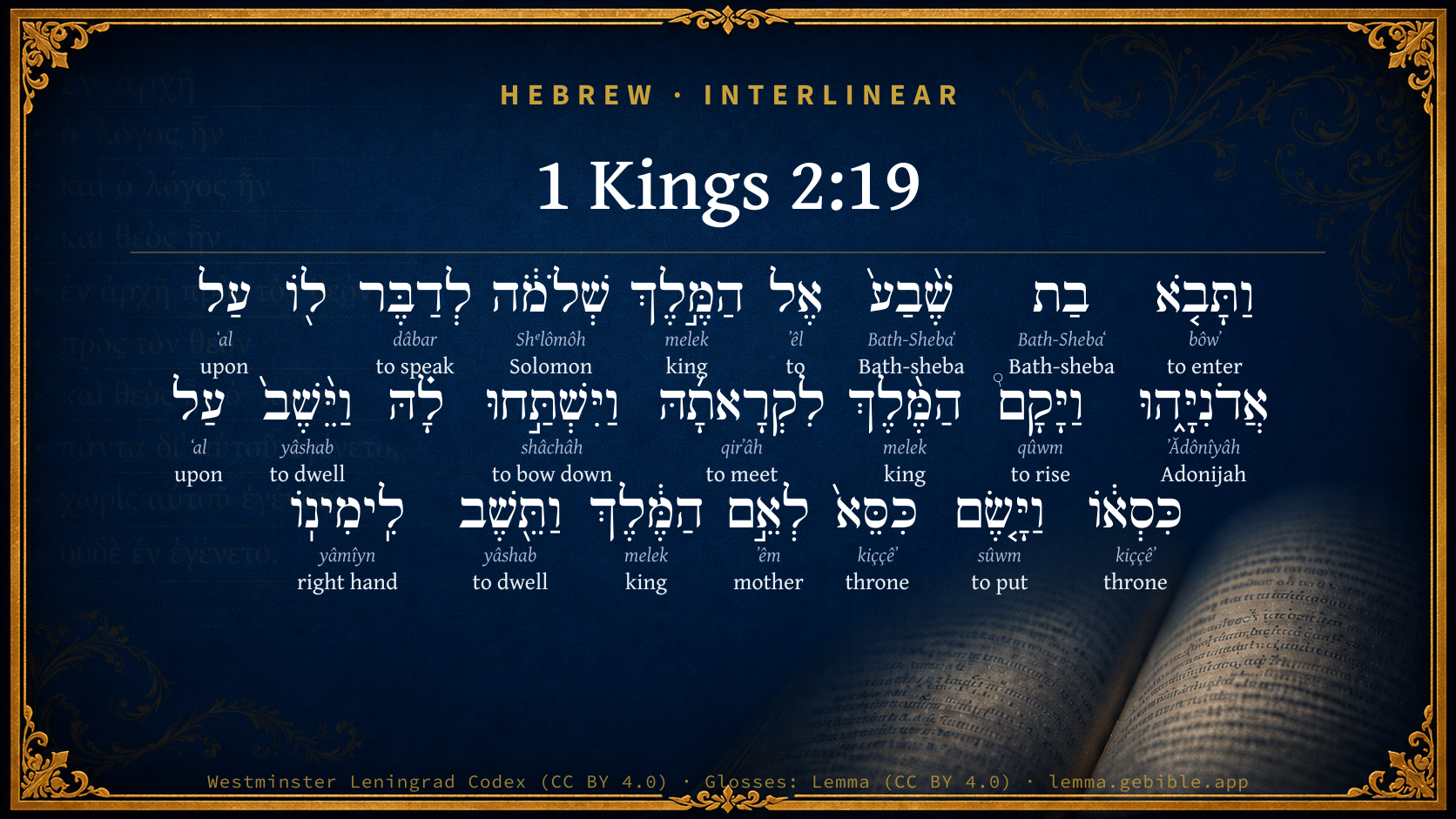
1 Kings 2:19

Hebrew (Westminster Leningrad Codex) 1 Kings 2:19 appears in the Hebrew Old Testament. The text above is from the Westminster Leningrad Codex. Each word links to its Strong’s number, a concise gloss, and parsing drawn from the Open Scriptures Hebrew Bible morphology. Click any word for its full Brown-Driver-Briggs (BDB) entry.
Download image
Cite this verse

1 Kings 2:19 (World English Bible). Public Domain. Lemma interlinear Bible study tool, https://lemma.gebible.app/v/1-kings/2/19.

Show BibTeX & RIS
BibTeX
RIS
English Translation
Bathsheba therefore went to king Solomon, to speak to him for Adonijah. The king rose up to meet her, and bowed himself to her, and sat down on his throne, and caused a throne to be set for the king's mother; and she sat on his right hand.
World English Bible · Public Domain
Download a study sheet

One document with this verse’s original text, its word-by-word gloss line, the meaning frame, cross-references with their text, attributed commentary, and full source and license credits — printable, and it pastes into notes with its structure intact.

This verse Autodidact and up

Study sheet (.html) Plain text (.txt)

A passage Seminary Student

Up to 50 verses in one chapter. A passage sheet keeps up to 6 commentary sources and 12 cross-references per verse, in the order this page ranks them, and says so on the sheet whenever that leaves anything out. Ask for a single verse and you get the Autodidact verse sheet above.

Everything on this page stays free to read, with no account — the sheet is a download of what is already on screen, not access to it.

Want to remove ads? Support Godless Engineer
Compare translations 3

The same verse in 3 English versions, stacked beneath the original-language interlinear above. Click any original word for its lexicon entry.

Each is an independent rendering of the whole verse — the interlinear is not word-aligned to these translations.

Highlighted words mark where these versions differ — a whole-verse word diff, not a word-by-word alignment.

  • World English Bible Public Domain
    Bathsheba therefore went to king Solomon, to speak to him for Adonijah. The king rose up to meet her, and bowed himself to her, and sat down on his throne, and caused a throne to be set for the king's mother; and she sat on his right hand.
  • King James Version Public Domain
    Bathsheba therefore went unto king Solomon, to speak unto him for Adonijah. And the king rose up to meet her, and bowed himself unto her, and sat down on his throne, and caused a seat to be set for the king's mother; and she sat on his right hand.
  • unfoldingWord Literal Text CC BY-SA 4.0
    And Bathsheba came to King Solomon to speak to him about Adonijah. And the king arose to meet her, and he bowed down to her. And he sat on his throne, and he set a throne for the mother of the king, and she sat at his right side.

unfoldingWord Literal Text — © unfoldingWord, licensed CC BY-SA 4.0. Word-aligned USFM3 via Door43 (git.door43.org/unfoldingWord/en_ult).

Versions to compare (up to 4)

3 of 4 selected

Show all 18 translations

Every available English version of this verse, each an independent rendering of the whole verse.

  • World English Bible Public Domain
    Bathsheba therefore went to king Solomon, to speak to him for Adonijah. The king rose up to meet her, and bowed himself to her, and sat down on his throne, and caused a throne to be set for the king's mother; and she sat on his right hand.
  • Berean Standard Bible Public Domain
    So Bathsheba went to King Solomon to speak to him for Adonijah. The king stood up to greet her, bowed to her, and sat down on his throne. Then the king had a throne brought for his mother, who sat down at his right hand.
  • Majority Standard Bible Public Domain
    So Bathsheba went to King Solomon to speak to him for Adonijah. The king stood up to greet her, bowed to her, and sat down on his throne. Then the king had a throne brought for his mother, who sat down at his right hand.
  • King James Version Public Domain
    Bathsheba therefore went unto king Solomon, to speak unto him for Adonijah. And the king rose up to meet her, and bowed himself unto her, and sat down on his throne, and caused a seat to be set for the king's mother; and she sat on his right hand.
  • American Standard Version (1901) Public Domain
    Bath-sheba therefore went unto king Solomon, to speak unto him for Adonijah. And the king rose up to meet her, and bowed himself unto her, and sat down on his throne, and caused a throne to be set for the king's mother; and she sat on his right hand.
  • Revised Version (1885) Public Domain
    Bath-sheba therefore went unto king Solomon, to speak unto him for Adonijah. And the king rose up to meet her, and bowed himself unto her, and sat down on his throne, and caused a throne to be set for the king’s mother; and she sat on his right hand.
  • Geneva Bible (1599) Public Domain
    Bath-sheba therefore went vnto King Salomon, to speake vnto him for Adonijah: and the King rose to meete her, and bowed himselfe vnto her, and sate downe on his throne: and he caused a seate to be set for the Kings mother, and she sate at his right hand.
  • Douay-Rheims (1899) Public Domain
    Then Bethsabee came to king Solomon, to speak to him for Adonias: and the king arose to meet her, and bowed to her, and sat down upon his throne: and a throne was set for the king's mother, and she sat on his right hand.
  • Young's Literal Translation Public Domain
    And Bath-Sheba cometh in unto king Solomon to speak to him for Adonijah, and the king riseth to meet her, and boweth himself to her, and sitteth on his throne, and placeth a throne for the mother of the king, and she sitteth at his right hand.
  • Literal Standard Version CC BY-SA 4.0
    And Bathsheba comes to King Solomon to speak to him for Adonijah, and the king rises to meet her, and bows himself to her, and sits on his throne, and places a throne for the mother of the king, and she sits at his right hand.
  • Unlocked Literal Bible CC BY-SA 4.0
    Bathsheba therefore went to King Solomon to speak to him for Adonijah. The king rose to meet her and bowed down to her. Then he sat down on his throne and had a throne brought for the king's mother. She sat at his right hand.
  • unfoldingWord Literal Text CC BY-SA 4.0
    And Bathsheba came to King Solomon to speak to him about Adonijah. And the king arose to meet her, and he bowed down to her. And he sat on his throne, and he set a throne for the mother of the king, and she sat at his right side.
  • Darby Bible Public Domain
    And Bathsheba went to king Solomon, to speak to him for Adonijah. And the king rose up to meet her, and bowed himself to her, and sat down on his throne; and he caused a throne to be set for the king's mother, and she sat on his right hand.
  • World Messianic Bible Public Domain
    Bathsheba therefore went to King Solomon, to speak to him for Adonijah. The king rose up to meet her and bowed himself to her, and sat down on his throne and caused a throne to be set for the king’s mother; and she sat on his right hand.
  • Webster's Bible Public Domain
    Bath-sheba therefore went to king Solomon, to speak to him for Adonijah. And the king rose up to meet her, and bowed himself to her, and sat down on his throne, and caused a seat to be set for the king's mother; and she sat on his right hand.
  • Free Bible Version CC BY-SA 4.0
    So Bathsheba went to talk to King Solomon for Adonijah. The king got up from his throne to meet her, and bowed before her. Then he sat back down and ordered another throne brought in for his mother. She sat to his right.
  • Bible in Basic English Public Domain
    So Bath-sheba went to King Solomon to have talk with him on Adonijah's account. And the king got up to come to her, and went down low to the earth before her; then he took his place on the king's seat and had a seat made ready for the king's mother and she took her place at his right hand.
  • JPS Tanakh (1917) Public Domain
    Bath-sheba therefore went unto king Solomon, to speak unto him for Adonijah. And the king rose up to meet her, and bowed down unto her, and sat down on his throne, and caused a throne to be set for the king's mother; and she sat on his right hand.

Literal Standard Version (2020), Covenant Press — licensed CC BY-SA 4.0. Text via the HelloAO Bible API (eBible.org). Unlocked Literal Bible (unfoldingWord) — licensed CC BY-SA 4.0. Text via the HelloAO Bible API (eBible.org). unfoldingWord Literal Text — © unfoldingWord, licensed CC BY-SA 4.0. Word-aligned USFM3 via Door43 (git.door43.org/unfoldingWord/en_ult). Free Bible Version, Dr. Jonathan Gallagher — licensed CC BY-SA 4.0. Text via the HelloAO Bible API (eBible.org).

Word by word

More ways to search: Search by grammar → Find every occurrence → Compare this word →

Practice this passage: Drill this verse → Learn its vocabulary →

בַת
Bath-Shebaʻ
H1339
“Bath-sheba”
Noun, Proper
Part of Speech
Noun
Type
Proper
Full BDB Definition

Origin: from H1323 and H7651 (in the sense of H7650 )

TWOT: None

Bath-sheba = "daughter of an oath" - the wife of Uriah whom David had murdered, having had adulterous relations with her; subsequently wife of David and mother of Solomon, Shimea, Shobab, and Nathan
  1. וַתָּבֹ֤א bôwʼ H935 “and · to enter” Conjunction + Verb, Qal, Sequential Imperfect, 3rd Person, Feminine, Singular
  2. שֶׁ֨בַע֙ Bath-Shebaʻ H1339 “Bath-sheba” Adjective, Cardinal number, Feminine, Singular, Absolute
  3. אֶל ʼêl H413 “to” Preposition
  4. הַמֶּ֣לֶךְ melek H4428 “the · king” Particle, Definite Article + Noun, Common, Masculine, Singular, Absolute
  5. שְׁלֹמֹ֔ה Shᵉlômôh H8010 “Solomon” Noun, Proper
  6. לְדַבֶּר dâbar H1696 “to speak” Preposition + Verb, Piel, Infinitive Construct
  7. עַל ʻal H5921 “upon” Preposition
  8. אֲדֹנִיָּ֑הוּ ʼĂdônîyâh H138 “Adonijah” Noun, Proper
  9. וַיָּקָם֩ qûwm H6965 “and · to rise” Conjunction + Verb, Qal, Sequential Imperfect, 3rd Person, Masculine, Singular
  10. הַמֶּ֨לֶךְ melek H4428 “the · king” Particle, Definite Article + Noun, Common, Masculine, Singular, Absolute
  11. לִקְרָאתָ֜הּ qirʼâh H7125 “to meet · her” Preposition + Verb, Qal, Infinitive Construct + Suffix, Personal, 3rd Person, Feminine, Singular
  12. וַיִּשְׁתַּ֣חוּ shâchâh H7812 “and · to bow down” Conjunction + Verb, Hithpael, Sequential Imperfect, 3rd Person, Masculine, Singular
  13. וַיֵּ֨שֶׁב֙ yâshab H3427 “and · to dwell” Conjunction + Verb, Qal, Sequential Imperfect, 3rd Person, Masculine, Singular
  14. עַל ʻal H5921 “upon” Preposition
  15. כִּסְא֔וֹ kiççêʼ H3678 “throne · his” Noun, Common, Masculine, Singular, Construct + Suffix, Personal, 3rd Person, Masculine, Singular
  16. וַיָּ֤שֶׂם sûwm H7760 “and · to put” Conjunction + Verb, Qal, Sequential Imperfect, 3rd Person, Masculine, Singular
  17. כִּסֵּא֙ kiççêʼ H3678 “throne” Noun, Common, Masculine, Singular, Absolute
  18. לְאֵ֣ם ʼêm H517 “to/for · mother of” Preposition + Noun, Common, Feminine, Singular, Construct
  19. הַמֶּ֔לֶךְ melek H4428 “the · king” Particle, Definite Article + Noun, Common, Masculine, Singular, Absolute
  20. וַתֵּ֖שֶׁב yâshab H3427 “and · to dwell” Conjunction + Verb, Qal, Sequential Imperfect, 3rd Person, Feminine, Singular
  21. לִֽימִינֽוֹ yâmîyn H3225 “to/for · right hand · his” Preposition + Noun, Common, Feminine, Singular, Construct + Suffix, Personal, 3rd Person, Masculine, Singular

About this verse

These counts appear in no published source. They are computed here, from the morphology-tagged text and Lemma’s own curated glosses. What Lemma adds →

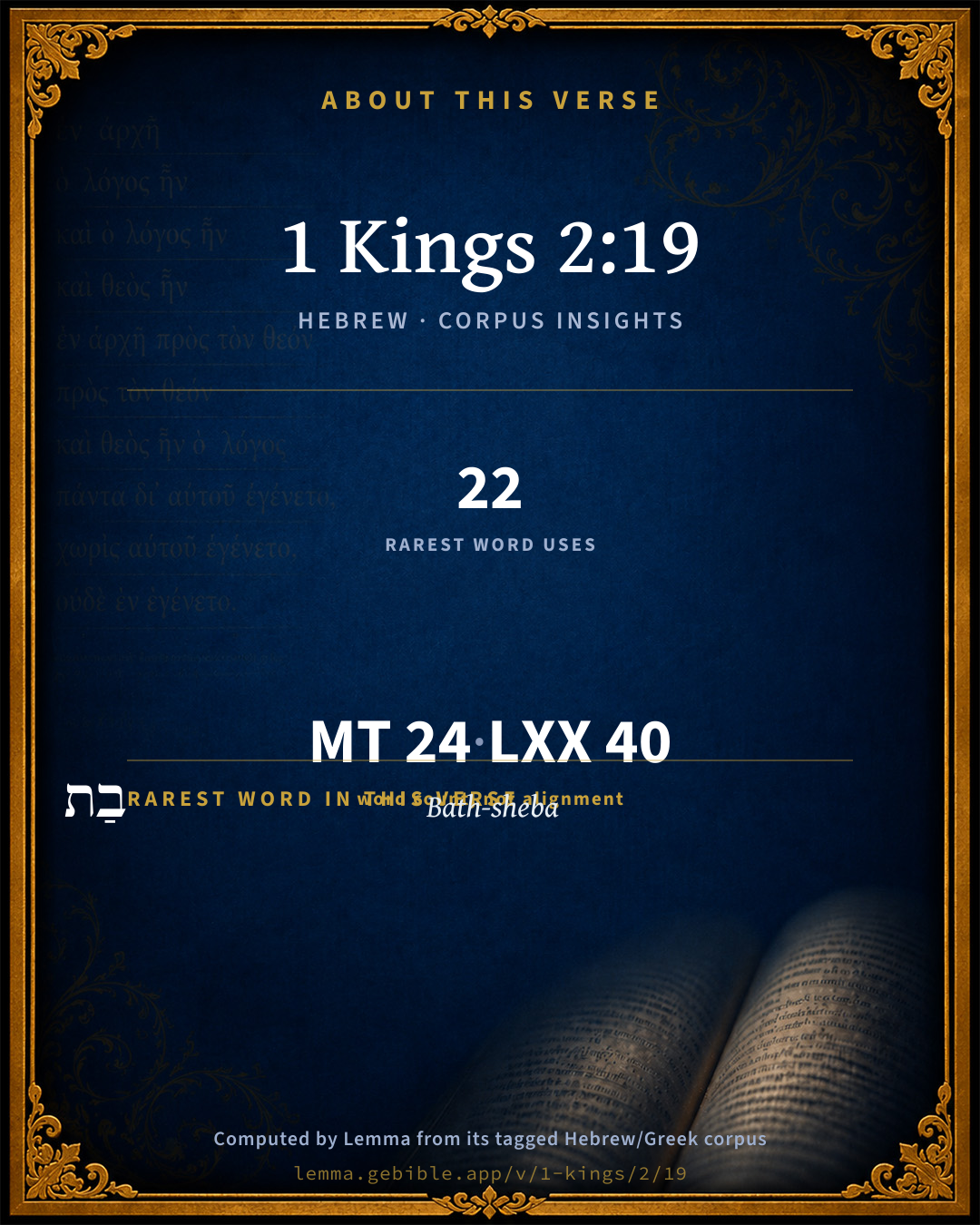
24
words
16
distinct lemmas
Historical
section

Notable vocabulary

The rarest word here is בַת Bath-sheba H1339 — appearing just 22 times in the whole Hebrew Bible.

Shared distinctive vocabulary

בַת Bath-sheba H1339 occurs in 11 verses of the Hebrew Bible. Also found in:

Grammatical profile

  • 8 verbs
  • 10 nouns
  • 1 adjective
  • 5 prepositions

Verb forms

  • וַתָּבֹ֤א Qal · Sequential Imperfect
  • לְדַבֶּר Piel · Infinitive Construct
  • וַיָּקָם֩ Qal · Sequential Imperfect
  • לִקְרָאתָ֜הּ Qal · Infinitive Construct
  • וַיִּשְׁתַּ֣חוּ Hithpael · Sequential Imperfect
  • וַיֵּ֨שֶׁב֙ Qal · Sequential Imperfect
  • וַיָּ֤שֶׂם Qal · Sequential Imperfect
  • וַתֵּ֖שֶׁב Qal · Sequential Imperfect

Repetition

Words recur within this verse — often emphatic in Hebrew:

  • הַמֶּ֣לֶךְ king H4428 ×3
  • בַת Bath-sheba H1339 ×2
  • עַל upon H5921 ×2
  • וַיֵּ֨שֶׁב֙ to dwell H3427 ×2
  • כִּסְא֔וֹ throne H3678 ×2

Hebrew & Septuagint length

In English translation the verse runs 48 words from the Hebrew and 47 from the Septuagint (LXX English) — closely comparable.

A rough comparison of the two English renderings, which tokenize alike — not a word-level alignment.

Word counts can differ between the Hebrew and the Greek without any difference in meaning — e.g. the Hebrew direct-object marker אֵת has no separate Greek word, and Greek often adds the article ὁ.

In the original languages it is 24 Hebrew tokens and 40 Greek tokens — but the two are counted differently (Hebrew bundles its prefixes and suffixes into one token; the Greek is in lemma form), so that isn’t a like-for-like length.

Cross-references

7

Topical passages linked to 1 Kings 2:19 in the Treasury of Scripture Knowledge — connected by theme and wording, ordered by reader-vote popularity; previews shown in the World English Bible.

  • Psalms 45:9 Kings' daughters are among your honorable women. At your right hand the queen stands in gold of Ophir.
  • Exodus 20:12 "Honor your father and your mother, that your days may be long in the land which Yahweh your God gives you.
  • Leviticus 19:3 "'Each one of you shall respect his mother and his father. You shall keep my Sabbaths. I am Yahweh your God.
  • Leviticus 19:32 You shall rise up before the gray head, and honor the face of an old man, and you shall fear your God. I am Yahweh.
  • 1 Kings 15:13 Also Maacah his mother he removed from being queen, because she had made an abominable image for an Asherah; and Asa cut down her image, and burnt it at the brook Kidron.
  • Psalms 110:1 Yahweh says to my Lord, "Sit at my right hand, Until I make your enemies your footstool for your feet."
  • Matthew 25:33 He will set the sheep on his right hand, but the goats on the left.

Cross-references courtesy of OpenBible.info (CC BY 4.0).

Hebrew and Greek witnesses Masoretic Hebrew ↔ Greek Septuagint

The same verse in the two great witnesses to the Old Testament, shown verse-for-verse.

These are two independent witnesses, not word-aligned to each other, and the Septuagint is shown in lemma (dictionary) form.

Hebrew 1 Kings 2:19 Masoretic · Westminster Leningrad Codex

וַתָּבֹ֤א בַת שֶׁ֨בַע֙ אֶל הַמֶּ֣לֶךְ שְׁלֹמֹ֔ה לְדַבֶּר ל֖וֹ עַל אֲדֹנִיָּ֑הוּ וַיָּקָם֩ הַמֶּ֨לֶךְ לִקְרָאתָ֜הּ וַיִּשְׁתַּ֣חוּ לָ֗הּ וַיֵּ֨שֶׁב֙ עַל כִּסְא֔וֹ וַיָּ֤שֶׂם כִּסֵּא֙ לְאֵ֣ם הַמֶּ֔לֶךְ וַתֵּ֖שֶׁב לִֽימִינֽוֹ

Bathsheba therefore went to king Solomon, to speak to him for Adonijah. The king rose up to meet her, and bowed himself to her, and sat down on his throne, and caused a throne to be set for the king's mother; and she sat on his right hand.

World English Bible · Public Domain

Greek LXX 1 Kings 2:19 Septuagint · lemma form

καί εἰςἔρχομαι βηρσαβεε πρός ὁ βασιλεύς σαλωμών λαλέω αὐτός περί αδωνίας καί ἐκ ἀναἵστημι ὁ βασιλεύς εἰς ἀπαντή αὐτός καί καταφιλέω αὐτός καί καταἵζω ἐπί ὁ θρόνος αὐτός καί τίθημι θρόνος ὁ μήτηρ ὁ βασιλεύς καί καταἵζω ἐκ δεξιός αὐτός

And Bersabee went in to king Solomon to speak to him concerning Adonias; and the king rose up to meet her, and kissed her, and sat on the throne, and a throne was set for the mother of the king, and she sat on his right hand.

LXX2012 (modern English Septuagint) · Public Domain

On this verse, The Pulpit Commentary discusses the Septuagint’s reading. Read the note in Commentary ↓

Hebrew: Westminster Leningrad Codex (CC BY 4.0). Greek: Septuagint (public domain); English from LXX2012 (modern English Septuagint) (Public Domain). How the Septuagint differs from the Hebrew →

Targum (Aramaic paraphrase)

1

The Targum is the ancient Jewish Aramaic paraphrase of the Hebrew Scriptures — an interpretive translation, not the Hebrew text itself. Onkelos (literal) and Pseudo-Jonathan (expansive) render the Torah, and Jonathan the Prophets. Coverage is partial: where no permissively-licensed English translation exists for a verse, only the Aramaic is shown. This is verse-level text, not a word-by-word alignment to the Hebrew.

  1. Targum Jonathan Prophets (Joshua–Malachi)
    וַאֲתַת בַּת שֶׁבַע לָקֳדָם מַלְכָּא שְׁלֹמֹה לְמַלָלָא עִמֵיהּ עַל אֲדֹנִיָהוּ וְקָם מַלְכָּא לָקֳדָמוּתָהּ וּסְגִיד לָהּ וִיתֵיב עַל כּוּרְסֵיהּ וְשַׁוִי כּוּרְסָא לְאִמָא דְמַלְכָּא וִיתֵיבַת לְיַמִינֵיהּ:

    (no public-domain English translation for this verse)

    Targum Jonathan — Aramaic: “Mikraot Gedolot” (public domain). English: “Sefaria Community Translation” (CC0 1.0 (public-domain dedication)); “London "Chaldee Paraphrase," 1871” (public domain). Text via Sefaria.

Commentary

Notes on 1 Kings 2:19 from classic Christian and Jewish commentators (each source and its license shown beneath its notes). The classic Christian expositions comment on the surrounding passage and are grouped to its opening verse, so a note may address several verses; the Jewish commentaries on the Tanakh (Rashi and others) are per-verse, so they appear only where the commentator wrote on this verse.

Lemma curates 59 commentaries, every one of them public domain or Creative Commons licensed, each selected and text-cleaned for this edition rather than reprinted as found. About our sources →

Trapp's Complete Commentary

John Trapp

1Ki 2:19 Bathsheba therefore went unto king Solomon, to speak unto him for Adonijah. And the king rose up to meet her, and bowed himself unto her, and sat down on his throne, and caused a seat to be set for the king’s mother; and she sat on his right hand.

Ver. 19. And bowed himself unto her.] Sir Thomas More, Lord Chancellor of England, would in Westminster Hall beg his father’s blessing on his knees.

John Trapp, A Commentary or Exposition upon All the Books of the Old and New Testament (1647–1656) — public domain. Text from a community e-Sword module.

The Biblical Illustrator

Joseph S. Exell

1Ki_2:19-20

Bathsheba therefore went unto King Solomon, to speak unto him for Adonijah.

What mothers can do for their children

Nearly twenty times the Book of Kings makes mention of the names of mothers as connected with the good or evil deeds of their sons. We are not always told what was the character of these mothers, nor how far it was due to their influence that their sons turned out as they did, but the introduction of their names in such close connection with the good or evil, is sufficiently significant. His mothers name was Jecholiah; and he did that which was right in the sight of the Lord. The sacred penman adds no more, and yet we can scarce restrain the natural exclamation of the heart, Blessed art thou among women! so certain are we that the youth who honoured God had enjoyed the care of a good mother. In contrast, what unenviable notoriety is given to Abijahs name when the mention of it is accompanied with the painful record, he walked in all the sins of his father (1Ki_15:2). Maachah, the mother, may have been a good woman herself, in spite of her husbands evil ways; yet what volumes are expressed in that embalming of her name--and only hers--in connection with the wrong-doings of her son! Alas! the agonies of the wretched parents heart, in this world and the next, concerning whose offspring the record must be made, he did evil all his life; he did evil because of his mothers neglect to teach him better! St. Augustine, and Gregory of Nazianzen, are striking examples, which cry aloud, Christian mothers, pray on in faith! Theodoret, and Basil the Great, and Chrysostom were instances almost as remarkable. General Harrison, not long before taking his place at the head of the Government, visited his old home in Virginia, and turned his steps at once to his mothers room, where, as he said, he had seen her daily reading her Bible, and where she had taught him to pray. Fame and glory became dim before him as the pleasant light burst forth from the scene of his earliest and best impressions. Where is the son so wayward and so cruel, who would not promptly answer, like Israels king, when besought by her who had nursed him in helpless infancy, Ask on, my mother, for I will not say thee nay? My mother asked me never to use tobacco, remarked Senator Thomas H. Benton, and I have never touched it from that time to the present day. She asked me never to gamble, and I never have. She admonished me against hard drinking, and whatever usefulness I have attained in life, I owe to my compliance with her pious wishes. The Christian mother who thus loves her children may be sure of their sincerest affection in return. An old man, wasted with disease, was struggling feebly with death. His family and friends stood by, rendering every kind office which they could, but still there was one thing which he longed for, and which all their tenderest affections failed to supply. He rolled his head in agony, and faintly whispered, I want mother! She had been dead for fifty years! As a child, he had carried his little sorrows to his mother, and she had always proved his ready comforter, and now, after all this lapse of time, forgetful, for the moment, that wife and children and grandchildren were with him, he remembered no one but his mother! A noted infidel was once suddenly brought under religious influences, and cried aloud, in his agony, God of my mother, have mercy on me! When a lady once told Archbishop Sharpe that she would not trouble her children with instruction about religion until they had reached the years of discretion, the shrewd prelate answered, If you do not teach them, the devil will! (J. N. Norton.)

The power of mothers

The power of mothers is a fertile theme for contemplation and one most fascinating. It has been said that the greatest moral power in the world is that exercised by a mother over her child. Can you name any force which you dare call equal to it? Is it not true, as Douglas Jerrold put it, that she who rocks the cradle rules the world? In the first place, note the fact that--

I. The early years of a child belong to the mother. These are the years which give shape and colour to all the rest of life. And in these the natural guide and companion of the child is the mother. Her presence and her varied teachings are the most potent force brought to bear upon it in the fresh and dewy morning of its existence. As soon as the child begins to comprehend language and to ponder ideas it conveys, what priceless opportunities are the mothers for inspiring and leading it! It learns its words from her lips and pronounces them after her methods. A mispronunciation acquired in childhood often clings to one all his days. The child thinks its mothers thoughts as well as speaks her words. Its views of things are largely derived from her. She can teach the child to be observant of what is within him and without him, upon notice of which wisdom so largely depends. She can develop in it the habit of thought, which so enhances the power of thought. She can elevate its thinking. She can teach it to be affectionate, aspiring, loyal, and brave. In short, she can mould her child well-nigh as easily as the sculptor shapes his plastic clay into the statue of faultless beauty.

II. The example and the teachings of the mother are permanent influences. This from their very nature, not simply because she has the control of the years of youth. A mothers life is one of the regulating and animating forces of that of her children as long as they live. There is a sacredness in that example which time increases rather than lessens in the bosom of every right-minded child. Even those who are wayward admit its power, and it is always one of the most invincible agents in their restoration. The same is true of the precepts she has given him. Not merely do they start him in the course he takes, they remain with him as elemental factors of his being and his conduct. They were the warrant of his early actions, and he unconsciously makes appeal to them all his life. Charles Reade, the famous novelist, when near the end of his life, declared: I owe the larger half of what I am to my mother. And John Ruskin, nobly eminent as he is, cannot be disloyal to the memory of her who gave him birth. He wrote in this strain: My mothers influence in moulding my character was conspicuous. She forced me to learn daily long chapters of the Bible by heart. To that discipline and patient, accurate resolve I owe not only much of general power of taking pains, but the best part of my taste for literature. And this is the testimony of an author whose facile pen has traced some of the most superb and exquisite sentences to be found in our English speech.

III. Affection for mothers is enduring. It is this, in large measure, which lends power to their example and instruction. Still, it is a force by itself beyond these, in all the life of the child. If there is no love on earth like a mothers love, it calls forth in response an affection that many waters cannot drown. And this affection is a purifying, uplifting, gladdening element in the life of one who shares it. It spurs him to labour and self-denial. It kindles patience, zeal, hope, courage. It elevates, and quickens all his nature by its silent yet persuasive influence. When he is tempted, that love nerves him for victory. When he is despondent it clothes him with fortitude. When he is weary he rests upon it. When he is lonely its sweet presence enlivens his soul. When he is strong he rejoices for her dear sake. When he is successful he exults because she will be happy. Said Lord Macaulay: I am sure it is worth while being sick to be nursed by a mother. One of the most pathetic elements in the sensitive spirit of William Cowper was his affectionate regard for his mother, who died when he was in his sixth year. To a niece who sent him her picture he wrote: Every creature that bears an affinity to my mother is dear to me . . . The world could not have furnished you with a present so acceptable to me as the picture which you have so kindly sent me. I kissed it and hung it where it is the last object that I see at night, and, of course, the first on which I open my eyes in the morning. Who can doubt the healthful charm of that beautiful portrait over the life of the son? A mothers face--what beauty in its outlines, what sweetness in its expression, what inspiration in its presence in the mind only! No wonder that Napoleon said the greatest need of France was mothers. It does not appear strange that in the early centuries of our era Christian matrons should have been held in high esteem. The names of the mothers of not a few heroes of the Church are inseparably linked with their own. Emmelia with Basil; Nonna, who died while praying, with Gregory Nazienzen; Anthusa, whose noble character led the heathen to exclaim: Ah, what wonderful women there are among Christians! with Chrysostom, the golden-mouthed; Monica, who died in the arms of her son, with Augustine, the great theologian; Aletta, of whom an eloquent orator has recently said, I cannot but feel that that saintly mother who died eight hundred years ago in Burgundy has modified the civilisation of the age in which we live--that she has left the touch of her hand immortal on your heart and mine! with Bernard of Clairvaux. And in modern times the mother of the Wesleys is called also the mother of Methodism, such was her impress upon her sons. John Quincey Adams doubtless gave utterance to the sober truth when he said: All I am, or ever have been, in this world, I owe, under God, to my mother. And there is no flower in all the field that owes as much to the sun aa multitudes in the lesser walks of life owe to their mothers. The glory of motherhood has been strikingly set forth by some one who said: God could not be everywhere, and therefore He made mothers. Theirs is the post of honour in the world. They sit upon thrones most regal. Sceptres of unbounded empire are in their hands. O mothers, realise the proud eminence you have attained! Aim to meet well its immense responsibilities, its limitless possibilities. Your children are, in a large degree, at your own disposal. Charles Dickens did not err when he thought that it must be written somewhere that the virtues of mothers should be visited, occasionally, upon their children as well as the sins of fathers. (A. W. Hazen, D. D.)

The king rose up to meet her, and bowed himself unto her.--

A mothers noble recognition

The story is told that not long ago President Loubet paid a brief official visit to a town near his birthplace. A triumphal procession was formed through the town, and the President, seated in the magnificent four-horse state carriage, was driven between long lines of enthusiastic people towards another part of the town, where his old peasant mother patiently awaited his coming. She had a special seat, from which she could have an uninterrupted view of the passing procession. When she caught sight of the magnificent carriage approaching, surrounded by a brilliant cavalry escort, notwithstanding her eighty-six years, she rose quickly to her feet in order to get a better view of her boy, as she always calls the President. The latter, who had been privately told where his mother was, noticed the movement. Seized by a sudden impulse, he ordered the carriage to step, and, turning to the general in attendance, said hastily: For the moment I cease to be President of France, and become a son. Then, springing quickly to the ground, Monsieur Loubet hastened by the garden, which he well knew, to the little stand, caught the quivering old mother in his arms, and embraced her long and silently, while copious tears streamed down her wrinkled cheeks. The large crowd that witnessed this scene of filial affection was so touched as not to be able at first to signify their approval, and it was not till the President was in his carriage again, and the procession was moving once more, that the spell was broken, and the people cheered the dutiful son as he deserved.

A rulers regard for his mother

President Roosevelt, in his life of Oliver Cromwell, tells us how devoted the mother of Cromwell was to her great son, and how he loved her. When he was young, he followed her counsel. When he became Dictator of England, he placed her in the royal palace of Whitehall; and when she died, he buried her in Westminster Abbey. This care for our mothers is one element of greatness which we may all possess.

The Biblical Illustrator, edited by Joseph S. Exell (c. 1880s–1900s) — public domain. Text from a community e-Sword module.

Joseph Benson's Commentary

1Ki 2:19. The king rose up to meet her, and bowed himself — For the high dignity to which he was advanced, did not make him forget the honour due to a parent: an amiable example this, to teach all children to continue to show respect to their parents, how much soever they may be advanced above them in wealth, dignity, or honour. She sat on his right hand — The most honourable place, next to the king.

Joseph Benson's Commentary on the Old and New Testaments (1811–1818) — public domain. Text from a community e-Sword module.

Tyndale Open Study Notes

Tyndale Open Resources

2:19-21 Solomon understood the intentions behind Adonijah’s small request. Adonijah’s desire to marry Abishag could have launched a claim to the throne, whether or not she was officially in David’s harem.

Tyndale Open Study Notes — © Tyndale Open Resources, licensed CC BY-SA 4.0. Text via the HelloAO Bible API.

Geneva Bible (1599)

Geneva Bible translators

In token of reverence, and that others by his example might have her in greater honor.

Geneva Bible (1599) marginal notes — public domain. Text via Bolls.life.

Jamieson, Fausset & Brown

Robert Jamieson, A. R. Fausset & David Brown

Bath-sheba . . . went unto King Solomon--The filial reverence and the particular act of respect, which Solomon rendered, were quite in accordance with the sentiments and customs of the East. The right hand is the place of honor; and as it expressly said to have been assigned to "the king's mother," it is necessary to remark that, when a husband dies, his widow acquires a higher dignity and power, as a mother over her son, than she ever possessed before. Besides, the dignity of "king's mother" is a state office, to which certain revenues are attached. The holder has a separate palace or court, as well as possesses great influence in public affairs; and as the dignity is held for life, it sometimes happens, in consequence of deaths, that the person enjoying it may not be related to the reigning sovereign by natural maternity. Bath-sheba had evidently been invested with this honorable office.

Jamieson, Fausset & Brown — Commentary Critical and Explanatory on the Whole Bible (1871) — public domain (CC PDM 1.0). Text via the HelloAO Bible API.

The Cambridge Bible for Schools and Colleges

gen. ed. J. J. S. Perowne

19. caused a seat to be set for the king’s mother] For ‘seat’ we should have throne. The word is the same as that which occurs earlier in the verse for Solomon’s own ‘throne.’ In Eastern nations the queen-mother was a very important personage and treated with the same sort of reverence as the king. This we may see in the case of Maachah (1Ki_15:13) who held authority and was called queen, even during the reign of her grandson Asa. Compare also the influential position of Athaliah, which enabled her to destroy nearly all the seedroyal (2Ki_11:1).

and she sat on his right hand] This being the place of greatest honour, cf. Psa_45:9.

The Cambridge Bible for Schools and Colleges (gen. ed. J. J. S. Perowne; Cambridge University Press, 1878–1918) — public domain. Text from a community e-Sword module.

John Gill's Exposition

Bathsheba therefore went unto King Solomon, to speak unto him for Adonijah,.... She went from her own house to the palace; for she might not live at court; or however had an apartment to herself, from whence she went to the king with her suit in favour of Adonijah:

and the king rose up to meet her, and bowed himself unto her; upon her entrance into the presence chamber, in honour to her as a parent, he rose up from his throne, and made his obeisance to her, as a dutiful son:

and sat down on his throne, and caused a seat to be set for the king's mother; a magnificent seat or throne, as the word is, was ordered to be set for her:

and she sat on his right hand; where he placed her in honour to her as his mother; so Nero (a) placed Tiridates king of Armenia at his right hand, to do him honour.

(a) Suetonius in Vit. Neron. c. 13.

John Gill's Exposition of the Whole Bible (1746–1763) — public domain (CC PDM 1.0). Text via the HelloAO Bible API.

Albert Barnes' Notes on the Bible

A seat - Or, “a throne.” We have here a proof of the high dignity of the Queen-mother. Compare also 1Ki 15:13; 2Ki 11:1-3. In the Persian court the Queen-mother had often the chief power.

Albert Barnes' Notes on the Bible (1834–1885) — public domain. Text from a community e-Sword/MySword module.

Haydock's Catholic Bible Commentary

To her. Only fools will despise their parents, Proverbs xv. 20., Ecclesiasticus iii. 18., and Tobias iv. 3. The Persians would allow no one to sit in his mother’s presence, without her leave; and Alexander would treat Sysigambis with the like respect. (Q. Curtius v.) --- Right hand. In the most honourable place, next to his own, Genesis xlviii. 13. The Turks and Persians give the preference to the left. (Xenophon, Cyrop. viii.)

George Leo Haydock (1774–1849), Haydock's Catholic Family Bible and Commentary, 1859 edition — public domain. Excludes Psalms (Douay-Rheims chapter numbering differs from Protestant) and Deuterocanonical books (Catholic canon only).

Matthew Poole's English Annotations

The most honourable place next to the king’s. See 2Ch 18:18; Neh 8:4; Psa 45:9; Mat 20:21.

Matthew Poole's English Annotations on the Holy Bible (1683–1685) — public domain. Text from a community e-Sword/MySword module.

Whedon's Commentary on the Bible

Daniel D. Whedon

19. The king rose up to meet her — Here we see with what respect and honour the “queen mother” was treated. Bathsheba now, as mother of the reigning king, has more power and influence in court than she had while David lived. See note on 1Ki_15:13.

Caused a seat to be set — The word here rendered seat is the same as that rendered throne in the preceding sentence. It was evidently a royal seat, and placed on the king’s right hand — the place of honour.

Daniel D. Whedon (gen. ed.), Commentary on the Old and New Testaments (1874–1909) — public domain. Text from a community e-Sword module.

The Pulpit Commentary

Bathsheba therefore lit., And Bathsheba went unto king Heb. the king Solomon, to speak unto him for Adonijah. And the king rose up to meet her, and bowed himself unto her, the LXX reads, "and kissed" her (kailhsen aujthn). There is not necessarily a pregnant construction, as Keil insists: "rose up and went down to meet her." We get here a glimpse of the stateliness of Solomon"s court and sat down on his throne, and caused a seat lit., throne, same word to be set most probably the servants of Solomon placed the seat for the queen mother, as the LXX (ejteqh qronov) and most translators. The reception was clearly a public one, if the interview was private. But the original is simply, "and he set," etc., suggesting that Solomon may have done it, as a mark of respect, with his own hands. He "received his mother as hrybiG". (1Ki_15:13) Bahr for the mother of the king, and she sat on his right hand. The place of honour. Cf. Psa_110:1; Mat_20:21 Mat_25:33; Act_7:56; Rom_8:34; Heb_1:3 Heb_8:1, etc. It was also the place of honour amongst Arabians (Keil) Greeks, and Romans, as the very names eujwnumov an euphemism for ajristerov and sinistra, show.

The Pulpit Commentary (1880–1919), ed. H.D.M. Spence-Jones & Joseph S. Exell — public domain. Text from a community e-Sword module.

unfoldingWord translationNotes

Door43 World Missions Community

General Information:

Bathsheba goes to King Solomon with Adonijah's request.

The king rose

"The king stood up" from where he was sitting on his throne.

had a throne brought

This can be stated in active form. AT: "told someone to bring a throne" (See: Active or Passive)

the king's mother

Bathsheba

you will not turn away from my face ... I will not turn away from your face

Turning from the face of someone is a metonym for refusing to look at someone, which in turn is a metonym for refusing to do what that person requests. See how you translated similar words in 1 Kings 2:16-17. AT: "you will not refuse to do what I request ... I will not refuse to do what you request" (See: Metonymy)

Let Abishag the Shunammite be given to Adonijah ... as his wife

This can be translated in active form. AT: "Allow Adonijah ... to marry Abishag the Shunammite" or "Give Abishag the Shunammite to Adonijah ... as his wife" (See: Active or Passive)

translationWords

raise

bow

throne

right hand

unfoldingWord translationNotes — © Distant Shores Media and the Door43 World Missions Community, licensed CC BY-SA 4.0. Source: git.door43.org/Door43/en_tn.

Rashi

Rabbi Shlomo Yitzchaki (Rashi)

To speak to him. To speak on his behalf, on behalf of Adoniyahu.

For the mother of the king. Our Rabbis said [this refers] to Rus the matriarch of kingship.

Rashi on the Tanakh — English translations: “The Judaica Press complete Tanach with Rashi, translated by A. J. Rosenberg” (CC BY 4.0); “Pentateuch with Rashi's commentary by M. Rosenbaum and A.M. Silbermann, 1929-1934” (public domain); “The Metsudah Tanach series, Lakewood, N.J” (CC BY 4.0); and “The Book of Joshua, Metsudah Publications, 1997” (CC BY 4.0). Text via Sefaria.

Lesson kit

Teaching starters — assembled from the data on this page, not authored interpretation. Every prompt links to the verse data it draws on. Edit before teaching.

1 Kings, in the Historical, opens this verse with 24 words (16 distinct Hebrew lemmas). Its most distinctive word is Bath-Shebaʻ (“Bath-sheba”). A historical commentator’s framing appears above. Read the whole chapter for the surrounding context.

Discussion questions

  1. The word Bath-Shebaʻ carries the sense “Bath-sheba.” How does it shape the verse?
  2. How does 2 Samuel 11:3, which shares the word «Bath-sheba», read alongside this verse?
  3. What does the repetition of “king” (3× in this one verse) do in this verse?
  4. These translations render this verse differently. What is at stake in choosing one wording over another?
  5. «וַתָּבֹ֤א» is a Qal Sequential Imperfect verb. How does that grammatical form shape the action described?
  6. Compare how Trapp's Complete Commentary and The Biblical Illustrator read this verse. Where do they agree or differ?

Things to notice

Reading settings

Reading text

Shown beneath each verse's original-language words.

Old Testament
Old Testament edition

Read the OT as the Masoretic Hebrew (MT) or the Greek Septuagint (LXX).

English shown for the Greek Septuagint (in the Hebrew ↔ Greek comparison).

Comparing translations? Open the Compare panel on any verse page to stack up to four side by side.