1 Samuel 25:41

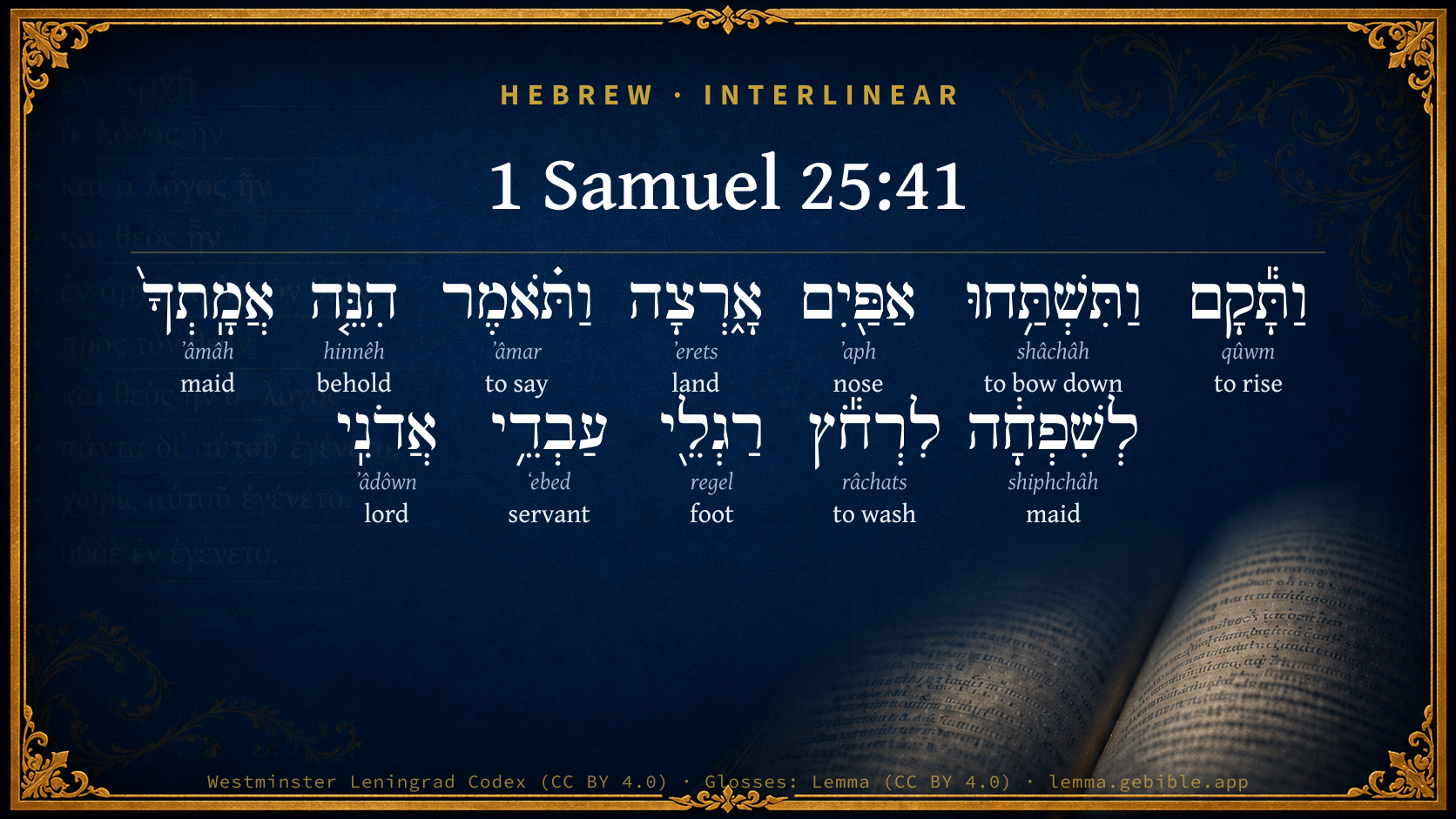
Hebrew (Westminster Leningrad Codex) 1 Samuel 25:41 appears in the Hebrew Old Testament. The text above is from the Westminster Leningrad Codex. Each word links to its Strong’s number, a concise gloss, and parsing drawn from the Open Scriptures Hebrew Bible morphology. Click any word for its full Brown-Driver-Briggs (BDB) entry.
Download image
Cite this verse

1 Samuel 25:41 (World English Bible). Public Domain. Lemma interlinear Bible study tool, https://lemma.gebible.app/v/1-samuel/25/41.

Show BibTeX & RIS
BibTeX
RIS
English Translation
She arose, and bowed herself with her face to the earth, and said, Behold, your handmaid is a servant to wash the feet of the servants of my lord.
World English Bible · Public Domain
Download a study sheet

One document with this verse’s original text, its word-by-word gloss line, the meaning frame, cross-references with their text, attributed commentary, and full source and license credits — printable, and it pastes into notes with its structure intact.

This verse Autodidact and up

Study sheet (.html) Plain text (.txt)

A passage Seminary Student

Up to 50 verses in one chapter. A passage sheet keeps up to 6 commentary sources and 12 cross-references per verse, in the order this page ranks them, and says so on the sheet whenever that leaves anything out. Ask for a single verse and you get the Autodidact verse sheet above.

Everything on this page stays free to read, with no account — the sheet is a download of what is already on screen, not access to it.

Want to remove ads? Support Godless Engineer
Compare translations 3

The same verse in 3 English versions, stacked beneath the original-language interlinear above. Click any original word for its lexicon entry.

Each is an independent rendering of the whole verse — the interlinear is not word-aligned to these translations.

Highlighted words mark where these versions differ — a whole-verse word diff, not a word-by-word alignment.

  • World English Bible Public Domain
    She arose, and bowed herself with her face to the earth, and said, Behold, your handmaid is a servant to wash the feet of the servants of my lord.
  • King James Version Public Domain
    And she arose, and bowed herself on her face to the earth, and said, Behold, let thine handmaid be a servant to wash the feet of the servants of my lord.
  • unfoldingWord Literal Text CC BY-SA 4.0
    And she arose and bowed down, nostrils to the ground, and she said, “Behold your female servant, for a maidservant for washing the feet of the servants of my master.”

unfoldingWord Literal Text — © unfoldingWord, licensed CC BY-SA 4.0. Word-aligned USFM3 via Door43 (git.door43.org/unfoldingWord/en_ult).

Versions to compare (up to 4)

3 of 4 selected

Show all 18 translations

Every available English version of this verse, each an independent rendering of the whole verse.

  • World English Bible Public Domain
    She arose, and bowed herself with her face to the earth, and said, Behold, your handmaid is a servant to wash the feet of the servants of my lord.
  • Berean Standard Bible Public Domain
    She arose, then bowed facedown and said, “Here is your maidservant, ready to serve and to wash the feet of my lord’s servants.”
  • Majority Standard Bible Public Domain
    She arose, bowed facedown, and said, “Here is your servant, ready to serve and to wash the feet of my lord’s servants.”
  • King James Version Public Domain
    And she arose, and bowed herself on her face to the earth, and said, Behold, let thine handmaid be a servant to wash the feet of the servants of my lord.
  • American Standard Version (1901) Public Domain
    And she arose, and bowed herself with her face to the earth, and said, Behold, thy handmaid is a servant to wash the feet of the servants of my lord.
  • Revised Version (1885) Public Domain
    And she arose, and bowed herself with her face to the earth, and said, Behold, thine handmaid is a servant to wash the feet of the servants of my lord.
  • Geneva Bible (1599) Public Domain
    And she arose, and bowed her selfe on her face to the earth, and said, Behold, let thine handmayde be a seruant to wash the feete of the seruants of my lord.
  • Douay-Rheims (1899) Public Domain
    And she arose and bowed herself down with her face to the earth, and said: Behold, let thy servant be a handmaid, to wash the feet of the servants of my lord.
  • Young's Literal Translation Public Domain
    And she riseth and boweth herself -- face to the earth -- and saith, `Lo, thy handmaid `is' for a maid-servant to wash the feet of the servants of my lord.'
  • Literal Standard Version CC BY-SA 4.0
    And she rises and bows herself—face to the earth—and says, “Behold, your handmaid [is] for a maidservant to wash the feet of the servants of my lord.”
  • Unlocked Literal Bible CC BY-SA 4.0
    She arose, bowed herself with her face to the ground, and said, “See, your female servant is a servant to wash the feet of the servants of my master.”
  • unfoldingWord Literal Text CC BY-SA 4.0
    And she arose and bowed down, nostrils to the ground, and she said, “Behold your female servant, for a maidservant for washing the feet of the servants of my master.”
  • Darby Bible Public Domain
    And she arose and bowed herself on her face to the earth, and said, Behold, let thy handmaid be a bondwoman to wash the feet of the servants of my lord.
  • World Messianic Bible Public Domain
    She arose and bowed herself with her face to the earth, and said, “Behold, your servant is a servant to wash the feet of the servants of my lord.”
  • Webster's Bible Public Domain
    And she arose, and bowed herself on her face to the earth, and said, Behold, let thy handmaid be a servant to wash the feet of the servants of my lord.
  • Free Bible Version CC BY-SA 4.0
    She stood up, then bowed down low, and said, “I am David's maidservant. I am prepared to serve and to wash the feet of my master's servants.”
  • Bible in Basic English Public Domain
    And she got up, and going down on her face to the earth, said, See, I am ready to be a servant-girl, washing the feet of the servants of my lord.
  • JPS Tanakh (1917) Public Domain
    And she arose, and bowed down with her face to the earth, and said: 'Behold, thy handmaid is a servant to wash the feet of the servants of my lord.'

Literal Standard Version (2020), Covenant Press — licensed CC BY-SA 4.0. Text via the HelloAO Bible API (eBible.org). Unlocked Literal Bible (unfoldingWord) — licensed CC BY-SA 4.0. Text via the HelloAO Bible API (eBible.org). unfoldingWord Literal Text — © unfoldingWord, licensed CC BY-SA 4.0. Word-aligned USFM3 via Door43 (git.door43.org/unfoldingWord/en_ult). Free Bible Version, Dr. Jonathan Gallagher — licensed CC BY-SA 4.0. Text via the HelloAO Bible API (eBible.org).

Word by word

More ways to search: Search by grammar → Find every occurrence → Compare this word →

Practice this passage: Drill this verse → Learn its vocabulary →

אֲמָֽתְךָ֙
ʼâmâh
H519
“maid · your”
Noun, Common, Feminine, Singular, Construct + Suffix, Personal, 2nd Person, Masculine, Singular
Part of Speech
Noun
Type
Common
Gender
Feminine
Number
Singular
State
Construct
Full BDB Definition

Origin: apparently a primitive word

TWOT: 112

maid-servant, female slave, maid, handmaid, concubine - of humility (figuratively)
  1. וַתָּ֕קָם qûwm H6965 “and · to rise” Conjunction + Verb, Qal, Sequential Imperfect, 3rd Person, Feminine, Singular
  2. וַתִּשְׁתַּ֥חוּ shâchâh H7812 “and · to bow down” Conjunction + Verb, Hishtaphel, Sequential Imperfect, 3rd Person, Feminine, Singular
  3. אַפַּ֖יִם ʼaph H639 “nostrils” Noun, Common, Masculine, Dual, Absolute
  4. אָ֑רְצָה ʼerets H776 “land · toward” Noun, Common, Both, Singular, Absolute + Suffix, Demonstrative
  5. וַתֹּ֗אמֶר ʼâmar H559 “and · to say” Conjunction + Verb, Qal, Sequential Imperfect, 3rd Person, Feminine, Singular
  6. הִנֵּ֤ה hinnêh H2009 “behold” Particle, Demonstrative
  7. לְשִׁפְחָ֔ה shiphchâh H8198 “to/for · maid” Preposition + Noun, Common, Feminine, Singular, Absolute
  8. לִרְחֹ֕ץ râchats H7364 “to wash” Preposition + Verb, Qal, Infinitive Construct
  9. רַגְלֵ֖י regel H7272 “feet of” Noun, Common, Feminine, Dual, Construct
  10. עַבְדֵ֥י ʻebed H5650 “servants of” Noun, Common, Masculine, Plural, Construct
  11. אֲדֹנִֽי ʼâdôwn H113 “lord · my” Noun, Common, Masculine, Singular, Construct + Suffix, Personal, 1st Person, Common, Singular

About this verse

These counts appear in no published source. They are computed here, from the morphology-tagged text and Lemma’s own curated glosses. What Lemma adds →

12
words
12
distinct lemmas
Historical
section

Shared distinctive vocabulary

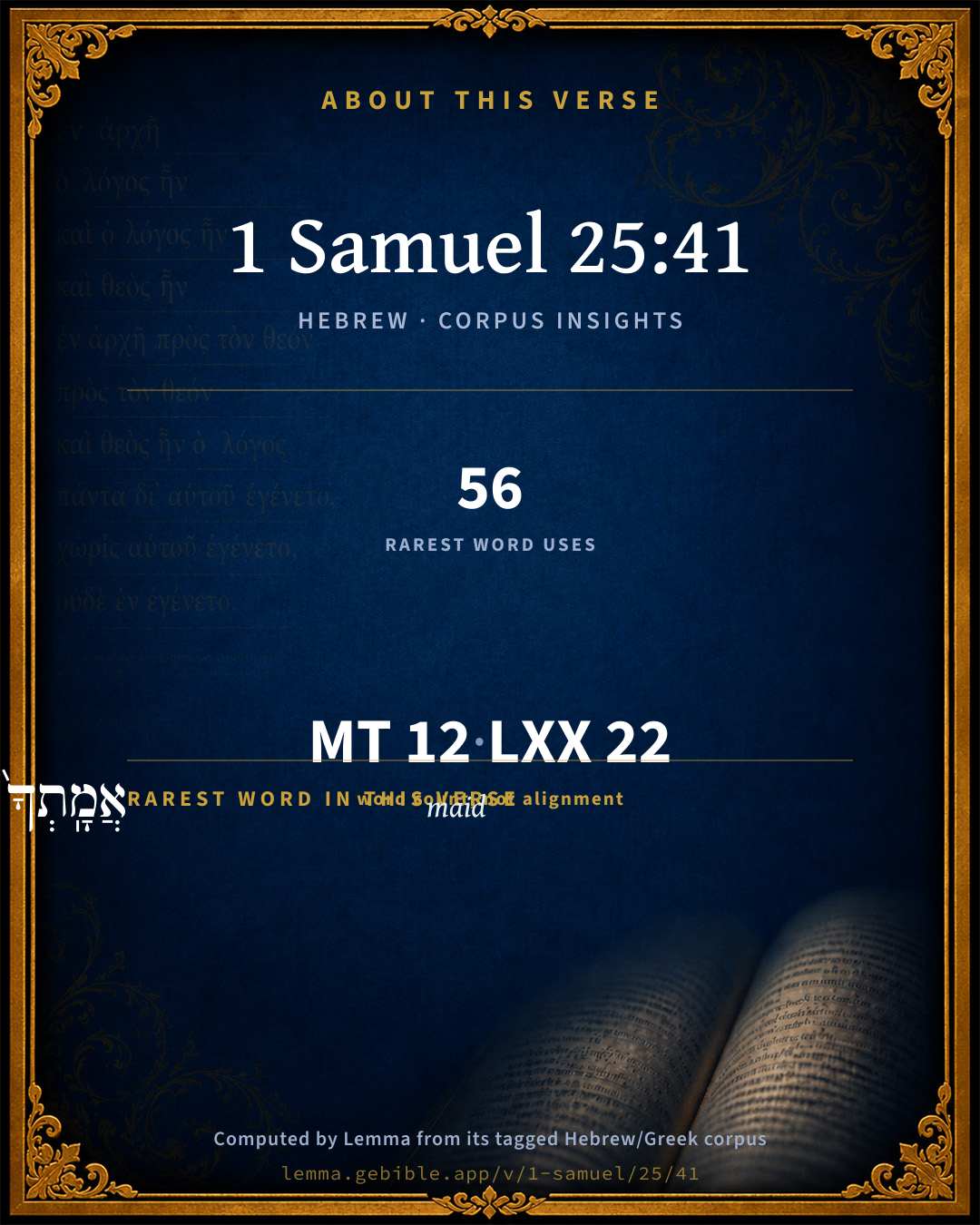
אֲמָֽתְךָ֙ maid H519 occurs in 49 verses of the Hebrew Bible. Also found in:

Grammatical profile

  • 4 verbs
  • 7 nouns
  • 1 particle

Verb forms

  • וַתָּ֕קָם Qal · Sequential Imperfect
  • וַתִּשְׁתַּ֥חוּ Hishtaphel · Sequential Imperfect
  • וַתֹּ֗אמֶר Qal · Sequential Imperfect
  • לִרְחֹ֕ץ Qal · Infinitive Construct

Hebrew & Septuagint length

In English translation the verse runs 29 words from the Hebrew and 28 from the Septuagint (LXX English) — closely comparable.

A rough comparison of the two English renderings, which tokenize alike — not a word-level alignment.

Word counts can differ between the Hebrew and the Greek without any difference in meaning — e.g. the Hebrew direct-object marker אֵת has no separate Greek word, and Greek often adds the article ὁ.

In the original languages it is 12 Hebrew tokens and 22 Greek tokens — but the two are counted differently (Hebrew bundles its prefixes and suffixes into one token; the Greek is in lemma form), so that isn’t a like-for-like length.

Cross-references

7

Topical passages linked to 1 Samuel 25:41 in the Treasury of Scripture Knowledge — connected by theme and wording, ordered by reader-vote popularity; previews shown in the World English Bible.

  • 1 Timothy 5:10 being approved by good works, if she has brought up children, if she has been hospitable to strangers, if she has washed the saints' feet, if she has relieved the afflicted, and if she has diligently followed every good work.
  • Ruth 2:10 Then she fell on her face, and bowed herself to the ground, and said to him, Why have I found favor in your sight, that you should take knowledge of me, seeing I am a foreigner?
  • John 13:3–5 Jesus, knowing that the Father had given all things into his hands, and that he came forth from God, and was going to God,
  • Genesis 18:4 Now let a little water be fetched, wash your feet, and rest yourselves under the tree.
  • Proverbs 15:33 The fear of Yahweh teaches wisdom. Before honor is humility.
  • Proverbs 18:12 Before destruction the heart of man is proud, But before honor is humility.
  • Ruth 2:13 Then she said, Let me find favor in your sight, my lord, because you have comforted me, and because you have spoken kindly to your handmaid, though I am not as one of your handmaidens.

Cross-references courtesy of OpenBible.info (CC BY 4.0).

Hebrew and Greek witnesses Masoretic Hebrew ↔ Greek Septuagint

The same verse in the two great witnesses to the Old Testament, shown verse-for-verse.

These are two independent witnesses, not word-aligned to each other, and the Septuagint is shown in lemma (dictionary) form.

Hebrew 1 Samuel 25:41 Masoretic · Westminster Leningrad Codex

וַתָּ֕קָם וַתִּשְׁתַּ֥חוּ אַפַּ֖יִם אָ֑רְצָה וַתֹּ֗אמֶר הִנֵּ֤ה אֲמָֽתְךָ֙ לְשִׁפְחָ֔ה לִרְחֹ֕ץ רַגְלֵ֖י עַבְדֵ֥י אֲדֹנִֽי

She arose, and bowed herself with her face to the earth, and said, Behold, your handmaid is a servant to wash the feet of the servants of my lord.

World English Bible · Public Domain

Greek LXX 1 Samuel 25:41 Septuagint · lemma form

καί ἀναἵστημι καί προςκυνέω ἐπί ὁ γῆ ἐπί πρόσωπον καί εἶπον ἰδού ὁ δούλη σύ εἰς παιδίσκη νίπτω πούς ὁ παῖς σύ

And she arose, and did reverence with her face to the earth, and said, Behold, your servant is for an handmaid to wash the feet of your servants.

LXX2012 (modern English Septuagint) · Public Domain

Hebrew: Westminster Leningrad Codex (CC BY 4.0). Greek: Septuagint (public domain); English from LXX2012 (modern English Septuagint) (Public Domain). How the Septuagint differs from the Hebrew →

Targum (Aramaic paraphrase)

1

The Targum is the ancient Jewish Aramaic paraphrase of the Hebrew Scriptures — an interpretive translation, not the Hebrew text itself. Onkelos (literal) and Pseudo-Jonathan (expansive) render the Torah, and Jonathan the Prophets. Coverage is partial: where no permissively-licensed English translation exists for a verse, only the Aramaic is shown. This is verse-level text, not a word-by-word alignment to the Hebrew.

  1. Targum Jonathan Prophets (Joshua–Malachi)
    וְקָמַת וּסְגִידַת עַל אַפָּהָא עַל אַרְעָא וַאֲמַרַת הָא אַמְתָךְ לְאַמְהוּ לְאַסְחָאָה רִיגְלֵי עַבְדֵי רִבּוֹנִי:

    (no public-domain English translation for this verse)

    Targum Jonathan — Aramaic: “Mikraot Gedolot” (public domain). English: “Sefaria Community Translation” (CC0 1.0 (public-domain dedication)); “London "Chaldee Paraphrase," 1871” (public domain). Text via Sefaria.

Commentary

Notes on 1 Samuel 25:41 from classic Christian and Jewish commentators (each source and its license shown beneath its notes). The classic Christian expositions comment on the surrounding passage and are grouped to its opening verse, so a note may address several verses; the Jewish commentaries on the Tanakh (Rashi and others) are per-verse, so they appear only where the commentator wrote on this verse.

Lemma curates 59 commentaries, every one of them public domain or Creative Commons licensed, each selected and text-cleaned for this edition rather than reprinted as found. About our sources →

Trapp's Complete Commentary

John Trapp

1Sa 25:41 And she arose, and bowed herself on [her] face to the earth, and said, Behold, [let] thine handmaid [be] a servant to wash the feet of the servants of my lord.

Ver. 41. Behold, let thine handmaid be a servant.] A most lowly and lovely compliment: wherein also she expresseth her faith, in thinking so highly of David, when he was at such an under. He also showed his trust in God, by taking a wife in the midst of so many troubles.

John Trapp, A Commentary or Exposition upon All the Books of the Old and New Testament (1647–1656) — public domain. Text from a community e-Sword module.

The Cambridge Bible for Schools and Colleges

gen. ed. J. J. S. Perowne

41. and bowed herself, &c.] With the obsequiousness characteristic of Oriental nations, she expresses her devotion both by gesture and word. “Washing the feet” like “loosing the shoe-latchet” (Mar_1:7) was the service of the meanest slaves.

The Cambridge Bible for Schools and Colleges (gen. ed. J. J. S. Perowne; Cambridge University Press, 1878–1918) — public domain. Text from a community e-Sword module.

John Gill's Exposition

And she arose, and bowed herself on her face to the earth,.... As she did before David, Sa1 25:23; and did as she would have done had he been present, considering his messengers as representing him and therefore showed the same respect and reverence and did the same honour, as if he had been there in person:

and said; expressed herself in such language as if David had been before her:

behold, let thine handmaid be a servant to wash the feet of the servants of my lord; which she said through her great humility, this being one of the meanest services she could be put to; intimating, that she was so far from being worthy to be the wife of such a man that she was only fit and it would be honour enough to her to perform the meanest services to those that waited upon him; or her sense is that it would be enough for her to be the wife of one of David's servants, and not his; it being the business of a wife, as Ben Gersom observes to wash the feet of her husband.

John Gill's Exposition of the Whole Bible (1746–1763) — public domain (CC PDM 1.0). Text via the HelloAO Bible API.

Haydock's Catholic Bible Commentary

Thy servant. She speaks to David’s representatives, as if he had been present. (Haydock) --- The marriage was proposed probably a month or two after the death of Nabal; and Abigail followed the messengers, in a short time. (Menochius)

George Leo Haydock (1774–1849), Haydock's Catholic Family Bible and Commentary, 1859 edition — public domain. Excludes Psalms (Douay-Rheims chapter numbering differs from Protestant) and Deuterocanonical books (Catholic canon only).

Matthew Poole's English Annotations

She showed this reverence, and spake thus to them, as representing David’s person.

Matthew Poole's English Annotations on the Holy Bible (1683–1685) — public domain. Text from a community e-Sword/MySword module.

Whedon's Commentary on the Bible

Daniel D. Whedon

41. To wash the feet — To perform the most humble services.

Daniel D. Whedon (gen. ed.), Commentary on the Old and New Testaments (1874–1909) — public domain. Text from a community e-Sword module.

unfoldingWord translationNotes

Door43 World Missions Community

She arose, bowed herself

Abigail responded by bowing. The reader should understand that she was probably already standing when the men were talking to her in 1 Samuel 25:40, and so the word "arose" is a metonym for deciding to bow down. (See: Metonymy)

See, your female servant is a servant to wash the feet of the servants of my master

Abigail speaks as if she were another person to show that she is humble. She shows that she desires to be David's new wife by offering to wash the feet of David's servants. AT: "See, I will serve you, the servants of my master David, by washing your feet" (See: Pronouns)

hurried and arose, and rode

You may need to make explicit what Abigail did after she arose and before she rode. AT: "quickly did what she needed to do to prepare for the journey, and then she rode" (See: Assumed Knowledge and Implicit Information)

five servant girls of hers who followed her

Abigail was riding a donkey, but the servant girls were walking.

translationWords

raise

bow

servant

donkey

messenger

unfoldingWord translationNotes — © Distant Shores Media and the Door43 World Missions Community, licensed CC BY-SA 4.0. Source: git.door43.org/Door43/en_tn.

Lesson kit

Teaching starters — assembled from the data on this page, not authored interpretation. Every prompt links to the verse data it draws on. Edit before teaching.

1 Samuel, in the Historical, opens this verse with 12 words (12 distinct Hebrew lemmas). Its most distinctive word is ʼâmâh (“maid”). A historical commentator’s framing appears above. Read the whole chapter for the surrounding context.

Discussion questions

  1. How does “maid” (ʼâmâh) shape what this verse is saying?
  2. Genesis 20:17 shares the word «maid» with this verse. How do the two illuminate each other?
  3. These translations render this verse differently; the difference is in the English rendering, not the original. What questions does that raise?
  4. The verb «וַתָּ֕קָם» is Qal Sequential Imperfect. How does its form color the action?
  5. Reading how Trapp's Complete Commentary and The Cambridge Bible for Schools and Colleges read this verse, where do the two commentators agree and where do they part?

Things to notice

Reading settings

Reading text

Shown beneath each verse's original-language words.

Old Testament
Old Testament edition

Read the OT as the Masoretic Hebrew (MT) or the Greek Septuagint (LXX).

English shown for the Greek Septuagint (in the Hebrew ↔ Greek comparison).

Comparing translations? Open the Compare panel on any verse page to stack up to four side by side.