
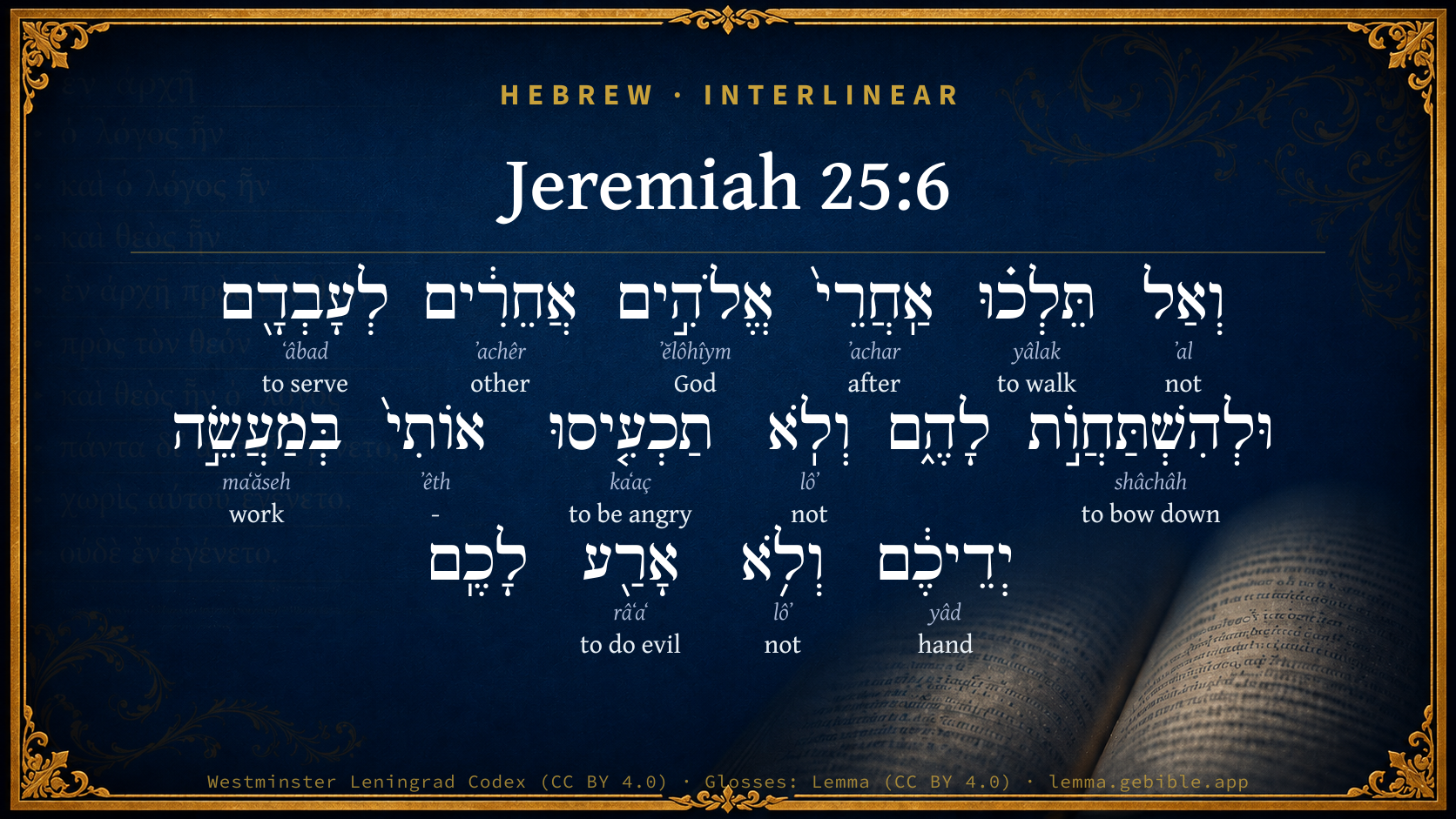
Jeremiah 25:6

Hebrew (Westminster Leningrad Codex) Jeremiah 25:6 appears in the Hebrew Old Testament. The text above is from the Westminster Leningrad Codex. Each word links to its Strong’s number, a concise gloss, and parsing drawn from the Open Scriptures Hebrew Bible morphology. Click any word for its full Brown-Driver-Briggs (BDB) entry.
Download image
Cite this verse

Jeremiah 25:6 (World English Bible). Public Domain. Lemma interlinear Bible study tool, https://lemma.gebible.app/v/jeremiah/25/6.

Show BibTeX & RIS
BibTeX
RIS
English Translation
and don't go after other gods to serve them or worship them, and don't provoke me to anger with the work of your hands; and I will do you no harm.
World English Bible · Public Domain
Download a study sheet

One document with this verse’s original text, its word-by-word gloss line, the meaning frame, cross-references with their text, attributed commentary, and full source and license credits — printable, and it pastes into notes with its structure intact.

This verse Autodidact and up

Study sheet (.html) Plain text (.txt)

A passage Seminary Student

Up to 50 verses in one chapter. A passage sheet keeps up to 6 commentary sources and 12 cross-references per verse, in the order this page ranks them, and says so on the sheet whenever that leaves anything out. Ask for a single verse and you get the Autodidact verse sheet above.

Everything on this page stays free to read, with no account — the sheet is a download of what is already on screen, not access to it.

Want to remove ads? Support Godless Engineer
Compare translations 3

The same verse in 3 English versions, stacked beneath the original-language interlinear above. Click any original word for its lexicon entry.

Each is an independent rendering of the whole verse — the interlinear is not word-aligned to these translations.

Highlighted words mark where these versions differ — a whole-verse word diff, not a word-by-word alignment.

  • World English Bible Public Domain
    and don't go after other gods to serve them or worship them, and don't provoke me to anger with the work of your hands; and I will do you no harm.
  • King James Version Public Domain
    And go not after other gods to serve them, and to worship them, and provoke me not to anger with the works of your hands; and I will do you no hurt.
  • unfoldingWord Literal Text CC BY-SA 4.0
    And do not go after other gods to serve them and to bow down to them, and do not provoke me to anger with the work of your hands, and I will not do harm to you.’

unfoldingWord Literal Text — © unfoldingWord, licensed CC BY-SA 4.0. Word-aligned USFM3 via Door43 (git.door43.org/unfoldingWord/en_ult).

Versions to compare (up to 4)

3 of 4 selected

Show all 18 translations

Every available English version of this verse, each an independent rendering of the whole verse.

  • World English Bible Public Domain
    and don't go after other gods to serve them or worship them, and don't provoke me to anger with the work of your hands; and I will do you no harm.
  • Berean Standard Bible Public Domain
    Do not follow other gods to serve and worship them, and do not provoke Me to anger with the works of your hands. Then I will do you no harm.’
  • Majority Standard Bible Public Domain
    Do not follow other gods to serve and worship them, and do not provoke Me to anger with the works of your hands. Then I will do you no harm.’
  • King James Version Public Domain
    And go not after other gods to serve them, and to worship them, and provoke me not to anger with the works of your hands; and I will do you no hurt.
  • American Standard Version (1901) Public Domain
    and go not after other gods to serve them, and to worship them, and provoke me not to anger with the work of your hands; and I will do you no hurt.
  • Revised Version (1885) Public Domain
    and go not after other gods to serve them, and to worship them, and provoke me not to anger with the work of your hands; and I will do you no hurt.
  • Geneva Bible (1599) Public Domain
    And go not after other gods to serue them and to worshippe them, and prouoke me not to anger with the workes of your hands, and I will not punish you.
  • Douay-Rheims (1899) Public Domain
    And go not after strange gods to serve them, and adore them: nor provoke me to wrath by the works of your hands, and I will not afflict you.
  • Young's Literal Translation Public Domain
    And ye do not go after other gods to serve them, and to bow yourselves to them, nor do ye provoke Me to anger with the work of your hands, and I do no evil to you;
  • Literal Standard Version CC BY-SA 4.0
    and you do not go after other gods to serve them, and to bow yourselves to them, nor do you provoke Me to anger with the work of your hands, and I do no evil to you;
  • Unlocked Literal Bible CC BY-SA 4.0
    So do not walk after other gods to worship them or bow down to them, and do not provoke him with the work of your hands so that he does you harm.'
  • unfoldingWord Literal Text CC BY-SA 4.0
    And do not go after other gods to serve them and to bow down to them, and do not provoke me to anger with the work of your hands, and I will not do harm to you.’
  • Darby Bible Public Domain
    And go not after other gods, to serve them and to worship them; and provoke me not to anger with the work of your hands; and I will do you no hurt.
  • World Messianic Bible Public Domain
    Don’t go after other gods to serve them or worship them, and don’t provoke me to anger with the work of your hands; then I will do you no harm.”
  • Webster's Bible Public Domain
    And go not after other gods to serve them, and to worship them, and provoke me not to anger with the works of your hands; and I will do you no hurt.
  • Free Bible Version CC BY-SA 4.0
    Don't follow other gods and worship them, and don't anger me by making idols. Then I won't do anything to hurt you.
  • Bible in Basic English Public Domain
    Do not go after other gods to be their servants and to give them worship, and do not make me angry with the work of your hands, causing evil to yourselves.
  • JPS Tanakh (1917) Public Domain
    and go not after other gods to serve them, and to worship them, and provoke Me not with the work of your hands, and I will do you no hurt.'

Literal Standard Version (2020), Covenant Press — licensed CC BY-SA 4.0. Text via the HelloAO Bible API (eBible.org). Unlocked Literal Bible (unfoldingWord) — licensed CC BY-SA 4.0. Text via the HelloAO Bible API (eBible.org). unfoldingWord Literal Text — © unfoldingWord, licensed CC BY-SA 4.0. Word-aligned USFM3 via Door43 (git.door43.org/unfoldingWord/en_ult). Free Bible Version, Dr. Jonathan Gallagher — licensed CC BY-SA 4.0. Text via the HelloAO Bible API (eBible.org).

Word by word

More ways to search: Search by grammar → Find every occurrence → Compare this word →

Practice this passage: Drill this verse → Learn its vocabulary →

תַכְעִ֤יסוּ
kaʻaç
H3707
“to be angry”
Verb, Hiphil, Imperfect, 2nd Person, Masculine, Plural
Part of Speech
Verb
Stem
Hiphil
Form
Imperfect
Person
2nd Person
Gender
Masculine
Number
Plural
Full BDB Definition

Origin: a primitive root

TWOT: 1016

to be angry, be vexed, be indignant, be wroth, be grieved, provoke to anger and wrath - (Qal) - to be vexed, be indignant - to be angry - (Piel) to provoke to anger - (Hiphil) - to vex - to vex, provoke to anger
  1. וְאַל ʼal H408 “and · not” Conjunction + Particle, Negative
  2. תֵּלְכ֗וּ yâlak H3212 “to walk” Verb, Qal, Jussive, 2nd Person, Masculine, Plural
  3. אַֽחֲרֵי֙ ʼachar H310 “after” Preposition
  4. אֱלֹהִ֣ים ʼĕlôhîym H430 “God(s)” Noun, Common, Masculine, Plural, Absolute
  5. אֲחֵרִ֔ים ʼachêr H312 “other” Adjective, Adjective, Masculine, Plural, Absolute
  6. לְעָבְדָ֖ם ʻâbad H5647 “to serve · them” Preposition + Verb, Qal, Infinitive Construct + Suffix, Personal, 3rd Person, Masculine, Plural
  7. וּלְהִשְׁתַּחֲוֺ֣ת shâchâh H7812 “and · to bow down” Conjunction + Preposition + Verb, Hishtaphel, Infinitive Construct
  8. וְלֹֽא lôʼ H3808 “and · not” Conjunction + Particle, Negative
  9. אוֹתִי֙ ʼêth H853 “- · me” Particle, Direct Object + Suffix, Personal, 1st Person, Common, Singular
  10. בְּמַעֲשֵׂ֣ה maʻăseh H4639 “in/at · work of” Preposition + Noun, Common, Masculine, Singular, Construct
  11. יְדֵיכֶ֔ם yâd H3027 “hands · your” Noun, Common, Both, Dual, Construct + Suffix, Personal, 2nd Person, Masculine, Plural
  12. וְלֹ֥א lôʼ H3808 “and · not” Conjunction + Particle, Negative
  13. אָרַ֖ע râʻaʻ H7489 “to do evil” Verb, Hiphil, Imperfect, 1st Person, Common, Singular

About this verse

These counts appear in no published source. They are computed here, from the morphology-tagged text and Lemma’s own curated glosses. What Lemma adds →

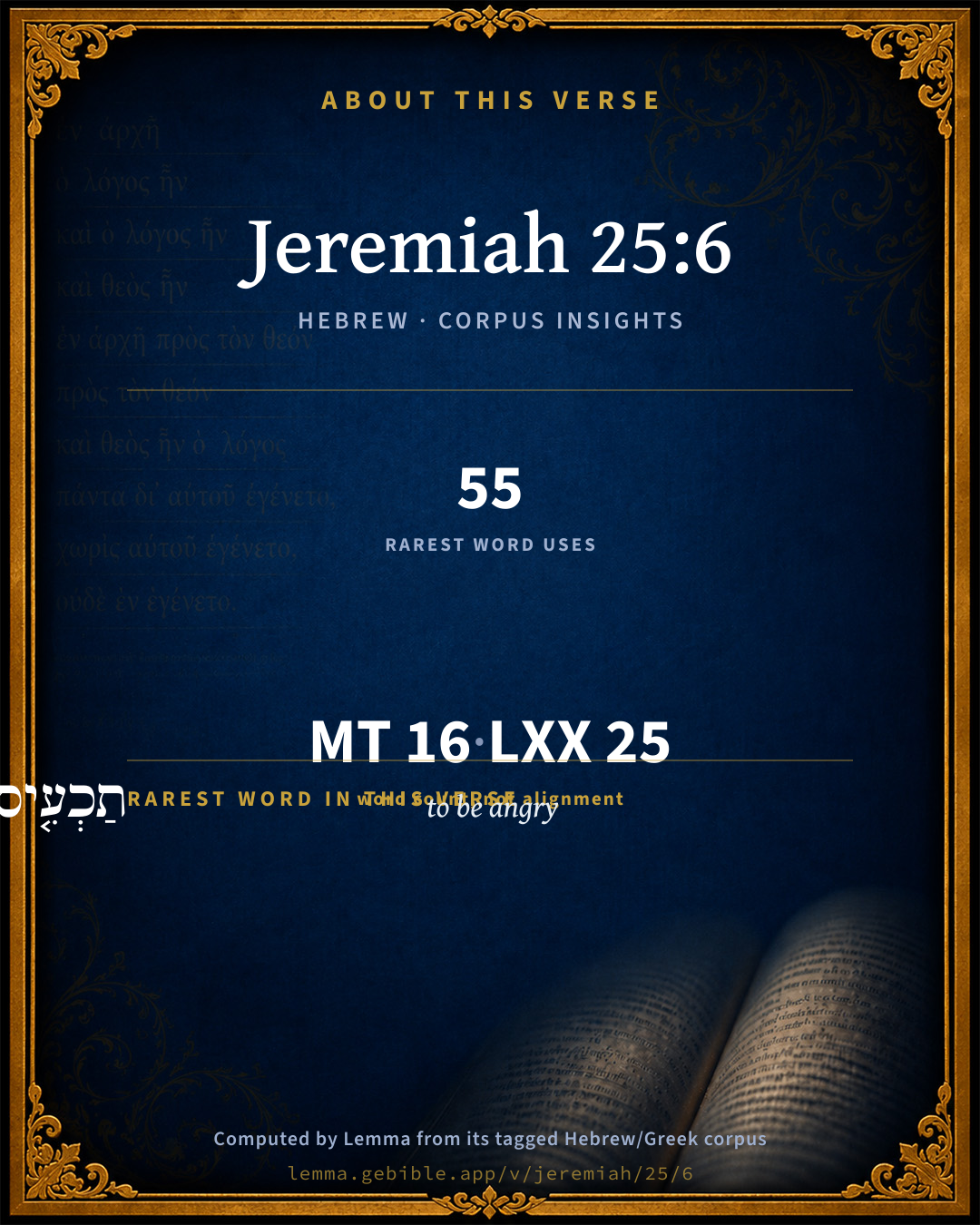
16
words
13
distinct lemmas
Prophets
section

Shared distinctive vocabulary

תַכְעִ֤יסוּ to be angry H3707 occurs in 53 verses of the Hebrew Bible. Also found in:

Grammatical profile

  • 5 verbs
  • 3 nouns
  • 1 adjective
  • 3 prepositions
  • 4 particles

Verb forms

  • תֵּלְכ֗וּ Qal · Jussive
  • לְעָבְדָ֖ם Qal · Infinitive Construct
  • וּלְהִשְׁתַּחֲוֺ֣ת Hishtaphel · Infinitive Construct
  • תַכְעִ֤יסוּ Hiphil · Imperfect
  • אָרַ֖ע Hiphil · Imperfect

Repetition

A word recurs within this verse — often emphatic in Hebrew:

  • וְלֹֽא not H3808 ×2

Hebrew & Septuagint length

In the original languages it is 16 Hebrew tokens and 25 Greek tokens — but the two are counted differently (Hebrew bundles its prefixes and suffixes into one token; the Greek is in lemma form), so that isn’t a like-for-like length.

Cross-references

13

Topical passages linked to Jeremiah 25:6 in the Treasury of Scripture Knowledge — connected by theme and wording, ordered by reader-vote popularity; previews shown in the World English Bible.

  • Deuteronomy 8:19 It shall be, if you shall forget Yahweh your God, and walk after other gods, and serve them, and worship them, I testify against you this day that you shall surely perish.
  • Deuteronomy 6:14 You shall not go after other gods, of the gods of the peoples who are round about you;
  • 1 Kings 14:22 Judah did that which was evil in the sight of Yahweh, and they provoked him to jealousy with their sins which they committed, above all that their fathers had done.
  • 2 Kings 17:35 with whom Yahweh had made a covenant, and charged them, saying, You shall not fear other gods, nor bow yourselves to them, nor serve them, nor sacrifice to them:
  • Jeremiah 7:6 if you don't oppress the foreigner, the fatherless, and the widow, and don't shed innocent blood in this place, neither walk after other gods to your own hurt:
  • Jeremiah 35:15 I have sent also to you all my servants the prophets, rising up early and sending them, saying, Return you now every man from his evil way, and amend your doings, and don't go after other gods to serve them, and you shall dwell in the land which I have given to you and to your fathers: but you have not inclined your ear, nor listened to me.
  • Exodus 20:3 You shall have no other gods before me.
  • Exodus 20:23 You shall most certainly not make alongside of me gods of silver, or gods of gold for yourselves.
  • Deuteronomy 13:2 and the sign or the wonder come to pass, of which he spoke to you, saying, Let us go after other gods, which you have not known, and let us serve them;
  • Deuteronomy 28:14 and shall not turn aside from any of the words which I command you this day, to the right hand, or to the left, to go after other gods to serve them.
  • Joshua 24:20 If you forsake Yahweh, and serve foreign gods, then he will turn and do you evil, and consume you, after that he has done you good.
  • 1 Kings 11:4–10 For it happened, when Solomon was old, that his wives turned away his heart after other gods; and his heart was not perfect with Yahweh his God, as was the heart of David his father.
  • Jeremiah 7:9 Will you steal, murder, and commit adultery, and swear falsely, and burn incense to Baal, and walk after other gods that you have not known,

Cross-references courtesy of OpenBible.info (CC BY 4.0).

Hebrew and Greek witnesses Masoretic Hebrew ↔ Greek Septuagint

The same verse in the two great witnesses to the Old Testament, shown verse-for-verse.

These are two independent witnesses, not word-aligned to each other, and the Septuagint is shown in lemma (dictionary) form.

Hebrew Jeremiah 25:6 Masoretic · Westminster Leningrad Codex

וְאַל תֵּלְכ֗וּ אַֽחֲרֵי֙ אֱלֹהִ֣ים אֲחֵרִ֔ים לְעָבְדָ֖ם וּלְהִשְׁתַּחֲוֺ֣ת לָהֶ֑ם וְלֹֽא תַכְעִ֤יסוּ אוֹתִי֙ בְּמַעֲשֵׂ֣ה יְדֵיכֶ֔ם וְלֹ֥א אָרַ֖ע לָכֶֽם

and don't go after other gods to serve them or worship them, and don't provoke me to anger with the work of your hands; and I will do you no harm.

World English Bible · Public Domain

Greek LXX Structure differs

In the Septuagint, Jeremiah is about an eighth shorter than the Hebrew and arranges its material differently — the Oracles Against the Nations (Hebrew chapters 46–51) appear in the middle of the Greek book, after 25:13. Because the chapter and verse boundaries do not line up, a verse-for-verse comparison with the Hebrew is not shown.

A verse-for-verse comparison isn’t shown here because the chapters and verses don’t line up. Switch to the LXX edition with the MT / LXX toggle above to read the Greek directly.

Hebrew: Westminster Leningrad Codex (CC BY 4.0). Greek: Septuagint (public domain); English from a public-domain English Septuagint. How the Septuagint differs from the Hebrew →

Targum (Aramaic paraphrase)

1

The Targum is the ancient Jewish Aramaic paraphrase of the Hebrew Scriptures — an interpretive translation, not the Hebrew text itself. Onkelos (literal) and Pseudo-Jonathan (expansive) render the Torah, and Jonathan the Prophets. Coverage is partial: where no permissively-licensed English translation exists for a verse, only the Aramaic is shown. This is verse-level text, not a word-by-word alignment to the Hebrew.

  1. Targum Jonathan Prophets (Joshua–Malachi)
    וְלָא תְהָכוּן בָּתַר טַעֲוַת פַּלְחֵי כּוֹכְבַיָא לְמִפְלַחְהָן וּלְמִסְגַד לְהֵן וְלָא תִרְגְזוּן קָדָמַי בְּעוֹבָדֵי יְדֵיכוֹן וְלָא אַבְאֵישׁ לְכוֹן:

    (no public-domain English translation for this verse)

    Targum Jonathan — Aramaic: “Mikraot Gedolot” (public domain). English: “Sefaria Community Translation” (CC0 1.0 (public-domain dedication)); “London "Chaldee Paraphrase," 1871” (public domain). Text via Sefaria.

Commentary

Notes on Jeremiah 25:6 from classic Christian and Jewish commentators (each source and its license shown beneath its notes). The classic Christian expositions comment on the surrounding passage and are grouped to its opening verse, so a note may address several verses; the Jewish commentaries on the Tanakh (Rashi and others) are per-verse, so they appear only where the commentator wrote on this verse.

Lemma curates 59 commentaries, every one of them public domain or Creative Commons licensed, each selected and text-cleaned for this edition rather than reprinted as found. About our sources →

Trapp's Complete Commentary

John Trapp

Jer 25:6 And go not after other gods to serve them, and to worship them, and provoke me not to anger with the works of your hands; and I will do you no hurt.

Ver. 6. And I will do you no hurt.] Heb., I will not do evil to you; as else I must. The Romans honoured their Vejoves, that they might not harm them.

John Trapp, A Commentary or Exposition upon All the Books of the Old and New Testament (1647–1656) — public domain. Text from a community e-Sword module.

The Biblical Illustrator

Joseph S. Exell

Jer_25:6

I will do you no hurt.

No hurt from God

I. The import of the promise.

1. Such a promise can apply to none but the people of God.

2. The Lords people are apt to fear He should do them hurt, and hence He kindly assures them of the contrary. We want more of that love to God which beareth all things at His hand, which believeth all good things concerning Him, and hopeth for all things from Him.

3. As God will do no hurt to them that fear Him, so neither will He suffer others to hurt them. If God does not change their hearts, He win tie their hands; or if for wise ends He suffers them to injure you in your worldly circumstances, yet your heavenly inheritance is sure, and your treasure is laid up where thieves cannot break through nor steal.

4. More is implied in the promise than is absolutely expressed; for when the Lord says He will do His people no hurt, He means that He will really do them good. All things to Gods people are blessings in their own nature, or are turned into blessings for their sake; so that all the paths of the Lord are mercy and truth unto such as keep His covenant and His testimonies to do them (Gen_50:20; Jer_24:5-6; Rom_8:28).

II. The assurance we have that this promise will be fulfilled.

1. The Lord thinks no hurt of His people, and therefore He will certainly do them no hurt. His conduct is a copy of His decrees: He worketh all things according to the counsel of His own will, and therefore where no evil is determined, no evil can take place.

2. The Lord threatens them no hurt; no penal sentence lies against them.

3. He never has done them any hurt, but good, all the days of their life. Former experience of the Divine goodness should strengthen the believers confidence, and fortify him against present discouragements (Jdg_13:23; Psa_42:6; Psa_77:12; 2Co_1:10). (B. Beddome, M.A.)

The Biblical Illustrator, edited by Joseph S. Exell (c. 1880s–1900s) — public domain. Text from a community e-Sword module.

Jamieson, Fausset & Brown

Robert Jamieson, A. R. Fausset & David Brown

He instances one sin, idolatry, as representative of all their sins; as nothing is dearer to God than a pure worship of Himself.

Jamieson, Fausset & Brown — Commentary Critical and Explanatory on the Whole Bible (1871) — public domain (CC PDM 1.0). Text via the HelloAO Bible API.

John Calvin's Commentaries

The Prophet mentions here one kind of sin; for though the Jews in many, and even in numberless ways kindled God’s wrath, yet they especially procured a heavy judgment for themselves by their superstitions. They indeed manifested their contempt of God by adultery, theft, and plunder, but in a way not so direct; for when they abandoned themselves to the superstitions of the Gentiles, they thus shook off the yoke of God, as though they openly testified that he was no longer their God. And we know that nothing is so much valued and approved by God as a sincere attention to real piety; hence the Church is taught in the first table of the Law how he is to be worshipped. This is the reason why the Prophet especially reminds the Jews here that they had, in this respect, been rebellious against God, because he could not bring them back from their corrupt superstitions. He does not at the same time absolve them of other sins; but he mentions this one kind, in order that they might understand, that they were not only in part, but altogether rebellious against God; for they wholly departed from him when they vitiated his worship with wicked superstitions. We must then bear in mind, that the Jews were not condemned for some small offenses, but accused of the most heinous of sins; for they had become covenant-breakers and apostates, and had forsaken God himself and his law.

He says, Walk ye not after foreign gods to serve them and to worship them He pointed out as by the finger, how gross had been their impiety; for they had given themselves up to idols, that they might basely serve them; they had wholly devoted themselves to them. It was not then an excusable error, but a manifest treachery. He adds, Provoke me not by the work of your hands No doubt the Prophet meant by these words to confirm what has been already stated, that idolatry is before God an intolerable wickedness: and at the same time he shews, that they had not sinned through ignorance, for they had in time been reminded of the atrocity of this sin. As then they had not ceased from their superstitions, they were thus proved guilty of a diabolical madness, for they feared not to provoke God against them. And he says, by the work of your hands; and thus he speaks contemptuously or rather reproachfully of idols. They called them gods, not that they were ignorant that they were statues curiously made of wood and stone, or of some other material; but still they thought that divinity was connected with them, for they believed that God was thus rightly worshipped. Now, then, the Prophet calls them the work of hands, as though he had said, “If the Jews themselves are nothing, the idols are less than nothing; for they are only the work of hands.” And this way of speaking often occurs in the Prophets, by which God intended to shake off the stupidity of men, who were become quite senseless in their own devices; as though he had said, “Have you not a particle of a right understanding in you? do you not know, that this which ye worship is the work of your own hands? and what can your hands do? for what are ye yourselves?” We now perceive what the Prophet had in view in using these words.

There is, again; a promise given, I will not do you evil God declares by these words that they would be exempt from all trouble and distress, if they continued to walk according to the rule of true religion; and thus he intimates that whatever evils they had already endured, and would have hereafter to endure, could not be imputed to anything but to their own perverseness, for God had of his own free-will promised to spare them, provided they departed from their wicked ways. And such a hope ought especially to encourage us to repent, for we see that God is ready to receive us and seeks reconciliation with us, and is always prepared to forgive all our sins, provided we from the heart return to him; and he seems as one unwilling to inflict punishment. Here again the impiety of the people is more fully proved, for they refused to receive from God this invaluable favor. It follows, —

John Calvin's Commentaries (1540-1563) — public domain. Text from the Calvin Translation Society English edition (1840s-50s) via the Christian Classics Ethereal Library (ccel.org). Calvin's coverage is partial (roughly two-thirds of the Bible); uncommented books and verses are honest gaps, never fabricated. The 19th-century editor's footnotes and remarks are omitted so the notes are faithfully Calvin's own voice.

Ellicott's Commentary for English Readers

(6) The works of your hands.—These were, of course, the idols which they had made and worshipped.

A Bible Commentary for English Readers, edited by Charles John Ellicott (1878–1897) — public domain. Text from a community e-Sword module.

The Cambridge Bible for Schools and Colleges

gen. ed. J. J. S. Perowne

6. provoke me not] Read provoke not Jehovah, a correction easily made in the Hebrew.

The Cambridge Bible for Schools and Colleges (gen. ed. J. J. S. Perowne; Cambridge University Press, 1878–1918) — public domain. Text from a community e-Sword module.

John Gill's Exposition

And go not after other gods to serve them, and to worship them,.... So long as they served the Lord God, they continued in their own land, in the comfortable enjoyment of all the blessings of it; for their government was a theocracy; God was their King; and as long as they served and worshipped him only, he protected and defended them; but when they forsook him, and went after other gods, and served and worshipped them, then they were threatened to be turned out of their land, and carried captive into other lands; and yet, after all, if they returned from their idolatries, and left off worshipping idols, the Lord was ready to receive them kindly, and continue his favours to them:

and provoke me not to anger with the works of your hands; their idols, which their own hands made, and then fell down to worship them; than which nothing can be more provoking to God:

and I will do you no hurt; by sword, or famine, or pestilence, or captivity; signifying the hurt he had threatened them with should not be done, provided they forsook their idolatrous worship; God does no hurt to his true worshippers; yea, he makes all things work together for their good.

John Gill's Exposition of the Whole Bible (1746–1763) — public domain (CC PDM 1.0). Text via the HelloAO Bible API.

Matthew Poole's English Annotations

Gods; idols, which indeed are no gods, but so called by idolaters.

To serve them, and to worship them; to pay any divine homage unto them.

And provoke me not to anger by idols, which are the work of men’s hands (no uncreated beings). Or more generally, any works which are contrary to the law of God. If you do this, I will by my providence do you no harm, you shall yet enjoy your own land and prosper.

Matthew Poole's English Annotations on the Holy Bible (1683–1685) — public domain. Text from a community e-Sword/MySword module.

Whedon's Commentary on the Bible

Daniel D. Whedon

6. Compare Jer_7:6; Jer_1:16.

Daniel D. Whedon (gen. ed.), Commentary on the Old and New Testaments (1874–1909) — public domain. Text from a community e-Sword module.

Lesson kit

Teaching starters — assembled from the data on this page, not authored interpretation. Every prompt links to the verse data it draws on. Edit before teaching.

Jeremiah, in the Prophets, opens this verse with 16 words (13 distinct Hebrew lemmas). Its most distinctive word is kaʻaç (“to be angry”). A historical commentator’s framing appears above. Read the whole chapter for the surrounding context.

Discussion questions

  1. What does “to be angry” (kaʻaç) contribute to the verse as a whole?
  2. Deuteronomy 4:25 shares the word «to be angry» with this verse. How do the two illuminate each other?
  3. “not” occurs 2× in this one verse. What is the effect of the repetition?
  4. These translations render this verse differently; the difference is in the English rendering, not the original. What questions does that raise?
  5. The verb «תֵּלְכ֗וּ» is Qal Jussive. How does its form color the action?
  6. Reading how Trapp's Complete Commentary and The Biblical Illustrator read this verse, where do the two commentators agree and where do they part?

Things to notice

Reading settings

Reading text

Shown beneath each verse's original-language words.

Old Testament
Old Testament edition

Read the OT as the Masoretic Hebrew (MT) or the Greek Septuagint (LXX).

English shown for the Greek Septuagint (in the Hebrew ↔ Greek comparison).

Comparing translations? Open the Compare panel on any verse page to stack up to four side by side.