2 Samuel 9:8

Hebrew (Westminster Leningrad Codex) 2 Samuel 9:8 appears in the Hebrew Old Testament. The text above is from the Westminster Leningrad Codex. Each word links to its Strong’s number, a concise gloss, and parsing drawn from the Open Scriptures Hebrew Bible morphology. Click any word for its full Brown-Driver-Briggs (BDB) entry.
Download image
Cite this verse

2 Samuel 9:8 (World English Bible). Public Domain. Lemma interlinear Bible study tool, https://lemma.gebible.app/v/2-samuel/9/8.

Show BibTeX & RIS
BibTeX
RIS
English Translation
He did obeisance, and said, "What is your servant, that you should look on such a dead dog as I am?"
World English Bible · Public Domain
Download a study sheet

One document with this verse’s original text, its word-by-word gloss line, the meaning frame, cross-references with their text, attributed commentary, and full source and license credits — printable, and it pastes into notes with its structure intact.

This verse Autodidact and up

Study sheet (.html) Plain text (.txt)

A passage Seminary Student

Up to 50 verses in one chapter. A passage sheet keeps up to 6 commentary sources and 12 cross-references per verse, in the order this page ranks them, and says so on the sheet whenever that leaves anything out. Ask for a single verse and you get the Autodidact verse sheet above.

Everything on this page stays free to read, with no account — the sheet is a download of what is already on screen, not access to it.

Want to remove ads? Support Godless Engineer
Compare translations 3

The same verse in 3 English versions, stacked beneath the original-language interlinear above. Click any original word for its lexicon entry.

Each is an independent rendering of the whole verse — the interlinear is not word-aligned to these translations.

Highlighted words mark where these versions differ — a whole-verse word diff, not a word-by-word alignment.

  • World English Bible Public Domain
    He did obeisance, and said, "What is your servant, that you should look on such a dead dog as I am?"
  • King James Version Public Domain
    And he bowed himself, and said, What is thy servant, that thou shouldest look upon such a dead dog as I am?
  • unfoldingWord Literal Text CC BY-SA 4.0
    And he prostrated himself, and he said, “What your servant, that you should turn to a dead dog that like me?”

unfoldingWord Literal Text — © unfoldingWord, licensed CC BY-SA 4.0. Word-aligned USFM3 via Door43 (git.door43.org/unfoldingWord/en_ult).

Versions to compare (up to 4)

3 of 4 selected

Show all 18 translations

Every available English version of this verse, each an independent rendering of the whole verse.

  • World English Bible Public Domain
    He did obeisance, and said, "What is your servant, that you should look on such a dead dog as I am?"
  • Berean Standard Bible Public Domain
    Mephibosheth bowed down and said, “What is your servant, that you should show regard for a dead dog like me?”
  • Majority Standard Bible Public Domain
    Mephibosheth bowed down and said, “What is your servant, that you should show regard for a dead dog like me?”
  • King James Version Public Domain
    And he bowed himself, and said, What is thy servant, that thou shouldest look upon such a dead dog as I am?
  • American Standard Version (1901) Public Domain
    And he did obeisance, and said, What is thy servant, that thou shouldest look upon such a dead dog as I am?
  • Revised Version (1885) Public Domain
    And he did obeisance, and said, What is thy servant, that thou shouldest look upon such a dead dog as I am?
  • Geneva Bible (1599) Public Domain
    And he bowed himselfe and sayd, What is thy seruant, that thou shouldest looke vpon such a dead dog as I am?
  • Douay-Rheims (1899) Public Domain
    He bowed down to him, and said: Who am I thy servant, that thou shouldst look upon such a dead dog as I am?
  • Young's Literal Translation Public Domain
    And he boweth himself, and saith, `What `is' thy servant, that thou hast turned unto the dead dog -- such as I?'
  • Literal Standard Version CC BY-SA 4.0
    And he bows himself and says, “What [is] your servant, that you have turned to the dead dog—such as I?”
  • Unlocked Literal Bible CC BY-SA 4.0
    Mephibosheth bowed and said, “What is your servant, that you should look with favor on such a dead dog as I am?”
  • unfoldingWord Literal Text CC BY-SA 4.0
    And he prostrated himself, and he said, “What your servant, that you should turn to a dead dog that like me?”
  • Darby Bible Public Domain
    And he bowed himself, and said, What is thy servant, that thou shouldest look upon such a dead dog as I am?
  • World Messianic Bible Public Domain
    He bowed down, and said, “What is your servant, that you should look at such a dead dog as I am?”
  • Webster's Bible Public Domain
    And he bowed himself, and said, What is thy servant, that thou shouldst look upon such a dead dog as I am?
  • Free Bible Version CC BY-SA 4.0
    Mephibosheth bowed down and said, “Who am I, your servant, that you should pay any attention to a dead dog like me?”
  • Bible in Basic English Public Domain
    And he went down on his face before the king, and said, What is your servant, for you to take note of a dead dog such as I am?
  • JPS Tanakh (1917) Public Domain
    And he bowed down, and said: 'What is thy servant, that thou shouldest look upon such a dead dog as I am?'

Literal Standard Version (2020), Covenant Press — licensed CC BY-SA 4.0. Text via the HelloAO Bible API (eBible.org). Unlocked Literal Bible (unfoldingWord) — licensed CC BY-SA 4.0. Text via the HelloAO Bible API (eBible.org). unfoldingWord Literal Text — © unfoldingWord, licensed CC BY-SA 4.0. Word-aligned USFM3 via Door43 (git.door43.org/unfoldingWord/en_ult). Free Bible Version, Dr. Jonathan Gallagher — licensed CC BY-SA 4.0. Text via the HelloAO Bible API (eBible.org).

Word by word

More ways to search: Search by grammar → Find every occurrence → Compare this word →

Practice this passage: Drill this verse → Learn its vocabulary →

הַכֶּ֥לֶב
keleb
H3611
“the · dog”
Particle, Definite Article + Noun, Common, Masculine, Singular, Absolute
Part of Speech
Particle + Noun
Type
Common
Gender
Masculine
Number
Singular
State
Absolute
Full BDB Definition

Origin: from an unused root means. to yelp, or else to attack

TWOT: 981a

dog - dog (literal) - contempt or abasement (figuratively) - of pagan sacrifice - of male cult prostitute (figuratively)
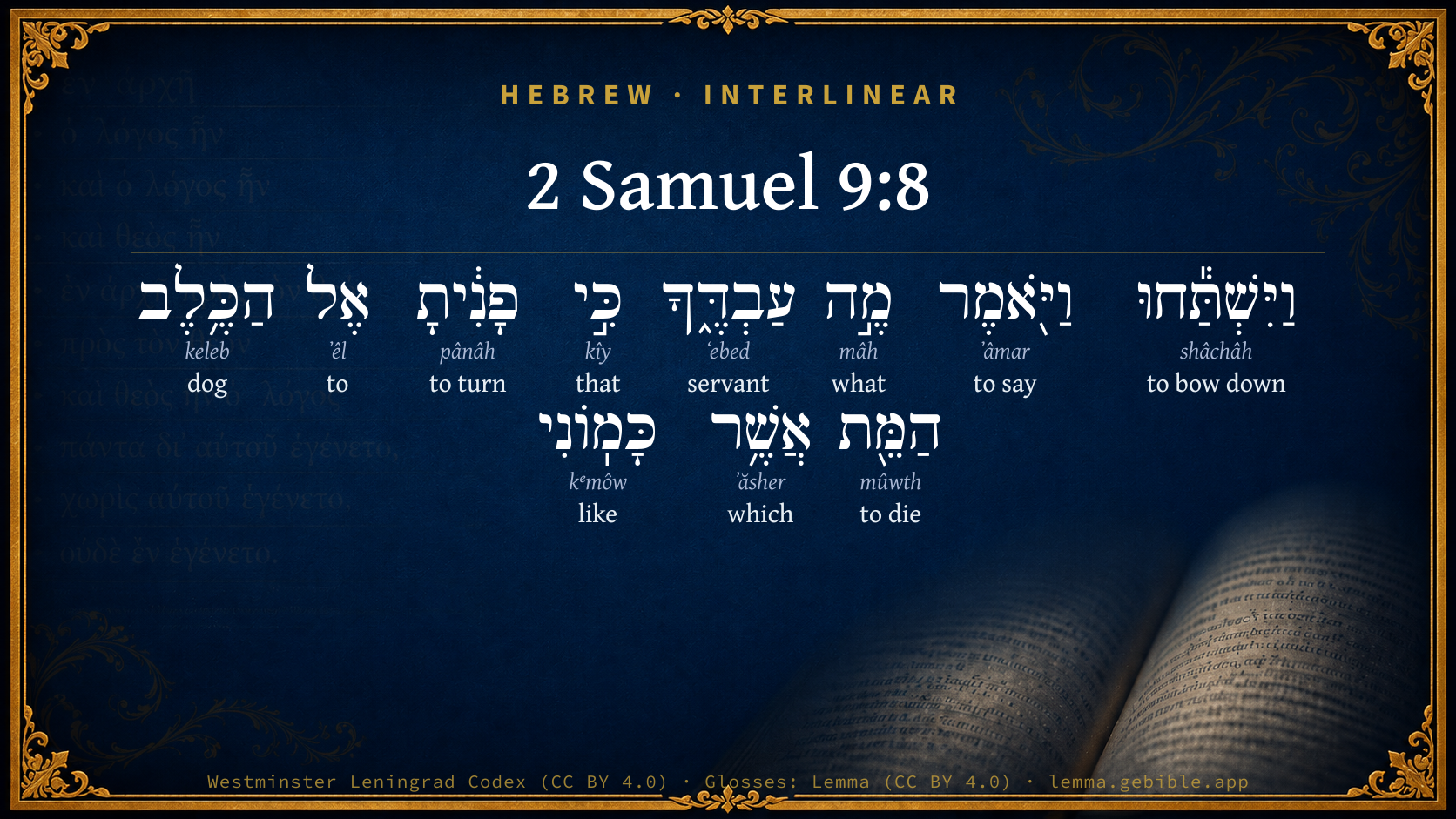
  1. וַיִּשְׁתַּ֕חוּ shâchâh H7812 “and · to bow down” Conjunction + Verb, Hithpael, Sequential Imperfect, 3rd Person, Masculine, Singular
  2. וַיֹּ֖אמֶר ʼâmar H559 “and · to say” Conjunction + Verb, Qal, Sequential Imperfect, 3rd Person, Masculine, Singular
  3. מֶ֣ה mâh H4100 “what” Particle, Interrogative
  4. עַבְדֶּ֑ךָ ʻebed H5650 “servant · your” Noun, Common, Masculine, Singular, Construct + Suffix, Personal, 2nd Person, Masculine, Singular
  5. כִּ֣י kîy H3588 “that” Conjunction
  6. פָנִ֔יתָ pânâh H6437 “to turn” Verb, Qal, Perfect, 2nd Person, Masculine, Singular
  7. אֶל ʼêl H413 “to” Preposition
  8. הַמֵּ֖ת mûwth H4191 “the · dying” Particle, Definite Article + Verb, Qal, Participle Active, Masculine, Singular, Absolute
  9. אֲשֶׁ֥ר ʼăsher H834 “which” Particle, Relative
  10. כָּמֽוֹנִי kᵉmôw H3644 “like · me” Preposition + Suffix, Personal, 1st Person, Common, Singular

About this verse

These counts appear in no published source. They are computed here, from the morphology-tagged text and Lemma’s own curated glosses. What Lemma adds →

11
words
11
distinct lemmas
Historical
section

Shared distinctive vocabulary

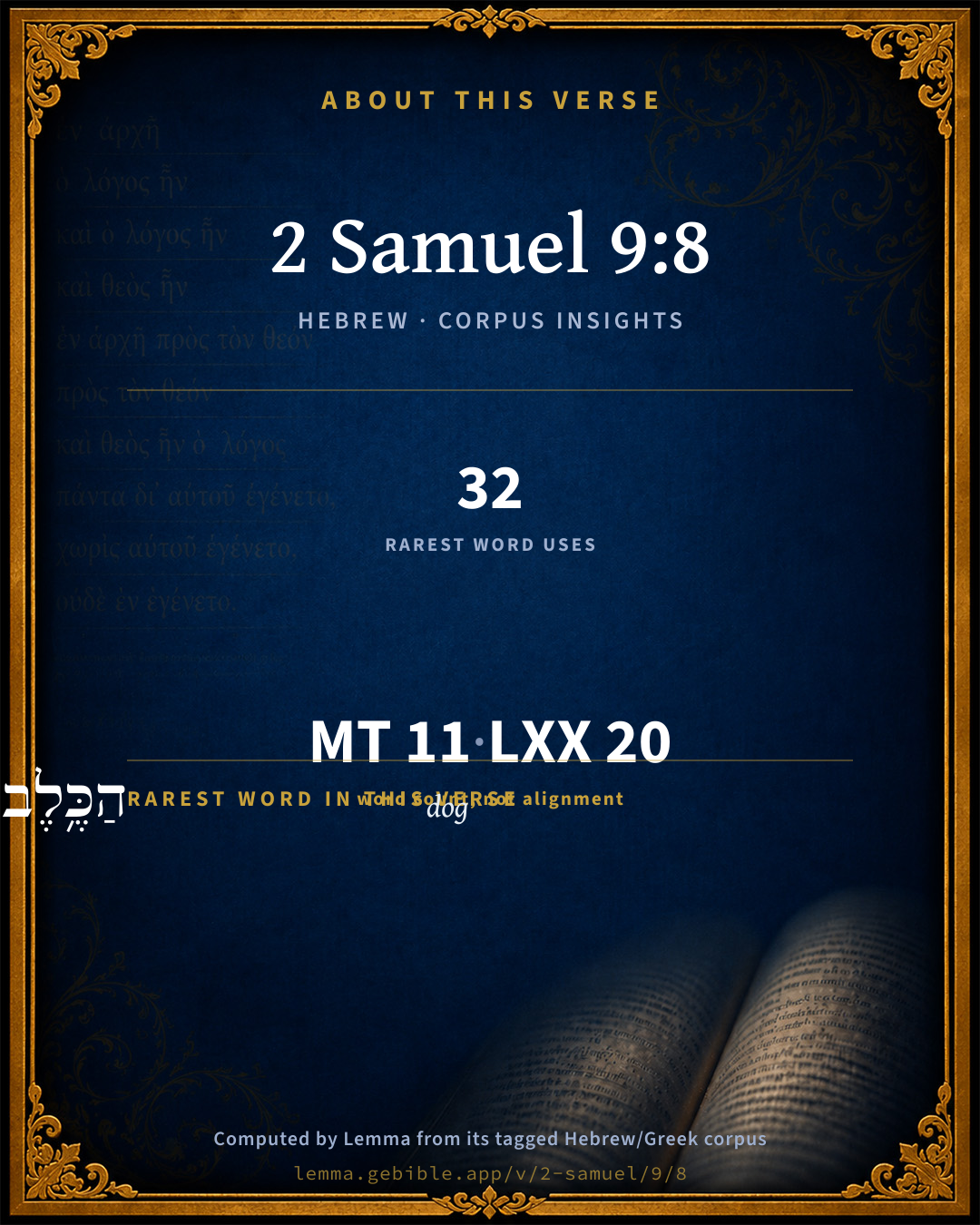
הַכֶּ֥לֶב dog H3611 occurs in 31 verses of the Hebrew Bible. Also found in:

Grammatical profile

  • 4 verbs
  • 2 nouns
  • 2 prepositions
  • 1 conjunction
  • 2 particles

Verb forms

  • וַיִּשְׁתַּ֕חוּ Hithpael · Sequential Imperfect
  • וַיֹּ֖אמֶר Qal · Sequential Imperfect
  • פָנִ֔יתָ Qal · Perfect
  • הַמֵּ֖ת Qal · Participle Active

Hebrew & Septuagint length

In English translation the verse runs 21 words from the Hebrew and 21 from the Septuagint (LXX English) — the same length.

A rough comparison of the two English renderings, which tokenize alike — not a word-level alignment.

Word counts can differ between the Hebrew and the Greek without any difference in meaning — e.g. the Hebrew direct-object marker אֵת has no separate Greek word, and Greek often adds the article ὁ.

In the original languages it is 11 Hebrew tokens and 20 Greek tokens — but the two are counted differently (Hebrew bundles its prefixes and suffixes into one token; the Greek is in lemma form), so that isn’t a like-for-like length.

Cross-references

5

Topical passages linked to 2 Samuel 9:8 in the Treasury of Scripture Knowledge — connected by theme and wording, ordered by reader-vote popularity; previews shown in the World English Bible.

  • 2 Samuel 16:9 Then said Abishai the son of Zeruiah to the king, "Why should this dead dog curse my lord the king? Please let me go over and take off his head."
  • Matthew 15:26–27 But he answered, "It is not appropriate to take the children's bread and throw it to the dogs."
  • 1 Samuel 24:14–15 After whom is the king of Israel come out? after whom do you pursue? after a dead dog, after a flea.
  • 1 Samuel 26:20 Now therefore, don't let my blood fall to the earth away from the presence of Yahweh: for the king of Israel is come out to seek a flea, as when one does hunt a partridge in the mountains.
  • 2 Samuel 3:8 Then was Abner very angry for the words of Ish-bosheth, and said, Am I a dog's head that belongs to Judah? This day do I show kindness to the house of Saul your father, to his brothers, and to his friends, and have not delivered you into the hand of David; and yet you charge me this day with a fault concerning this woman.

Cross-references courtesy of OpenBible.info (CC BY 4.0).

Hebrew and Greek witnesses Masoretic Hebrew ↔ Greek Septuagint

The same verse in the two great witnesses to the Old Testament, shown verse-for-verse.

These are two independent witnesses, not word-aligned to each other, and the Septuagint is shown in lemma (dictionary) form.

Hebrew 2 Samuel 9:8 Masoretic · Westminster Leningrad Codex

וַיִּשְׁתַּ֕חוּ וַיֹּ֖אמֶר מֶ֣ה עַבְדֶּ֑ךָ כִּ֣י פָנִ֔יתָ אֶל הַכֶּ֥לֶב הַמֵּ֖ת אֲשֶׁ֥ר כָּמֽוֹנִי

He did obeisance, and said, "What is your servant, that you should look on such a dead dog as I am?"

World English Bible · Public Domain

Greek LXX 2 Samuel 9:8 Septuagint · lemma form

καί προςκυνέω μεμφιβοσθε καί εἶπον τίς εἰμί ὁ δοῦλος σύ ὅτι ἐπιβλέπω ἐπί ὁ κύων ὁ θνήσκω ὁ ὅμοιος ἐγώ

And Memphibosthe did obeisance, and said, Who am I your servant, that you have looked upon a dead dog like me?

LXX2012 (modern English Septuagint) · Public Domain

Hebrew: Westminster Leningrad Codex (CC BY 4.0). Greek: Septuagint (public domain); English from LXX2012 (modern English Septuagint) (Public Domain). How the Septuagint differs from the Hebrew →

Targum (Aramaic paraphrase)

1

The Targum is the ancient Jewish Aramaic paraphrase of the Hebrew Scriptures — an interpretive translation, not the Hebrew text itself. Onkelos (literal) and Pseudo-Jonathan (expansive) render the Torah, and Jonathan the Prophets. Coverage is partial: where no permissively-licensed English translation exists for a verse, only the Aramaic is shown. This is verse-level text, not a word-by-word alignment to the Hebrew.

  1. Targum Jonathan Prophets (Joshua–Malachi)
    וּסְגִיד וַאֲמַר מָה עַבְדָךְ אֲרֵי אִתְפְּנִיתָא עַל גְבַר הֶדְיוֹט דִכְוָתִי:

    (no public-domain English translation for this verse)

    Targum Jonathan — Aramaic: “Mikraot Gedolot” (public domain). English: “Sefaria Community Translation” (CC0 1.0 (public-domain dedication)); “London "Chaldee Paraphrase," 1871” (public domain). Text via Sefaria.

Commentary

Notes on 2 Samuel 9:8 from classic Christian and Jewish commentators (each source and its license shown beneath its notes). The classic Christian expositions comment on the surrounding passage and are grouped to its opening verse, so a note may address several verses; the Jewish commentaries on the Tanakh (Rashi and others) are per-verse, so they appear only where the commentator wrote on this verse.

Lemma curates 59 commentaries, every one of them public domain or Creative Commons licensed, each selected and text-cleaned for this edition rather than reprinted as found. About our sources →

Trapp's Complete Commentary

John Trapp

2Sa 9:8 And he bowed himself, and said, What [is] thy servant, that thou shouldest look upon such a dead dog as I [am]?

Ver. 8. Upon such a dead dog as I am?] So he calleth himself, as being lame, poor, of a rejected stock, and no way to be compared to David and his children, whose companion and fellow commoner he was now to be made. There is no more certain way to honour and advancement, than a lowly dejection of ourselves.

John Trapp, A Commentary or Exposition upon All the Books of the Old and New Testament (1647–1656) — public domain. Text from a community e-Sword module.

Tyndale Open Study Notes

Tyndale Open Resources

9:8 a dead dog like me: Mephibosheth knew that anyone with a possible claim to the throne might be killed as a threat.

Tyndale Open Study Notes — © Tyndale Open Resources, licensed CC BY-SA 4.0. Text via the HelloAO Bible API.

Geneva Bible (1599)

Geneva Bible translators

Meaning, a despised person.

Geneva Bible (1599) marginal notes — public domain. Text via Bolls.life.

The Cambridge Bible for Schools and Colleges

gen. ed. J. J. S. Perowne

8. he bowed himself] The same Heb. word as “did reverence” in 2Sa_9:6.

a dead dog] The vilest and most contemptible object possible. See note on ch. 2Sa_3:8; and cp. ch. 2Sa_16:9; 1Sa_24:14.

The Cambridge Bible for Schools and Colleges (gen. ed. J. J. S. Perowne; Cambridge University Press, 1878–1918) — public domain. Text from a community e-Sword module.

John Gill's Exposition

And he bowed himself,.... In token of gratitude, and as a sign of humility, and of the sense he had of his unworthiness to enjoy such a favour:

and said, what is thy servant, that thou shouldest look on such a dead dog as I am? one so mean, and base, and worthless; which he might say with respect to the infirmities of his body, the rejection of his family by the Lord, their attainder of high treason for rebellion against David, and the low circumstances he was brought into and now under; though one of the royal family, the son of a prince, and grandson of a king; such was his humility, and the sense he had of his being undeserving of any favour from the king, and says this with admiration and astonishment.

John Gill's Exposition of the Whole Bible (1746–1763) — public domain (CC PDM 1.0). Text via the HelloAO Bible API.

Albert Barnes' Notes on the Bible

Mephibosheth’s humility of expression, even in the mouth of an Oriental, is painful. It was perhaps in part the result of his helpless lameness, and of the other misfortunes of his life.

A dead dog - The wild dogs of the East, which still abound in every town, are the natural objects of contempt and dislike.

Albert Barnes' Notes on the Bible (1834–1885) — public domain. Text from a community e-Sword/MySword module.

Matthew Poole's English Annotations

So contemptible in my person and condition.

Matthew Poole's English Annotations on the Holy Bible (1683–1685) — public domain. Text from a community e-Sword/MySword module.

Whedon's Commentary on the Bible

Daniel D. Whedon

8. A dead dog — Compare 1Sa_24:14. “The strongest devisable hyperbole of unworthiness and degradation; for in a dead dog the vileness of a corpse is added to the vileness of a dog.” — Kitto.

Daniel D. Whedon (gen. ed.), Commentary on the Old and New Testaments (1874–1909) — public domain. Text from a community e-Sword module.

The Pulpit Commentary

A dead dog. At first sight this extreme self-humiliation makes us look on Mephibosheth as a poor creature, whom early misfortune and personal deformity had combined to depress But really this is to impose on an Oriental hyperbole a Western exactness of meaning. When in the East your entertainer assures you that everything he has to his last dirhem is yours, he nevertheless expects you to pay twice the value foreverything you consume; but he makes his exaction pleasant by his extreme courtliness. So Ephron offered his cave at Machpelah to Abraham as a free gift, but he took care to obtain for it an exorbitant price. (Gen_23:11, Gen_23:15) Mephibosheth described himself in terms similar to those used by David of himself to Saul; (1Sa_24:14) but he meant no more than to express great gratitude, and also to acknowledge the disparity of rank between him and the king.

The Pulpit Commentary (1880–1919), ed. H.D.M. Spence-Jones & Joseph S. Exell — public domain. Text from a community e-Sword module.

John Wesley's Explanatory Notes

Bowed himself - It is good to have the heart humbled under humbling providences. If when divine providence brings our condition down, divine grace brings our spirits down, we shall be easy.

John Wesley, Explanatory Notes Upon the Whole Bible (1754–1765) — public domain. Text via the GEBible commentary corpus.

Lesson kit

Teaching starters — assembled from the data on this page, not authored interpretation. Every prompt links to the verse data it draws on. Edit before teaching.

2 Samuel, in the Historical, opens this verse with 11 words (11 distinct Hebrew lemmas). Its most distinctive word is keleb (“dog”). A historical commentator’s framing appears above. Read the whole chapter for the surrounding context.

Discussion questions

  1. The word keleb carries the sense “dog.” How does it shape the verse?
  2. Exodus 11:7 shares the word «dog» with this verse. How do the two illuminate each other?
  3. The translations on this page render this verse differently — a whole-verse word diff, not a word-by-word alignment. What might account for the different wordings?
  4. The verb «וַיִּשְׁתַּ֕חוּ» is Hithpael Sequential Imperfect. How does its form color the action?
  5. Reading how Trapp's Complete Commentary and Tyndale Open Study Notes read this verse, where do the two commentators agree and where do they part?

Things to notice

Reading settings

Reading text

Shown beneath each verse's original-language words.

Old Testament
Old Testament edition

Read the OT as the Masoretic Hebrew (MT) or the Greek Septuagint (LXX).

English shown for the Greek Septuagint (in the Hebrew ↔ Greek comparison).

Comparing translations? Open the Compare panel on any verse page to stack up to four side by side.