
Isaiah 44:15

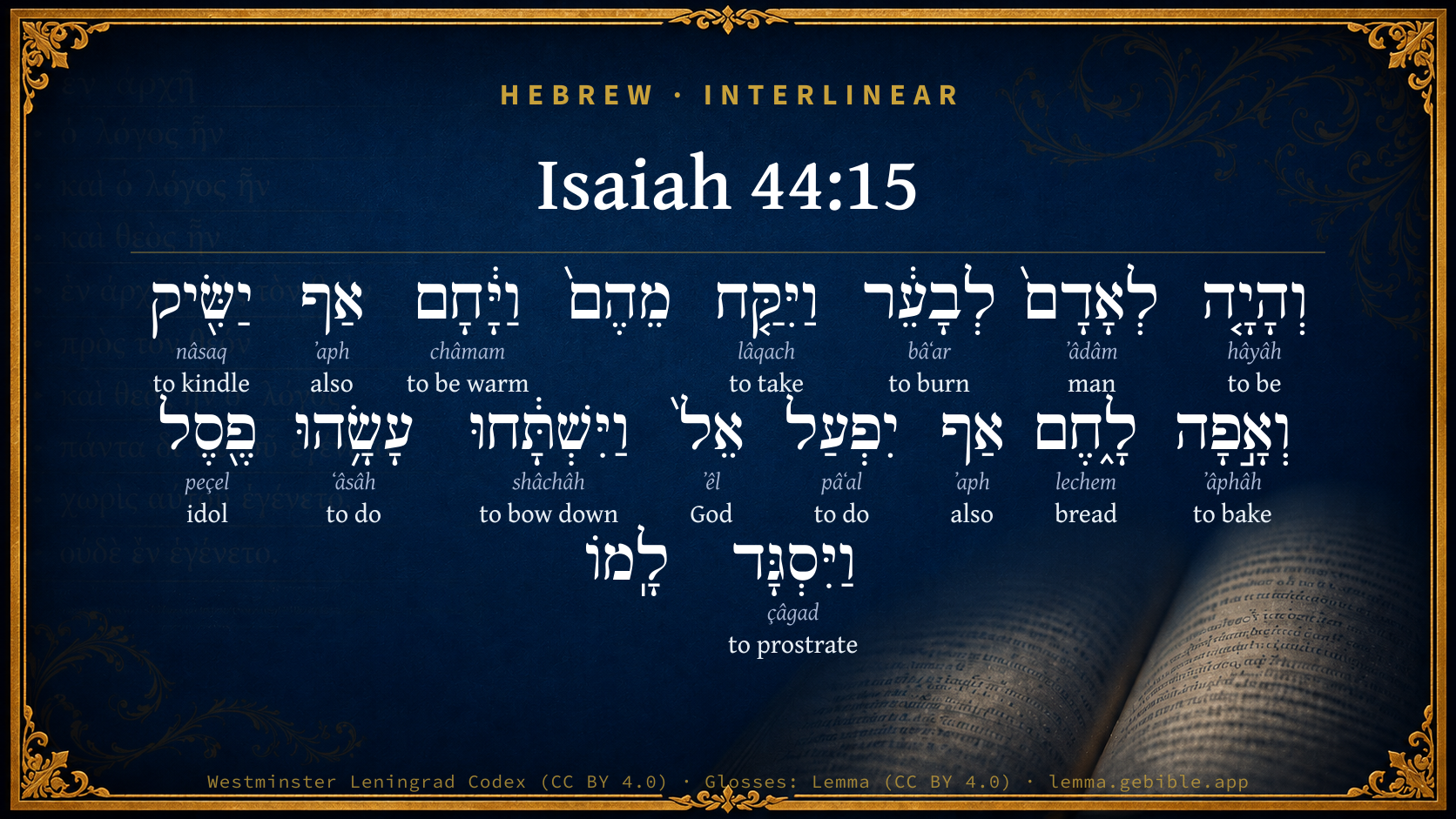
Hebrew (Westminster Leningrad Codex) Isaiah 44:15 appears in the Hebrew Old Testament. The text above is from the Westminster Leningrad Codex. Each word links to its Strong’s number, a concise gloss, and parsing drawn from the Open Scriptures Hebrew Bible morphology. Click any word for its full Brown-Driver-Briggs (BDB) entry.
Download image
Cite this verse

Isaiah 44:15 (World English Bible). Public Domain. Lemma interlinear Bible study tool, https://lemma.gebible.app/v/isaiah/44/15.

Show BibTeX & RIS
BibTeX
RIS
English Translation
Then shall it be for a man to burn; and he takes of it, and warms himself; yes, he kindles it, and bakes bread: yes, he makes a god, and worships it; he makes it an engraved image, and falls down to it.
World English Bible · Public Domain
Highlights
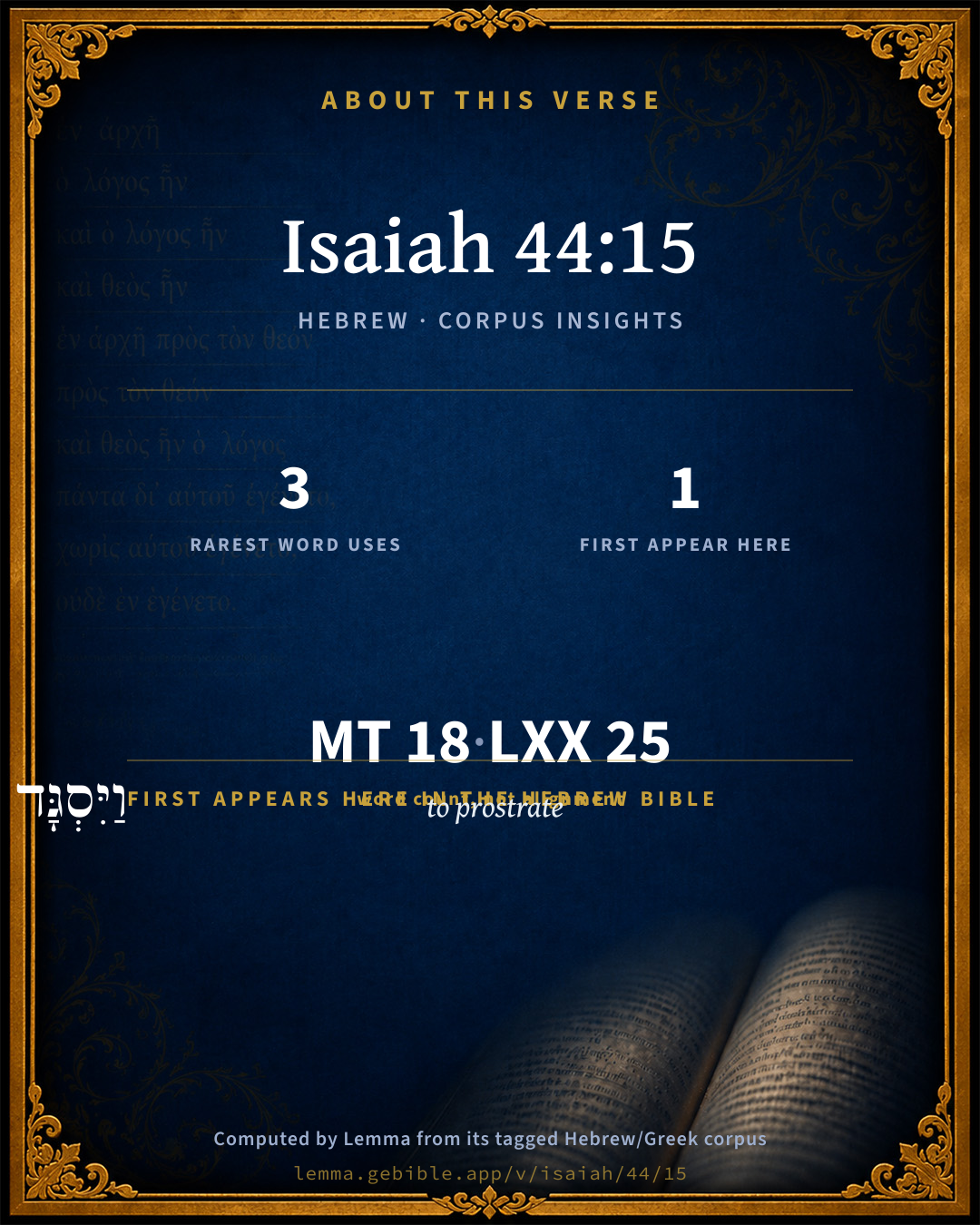
  • 1 first appearance in the Hebrew Bible
Full analysis ↓
Download a study sheet

One document with this verse’s original text, its word-by-word gloss line, the meaning frame, cross-references with their text, attributed commentary, and full source and license credits — printable, and it pastes into notes with its structure intact.

This verse Autodidact and up

Study sheet (.html) Plain text (.txt)

A passage Seminary Student

Up to 50 verses in one chapter. A passage sheet keeps up to 6 commentary sources and 12 cross-references per verse, in the order this page ranks them, and says so on the sheet whenever that leaves anything out. Ask for a single verse and you get the Autodidact verse sheet above.

Everything on this page stays free to read, with no account — the sheet is a download of what is already on screen, not access to it.

Want to remove ads? Support Godless Engineer
Compare translations 3

The same verse in 3 English versions, stacked beneath the original-language interlinear above. Click any original word for its lexicon entry.

Each is an independent rendering of the whole verse — the interlinear is not word-aligned to these translations.

Highlighted words mark where these versions differ — a whole-verse word diff, not a word-by-word alignment.

  • World English Bible Public Domain
    Then shall it be for a man to burn; and he takes of it, and warms himself; yes, he kindles it, and bakes bread: yes, he makes a god, and worships it; he makes it an engraved image, and falls down to it.
  • King James Version Public Domain
    Then shall it be for a man to burn: for he will take thereof, and warm himself; yea, he kindleth it, and baketh bread; yea, he maketh a god, and worshippeth it; he maketh it a graven image, and falleth down thereto.
  • unfoldingWord Literal Text CC BY-SA 4.0
    And it is for man to burn, and he takes from them and is warm. Indeed, he kindles and bakes bread; indeed, he makes a god and bows down, he makes it an idol and prostrates to it.

unfoldingWord Literal Text — © unfoldingWord, licensed CC BY-SA 4.0. Word-aligned USFM3 via Door43 (git.door43.org/unfoldingWord/en_ult).

Versions to compare (up to 4)

3 of 4 selected

Show all 18 translations

Every available English version of this verse, each an independent rendering of the whole verse.

  • World English Bible Public Domain
    Then shall it be for a man to burn; and he takes of it, and warms himself; yes, he kindles it, and bakes bread: yes, he makes a god, and worships it; he makes it an engraved image, and falls down to it.
  • Berean Standard Bible Public Domain
    It serves as fuel for man. He takes some of it to warm himself, and he kindles a fire and bakes his bread; he even fashions it into a god and worships it; he makes an idol and bows down to it.
  • Majority Standard Bible Public Domain
    It serves as fuel for man. He takes some of it to warm himself, and he kindles a fire and bakes his bread. He also fashions it into a god and worships it; he makes an idol and bows down to it.
  • King James Version Public Domain
    Then shall it be for a man to burn: for he will take thereof, and warm himself; yea, he kindleth it, and baketh bread; yea, he maketh a god, and worshippeth it; he maketh it a graven image, and falleth down thereto.
  • American Standard Version (1901) Public Domain
    Then shall it be for a man to burn; and he taketh thereof, and warmeth himself; yea, he kindleth it, and baketh bread: yea, he maketh a god, and worshippeth it; he maketh it a graven image, and falleth down thereto.
  • Revised Version (1885) Public Domain
    Then shall it be for a man to burn; and he taketh thereof, and warmeth himself; yea, he kindleth it, and baketh bread: yea, he maketh a god, and worshippeth it; he maketh it a graven image, and falleth down thereto.
  • Geneva Bible (1599) Public Domain
    And man burneth thereof: for he will take thereof and warme himselfe: he also kindleth it and baketh bread, yet he maketh a god, and worshippeth it: he maketh it an idole and boweth vnto it.
  • Douay-Rheims (1899) Public Domain
    And it hath served men for fuel: he took thereof, and warmed himself: and he kindled it, and baked bread: but of the rest he made a god, and adored it: he made a graven thing, and bowed down before it.
  • Young's Literal Translation Public Domain
    And it hath been for man to burn, And he taketh of them, and becometh warm, Yea, he kindleth `it', and hath baked bread, Yea, he maketh a god, and boweth himself, He hath made it a graven image, And he falleth down to it.
  • Literal Standard Version CC BY-SA 4.0
    And it has been for man to burn, || And he takes of them, and becomes warm, || Indeed, he kindles [it], and has baked bread, || Indeed, he makes a god, and bows himself, || He has made it a carved image, || And he falls down to it.
  • Unlocked Literal Bible CC BY-SA 4.0
    Then a man uses it for a fire and warms himself. Yes, he kindles a fire and bakes bread. Then he makes from it a god and bows down to it; he makes an idol and bows down to it.
  • unfoldingWord Literal Text CC BY-SA 4.0
    And it is for man to burn, and he takes from them and is warm. Indeed, he kindles and bakes bread; indeed, he makes a god and bows down, he makes it an idol and prostrates to it.
  • Darby Bible Public Domain
    And it shall be for a man to burn, and he taketh thereof, and warmeth himself; he kindleth it also, and baketh bread; he maketh also a ùgod, and worshippeth it; he maketh it a graven image, and falleth down thereto.
  • World Messianic Bible Public Domain
    Then it will be for a man to burn; and he takes some of it and warms himself. Yes, he burns it and bakes bread. Yes, he makes a god and worships it; he makes it a carved image, and falls down to it.
  • Webster's Bible Public Domain
    Then shall it be for a man to burn: for he will take of it, and warm himself; indeed he kindleth it, and baketh bread; yes, he maketh a god, and worshipeth it; he maketh it a graven image, and falleth down to it.
  • Free Bible Version CC BY-SA 4.0
    Some wood he burns, to keep him warm and to bake his bread. Then he uses some of the same wood to make a god to worship, an idol he bows down to!
  • Bible in Basic English Public Domain
    Then it will be used to make a fire, so that a man may get warm; he has the oven heated with it and makes bread: he makes a god with it, to which he gives worship: he makes a pictured image out of it, and goes down on his face before it.
  • JPS Tanakh (1917) Public Domain
    Then a man useth it for fuel; and he taketh thereof, and warmeth himself; yea, he kindleth it, and baketh bread; yea, he maketh a god, and worshippeth it; he maketh it a graven image, and falleth down thereto.

Literal Standard Version (2020), Covenant Press — licensed CC BY-SA 4.0. Text via the HelloAO Bible API (eBible.org). Unlocked Literal Bible (unfoldingWord) — licensed CC BY-SA 4.0. Text via the HelloAO Bible API (eBible.org). unfoldingWord Literal Text — © unfoldingWord, licensed CC BY-SA 4.0. Word-aligned USFM3 via Door43 (git.door43.org/unfoldingWord/en_ult). Free Bible Version, Dr. Jonathan Gallagher — licensed CC BY-SA 4.0. Text via the HelloAO Bible API (eBible.org).

Word by word

More ways to search: Search by grammar → Find every occurrence → Compare this word →

Practice this passage: Drill this verse → Learn its vocabulary →

יַשִּׂ֖יק
nâsaq
H5400
“to kindle”
Verb, Hiphil, Imperfect, 3rd Person, Masculine, Singular
Part of Speech
Verb
Stem
Hiphil
Form
Imperfect
Person
3rd Person
Gender
Masculine
Number
Singular
Full BDB Definition

Origin: a primitive root

TWOT: 2266

to kindle, burn - (Niphal) to be kindled - (Hiphil) to make a fire, burn
  1. וְהָיָ֤ה hâyâh H1961 “and · to be” Conjunction + Verb, Qal, Sequential Perfect, 3rd Person, Masculine, Singular
  2. לְאָדָם֙ ʼâdâm H120 “to/for · man” Preposition + Noun, Common, Masculine, Singular, Absolute
  3. לְבָעֵ֔ר bâʻar H1197 “to burn” Preposition + Verb, Piel, Infinitive Construct
  4. וַיִּקַּ֤ח lâqach H3947 “and · to take” Conjunction + Verb, Qal, Sequential Imperfect, 3rd Person, Masculine, Singular
  5. וַיָּ֔חָם châmam H2552 “and · to be warm” Conjunction + Verb, Qal, Sequential Imperfect, 3rd Person, Masculine, Singular
  6. אַף ʼaph H637 “also” Particle, Accusative
  7. וְאָ֣פָה ʼâphâh H644 “and · to bake” Conjunction + Verb, Qal, Sequential Perfect, 3rd Person, Masculine, Singular
  8. לָ֑חֶם lechem H3899 “bread” Noun, Common, Both, Singular, Absolute
  9. אַף ʼaph H637 “also” Particle, Accusative
  10. יִפְעַל pâʻal H6466 “to do” Verb, Qal, Imperfect, 3rd Person, Masculine, Singular
  11. אֵל֙ ʼêl H410 “God” Noun, Common, Masculine, Singular, Absolute
  12. וַיִּשְׁתָּ֔חוּ shâchâh H7812 “and · to bow down” Conjunction + Verb, Hithpael, Sequential Imperfect, 3rd Person, Masculine, Singular
  13. עָשָׂ֥הוּ ʻâsâh H6213 “to do · him” Verb, Qal, Perfect, 3rd Person, Masculine, Singular + Suffix, Personal, 3rd Person, Masculine, Singular
  14. פֶ֖סֶל peçel H6459 “idol” Noun, Common, Masculine, Singular, Absolute
  15. וַיִּסְגָּד çâgad H5456 “and · to prostrate” Conjunction + Verb, Qal, Sequential Imperfect, 3rd Person, Masculine, Singular

About this verse

These counts appear in no published source. They are computed here, from the morphology-tagged text and Lemma’s own curated glosses. What Lemma adds →

18
words
15
distinct lemmas
Prophets
section

Notable vocabulary

The rarest word here is יַשִּׂ֖יק to kindle H5400 — appearing just 3 times in the whole Hebrew Bible.

First appearance in Scripture

This word makes its first canonical appearance in the Hebrew Bible here:

  • וַיִּסְגָּד to prostrate H5456

Shared distinctive vocabulary

יַשִּׂ֖יק to kindle H5400 occurs in 3 verses of the Hebrew Bible. Also found in:

Grammatical profile

  • 10 verbs
  • 4 nouns
  • 2 prepositions
  • 2 particles

Verb forms

  • וְהָיָ֤ה Qal · Sequential Perfect
  • לְבָעֵ֔ר Piel · Infinitive Construct
  • וַיִּקַּ֤ח Qal · Sequential Imperfect
  • וַיָּ֔חָם Qal · Sequential Imperfect
  • יַשִּׂ֖יק Hiphil · Imperfect
  • וְאָ֣פָה Qal · Sequential Perfect
  • יִפְעַל Qal · Imperfect
  • וַיִּשְׁתָּ֔חוּ Hithpael · Sequential Imperfect
  • עָשָׂ֥הוּ Qal · Perfect
  • וַיִּסְגָּד Qal · Sequential Imperfect

Repetition

A word recurs within this verse — often emphatic in Hebrew:

  • אַף also H637 ×2

Hebrew & Septuagint length

In English translation the verse runs 43 words from the Hebrew and 40 from the Septuagint (LXX English) — closely comparable.

A rough comparison of the two English renderings, which tokenize alike — not a word-level alignment.

Word counts can differ between the Hebrew and the Greek without any difference in meaning — e.g. the Hebrew direct-object marker אֵת has no separate Greek word, and Greek often adds the article ὁ.

In the original languages it is 18 Hebrew tokens and 25 Greek tokens — but the two are counted differently (Hebrew bundles its prefixes and suffixes into one token; the Greek is in lemma form), so that isn’t a like-for-like length.

Cross-references

5

Topical passages linked to Isaiah 44:15 in the Treasury of Scripture Knowledge — connected by theme and wording, ordered by reader-vote popularity; previews shown in the World English Bible.

  • 2 Chronicles 25:14 Now it happened, after that Amaziah was come from the slaughter of the Edomites, that he brought the gods of the children of Seir, and set them up to be his gods, and bowed down himself before them, and burned incense to them.
  • Judges 2:19 But it happened, when the judge was dead, that they turned back, and dealt more corruptly than their fathers, in following other gods to serve them, and to bow down to them; they didn't cease from their doings, nor from their stubborn way.
  • Isaiah 44:10 Who has fashioned a god, or molten an image that is profitable for nothing?
  • Isaiah 45:20 Assemble yourselves and come; draw near together, you who have escaped from the nations: they have no knowledge who carry the wood of their engraved image, and pray to a god that can't save.
  • Revelation 9:20 The rest of mankind, who were not killed with these plagues, didn't repent of the works of their hands, that they wouldn't worship demons, and the idols of gold, and of silver, and of brass, and of stone, and of wood; which can neither see, nor hear, nor walk.

Cross-references courtesy of OpenBible.info (CC BY 4.0).

Hebrew and Greek witnesses Masoretic Hebrew ↔ Greek Septuagint

The same verse in the two great witnesses to the Old Testament, shown verse-for-verse.

These are two independent witnesses, not word-aligned to each other, and the Septuagint is shown in lemma (dictionary) form.

Hebrew Isaiah 44:15 Masoretic · Westminster Leningrad Codex

וְהָיָ֤ה לְאָדָם֙ לְבָעֵ֔ר וַיִּקַּ֤ח מֵהֶם֙ וַיָּ֔חָם אַף יַשִּׂ֖יק וְאָ֣פָה לָ֑חֶם אַף יִפְעַל אֵל֙ וַיִּשְׁתָּ֔חוּ עָשָׂ֥הוּ פֶ֖סֶל וַיִּסְגָּד לָֽמוֹ

Then shall it be for a man to burn; and he takes of it, and warms himself; yes, he kindles it, and bakes bread: yes, he makes a god, and worships it; he makes it an engraved image, and falls down to it.

World English Bible · Public Domain

Greek LXX Isaiah 44:15 Septuagint · lemma form

ἵνα εἰμί ἄνθρωπος εἰς καῦσις καί λαμβάνω ἀπό αὐτός θερμαίνω καί καίω πέσσω ἄρτος ἐπί αὐτός ὁ δέ λοιπός ἐργάζομαι εἰς θεός καί προςκυνέω αὐτός

that it might be for men to burn: and having taken part of it he warms himself; yes, they burn part of it, and bake loaves thereon; and of the rest they make for themselves gods, and they worship them.

LXX2012 (modern English Septuagint) · Public Domain

Hebrew: Westminster Leningrad Codex (CC BY 4.0). Greek: Septuagint (public domain); English from LXX2012 (modern English Septuagint) (Public Domain). How the Septuagint differs from the Hebrew →

Targum (Aramaic paraphrase)

1

The Targum is the ancient Jewish Aramaic paraphrase of the Hebrew Scriptures — an interpretive translation, not the Hebrew text itself. Onkelos (literal) and Pseudo-Jonathan (expansive) render the Torah, and Jonathan the Prophets. Coverage is partial: where no permissively-licensed English translation exists for a verse, only the Aramaic is shown. This is verse-level text, not a word-by-word alignment to the Hebrew.

  1. Targum Jonathan Prophets (Joshua–Malachi)
    וֶהֱוֵי לֶאֱנָשָׁא לְאַדְלָקָא וּנְסֵיב מִנְהוֹן וּשְׁחֵין אַף אֲזָא וְאָפָא לְחֵם אַף עָבְדֵהּ דַחֲלָא וּסְגֵיד אִתְּכֵהּ צַלְמָא וּבְעָא מִנֵהּ:

    That it may serve a man to burn: and he taketh thereof, and warmeth himself; yea, he kindleth it, and baketh bread; yea, he maketh it a god, and worshippeth it; he formeth it an image, and prayeth to it.

    Targum Jonathan — Aramaic: “Mikraot Gedolot” (public domain). English: “Sefaria Community Translation” (CC0 1.0 (public-domain dedication)); “London "Chaldee Paraphrase," 1871” (public domain). Text via Sefaria.

Commentary

Notes on Isaiah 44:15 from classic Christian and Jewish commentators (each source and its license shown beneath its notes). The classic Christian expositions comment on the surrounding passage and are grouped to its opening verse, so a note may address several verses; the Jewish commentaries on the Tanakh (Rashi and others) are per-verse, so they appear only where the commentator wrote on this verse.

Lemma curates 59 commentaries, every one of them public domain or Creative Commons licensed, each selected and text-cleaned for this edition rather than reprinted as found. About our sources →

Trapp's Complete Commentary

John Trapp

Isa 44:15 Then shall it be for a man to burn: for he will take thereof, and warm himself; yea, he kindleth [it], and baketh bread; yea, he maketh a god, and worshippeth [it]; he maketh it a graven image, and falleth down thereto.

Ver. 15. Then shall it be for a man to burn.] The chips at least shall, and the offal.

Yea, he maketh a god, and worshippeth it.] Quod Dei est, trunco tribuit.

John Trapp, A Commentary or Exposition upon All the Books of the Old and New Testament (1647–1656) — public domain. Text from a community e-Sword module.

Tyndale Open Study Notes

Tyndale Open Resources

44:15-17 he uses part of the wood to make a fire . . . he takes the rest of it and makes himself a god to worship: This description of the process of making an idol drips with sarcasm and ridicule at the stupidity of the foolish idol worshipers (see also 44:19).

Tyndale Open Study Notes — © Tyndale Open Resources, licensed CC BY-SA 4.0. Text via the HelloAO Bible API.

Geneva Bible (1599)

Geneva Bible translators

He setteth forth the obstinacy and malice of the idolaters, which though they see by daily experience that their idols are no better than the rest of the matter whereof they are made, yet they refuse the one part, and make a god of the other, as the Papists make their cake god, and the rest of their idols.

Geneva Bible (1599) marginal notes — public domain. Text via Bolls.life.

Jamieson, Fausset & Brown

Robert Jamieson, A. R. Fausset & David Brown

The same tree that furnishes the material for the god is in part used as fuel for a fire to cook his meals and warm himself!

thereto--rather, "he falleth down before them," that is, such images [MAURER].

Jamieson, Fausset & Brown — Commentary Critical and Explanatory on the Whole Bible (1871) — public domain (CC PDM 1.0). Text via the HelloAO Bible API.

Ellicott's Commentary for English Readers

(15-17) Then shall it be. . . .—The point on which the prophet dwells with indignant iteration is that it is a mere chance which half of the shapeless log is to be worshipped as a god, and which to be used for cooking the workmen’s dinner. Diagoras of Melos, the reputed atheist disciple of Democritus, is said to have thrown a wooden Hercules on his hearth, bidding the hero-god do a thirteenth labour, and boil his turnips (Del.).

A Bible Commentary for English Readers, edited by Charles John Ellicott (1878–1897) — public domain. Text from a community e-Sword module.

The Cambridge Bible for Schools and Colleges

gen. ed. J. J. S. Perowne

15, 16. Comp. (with Lowth) Horace, Sat. 1. 8, 1 ff.:

“Olim truncus eram ficulnus, inutile lignum,

Cum faber, incertus, scamnum faceretne Priapum,

Maluit esse Deum.”

Also Wisd. Sol. 13:11–13.

The word rendered “falleth down (ṣâgad)” is an Aramaic verb meaning “worship,” recurring in the O.T. only Isa_44:17; Isa_44:19 and ch. Isa_46:6. It is the root of the Arabic word mosque (musðid).

The Cambridge Bible for Schools and Colleges (gen. ed. J. J. S. Perowne; Cambridge University Press, 1878–1918) — public domain. Text from a community e-Sword module.

John Gill's Exposition

Then shall it be for a man to burn,.... And which indeed is the proper use of it, but not all that this man puts it to; only the boughs, and what he cuts off as useless to his purpose, and the chips he makes, which he commits to the fire:

for he will take thereof, and warm himself; with some part of it he makes a fire in his parlour, and warms himself when it is cold weather:

yea, he kindleth it, and baketh bread; he heats his oven with another part of it, and bakes the bread he has made for himself and family to live on, and which is putting it to a good use:

yea, he maketh a god, and worshippeth it; he maketh a graven image, and falleth down thereto; the other part of the tree, and which is the better part, he makes an image of, and carves it, and calls it a god; and not only so, but when he has done, falls down and worships it; than which there cannot be a greater instance of stupidity and folly.

John Gill's Exposition of the Whole Bible (1746–1763) — public domain (CC PDM 1.0). Text via the HelloAO Bible API.

Albert Barnes' Notes on the Bible

Then shall it be for a man to burn - It will afford materials for a fire. The design of this verse and the following is, to ridicule the idea of a man’s using parts of the same tree to make a fire to cook his victuals, to warm himself, and to shape a god. Nothing could be more stupid than the conduct here referred to, and yet it is common all over the pagan world. It shows the utter debasement of the race, that they thus of the same tree make a fire, cook their food, and construct their gods.

Albert Barnes' Notes on the Bible (1834–1885) — public domain. Text from a community e-Sword/MySword module.

Matthew Poole's English Annotations

Having related the practices of idolaters, he now discovers the vanity and folly of them; that he maketh his fire and his god of the same materials, distinguished only by the art of man.

Matthew Poole's English Annotations on the Holy Bible (1683–1685) — public domain. Text from a community e-Sword/MySword module.

The Pulpit Commentary

Then shall it be for a man to burn. The tree that has been planted, and nourished, and has grown up is naturally "for a man to burn." That is its ordinary destination; and even the idolater applies it partly to this purpose; but out of a portion he maketh a god. The very same tree serves him both for fuel and for a divinity.

The Pulpit Commentary (1880–1919), ed. H.D.M. Spence-Jones & Joseph S. Exell — public domain. Text from a community e-Sword module.

John Wesley's Explanatory Notes

Fallen down - Having related the practices of idolaters, he now discovers the folly of them, that he makes his fire and his God of the same materials, distinguished only by the art of man.

John Wesley, Explanatory Notes Upon the Whole Bible (1754–1765) — public domain. Text via the GEBible commentary corpus.

J. A. Alexander on Isaiah

Joseph Addison Alexander

“And it shall be to men for burning (i.e., for fuel), and he has taken of them and warmed himself; yes, he will kindle and bake bread; yes, he will form a god and fall prostrate; he has made it a graven image and bowed down to them.” The future meaning of the first verb is determined by its intimate connection with the last word of the foregoing verse. The Prophet seems designedly to interchange the singular and plural forms, in order to identify with more effect the idol worshipped and the sticks consumed. He takes of them (the sticks), kindles a fire, warms himself, bakes bread, then makes a god, and worships, yes, bows down before them (the sticks of wood). The argument of this and the succeeding verses is intended to exhibit the absurdity of worshipping the same material that is constantly applied to the most trivial domestic uses.

Joseph Addison Alexander, The Prophecies of Isaiah (1846–1847; New York: Scribner, 1870–1878) — public domain. Text from a community e-Sword module.

unfoldingWord translationNotes

Door43 World Missions Community

Then a man uses it

"The man uses the wood"

he makes an idol and bows down to it

This part of the sentence says basically the same as the first to emphasize it. (See: Parallelism)

translationWords

bread

false god

bow

false god

unfoldingWord translationNotes — © Distant Shores Media and the Door43 World Missions Community, licensed CC BY-SA 4.0. Source: git.door43.org/Door43/en_tn.

Rashi

Rabbi Shlomo Yitzchaki (Rashi)

And it was for man to ignite And part of that very tree was for man’s necessities, [viz.] to ignite.

and he took from the trees. and he warmed his body opposite them.

he even heated an oven with them and baked bread.

he even made a God from what was left over.

Rashi on the Tanakh — English translations: “The Judaica Press complete Tanach with Rashi, translated by A. J. Rosenberg” (CC BY 4.0); “Pentateuch with Rashi's commentary by M. Rosenbaum and A.M. Silbermann, 1929-1934” (public domain); “The Metsudah Tanach series, Lakewood, N.J” (CC BY 4.0); and “The Book of Joshua, Metsudah Publications, 1997” (CC BY 4.0). Text via Sefaria.

Ibn Ezra

Rabbi Abraham ibn Ezra

לבער To bum. Then shall it be for a man, etc. Some warm themselves by the fire, others kindle it, etc. ישיק He kindleth it. Comp. נשקה was kindled (Ps. Ixxviii. 21); the meaning of נשק is similar to that of בער to burn.

ויסגד And falleth down. This word is frequently met with in Arabic and Chaldaic.

Ibn Ezra on the Tanakh — English translations: “Sefaria Community Translation” (CC0 1.0 (public-domain dedication)); “Yalkut, Sifsei Chachomim Chumash, Metsudah Publications, 2009” (CC BY 4.0); and “Commentary of Ibn Ezra on Isaiah - trans. by M. Friedlander, 1873” (public domain). Text via Sefaria.

Lesson kit

Teaching starters — assembled from the data on this page, not authored interpretation. Every prompt links to the verse data it draws on. Edit before teaching.

Isaiah, in the Prophets, opens this verse with 18 words (15 distinct Hebrew lemmas). Its most distinctive word is nâsaq (“to kindle”). A historical commentator’s framing appears above. Read the whole chapter for the surrounding context.

Discussion questions

  1. How does “to kindle” (nâsaq) shape what this verse is saying?
  2. This is the first place “to prostrate” appears in Scripture (first appears here). What does its debut here establish?
  3. How does Psalms 78:21, which shares the word «to kindle», read alongside this verse?
  4. What does the repetition of “also” (2× in this one verse) do in this verse?
  5. These translations render this verse differently; the difference is in the English rendering, not the original. What questions does that raise?
  6. «וְהָיָ֤ה» is a Qal Sequential Perfect verb. How does that grammatical form shape the action described?
  7. Compare how Trapp's Complete Commentary and Tyndale Open Study Notes read this verse. Where do they agree or differ?

Things to notice

Reading settings

Reading text

Shown beneath each verse's original-language words.

Old Testament
Old Testament edition

Read the OT as the Masoretic Hebrew (MT) or the Greek Septuagint (LXX).

English shown for the Greek Septuagint (in the Hebrew ↔ Greek comparison).

Comparing translations? Open the Compare panel on any verse page to stack up to four side by side.