
Isaiah 49:23

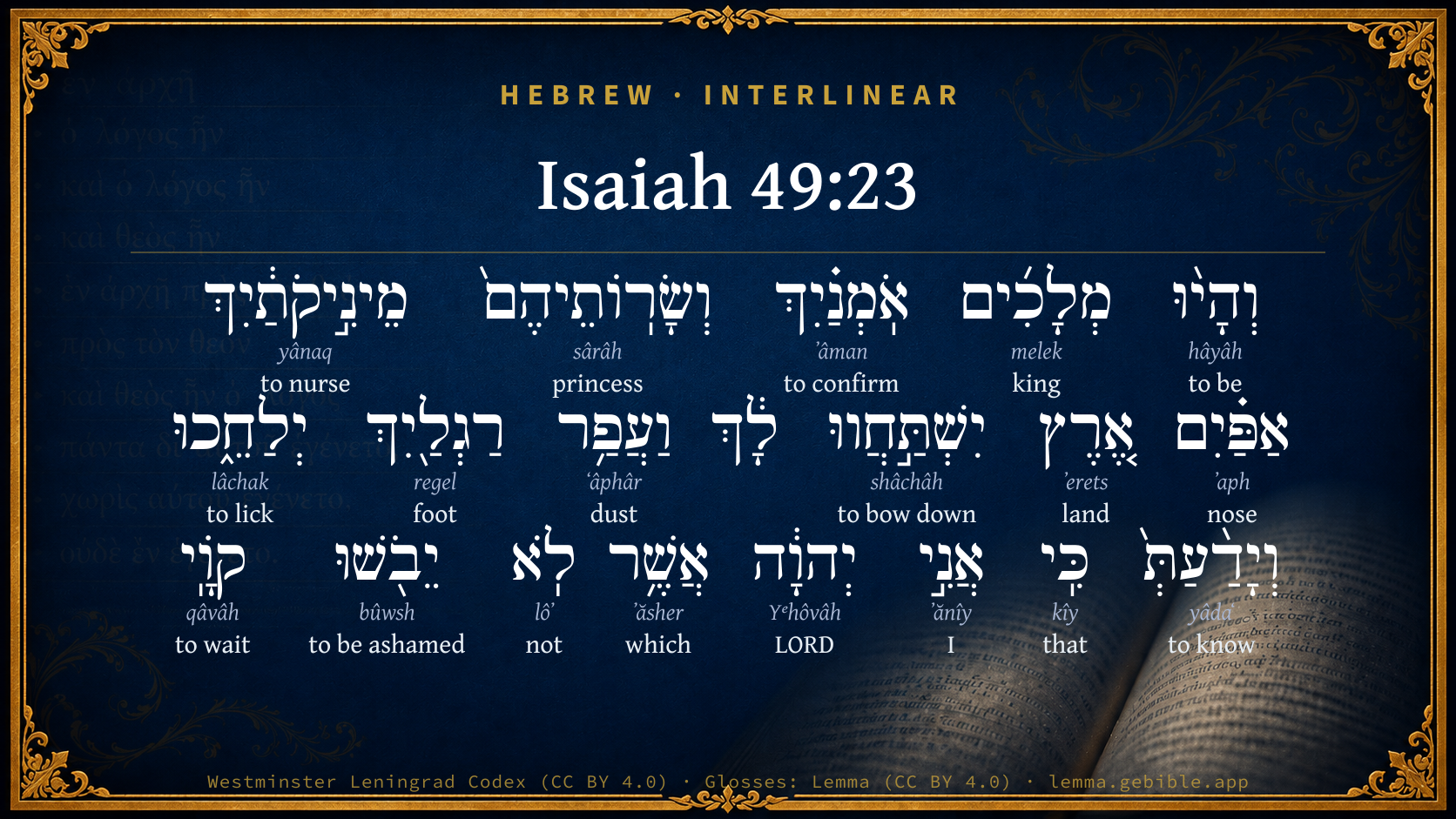
Hebrew (Westminster Leningrad Codex) Isaiah 49:23 appears in the Hebrew Old Testament. The text above is from the Westminster Leningrad Codex. Each word links to its Strong’s number, a concise gloss, and parsing drawn from the Open Scriptures Hebrew Bible morphology. Click any word for its full Brown-Driver-Briggs (BDB) entry.
Download image
Cite this verse

Isaiah 49:23 (World English Bible). Public Domain. Lemma interlinear Bible study tool, https://lemma.gebible.app/v/isaiah/49/23.

Show BibTeX & RIS
BibTeX
RIS
English Translation
Kings shall be your nursing fathers, and their queens your nursing mothers: they shall bow down to you with their faces to the earth, and lick the dust of your feet; and you shall know that I am Yahweh; and those who wait for me shall not be disappointed.
World English Bible · Public Domain
Download a study sheet

One document with this verse’s original text, its word-by-word gloss line, the meaning frame, cross-references with their text, attributed commentary, and full source and license credits — printable, and it pastes into notes with its structure intact.

This verse Autodidact and up

Study sheet (.html) Plain text (.txt)

A passage Seminary Student

Up to 50 verses in one chapter. A passage sheet keeps up to 6 commentary sources and 12 cross-references per verse, in the order this page ranks them, and says so on the sheet whenever that leaves anything out. Ask for a single verse and you get the Autodidact verse sheet above.

Everything on this page stays free to read, with no account — the sheet is a download of what is already on screen, not access to it.

Want to remove ads? Support Godless Engineer
Compare translations 3

The same verse in 3 English versions, stacked beneath the original-language interlinear above. Click any original word for its lexicon entry.

Each is an independent rendering of the whole verse — the interlinear is not word-aligned to these translations.

Highlighted words mark where these versions differ — a whole-verse word diff, not a word-by-word alignment.

  • World English Bible Public Domain
    Kings shall be your nursing fathers, and their queens your nursing mothers: they shall bow down to you with their faces to the earth, and lick the dust of your feet; and you shall know that I am Yahweh; and those who wait for me shall not be disappointed.
  • King James Version Public Domain
    And kings shall be thy nursing fathers, and their queens thy nursing mothers: they shall bow down to thee with their face toward the earth, and lick up the dust of thy feet; and thou shalt know that I am the LORD: for they shall not be ashamed that wait for me.
  • unfoldingWord Literal Text CC BY-SA 4.0
    And kings will be the ones fostering you, and their princesses, the ones nursing you. Nostrils the earth, they will prostrate themselves to you, and they will lick the dust of your feet. And you will know that I Yahweh; who will not have shame, the ones waiting for me.” q1

unfoldingWord Literal Text — © unfoldingWord, licensed CC BY-SA 4.0. Word-aligned USFM3 via Door43 (git.door43.org/unfoldingWord/en_ult).

Versions to compare (up to 4)

3 of 4 selected

Show all 18 translations

Every available English version of this verse, each an independent rendering of the whole verse.

  • World English Bible Public Domain
    Kings shall be your nursing fathers, and their queens your nursing mothers: they shall bow down to you with their faces to the earth, and lick the dust of your feet; and you shall know that I am Yahweh; and those who wait for me shall not be disappointed.
  • Berean Standard Bible Public Domain
    Kings will be your foster fathers, and their queens your nursing mothers. They will bow to you facedown and lick the dust at your feet. Then you will know that I am the LORD; those who hope in Me will never be put to shame.”
  • Majority Standard Bible Public Domain
    Kings will be your foster fathers, and their queens your nursing mothers. They will bow to you facedown and lick the dust at your feet. Then you will know that I am the LORD; those who hope in Me will never be put to shame.”
  • King James Version Public Domain
    And kings shall be thy nursing fathers, and their queens thy nursing mothers: they shall bow down to thee with their face toward the earth, and lick up the dust of thy feet; and thou shalt know that I am the LORD: for they shall not be ashamed that wait for me.
  • American Standard Version (1901) Public Domain
    And kings shall be thy nursing fathers, and their queens thy nursing mothers: they shall bow down to thee with their faces to the earth, and lick the dust of thy feet; and thou shalt know that I am Jehovah; and they that wait for me shall not be put to shame.
  • Revised Version (1885) Public Domain
    And kings shall be thy nursing fathers, and their queens thy nursing mothers: they shall bow down to thee with their faces to the earth, and lick the dust of thy feet; and thou shalt know that I am the LORD, and they that wait for me shall not be ashamed.
  • Geneva Bible (1599) Public Domain
    And Kings shalbe thy nourcing fathers, and Queenes shalbe thy nources: they shall worship thee with their faces towarde the earth, and licke vp the dust of thy feete: and thou shalt knowe that I am the Lord: for they shall not be ashamed that waite for me.
  • Douay-Rheims (1899) Public Domain
    And kings shall be thy nursing fathers, and queens thy nurses: they shall worship thee with their face toward the earth, and they shall lick up the dust of thy feet. And thou shalt know that I am the Lord, for they shall not be confounded that wait for him.
  • Young's Literal Translation Public Domain
    And kings have been thy nursing fathers, And their princesses thy nursing mothers; Face to the earth -- they bow down to thee, And the dust of thy feet they lick up, And thou hast known that I `am' Jehovah, That those expecting Me are not ashamed.
  • Literal Standard Version CC BY-SA 4.0
    And kings have been your nursing fathers, || And their princesses—your nursing mothers; Face to the earth—they bow down to you, || And they lick up the dust of your feet, || And you have known that I [am] YHWH, || That those expecting Me are not ashamed.”
  • Unlocked Literal Bible CC BY-SA 4.0
    Kings will be your foster fathers, and their queens your nursemaids; they will bow down to you with their faces to the earth and lick the dust of your feet; and you will know that I am Yahweh; those who wait for me will not be put to shame.”
  • unfoldingWord Literal Text CC BY-SA 4.0
    And kings will be the ones fostering you, and their princesses, the ones nursing you. Nostrils the earth, they will prostrate themselves to you, and they will lick the dust of your feet. And you will know that I Yahweh; who will not have shame, the ones waiting for me.” q1
  • Darby Bible Public Domain
    And kings shall be thy nursing-fathers, and their princesses thy nursing-mothers: they shall bow down to thee with the face toward the earth, and lick up the dust of thy feet. And thou shalt know that I [am] Jehovah; for they shall not be ashamed who wait on me.
  • World Messianic Bible Public Domain
    Kings shall be your foster fathers, and their queens your nursing mothers. They will bow down to you with their faces to the earth, and lick the dust of your feet. Then you will know that I am the LORD; and those who wait for me won’t be disappointed.”
  • Webster's Bible Public Domain
    And kings shall be thy nursing fathers, and their queens thy nursing mothers: they shall bow to thee with their face towards the earth, and lick up the dust of thy feet; and thou shalt know that I am the LORD: for they shall not be ashamed that wait for me.
  • Free Bible Version CC BY-SA 4.0
    Kings will be your childminders; queens will be your nurses. They will bow low before you, and lick the dust from your feet. Then you will know that I am the Lord, and that those who put their trust in me will never be ashamed.
  • Bible in Basic English Public Domain
    And kings will take care of you, and queens will give you their milk: they will go down on their faces before you, kissing the dust of your feet; and you will be certain that I am the Lord, and that those who put their hope in me will not be shamed.
  • JPS Tanakh (1917) Public Domain
    And kings shall be thy foster-fathers, and their queens thy nursing mothers; they shall bow down to thee with their face to the earth, and lick the dust of thy feet; and thou shalt know that I am the LORD, for they shall not be ashamed that wait for Me.

Literal Standard Version (2020), Covenant Press — licensed CC BY-SA 4.0. Text via the HelloAO Bible API (eBible.org). Unlocked Literal Bible (unfoldingWord) — licensed CC BY-SA 4.0. Text via the HelloAO Bible API (eBible.org). unfoldingWord Literal Text — © unfoldingWord, licensed CC BY-SA 4.0. Word-aligned USFM3 via Door43 (git.door43.org/unfoldingWord/en_ult). Free Bible Version, Dr. Jonathan Gallagher — licensed CC BY-SA 4.0. Text via the HelloAO Bible API (eBible.org).

Word by word

More ways to search: Search by grammar → Find every occurrence → Compare this word →

Practice this passage: Drill this verse → Learn its vocabulary →

וְשָׂרֽוֹתֵיהֶם֙
sârâh
H8282
“and · princesses · their”
Conjunction + Noun, Common, Feminine, Plural, Construct + Suffix, Personal, 3rd Person, Masculine, Plural
Part of Speech
Conjunction + Noun
Type
Common
Gender
Feminine
Number
Plural
State
Construct
Full BDB Definition

Origin: from H8269

TWOT: 2295b

princess, noblewoman, noble lady
  1. וְהָי֨וּ hâyâh H1961 “and · to be” Conjunction + Verb, Qal, Sequential Perfect, 3rd Person, Common, Plural
  2. מְלָכִ֜ים melek H4428 “kings” Noun, Common, Masculine, Plural, Absolute
  3. אֹֽמְנַ֗יִךְ ʼâman H539 “confirming · you” Verb, Qal, Participle Active, Masculine, Plural, Construct + Suffix, Personal, 2nd Person, Feminine, Singular
  4. מֵינִ֣יקֹתַ֔יִךְ yânaq H3243 “nursing · you” Verb, Hiphil, Participle Active, Feminine, Plural, Construct + Suffix, Personal, 2nd Person, Feminine, Singular
  5. אַפַּ֗יִם ʼaph H639 “nostrils” Noun, Common, Masculine, Dual, Absolute
  6. אֶ֚רֶץ ʼerets H776 “land” Noun, Common, Both, Singular, Absolute
  7. יִשְׁתַּ֣חֲווּ shâchâh H7812 “to bow down” Verb, Hishtaphel, Imperfect, 3rd Person, Masculine, Plural
  8. וַעֲפַ֥ר ʻâphâr H6083 “and · dust of” Conjunction + Noun, Common, Masculine, Singular, Construct
  9. רַגְלַ֖יִךְ regel H7272 “feet · your” Noun, Common, Feminine, Dual, Construct + Suffix, Personal, 2nd Person, Feminine, Singular
  10. יְלַחֵ֑כוּ lâchak H3897 “to lick” Verb, Piel, Imperfect, 3rd Person, Masculine, Plural
  11. וְיָדַ֨עַתְּ֙ yâdaʻ H3045 “and · to know” Conjunction + Verb, Qal, Sequential Perfect, 2nd Person, Feminine, Singular
  12. כִּֽי kîy H3588 “that” Conjunction
  13. אֲנִ֣י ʼănîy H589 “I” Pronoun, Personal, 1st Person, Common, Singular
  14. יְהוָ֔ה Yᵉhôvâh H3068 “LORD” Noun, Proper
  15. אֲשֶׁ֥ר ʼăsher H834 “which” Particle, Relative
  16. לֹֽא lôʼ H3808 “not” Particle, Negative
  17. יֵבֹ֖שׁוּ bûwsh H954 “to be ashamed” Verb, Qal, Imperfect, 3rd Person, Masculine, Plural
  18. קוָֹֽי qâvâh H6960 “waiting · me” Verb, Qal, Participle Active, Masculine, Plural, Construct + Suffix, Personal, 1st Person, Common, Singular

About this verse

These counts appear in no published source. They are computed here, from the morphology-tagged text and Lemma’s own curated glosses. What Lemma adds →

20
words
19
distinct lemmas
Prophets
section

Notable vocabulary

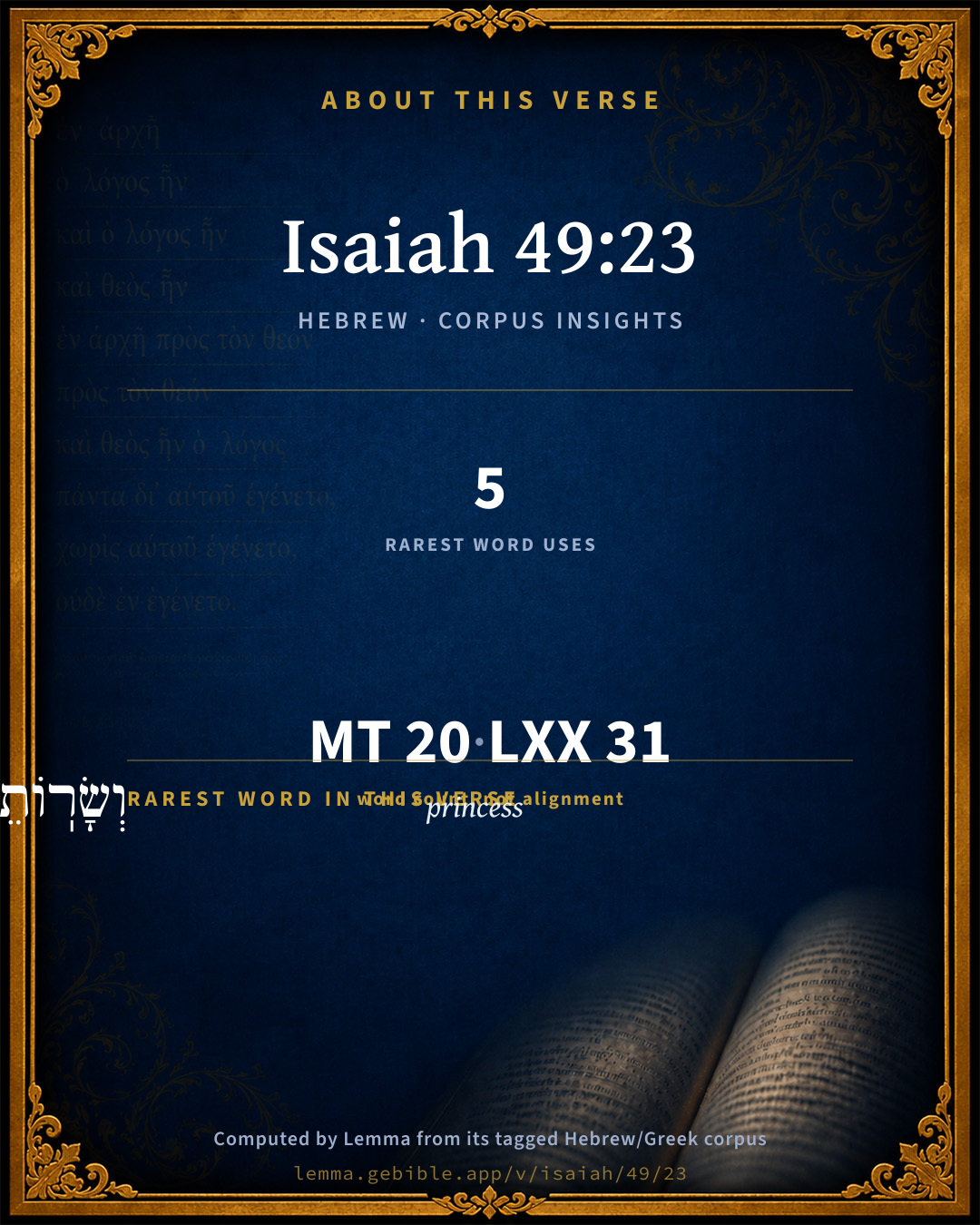
The rarest word here is וְשָׂרֽוֹתֵיהֶם֙ princess H8282 — appearing just 5 times in the whole Hebrew Bible.

Shared distinctive vocabulary

וְשָׂרֽוֹתֵיהֶם֙ princess H8282 occurs in 5 verses of the Hebrew Bible. Also found in:

Grammatical profile

  • 8 verbs
  • 7 nouns
  • 1 pronoun
  • 1 preposition
  • 1 conjunction
  • 2 particles

Verb forms

  • וְהָי֨וּ Qal · Sequential Perfect
  • אֹֽמְנַ֗יִךְ Qal · Participle Active
  • מֵינִ֣יקֹתַ֔יִךְ Hiphil · Participle Active
  • יִשְׁתַּ֣חֲווּ Hishtaphel · Imperfect
  • יְלַחֵ֑כוּ Piel · Imperfect
  • וְיָדַ֨עַתְּ֙ Qal · Sequential Perfect
  • יֵבֹ֖שׁוּ Qal · Imperfect
  • קוָֹֽי Qal · Participle Active

Hebrew & Septuagint length

In English translation the verse runs 49 words from the Hebrew and 51 from the Septuagint (LXX English) — closely comparable.

A rough comparison of the two English renderings, which tokenize alike — not a word-level alignment.

Word counts can differ between the Hebrew and the Greek without any difference in meaning — e.g. the Hebrew direct-object marker אֵת has no separate Greek word, and Greek often adds the article ὁ.

In the original languages it is 20 Hebrew tokens and 31 Greek tokens — but the two are counted differently (Hebrew bundles its prefixes and suffixes into one token; the Greek is in lemma form), so that isn’t a like-for-like length.

Cross-references

32

Topical passages linked to Isaiah 49:23 in the Treasury of Scripture Knowledge — connected by theme and wording, ordered by reader-vote popularity; previews shown in the World English Bible.

  • Isaiah 60:14 The sons of those who afflicted you shall come bending to you; and all those who despised you shall bow themselves down at the soles of your feet; and they shall call you The city of Yahweh, The Zion of the Holy One of Israel.
  • Isaiah 60:16 You shall also suck the milk of the nations, and shall suck the breast of kings; and you shall know that I, Yahweh, am your Savior, and your Redeemer, the Mighty One of Jacob.
  • Isaiah 60:3 Nations shall come to your light, and kings to the brightness of your rising.
  • Micah 7:17 They will lick the dust like a serpent. Like crawling things of the earth they shall come trembling out of their dens. They will come with fear to Yahweh our God, And will be afraid because of you.
  • Isaiah 45:14 Thus says Yahweh: "The labor of Egypt, and the merchandise of Ethiopia, and the Sabeans, men of stature, shall come over to you, and they shall be yours. They shall go after you. In chains they shall come over; and they shall fall down to you. They shall make supplication to you: 'Surely God is in you; and there is none else, there is no other god.
  • Isaiah 60:10–11 Foreigners shall build up your walls, and their kings shall minister to you: for in my wrath I struck you, but in my favor have I had mercy on you.
  • Romans 10:11 For the Scripture says, "Whoever believes in him will not be disappointed."
  • Psalms 25:3 Yes, no one who waits for you shall be shamed. They shall be shamed who deal treacherously without cause.
  • Isaiah 64:4 For from of old men have not heard, nor perceived by the ear, neither has the eye seen a God besides you, who works for him who waits for him.
  • Isaiah 49:7 Thus says Yahweh, the Redeemer of Israel, [and] his Holy One, to him whom man despises, to him whom the nation abhors, to a servant of rulers: Kings shall see and arise; princes, and they shall worship; because of Yahweh who is faithful, [even] the Holy One of Israel, who has chosen you.
  • Revelation 3:9 Behold, I give of the synagogue of Satan, of those who say they are Jews, and they are not, but lie. Behold, I will make them to come and worship before your feet, and to know that I have loved you.
  • Psalms 34:22 Yahweh redeems the soul of his servants. None of those who take refuge in him shall be condemned.
  • Isaiah 25:9 It shall be said in that day, Behold, this is our God; we have waited for him, and he will save us: this is Yahweh; we have waited for him, we will be glad and rejoice in his salvation.
  • Psalms 2:10–12 Now therefore be wise, you kings. Be instructed, you judges of the earth.
  • 1 Peter 2:6 Because it is contained in Scripture, "Behold, I lay in Zion a chief cornerstone, chosen, and precious: He who believes in him will not be disappointed."
  • Revelation 21:24–26 The nations will walk in its light. The kings of the earth bring the glory and honor of the nations into it.
  • Numbers 11:12 Have I conceived all this people? have I brought them forth, that you should tell me, Carry them in your bosom, as a nursing-father carries the sucking child, to the land which you swore to their fathers?
  • Psalms 72:9–11 Those who dwell in the wilderness shall bow before him. His enemies shall lick the dust.
  • Isaiah 62:2 The nations shall see your righteousness, and all kings your glory, and you shall be called by a new name, which the mouth of Yahweh shall name.
  • Romans 9:33 even as it is written, "Behold, I lay in Zion a stumbling stone and a rock of offense; And no one who believes in him will be disappointed."
  • Psalms 68:31 Princes shall come out of Egypt. Ethiopia shall hurry to stretch out her hands to God.
  • Psalms 138:4 All the kings of the earth will give you thanks, Yahweh, For they have heard the words of your mouth.
  • Isaiah 52:15 so shall he sprinkle many nations; kings shall shut their mouths at him: for that which had not been told them shall they see; and that which they had not heard shall they understand.
  • Romans 5:5 and hope doesn't disappoint us, because God's love has been poured out into our hearts through the Holy Spirit who was given to us.
  • Esther 8:1–10 On that day did the king Ahasuerus give the house of Haman the Jews' enemy to Esther the queen. Mordecai came before the king; for Esther had told what he was to her.
  • Joel 2:27 You will know that I am in the midst of Israel, And that I am Yahweh, your God, and there is no one else; And my people will never again be disappointed.
  • Ezra 1:2–4 Thus says Cyrus king of Persia, All the kingdoms of the earth has Yahweh, the God of heaven, given me; and he has charged me to build him a house in Jerusalem, which is in Judah.
  • Ezra 6:7–12 let the work of this house of God alone; let the governor of the Jews and the elders of the Jews build this house of God in its place.
  • Nehemiah 2:6–10 The king said to me (the queen also sitting by him), For how long shall your journey be? and when will you return? So it pleased the king to send me; and I set him a time.
  • Psalms 69:6 Don't let those who wait for you be shamed through me, Lord Yahweh of Hosts. Don't let those who seek you be brought to dishonor through me, God of Israel.
  • Genesis 43:26 When Joseph came home, they brought him the present which was in their hand into the house, and bowed down themselves to him to the earth.
  • Ezra 7:11–28 Now this is the copy of the letter that the king Artaxerxes gave to Ezra the priest, the scribe, even the scribe of the words of the commandments of Yahweh, and of his statutes to Israel:

Cross-references courtesy of OpenBible.info (CC BY 4.0).

Hebrew and Greek witnesses Masoretic Hebrew ↔ Greek Septuagint

The same verse in the two great witnesses to the Old Testament, shown verse-for-verse.

These are two independent witnesses, not word-aligned to each other, and the Septuagint is shown in lemma (dictionary) form.

Hebrew Isaiah 49:23 Masoretic · Westminster Leningrad Codex

וְהָי֨וּ מְלָכִ֜ים אֹֽמְנַ֗יִךְ וְשָׂרֽוֹתֵיהֶם֙ מֵינִ֣יקֹתַ֔יִךְ אַפַּ֗יִם אֶ֚רֶץ יִשְׁתַּ֣חֲווּ לָ֔ךְ וַעֲפַ֥ר רַגְלַ֖יִךְ יְלַחֵ֑כוּ וְיָדַ֨עַתְּ֙ כִּֽי אֲנִ֣י יְהוָ֔ה אֲשֶׁ֥ר לֹֽא יֵבֹ֖שׁוּ קוָֹֽי

Kings shall be your nursing fathers, and their queens your nursing mothers: they shall bow down to you with their faces to the earth, and lick the dust of your feet; and you shall know that I am Yahweh; and those who wait for me shall not be disappointed.

World English Bible · Public Domain

Greek LXX Isaiah 49:23 Septuagint · lemma form

καί εἰμί βασιλεύς τιθηνός σύ ὁ δέ ἄρχω τροφός σύ ἐπί πρόσωπον ὁ γῆ προςκυνέω σύ καί ὁ χοῦς ὁ πούς σύ λείχω καί γιγνώσκω ὅτι ἐγώ κύριος καί οὐ αἰσχύνω

And kings shall be your nursing fathers, and their princesses your nurses, they shall bow down to you on the face of the earth, and shall lick the dust of your feet; and you shall know that I am the Lord, and they that wait on me shall not be ashamed.

LXX2012 (modern English Septuagint) · Public Domain

Hebrew: Westminster Leningrad Codex (CC BY 4.0). Greek: Septuagint (public domain); English from LXX2012 (modern English Septuagint) (Public Domain). How the Septuagint differs from the Hebrew →

Targum (Aramaic paraphrase)

1

The Targum is the ancient Jewish Aramaic paraphrase of the Hebrew Scriptures — an interpretive translation, not the Hebrew text itself. Onkelos (literal) and Pseudo-Jonathan (expansive) render the Torah, and Jonathan the Prophets. Coverage is partial: where no permissively-licensed English translation exists for a verse, only the Aramaic is shown. This is verse-level text, not a word-by-word alignment to the Hebrew.

  1. Targum Jonathan Prophets (Joshua–Malachi)
    וִיהוֹן מַלְכַיָא תּוּרְבְּיָנָךְ וּמַלְכְּוַתְהוֹן יְשַׁמְשׁוּנִיךְ עַל אַפֵּיהוֹן עַל אַרְעָא יִשְׁתַּטְחוּן לְמִבְעֵי מִנִיךְ וַעֲפַר רִגְלָךְ יְלַחֲכוּן וְתֵידְעִין אֲרֵי אֲנָא יְיָ דְלָא יִבְהֲתוּן צַדִיקַיָא דִמְסַבְרִין לְפוּרְקָנִי:

    And kings shall be thy nursing fathers, and their queens shall minister unto thee; they shall prostrate themselves with their faces to the earth to supplicate to thee, and lick the dust of thy feet; and thou shalt know that I am the Lord; because the righteous that hope for my salvation shall not be ashamed.

    Targum Jonathan — Aramaic: “Mikraot Gedolot” (public domain). English: “Sefaria Community Translation” (CC0 1.0 (public-domain dedication)); “London "Chaldee Paraphrase," 1871” (public domain). Text via Sefaria.

Commentary

Notes on Isaiah 49:23 from classic Christian and Jewish commentators (each source and its license shown beneath its notes). The classic Christian expositions comment on the surrounding passage and are grouped to its opening verse, so a note may address several verses; the Jewish commentaries on the Tanakh (Rashi and others) are per-verse, so they appear only where the commentator wrote on this verse.

Lemma curates 59 commentaries, every one of them public domain or Creative Commons licensed, each selected and text-cleaned for this edition rather than reprinted as found. About our sources →

Trapp's Complete Commentary

John Trapp

Isa 49:23 And kings shall be thy nursing fathers, and their queens thy nursing mothers: they shall bow down to thee with [their] face toward the earth, and lick up the dust of thy feet; and thou shalt know that I [am] the LORD: for they shall not be ashamed that wait for me.

Ver. 23. And kings shall be thy nursing fathers.] Such were David, Solomon, Hezekiah, Josiah, Constantine, Theodosius, Placilla, Queen Elizabeth, &c.

They shall bow down to thee.] They shall give thee civil worship, and low obeisance, and that for Christ’s sake, who is thine head and husband, and dwelleth in thee.

They shall bow down to thee, &c.] Such honour hath every saint through Christ. The Pope’s parasites would hence ground his holding out his feet to be kissed; yea, his treading upon kings and emperors. But Peter would none of this; {Act 10:25-26} so little cause had that Pope to cry out, Et mihi et Petro. Interpreters do rightly note that in these and the like texts, the prophet alludes to the manner of the Persians, among whom those that would speak unto the king, did first kiss the pavement that the king had trodden upon. {a} Hence Martial,

“ Pietorum sola basiare regum. ”

The ancient Christians also, to honour and hearten their confessors, and such as suffered imprisonment for the truth’s sake, did use to kiss their hands, yea, to cast themselves down at their feet. Tertullian, writing to some of the martyrs, saith, Non tantus sum ut vos alloquar, I am not good enough to speak unto you. He telleth also of some in his time, that they did reptare ad vincula martyrum, creep to the bands of the martyrs in way of honour to them.

{a} Xenophon, lib. viii. Plutarch., in Alcib.

John Trapp, A Commentary or Exposition upon All the Books of the Old and New Testament (1647–1656) — public domain. Text from a community e-Sword module.

The Biblical Illustrator

Joseph S. Exell

Isa_49:23

And kings shall be thy nursing fathers

Princes and rulers should promote the will of God

I.

PRINCES, OR RULERS, AS SUCH, ARE THE POSITIVE SERVANTS OF GOD, AND THEREFORE ARE BOUND TO PROMOTE, ABOVE ALL THINGS, THE INTERESTS OF HIS REVEALED WORD, AND THE HONOUR OF HIS NAME, IN THE WELFARE OF HIS CHURCH AND PEOPLE. It must be a self-evident proposition, that all who are entrusted with the ruling authority are bound to promote the best interests of the people over whom they preside. But the question is, in what do the best interests of a people consist? Do they consist in the extension of territory; the multiplicity of resources; the advancement of the arts and sciences; of wealth and honour; business and trade? We deny the assertion. As our Lord speaks of a man, so we of a nation, prince, or ruler. What is either he or they profited if they gain the whole world and lose their own soul? Or what shall a man, or any number of men, give in exchange for their soul? The soul, then, in all its vast, interesting, immortal, and eternal concerns, is the chief business of man.

1. From whence does the kingly office, or ruling authority proceed? Does it proceed from the people? No. It proceeds from God.

2. We must not omit to notice the manner in which the Lord speaks of princes and rulers in His Word. They are always spoken of in reference to their accountability to Him, and as bound to the execution of His will, and the promotion of His glory.

3. It may be useful here to adduce what is the estimate of our own Church on this subject.

II. SUCH A DISCHARGE OR DISREGARD OF THIS OBLIGATION WILL ALWAYS YIELD A SURE TEST OF THEIR OWN STATE AND THE CHARACTER OF THEIR GOVERNMENT, AND WHERE IT PREVAILS IT WILL BE VISIBLE, MORE OR LESS, IN ALL THEIR WAYS AND WORKS. We are to judge of the character and condition of princes and rulers, as such, as we do of private individuals and professing Christians, as such, and of the character of their government as we do of the general tenor of a mans life.

1. There will be deep humiliation before God, coupled with free and ingenuous confessions both of individual and national guilt (2Sa_7:1-29).

2. There will also be a desire to seek the guidance and acknowledge the hand of God in everything.

3. There will also be a fixed determination to banish all wicked men from their presence, and to exclude them from their councils.

4. There will be an anxiety to fill all the offices of the Church and State with men that fear the Lord, love the truth, and who will labour with heart and hand in the same cause for the advancement of true godliness. If the foregoing statements are based on the authority of Divine truth, the following deductions will ensue as some of their most obvious results

(1) It is not an easy office to be exalted to a throne, or to be entrusted with the affairs of a kingdom!

(2) How obvious is the connection between the Church and State! An established religion, nationally considered, is nothing more than that form of godliness, according to Gods revealed will, which is selected, supported, and maintained by the State, for the general benefit of all.

(3) How great is the guilt of ungodly princes and rulers, and how earnestly should we pray for them that God may bless and direct them in all His ways! (R. Shittier.)

They shall not be ashamed that wait for Me

Waiting upon God

I. WAITING UPON GOD signifies--

1. A patient expectation of the fulfilment of His Word, whether it be prophecy or promise.

2. A regular attention to the means of grace.

II. THE RESULT OF WAITING UPON GOD. Not disappointment and humiliation, but prayers answered, and hopes fulfilled.

1. The penitent.

2. The Christian relying upon the providential help of a covenant-keeping God.

3. The believer waiting for the accomplishment of Gods purpose in his sanctification.

4. The Christian waiting for the coming of Christ. (T. Blackley, M. A.)

Wait

This is the one word which the Divine wisdom often seems to utter in rebuke of human impatience. Man is eager, hurried, impatient, but God is never in haste. The Divine proceedings are slow--everywhere slow.

I. We see it in the realms of NATURE AND PROVIDENCE.

1. The history of the earth.

2. The movement of the seasons. The changes of day and night, &c., how slow, how gradual, how imperceptible!

3. The history of all life and growth.

II. REVEALED RELIGION includes much in harmony with these facts.

1. The long interval between the promise of a Saviour and His advent.

2. The manner of His coming (Luk_17:20).

3. The history of revealed religion since the advent.

4. The spiritual history of the individual believer.

5. The events which make up the story of a life. With regard to much in our history, we are expected to wait for the revelations of the world to come. (R. Vaughan, D. D.)

The Biblical Illustrator, edited by Joseph S. Exell (c. 1880s–1900s) — public domain. Text from a community e-Sword module.

Tyndale Open Study Notes

Tyndale Open Resources

49:23 you will know that I am the Lord: The stunning role-reversal—kings and queens serving the lowly exiles upon their return—would reveal God’s power to do the unimaginable (see also 60:16). • The godly would experience temporary disgrace in the Exile but would not ultimately be put to shame, as the idolaters and ungodly were.

Tyndale Open Study Notes — © Tyndale Open Resources, licensed CC BY-SA 4.0. Text via the HelloAO Bible API.

Geneva Bible (1599)

Geneva Bible translators

Being joined with the Church, they shall humble themselves to Christ their head, and give him all honor.

Meaning, that Kings shall be converted to the Gospel, and bestow their power and authority for the preservation of the Church.

Geneva Bible (1599) marginal notes — public domain. Text via Bolls.life.

Jamieson, Fausset & Brown

Robert Jamieson, A. R. Fausset & David Brown

lick . . . dust--that is, kiss thy feet in token of humble submission.

for they . . . not . . . ashamed . . . wait for me--The restoration of Israel shall be in answer to their prayerful waiting on the Lord (Isa 30:18-19; Psa 102:16-17; Zac 12:10; Zac 14:3).

Jamieson, Fausset & Brown — Commentary Critical and Explanatory on the Whole Bible (1871) — public domain (CC PDM 1.0). Text via the HelloAO Bible API.

Adam Clarke's Commentary

Verse 23. With their face toward the earth - "With their faces to the earth"] It is well known that expressions of submission, homage, and reverence always have been and are still carried to a great degree of extravagance in the eastern countries. When Joseph's brethren were introduced to him, "they bowed down themselves before him with their faces to the earth," Ge 42:6. The kings of Persia never admitted any one to their presence without exacting this act of adoration; for that was the proper term for it. Necesse est, says the Persian courtier to Conon, si in conspectum veneris, venerari te regem; quod προσκυνειν illi vocant. "It is necessary, if thou shouldest come in sight, to venerate thee as king; which they call worshipping." - NEPOS in Conone. Alexander, intoxicated with success, affected this piece of oriental pride: Itaque more Persarum Macedonas venerabundos ipsum salutare, prosternentes humi corpora. "The Macedonians after the manner of the Persians, saluted their monarch with the ceremony of prostration." - CURTIUS, lib. viii. The insolence of eastern monarchs to conquered princes, and the submission of the latter, is astonishing. Mr. Harmer, Observ. ii. 43, gives the following instance of it from D'Herbelot: "This prince threw himself one day on the ground, and kissed the prints that his victorious enemy's horse had made there; reciting some verses in Persian, which he had composed, to this effect: -

"'The mark that the foot of your horse has left upon the dust, serves me now for a crown.

"'The ring which I wear as the badge of my slavery, is become my richest ornament.

"'While I shall have the happiness to kiss the dust of your feet, I shall think that fortune favours me with its tenderest caresses, and its sweetest kisses.'"

These expressions therefore of the prophet are only general poetical images, taken from the manners of the country, to denote great respect and reverence: and such splendid poetical images, which frequently occur in the prophetical writings, were intended only as general amplifications of the subject, not as predictions to be understood and fulfilled precisely according to the letter. For the different kinds of adoration in the east, see the note on Isa 44:17.

Adam Clarke's Commentary on the Bible (1810–1826) — public domain. Text from a community e-Sword/MySword module.

Ellicott's Commentary for English Readers

(23) Kings shall be thy nursing fathers . . .—As a rule kings gave their children to be brought up by their nobles (2Ki_10:5). Zion should have kings themselves and their queens to rear her children. They shall bow down to her, the true Israel, the true Ecclesia, as the dwelling-place of Jehovah.

A Bible Commentary for English Readers, edited by Charles John Ellicott (1878–1897) — public domain. Text from a community e-Sword module.

The Cambridge Bible for Schools and Colleges

gen. ed. J. J. S. Perowne

23. thy nursing fathers] thy guardians; i.e. of course, the guardians of her children (in spite of ch. Isa_60:16); see Num_11:12; 2Ki_10:1; Est_2:7 &c. The figure appears to express the permanent relation of the kingdoms of the world to the glorified people of God.

lick up the dust of thy feet] An extravagant, but thoroughly Oriental, metaphor for abject self-humiliation (cf. Mic_7:17; Psa_72:9). Gesenius quotes from a Persian poem the following sentiment of a prince to his conqueror: “When I shall have the good fortune to kiss the dust of thy feet, then I shall believe that fortune flatters me,” &c. Comp. ch. Isa_45:14, Isa_60:14.

for they shall not be ashamed &c.] Strictly a relative sentence, “they that wait on Whom shall not be ashamed”; which is perhaps hardly English. Render as R.V. and they that wait for me shall not be ashamed.

The Cambridge Bible for Schools and Colleges (gen. ed. J. J. S. Perowne; Cambridge University Press, 1878–1918) — public domain. Text from a community e-Sword module.

John Gill's Exposition

And kings shall be thy nursing fathers, and their queens thy nursing mothers,.... Who shall show favour and respect to the church and people of God, grant them liberty, and protect and defend them in their religious privileges: for this is to be understood not figuratively of apostles and apostolical men, as Jerom, who are kings and priests unto God, and who feed the church with the milk of the word, and the breasts of ordinances; but literally of the kings and queens of the earth; and is thought to have had its fulfilment, at least in part, in Cyrus, Ahasuerus, Esther, and others; but more so in Christian kings and queens, as Constantine and Helena, Theodosius and Placilla, and others; and will have a far greater accomplishment in the latter day glory; see Isa 60:3,

they shall bow down toward thee with their faces toward the earth; which expresses the great veneration and respect these great personages shall have for the church of God, and their entire submission and subjection to the Gospel of Christ, and the ordinances of it, and to the laws and discipline of his house; for they shall now become members of the Christian church, and be entirely under the government of it, as to religious things; see Rev 3:9.

and lick up the dust of thy feet; the allusion is to the eastern nations, especially the Persians, who, in the adoration of their kings, used to kiss the ground they stood on, and seemed to lick, if they did not, the dust that was about them; and it expresses the very low submission of kings and princes to the church, and their high veneration of it; their willingness to do the meanest office for the good of it, and their great regard and affection for the meanest of its members, the dust of Zion; see Psa 72:9,

and thou shalt know that I am the Lord; the King of kings, and Lord of lords, who has the hearts of all men, even of kings, in his hands, and can turn them, and bring them to a thorough submission to his will; and who is able to accomplish all his promises, and is true and faithful to them; this will be known and owned by the church, when the above things have their accomplishment:

for they shall not be ashamed that wait for me; or for my salvation, as the Targum; for favours from him; for the light of his countenance; for the discoveries and application of pardoning grace; for the performance of promises; for answers of prayer; for his spiritual coming, and for eternal glory and happiness; these shall not be ashamed of him for whom they wait, nor of their hope and expectation of him, nor at his coming.

John Gill's Exposition of the Whole Bible (1746–1763) — public domain (CC PDM 1.0). Text via the HelloAO Bible API.

Albert Barnes' Notes on the Bible

And kings shall be thy nursing fathers - Margin, ‘Nourishers.’ That is, they would patronize the church of God; they would protect it by their laws, and foster it by their influence and become the personal advocates of the cause of Zion. The idea is properly that of guarding, educating, and proriding for children; and the sense is that kings and princes would evince the same tender care for the interests of the people of God which a parent or a nurse does for a child. It is needless to say that this has been already to a considerable extent fulfilled, and that many princes and monarchs have been the patrons of the church, though doubtless it is destined to a more ample fulfillment still in the brighter days of this world’s history, when the gospel shall spread everywhere. It is remarkable that, in the Sandwich and South Sea Islands, the Christian religion has been uniformly, almost, taken under the protection of the kings and chiefs since its first introduction there, and has been carried forward and extended under their direct authority.

They shall bow down to thee with their face toward the earth - A posture indicating the profoundest reverence. This is the common posture of showing great respect in the East.

And lick up the dust of thy feet - An act denoting the utmost possible respect and veneration for the church and people of God.

For they shall not be ashamed that wait for me - They who worship me shall not be ashamed of the act requiring the deepest self-abasement, to show their reverence for me. Even those of most elevated rank shall be willing to humble themselves with the profoundest expressions of adoration.

Albert Barnes' Notes on the Bible (1834–1885) — public domain. Text from a community e-Sword/MySword module.

Haydock's Catholic Bible Commentary

Nurses. The Persian kings favoured the captives. The greatest monarchs bow before the prelates of the Church, (Menochius) and kiss the Pope’s toe. They venerate relics, (Haydock) and greatly enrich the Church. (Calmet)

George Leo Haydock (1774–1849), Haydock's Catholic Family Bible and Commentary, 1859 edition — public domain. Excludes Psalms (Douay-Rheims chapter numbering differs from Protestant) and Deuterocanonical books (Catholic canon only).

Matthew Poole's English Annotations

Kings shall be thy nursing fathers, and their queens thy nursing mothers; kings and queens shall have a sincere affection and tender regard unto thee and thy children, which was in some sort fulfilled by Cyrus, Ahasuerus, and some few others of the Persian kings or queens, but much more truly and fully by those many kings and emperors of the Gentile world, which after Christ’s time did both themselves embrace the true religion, and also set it up in their several dominions.

They shall bow down to thee with their face toward the earth, and lick up the dust of thy feet; they shall highly reverence and honour thee, and shall most humbly and readily submit themselves unto thee, which was not verified in any of the Persian kings, but only in these kings who were converted to the Christian faith and church. The expressions are borrowed from the practice of the Eastern people in their prostrations and adorations, when they bowed so low as to touch and kiss the ground, whereby they did or might seem to lick up the very dust of the ground which was about or under the feet of those whom they adored.

They shall not be ashamed that wait for me; their hopes and expectations shall not be disappointed, but abundantly satisfied.

Matthew Poole's English Annotations on the Holy Bible (1683–1685) — public domain. Text from a community e-Sword/MySword module.

Whedon's Commentary on the Bible

Daniel D. Whedon

23. Kings shall be thy nursing fathers… queens thy nursing mothers — This verse teaches that the principles of Messiah’s reign shall take hold of all — the highest and the lowest. Affection for Zion shall be the profoundest conceivable. Monarchs, with their subjects, shall bow to Messiah; the former shall become foster fathers, and queens and princesses foster mothers, to the weak, poor, and lowly. The foster father or mother was, and yet is, to great houses throughout the East, a no inconsiderable person. But in last results of the rule of the great Anointed, the heads themselves of houses and nations take earnestly to this service. The divine will is the tie that consentaneously holds all.

Daniel D. Whedon (gen. ed.), Commentary on the Old and New Testaments (1874–1909) — public domain. Text from a community e-Sword module.

The Pulpit Commentary

Kings shall be thy nursing fathers, and their queens thy nursing mothers; or, thy foster-fathers... thy foster-mothers. Kings and queens (sultanas) shall put themselves at the disposal of the Church, to nourish and cherish such of the Church"s children as may be entrusted to their care. They shall bow down. They shall not seek to lord it over the Church, but shall acknowledge in the officers of the Church a spiritual authority superior to their own, before which they shall "bow down," as Theodosius did. They shall even be willing, when they are conscious of guilt, to "lick the dust" under the Church"s feet, or subject themselves to deep humiliation, that they may be restored. They shall not be ashamed that wait for me. Such as wait patiently and trust in the fulfilment of all these gracious promises shall escape shame, for the promises will assuredly be fulfilled.

Vers. 23, 25. The fear which may be fearless, etc.

We have two conditions indicated in these two texts which present us with a perfect contrast. We have

I THE FEAR WHICH MAY BE FEARLESS. "They shall not be ashamed that wait for me," or "that hope in me." Reverent trust in the living God, in the Divine Friend of man, has nothing to fear. It may be seriously threatened, but it is secure. Sickness may come, adversity may assail, friends may forsake, bereavement may afflict, death may cast its shadows; but a confiding trust in the love and the faithfulness of God will never be put to shame. It will retain its calmness under all; it will triumph over all.

II THE HOPE WHICH MUST BE HOPELESS. "I will contend with him that contendeth with thee." He who fights against the people, the truth, the cause of God, is fighting against the Almighty One himself. However promising outward appearances may be, he is foredoomed to utter and disastrous failure: his hope is hopeless. C.

No shame in waiting for God.

"For they shall not be ashamed that wait for me." Those who wait for him, in a dependence upon his promise and a resignation to his will, shall not be made ashamed of their hope. Quaintly stating the reasons for God"s withholding his blessings from us awhile, Thomas Brookes (1650) says, God oftentimes delays, that his people may come to him with greater strength and importunity. He puts them off, that they may put on with more life and vigour. God seems to be cold, that he may make us the more hot; he seems to be slack, that he may make us the more earnest; he seems to be backward, that he may make us the more forward in pressing upon him." The particular shame here referred to is that which comes from disappointment of expectations and hopes. "The hope that"s built upon his word Can ne"er be overthrown.

The line of thought suggested is this: Find the various sources whence comes our disappointment with men, and show, in each case, that they cannot possibly apply to God.

I MEN PROMISE MORE THAN THEY CAN PERFORM. Often they do this in

(1) gushing and impulsive generosity; or in

(2) desire to produce an extravagant impression of their ability; or in

(3) false estimate of their means; or in

(4) simple but weak good nature.

Such people are not thoroughly true; and we learn by experience never to trust their promises. We give them credit for meaning well, and then forget what they said. God"s promises are strictly true to his intentions and his power.

II MEN PROMISE WHAT THEY NEVER INTEND TO PERFORM. A man who had just parted from a female friend was overheard to say, "I told her more in a minute than she will find come true in a twelvemonth." Men intentionally deceive, and then we cannot but be ashamed and disappointed in them. Of this we may be quite sure God intends to fulfil everything he promises. "Hath he said, and shall he not do it?" "If we believe not, yet he abideth faithful: he cannot deny himself.

III MEN PROMISE WHAT CIRCUMSTANCES NEVER ALLOW THEM TO PERFORM. With the best intentions, and the best ability at the time of promising, men cannot anticipate the changes of life, and may disappoint us through force of circumstances. But he who sees the end from the beginning makes his promises in view of every possible contingency; and "His very word of grace is strong As that which built the skies; The voice that moves the stars along Speaks all the promises R.T.

The Pulpit Commentary (1880–1919), ed. H.D.M. Spence-Jones & Joseph S. Exell — public domain. Text from a community e-Sword module.

John Wesley's Explanatory Notes

Lick the dust - They shall highly reverence and honour thee. These expressions are borrowed from the practice of the eastern people, who bowed so low as to touch the ground. Ashamed - Their expectations shall not be disappointed.

John Wesley, Explanatory Notes Upon the Whole Bible (1754–1765) — public domain. Text via the GEBible commentary corpus.

Keil & Delitzsch

C. F. Keil & F. Delitzsch

Such affectionate treatment does the church receive, which is assembling once more upon its native soil, whilst kings and their consorts hasten to serve the re-assembled community. "And kings become thy foster-fathers, and their princesses they nurses: they bow down their face to thee to the earth, and they lick the dust of thy feet; and thou learnest that I am Jehovah, He whose hoping ones are not put to shame." As foster-fathers devote all their strength and care to those entrusted to them, and nurses nourish children from the very marrow of their own life, so will kings become the shelterers of Zion, and princesses the sustainers of her growth. All that is true in the regal headship of the church will be realized, and all that is false in regal territorialism will condemn itself: "vultu in terram demisso adorabunt te et pulverem pedum tuorum lingent" (Jerome). They do homage to the church, and kiss the ground upon which she stands and walks. According to Isa 45:14, this adoration belongs to the God who is present in the church, and points the church itself away from all thought of her own merits to Jehovah, the God of salvation, cui qui confidunt non pudefient (וידעתּ with an auxiliary pathach, like יגעתּ in Isa 47:15; Ges. 65, 2: אשׁר with the first person made into a relative as in Isa 41:8; Ges. 123, 1, Anm. 1). Observe, however, that the state will not be swallowed up by the church - a thing which never will occur, and is never meant to occur; but by the state becoming serviceable to the church, there is realized a prelude of the perfected kingdom of God, in which the dualism of the state and the church is entirely abolished.

Keil & Delitzsch — Biblical Commentary on the Old Testament (1861–1891) — public domain (CC PDM 1.0). Text via the HelloAO Bible API. (Old Testament only.)

J. A. Alexander on Isaiah

Joseph Addison Alexander

“And kings shall be thy nursing fathers, and their queens thy nursing mothers; face to the ground shall they bow to thee, and the dust of thy feet shall they lick; and thou shalt know that I am Jehovah, whose waiters (or hopers, (i.e., those who trust in him) shall not be ashamed (or disappointed).” The same promise is repeated in substance with a change of form. Instead of the nations, we have now their kings and queens; and instead of Zion’s sons and daughters, Zion herself. This last variation, while it either perplexes or annoys the rhetorical precisian, aids the rational interpreter by showing that the figures of the preceding verse, however natural and just, are not to be rigidly explained. In other words, it shows that between the Zion of this passage and her children there is no essential difference, and that what is promised to the one is promised to the other. This identity is clear from the apparent solecism of representing the bereaved and childless mother as herself an infant in the arms and at the breast, because really as much in need of sustenance and care as those before called her sons and daughters, or rather because she is but another figure for the same thing. This confusion of imagery all tends to confirm the supposition that the Zion of these prophecies is not a city, which could scarcely be thus confounded with its citizens, but a society or corporation, between which as an ideal person and its individual members or any given portion of them, there is no such well-defined and palpable distinction. The Hebrew word to which the English Version and some others give the sense of nourishers, is now explained to mean a ‘carrier’ or ‘bearer’, which last name is applied by the English in India to the male nurses of their children. Some regard it as equivalent to paidagowgos { naidayMyog}(Gal 3:24), and as referring to a later period of childhood than the other, which is properly a suckler or wet-nurse. But as there is nothing in the text to suggest the idea of succession in time, they may be regarded as poetical equivalents. The image is still that of a tender infant, with an almost imperceptible substitution of the mother for her children. Face-to-the-ground is a kind of compound adverb like our English phrases sword-in-hand, arm-in-arm, but still more concise in the original. The addition of these words determines the meaning of the preceding verb as denoting actual prostration, which is also clear from the next clause, where the licking of the dust cannot be naturally understood as a strong expression for the kissing of the feet or of the earth in token of homage, but is rather like the biting of the dust in Homer, a poetical description of complete and compulsory prostration, not merely that of subjects to their sovereign, but of vanquished enemies before their conquerors. (Compare Mic 7:17; Psa 72:9).

Joseph Addison Alexander, The Prophecies of Isaiah (1846–1847; New York: Scribner, 1870–1878) — public domain. Text from a community e-Sword module.

unfoldingWord translationNotes

Door43 World Missions Community

General Information:

Yahweh continues speaking to Zion as if it were a woman. (See: Personification)

Kings will be your foster fathers, and their queens your nursemaids

Yahweh speaks of the people who will inhabit Zion as if they were the city's children. The terms "foster fathers" and "nursemaids" refer to men and women who become responsible for the care of children. AT: "The kings and queens of other nations will provide for your inhabitants" (See: Metaphor)

they will bow down to you with their faces to the earth and lick the dust of your feet

These phrases describe gestures that people used to express complete submission to a superior.

lick the dust of your feet

Possible meanings are 1) that this is a literal expression of submission where the person licks the dust off of a superior's foot or from the ground at the superior's foot or 2) that this is an idiom that describes a person prostrating himself before a superior. (See: Idiom)

will not be put to shame

This can be stated in active form. AT: "will not be ashamed" or "will not be disappointed" (See: Active or Passive)

translationWords

king

ancestor

queen

bow

face

earth

know

Yahweh

shame

unfoldingWord translationNotes — © Distant Shores Media and the Door43 World Missions Community, licensed CC BY-SA 4.0. Source: git.door43.org/Door43/en_tn.

Ibn Ezra

Rabbi Abraham ibn Ezra

אומניך Thy nursing fathers. Comp. ויהי אמן and he brought up (Est. 2:7). It is a figurative expression for the great honour which will be shown to Israel.

Ibn Ezra on the Tanakh — English translations: “Sefaria Community Translation” (CC0 1.0 (public-domain dedication)); “Yalkut, Sifsei Chachomim Chumash, Metsudah Publications, 2009” (CC BY 4.0); and “Commentary of Ibn Ezra on Isaiah - trans. by M. Friedlander, 1873” (public domain). Text via Sefaria.

Lesson kit

Teaching starters — assembled from the data on this page, not authored interpretation. Every prompt links to the verse data it draws on. Edit before teaching.

Isaiah, in the Prophets, opens this verse with 20 words (19 distinct Hebrew lemmas). Its most distinctive word is sârâh (“princess”). A historical commentator’s framing appears above. Read the whole chapter for the surrounding context.

Discussion questions

  1. What does “princess” (sârâh) contribute to the verse as a whole?
  2. How does Judges 5:29, which shares the word «princess», read alongside this verse?
  3. The translations on this page render this verse differently — a whole-verse word diff, not a word-by-word alignment. What might account for the different wordings?
  4. «וְהָי֨וּ» is a Qal Sequential Perfect verb. How does that grammatical form shape the action described?
  5. Compare how Trapp's Complete Commentary and The Biblical Illustrator read this verse. Where do they agree or differ?

Things to notice

Reading settings

Reading text

Shown beneath each verse's original-language words.

Old Testament
Old Testament edition

Read the OT as the Masoretic Hebrew (MT) or the Greek Septuagint (LXX).

English shown for the Greek Septuagint (in the Hebrew ↔ Greek comparison).

Comparing translations? Open the Compare panel on any verse page to stack up to four side by side.