
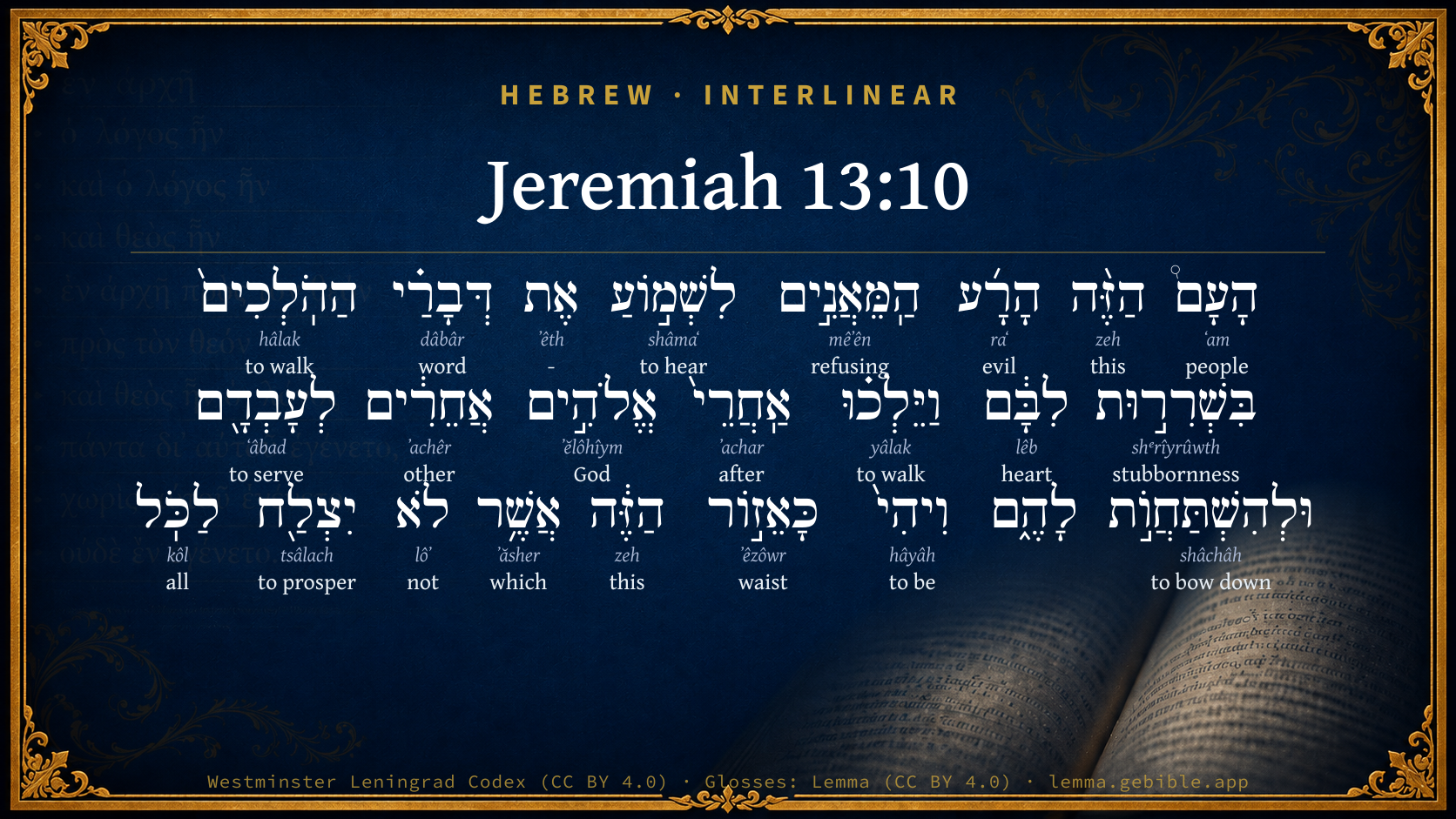
Jeremiah 13:10

Hebrew (Westminster Leningrad Codex) Jeremiah 13:10 appears in the Hebrew Old Testament. The text above is from the Westminster Leningrad Codex. Each word links to its Strong’s number, a concise gloss, and parsing drawn from the Open Scriptures Hebrew Bible morphology. Click any word for its full Brown-Driver-Briggs (BDB) entry.
Download image
Cite this verse

Jeremiah 13:10 (World English Bible). Public Domain. Lemma interlinear Bible study tool, https://lemma.gebible.app/v/jeremiah/13/10.

Show BibTeX & RIS
BibTeX
RIS
English Translation
This evil people, who refuse to hear my words, who walk in the stubbornness of their heart, and are gone after other gods to serve them, and to worship them, shall even be as this belt, which is profitable for nothing.
World English Bible · Public Domain
Highlights
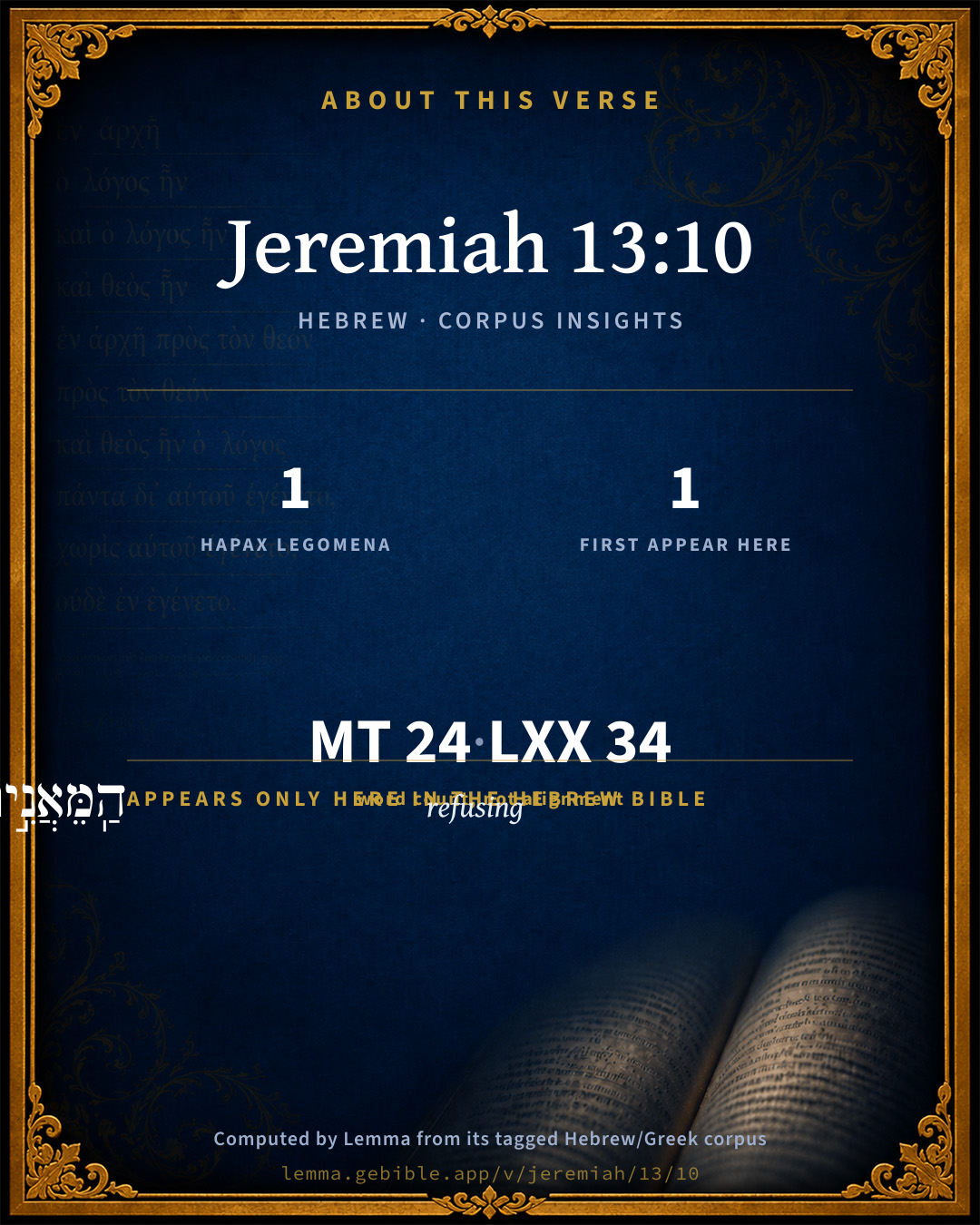
  • 1 hapax legomenon — only here in the Hebrew Bible
  • 1 first appearance in the Hebrew Bible
Full analysis ↓
Download a study sheet

One document with this verse’s original text, its word-by-word gloss line, the meaning frame, cross-references with their text, attributed commentary, and full source and license credits — printable, and it pastes into notes with its structure intact.

This verse Autodidact and up

Study sheet (.html) Plain text (.txt)

A passage Seminary Student

Up to 50 verses in one chapter. A passage sheet keeps up to 6 commentary sources and 12 cross-references per verse, in the order this page ranks them, and says so on the sheet whenever that leaves anything out. Ask for a single verse and you get the Autodidact verse sheet above.

Everything on this page stays free to read, with no account — the sheet is a download of what is already on screen, not access to it.

Want to remove ads? Support Godless Engineer
Compare translations 3

The same verse in 3 English versions, stacked beneath the original-language interlinear above. Click any original word for its lexicon entry.

Each is an independent rendering of the whole verse — the interlinear is not word-aligned to these translations.

Highlighted words mark where these versions differ — a whole-verse word diff, not a word-by-word alignment.

  • World English Bible Public Domain
    This evil people, who refuse to hear my words, who walk in the stubbornness of their heart, and are gone after other gods to serve them, and to worship them, shall even be as this belt, which is profitable for nothing.
  • King James Version Public Domain
    This evil people, which refuse to hear my words, which walk in the imagination of their heart, and walk after other gods, to serve them, and to worship them, shall even be as this girdle, which is good for nothing.
  • unfoldingWord Literal Text CC BY-SA 4.0
    This evil people, the ones who refuse to listen to my words, the ones walking in the stubbornness of their heart, and they have walked after other gods to serve them and to bow down to them—let him be like this loincloth that is not good for anything.

unfoldingWord Literal Text — © unfoldingWord, licensed CC BY-SA 4.0. Word-aligned USFM3 via Door43 (git.door43.org/unfoldingWord/en_ult).

Versions to compare (up to 4)

3 of 4 selected

Show all 18 translations

Every available English version of this verse, each an independent rendering of the whole verse.

  • World English Bible Public Domain
    This evil people, who refuse to hear my words, who walk in the stubbornness of their heart, and are gone after other gods to serve them, and to worship them, shall even be as this belt, which is profitable for nothing.
  • Berean Standard Bible Public Domain
    These evil people, who refuse to listen to My words, who follow the stubbornness of their own hearts, and who go after other gods to serve and worship them, they will be like this loincloth—of no use at all.
  • Majority Standard Bible Public Domain
    These evil people, who refuse to listen to My words, who follow the stubbornness of their own hearts, and who go after other gods to serve and worship them, they will be like this loincloth—of no use at all.
  • King James Version Public Domain
    This evil people, which refuse to hear my words, which walk in the imagination of their heart, and walk after other gods, to serve them, and to worship them, shall even be as this girdle, which is good for nothing.
  • American Standard Version (1901) Public Domain
    This evil people, that refuse to hear my words, that walk in the stubbornness of their heart, and are gone after other gods to serve them, and to worship them, shall even be as this girdle, which is profitable for nothing.
  • Revised Version (1885) Public Domain
    This evil people, which refuse to hear my words, which walk in the stubbornness of their heart, and are gone after other gods to serve them, and to worship them, shall even be as this girdle, which is profitable for nothing.
  • Geneva Bible (1599) Public Domain
    This wicked people haue refused to heare my word, and walke after ye stubbernesse of their owne heart, and walke after other gods to serue them, and to worship them: therefore they shalbe as this girdle, which is profitable to nothing.
  • Douay-Rheims (1899) Public Domain
    This wicked people, that will not hear my words, and that walk in the perverseness of their heart, and have gone after strange gods to serve them, and to adore them: and they shall be as this girdle which is fit for no use.
  • Young's Literal Translation Public Domain
    This evil people, who refuse to hear My words, Who walk in the stubbornness of their heart, And go after other gods to serve them, And to bow themselves to them, Yea it is -- as this girdle, that is not profitable for anything.
  • Literal Standard Version CC BY-SA 4.0
    This evil people, who refuse to hear My words, || Who walk in the stubbornness of their heart, || And go after other gods to serve them, || And to bow themselves to them, || Indeed it is—as this girdle, that is not profitable for anything.
  • Unlocked Literal Bible CC BY-SA 4.0
    This wicked people who refuses to listen to my word, who walk in the hardness of their heart, who go after other gods to worship them and bow down to them—they will be like this undergarment that is good for nothing.
  • unfoldingWord Literal Text CC BY-SA 4.0
    This evil people, the ones who refuse to listen to my words, the ones walking in the stubbornness of their heart, and they have walked after other gods to serve them and to bow down to them—let him be like this loincloth that is not good for anything.
  • Darby Bible Public Domain
    This evil people, who refuse to hear my words, who walk in the stubbornness of their heart, and go after other gods, to serve them and to worship them, shall even be as this girdle which is good for nothing.
  • World Messianic Bible Public Domain
    This evil people, who refuse to hear my words, who walk in the stubbornness of their heart, and have gone after other gods to serve them and to worship them, will even be as this belt, which is profitable for nothing.
  • Webster's Bible Public Domain
    This evil people, who refuse to hear my words, who walk in the imagination of their heart, and walk after other gods, to serve them, and to worship them, shall even be as this girdle, which is good for nothing.
  • Free Bible Version CC BY-SA 4.0
    These evil people refuse to listen to what I tell them. They follow their own stubborn and evil thinking and run off to worship other gods—they will be like this loincloth, completely useless.
  • Bible in Basic English Public Domain
    These evil people who say they will not give ear to my words, who go on in the pride of their hearts and have become servants and worshippers of other gods, will become like this band which is of no use for anything.
  • JPS Tanakh (1917) Public Domain
    even this evil people, that refuse to hear My words, that walk in the stubbornness of their heart, and are gone after other gods to serve them, and to worship them, that it be as this girdle, which is profitable for nothing.

Literal Standard Version (2020), Covenant Press — licensed CC BY-SA 4.0. Text via the HelloAO Bible API (eBible.org). Unlocked Literal Bible (unfoldingWord) — licensed CC BY-SA 4.0. Text via the HelloAO Bible API (eBible.org). unfoldingWord Literal Text — © unfoldingWord, licensed CC BY-SA 4.0. Word-aligned USFM3 via Door43 (git.door43.org/unfoldingWord/en_ult). Free Bible Version, Dr. Jonathan Gallagher — licensed CC BY-SA 4.0. Text via the HelloAO Bible API (eBible.org).

Word by word

More ways to search: Search by grammar → Find every occurrence → Compare this word →

Practice this passage: Drill this verse → Learn its vocabulary →

הַֽמֵּאֲנִ֣ים
mêʼên
H3987
“the · refusing”
Particle, Definite Article + Verb, Piel, Participle Active, Masculine, Plural, Absolute
Part of Speech
Particle + Verb
Stem
Piel
Form
Participle Active
Gender
Masculine
Number
Plural
State
Absolute
Full BDB Definition

Origin: from H3985

TWOT: 1138b

refusing
  1. הָעָם֩ ʻam H5971 “the · people” Particle, Definite Article + Noun, Common, Masculine, Singular, Absolute
  2. הַזֶּ֨ה zeh H2088 “the · this” Particle, Definite Article + Pronoun, Demonstrative, Masculine, Singular
  3. הָרָ֜ע raʻ H7451 “the · evil” Particle, Definite Article + Adjective, Adjective, Masculine, Singular, Absolute
  4. לִשְׁמ֣וֹעַ shâmaʻ H8085 “to hear” Preposition + Verb, Qal, Infinitive Construct
  5. אֶת ʼêth H853 “-” Particle, Direct Object
  6. דְּבָרַ֗י dâbâr H1697 “words · my” Noun, Common, Masculine, Plural, Construct + Suffix, Personal, 1st Person, Common, Singular
  7. הַהֹֽלְכִים֙ hâlak H1980 “the · walking” Particle, Definite Article + Verb, Qal, Participle Active, Masculine, Plural, Absolute
  8. בִּשְׁרִר֣וּת shᵉrîyrûwth H8307 “in/at · stubbornness of” Preposition + Noun, Common, Feminine, Singular, Construct
  9. לִבָּ֔ם lêb H3820 “heart · their” Noun, Common, Masculine, Singular, Construct + Suffix, Personal, 3rd Person, Masculine, Plural
  10. וַיֵּלְכ֗וּ yâlak H3212 “and · to walk” Conjunction + Verb, Qal, Sequential Imperfect, 3rd Person, Masculine, Plural
  11. אַֽחֲרֵי֙ ʼachar H310 “after” Preposition
  12. אֱלֹהִ֣ים ʼĕlôhîym H430 “God(s)” Noun, Common, Masculine, Plural, Absolute
  13. אֲחֵרִ֔ים ʼachêr H312 “other” Adjective, Adjective, Masculine, Plural, Absolute
  14. לְעָבְדָ֖ם ʻâbad H5647 “to serve · them” Preposition + Verb, Qal, Infinitive Construct + Suffix, Personal, 3rd Person, Masculine, Plural
  15. וּלְהִשְׁתַּחֲוֺ֣ת shâchâh H7812 “and · to bow down” Conjunction + Preposition + Verb, Hishtaphel, Infinitive Construct
  16. וִיהִי֙ hâyâh H1961 “and · to be” Conjunction + Verb, Qal, Jussive, 3rd Person, Masculine, Singular
  17. כָּאֵז֣וֹר ʼêzôwr H232 “like/as the · waist” Preposition, Determined + Noun, Common, Masculine, Singular, Absolute
  18. הַזֶּ֔ה zeh H2088 “the · this” Particle, Definite Article + Pronoun, Demonstrative, Masculine, Singular
  19. אֲשֶׁ֥ר ʼăsher H834 “which” Particle, Relative
  20. לֹא lôʼ H3808 “not” Particle, Negative
  21. יִצְלַ֖ח tsâlach H6743 “to prosper” Verb, Qal, Imperfect, 3rd Person, Masculine, Singular
  22. לַכֹּֽל kôl H3605 “to/for the · all” Preposition, Determined + Noun, Common, Masculine, Singular, Absolute

About this verse

These counts appear in no published source. They are computed here, from the morphology-tagged text and Lemma’s own curated glosses. What Lemma adds →

24
words
22
distinct lemmas
Prophets
section

Notable vocabulary

1 hapax legomenon — a word that appears only here in the entire Hebrew Bible:

  • הַֽמֵּאֲנִ֣ים refusing H3987

First appearance in Scripture

This word makes its first canonical appearance in the Hebrew Bible here:

  • הַֽמֵּאֲנִ֣ים refusing H3987

Shared distinctive vocabulary

בִּשְׁרִר֣וּת stubbornness H8307 occurs in 10 verses of the Hebrew Bible. Also found in:

Grammatical profile

  • 8 verbs
  • 7 nouns
  • 2 adjectives
  • 2 pronouns
  • 2 prepositions
  • 3 particles

Verb forms

  • הַֽמֵּאֲנִ֣ים Piel · Participle Active
  • לִשְׁמ֣וֹעַ Qal · Infinitive Construct
  • הַהֹֽלְכִים֙ Qal · Participle Active
  • וַיֵּלְכ֗וּ Qal · Sequential Imperfect
  • לְעָבְדָ֖ם Qal · Infinitive Construct
  • וּלְהִשְׁתַּחֲוֺ֣ת Hishtaphel · Infinitive Construct
  • וִיהִי֙ Qal · Jussive
  • יִצְלַ֖ח Qal · Imperfect

Repetition

A word recurs within this verse — often emphatic in Hebrew:

  • הַזֶּ֨ה this H2088 ×2

Hebrew & Septuagint length

In the original languages it is 24 Hebrew tokens and 34 Greek tokens — but the two are counted differently (Hebrew bundles its prefixes and suffixes into one token; the Greek is in lemma form), so that isn’t a like-for-like length.

Cross-references

21

Topical passages linked to Jeremiah 13:10 in the Treasury of Scripture Knowledge — connected by theme and wording, ordered by reader-vote popularity; previews shown in the World English Bible.

  • Jeremiah 9:14 but have walked after the stubbornness of their own heart, and after the Baals, which their fathers taught them;
  • Jeremiah 16:12 and you have done evil more than your fathers; for, behold, you walk every one after the stubbornness of his evil heart, so that you don't listen to me:
  • Numbers 14:11 Yahweh said to Moses, How long will this people despise me? and how long will they not believe in me, for all the signs which I have worked among them?
  • 2 Chronicles 36:15–16 Yahweh, the God of their fathers, sent to them by his messengers, rising up early and sending, because he had compassion on his people, and on his dwelling-place:
  • Jeremiah 3:17 At that time they shall call Jerusalem the throne of Yahweh; and all the nations shall be gathered to it, to the name of Yahweh, to Jerusalem: neither shall they walk any more after the stubbornness of their evil heart.
  • Jeremiah 11:7–8 For I earnestly protested to your fathers in the day that I brought them up out of the land of Egypt, even to this day, rising early and protesting, saying, Obey my voice.
  • Jeremiah 13:7 Then I went to the Euphrates, and dug, and took the belt from the place where I had hid it; and, behold, the belt was marred, it was profitable for nothing.
  • Acts 7:51 "You stiff-necked and uncircumcised in heart and ears, you always resist the Holy Spirit! As your fathers did, so you do.
  • Ephesians 4:17–19 This I say therefore, and testify in the Lord, that you no longer walk as the rest of the Gentiles also walk, in the futility of their mind,
  • Psalms 78:8 And might not be as their fathers, A stubborn and rebellious generation, A generation that didn't make their hearts loyal, Whose spirit was not steadfast with God.
  • Ecclesiastes 11:9 Rejoice, young man, in your youth, And let your heart cheer you in the days of your youth, And walk in the ways of your heart, And in the sight of your eyes; But know that for all these things God will bring you into judgment.
  • Isaiah 3:24 It shall happen that instead of sweet spices, there shall be rottenness; Instead of a belt, a rope; Instead of well set hair, baldness; Instead of a robe, a girding of sackcloth; And branding instead of beauty.
  • Jeremiah 5:23 But this people has a revolting and a rebellious heart; they are revolted and gone.
  • Jeremiah 7:24–28 But they didn't listen nor turn their ear, but walked in [their own] counsels [and] in the stubbornness of their evil heart, and went backward, and not forward.
  • Jeremiah 8:5 Why then is this people of Jerusalem slidden back by a perpetual backsliding? they hold fast deceit, they refuse to return.
  • Jeremiah 11:18 Yahweh gave me knowledge of it, and I knew it: then you shown me their doings.
  • Jeremiah 15:1–4 Then said Yahweh to me, Though Moses and Samuel stood before me, yet my mind would not be toward this people: cast them out of my sight, and let them go forth.
  • Jeremiah 16:4 They shall die grievous deaths: they shall not be lamented, neither shall they be buried; they shall be as dung on the surface of the ground; and they shall be consumed by the sword, and by famine; and their dead bodies shall be food for the birds of the sky, and for the animals of the earth.
  • Jeremiah 25:3–7 From the thirteenth year of Josiah the son of Amon, king of Judah, even to this day, these twenty-three years, the word of Yahweh has come to me, and I have spoken to you, rising up early and speaking; but you have not listened.
  • Jeremiah 34:14–17 At the end of seven years you shall let go every man his brother who is a Hebrew, who has been sold to you, and has served you six years, you shall let him go free from you: but your fathers didn't listen to me, neither inclined their ear.
  • Hebrews 12:25 See that you don't refuse him who speaks. For if they didn't escape when they refused him who warned on the Earth, how much more will we not escape who turn away from him who warns from heaven,

Cross-references courtesy of OpenBible.info (CC BY 4.0).

Hebrew and Greek witnesses Masoretic Hebrew ↔ Greek Septuagint

The same verse in the two great witnesses to the Old Testament, shown verse-for-verse.

These are two independent witnesses, not word-aligned to each other, and the Septuagint is shown in lemma (dictionary) form.

Hebrew Jeremiah 13:10 Masoretic · Westminster Leningrad Codex

הָעָם֩ הַזֶּ֨ה הָרָ֜ע הַֽמֵּאֲנִ֣ים לִשְׁמ֣וֹעַ אֶת דְּבָרַ֗י הַהֹֽלְכִים֙ בִּשְׁרִר֣וּת לִבָּ֔ם וַיֵּלְכ֗וּ אַֽחֲרֵי֙ אֱלֹהִ֣ים אֲחֵרִ֔ים לְעָבְדָ֖ם וּלְהִשְׁתַּחֲוֺ֣ת לָהֶ֑ם וִיהִי֙ כָּאֵז֣וֹר הַזֶּ֔ה אֲשֶׁ֥ר לֹא יִצְלַ֖ח לַכֹּֽל

This evil people, who refuse to hear my words, who walk in the stubbornness of their heart, and are gone after other gods to serve them, and to worship them, shall even be as this belt, which is profitable for nothing.

World English Bible · Public Domain

Greek LXX Structure differs

In the Septuagint, Jeremiah is about an eighth shorter than the Hebrew and arranges its material differently — the Oracles Against the Nations (Hebrew chapters 46–51) appear in the middle of the Greek book, after 25:13. Because the chapter and verse boundaries do not line up, a verse-for-verse comparison with the Hebrew is not shown.

A verse-for-verse comparison isn’t shown here because the chapters and verses don’t line up. Switch to the LXX edition with the MT / LXX toggle above to read the Greek directly.

Hebrew: Westminster Leningrad Codex (CC BY 4.0). Greek: Septuagint (public domain); English from a public-domain English Septuagint. How the Septuagint differs from the Hebrew →

Targum (Aramaic paraphrase)

1

The Targum is the ancient Jewish Aramaic paraphrase of the Hebrew Scriptures — an interpretive translation, not the Hebrew text itself. Onkelos (literal) and Pseudo-Jonathan (expansive) render the Torah, and Jonathan the Prophets. Coverage is partial: where no permissively-licensed English translation exists for a verse, only the Aramaic is shown. This is verse-level text, not a word-by-word alignment to the Hebrew.

  1. Targum Jonathan Prophets (Joshua–Malachi)
    עַמָא הָדֵין דְעוֹבָדֵיהוֹן בִּישִׁין דְסָרִיבוּ לְקַבָּלָא יַת פִּתְגָמָא דְאָזְלִין בָּתַר הִרְהוּר לִבְּהוֹן וּטְעוֹ בָּתַר טַעֲוַת פַּלְחֵי כּוֹכְבַיָא לְמִפְלַחְהוֹן וּלְמִסְגֵיד לְהוֹן וִיהוֹן כְּזַרְזָא הָדֵין דְלֵית בְּהוֹן צְרוֹךְ לְכָל מִדָעַם:

    (no public-domain English translation for this verse)

    Targum Jonathan — Aramaic: “Mikraot Gedolot” (public domain). English: “Sefaria Community Translation” (CC0 1.0 (public-domain dedication)); “London "Chaldee Paraphrase," 1871” (public domain). Text via Sefaria.

Commentary

Notes on Jeremiah 13:10 from classic Christian and Jewish commentators (each source and its license shown beneath its notes). The classic Christian expositions comment on the surrounding passage and are grouped to its opening verse, so a note may address several verses; the Jewish commentaries on the Tanakh (Rashi and others) are per-verse, so they appear only where the commentator wrote on this verse.

Lemma curates 59 commentaries, every one of them public domain or Creative Commons licensed, each selected and text-cleaned for this edition rather than reprinted as found. About our sources →

Trapp's Complete Commentary

John Trapp

Jer 13:10 This evil people, which refuse to hear my words, which walk in the imagination of their heart, and walk after other gods, to serve them, and to worship them, shall even be as this girdle, which is good for nothing.

Ver. 10. This evil people.] Populus ille pessimus; these Poneropolitans, who are naught all over, nequitia cooperti.

Walk in the imagination of their heart.] See Jer 9:13; Jer 11:8.

John Trapp, A Commentary or Exposition upon All the Books of the Old and New Testament (1647–1656) — public domain. Text from a community e-Sword module.

The Biblical Illustrator

Joseph S. Exell

Jer_13:10

This evil people which refuse to hear My words.

Rejecters of Gods word

I. Sensational preaching: in what sense to be approved. The style of this teaching of Jeremiah looks sensational. He is bidden to take a fine, new linen girdle--a most important and ornamental part of an Oriental gentlemans garments--and bury it for a time near the Euphrates. Taking it up afterwards, he was to exhibit it to the people of Judah and Jerusalem, with all the marks of injury and decay upon it, as a sign and type of the decline and decay that the Lord would bring on them in Babylon, when, parted from Him to whom they had been bound as a girdle to a mans body, they should be buried under the oppression and contempt of their proud and domineering captors.

II. Rejection of the divine word.

1. Even the most highly favoured persons may reject Gods Word.

2. The transgressors in such cases prefer their own imagination to Gods revelations. Religion says to God, Thy will be done. The natural heart says, My will be done--Who is the Lord that I should obey Him?

3. The moral influence of such perverseness is bad, progressively bad. Having cast off God, the human nature cannot stand up alone. It needs a support. It must worship. So it goes after other, and of course false, gods. Every sin has three distinct effects, apart from the punishment of the future:

(1) It depraves and deteriorates the nature that sins. The brain is not broken, but strained; the marble is not fractured, but the eye of omniscience sees the flaw.

(2) It familiarises with evil and goes so far towards making an evil habit.

(3) It renders some other sin not only easier, but apparently necessary. Having done one thing, says the sinner, of course I had to do the other.

4. The effect of rejecting Gods Word is lamentable in the extreme. If the fire of Divine anger burnt up that vine which He had planted, how will it be with the common tree of the forest?

III. By whom is the word of the Lord rejected?

1. In a certain strict and literal sense every unbeliever is an infidel, i.e. he is without faith. But many are without faith who yet assent to the general truths of Gods Word. Many infidels have made it their own interest to impugn and deny Divine revelation. A man has broken its precepts--perhaps suffered socially in consequence--has not repented, but only been embittered, begins to count those who censure or condemn him first bigoted, narrow-minded, then pharisaical, and hypocritical or fanatical. They justify their action by the Scriptures, and he begins to transfer his dislike to the Scriptures, feels a pleasure in any doubt cast on them, flatters himself that to weaken them is to strengthen his case, and that contempt poured on them is respect won back for him. Hence the bitterest scoffers have often been the religiously trained sinners.

2. Sceptics are included among the rejecters of Gods Word. Not that they are necessarily irreligious, or deniers of a Divine Being and of obligation to Him; but they deny the Scriptures as an authoritative revelation from Him and make nature a sufficient teacher.

3. If I include Romanism among the rejecters of Gods Word, it must be with a qualification. That system admits the inspiration, Divine origin, and partial authority of Gods Word, and so far as it can appeal to Scripture does so. Its sins in this regard are:

(1) Putting up beside the Word tradition, which, like that of the Pharisees, makes the Word of God of no effect.

(2) Making the authorisation of the Scripture depend on the Church, and constituting the Church the only expounder of Scripture.

(3) And following from this, she withholds the Scriptures from her people.

4. The indifferent and unbelieving reject Gods Word. You have heard it explained, read it, had it urged on you by beloved ones, now praising God in the rest of the saints. Have you believed it? Received Christ? Are you resting on Him? Doing His will? For if not, your condemnation is doubly sure. (John Hall, D. D.)

Gods girdle

I. Israel and Judah clave unto Jehovah as a girdle to the loins of a man.

1. Unto His person for favour.

2. Unto His Word for direction and teaching.

3. Unto His promise for encouragement.

4. Unto His worship for devotion.

II. Israel and Judah were then a praise and glory to Jehovah. A girdle of strength and honour before the nations.

1. As opposed to the idolatries of the world.

2. As expressing obedience to Divine law.

3. As exhibiting the beneficial effects of true religion.

III. Israel and Judah became faithless and disobedient.

1. An evil people refusing to hear the Word.

2. A stubborn people going their own way.

3. A deluded people in vain imaginations.

4. An idolatrous people, like the nations less favoured, going after other gods to serve and worship them.

IV. Israel and Judah becoming faithless, became also weak and worthless. Went from prominence to obscurity, from freedom to captivity, from privilege to punishment. (W. Whale.)

Cleaving unto God

In Trinidad there are small oysters to be found that grow upon trees, or rather cluster round the roots of trees, in the river mouths. The little bivalves are so firmly attached that it is usual to saw down the trees in order to obtain the oysters, and such an attachment is typical of the ideal life of a Christian. He should love the Lord his God, and obey His voice, that he may cleave unto Him. God, who is the source of all life, will indeed be his life and the light of his days. As the strength of the tree is placed at the disposal of the oyster, so is the omnipotence of God offered to all who will trust Him. (Christian Commonwealth.)

Which is good for nothing.

Good for nothing

I. Dwell upon a painful fact. All was done for them that could be, and yet good for nothing.

II. Point out the cause of their sad condition.

1. They refused to hear the Word of the Lord.

2. They followed the imagination of their hearts.

3. They became idolaters.

III. Show what they might have been as a people.

1. Separated from the nations as peculiarly the people of God.

2. Before the nations for the glory of Jehovah, as opposed to idols.

3. Among the nations as witnesses and examples.

IV. Proclaim some universal truths.

1. Refusing to hear Gods Word is proof that the people are all evil people.

2. An evil people will substitute a false worship for that which is true.

3. A false worship will produce and foster an erroneous religious life.

4. A people walking according to the imagination of their own hearts must be useless to themselves, to the world, to the Church, or to God. (W. Whale.)

The unprofitableness of a sinful life

I heard the other day a Sunday school address which pleased me much. The teacher, speaking to the boys, said, Boys, here is a watch; what is it for? To tell the time. Well, said he, suppose my watch does not tell the time, what is it good for? Good for nothing, sir. Then he took out a pencil. What is this pencil for? It is to write with, sir. Suppose this pencil wont make a mark, what is it good for? Good for nothing, sir. Then he took out a pocket knife. Boys, what is this for? They were American boys, so they shouted, To whittle with,--that is, to experiment on any substance that came in their way, by cutting a notch in it. But, said he, suppose it will not cut, what is the knife good for? Good for nothing, sir. Then the teacher said, What is the chief end of man? and they replied, To glorify God. But suppose a man does not glorify God, what is he good for? Good for nothing, sir. (C. H. Spurgeon.)

The Biblical Illustrator, edited by Joseph S. Exell (c. 1880s–1900s) — public domain. Text from a community e-Sword module.

Tyndale Open Study Notes

Tyndale Open Resources

13:10-11 The rotten loincloth represented the people of Judah and Israel, whose wicked rebellion had corrupted them and made them worthless. • clings: The same Hebrew word can be translated “joins” and is used to describe marital faithfulness (Gen 2:24). • my people . . . an honor to my name: See also Exod 19:5, 6; Deut 32:10-12; Eph 2:7; 3:10.

Tyndale Open Study Notes — © Tyndale Open Resources, licensed CC BY-SA 4.0. Text via the HelloAO Bible API.

Jamieson, Fausset & Brown

Robert Jamieson, A. R. Fausset & David Brown

imagination--rather, "obstinacy."

Jamieson, Fausset & Brown — Commentary Critical and Explanatory on the Whole Bible (1871) — public domain (CC PDM 1.0). Text via the HelloAO Bible API.

John Calvin's Commentaries

The Prophet said, according to what we observed yesterday, that the people would be like the belt which he had hidden in a hole and found putrified: but now the cause is expressed why God had resolved to treat them with so much severity. He then says that he would be an avenger, because the Jews had refused to obey his voice, and preferred their own inventions in walking after the hardness, or the wickedness of their own heart We hence see that the cause of this calamity was, that the people had rejected the teaching of the prophets. This indeed was far more grievous than if they had fallen away through mistake or ignorance, as we often see that men go miserably astray when the teaching of the truth is taken away. But when God shews the way, and prescribes what is right, when by his servants he exhorts his people, it is an inexcusable hardness if men repudiate such a kindness. But as this subject has been elsewhere largely treated, I shall only touch on it now briefly.

We see then that God threatens his people with extreme calamity, because they would not. bear to be taught by his prophets. Then he adds, that they had walked after the wickedness of their own heart, and had walked after foreign gods He in the first place complains that they had been so refractory as to prefer to obey their own impious inclinations than to be ruled by good and salutary counsels. But it was necessary to specify their crime; for had the Prophet only spoken of their hardness, they might have had their objections ready at hand; but when he said that they had walked after foreign gods, there was no longer any room for evasion. The word to walk has a reference to a way. This metaphor has indeed a relation to something else; for men are not wont to take a course without going somewhere, we must therefore have some end in view when we walk along any way. Now, there is to be understood here a contrast, that the people despised the way pointed out to them by God, and that they had preferred to follow their own errors. God was ready to guide the Jews; by his own law; but they chose rather, as I have said, to abandon themselves to their own errors, as it were designedly.

He says, that they had walked after alien gods, that they might serve them, and prostrate themselves before them; for such is the meaning of the last verb. The Prophet no doubt repeats the same thing, for to serve is not only to obey, but also to worship. And hence is refuted that folly of the Papists, who imagine that worship (duliam) is not inconsistent with true religion; for they say that service (latriam) is due only to God, but that worship may be given to angels, to statues, or to dead men, as though God, forsooth! in condemning superstitions, did not use the word עבד obed, to serve. It hence follows that it is extremely ridiculous to devise two sorts of worship, one peculiar to God, and another common to angels as well as to men and dead idols. We now understand the import of this verse: the Prophet draws this conclusion, that the Jews would become like a useless or a putrefied belt. It afterwards follows —

John Calvin's Commentaries (1540-1563) — public domain. Text from the Calvin Translation Society English edition (1840s-50s) via the Christian Classics Ethereal Library (ccel.org). Calvin's coverage is partial (roughly two-thirds of the Bible); uncommented books and verses are honest gaps, never fabricated. The 19th-century editor's footnotes and remarks are omitted so the notes are faithfully Calvin's own voice.

Ellicott's Commentary for English Readers

(10) Imagination.—Better, as before, stubbornness.

Shall even be as this girdle.—The same thought is reproduced in the imagery of the potter’s vessel in Jer_18:4. On the other hand there is a partial reversal of the sentence in Jer_24:5, where the “good figs” represent the exiles who learnt repentance from their sufferings, and the “bad” those who still remained at Jerusalem under Zedekiah.

Which is good for nothing.—Better, profitable for nothing, the Hebrew verse being the same as in Jer_13:7.

A Bible Commentary for English Readers, edited by Charles John Ellicott (1878–1897) — public domain. Text from a community e-Sword module.

The Cambridge Bible for Schools and Colleges

gen. ed. J. J. S. Perowne

10. stubbornness] See ch. Jer_3:17.

shall even be] Heb. let it be.

The Cambridge Bible for Schools and Colleges (gen. ed. J. J. S. Perowne; Cambridge University Press, 1878–1918) — public domain. Text from a community e-Sword module.

John Gill's Exposition

For as the girdle cleaveth to the loins of a man,.... Being girt tight unto him:

so have I caused to cleave unto me the whole house of Israel, and the whole house of Judah; whom he chose above all people, and caused to approach unto him, and dwell in his courts; whom he favoured with his presence, and encouraged them to follow after him, and cleave to him in faith and affection, and with full purpose of heart; so that they were a people near unto him as a man's girdle is to his loins: and the end of this was, and would have been, had they continued so,

that they might be unto me for a people; his own people, a special and peculiar people above all others, peculiarly favoured and blessed by him, and continue so, and in the enjoyment of all good things:

and for a name, and for a praise, and for a glory; for a famous and renowned people, that should be to the praise and glory of God, and an honour to him, and an ornament to the profession of him; whereas they were the reverse:

but they would not hear; the words of the Lord, nor obey his voice; but served other gods, departed from the Lord, to whom they should have cleaved, and so became like this rotten girdle.

John Gill's Exposition of the Whole Bible (1746–1763) — public domain (CC PDM 1.0). Text via the HelloAO Bible API.

Albert Barnes' Notes on the Bible

This verse limits the application of the symbol. Only the ungodly and the idolatrous part of the people decayed at Babylon. The religious portion was strengthened and invigorated by the exile Jer 24:5-7.

Albert Barnes' Notes on the Bible (1834–1885) — public domain. Text from a community e-Sword/MySword module.

Matthew Poole's English Annotations

Hitherto the prophet had yielded a blind obedience to God, doing what he commanded him, though he possibly knew no other reason for it but because God bade him do so (which is a homage we owe unto God, though to none but him); now God expounds himself what he meant to teach the Jews by this, viz. that he did intend that they should be consumed by the people beyond the river Euphrates, as that girdle was there marred; and he also shows them that their own sins in disobeying his word, and following the imaginations of their own hearts, particularly their idolatry, was what had brought this sore judgment upon them.

Matthew Poole's English Annotations on the Holy Bible (1683–1685) — public domain. Text from a community e-Sword/MySword module.

Whedon's Commentary on the Bible

Daniel D. Whedon

10. Good for nothing — In themselves, and to outward appearance, but really more fit for God’s high purposes than before. Their political existence was virtually terminated; but as instruments of preparation for the coming reign of Messiah they were still to serve an important use.

Daniel D. Whedon (gen. ed.), Commentary on the Old and New Testaments (1874–1909) — public domain. Text from a community e-Sword module.

Rashi

Rabbi Shlomo Yitzchaki (Rashi)

and it shall be like this girdle Their pride shall be like this rotten girdle.

Rashi on the Tanakh — English translations: “The Judaica Press complete Tanach with Rashi, translated by A. J. Rosenberg” (CC BY 4.0); “Pentateuch with Rashi's commentary by M. Rosenbaum and A.M. Silbermann, 1929-1934” (public domain); “The Metsudah Tanach series, Lakewood, N.J” (CC BY 4.0); and “The Book of Joshua, Metsudah Publications, 1997” (CC BY 4.0). Text via Sefaria.

Lesson kit

Teaching starters — assembled from the data on this page, not authored interpretation. Every prompt links to the verse data it draws on. Edit before teaching.

Jeremiah, in the Prophets, opens this verse with 24 words (22 distinct Hebrew lemmas). Its most distinctive word is mêʼên (“refusing”). A historical commentator’s framing appears above. Read the whole chapter for the surrounding context.

Discussion questions

  1. What does “refusing” (mêʼên) contribute to the verse as a whole?
  2. This verse holds 1 word here found nowhere else in the Hebrew Bible. What might the rare word draw attention to?
  3. The word “refusing” first appears here in Scripture. What is being introduced at this debut?
  4. Deuteronomy 29:19 shares the word «stubbornness» with this verse. How do the two illuminate each other?
  5. “this” occurs 2× in this one verse. What is the effect of the repetition?
  6. These translations render this verse differently; the difference is in the English rendering, not the original. What questions does that raise?
  7. The verb «הַֽמֵּאֲנִ֣ים» is Piel Participle Active. How does its form color the action?
  8. Reading how Trapp's Complete Commentary and The Biblical Illustrator read this verse, where do the two commentators agree and where do they part?

Things to notice

  • 1 word in this verse appears nowhere else in the Hebrew Bible.
  • 1 word makes its first canonical appearance in Scripture here.
  • This verse counts 24 Hebrew ↔ 34 Greek words.
  • These translations choose different wording for 27 words in this verse.
  • “this” occurs 2× in this single verse.

Reading settings

Reading text

Shown beneath each verse's original-language words.

Old Testament
Old Testament edition

Read the OT as the Masoretic Hebrew (MT) or the Greek Septuagint (LXX).

English shown for the Greek Septuagint (in the Hebrew ↔ Greek comparison).

Comparing translations? Open the Compare panel on any verse page to stack up to four side by side.