
Zechariah 14:17

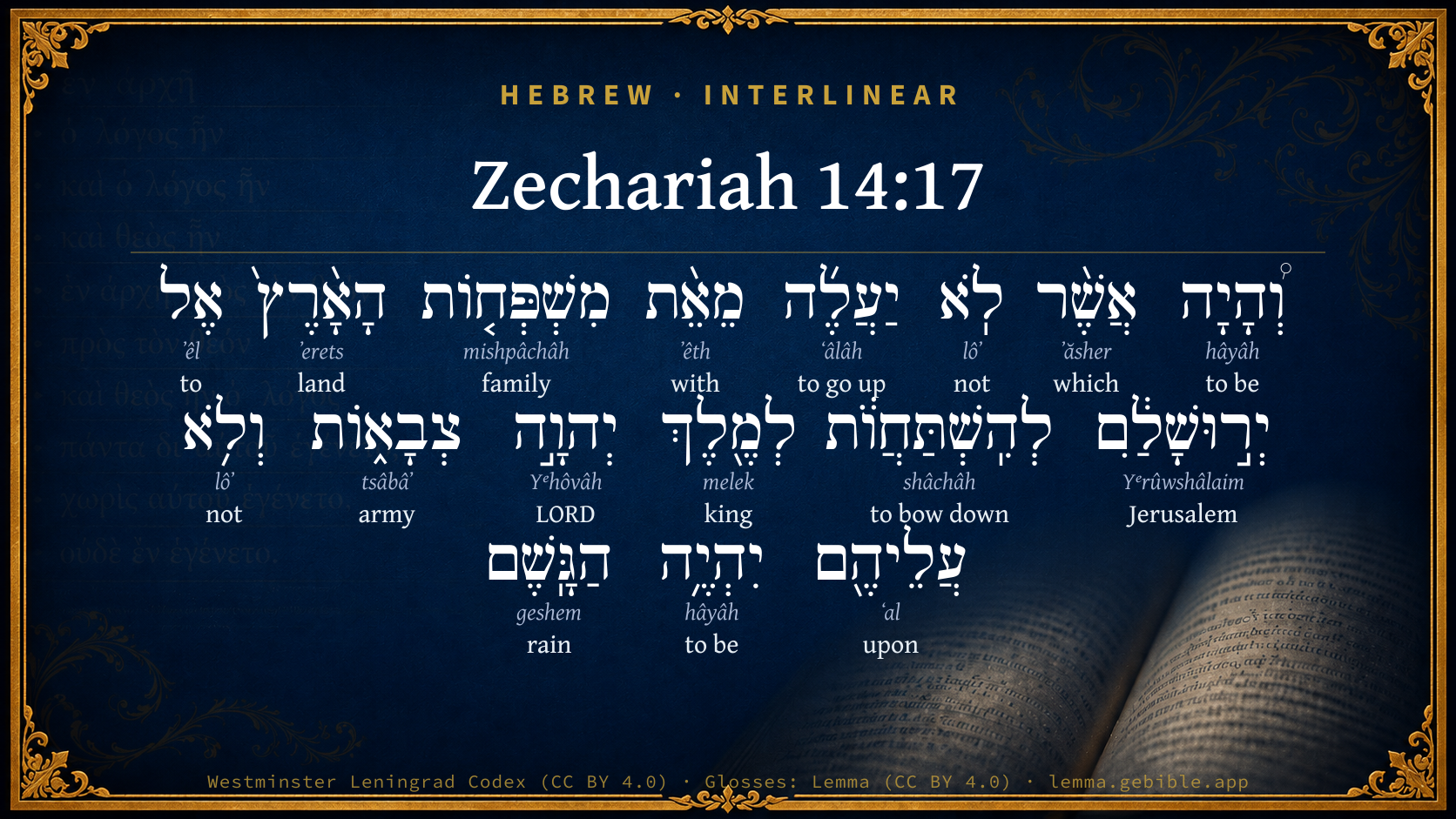
Hebrew (Westminster Leningrad Codex) Zechariah 14:17 appears in the Hebrew Old Testament. The text above is from the Westminster Leningrad Codex. Each word links to its Strong’s number, a concise gloss, and parsing drawn from the Open Scriptures Hebrew Bible morphology. Click any word for its full Brown-Driver-Briggs (BDB) entry.
Download image
Cite this verse

Zechariah 14:17 (World English Bible). Public Domain. Lemma interlinear Bible study tool, https://lemma.gebible.app/v/zechariah/14/17.

Show BibTeX & RIS
BibTeX
RIS
English Translation
It will be, that whoever of all the families of the earth doesn't go up to Jerusalem to worship the King, Yahweh of Hosts, on them there will be no rain.
World English Bible · Public Domain
Download a study sheet

One document with this verse’s original text, its word-by-word gloss line, the meaning frame, cross-references with their text, attributed commentary, and full source and license credits — printable, and it pastes into notes with its structure intact.

This verse Autodidact and up

Study sheet (.html) Plain text (.txt)

A passage Seminary Student

Up to 50 verses in one chapter. A passage sheet keeps up to 6 commentary sources and 12 cross-references per verse, in the order this page ranks them, and says so on the sheet whenever that leaves anything out. Ask for a single verse and you get the Autodidact verse sheet above.

Everything on this page stays free to read, with no account — the sheet is a download of what is already on screen, not access to it.

Want to remove ads? Support Godless Engineer
Compare translations 3

The same verse in 3 English versions, stacked beneath the original-language interlinear above. Click any original word for its lexicon entry.

Each is an independent rendering of the whole verse — the interlinear is not word-aligned to these translations.

Highlighted words mark where these versions differ — a whole-verse word diff, not a word-by-word alignment.

  • World English Bible Public Domain
    It will be, that whoever of all the families of the earth doesn't go up to Jerusalem to worship the King, Yahweh of Hosts, on them there will be no rain.
  • King James Version Public Domain
    And it shall be, that whoso will not come up of all the families of the earth unto Jerusalem to worship the King, the LORD of hosts, even upon them shall be no rain.
  • unfoldingWord Literal Text CC BY-SA 4.0
    It will happen if anyone from all the nations of the earth does not go up to Jerusalem to worship the king, Yahweh of hosts, then Yahweh will not bring rain on them.

unfoldingWord Literal Text — © unfoldingWord, licensed CC BY-SA 4.0. Word-aligned USFM3 via Door43 (git.door43.org/unfoldingWord/en_ult).

Versions to compare (up to 4)

3 of 4 selected

Show all 18 translations

Every available English version of this verse, each an independent rendering of the whole verse.

  • World English Bible Public Domain
    It will be, that whoever of all the families of the earth doesn't go up to Jerusalem to worship the King, Yahweh of Hosts, on them there will be no rain.
  • Berean Standard Bible Public Domain
    And should any of the families of the earth not go up to Jerusalem to worship the King, the LORD of Hosts, then the rain will not fall on them.
  • Majority Standard Bible Public Domain
    And should any of the families of the earth not go up to Jerusalem to worship the King, the LORD of Hosts, then the rain will not fall on them.
  • King James Version Public Domain
    And it shall be, that whoso will not come up of all the families of the earth unto Jerusalem to worship the King, the LORD of hosts, even upon them shall be no rain.
  • American Standard Version (1901) Public Domain
    And it shall be, that whoso of `all' the families of the earth goeth not up unto Jerusalem to worship the King, Jehovah of hosts, upon them there shall be no rain.
  • Revised Version (1885) Public Domain
    And it shall be, that whoso of all the families of the earth goeth not up unto Jerusalem to worship the King, the LORD of hosts, upon them there shall be no rain.
  • Geneva Bible (1599) Public Domain
    And who so will not come vp of all the families of the earth vnto Ierusalem to worship the King the Lord of hostes, euen vpon them shall come no raine.
  • Douay-Rheims (1899) Public Domain
    And it shall come to pass, that he that shall not go up of the families of the land to Jerusalem, to adore the King, the Lord of hosts, there shall be no rain upon them.
  • Young's Literal Translation Public Domain
    And it hath come to pass, That he who doth not go up of the families of the land unto Jerusalem, To bow himself to the King, Jehovah of Hosts, Even on them there is no shower.
  • Literal Standard Version CC BY-SA 4.0
    And it has come to pass, || That he who does not go up of the families of the land to Jerusalem, || To bow himself to the King, YHWH of Hosts, || Even on them there is no shower.
  • Unlocked Literal Bible CC BY-SA 4.0
    It will happen that if anyone from all the nations of the earth does not go up to Jerusalem to worship the king, Yahweh of hosts, then Yahweh will not bring rain on them.
  • unfoldingWord Literal Text CC BY-SA 4.0
    It will happen if anyone from all the nations of the earth does not go up to Jerusalem to worship the king, Yahweh of hosts, then Yahweh will not bring rain on them.
  • Darby Bible Public Domain
    And it shall be, that whoso goeth not up of the families of the earth unto Jerusalem to worship the King, Jehovah of hosts, upon them shall be no rain.
  • World Messianic Bible Public Domain
    It will be that whoever of all the families of the earth doesn’t go up to Jerusalem to worship the King, the LORD of Hosts, on them there will be no rain.
  • Webster's Bible Public Domain
    And it shall be, that whoever will not come up of all the families of the earth to Jerusalem to worship the King, the LORD of hosts, even upon them shall be no rain.
  • Free Bible Version CC BY-SA 4.0
    If any of the peoples of the world refuse to go to Jerusalem to worship the King, the Lord Almighty, they will have no rain.
  • Bible in Basic English Public Domain
    And it will be that if any one of all the families of the earth does not go up to Jerusalem to give worship to the King, the Lord of armies, on them there will be no rain.
  • JPS Tanakh (1917) Public Domain
    And it shall be, that whoso of the families of the earth goeth not up unto Jerusalem to worship the King, the LORD of hosts, upon them there shall be no rain.

Literal Standard Version (2020), Covenant Press — licensed CC BY-SA 4.0. Text via the HelloAO Bible API (eBible.org). Unlocked Literal Bible (unfoldingWord) — licensed CC BY-SA 4.0. Text via the HelloAO Bible API (eBible.org). unfoldingWord Literal Text — © unfoldingWord, licensed CC BY-SA 4.0. Word-aligned USFM3 via Door43 (git.door43.org/unfoldingWord/en_ult). Free Bible Version, Dr. Jonathan Gallagher — licensed CC BY-SA 4.0. Text via the HelloAO Bible API (eBible.org).

Word by word

More ways to search: Search by grammar → Find every occurrence → Compare this word →

Practice this passage: Drill this verse → Learn its vocabulary →

הַגָּֽשֶׁם
geshem
H1653
“the · rain”
Particle, Definite Article + Noun, Common, Masculine, Singular, Absolute
Part of Speech
Particle + Noun
Type
Common
Gender
Masculine
Number
Singular
State
Absolute
Full BDB Definition

Origin: from H1652

TWOT: 389a

rain, shower
  1. וְ֠הָיָה hâyâh H1961 “and · to be” Conjunction + Verb, Qal, Sequential Perfect, 3rd Person, Masculine, Singular
  2. אֲשֶׁ֨ר ʼăsher H834 “which” Particle, Relative
  3. לֹֽא lôʼ H3808 “not” Particle, Negative
  4. יַעֲלֶ֜ה ʻâlâh H5927 “to go up” Verb, Qal, Imperfect, 3rd Person, Masculine, Singular
  5. מֵאֵ֨ת ʼêth H854 “from · with” Preposition + Preposition
  6. מִשְׁפְּח֤וֹת mishpâchâh H4940 “families of” Noun, Common, Feminine, Plural, Construct
  7. הָאָ֨רֶץ֙ ʼerets H776 “the · land” Particle, Definite Article + Noun, Common, Both, Singular, Absolute
  8. אֶל ʼêl H413 “to” Preposition
  9. יְר֣וּשָׁלִַ֔ם Yᵉrûwshâlaim H3389 “Jerusalem” Noun, Proper
  10. לְהִֽשְׁתַּחֲוֺ֔ת shâchâh H7812 “to bow down” Preposition + Verb, Hithpael, Infinitive Construct
  11. לְמֶ֖לֶךְ melek H4428 “to/for · king” Preposition + Noun, Common, Masculine, Singular, Absolute
  12. יְהוָ֣ה Yᵉhôvâh H3068 “LORD” Noun, Proper
  13. צְבָא֑וֹת tsâbâʼ H6635 “armies” Noun, Common, Both, Plural, Absolute
  14. וְלֹ֥א lôʼ H3808 “and · not” Conjunction + Particle, Negative
  15. עֲלֵיהֶ֖ם ʻal H5921 “upon · them” Preposition + Suffix, Personal, 3rd Person, Masculine, Plural
  16. יִהְיֶ֥ה hâyâh H1961 “to be” Verb, Qal, Imperfect, 3rd Person, Masculine, Singular

About this verse

These counts appear in no published source. They are computed here, from the morphology-tagged text and Lemma’s own curated glosses. What Lemma adds →

17
words
15
distinct lemmas
Prophets
section

Shared distinctive vocabulary

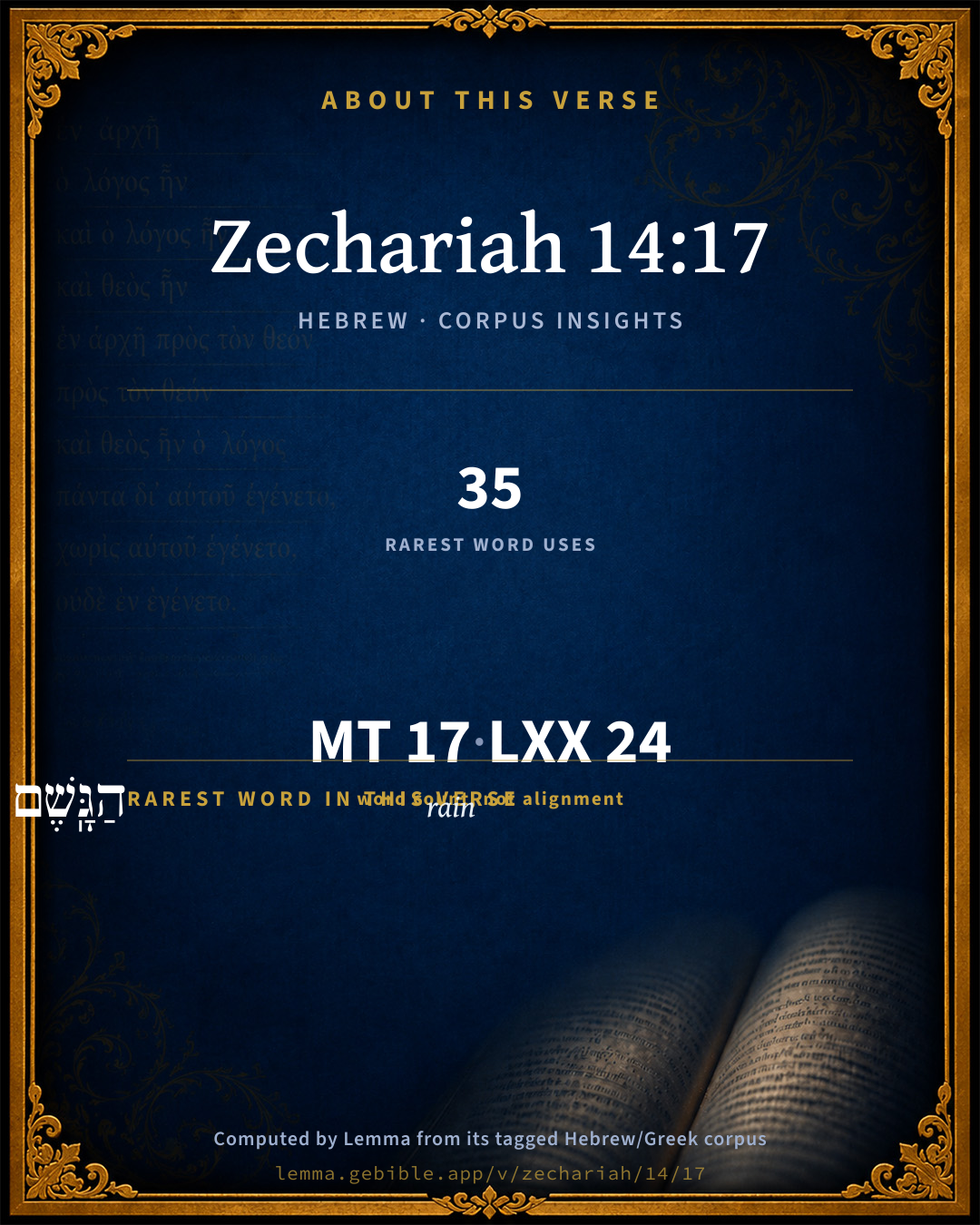
הַגָּֽשֶׁם rain H1653 occurs in 33 verses of the Hebrew Bible. Also found in:

Grammatical profile

  • 4 verbs
  • 7 nouns
  • 3 prepositions
  • 3 particles

Verb forms

  • וְ֠הָיָה Qal · Sequential Perfect
  • יַעֲלֶ֜ה Qal · Imperfect
  • לְהִֽשְׁתַּחֲוֺ֔ת Hithpael · Infinitive Construct
  • יִהְיֶ֥ה Qal · Imperfect

Repetition

Words recur within this verse — often emphatic in Hebrew:

  • וְ֠הָיָה to be H1961 ×2
  • לֹֽא not H3808 ×2

Hebrew & Septuagint length

In English translation the verse runs 31 words from the Hebrew and 36 from the Septuagint (LXX English) — closely comparable.

A rough comparison of the two English renderings, which tokenize alike — not a word-level alignment.

Word counts can differ between the Hebrew and the Greek without any difference in meaning — e.g. the Hebrew direct-object marker אֵת has no separate Greek word, and Greek often adds the article ὁ.

In the original languages it is 17 Hebrew tokens and 24 Greek tokens — but the two are counted differently (Hebrew bundles its prefixes and suffixes into one token; the Greek is in lemma form), so that isn’t a like-for-like length.

Cross-references

24

Topical passages linked to Zechariah 14:17 in the Treasury of Scripture Knowledge — connected by theme and wording, ordered by reader-vote popularity; previews shown in the World English Bible.

  • Isaiah 60:12 For that nation and kingdom that will not serve you shall perish; yes, those nations shall be utterly wasted.
  • Jeremiah 14:4 Because of the ground which is cracked, because no rain has been in the land, the plowmen are disappointed, they cover their heads.
  • Amos 4:7–8 "I also have withheld the rain from you, When there were yet three months to the harvest; And I caused it to rain on one city, And caused it not to rain on another city. One place was rained on, And the piece where it didn't rain withered.
  • James 5:17 Elijah was a man with a nature like ours, and he prayed earnestly that it might not rain, and it didn't rain on the earth for three years and six months.
  • Revelation 11:6 These have the power to shut up the sky, that it may not rain during the days of their prophecy. They have power over the waters, to turn them into blood, and to strike the earth with every plague, as often as they desire.
  • Genesis 12:3 I will bless those who bless you, and I will curse him who curses you. In you will all of the families of the earth be blessed."
  • Deuteronomy 11:17 and the anger of Yahweh be kindled against you, and he shut up the sky, so that there shall be no rain, and the land shall not yield its fruit; and you perish quickly from off the good land which Yahweh gives you.
  • Genesis 10:32 These are the families of the sons of Noah, after their generations, in their nations. Of these were the nations divided in the earth after the flood.
  • Genesis 28:14 Your seed will be as the dust of the earth, and you will spread abroad to the west, and to the east, and to the north, and to the south. In you and in your seed will all the families of the earth be blessed.
  • Deuteronomy 28:23–24 Your sky that is over your head shall be brass, and the earth that is under you shall be iron.
  • 1 Kings 17:1 Elijah the Tishbite, who was of the foreigners of Gilead, said to Ahab, As Yahweh, the God of Israel, lives, before whom I stand, there shall not be dew nor rain these years, but according to my word.
  • 2 Chronicles 6:26 When the sky is shut up, and there is no rain, because they have sinned against you; if they pray toward this place, and confess your name, and turn from their sin, when you do afflict them:
  • 2 Chronicles 7:13 If I shut up the sky so that there is no rain, or if I command the locust to devour the land, or if I send pestilence among my people;
  • Jeremiah 14:22 Are there any among the vanities of the nations that can cause rain? or can the sky give showers? Aren't you he, Yahweh our God? therefore we will wait for you; for you have made all these things.
  • Amos 3:2 "You only have I chosen of all the families of the earth. Therefore I will punish you for all of your sins."
  • 1 Kings 8:35 When the sky is shut up, and there is no rain, because they have sinned against you; if they pray toward this place, and confess your name, and turn from their sin, when you do afflict them:
  • Psalms 2:8–12 Ask of me, and I will give the nations for your inheritance, The uttermost parts of the earth for your possession.
  • Psalms 110:5–6 The Lord is at your right hand. He will crush kings in the day of his wrath.
  • Isaiah 5:6 I will lay it a wasteland. It won't be pruned nor hoed, But it will grow briers and thorns. I will also command the clouds that they rain no rain on it."
  • Isaiah 45:23 By myself have I sworn, the word is gone forth from my mouth [in] righteousness, and shall not return, that to me every knee shall bow, every tongue shall swear.
  • Zechariah 14:16 It will happen that everyone who is left of all the nations that came against Jerusalem will go up from year to year to worship the King, Yahweh of Hosts, and to keep the feast of tents.
  • Acts 17:26–27 He made from one blood every nation of men to dwell on all the surface of the earth, having determined appointed seasons, and the boundaries of their dwellings,
  • Romans 14:10–11 But you, why do you judge your brother? Or you again, why do you despise your brother? For we will all stand before the judgment seat of Christ.
  • Jeremiah 10:25 Pour out your wrath on the nations that don't know you, and on the families that don't call on your name: for they have devoured Jacob, yes, they have devoured him and consumed him, and have laid waste his habitation.

Cross-references courtesy of OpenBible.info (CC BY 4.0).

Hebrew and Greek witnesses Masoretic Hebrew ↔ Greek Septuagint

The same verse in the two great witnesses to the Old Testament, shown verse-for-verse.

These are two independent witnesses, not word-aligned to each other, and the Septuagint is shown in lemma (dictionary) form.

Hebrew Zechariah 14:17 Masoretic · Westminster Leningrad Codex

וְ֠הָיָה אֲשֶׁ֨ר לֹֽא יַעֲלֶ֜ה מֵאֵ֨ת מִשְׁפְּח֤וֹת הָאָ֨רֶץ֙ אֶל יְר֣וּשָׁלִַ֔ם לְהִֽשְׁתַּחֲוֺ֔ת לְמֶ֖לֶךְ יְהוָ֣ה צְבָא֑וֹת וְלֹ֥א עֲלֵיהֶ֖ם יִהְיֶ֥ה הַגָּֽשֶׁם

It will be, that whoever of all the families of the earth doesn't go up to Jerusalem to worship the King, Yahweh of Hosts, on them there will be no rain.

World English Bible · Public Domain

Greek LXX Zechariah 14:17 Septuagint · lemma form

καί εἰμί ὅσος ἐάν μή ἀναβαίνω ἐκ πᾶς ὁ φυλή ὁ γῆ εἰς ἰερουσαλήμ ὁ προςκυνέω ὁ βασιλεύς κύριος παντοκράτωρ καί οὗτος ἐκεῖνος προςτίθημι

And it shall come to pass, that whoever of all the families of the earth shall not come up to Jerusalem to worship the king, the Lord Almighty, even these shall be added to the others.

LXX2012 (modern English Septuagint) · Public Domain

On this verse, Haydock's Catholic Bible Commentary discusses the Septuagint’s reading. Read the note in Commentary ↓

Hebrew: Westminster Leningrad Codex (CC BY 4.0). Greek: Septuagint (public domain); English from LXX2012 (modern English Septuagint) (Public Domain). How the Septuagint differs from the Hebrew →

Targum (Aramaic paraphrase)

1

The Targum is the ancient Jewish Aramaic paraphrase of the Hebrew Scriptures — an interpretive translation, not the Hebrew text itself. Onkelos (literal) and Pseudo-Jonathan (expansive) render the Torah, and Jonathan the Prophets. Coverage is partial: where no permissively-licensed English translation exists for a verse, only the Aramaic is shown. This is verse-level text, not a word-by-word alignment to the Hebrew.

  1. Targum Jonathan Prophets (Joshua–Malachi)
    וִיהֵי דְלָא יִסַק מִן זַרְעֲיַת עַמְמֵי אַרְעָא לִירוּשְׁלֵם לְמִסְגֵיד קֳדָם מֶלַךְ עַלְמָא יְיָ צְבָאוֹת וְלָא עֲלֵיהוֹן יְהֵא מִטְרָא:

    (no public-domain English translation for this verse)

    Targum Jonathan — Aramaic: “Mikraot Gedolot” (public domain). English: “Sefaria Community Translation” (CC0 1.0 (public-domain dedication)); “London "Chaldee Paraphrase," 1871” (public domain). Text via Sefaria.

Commentary

Notes on Zechariah 14:17 from classic Christian and Jewish commentators (each source and its license shown beneath its notes). The classic Christian expositions comment on the surrounding passage and are grouped to its opening verse, so a note may address several verses; the Jewish commentaries on the Tanakh (Rashi and others) are per-verse, so they appear only where the commentator wrote on this verse.

Lemma curates 59 commentaries, every one of them public domain or Creative Commons licensed, each selected and text-cleaned for this edition rather than reprinted as found. About our sources →

Trapp's Complete Commentary

John Trapp

Zec 14:17 And it shall be, [that] whoso will not come up of [all] the families of the earth unto Jerusalem to worship the King, the LORD of hosts, even upon them shall be no rain.

Ver. 17. Even upon them shall be no rain] i.e. Nullam misericordiam assequentur, saith Theodoret; They shall get no good at God’s hand. Judea was sumen totius orbis, bread basket of the whole world, as one saith, a very fat and fertile country; but yet so as that her fruitfulness depended much upon seasonable showers, the former and latter rain; and the prophet seemeth here to allude to that of Moses, Deu 11:10-11, &c. If God did not hear the heaven, and the heaven the earth, the earth could not hear the grain, wine, and oil, nor those hear Jezreel, Hos 2:22. Judea was not like that country in Pliny, ubi siccitas dat lutum, imbres pulverem, where drought made dirt, rain made dust; but if the heaven were iron over them, the earth would soon be brass under them, and not yield her increase, {Psa 65:9 Isa 30:23} and then where would they be quickly? since animantis cuiusque vita in fuga est, life would be lost if not maintained by daily food. Rain is in Scripture put, 1. Properly, for water coming out of the clouds, Deu 11:11 Pro 16:15, nourishing the herbs and trees. 2. Metaphorically, for Christ, his gospel and his graces, wherewith the souls of men are made fruitful in good works, Isa 45:8 Deu 32:2 Hos 6:3. The want of rain is, on the contrary, made here and Rev 11:5 a sign of a curse. It waiteth not for the sons of men, Mic 5:7, but it accomplisheth what God appointeth, Isa 55:10-11. Why it falleth here and now we know not, and wonder.

John Trapp, A Commentary or Exposition upon All the Books of the Old and New Testament (1647–1656) — public domain. Text from a community e-Sword module.

Joseph Benson's Commentary

Zec 14:17-18. Whoso will not come up of all the families of the earth — If there be any remiss herein, and neglect to worship the Lord; even upon them shall be no rain — They shall be punished with want of rain, and of the blessings which plentiful and seasonable rains produce; their land shall be barren, and they shall suffer a famine. “There is a restriction, Zec 14:16,” says Newcome, “to such nations as warred against Jerusalem.” “But if, according to the opinion of many commentators, by going up to Jerusalem to worship, and to keep the feast of tabernacles, be only meant a conformity to the established worship of the one true God, or, which is the same thing, to the Christian religion, there can be no objection to understanding a strict universality of the nations. For it is repeatedly foretold, that a time would come, when all the ends of the world shall remember and turn unto the Lord, and all the families of the nations shall worship before him, Psa 22:27.” — Blayney. And if the family of Egypt go not up, that have no rain — Where, by the situation of the country, there is no rain; there shall be the plague wherewith the Lord will smite the heathen — That is, although they be not visited in the same manner as the other nations, namely, with a want of rain, which of itself would be no punishment to that country; yet, as it follows in the next verse, they shall not be exempt from the same punishment with the other nations that sinned in like manner, namely, famine, “which would be the sure consequence if the rains did not fall in Ethiopia, so as to cause an overflowing of the Nile.” — Newcome. The reader will observe, respecting these predictions, that the prophet, “foretelling the blessings arising from the restoration of the Jews, and the conversion of the Gentiles to the Christian faith, draws his images from the old dispensation; and, as is usual throughout the prophetic writings, expresses the rewards and punishments of the new dispensation, under figures borrowed from the old.”

Joseph Benson's Commentary on the Old and New Testaments (1811–1818) — public domain. Text from a community e-Sword module.

Tyndale Open Study Notes

Tyndale Open Resources

14:17 come to Jerusalem to worship: Jerusalem, with God’s Temple, is envisioned as the center of God’s universal kingdom (8:20-22; see Isa 56:6-7; 66:19-23; Mic 4:1; Hag 2:7; Rev 21:1-2, 10-27). • no rain: This was one of the curses God pronounced against Israel for covenant disobedience (see Deut 28:22-24). That curse extended to all the nations, as God’s rule extends over all peoples (cp. Zech 10:1).

Tyndale Open Study Notes — © Tyndale Open Resources, licensed CC BY-SA 4.0. Text via the HelloAO Bible API.

Jamieson, Fausset & Brown

Robert Jamieson, A. R. Fausset & David Brown

no rain--including every calamity which usually follows in the East from want of rain, namely, scarcity of provisions, famine, pestilence, &c. Rain is the symbol also of God's favor (Hos 6:3). That there shall be unconverted men under the millennium appears from the outbreak of God and Magog at the end of it (Rev 20:7-9); but they, like Satan their master, shall be restrained during the thousand years. Note, too, from this verse that the Gentiles shall come up to Jerusalem, rather than the Jews go as missionaries to the Gentiles (Isa 2:2; Mic 5:7). However, Isa 66:19 may imply the converse.

Jamieson, Fausset & Brown — Commentary Critical and Explanatory on the Whole Bible (1871) — public domain (CC PDM 1.0). Text via the HelloAO Bible API.

Adam Clarke's Commentary

Verse 17. Upon them shall be no rain.] Those who do not worship God shall not have his blessing; and those who do not attend Divine ordinances cannot have the graces and blessings which God usually dispenses by them. On such slothful, idle Christians, there shall be no rain!

Adam Clarke's Commentary on the Bible (1810–1826) — public domain. Text from a community e-Sword/MySword module.

John Calvin's Commentaries

Zechariah goes on here with the same subject, — that the name of the only true God would be known throughout the whole world, so that all nations would unite in his worship, while the whole earth was before polluted with various superstitions, and every one followed his own god: but the more clearly expresses here than in the last lecture, that vengeance was prepared for all the despisers of the true God. He says then, that the curse of God is laid up for all those who would not come to Jerusalem humbly to worship God to there.

We have said that in these words is set forth the legitimate worship of God; for after the coming of Christ it was not necessary to ascend into Jerusalem according to what John says in John 4:21

“The time comes and now is, that the true worshippers of God shall worship God, neither in this mountains nor at Jerusalem;”

but in every part of the world. But the Prophets speak according to the state of things in their time, and always describe the spiritual worship of God according to the types of the law. To ascend then into Jerusalem amounts to the same thing as to embrace true religion and cordially to engage in the worship of the only true God, such as has been prescribed in his word. The meaning then is, — that all who despised the God of Israel would be accursed.

Then what follows is mentioned by the Prophet as a part for the whole; he declares that there would be no rain on the despisers of God; as though he had said, that they would perceive God’s vengeance, as he would take away from them all the necessaries of life; for by rain the Prophet means whatever is needful for the support of life. And we know that as to the blessings of God needful for the present life, the chief thing is, when he renders the heavens and the earth the servants as it were of his bounty to us: for how can we be supplied with food, except the earth by his command open its bowels and the heavens hear the earth, as it is said elsewhere, (Hosea 2:21;) so that rain may irrigate it, and render it fruitful, which must be otherwise barren?

We now then understand the design of the Prophet, — that in order to invite all nations to the pure worship of God, he declares that all who refused to serve the only true God would be accursed. He further intended by this prophecy to animate the Jews, that they might firmly proceed in the course of true religion until the coming of Christ, and never doubt but that the God whom they worshipped would be the supreme king of the whole world, though before hidden as it were in a corner of the world, while worshipped in Judea alone. The Prophet then intimates that though God had been despised by all nations, his name would yet be sanctified and adored; and also, that if any deprived him of his legitimate worship they would be visited with punishment, because they were destined to perish through famine and want, inasmuch as the heavens would deny rain to them, and the earth would not give them food.

John Calvin's Commentaries (1540-1563) — public domain. Text from the Calvin Translation Society English edition (1840s-50s) via the Christian Classics Ethereal Library (ccel.org). Calvin's coverage is partial (roughly two-thirds of the Bible); uncommented books and verses are honest gaps, never fabricated. The 19th-century editor's footnotes and remarks are omitted so the notes are faithfully Calvin's own voice.

Ellicott's Commentary for English Readers

(17) No rain.—Though the worship of the Lord is to become universal, apostacy is not regarded as impossible. The punishment for such deflexion is spoken of in such figurative language as suits the symbolic description of the nations’ conversion.

A Bible Commentary for English Readers, edited by Charles John Ellicott (1878–1897) — public domain. Text from a community e-Sword module.

The Cambridge Bible for Schools and Colleges

gen. ed. J. J. S. Perowne

17. will not come up] goeth not up, R. V.

no rain] Comp. 1 Kings 17; Luk_4:25; Amo_4:7-8. “Pluviæ defectus omnem fere quæ inde oriri in illis terris solet comprehendit calamitatem, annonæ caritatem, seditiones, pestem.” Rosenm.

The Cambridge Bible for Schools and Colleges (gen. ed. J. J. S. Perowne; Cambridge University Press, 1878–1918) — public domain. Text from a community e-Sword module.

John Gill's Exposition

And it shall be, that whosoever will not come up,.... This, though it follows upon the former account, must be understood of times preceding the spiritual reign of Christ; for the rain of the Gospel will be upon all the earth in the latter day glory; and all nations will then serve and worship the King, the Lord of hosts, even those that remain after the general destruction of the antichristian states; besides, express mention is hereafter made of Egypt, which designs Rome, Rev 11:8 and the whole manifestly refers to the time of the witnesses prophesying in sackcloth, who had power to shut the heaven, that it rain not, Rev 11:6,

of all the families of the earth unto Jerusalem, to worship the King, the Lord of hosts: all of the antichristian party, that refuse to worship the Lord with his true church, according to his revealed will:

even upon them shall be no rain; not literally, but spiritually; and is to be understood either of the love and favour of God, comparable to rain in its original, it being owing to the will of God, and not to the merits of men, and therefore is distinguishing and sovereign; in its objects, persons very undeserving; in the manner of its communication, it tarries not for the will and works of men, and comes in great abundance; and in its effects, it softens, cools, refreshes, and makes fruitful; and not to have this is to be hated of God: or of the blessings of divine grace; these are from above like rain, depend on the will of God, are free gifts, and given in abundance, and make fruitful; the contrary to these is cursing: or of the Gospel, which is of God and from heaven, falls according to divine direction, and softens, refreshes, and revives; and not to have this is the sorest of judgments, Amo 8:11.

John Gill's Exposition of the Whole Bible (1746–1763) — public domain (CC PDM 1.0). Text via the HelloAO Bible API.

Albert Barnes' Notes on the Bible

Whoso will not go up - Cyril: “To those who ‘go not up,’” he threatens the same punishment as persecutors would endure. For enemies, and they who will not love, shall have the same lot. This is, I think, what Christ Himself said, ‘Whoso is not with Me is against Me, and whoso gathereth not with Me scattereth’ Luk 11:23.”

Upon them there shall be no rain - Rain was the most essential of God’s temporal gifts for the temporal well-being of His people. Moses marked out this, as his people were entering on the promised land, with recent memory of Egypt’s independence of rain in Egypt itself, and that this gift depended on obedience. “The land, whither thou goest in to possess it, is not as the land of Egypt, whence, ye came out, where thou sowedst thy seed and wateredst it with thy foot, as a garden of herbs” Deu 11:10-11 : but a “land of hills and valleys, it drinketh water of the rain of heaven; a land which the Lord thy God careth for; the eyes of the Lord are always upon it, from the beginning of the year even unto the end of the year. And it shall be, if ye shall hearken diligently unto My commandments - I will give you the rain of your land in its season, the first rain and the latter rain, that thou mayest gather in thy corn and thy wine and thine oil. And I will send grass in thy fields for thy cattle, that thou mayest eat and be full.”

But the threat on disobedience corresponded therewith. “Take heed to yourselves,” Moses continues, “that your heart be not deceived, and ye turn aside and serve other gods - and the Lord’s wrath be kindled against you, and He shut up the heaven, that there be no rain, and that the land yield not her fruit, and ye perish quickly from off the good land, which the Lord giveth you” Deut. 16-17; and, “Thy heaven, that is over thee, shall be brass, and the earth, that is under thee, shall be iron; the Lord shall make the rain of thy land powder and dust” Deu 28:23-24. Amos speaks of the withdrawal of rain as one of God’s chastisements (Amo 4:7. See vol. i. p. 28): the distress in the time of Ahab is pictured in the history of the woman of Sarepta 1Ki 17:9-16, and Ahab’s directions to Obadiah 1Ki 18:5. But it is also the symbol of spiritual blessings; both are united by Hosea Hos 6:3 and Joel Joe 2:23. as Joel and Amos also speak of spiritual blessings exclusively under the figure of temporal abundance Joe 3:18; Amo 9:13. In Isaiah it is simply a symbol, “Drop down, ye heavens, from above, and let the skies pour down righteousness; let the earth open, and let them bring forth salvation, and let righteousness spring up together” (Isa 45:8. See also Isa 5:6, both together Isa 30:23)

Albert Barnes' Notes on the Bible (1834–1885) — public domain. Text from a community e-Sword/MySword module.

Haydock's Catholic Bible Commentary

There. Septuagint, "these shall also be added to them" who perish. (Haydock)

George Leo Haydock (1774–1849), Haydock's Catholic Family Bible and Commentary, 1859 edition — public domain. Excludes Psalms (Douay-Rheims chapter numbering differs from Protestant) and Deuterocanonical books (Catholic canon only).

Matthew Poole's English Annotations

Whoso will not come up, if there be any more remiss than they ought herein, and neglect to worship the Lord, even upon them shall be no rain; they shall be punished with want of rain, and with want of the blessings which plentiful and seasonable rain produceth, their land shall be barren.

Matthew Poole's English Annotations on the Holy Bible (1683–1685) — public domain. Text from a community e-Sword/MySword module.

Whedon's Commentary on the Bible

Daniel D. Whedon

17. Those who fail to take part in the harvest festival of thanksgiving will be punished by the withholding of rain during the following year, which will result in the failure of crops and in famine. The withholding of rain is mentioned to carry to completion the figure in Zec_14:16. As the celebration of the harvest festival symbolizes the conversion of the nations, so the withholding of the rain symbolizes the withdrawal of all God’s blessings.

The text of Zec_14:18, as it stands at present, offers considerable difficulty. R.V. differs but slightly in its translation from A.V.; for “that have no rain” it reads “neither shall it be upon them.” All becomes smooth if, following LXX. and Peshitto, we omit one negative and alter the accentuation; then the verse will read, “And if the family of Egypt go not up and come not, upon them shall come the plague wherewith Jehovah will smite…”

Family — Nation (compare Amo_3:1).

Egypt — Egypt is singled out because of the peculiar condition of its climate. It is not dependent directly on rain for fertility, but on the overflowing of the Nile, caused by heavy rainfall in Ethiopia, south of Egypt. The threat of Zec_14:18, therefore, would have no special terror for Egypt, and some might think that Egypt could refuse to worship Jehovah. Not so, says the prophet; Egypt also must go or suffer severe punishment.

Plague — The context suggests that it also will consist in drought and failure of the crops; there seems to be no reference to the plague of Zec_14:12.

Daniel D. Whedon (gen. ed.), Commentary on the Old and New Testaments (1874–1909) — public domain. Text from a community e-Sword module.

The Pulpit Commentary

Will not come up; goeth not up. Those who neglected this yearly worship shall be punished according to the threat in Deu_11:16, Deu_11:17. No rain. The failure of periodic rain in Eastern countries meant drought, famine, and widespread distress. In a spiritual sense, rain represents the grace and blessing of God; these are withholden from those who refuse to worship him and wilfully cut themselves off from the Church. The LXX has, Kai outoi ekeinoiv prosteyhsontai , "These shall be associated with those," i.e. shall be reckoned among those enemies whose punishment has been mentioned above.

The Pulpit Commentary (1880–1919), ed. H.D.M. Spence-Jones & Joseph S. Exell — public domain. Text from a community e-Sword module.

Rashi

Rabbi Shlomo Yitzchaki (Rashi)

rain Actual rain to cause the produce of their land to grow. Now, what reason did He have for decreeing upon them the withholding of rain? That the commandments of the festival are based on the rains: the four species of the lulav and the water libation are to appease God for water. Since the festival of Tabernacles is the time of the rains of the year, no rain will fall on those who entertain doubts concerning the festival of Tabernacles. This is learned in the Tosefta of Sukkah (4:7).

Rashi on the Tanakh — English translations: “The Judaica Press complete Tanach with Rashi, translated by A. J. Rosenberg” (CC BY 4.0); “Pentateuch with Rashi's commentary by M. Rosenbaum and A.M. Silbermann, 1929-1934” (public domain); “The Metsudah Tanach series, Lakewood, N.J” (CC BY 4.0); and “The Book of Joshua, Metsudah Publications, 1997” (CC BY 4.0). Text via Sefaria.

Lesson kit

Teaching starters — assembled from the data on this page, not authored interpretation. Every prompt links to the verse data it draws on. Edit before teaching.

Zechariah, in the Prophets, opens this verse with 17 words (15 distinct Hebrew lemmas). Its most distinctive word is geshem (“rain”). A historical commentator’s framing appears above. Read the whole chapter for the surrounding context.

Discussion questions

  1. How does “rain” (geshem) shape what this verse is saying?
  2. Genesis 7:12 shares the word «rain» with this verse. How do the two illuminate each other?
  3. “to be” occurs 2× in this one verse. What is the effect of the repetition?
  4. These translations render this verse differently; the difference is in the English rendering, not the original. What questions does that raise?
  5. The verb «וְ֠הָיָה» is Qal Sequential Perfect. How does its form color the action?
  6. Reading how Trapp's Complete Commentary and Joseph Benson's Commentary read this verse, where do the two commentators agree and where do they part?

Things to notice

Reading settings

Reading text

Shown beneath each verse's original-language words.

Old Testament
Old Testament edition

Read the OT as the Masoretic Hebrew (MT) or the Greek Septuagint (LXX).

English shown for the Greek Septuagint (in the Hebrew ↔ Greek comparison).

Comparing translations? Open the Compare panel on any verse page to stack up to four side by side.