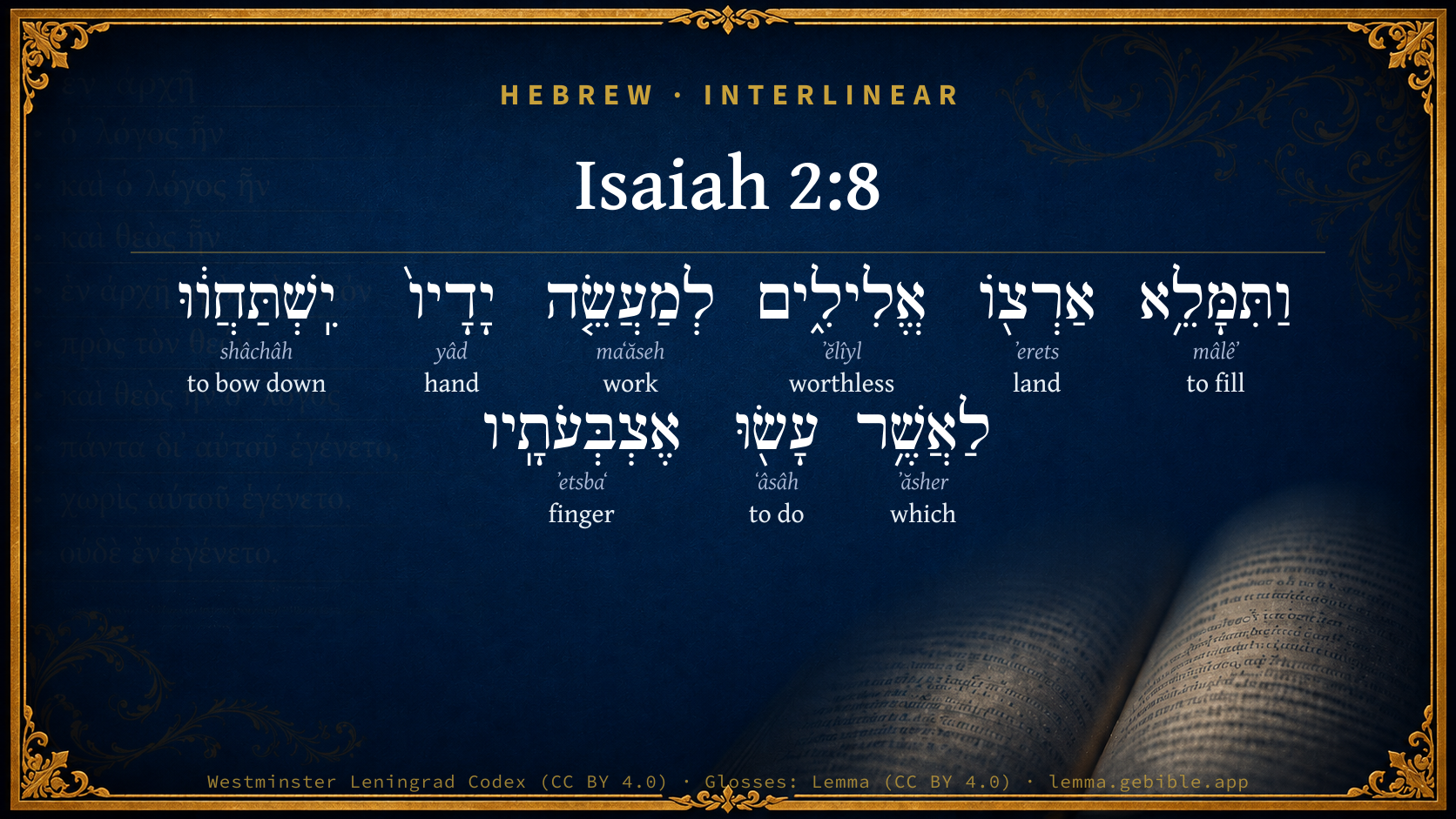
Isaiah 2:8

Hebrew (Westminster Leningrad Codex) Isaiah 2:8 appears in the Hebrew Old Testament. The text above is from the Westminster Leningrad Codex. Each word links to its Strong’s number, a concise gloss, and parsing drawn from the Open Scriptures Hebrew Bible morphology. Click any word for its full Brown-Driver-Briggs (BDB) entry.
Download image
Cite this verse

Isaiah 2:8 (World English Bible). Public Domain. Lemma interlinear Bible study tool, https://lemma.gebible.app/v/isaiah/2/8.

Show BibTeX & RIS
BibTeX
RIS
English Translation
Their land also is full of idols. They worship the work of their own hands, That which their own fingers have made.
World English Bible · Public Domain
Download a study sheet

One document with this verse’s original text, its word-by-word gloss line, the meaning frame, cross-references with their text, attributed commentary, and full source and license credits — printable, and it pastes into notes with its structure intact.

This verse Autodidact and up

Study sheet (.html) Plain text (.txt)

A passage Seminary Student

Up to 50 verses in one chapter. A passage sheet keeps up to 6 commentary sources and 12 cross-references per verse, in the order this page ranks them, and says so on the sheet whenever that leaves anything out. Ask for a single verse and you get the Autodidact verse sheet above.

Everything on this page stays free to read, with no account — the sheet is a download of what is already on screen, not access to it.

Want to remove ads? Support Godless Engineer
Compare translations 3

The same verse in 3 English versions, stacked beneath the original-language interlinear above. Click any original word for its lexicon entry.

Each is an independent rendering of the whole verse — the interlinear is not word-aligned to these translations.

Highlighted words mark where these versions differ — a whole-verse word diff, not a word-by-word alignment.

  • World English Bible Public Domain
    Their land also is full of idols. They worship the work of their own hands, That which their own fingers have made.
  • King James Version Public Domain
    Their land also is full of idols; they worship the work of their own hands, that which their own fingers have made:
  • unfoldingWord Literal Text CC BY-SA 4.0
    And his land is filled idols; they bow down to the work of his hands, to what his fingers have made.

unfoldingWord Literal Text — © unfoldingWord, licensed CC BY-SA 4.0. Word-aligned USFM3 via Door43 (git.door43.org/unfoldingWord/en_ult).

Versions to compare (up to 4)

3 of 4 selected

Show all 18 translations

Every available English version of this verse, each an independent rendering of the whole verse.

  • World English Bible Public Domain
    Their land also is full of idols. They worship the work of their own hands, That which their own fingers have made.
  • Berean Standard Bible Public Domain
    Their land is full of idols; they bow down to the work of their hands, to what their fingers have made.
  • Majority Standard Bible Public Domain
    Their land is full of idols; they bow down to the work of their hands, to what their fingers have made.
  • King James Version Public Domain
    Their land also is full of idols; they worship the work of their own hands, that which their own fingers have made:
  • American Standard Version (1901) Public Domain
    Their land also is full of idols; they worship the work of their own hands, that which their own fingers have made.
  • Revised Version (1885) Public Domain
    Their land also is full of idols; they worship the work of their own hands, that which their own fingers have made.
  • Geneva Bible (1599) Public Domain
    Their land also was full of idols: they worshipped the worke of their owne hands, which their owne fingers haue made.
  • Douay-Rheims (1899) Public Domain
    And their land is filled with horses: and their chariots are innumerable. Their land also is full of idols: they have adored the work of their own hands, which their own fingers have made.
  • Young's Literal Translation Public Domain
    And its land is full of idols, To the work of its hands it boweth itself, To that which its fingers have made,
  • Literal Standard Version CC BY-SA 4.0
    And its land is full of idols, || It bows itself to the work of its hands, || To that which its fingers have made,
  • Unlocked Literal Bible CC BY-SA 4.0
    Their land also is full of idols; they worship the craftsmanship of their own hands, things that their own fingers have made.
  • unfoldingWord Literal Text CC BY-SA 4.0
    And his land is filled idols; they bow down to the work of his hands, to what his fingers have made.
  • Darby Bible Public Domain
    And their land is full of idols; they bow themselves down to the work of their own hands, to that which their fingers have made.
  • World Messianic Bible Public Domain
    Their land also is full of idols. They worship the work of their own hands, that which their own fingers have made.
  • Webster's Bible Public Domain
    Their land also is full of idols; they worship the work of their own hands, that which their own fingers have made:
  • Free Bible Version CC BY-SA 4.0
    Their country is full of idols; they bow down and worship what they have made themselves—produced by their own hands!
  • Bible in Basic English Public Domain
    Their land is full of images; they give worship to the work of their hands, even to that which their fingers have made.
  • JPS Tanakh (1917) Public Domain
    Their land also is full of idols; every one worshippeth the work of his own hands, that which his own fingers have made.

Literal Standard Version (2020), Covenant Press — licensed CC BY-SA 4.0. Text via the HelloAO Bible API (eBible.org). Unlocked Literal Bible (unfoldingWord) — licensed CC BY-SA 4.0. Text via the HelloAO Bible API (eBible.org). unfoldingWord Literal Text — © unfoldingWord, licensed CC BY-SA 4.0. Word-aligned USFM3 via Door43 (git.door43.org/unfoldingWord/en_ult). Free Bible Version, Dr. Jonathan Gallagher — licensed CC BY-SA 4.0. Text via the HelloAO Bible API (eBible.org).

Word by word

More ways to search: Search by grammar → Find every occurrence → Compare this word →

Practice this passage: Drill this verse → Learn its vocabulary →

אֱלִילִ֑ים
ʼĕlîyl
H457
“idols”
Noun, Common, Masculine, Plural, Absolute
Part of Speech
Noun
Type
Common
Gender
Masculine
Number
Plural
State
Absolute
Full BDB Definition

Origin: apparently from H408

TWOT: 99a

of nought, good for nothing, worthless - of physicians, a shepherd, a divination - of false gods
  1. וַתִּמָּלֵ֥א mâlêʼ H4390 “and · to fill” Conjunction + Verb, Niphal, Sequential Imperfect, 3rd Person, Feminine, Singular
  2. אַרְצ֖וֹ ʼerets H776 “land · his” Noun, Common, Both, Singular, Construct + Suffix, Personal, 3rd Person, Masculine, Singular
  3. לְמַעֲשֵׂ֤ה maʻăseh H4639 “to/for · work of” Preposition + Noun, Common, Masculine, Singular, Construct
  4. יָדָיו֙ yâd H3027 “hands · his” Noun, Common, Both, Dual, Construct + Suffix, Personal, 3rd Person, Masculine, Singular
  5. יִֽשְׁתַּחֲו֔וּ shâchâh H7812 “to bow down” Verb, Hishtaphel, Imperfect, 3rd Person, Masculine, Plural
  6. לַאֲשֶׁ֥ר ʼăsher H834 “to/for · which” Preposition + Particle, Relative
  7. עָשׂ֖וּ ʻâsâh H6213 “to do” Verb, Qal, Perfect, 3rd Person, Common, Plural
  8. אֶצְבְּעֹתָֽיו ʼetsbaʻ H676 “fingers · his” Noun, Common, Feminine, Plural, Construct + Suffix, Personal, 3rd Person, Masculine, Singular

About this verse

These counts appear in no published source. They are computed here, from the morphology-tagged text and Lemma’s own curated glosses. What Lemma adds →

9
words
9
distinct lemmas
Prophets
section

Notable vocabulary

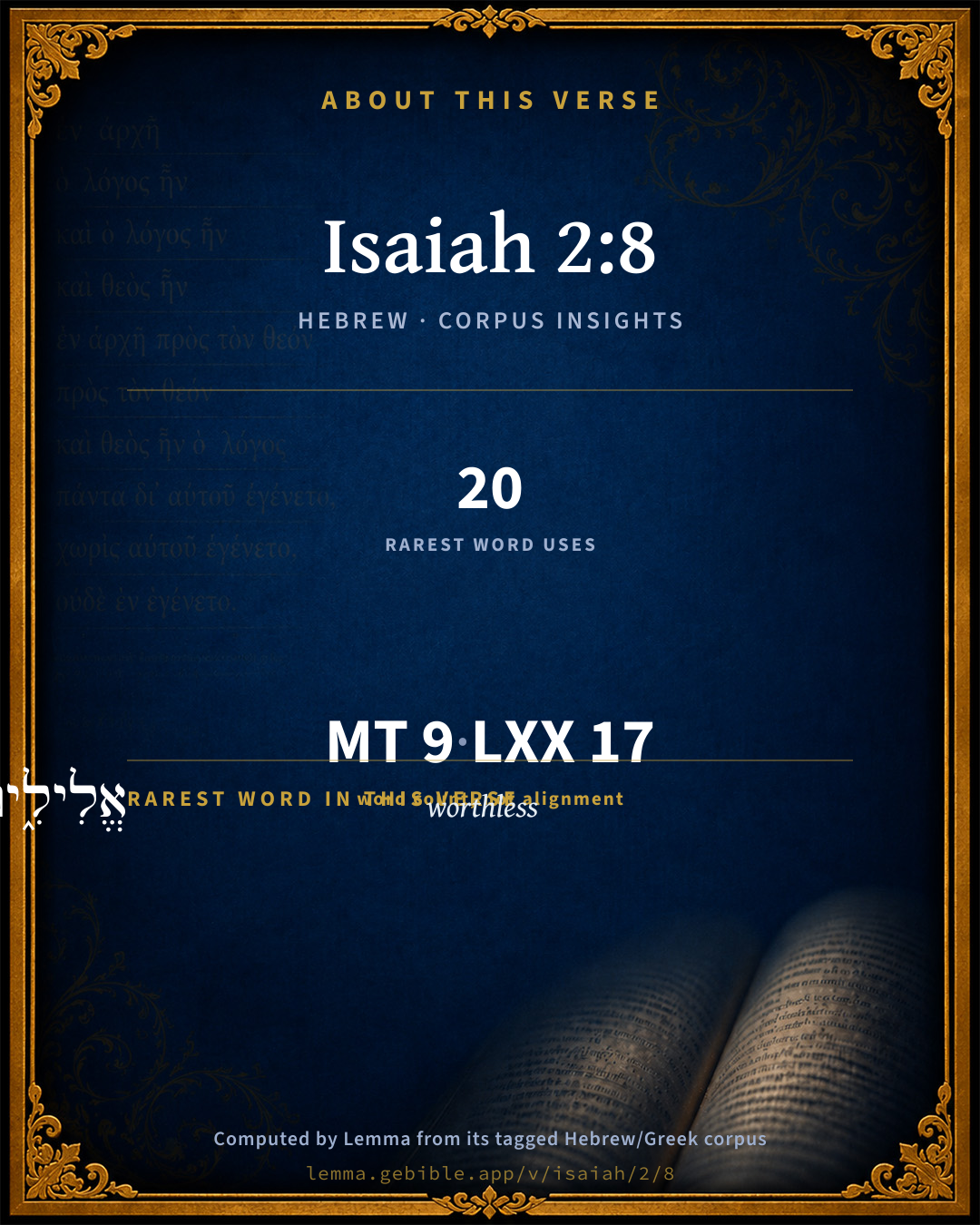
The rarest word here is אֱלִילִ֑ים worthless H457 — appearing just 20 times in the whole Hebrew Bible.

Shared distinctive vocabulary

אֱלִילִ֑ים worthless H457 occurs in 18 verses of the Hebrew Bible. Also found in:

Grammatical profile

  • 3 verbs
  • 5 nouns
  • 1 particle

Verb forms

  • וַתִּמָּלֵ֥א Niphal · Sequential Imperfect
  • יִֽשְׁתַּחֲו֔וּ Hishtaphel · Imperfect
  • עָשׂ֖וּ Qal · Perfect

Hebrew & Septuagint length

In English translation the verse runs 22 words from the Hebrew and 23 from the Septuagint (LXX English) — closely comparable.

A rough comparison of the two English renderings, which tokenize alike — not a word-level alignment.

Word counts can differ between the Hebrew and the Greek without any difference in meaning — e.g. the Hebrew direct-object marker אֵת has no separate Greek word, and Greek often adds the article ὁ.

In the original languages it is 9 Hebrew tokens and 17 Greek tokens — but the two are counted differently (Hebrew bundles its prefixes and suffixes into one token; the Greek is in lemma form), so that isn’t a like-for-like length.

Cross-references

20

Topical passages linked to Isaiah 2:8 in the Treasury of Scripture Knowledge — connected by theme and wording, ordered by reader-vote popularity; previews shown in the World English Bible.

  • Psalms 115:4–8 Their idols are silver and gold, The work of men's hands.
  • Revelation 9:20 The rest of mankind, who were not killed with these plagues, didn't repent of the works of their hands, that they wouldn't worship demons, and the idols of gold, and of silver, and of brass, and of stone, and of wood; which can neither see, nor hear, nor walk.
  • Isaiah 37:19 and have cast their gods into the fire: for they were no gods, but the work of men's hands, wood and stone; therefore they have destroyed them.
  • Jeremiah 2:28 But where are your gods that you have made you? let them arise, if they can save you in the time of your trouble: for according to the number of your cities are your gods, Judah.
  • Deuteronomy 4:28 There you shall serve gods, the work of men's hands, wood and stone, which neither see, nor hear, nor eat, nor smell.
  • 2 Chronicles 27:2 He did that which was right in the eyes of Yahweh, according to all that his father Uzziah had done: however he didn't enter into the temple of Yahweh. The people did yet corruptly.
  • 2 Chronicles 28:2–4 but he walked in the ways of the kings of Israel, and made also molten images for the Baals.
  • 2 Chronicles 28:23–25 For he sacrificed to the gods of Damascus, which struck him; and he said, Because the gods of the kings of Syria helped them, [therefore] will I sacrifice to them, that they may help me. But they were the ruin of him, and of all Israel.
  • 2 Chronicles 33:3–7 For he built again the high places which Hezekiah his father had broken down; and he reared up altars for the Baals, and made Asheroth, and worshiped all the host of the sky, and served them.
  • Isaiah 10:10–11 As my hand has found the kingdoms of the idols, whose engraved images did excel them of Jerusalem and of Samaria;
  • Isaiah 17:8 They shall not look to the altars, the work of their hands; neither shall they have respect to that which their fingers have made, either the Asherim, or the sun-images.
  • Isaiah 44:15–20 Then shall it be for a man to burn; and he takes of it, and warms himself; yes, he kindles it, and bakes bread: yes, he makes a god, and worships it; he makes it an engraved image, and falls down to it.
  • Isaiah 57:5 you who inflame yourselves among the oaks, under every green tree; who kill the children in the valleys, under the clefts of the rocks?
  • Jeremiah 11:13 For according to the number of your cities are your gods, Judah; and according to the number of the streets of Jerusalem have you set up altars to the shameful thing, even altars to burn incense to Baal.
  • Ezekiel 16:23–25 It is happen after all your wickedness, (woe, woe to you! says the Lord Yahweh),
  • Hosea 12:11 If Gilead is wicked, Surely they are worthless. In Gilgal they sacrifice bulls. Indeed, their altars are like heaps in the furrows of the field.
  • Hosea 13:2 Now they sin more and more, And have made themselves molten images of their silver, Even idols according to their own understanding, All of them the work of the craftsmen. They say of them, "They offer human sacrifice and kiss the calves."
  • Hosea 14:3 Assyria can't save us. We won't ride on horses; Neither will we say any more to the work of our hands, 'Our gods!' For in you the fatherless finds mercy."
  • Acts 17:16 Now while Paul waited for them at Athens, his spirit was provoked within him as he saw the city full of idols.
  • Hosea 8:6 For this is even from Israel! The workman made it, and it is no God; Indeed, the calf of Samaria shall be broken in pieces.

Cross-references courtesy of OpenBible.info (CC BY 4.0).

Hebrew and Greek witnesses Masoretic Hebrew ↔ Greek Septuagint

The same verse in the two great witnesses to the Old Testament, shown verse-for-verse.

These are two independent witnesses, not word-aligned to each other, and the Septuagint is shown in lemma (dictionary) form.

Hebrew Isaiah 2:8 Masoretic · Westminster Leningrad Codex

וַתִּמָּלֵ֥א אַרְצ֖וֹ אֱלִילִ֑ים לְמַעֲשֵׂ֤ה יָדָיו֙ יִֽשְׁתַּחֲו֔וּ לַאֲשֶׁ֥ר עָשׂ֖וּ אֶצְבְּעֹתָֽיו

Their land also is full of idols. They worship the work of their own hands, That which their own fingers have made.

World English Bible · Public Domain

Greek LXX Isaiah 2:8 Septuagint · lemma form

καί ἐνπίμπλημι ὁ γῆ βδέλυγμα ὁ ἔργον ὁ χείρ αὐτός καί προςκυνέω ὅς ποιέω ὁ δάκτυλος αὐτός

And the land is filled with abominations, even the works of their hands; and they have worshipped the works which their fingers made.

LXX2012 (modern English Septuagint) · Public Domain

Hebrew: Westminster Leningrad Codex (CC BY 4.0). Greek: Septuagint (public domain); English from LXX2012 (modern English Septuagint) (Public Domain). How the Septuagint differs from the Hebrew →

Targum (Aramaic paraphrase)

1

The Targum is the ancient Jewish Aramaic paraphrase of the Hebrew Scriptures — an interpretive translation, not the Hebrew text itself. Onkelos (literal) and Pseudo-Jonathan (expansive) render the Torah, and Jonathan the Prophets. Coverage is partial: where no permissively-licensed English translation exists for a verse, only the Aramaic is shown. This is verse-level text, not a word-by-word alignment to the Hebrew.

  1. Targum Jonathan Prophets (Joshua–Malachi)
    וְאִתְמְלִיאַת אַרְעֲהוֹן טַעֲוָן לְעוֹבָדֵי יְדֵיהוֹן סָגְדִין לִדְאַתְקִינָא אֶצְבְּעָתֵיהוֹן:

    Their land is also full of idols; they prostrate themselves to the work of their own hands, to that which is shaped by their own fingers.

    Targum Jonathan — Aramaic: “Mikraot Gedolot” (public domain). English: “Sefaria Community Translation” (CC0 1.0 (public-domain dedication)); “London "Chaldee Paraphrase," 1871” (public domain). Text via Sefaria.

Commentary

Notes on Isaiah 2:8 from classic Christian and Jewish commentators (each source and its license shown beneath its notes). The classic Christian expositions comment on the surrounding passage and are grouped to its opening verse, so a note may address several verses; the Jewish commentaries on the Tanakh (Rashi and others) are per-verse, so they appear only where the commentator wrote on this verse.

Lemma curates 59 commentaries, every one of them public domain or Creative Commons licensed, each selected and text-cleaned for this edition rather than reprinted as found. About our sources →

Trapp's Complete Commentary

John Trapp

Isa 2:8 Their land also is full of idols; they worship the work of their own hands, that which their own fingers have made:

Ver. 8. Their land also is full of idols.] As Babylon, "a land of idols"; {Jer 50:38} as Athens, "wholly given to idolatry"; {Act 17:16} as China is said to have in it at this day a hundred thousand gods. And what shall we think of Popish idols? The word here rendered idols signifieth nihilitates, nothingness; for an idol is nothing in the world. {1Co 8:4}

They worship the work of their own hands.] Scelestum el immane facinus, dirum scelus et execrandum; effraenata et praeceps amentia. See Isa 44:15; Isa 44:18.

John Trapp, A Commentary or Exposition upon All the Books of the Old and New Testament (1647–1656) — public domain. Text from a community e-Sword module.

The Biblical Illustrator

Joseph S. Exell

Isa_2:8

Their land also is full of idols

Idols

The philosophic theory of polytheism is one centre, many emanations.

Iamblicus and Porphyry defend it on this line against the monotheism of early Christianity. Hermes Trismegistus, according to St. Augustine, says the Egyptians regarded images as being merely the bodies of the gods. In India there may be seen any day of the week the ceremony of praying a spirit of Vishnu or of Shiva Into a statue, or into a symbolic stone, by the Brahmin priest. The priestly theory is one of consubstantiation, like the Lutheran theory of the Eucharist, the difference being between the spiritual indwelling in material bread and material wine In the one case, and material wood and stone in the other. The gods, thus made visible to the common people, are endowed, by the popular consent, with human passions and human prejudices. Each represents one or more of these human propensities. Some are emblems of the reproductive powers of nature--fertilizers of the flocks and fields. Their worship, pure at the first possibly, became beyond all telling, licentious and abominable. (F. Sessions.)

The Biblical Illustrator, edited by Joseph S. Exell (c. 1880s–1900s) — public domain. Text from a community e-Sword module.

Joseph Benson's Commentary

Isa 2:8-9. Their land also is full of idols — Every city had its god, (Jer 11:13,) and, according to the goodness and fertility of their lands, they made goodly images, Hos 10:1. They worship the work of their own hands — They gave that worship to their own creatures, to the images which their own fancies had devised, and their own fingers had made, which they denied to JEHOVAH their Creator, than which nothing could be more impious or more absurd. And the mean man boweth down, &c. — Men of all ranks, both high and low, rich and poor, learned and ignorant, fall down and worship idols. The corruption is universal, and the whole land is given to idolatry. Therefore forgive them not — Thou wilt not forgive them, the imperative being put for the future, as we have seen it frequently is in the Psalms. Vitringa, however, Dr. Waterland, and Bishop Lowth, with many others, consider this verse, not as describing their idolatry, but as a predicting the punishment which God was about to bring upon them for it; and therefore translate it, in perfect consistency with the Hebrew, in the future tense, thus: Therefore the mean man shall be bowed down, and the mighty man shall be humbled; and thou wilt not forgive them. “They bowed themselves down to their idols, therefore shall they be bowed down, and brought low, under the avenging hand of God.” — Bishop Lowth. According to this interpretation, “the prophet begins here to describe the imminent severe judgments of God, wherewith he would punish the pride of these men, and their alienation from the true worship of God and their disobedience to his law.”

Joseph Benson's Commentary on the Old and New Testaments (1811–1818) — public domain. Text from a community e-Sword module.

Jamieson, Fausset & Brown

Robert Jamieson, A. R. Fausset & David Brown

(Hos 8:4). Not so much public idolatry, which was not sanctioned in Uzziah's and Jotham's reign, but (see Kg2 15:4, Kg2 15:35) as private.

Jamieson, Fausset & Brown — Commentary Critical and Explanatory on the Whole Bible (1871) — public domain (CC PDM 1.0). Text via the HelloAO Bible API.

Adam Clarke's Commentary

Verse 8. Their land also is full of idols - "And his land is filled with idols"] Uzziah and Fotham are both said, 2Kg 15:3-4; 2Kg 15:34-35, "to have done that which was right in the sight of the Lord;" that is, to have adhered to and maintained the legal worship of God, in opposition to idolatry and all irregular worship; for to this sense the meaning of that phrase is commonly to be restrained; "save that the high places were not removed where the people still sacrificed and burned incense." There was hardly any time when they were quite free from this irregular and unlawful practice, which they seem to have looked upon as very consistent with the true worship of God; and which seems in some measure to have been tolerated, while the tabernacle was removed from place to place, and before the temple was built. Even after the conversion of Manasseh, when he had removed the strange gods, commanded Judah to serve JEHOVAH the God of Israel, it is added, "Nevertheless the people did sacrifice still on the high places, yet unto JEHOVAH their God only," 2Ch 33:17. The worshipping on the high places therefore does not necessarily imply idolatry; and from what is said of these two kings, Uzziah and Jotham, we may presume that the public exercise of idolatrous worship was not permitted in their time. The idols therefore here spoken of must have been such as were designed for a private and secret use. Such probably were the teraphim so often mentioned in Scripture; a kind of household gods, of human form, as it should seem, (see 1Sa 19:13, and compare Ge 31:34,) of different magnitude, used for idolatrous and superstitious purposes, particularly for divination, and as oracles, which they consulted for direction in their affairs.

Adam Clarke's Commentary on the Bible (1810–1826) — public domain. Text from a community e-Sword/MySword module.

Ellicott's Commentary for English Readers

(8) Their land also is full of idols.—The word which Isaiah chooses for “idols” (elîlîm—i.e., vain, false, gods) seems intentionally contrasted with elîm (gods, or mighty ones), and may fairly be rendered by no-gods. The reign of Ahaz was conspicuous from the first for this cultus (2Ch_28:2-3), but it had been prominent even under Jotham (2Ch_27:2).

A Bible Commentary for English Readers, edited by Charles John Ellicott (1878–1897) — public domain. Text from a community e-Sword module.

The Cambridge Bible for Schools and Colleges

gen. ed. J. J. S. Perowne

8. idols] Lit. “nonentities.”—The word (’ìlîlîm) is almost peculiar to Isaiah; and appears to contain a scornful play on the word for “gods” (’êlîm). work of their own hands] The prophet refuses to distinguish, as a heathen might, between the false deity and his image; the latter alone has real existence. Cf. Hos_13:2; Isa_40:19 f., Isa_41:7; Isa_44:12-20, &c.

The Cambridge Bible for Schools and Colleges (gen. ed. J. J. S. Perowne; Cambridge University Press, 1878–1918) — public domain. Text from a community e-Sword module.

John Gill's Exposition

Their land also is full of idols,.... Of the Virgin Mary, and of saints departed, whose images are set up to be worshipped in all their churches, and had in private houses:

and they worship the work of their own hands, that which their own fingers have made; namely, idols of gold, silver, brass, wood, and stone, Rev 9:20.

John Gill's Exposition of the Whole Bible (1746–1763) — public domain (CC PDM 1.0). Text via the HelloAO Bible API.

Albert Barnes' Notes on the Bible

Their land also is full of idols - compare Hos 8:4; Hos 10:1. Vitringa supposes that Isaiah here refers to idols that were kept in private houses, as Uzziah and Jotham were worshippers of the true God, and in their reign idolatry was not publicly practiced. It is certain, however, that though Uzziah himself did right, and was disposed to worship the true God, yet he did not effectually remove idolatry from the land. The high places were not removed, and the people still sacrificed and burned incense on them; 2Ki 15:4. It was customary with the pagan to keep in their houses “Penates or household gods” - small images, which they regarded as “protectors,” and to which they paid homage: compare Gen 30:19; Jdg 17:5; 1Sa 19:13; Hos 3:4. ‘This is a true and literal description of India. The traveler cannot proceed a “mile” through an inhabited country without seeing idols, and vestiges of idolatry in every direction. See their vessles, their implements of husbandry, their houses, their furniture, their ornaments, their sacred trees, their “domestic” and public temples; and they all declare that the land is full of idols.’ - “Roberts.”

The work of their own hands ... - Idols. It is often brought as proof of their great folly and degradation that they paid homage to what “they” had themselves made. See this severely satirized in Isa 40:18-20; Isa 41:6-7; Isa 44:9-17.

Albert Barnes' Notes on the Bible (1834–1885) — public domain. Text from a community e-Sword/MySword module.

Haydock's Catholic Bible Commentary

Horses. Which the kings were forbidden to multiply, Deuteronomy xvii. 16. Great riches often precede the ruin of states.

George Leo Haydock (1774–1849), Haydock's Catholic Family Bible and Commentary, 1859 edition — public domain. Excludes Psalms (Douay-Rheims chapter numbering differs from Protestant) and Deuterocanonical books (Catholic canon only).

Matthew Poole's English Annotations

They give that worship to their own creatures which they deny to me their Creator, than which nothing can be more impious and absurd.

Matthew Poole's English Annotations on the Holy Bible (1683–1685) — public domain. Text from a community e-Sword/MySword module.

Whedon's Commentary on the Bible

Daniel D. Whedon

8. Land… is full of idols — It is scarcely to be supposed that the idolatry mentioned here was public. The “idols” were a private possession of individuals and of families, like the teraphim in Jacob’s family. Gen_31:34. The word rendered “idols” properly signifies unrealities, nonentities, of no avail as deities or any thing else. Such is the prophet’s view of them. Psa_46:5.

Their own fingers have made — This expresses still deeper contempt of them. So, also, in Isa 41-67.

Daniel D. Whedon (gen. ed.), Commentary on the Old and New Testaments (1874–1909) — public domain. Text from a community e-Sword module.

The Pulpit Commentary

Full of idols. The historians declare that both Uzziah and Jotham maintained the worship of Jehovah and disallowed idolatry, (2Ki_15:3, 34 2Ch_26:4 2Ch_27:2) so that we must regard the idol-worship of the time as an irregular and private practice. (It is, perhaps, alluded to in 2Ch_27:2; and the fact of its prevalence is stated (Amo_2:1 Mic_5:13) Perhaps Bishop Lowth is right in regarding it as mainly a continuation of the old private teraphim worship ("Notes," p. 25).

The Pulpit Commentary (1880–1919), ed. H.D.M. Spence-Jones & Joseph S. Exell — public domain. Text from a community e-Sword module.

J. A. Alexander on Isaiah

Joseph Addison Alexander

The third and greatest evil flowing from this intercourse with foreign nations was idolatry itself, which was usually introduced under the cloak of mere political alliances (see e. g. 2Ki 16:10). Here as elsewhere the terms used to describe it are contemptuous in a high degree. “And his land is filled with idols” (properly nonentities, ‘gods which yet are no gods,’ (Jer 2:1); ‘for we know that an idol is nothing in the world,’ (1Co 8:4)), "to the work of their hands they bow down, to that which their fingers have made, one of the great absurdities charged by the Prophets on idolaters, as if that could be a god to them which was not only a creature but their own creature" (Matthew Henry).

Joseph Addison Alexander, The Prophecies of Isaiah (1846–1847; New York: Scribner, 1870–1878) — public domain. Text from a community e-Sword module.

Rashi

Rabbi Shlomo Yitzchaki (Rashi)

they prostrate themselves Heb. ישתחוו. Although the form is future, it is to be rendered like מִשְׁתַּחֲוִים, they prostrate themselves.

Rashi on the Tanakh — English translations: “The Judaica Press complete Tanach with Rashi, translated by A. J. Rosenberg” (CC BY 4.0); “Pentateuch with Rashi's commentary by M. Rosenbaum and A.M. Silbermann, 1929-1934” (public domain); “The Metsudah Tanach series, Lakewood, N.J” (CC BY 4.0); and “The Book of Joshua, Metsudah Publications, 1997” (CC BY 4.0). Text via Sefaria.

Ibn Ezra

Rabbi Abraham ibn Ezra

אלילים Idols. Root אַל "not"; the idols are called by this name, because there is no reality in them.

They worship the work of his hands, that which his fingers have made. They—all the people—worship the work of his—the smith’s—hands, that which his—the smith’s—fingers have made. ידיו "his hands", and ישתחוו "they worship"; the Version evades the difficulty by translating ידיו "their hands".

Ibn Ezra on the Tanakh — English translations: “Sefaria Community Translation” (CC0 1.0 (public-domain dedication)); “Yalkut, Sifsei Chachomim Chumash, Metsudah Publications, 2009” (CC BY 4.0); and “Commentary of Ibn Ezra on Isaiah - trans. by M. Friedlander, 1873” (public domain). Text via Sefaria.

Lesson kit

Teaching starters — assembled from the data on this page, not authored interpretation. Every prompt links to the verse data it draws on. Edit before teaching.

Isaiah, in the Prophets, opens this verse with 9 words (9 distinct Hebrew lemmas). Its most distinctive word is ʼĕlîyl (“worthless”). A historical commentator’s framing appears above. Read the whole chapter for the surrounding context.

Discussion questions

  1. What does “worthless” (ʼĕlîyl) contribute to the verse as a whole?
  2. How does Leviticus 19:4, which shares the word «worthless», read alongside this verse?
  3. These translations render this verse differently; the difference is in the English rendering, not the original. What questions does that raise?
  4. «וַתִּמָּלֵ֥א» is a Niphal Sequential Imperfect verb. How does that grammatical form shape the action described?
  5. Compare how Trapp's Complete Commentary and The Biblical Illustrator read this verse. Where do they agree or differ?

Things to notice

Reading settings

Reading text

Shown beneath each verse's original-language words.

Old Testament
Old Testament edition

Read the OT as the Masoretic Hebrew (MT) or the Greek Septuagint (LXX).

English shown for the Greek Septuagint (in the Hebrew ↔ Greek comparison).

Comparing translations? Open the Compare panel on any verse page to stack up to four side by side.