Psalms 97:7

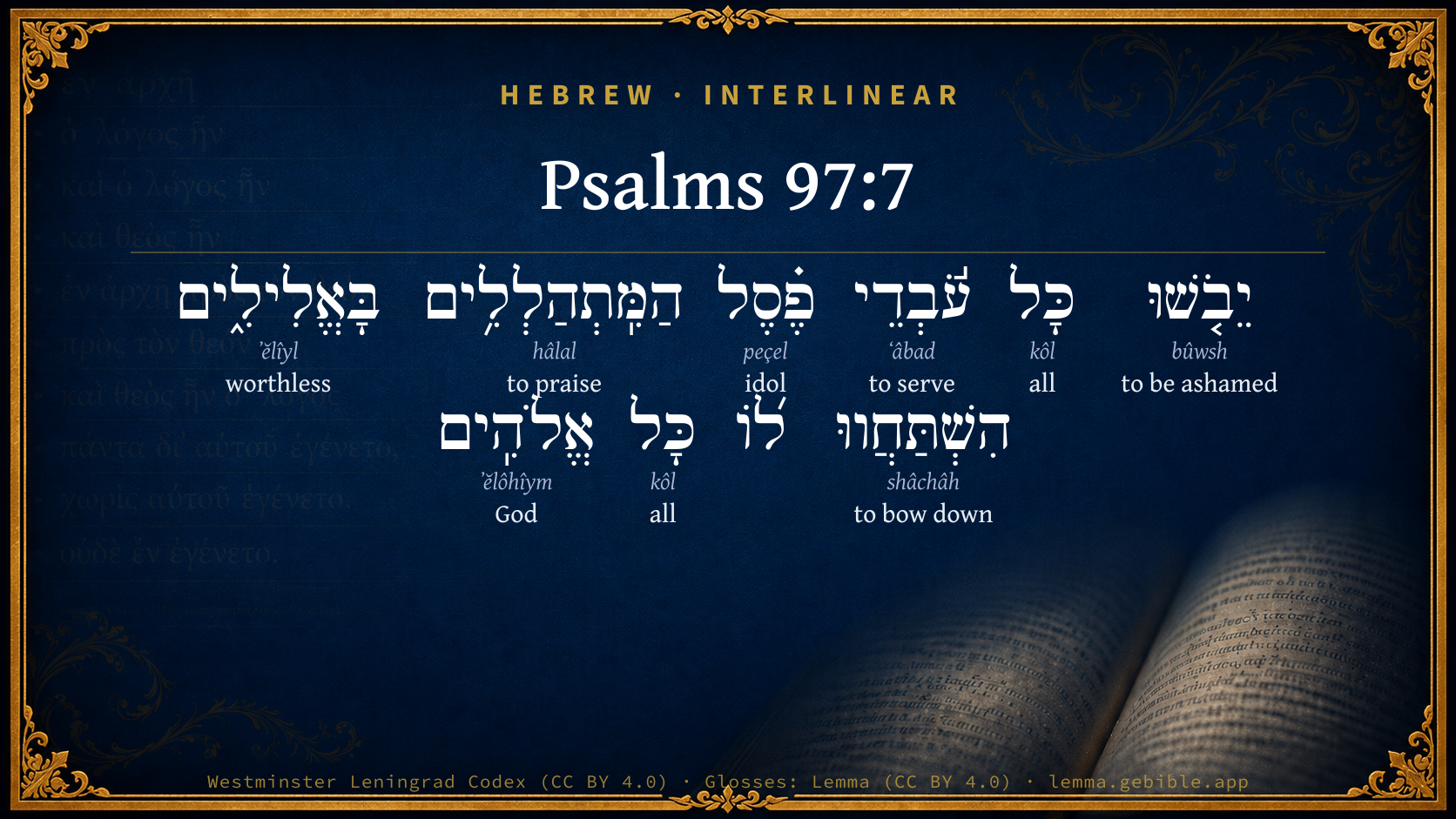
Hebrew (Westminster Leningrad Codex) Psalms 97:7 appears in the Hebrew Old Testament. The text above is from the Westminster Leningrad Codex. Each word links to its Strong’s number, a concise gloss, and parsing drawn from the Open Scriptures Hebrew Bible morphology. Click any word for its full Brown-Driver-Briggs (BDB) entry.
Download image
Cite this verse

Psalms 97:7 (World English Bible). Public Domain. Lemma interlinear Bible study tool, https://lemma.gebible.app/v/psalms/97/7.

Show BibTeX & RIS
BibTeX
RIS
English Translation
Let all them be shamed who serve engraved images, Who boast in their idols. Worship him, all you gods!
World English Bible · Public Domain
Download a study sheet

One document with this verse’s original text, its word-by-word gloss line, the meaning frame, cross-references with their text, attributed commentary, and full source and license credits — printable, and it pastes into notes with its structure intact.

This verse Autodidact and up

Study sheet (.html) Plain text (.txt)

A passage Seminary Student

Up to 50 verses in one chapter. A passage sheet keeps up to 6 commentary sources and 12 cross-references per verse, in the order this page ranks them, and says so on the sheet whenever that leaves anything out. Ask for a single verse and you get the Autodidact verse sheet above.

Everything on this page stays free to read, with no account — the sheet is a download of what is already on screen, not access to it.

Want to remove ads? Support Godless Engineer
Compare translations 3

The same verse in 3 English versions, stacked beneath the original-language interlinear above. Click any original word for its lexicon entry.

Each is an independent rendering of the whole verse — the interlinear is not word-aligned to these translations.

Highlighted words mark where these versions differ — a whole-verse word diff, not a word-by-word alignment.

  • World English Bible Public Domain
    Let all them be shamed who serve engraved images, Who boast in their idols. Worship him, all you gods!
  • King James Version Public Domain
    Confounded be all they that serve graven images, that boast themselves of idols: worship him, all ye gods.
  • unfoldingWord Literal Text CC BY-SA 4.0
    Let all those serving a carved image have shame, those boasting in worthless idols— bow down to him, all you gods!

unfoldingWord Literal Text — © unfoldingWord, licensed CC BY-SA 4.0. Word-aligned USFM3 via Door43 (git.door43.org/unfoldingWord/en_ult).

Versions to compare (up to 4)

3 of 4 selected

Show all 18 translations

Every available English version of this verse, each an independent rendering of the whole verse.

  • World English Bible Public Domain
    Let all them be shamed who serve engraved images, Who boast in their idols. Worship him, all you gods!
  • Berean Standard Bible Public Domain
    All worshipers of images are put to shame—those who boast in idols. Worship Him, all you gods!
  • Majority Standard Bible Public Domain
    All worshipers of images are put to shame—those who boast in idols. Worship Him, all you gods!
  • King James Version Public Domain
    Confounded be all they that serve graven images, that boast themselves of idols: worship him, all ye gods.
  • American Standard Version (1901) Public Domain
    Let all them be put to shame that serve graven images, That boast themselves of idols: Worship him, all ye gods.
  • Revised Version (1885) Public Domain
    Ashamed be all they that serve graven images, that boast themselves of idols: worship him, all ye gods.
  • Geneva Bible (1599) Public Domain
    Confounded be all they that serue grauen images, and that glory in idoles: worship him all ye gods.
  • Douay-Rheims (1899) Public Domain
    Let them be all confounded that adore graven things, and that glory in their idols. Adore him, all you his angels:
  • Young's Literal Translation Public Domain
    Ashamed are all servants of a graven image, Those boasting themselves in idols, Bow yourselves to him, all ye gods.
  • Literal Standard Version CC BY-SA 4.0
    All servants of a carved image are ashamed, || Those boasting themselves in idols, || Bow yourselves to Him, all you gods.
  • Unlocked Literal Bible CC BY-SA 4.0
    All those who worship carved figures will be shamed, those who boast in worthless idols— bow down to him, all you gods!
  • unfoldingWord Literal Text CC BY-SA 4.0
    Let all those serving a carved image have shame, those boasting in worthless idols— bow down to him, all you gods!
  • Darby Bible Public Domain
    Ashamed be all they that serve graven images, that boast themselves of idols. Worship him, all ye gods.
  • World Messianic Bible Public Domain
    Let all them be shamed who serve engraved images, who boast in their idols. Worship him, all you gods!
  • Webster's Bible Public Domain
    Confounded be all they that serve graven images, that boast themselves of idols; worship him, all ye gods.
  • Free Bible Version CC BY-SA 4.0
    All those who worship idols are humiliated, those who are proud of their idols—for all “gods” bow down before him.
  • Bible in Basic English Public Domain
    Shamed be all those who give worship to images, and take pride in false gods; give him worship, all you gods.
  • JPS Tanakh (1917) Public Domain
    Ashamed be all they that serve graven images, that boast themselves of things of nought; bow down to Him, all ye gods.

Literal Standard Version (2020), Covenant Press — licensed CC BY-SA 4.0. Text via the HelloAO Bible API (eBible.org). Unlocked Literal Bible (unfoldingWord) — licensed CC BY-SA 4.0. Text via the HelloAO Bible API (eBible.org). unfoldingWord Literal Text — © unfoldingWord, licensed CC BY-SA 4.0. Word-aligned USFM3 via Door43 (git.door43.org/unfoldingWord/en_ult). Free Bible Version, Dr. Jonathan Gallagher — licensed CC BY-SA 4.0. Text via the HelloAO Bible API (eBible.org).

Word by word

More ways to search: Search by grammar → Find every occurrence → Compare this word →

Practice this passage: Drill this verse → Learn its vocabulary →

בָּאֱלִילִ֑ים
ʼĕlîyl
H457
“in/at the · idols”
Preposition, Determined + Noun, Common, Masculine, Plural, Absolute
Part of Speech
Preposition + Noun
Type
Common
Gender
Masculine
Number
Plural
State
Absolute
Full BDB Definition

Origin: apparently from H408

TWOT: 99a

of nought, good for nothing, worthless - of physicians, a shepherd, a divination - of false gods
  1. יֵבֹ֤שׁוּ bûwsh H954 “to be ashamed” Verb, Qal, Imperfect, 3rd Person, Masculine, Plural
  2. כָּל kôl H3605 “all of” Noun, Common, Masculine, Singular, Construct
  3. עֹ֬בְדֵי ʻâbad H5647 “serving” Verb, Qal, Participle Active, Masculine, Plural, Construct
  4. פֶ֗סֶל peçel H6459 “idol” Noun, Common, Masculine, Singular, Absolute
  5. הַמִּֽתְהַלְלִ֥ים hâlal H1984 “the · praising” Particle, Definite Article + Verb, Hithpael, Participle Active, Masculine, Plural, Absolute
  6. הִשְׁתַּחֲווּ shâchâh H7812 “bow down” Verb, Hishtaphel, Imperative, 2nd Person, Masculine, Plural
  7. כָּל kôl H3605 “all of” Noun, Common, Masculine, Singular, Construct
  8. אֱלֹהִֽים ʼĕlôhîym H430 “God(s)” Noun, Common, Masculine, Plural, Absolute

About this verse

These counts appear in no published source. They are computed here, from the morphology-tagged text and Lemma’s own curated glosses. What Lemma adds →

10
words
8
distinct lemmas
Wisdom
section

Notable vocabulary

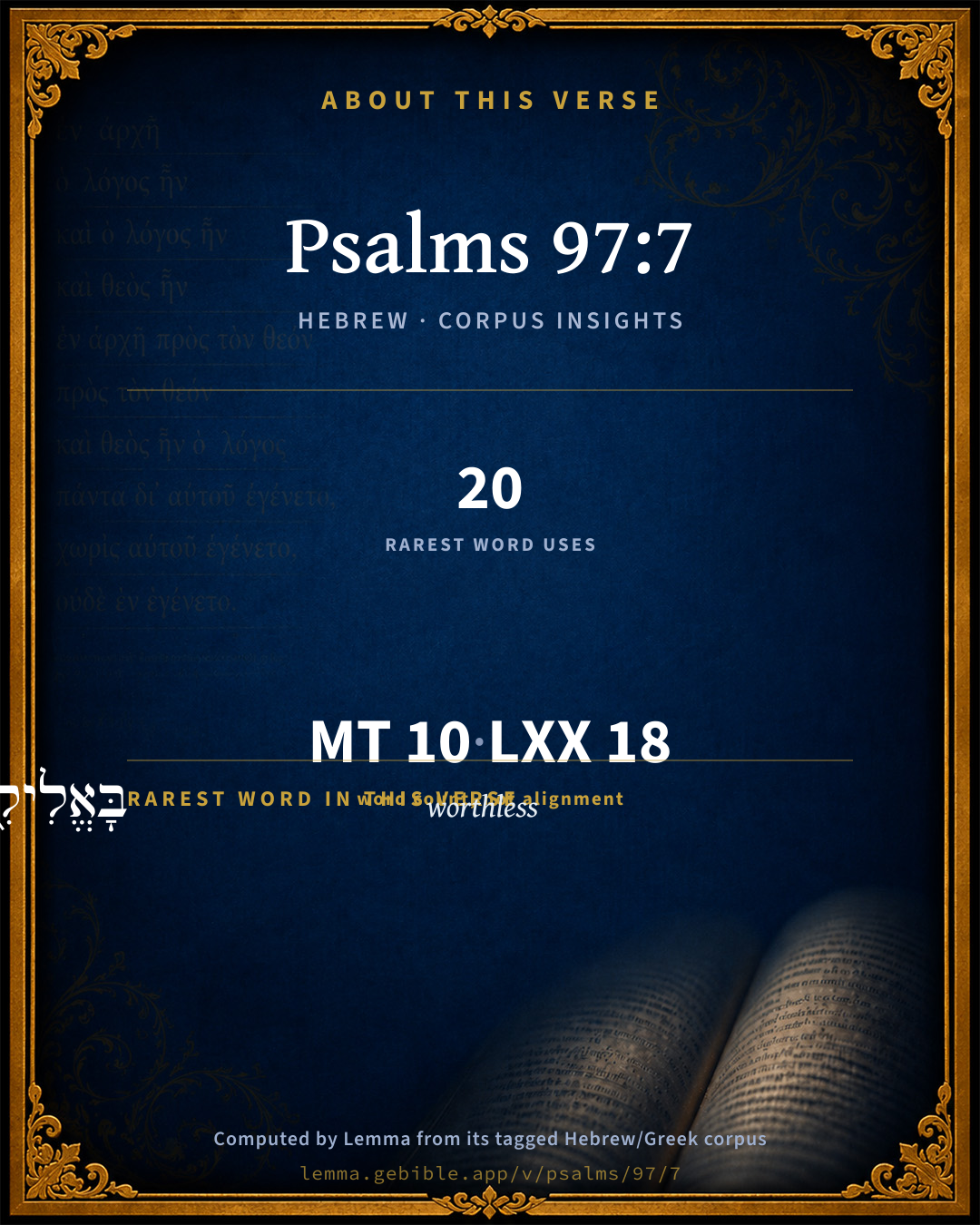
The rarest word here is בָּאֱלִילִ֑ים worthless H457 — appearing just 20 times in the whole Hebrew Bible.

Shared distinctive vocabulary

בָּאֱלִילִ֑ים worthless H457 occurs in 18 verses of the Hebrew Bible. Also found in:

Grammatical profile

  • 4 verbs
  • 5 nouns
  • 1 preposition

Verb forms

  • יֵבֹ֤שׁוּ Qal · Imperfect
  • עֹ֬בְדֵי Qal · Participle Active
  • הַמִּֽתְהַלְלִ֥ים Hithpael · Participle Active
  • הִשְׁתַּחֲווּ Hishtaphel · Imperative

Repetition

A word recurs within this verse — often emphatic in Hebrew:

Hebrew & Septuagint length

In English translation the verse runs 19 words from the Hebrew and 19 from the Septuagint (LXX English) — the same length.

A rough comparison of the two English renderings, which tokenize alike — not a word-level alignment.

Word counts can differ between the Hebrew and the Greek without any difference in meaning — e.g. the Hebrew direct-object marker אֵת has no separate Greek word, and Greek often adds the article ὁ.

In the original languages it is 10 Hebrew tokens and 18 Greek tokens — but the two are counted differently (Hebrew bundles its prefixes and suffixes into one token; the Greek is in lemma form), so that isn’t a like-for-like length.

Cross-references

15

Topical passages linked to Psalms 97:7 in the Treasury of Scripture Knowledge — connected by theme and wording, ordered by reader-vote popularity; previews shown in the World English Bible.

  • Jeremiah 10:14 Every man is become brutish [and is] without knowledge; every goldsmith is disappointed by his engraved image; for his molten image is falsehood, and there is no breath in them.
  • Hebrews 1:6 Again, when he brings in the firstborn into the world he says, "Let all the angels of God worship him."
  • Isaiah 42:17 They shall be turned back, they shall be utterly disappointed, who trust in engraved images, who tell molten images, You are our gods.
  • Leviticus 26:1 "'You shall make for yourselves no idols, neither shall you raise up an engraved image or a pillar, neither shall you place any figured stone in your land, to bow down to it: for I am Yahweh your God.
  • Revelation 5:11–14 I saw, and I heard something like a voice of many angels around the throne, the living creatures, and the elders; and the number of them was ten thousands of ten thousands, and thousands of thousands;
  • Exodus 20:4 "You shall not make for yourselves an idol, nor any image of anything that is in the heavens above, or that is in the earth beneath, or that is in the water under the earth:
  • Isaiah 41:29 Behold, all of them, their works are vanity [and] nothing; their molten images are wind and confusion.
  • Isaiah 44:9–11 Those who fashion an engraved image are all of them vanity; and the things that they delight in shall not profit; and their own witnesses don't see, nor know: that they may be disappointed.
  • Exodus 25:20 The cherubim shall spread out their wings upward, covering the mercy seat with their wings, with their faces toward one another. The faces of the cherubim shall be toward the mercy seat.
  • Deuteronomy 5:8 "You shall not make an engraved image for yourself, [nor] any likeness [of anything] that is in heaven above, or that is in the earth beneath, or that is in the water under the earth:
  • Deuteronomy 27:15 Cursed be the man who makes an engraved or molten image, an abomination to Yahweh, the work of the hands of the craftsman, and sets it up in secret. All the people shall answer and say, Amen.
  • 2 Chronicles 3:13 The wings of these cherubim spread themselves forth twenty cubits: and they stood on their feet, and their faces were toward the house.
  • Isaiah 37:18–19 Of a truth, Yahweh, the kings of Assyria have laid waste all the countries, and their land,
  • 1 Peter 1:12 To them it was revealed, that not to themselves, but to you, did they minister these things, which now have been announced to you through those who preached the Gospel to you by the Holy Spirit sent out from heaven; which things angels desire to look into.
  • Revelation 14:8–10 Another, a second angel, followed, saying, "Babylon the great has fallen, which has made all the nations to drink of the wine of the wrath of her sexual immorality."

Cross-references courtesy of OpenBible.info (CC BY 4.0).

Hebrew and Greek witnesses Masoretic Hebrew ↔ Greek Septuagint

The same verse in the two great witnesses to the Old Testament, shown verse-for-verse.

You’re reading Greek Psalm 96 (Hebrew Psalm 97). The Septuagint counts the superscription, so verse numbers can differ from the Hebrew — chapter-level alignment, not verse-by-verse. Numbering follows Rahlfs.

These are two independent witnesses, not word-aligned to each other, and the Septuagint is shown in lemma (dictionary) form.

Hebrew Psalms 97:7 Masoretic · Westminster Leningrad Codex

יֵבֹ֤שׁוּ כָּל עֹ֬בְדֵי פֶ֗סֶל הַמִּֽתְהַלְלִ֥ים בָּאֱלִילִ֑ים הִשְׁתַּחֲווּ ל֝וֹ כָּל אֱלֹהִֽים

Let all them be shamed who serve engraved images, Who boast in their idols. Worship him, all you gods!

World English Bible · Public Domain

Greek LXX Greek Psalm 96:7 Septuagint · lemma form

αἰσχύνω πᾶς ὁ προςκυνέω ὁ γλυπτός ὁ ἐνκαυχάομαι ἐν ὁ εἴδωλον αὐτός προςκυνέω αὐτός πᾶς ὁ ἄγγελος αὐτός

Let all that worship graven images be ashamed, who boast of their idols; worship him, all you⌃ his angels.

LXX2012 (modern English Septuagint) · Public Domain

On this verse, Whedon's Commentary on the Bible discusses the Septuagint’s reading. Read the note in Commentary ↓

Hebrew: Westminster Leningrad Codex (CC BY 4.0). Greek: Septuagint (public domain); English from LXX2012 (modern English Septuagint) (Public Domain). How the Septuagint differs from the Hebrew →

Commentary

Notes on Psalms 97:7 from classic Christian and Jewish commentators (each source and its license shown beneath its notes). The classic Christian expositions comment on the surrounding passage and are grouped to its opening verse, so a note may address several verses; the Jewish commentaries on the Tanakh (Rashi and others) are per-verse, so they appear only where the commentator wrote on this verse.

Lemma curates 59 commentaries, every one of them public domain or Creative Commons licensed, each selected and text-cleaned for this edition rather than reprinted as found. About our sources →

Trapp's Complete Commentary

John Trapp

Psa 97:7 Confounded be all they that serve graven images, that boast themselves of idols: worship him, all [ye] gods.

Ver. 7. Confounded be all they that serve graven images] Those instruments of idolatry, and lurking places of devils, diabolicae inspirationis et iustinctus participes. Such and their servants we may lawfully pray against.

That boast themselves of idols] As did that idolatrous Micah, Jdg 17:4-5, Nebuchadnezzar, Dan 3:1-7; Julian, called, therefore Idolian; the Papists at this day. See Dr Rainolds de Idololatria Romana.

Worship him, all ye gods] i.e. All ye angels, saith the Greek and Arabic; and the apostle saith the same, Heb 1:6, proving Christ to be God-man. This psalm, saith Beza, is highly to be prized of all Christ’s, as containing a most divine epitome of all gospel mysteries.

John Trapp, A Commentary or Exposition upon All the Books of the Old and New Testament (1647–1656) — public domain. Text from a community e-Sword module.

Joseph Benson's Commentary

Psa 97:7. Confounded be all they that serve graven images — That is, the Gentile world, who did service to them who by nature were no gods, Gal 4:8. Let them be ashamed of their former folly herein, and be thereby brought to detest and forsake their idols. Thus interpreted, the words are a prayer for the conversion of the Gentiles, that those who had been so long serving dumb idols might be convinced of their error, ashamed of their folly, and might be brought, by the power of Christ’s gospel, to serve the only living and true God, and be as much ashamed of their idols as ever they were proud of them, Isa 2:20-21. Or, they shall be confounded. And so this is a prophecy, predicting the ruin of those that would not be reclaimed from their idolatry; they shall be confounded by the destruction of paganism in the Roman empire, which was fulfilled about three hundred years after Christ, so much to the terror of idolaters that even the mighty men among them are represented, Rev 6:15-16, as saying to the rocks, Fall on us, and hide us from the face of him that sitteth on the throne, &c. This prayer and prophecy are still in force against anti-christian idolaters, who may here read their doom.

Joseph Benson's Commentary on the Old and New Testaments (1811–1818) — public domain. Text from a community e-Sword module.

Whedon's Commentary on the Bible

Daniel D. Whedon

7. Confounded—Put to shame, or confusion. The word denotes that confusion or perplexity of mind which results from a misplaced confidence, or the consequences of a wicked course now at length arrested and brought to judgment.

Idols—See on Psa_96:5, where the same word occurs, but nowhere else in the Psalms.

Worship him, all ye gods— “Gods,” here, is, in Hebrew, Eloheem, the name of the one living and true God, which generally occurs in the plural form. It is sometimes, as here, applied to kings and magistrates, on account of their office as representatives of God, (see note on Psa_8:5,) and the psalmist calls on such to abandon their “idols” and worship Him who is “over all, God blessed for ever.” In Heb_1:6, (where see note,) the apostle quotes from the Septuagint, and applies to Christ, “And let all the angels of God worship him,” which is generally admitted to refer to these words of the psalmist. The Septuagint of Deu_32:43 has the same words: “Rejoice, ye heavens, with him, and let all the angels of God worship him.” But these words are not in the Hebrew, and it is inadmissible to suppose the apostle would quote an interpolation of a version to support a fundamental doctrine. He refers obviously to Psa_97:7, and it is the clearest instance in Scripture of the translation of eloheem by angels. Professor Stuart supposes there was “a usus loquendi among the Jews” which allowed it, though not clearly brought out in the Scriptures, which appears probable. This quotation of the apostle determines our psalm to be Messianic in a high degree, and ranks it with Psalms 2, 110

Daniel D. Whedon (gen. ed.), Commentary on the Old and New Testaments (1874–1909) — public domain. Text from a community e-Sword module.

J. A. Alexander on Psalms

Joseph Addison Alexander

7. (Psa 97:7) Shamed shall be all serving a graven image and boasting themselves of idols. Bow down to him, all ye gods! The first word means not merely ashamed, but disappointed, defeated, and confounded. All serving or all servers (i.e. worshippers) of a graven image. Boasting themselves, exulting in the knowledge and possession and imagined favour of material images. Idols, nothings or nonentities, as in Psa 96:5. The use of this word shews that in the following clause the false gods are invested with existence only to be treated with the more contempt. Compare Exo 12:12, Num 33:4, Isa 19:1; Isa 42:17; Isa 44:9. The verb in this clause might be taken as a preterite, worship or have worshipped; but the imperative construction seems to be required by the analogy of Psa 96:9. These words are not applied to Christ directly in Heb 1:6. It is merely said that when God sends his Son into the world, he may be understood as saying again of him, what is here said of himself, to wit, that even the false gods are required to worship him, much more the angels who have real existence. The passage was no doubt suggested to the mind of the New Testament writer by the fact that the Septuagint renders gods by angels, though he does not copy this erroneous version.

Joseph Addison Alexander, The Psalms Translated and Explained (1850) — public domain. Text from a community e-Sword module.

Tyndale Open Study Notes

Tyndale Open Resources

97:7 At the Lord’s coming, when every god must bow to him, those who worship other gods will face their own folly (see 95:3-5).

Tyndale Open Study Notes — © Tyndale Open Resources, licensed CC BY-SA 4.0. Text via the HelloAO Bible API.

Geneva Bible (1599)

Geneva Bible translators

He signifieth that God’s judgments are in a readiness to destroy the idolaters.

Let all that which is esteemed in the world fall down before him.

Geneva Bible (1599) marginal notes — public domain. Text via Bolls.life.

Adam Clarke's Commentary

Verse 7. Confounded be all they] Rather, They shall be confounded that boast themselves in idols. There is a remarkable play on the letters here, המתהללים hammithhalelim, who move like madmen; referring to the violent gestures practised in idolatrous rites.

Of idols] באלילים baelilim, in vanities, emptinesses; who "make much ado about nothing," and take a mad and painful pleasure in ridiculous and unprofitable ceremonies of religion.

Worship him] WHO? JESUS: so says the apostle, Heb 1:6. Who will dare to dispute his authority?

All ye gods.] Οἱ αγγελοι αυτου, his angels: so the Septuagint and the apostle: "Let all the angels of God worship him:" and the words are most certainly applied to the Saviour of the world by the author of the Epistle to the Hebrews; see the note there. The Chaldee says: "All nations who worship idols shall adore him."

Adam Clarke's Commentary on the Bible (1810–1826) — public domain. Text from a community e-Sword/MySword module.

John Calvin's Commentaries

7 Confounded be all those who serve graven images. The Psalmist draws a broad distinction here, as in the psalm next to this, between the true God and the false gods which men form for themselves. This he does that the praise which he had ascribed might not be applied to any but the true God. Men are all ready to admit that they ought to celebrate the praises of God, but, naturally prone as they are to superstition, few indeed will be bound down to worship God in the manner which is right. No sooner have they to do with God than they deviate into the most baseless delusions. Each fashions a god for himself, and all choose what suits them best in the medley of inventions. This is the reason why the sacred writers, under the apprehension that men may turn to false gods, are careful in giving exhortations to the worship of God, to state at the same time who the true God is. The order observed by the Psalmist suggests the remark, that corrupt superstitions will never be removed until the true religion obtains. Prevented from coming to the true God by the slowness of their spiritual apprehension, men cannot fail to wander in vanities of their own; and it is the knowledge of the true God which dispels these, as the sun disperses the darkness. All have naturally a something of religion born with them, but owing to the blindness and stupidity, as well as the weakness of our minds, the apprehension which we conceive of God is immediately depraved. Religion is thus the beginning of all superstitions, not in its own nature, but through the darkness which has settled down upon the minds of men, and which prevents them from distinguishing between idols and the true God. The truth of God is effectual when revealed in dispelling and dissipating superstitions. Does the sun absorb the vapors which intervene in the air, and shall not the presence of God himself be effectual much more? We need not wonder then that the Psalmist, in predicting the Kingdom of God, triumphs over the ungodly nations, which boasted in graven images, as when Isaiah, speaking of the rise of the Gospel, adds,

“Then all the idols of Egypt shall fall,” (Isaiah 19:1)

Since the knowledge of God has been hid from the view of men, we are taught also that there is no reason to be surprised at the host of superstitions which have overspread the world. We have an exemplification of the same truth in our own day. The knowledge of the true doctrine is extinguished amongst the Turks, the Jews, and Papists, and, as a necessary consequence, they lie immersed in error; for they cannot possibly return to a sound mind, or repent of their errors, when they are ignorant of the true God. When the Psalmist speaks of their being confounded, he means that the time was come when those who were given to idolatry should repent, and return to the worship of the true God. Not that all without exception would be brought to genuine repentance, — for experience has taught us in these our own times how atheistical men will cast off superstition, and yet assume the most shameless effrontery, but that this is one of those consequences which the knowledge of God should effect, the turning of men from their errors unto God. Some there are who obstinately resist God, of which we have many examples in the Papacy; but we have every reason to believe that they are secretly prostrated by that which they affect to despise, and confounded notwithstanding their opposition. What the Psalmist says a little after, Let all the gods worship before him, properly applies to the angels, in whom there shines forth some small portion of divinity, yet it may, though less appropriately, be extended to fictitious gods; as if he had said, Whatever is accounted or held as a god must quit its place and renounce its claims, that God alone may be exalted. Hence it may be gathered that the true definition of piety is, when the true God is perfectly served, and when he alone is so exalted, that no creature obscures his divinity; and, accordingly, if we would not have true piety entirely destroyed amongst us, we must hold by this principle, That no creature whatever be exalted by us beyond measure,

John Calvin's Commentaries (1540-1563) — public domain. Text from the Calvin Translation Society English edition (1840s-50s) via the Christian Classics Ethereal Library (ccel.org). Calvin's coverage is partial (roughly two-thirds of the Bible); uncommented books and verses are honest gaps, never fabricated. The 19th-century editor's footnotes and remarks are omitted so the notes are faithfully Calvin's own voice.

Ellicott's Commentary for English Readers

(7) Confounded—i.e., ashamed (Isa_42:17; Jer_10:14). The same idea is conveyed by the very word “idols” in Hebrew—empty, worthless things, shaming those who worship them.

It is doubtful whether the verbs here are to be taken as imperatives. So LXX., Vulgate, and Authorised Version. Probably a fact is stated.

All ye gods.—Not “angels,” as in LXX. (See Note, Psa_8:5.) Here, however, the term is directly intended to include among superhuman beings the agencies worshipped by heathen nations as deities. The quotation Heb_1:6 (see Note, New Testament Commentary) is made from the LXX. of Deu_32:43.

A Bible Commentary for English Readers, edited by Charles John Ellicott (1878–1897) — public domain. Text from a community e-Sword module.

The Cambridge Bible for Schools and Colleges

gen. ed. J. J. S. Perowne

7. Ashamed shall be all that serve graven Images] Dismayed at the impotence of their gods. The Babylonians in particular are meant. Cp. Isa_42:17; Isa_44:9; Jer_10:14.

idols] Things of nought, as Psa_96:5.

worship him, all ye gods] The A.V. follows the LXX and Jer. in rendering the verb as an imperative, but more probably the words are not an ironical challenge but an assertion, all gods worship him. It need not be supposed that the Psalmist regarded the gods of the heathen as having any real existence. The LXX rendering worship him all his angels (cp. LXX of Psa_8:5) may however have been suggested by an unwillingness to seem to countenance such an idea; at the same time it may point to a wider meaning of the Psalmist’s words. All supernatural beings, whether really existing or existing only in the minds of their worshippers, must do homage to Jehovah. The quotation in Heb_1:6 may be taken from this passage or from the LXX expansion of Deu_32:43.

7–9. The impression produced by the judgement.

The Cambridge Bible for Schools and Colleges (gen. ed. J. J. S. Perowne; Cambridge University Press, 1878–1918) — public domain. Text from a community e-Sword module.

John Gill's Exposition

Confounded be all they that serve graven images,.... Images of gold, silver, and stone, graven by art and man's device; to serve and worship which must be the grossest ignorance and stupidity, which, when convinced of, must fill with shame and confusion: this may be considered either as a prayer, that the idolatrous Gentiles might be enlightened to see the vanity of their idols, and their worship of them, and turn to the living God; or as a prophecy that it should be; for it may be rendered, "they are" or "shall be confounded", or "ashamed" (t), as the Targum, Jarchi, and Kimchi; which had its accomplishment in the first times of the Gospel; when, being preached in the Gentile world, multitudes forsook their idols and served the true God; and especially at the opening of the sixth seal, when Pagan worship was abolished throughout the Roman empire; and when the kings and great men in it, through shame, confusion, and dread, fled to the rocks and mountains, to hide them from the wrath of the Lamb, Rev 6:12, and will have a further accomplishment, when the Papists, the worshippers of the beast, shall be ashamed of their graven images, of the Virgin Mary, and other saints; which will be when the Gospel shall be published throughout the world, Rev 14:6,

that boast themselves of idols; as their saviours and deliverers, which yet are nothing, as the word (u) signifies; that praise and extol them, as the givers of good things to them, or the procurers of them for them; that glory in them, and in their worship of them, than which nothing can be a greater instance of folly and madness:

worship him, all ye gods; those that are so called, the graven images and idols before mentioned; let them bow down, and be prostrate before the Lord, as Dagon before the ark; or they that serve other gods, as Kimchi; so the Targum,

"and all the nations that serve idols shall worship before him;''

rather kings and princes, civil magistrates, who are sometimes called gods, are meant, Psa 95:3, and who, in the latter day especially, shall serve and worship the Messiah, Psa 72:10 though it is best of all to interpret it of angels, as this word Elohim is rendered in Psa 8:5, and Aben Ezra says there are some of their interpreters that understand it of angels: the Septuagint, Vulgate Latin, and all the Oriental versions, and so Apollinarius, render it, "worship him, all his angels": Gussetius (w) interprets it, "all that is God's"; all that belong to him, angels and men, and all creatures; particularly angels, the most noble of all: and this sense is confirmed by an inspired writer, who manifestly refers to and quotes this passage, and applies it to the angels worshipping Christ, the first begotten Son of God, when he came into the world, Heb 1:6, with which compare Luk 2:13, from whence it appears not only that Christ is superior to angels, for the proof of which it is produced by the apostle; but that he is truly God, since God only is the object of religions worship; and that, if he is worshipped by angels, he ought to be worshipped by men; and that angels are not the proper objects of worship, since they are worshippers.

(t) "pudefiunt", Cocceius; "erubescent", Gejerus. (u) "in diis nihili"; Tigurine version; so some in Vatablus, Cocceius. (w) Ebr. Comment. p. 386.

John Gill's Exposition of the Whole Bible (1746–1763) — public domain (CC PDM 1.0). Text via the HelloAO Bible API.

Albert Barnes' Notes on the Bible

Confounded be all they that serve graven images - Hebrew, “Let them be ashamed.” The idea is, that they would be disappointed. They would find that these were not real gods; that their trust in them was vain; and that they had evinced great folly in relying on that which could not aid them in the day of necessity. See Job 6:20, note; Psa 22:5, note; Psa 25:2, note. Compare Isa 20:5. What is here affirmed of the worshippers of idols will be found to be true at last of all who put their trust in anything but the true God.

That boast themselves of idols - That worship idols, and glory in them as if they could save; or, that glory in their own idol-gods as if they were more powerful than those of other people. It would not be unnatural that nations which worshipped idols should glory in them, or that one people should boast of their gods as more powerful - more worthy to be trusted - than those which were worshipped in other lands.

Worship him, all ye gods - Hebrew, אלהים 'Elohiym. The Septuagint and the Vulgate render this, “all his angels.” The original word אלהים 'Elohiym is that which is commonly applied to the true God (Gen 1:1, et saepe), though it may be applied to angels, or to magistrates. See Psa 82:1, note; Psa 82:6, note. On the general meaning of this passage, and the question respecting its reference to the Messiah, see the notes at Heb 1:6. The reference here, according to the quotation in Heb 1:6, is to the angels. The original word will admit of this interpretation, and the entire structure of the psalm will justify its application to the Messiah.

Albert Barnes' Notes on the Bible (1834–1885) — public domain. Text from a community e-Sword/MySword module.

Matthew Poole's English Annotations

Confounded be all they; let them be ashamed of their former folly herein, and be thereby brought to detest and forsake them; and those who will obstinately persist in their impiety and idolatry, let them be brought to confusion. Or, they shall be confounded; for this may be a prediction, and not an imprecation.

All ye gods; all you whom the Gentiles have made the objects of their worship, and who are capable of giving him worship; which two qualifications agree principally, if not solely, to the angels of God, whom the heathens manifestly worshipped in their images as an inferior sort of gods, of whom therefore this text is expounded, Heb 1:6.

Matthew Poole's English Annotations on the Holy Bible (1683–1685) — public domain. Text from a community e-Sword/MySword module.

The Treasury of David

Charles H. Spurgeon

Ver. 7. Confounded be all they that serve graven images, that boast themselves of idols. They shall be so; shame shall cover their faces, they shall blush to think of their former besotted boastings. When a man gravely worships what has been engraved by a man's hand, and puts his trust in a mere nothing and nonentity, he is indeed brutish, and when he is converted from such absurdity, he may well be ashamed. A man who worships an image is but the image of a man, his senses must have left him. He who boasts of an idol makes an idle boast.

Worship him, all ye gods. Bow down yourselves, ye fancied gods. Let Jove do homage to Jehovah, let Thor lay down his hammer at the foot of the cross, and Juggernaut remove his blood stained car out of the road of Immanuel. If the false gods are thus bidden to worship the coming Lord, how much more shall they adore him who are godlike creatures in heaven, even the angelic spirits? Paul quotes this passage as the voice of God to angels when he sent his Son into the world. All powers are bound to recognise the chief power; since they derive their only rightful authority from the Lord, they should be careful to acknowledge his superiority at all times by the most reverent adoration.

Ver. 7. Confounded be all they that serve graven images. etc. Albeit such as are lovers of imagery not only do serve images, but also will defend the use of images in the exercise of religion, and glory in them; yet shall they at length be ashamed of their boasting. David Dickson.

Ver. 7. Worship him, all ye gods, or Let all the angels of God worship him. The matter of the psalm itself makes it manifest that the Holy Ghost treats in it about God's bringing in the firstborn into the world, and the setting up of his kingdom in him. A kingdom is described wherein God would reign, which should destroy idolatry and false worship; a kingdom wherein the isles of the Gentiles should rejoice, being called to an interest therein; a kingdom that was to be preached, proclaimed, declared, unto the increase of light and holiness in the world, with the manifestation of the glory of God unto the ends of all the earth: every part whereof declareth the kingdom of Christ to be intended in the psalm, and consequently that it is a prophecy of the bringing in of the first begotten into the world. Our inquiry is, whether the angels be intended in these words. They are Myhla-lk omnes dii; and are so rendered by Jerome, Adorate eum, omnes dii; and by our authorised version, "Worship him, all ye gods." The preceding words are, "Confounded be all they that serve graven images", Mylylab Myllhtmh, that boast themselves in or of "idols", "vanities, nothings", as the word signifies, wherein ensues this apostrophe, "Worship him, Myhla-lb, all ye gods." And who they are is our present inquiry. Some, as all the modern Jews, say that it is the gods of the Gentiles, those whom they worship, that are intended; so making Myhla and owlyla, "gods", and "vain idols", to be the same in this place.

But (1) It cannot be that the psalmist should exhort the idols of the heathen, some whereof were devils, some dead men, some inanimate parts of the creations, unto a reverential worshipping of God reigning over all. Hence the Targumist, seeing the vanity of that interpretation, perverts the words, and renders them, "Worship before Him, all ye nations which serve idols."

(2) Myhla, "Elohim", is so far in this place from being exegetical of Mylyla "gods", or "vain idols"; that it is put in direct opposition to it, as is evident from the words themselves.

(3) The word Elohim, which most frequently denotes the true God, doth never alone, and absolutely taken, signify false gods or idols, but only when it is joined with some other word discovering its application, as his god, or their gods, or the gods of this or that people, in which case it is rendered by the LXX., (Septuagint) sometimes eidwlon an "idol"; sometimes ceiropoihton, an "idol made with hands"; sometimes bdelugma an "abomination." But here it hath no such limitation or restriction.

Whereas, therefore, there are some creatures who, by reason of some peculiar excellency and likeness unto God, or subordination unto him in their work, are called gods, it must be those, or some of them, that are intended in the expression. Now these are either magistrates or angels.

(1) Magistrates are somewhere called elohim, because of the representation they make of God in his power, and their peculiar subordination unto him in their working. The Jews, indeed, contend that no other magistrates but those only of the great Sanhedrim are anywhere called gods; but that concerns not our present inquiry. Some magistrates are so called, but none of them are intended by the psalmist, there being no occasion administered unto him of any such apostrophe unto them.

(2) Angels are called elohim: Degomenoi yeoi, 1Co 8:5. They have the name of God attributed unto them, and these are they whom the psalmist speaks unto. Having called on the whole creation to rejoice in the bringing forth of the kingdom of God, and pressed his exhortation upon things on the earth, he turns unto the ministering angels, and calls on them to the discharge of their duty unto the King of that kingdom. Hence the Targamist, in the beginning of Ps 96:1-13 expressly mentioned "his high angels", joining in his praise and worship, using the Greek word aggelov, for distinction's sake, as on the same account it often occurs in the Targum.

We have thus evinced that the psalm treats about the bringing in of the firstborn into the world; as also that they are the ministering angels who are here commanded to worship him. John Owen.

Psalms 97:8*

Charles H. Spurgeon's The Treasury of David (1869–1885) — public domain. Psalms only. Text from a community e-Sword/MySword module.

The Pulpit Commentary

Confounded be all they that serve graven images, that boast themselves of idols. Professor Cheyne transposes this verse and the next, but without any necessity. It is quite natural that the effect of the theophany on God"s enemies should be noted first. The effect is that they are "confounded," or rather, covered with shame. The display of real Divine power makes manifest the impotency of the idols, and puts their worshippers to the blush. Worship him, all ye gods. The theophany is a call on the false gods to worship the true God.

Men"s own gods.

The figures which men worshipped in the olden time were either shaped of wood or molten metal; but in either case they were hand carved or hand graven, finished off by man"s skill; and to set prominently the fact of man"s share in their making, they are called "graven" images. It does not matter what form a man"s god may take whether it be a creation of his hand or of his imagination; the thing that makes it an idol, a vanity, an altogether unworthy thing, is that it is his. Man is a dependent creature. He did not make himself; he has a Maker. He does not want a God; he has a God. Whatever a man makes is less than the man. The god a man makes must be an inferior being to himself; and so cannot be really his God.

I THE INFLUENCES ON MEN OF WORSHIPPING THEIR OWN GODS. As they have no standard beyond themselves, there is no hope of their rising higher in intellectual or moral attainments. And men make their gods to represent what they like their pleasures. So their gods are always actually lower than their best selves, and the worship of them must debase and degrade them. This is abundantly illustrated by the immorality of all heathenism, both formal and intellectual.

II THE CONSEQUENCES OF MEN"S WORSHIPPING THEIR OWN GODS. They must come into a "confounding." Life brings round the strain-times when the helplessness of idols is revealed. Illustrate by the helplessness of the Baal priests in the great testing day of Carmel. Intellectual idols, in which men boast themselves now, can provide no cheer for sorrow, no light for death.

III THE INFLUENCES ON MEN OF WORSHIPPING THE ONE GOD. They have the inspiration of an absolute standard. They can always see in God what they ought to be, what they might be, and what they should strive to be. They can always find in God something beyond them, something that they are not. High thoughts of God draw us on to noble attainments.

IV THE CONSEQUENCES OF MEN"S WORSHIPPING THE ONE GOD. They are never "confounded." They do receive Divine help. They are lifted above all fear of nature forces or of human forces that may be arrayed against them. R.T.

The Pulpit Commentary (1880–1919), ed. H.D.M. Spence-Jones & Joseph S. Exell — public domain. Text from a community e-Sword module.

John Wesley's Explanatory Notes

Confounded - Let them be ashamed of their folly. Gods - All you whom the Gentiles have made the objects of their worship.

John Wesley, Explanatory Notes Upon the Whole Bible (1754–1765) — public domain. Text via the GEBible commentary corpus.

Keil & Delitzsch

C. F. Keil & F. Delitzsch

When the glory of Jahve becomes manifest, everything that is opposed to it will be punished and consumed by its light. Those who serve idols will become conscious of their delusion with shame and terror, Isa 42:17; Jer 10:14. The superhuman powers (lxx ἄγγελοι), deified by the heathen, then bow down to Him who alone is Elohim in absolute personality. השׁתּחווּ is not imperative (lxx, Syriac), for as a command this clause would be abrupt and inconsequential, but the perfect of that which actually takes place. The quotation in Heb 1:6 is taken from Deu 32:43, lxx. In Psa 97:8 (after Psa 48:12) the survey of the poet again comes back to his own nation. When Zion hears that Jahve has appeared, and all the world and all the powers bow down to Him, she rejoices; for it is in fact her God whose kingship has come to the acknowledge. And all the daughter-churches of the Jewish land exult together with the mother-church over the salvation which dawns through judgments.

Keil & Delitzsch — Biblical Commentary on the Old Testament (1861–1891) — public domain (CC PDM 1.0). Text via the HelloAO Bible API. (Old Testament only.)

Rashi

Rabbi Shlomo Yitzchaki (Rashi)

All worshippers of graven images will be ashamed as it is written (Isa. 2:18): “And the idols will completely pass away.”

who boast Who praise themselves with their worship.

Rashi on the Tanakh — English translations: “The Judaica Press complete Tanach with Rashi, translated by A. J. Rosenberg” (CC BY 4.0); “Pentateuch with Rashi's commentary by M. Rosenbaum and A.M. Silbermann, 1929-1934” (public domain); “The Metsudah Tanach series, Lakewood, N.J” (CC BY 4.0); and “The Book of Joshua, Metsudah Publications, 1997” (CC BY 4.0). Text via Sefaria.

Lesson kit

Teaching starters — assembled from the data on this page, not authored interpretation. Every prompt links to the verse data it draws on. Edit before teaching.

Psalms, in the Wisdom, opens this verse with 10 words (8 distinct Hebrew lemmas). Its most distinctive word is ʼĕlîyl (“worthless”). A historical commentator’s framing appears above. Read the whole chapter for the surrounding context.

Discussion questions

  1. How does “worthless” (ʼĕlîyl) shape what this verse is saying?
  2. How does Leviticus 19:4, which shares the word «worthless», read alongside this verse?
  3. What does the repetition of “all” (2× in this one verse) do in this verse?
  4. These translations render this verse differently. What is at stake in choosing one wording over another?
  5. «יֵבֹ֤שׁוּ» is a Qal Imperfect verb. How does that grammatical form shape the action described?
  6. Compare how Trapp's Complete Commentary and Joseph Benson's Commentary read this verse. Where do they agree or differ?

Things to notice

Reading settings

Reading text

Shown beneath each verse's original-language words.

Old Testament
Old Testament edition

Read the OT as the Masoretic Hebrew (MT) or the Greek Septuagint (LXX).

English shown for the Greek Septuagint (in the Hebrew ↔ Greek comparison).

Comparing translations? Open the Compare panel on any verse page to stack up to four side by side.