
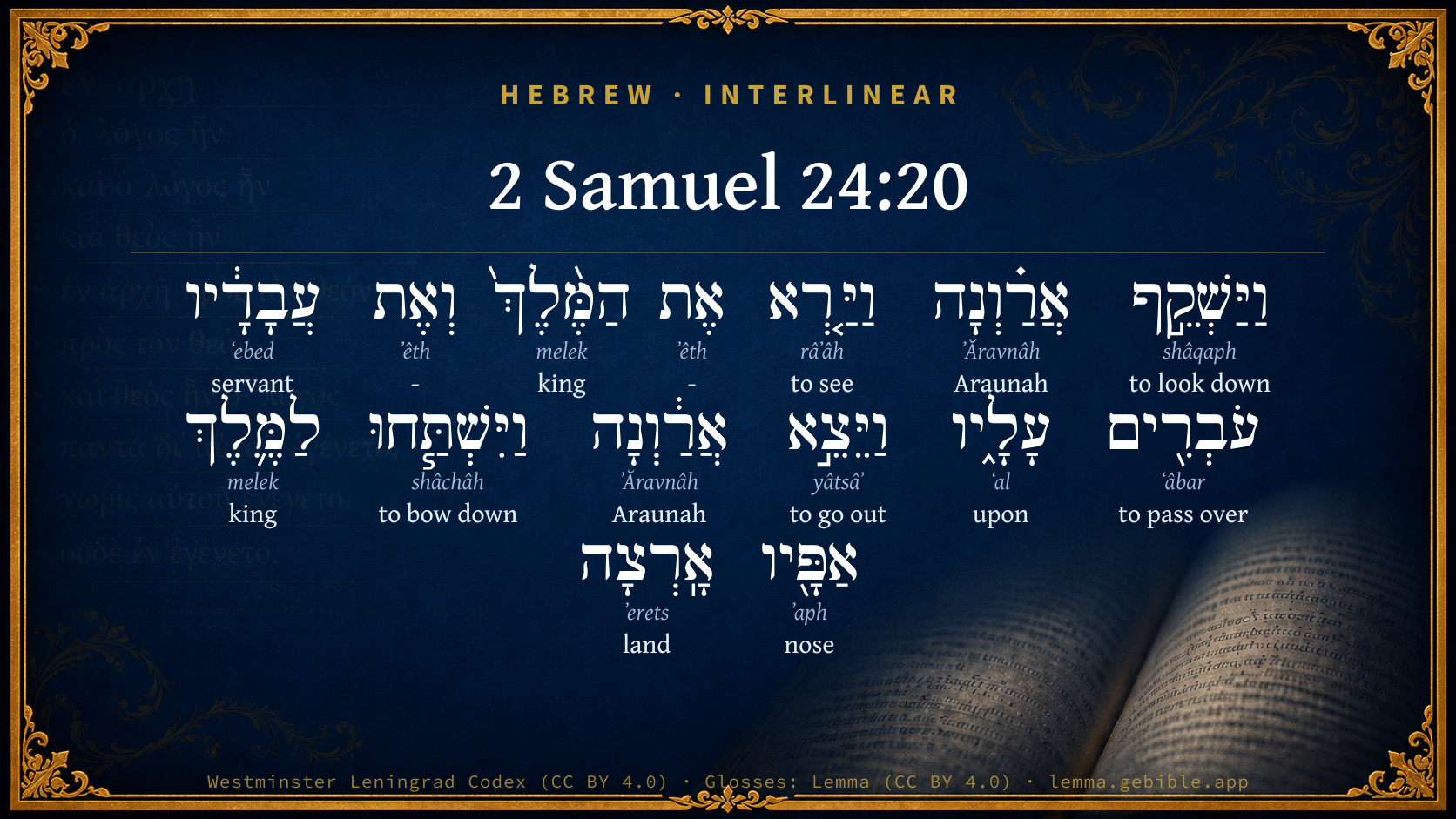
2 Samuel 24:20

Hebrew (Westminster Leningrad Codex) 2 Samuel 24:20 appears in the Hebrew Old Testament. The text above is from the Westminster Leningrad Codex. Each word links to its Strong’s number, a concise gloss, and parsing drawn from the Open Scriptures Hebrew Bible morphology. Click any word for its full Brown-Driver-Briggs (BDB) entry.
Download image
Cite this verse

2 Samuel 24:20 (World English Bible). Public Domain. Lemma interlinear Bible study tool, https://lemma.gebible.app/v/2-samuel/24/20.

Show BibTeX & RIS
BibTeX
RIS
English Translation
Araunah looked forth, and saw the king and his servants coming on toward him: and Araunah went out, and bowed himself before the king with his face to the ground.
World English Bible · Public Domain
Download a study sheet

One document with this verse’s original text, its word-by-word gloss line, the meaning frame, cross-references with their text, attributed commentary, and full source and license credits — printable, and it pastes into notes with its structure intact.

This verse Autodidact and up

Study sheet (.html) Plain text (.txt)

A passage Seminary Student

Up to 50 verses in one chapter. A passage sheet keeps up to 6 commentary sources and 12 cross-references per verse, in the order this page ranks them, and says so on the sheet whenever that leaves anything out. Ask for a single verse and you get the Autodidact verse sheet above.

Everything on this page stays free to read, with no account — the sheet is a download of what is already on screen, not access to it.

Want to remove ads? Support Godless Engineer
Compare translations 3

The same verse in 3 English versions, stacked beneath the original-language interlinear above. Click any original word for its lexicon entry.

Each is an independent rendering of the whole verse — the interlinear is not word-aligned to these translations.

Highlighted words mark where these versions differ — a whole-verse word diff, not a word-by-word alignment.

  • World English Bible Public Domain
    Araunah looked forth, and saw the king and his servants coming on toward him: and Araunah went out, and bowed himself before the king with his face to the ground.
  • King James Version Public Domain
    And Araunah looked, and saw the king and his servants coming on toward him: and Araunah went out, and bowed himself before the king on his face upon the ground.
  • unfoldingWord Literal Text CC BY-SA 4.0
    And Araunah looked down, and he saw the king and his servants coming over to him. And Araunah went out, and he prostrated himself to the king, his nose to the ground.

unfoldingWord Literal Text — © unfoldingWord, licensed CC BY-SA 4.0. Word-aligned USFM3 via Door43 (git.door43.org/unfoldingWord/en_ult).

Versions to compare (up to 4)

3 of 4 selected

Show all 18 translations

Every available English version of this verse, each an independent rendering of the whole verse.

  • World English Bible Public Domain
    Araunah looked forth, and saw the king and his servants coming on toward him: and Araunah went out, and bowed himself before the king with his face to the ground.
  • Berean Standard Bible Public Domain
    When Araunah looked out and saw the king and his servants coming toward him, he went out and bowed facedown before the king.
  • Majority Standard Bible Public Domain
    When Araunah looked out and saw the king and his servants coming toward him, he went out and bowed facedown before the king.
  • King James Version Public Domain
    And Araunah looked, and saw the king and his servants coming on toward him: and Araunah went out, and bowed himself before the king on his face upon the ground.
  • American Standard Version (1901) Public Domain
    And Araunah looked forth, and saw the king and his servants coming on toward him: and Araunah went out, and bowed himself before the king with his face to the ground.
  • Revised Version (1885) Public Domain
    And Araunah looked forth, and saw the king and his servants coming on toward him: and Araunah went out, and bowed himself before the king with his face to the ground.
  • Geneva Bible (1599) Public Domain
    And Araunah looked, and sawe the King and his seruants comming towarde him, and Araunah went out, and bowed himselfe before the King on his face to the ground,
  • Douay-Rheims (1899) Public Domain
    And Areuna looked, and saw the king and his servants coming towards him:
  • Young's Literal Translation Public Domain
    And Araunah looketh, and seeth the king and his servants passing over unto him, and Araunah goeth out and boweth himself to the king -- his face to the earth.
  • Literal Standard Version CC BY-SA 4.0
    And Araunah looks, and sees the king and his servants passing over to him, and Araunah goes out and bows himself to the king [with] his face to the earth.
  • Unlocked Literal Bible CC BY-SA 4.0
    Araunah looked out and saw the king and his servants approaching. So Araunah went out and bowed to the king with his face to the ground.
  • unfoldingWord Literal Text CC BY-SA 4.0
    And Araunah looked down, and he saw the king and his servants coming over to him. And Araunah went out, and he prostrated himself to the king, his nose to the ground.
  • Darby Bible Public Domain
    And Araunah looked, and saw the king and his servants coming on towards him; and Araunah went out, and bowed himself before the king with his face to the ground.
  • World Messianic Bible Public Domain
    Araunah looked out, and saw the king and his servants coming on toward him. Then Araunah went out and bowed himself before the king with his face to the ground.
  • Webster's Bible Public Domain
    And Araunah looked, and saw the king and his servants coming towards him: And Araunah went out, and bowed himself before the king on his face upon the ground.
  • Free Bible Version CC BY-SA 4.0
    When Araunah looked up, he saw the king and his officials approaching. So he went out and bowed before the king with his face to the ground.
  • Bible in Basic English Public Domain
    And Araunah, looking out, saw the king and his servants coming to him: and Araunah went out, and went down on his face to the earth before the king.
  • JPS Tanakh (1917) Public Domain
    And Araunah looked forth, and saw the king and his servants coming on toward him; and Araunah went out, and bowed down before the king with his face to the ground.

Literal Standard Version (2020), Covenant Press — licensed CC BY-SA 4.0. Text via the HelloAO Bible API (eBible.org). Unlocked Literal Bible (unfoldingWord) — licensed CC BY-SA 4.0. Text via the HelloAO Bible API (eBible.org). unfoldingWord Literal Text — © unfoldingWord, licensed CC BY-SA 4.0. Word-aligned USFM3 via Door43 (git.door43.org/unfoldingWord/en_ult). Free Bible Version, Dr. Jonathan Gallagher — licensed CC BY-SA 4.0. Text via the HelloAO Bible API (eBible.org).

Word by word

More ways to search: Search by grammar → Find every occurrence → Compare this word →

Practice this passage: Drill this verse → Learn its vocabulary →

אֲרַ֗וְנָה
ʼĂravnâh
H728
“Araunah”
Noun, Proper
Part of Speech
Noun
Type
Proper
Full BDB Definition

Origin: all by orthographical variation for H771

TWOT: None

= "joyful shouting of Jah ( 2Sa 24:18 )" = "make ye to shine ( 2Sa 24:16 )" = "joyful shouting of Jah ( 2Sa 24:18 )" - a Jebusite who sold David the site for an altar
  1. וַיַּשְׁקֵ֣ף shâqaph H8259 “and · to look down” Conjunction + Verb, Hiphil, Sequential Imperfect, 3rd Person, Masculine, Singular
  2. וַיַּ֤רְא râʼâh H7200 “and · to see” Conjunction + Verb, Qal, Sequential Imperfect, 3rd Person, Masculine, Singular
  3. אֶת ʼêth H853 “-” Particle, Direct Object
  4. הַמֶּ֨לֶךְ֙ melek H4428 “the · king” Particle, Definite Article + Noun, Common, Masculine, Singular, Absolute
  5. וְאֶת ʼêth H853 “and · -” Conjunction + Particle, Direct Object
  6. עֲבָדָ֔יו ʻebed H5650 “servants · his” Noun, Common, Masculine, Plural, Construct + Suffix, Personal, 3rd Person, Masculine, Singular
  7. עֹבְרִ֖ים ʻâbar H5674 “passing over” Verb, Qal, Participle Active, Masculine, Plural, Absolute
  8. עָלָ֑יו ʻal H5921 “upon · him” Preposition + Suffix, Personal, 3rd Person, Masculine, Singular
  9. וַיֵּצֵ֣א yâtsâʼ H3318 “and · to go out” Conjunction + Verb, Qal, Sequential Imperfect, 3rd Person, Masculine, Singular
  10. אֲרַ֔וְנָה ʼĂravnâh H728 “Araunah” Noun, Proper
  11. וַיִּשְׁתַּ֧חוּ shâchâh H7812 “and · to bow down” Conjunction + Verb, Hithpael, Sequential Imperfect, 3rd Person, Masculine, Singular
  12. לַמֶּ֛לֶךְ melek H4428 “to/for the · king” Preposition, Determined + Noun, Common, Masculine, Singular, Absolute
  13. אַפָּ֖יו ʼaph H639 “nostrils · his” Noun, Common, Masculine, Dual, Construct + Suffix, Personal, 3rd Person, Masculine, Singular
  14. אָֽרְצָה ʼerets H776 “land · toward” Noun, Common, Both, Singular, Absolute + Suffix, Demonstrative

About this verse

These counts appear in no published source. They are computed here, from the morphology-tagged text and Lemma’s own curated glosses. What Lemma adds →

15
words
12
distinct lemmas
Historical
section

Notable vocabulary

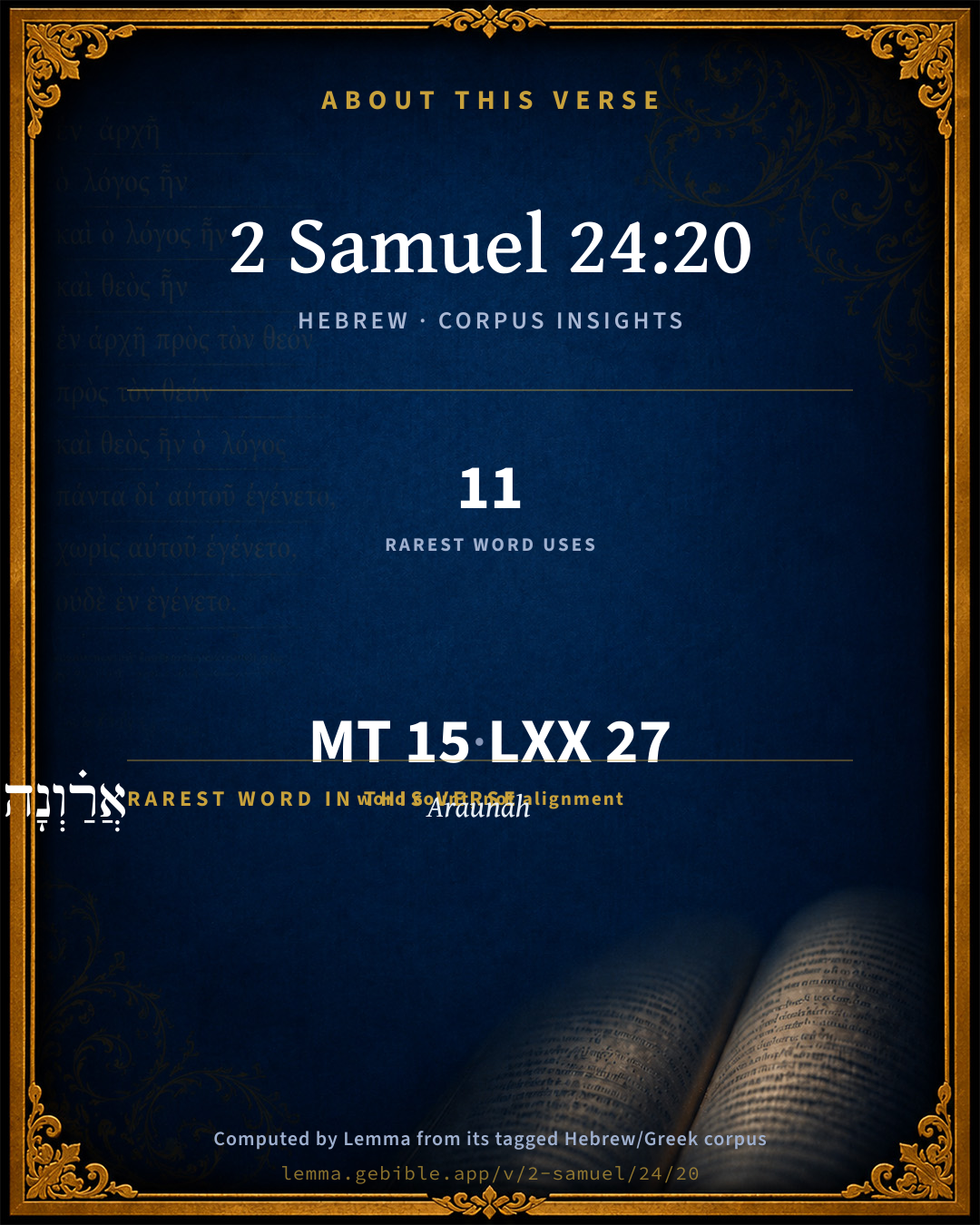
The rarest word here is אֲרַ֗וְנָה Araunah H728 — appearing just 11 times in the whole Hebrew Bible.

Shared distinctive vocabulary

אֲרַ֗וְנָה Araunah H728 occurs in 7 verses of the Hebrew Bible. Also found in:

Grammatical profile

  • 5 verbs
  • 7 nouns
  • 1 preposition
  • 2 particles

Verb forms

  • וַיַּשְׁקֵ֣ף Hiphil · Sequential Imperfect
  • וַיַּ֤רְא Qal · Sequential Imperfect
  • עֹבְרִ֖ים Qal · Participle Active
  • וַיֵּצֵ֣א Qal · Sequential Imperfect
  • וַיִּשְׁתַּ֧חוּ Hithpael · Sequential Imperfect

Repetition

Words recur within this verse — often emphatic in Hebrew:

  • אֲרַ֗וְנָה Araunah H728 ×2
  • הַמֶּ֨לֶךְ֙ king H4428 ×2

Hebrew & Septuagint length

In English translation the verse runs 30 words from the Hebrew and 31 from the Septuagint (LXX English) — closely comparable.

A rough comparison of the two English renderings, which tokenize alike — not a word-level alignment.

Word counts can differ between the Hebrew and the Greek without any difference in meaning — e.g. the Hebrew direct-object marker אֵת has no separate Greek word, and Greek often adds the article ὁ.

In the original languages it is 15 Hebrew tokens and 27 Greek tokens — but the two are counted differently (Hebrew bundles its prefixes and suffixes into one token; the Greek is in lemma form), so that isn’t a like-for-like length.

Cross-references

4

Topical passages linked to 2 Samuel 24:20 in the Treasury of Scripture Knowledge — connected by theme and wording, ordered by reader-vote popularity; previews shown in the World English Bible.

  • Genesis 18:2 He lifted up his eyes and looked, and saw that three men stood opposite him. When he saw them, he ran to meet them from the tent door, and bowed himself to the earth,
  • Ruth 2:10 Then she fell on her face, and bowed herself to the ground, and said to him, Why have I found favor in your sight, that you should take knowledge of me, seeing I am a foreigner?
  • 2 Samuel 9:8 He did obeisance, and said, "What is your servant, that you should look on such a dead dog as I am?"
  • 1 Chronicles 21:20–21 Ornan turned back, and saw the angel; and his four sons who were with him hid themselves. Now Ornan was threshing wheat.

Cross-references courtesy of OpenBible.info (CC BY 4.0).

Hebrew and Greek witnesses Masoretic Hebrew ↔ Greek Septuagint

The same verse in the two great witnesses to the Old Testament, shown verse-for-verse.

These are two independent witnesses, not word-aligned to each other, and the Septuagint is shown in lemma (dictionary) form.

Hebrew 2 Samuel 24:20 Masoretic · Westminster Leningrad Codex

וַיַּשְׁקֵ֣ף אֲרַ֗וְנָה וַיַּ֤רְא אֶת הַמֶּ֨לֶךְ֙ וְאֶת עֲבָדָ֔יו עֹבְרִ֖ים עָלָ֑יו וַיֵּצֵ֣א אֲרַ֔וְנָה וַיִּשְׁתַּ֧חוּ לַמֶּ֛לֶךְ אַפָּ֖יו אָֽרְצָה

Araunah looked forth, and saw the king and his servants coming on toward him: and Araunah went out, and bowed himself before the king with his face to the ground.

World English Bible · Public Domain

Greek LXX 2 Samuel 24:20 Septuagint · lemma form

καί διακύπτω ορνα καί ὁράω ὁ βασιλεύς καί ὁ παῖς αὐτός παραπορεύομαι ἐπάνω αὐτός καί ἐκἔρχομαι ορνα καί προςκυνέω ὁ βασιλεύς ἐπί πρόσωπον αὐτός ἐπί ὁ γῆ

And Orna looked out, and saw the king and his servants coming on before him: and Orna went forth, and did obeisance to the king with his face to the earth.

LXX2012 (modern English Septuagint) · Public Domain

Hebrew: Westminster Leningrad Codex (CC BY 4.0). Greek: Septuagint (public domain); English from LXX2012 (modern English Septuagint) (Public Domain). How the Septuagint differs from the Hebrew →

Targum (Aramaic paraphrase)

1

The Targum is the ancient Jewish Aramaic paraphrase of the Hebrew Scriptures — an interpretive translation, not the Hebrew text itself. Onkelos (literal) and Pseudo-Jonathan (expansive) render the Torah, and Jonathan the Prophets. Coverage is partial: where no permissively-licensed English translation exists for a verse, only the Aramaic is shown. This is verse-level text, not a word-by-word alignment to the Hebrew.

  1. Targum Jonathan Prophets (Joshua–Malachi)
    וְאִסְתְּכִי אֲרַוָן וַחֲזָא יַת מַלְכָּא וְיַת עַבְדוֹהִי עָבְרִין עֲלוֹהִי וּנְפַק אֲרְוָן וּסְגִיד לְמַלְכָּא אַפּוֹהִי עַל אַרְעָא:

    (no public-domain English translation for this verse)

    Targum Jonathan — Aramaic: “Mikraot Gedolot” (public domain). English: “Sefaria Community Translation” (CC0 1.0 (public-domain dedication)); “London "Chaldee Paraphrase," 1871” (public domain). Text via Sefaria.

Commentary

Notes on 2 Samuel 24:20 from classic Christian and Jewish commentators (each source and its license shown beneath its notes). The classic Christian expositions comment on the surrounding passage and are grouped to its opening verse, so a note may address several verses; the Jewish commentaries on the Tanakh (Rashi and others) are per-verse, so they appear only where the commentator wrote on this verse.

Lemma curates 59 commentaries, every one of them public domain or Creative Commons licensed, each selected and text-cleaned for this edition rather than reprinted as found. About our sources →

Trapp's Complete Commentary

John Trapp

2Sa 24:20 And Araunah looked, and saw the king and his servants coming on toward him: and Araunah went out, and bowed himself before the king on his face upon the ground.

Ver. 20. And Araunah looked and saw the king.] After that he had first seen the angel, {1Ch 21:20} whom scarce any of the Israelites, except David, had yet seen.

And Araunah went out,] sc., Out of the place where he had hid himself, together with his sons.

John Trapp, A Commentary or Exposition upon All the Books of the Old and New Testament (1647–1656) — public domain. Text from a community e-Sword module.

Ellicott's Commentary for English Readers

(20) Saw the king.—Not the angel, as in Chronicles, the words in Hebrew being much alike.

A Bible Commentary for English Readers, edited by Charles John Ellicott (1878–1897) — public domain. Text from a community e-Sword module.

The Cambridge Bible for Schools and Colleges

gen. ed. J. J. S. Perowne

20. saw the king] In Chron. saw the angel, but the words angel and king in Heb. are very similar, and probably king is the true reading there also.

went out] From the threshingfloor where he was at work threshing wheat.

The Cambridge Bible for Schools and Colleges (gen. ed. J. J. S. Perowne; Cambridge University Press, 1878–1918) — public domain. Text from a community e-Sword module.

John Gill's Exposition

And Araunah said, wherefore is my lord the king come to his servant?.... Which both implies admiration in him, that so great a person should visit him in his threshingfloor; that a king should come to a subject his servant, who should rather have come to him, and would upon the least intimation; it was a piece of condescension he marvelled at; and it expresses a desire to know his pleasure with him, supposing it must be something very urgent and important, that the king should come himself upon it: and to this David made answer:

and David said, what he was come for:

to buy the threshingfloor of thee, to build an altar to the Lord, that the plague may be stayed from the people; for though David had acknowledged his sin, and God had repented of the evil he inflicted for it, and given orders for stopping it; yet he would have an altar built, and sacrifices offered, to show that the only way to have peace, and pardon, and safety from ruin and destruction, deserved by sin, is through the expiatory sacrifice of Christ, of which fill sacrifices were typical, and were designed to lead the faith of the Lord's people to that.

John Gill's Exposition of the Whole Bible (1746–1763) — public domain (CC PDM 1.0). Text via the HelloAO Bible API.

Albert Barnes' Notes on the Bible

And his servants - In Chronicles “his four sons,” namely, David’s. It is very possible that David may have taken his sons with him, as well as his elders, and Gad’s original narrative may have mentioned the circumstance, which the compiler of this chapter did not care to specify, and so used the general term “his servants.”

Albert Barnes' Notes on the Bible (1834–1885) — public domain. Text from a community e-Sword/MySword module.

Whedon's Commentary on the Bible

Daniel D. Whedon

20. Araunah looked, and saw the king — According to Chronicles he, too, had seen the angel, and in their terror himself and his four sons had hid themselves.

Daniel D. Whedon (gen. ed.), Commentary on the Old and New Testaments (1874–1909) — public domain. Text from a community e-Sword module.

The Pulpit Commentary

Araunah saw the king. In 1Ch_21:20, "saw the angel;" but the text there is apparently corrupt, the difference, moreover, in Hebrew between "king" and "angel" being very slight. The addition there of the story of Araunah"s four sons hiding themselves is very lifelike and natural. For these remnants of the aborigines, though tolerated, yet held a very insecure position, as we have seen in the dealings of Saul with the Gibeonites; and the coming of the king with his retinue to the out of the way spot where Araunah was at work, no doubt filled them all with terror.

Vers. 20-23 (MORIAH.) (1Ch_21:18-23)

Araunah the Jebusite.

Araunah (Aravnah, Avarnah, Aranyah, Ornan) was:

1. A Gentile by birth; almost the last relic of the Canaanitish tribe whose fortress was taken nearly thirty years before. (2Sa_5:6) "He was not slain by David in the siege of Jerusalem, because of the good will he bore to the Hebrews, and a particular benignity and affection which he had to the king himself" (Josephus); with whom, during his exile, he may have become acquainted.

2. A proselyte to the faith of Israel (ver. 23). "There was no other people who were specially called the people of God; but they (the Jews) cannot deny that there have been certain men of other nations, who belonged, not by earthly but heavenly fellowship, to the true Israelites, the citizens of the country that is above" (Augustine).

3. A prosperous owner of property on the hill Moriah (at that time outside the city), where he had his threshing floor, and dwelt with his four sons. His prosperity was due, not merely to his own industry, but chiefly to his friendship with David and his people.

4. A partaker of the sufferings, as well as the privileges, of the inhabitants of Jerusalem. Whilst occupied in threshing wheat (by means of sledges drawn by oxen), it was given him to see the supernatural messenger of; (1Ch_21:20) and "his four sons with him, hid themselves" from fear.

1. A loyal subject; respectful, courteous (ver. 20), and grateful for the king"s visit to him in his threshing floor (ver. 21). "It was a piece of condescension to be marvelled at; and the language expresses a desire to know his pleasure concerning him, supposing it must be something very urgent and important" (Gill).

1. A generous donor and public-spirited man (ver. 22). "All does Araunah, O king, give to the king" (ver. 23). "His liberality and princely munificence is registered to all after ages in the Holy Scripture; what is done by a pious heart to the honour and worship of God shall never want its own reward

2. and blessed remembrance; as was the breaking of the box of precious ointment" (Guild).

3. A devout worshipper of God. "Jehovah thy God accept thee.

1. A ready helper toward the building of the altar and temple of God.

2. A pattern to Christians.

3. A pro-intimation of the willing homage of the Gentile world to Christ; (2Sa_22:50) an earnest or firstfruits of the harvest. (Psa_72:10, Psa_72:11) "In every place incense shall be offered," etc. D. (Mal_1:11)

The Pulpit Commentary (1880–1919), ed. H.D.M. Spence-Jones & Joseph S. Exell — public domain. Text from a community e-Sword module.

Scofield Reference Notes

C. I. Scofield

saw

Here read 1Ch 21:20.

The Scofield Reference Bible (1917 edition), notes by C. I. Scofield — public domain. Text from a community e-Sword module.

Rashi

Rabbi Shlomo Yitzchaki (Rashi)

Aravnoh saw. He was hiding from the angel, this is what is written in Divrei Hayomim.

Rashi on the Tanakh — English translations: “The Judaica Press complete Tanach with Rashi, translated by A. J. Rosenberg” (CC BY 4.0); “Pentateuch with Rashi's commentary by M. Rosenbaum and A.M. Silbermann, 1929-1934” (public domain); “The Metsudah Tanach series, Lakewood, N.J” (CC BY 4.0); and “The Book of Joshua, Metsudah Publications, 1997” (CC BY 4.0). Text via Sefaria.

Lesson kit

Teaching starters — assembled from the data on this page, not authored interpretation. Every prompt links to the verse data it draws on. Edit before teaching.

2 Samuel, in the Historical, opens this verse with 15 words (12 distinct Hebrew lemmas). Its most distinctive word is ʼĂravnâh (“Araunah”). A historical commentator’s framing appears above. Read the whole chapter for the surrounding context.

Discussion questions

  1. The word ʼĂravnâh carries the sense “Araunah.” How does it shape the verse?
  2. How does 2 Samuel 24:16, which shares the word «Araunah», read alongside this verse?
  3. What does the repetition of “Araunah” (2× in this one verse) do in this verse?
  4. These translations render this verse differently; the difference is in the English rendering, not the original. What questions does that raise?
  5. «וַיַּשְׁקֵ֣ף» is a Hiphil Sequential Imperfect verb. How does that grammatical form shape the action described?
  6. Compare how Trapp's Complete Commentary and Ellicott's Commentary for English Readers read this verse. Where do they agree or differ?

Things to notice

Reading settings

Reading text

Shown beneath each verse's original-language words.

Old Testament
Old Testament edition

Read the OT as the Masoretic Hebrew (MT) or the Greek Septuagint (LXX).

English shown for the Greek Septuagint (in the Hebrew ↔ Greek comparison).

Comparing translations? Open the Compare panel on any verse page to stack up to four side by side.