
2 Samuel 16:4

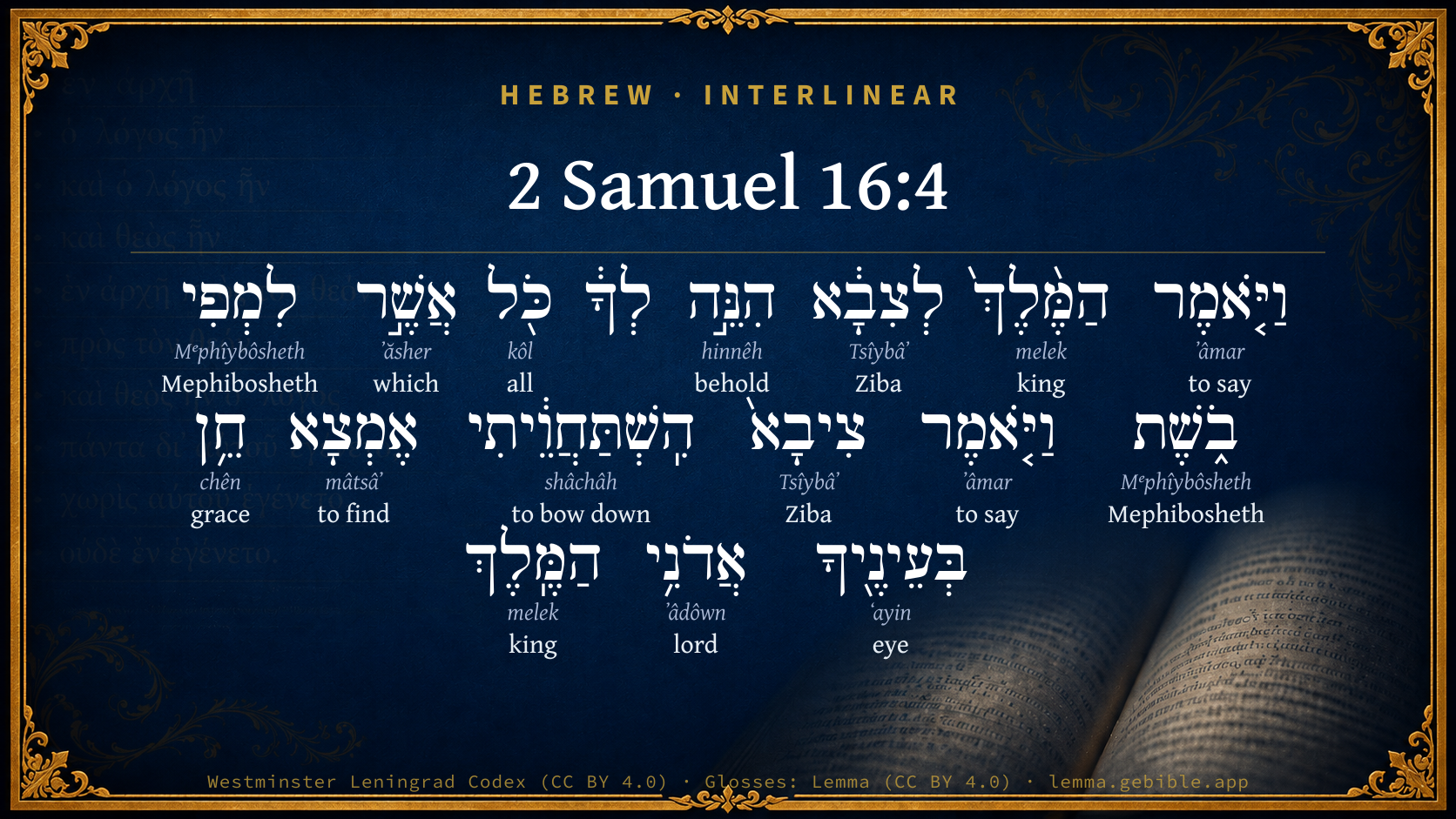
Hebrew (Westminster Leningrad Codex) 2 Samuel 16:4 appears in the Hebrew Old Testament. The text above is from the Westminster Leningrad Codex. Each word links to its Strong’s number, a concise gloss, and parsing drawn from the Open Scriptures Hebrew Bible morphology. Click any word for its full Brown-Driver-Briggs (BDB) entry.
Download image
Cite this verse

2 Samuel 16:4 (World English Bible). Public Domain. Lemma interlinear Bible study tool, https://lemma.gebible.app/v/2-samuel/16/4.

Show BibTeX & RIS
BibTeX
RIS
English Translation
Then said the king to Ziba, Behold, all that pertains to Mephibosheth is yours. Ziba said, I do obeisance; let me find favor in your sight, my lord, O king.
World English Bible · Public Domain
Download a study sheet

One document with this verse’s original text, its word-by-word gloss line, the meaning frame, cross-references with their text, attributed commentary, and full source and license credits — printable, and it pastes into notes with its structure intact.

This verse Autodidact and up

Study sheet (.html) Plain text (.txt)

A passage Seminary Student

Up to 50 verses in one chapter. A passage sheet keeps up to 6 commentary sources and 12 cross-references per verse, in the order this page ranks them, and says so on the sheet whenever that leaves anything out. Ask for a single verse and you get the Autodidact verse sheet above.

Everything on this page stays free to read, with no account — the sheet is a download of what is already on screen, not access to it.

Want to remove ads? Support Godless Engineer
Compare translations 3

The same verse in 3 English versions, stacked beneath the original-language interlinear above. Click any original word for its lexicon entry.

Each is an independent rendering of the whole verse — the interlinear is not word-aligned to these translations.

Highlighted words mark where these versions differ — a whole-verse word diff, not a word-by-word alignment.

  • World English Bible Public Domain
    Then said the king to Ziba, Behold, all that pertains to Mephibosheth is yours. Ziba said, I do obeisance; let me find favor in your sight, my lord, O king.
  • King James Version Public Domain
    Then said the king to Ziba, Behold, thine are all that pertained unto Mephibosheth. And Ziba said, I humbly beseech thee that I may find grace in thy sight, my lord, O king.
  • unfoldingWord Literal Text CC BY-SA 4.0
    And the king said to Ziba, “Behold, to you all that to Mephibosheth.” And Ziba said, “I prostrate myself. May I find favor in your eyes, my lord the king.”

unfoldingWord Literal Text — © unfoldingWord, licensed CC BY-SA 4.0. Word-aligned USFM3 via Door43 (git.door43.org/unfoldingWord/en_ult).

Versions to compare (up to 4)

3 of 4 selected

Show all 18 translations

Every available English version of this verse, each an independent rendering of the whole verse.

  • World English Bible Public Domain
    Then said the king to Ziba, Behold, all that pertains to Mephibosheth is yours. Ziba said, I do obeisance; let me find favor in your sight, my lord, O king.
  • Berean Standard Bible Public Domain
    So the king said to Ziba, “All that belongs to Mephibosheth is now yours!” “I humbly bow before you,” said Ziba. “May I find favor in your eyes, my lord the king!”
  • Majority Standard Bible Public Domain
    So the king said to Ziba, “All that belongs to Mephibosheth is now yours!” “I humbly bow before you,” said Ziba. “May I find favor in your eyes, my lord the king!”
  • King James Version Public Domain
    Then said the king to Ziba, Behold, thine are all that pertained unto Mephibosheth. And Ziba said, I humbly beseech thee that I may find grace in thy sight, my lord, O king.
  • American Standard Version (1901) Public Domain
    Then said the king to Ziba, Behold, thine is all that pertaineth unto Mephibosheth. And Ziba said, I do obeisance; let me find favor in thy sight, my lord, O king.
  • Revised Version (1885) Public Domain
    Then said the king to Ziba, Behold, thine is all that pertaineth unto Mephibosheth. And Ziba said, I do obeisance; let me find favour in thy sight, my lord, O king.
  • Geneva Bible (1599) Public Domain
    Then said the King to Ziba, Behold, thine are all that perteined vnto Mephibosheth. And Ziba saide, I beseech thee, let me finde grace in thy sight, my lord, O King.
  • Douay-Rheims (1899) Public Domain
    And the king said to Siba: I give thee all that belonged to Miphiboseth. And Siba said: I beseech thee let me find grace before thee, my lord, O king.
  • Young's Literal Translation Public Domain
    And the king saith to Ziba, `Lo, thine `are' all that Mephibosheth hath;' and Ziba saith, `I have bowed myself -- I find grace in thine eyes, my lord, O king.'
  • Literal Standard Version CC BY-SA 4.0
    And the king says to Ziba, “Behold, all that Mephibosheth has [is] for you”; and Ziba says, “I have bowed myself—I find grace in your eyes, my lord, O king.”
  • Unlocked Literal Bible CC BY-SA 4.0
    Then the king said to Ziba, “Look, all that belonged to Mephibosheth now belongs to you.” Ziba answered, “I bow in humility to you, my master, king. Let me find favor in your eyes.”
  • unfoldingWord Literal Text CC BY-SA 4.0
    And the king said to Ziba, “Behold, to you all that to Mephibosheth.” And Ziba said, “I prostrate myself. May I find favor in your eyes, my lord the king.”
  • Darby Bible Public Domain
    And the king said to Ziba, Behold, thine are all that pertained to Mephibosheth. And Ziba said, I humbly bow myself: may I find favour in thy sight, my lord, O king.
  • World Messianic Bible Public Domain
    Then the king said to Ziba, “Behold, all that belongs to Mephibosheth is yours.” Ziba said, “I bow down. Let me find favor in your sight, my lord, O king.”
  • Webster's Bible Public Domain
    Then said the king to Ziba, Behold, thine are all that pertained to Mephibosheth. And Ziba said, I humbly beseech thee that I may find grace in thy sight, my lord, O king.
  • Free Bible Version CC BY-SA 4.0
    The king told Ziba, “I give you everything that belongs to Mephibosheth!” “I bow before you,” Ziba replied. “May you approve of me, Your Majesty.”
  • Bible in Basic English Public Domain
    Then the king said to Ziba, Truly everything which was Mephibosheth's is yours. And Ziba said, I give honour to my lord, may I have grace in your eyes, my lord, O king!
  • JPS Tanakh (1917) Public Domain
    Then said the king to Ziba: 'Behold, thine is all that pertaineth unto Mephibosheth.' And Ziba said: 'I prostrate myself; let me find favour in thy sight, my lord, O king.'

Literal Standard Version (2020), Covenant Press — licensed CC BY-SA 4.0. Text via the HelloAO Bible API (eBible.org). Unlocked Literal Bible (unfoldingWord) — licensed CC BY-SA 4.0. Text via the HelloAO Bible API (eBible.org). unfoldingWord Literal Text — © unfoldingWord, licensed CC BY-SA 4.0. Word-aligned USFM3 via Door43 (git.door43.org/unfoldingWord/en_ult). Free Bible Version, Dr. Jonathan Gallagher — licensed CC BY-SA 4.0. Text via the HelloAO Bible API (eBible.org).

Word by word

More ways to search: Search by grammar → Find every occurrence → Compare this word →

Practice this passage: Drill this verse → Learn its vocabulary →

לְצִבָ֔א
Tsîybâʼ
H6717
“to/for · Ziba”
Preposition + Noun, Proper
Part of Speech
Preposition + Noun
Type
Proper
Full BDB Definition

Origin: from the same as H6678

TWOT: None

Ziba = "statue" - a servant of Saul whom David made steward of Jonathan's son Mephibosheth
  1. וַיֹּ֤אמֶר ʼâmar H559 “and · to say” Conjunction + Verb, Qal, Sequential Imperfect, 3rd Person, Masculine, Singular
  2. הַמֶּ֨לֶךְ֙ melek H4428 “the · king” Particle, Definite Article + Noun, Common, Masculine, Singular, Absolute
  3. הִנֵּ֣ה hinnêh H2009 “behold” Particle, Demonstrative
  4. כֹּ֖ל kôl H3605 “all” Noun, Common, Masculine, Singular, Absolute
  5. אֲשֶׁ֣ר ʼăsher H834 “which” Particle, Relative
  6. לִמְפִי Mᵉphîybôsheth H4648 “to/for · Mephibosheth” Preposition + Noun, Proper
  7. בֹ֑שֶׁת Mᵉphîybôsheth H4648 “Mephibosheth” Noun, Proper
  8. וַיֹּ֤אמֶר ʼâmar H559 “and · to say” Conjunction + Verb, Qal, Sequential Imperfect, 3rd Person, Masculine, Singular
  9. צִיבָא֙ Tsîybâʼ H6717 “Ziba” Noun, Proper
  10. הִֽשְׁתַּחֲוֵ֔יתִי shâchâh H7812 “to bow down” Verb, Hishtaphel, Perfect, 1st Person, Common, Singular
  11. אֶמְצָא mâtsâʼ H4672 “to find” Verb, Qal, Imperfect, 1st Person, Common, Singular
  12. חֵ֥ן chên H2580 “grace” Noun, Common, Masculine, Singular, Absolute
  13. בְּעֵינֶ֖יךָ ʻayin H5869 “in/at · eyes · your” Preposition + Noun, Common, Both, Dual, Construct + Suffix, Personal, 2nd Person, Masculine, Singular
  14. אֲדֹנִ֥י ʼâdôwn H113 “lord · my” Noun, Common, Masculine, Singular, Construct + Suffix, Personal, 1st Person, Common, Singular
  15. הַמֶּֽלֶךְ melek H4428 “the · king” Particle, Definite Article + Noun, Common, Masculine, Singular, Absolute

About this verse

These counts appear in no published source. They are computed here, from the morphology-tagged text and Lemma’s own curated glosses. What Lemma adds →

17
words
12
distinct lemmas
Historical
section

Notable vocabulary

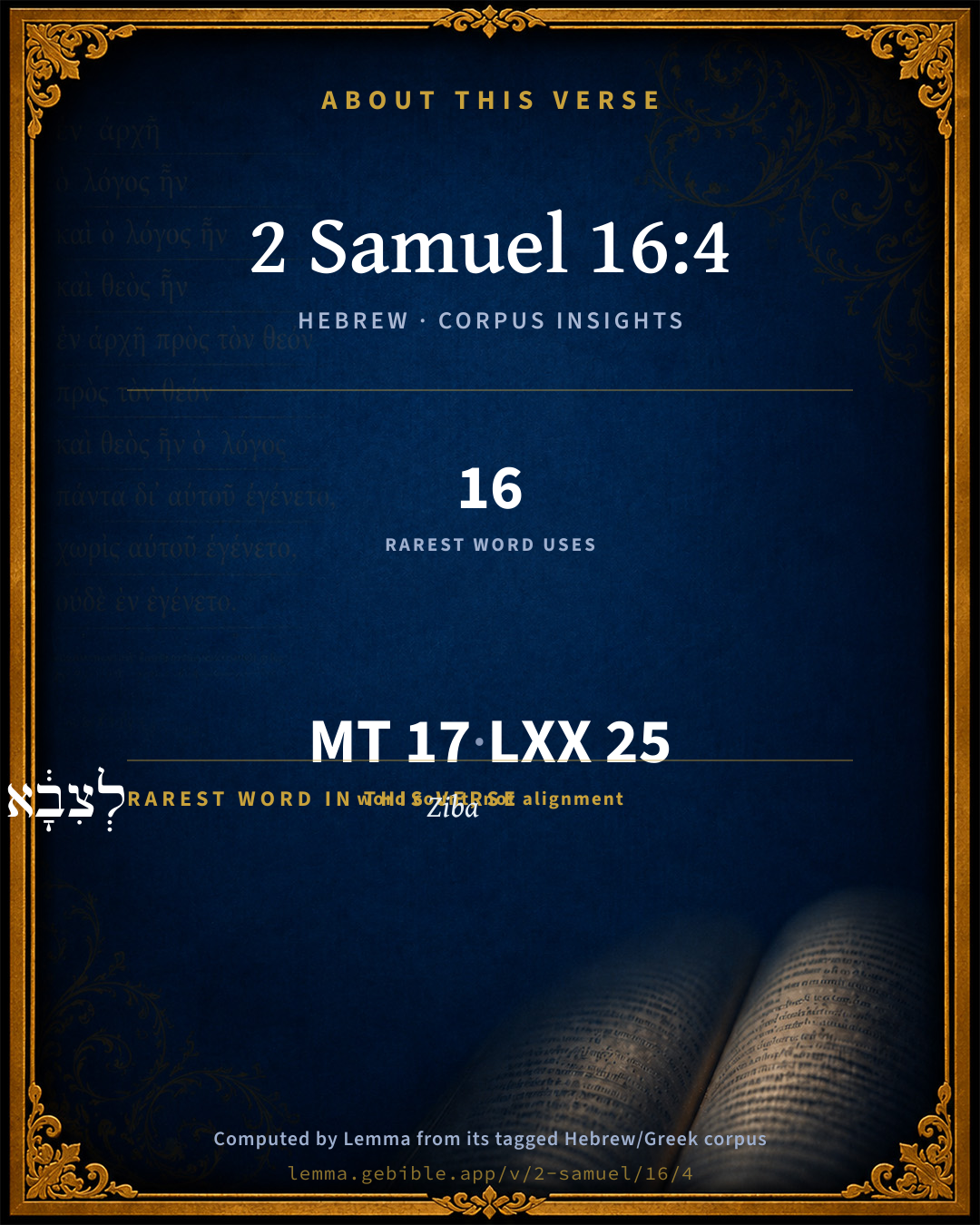
The rarest word here is לְצִבָ֔א Ziba H6717 — appearing just 16 times in the whole Hebrew Bible.

Shared distinctive vocabulary

לְצִבָ֔א Ziba H6717 occurs in 13 verses of the Hebrew Bible. Also found in:

Grammatical profile

  • 4 verbs
  • 10 nouns
  • 1 preposition
  • 2 particles

Verb forms

  • וַיֹּ֤אמֶר Qal · Sequential Imperfect
  • וַיֹּ֤אמֶר Qal · Sequential Imperfect
  • הִֽשְׁתַּחֲוֵ֔יתִי Hishtaphel · Perfect
  • אֶמְצָא Qal · Imperfect

Repetition

Words recur within this verse — often emphatic in Hebrew:

  • וַיֹּ֤אמֶר to say H559 ×2
  • הַמֶּ֨לֶךְ֙ king H4428 ×2
  • לְצִבָ֔א Ziba H6717 ×2
  • לִמְפִי Mephibosheth H4648 ×2

Hebrew & Septuagint length

In English translation the verse runs 30 words from the Hebrew and 29 from the Septuagint (LXX English) — closely comparable.

A rough comparison of the two English renderings, which tokenize alike — not a word-level alignment.

Word counts can differ between the Hebrew and the Greek without any difference in meaning — e.g. the Hebrew direct-object marker אֵת has no separate Greek word, and Greek often adds the article ὁ.

In the original languages it is 17 Hebrew tokens and 25 Greek tokens — but the two are counted differently (Hebrew bundles its prefixes and suffixes into one token; the Greek is in lemma form), so that isn’t a like-for-like length.

Cross-references

8

Topical passages linked to 2 Samuel 16:4 in the Treasury of Scripture Knowledge — connected by theme and wording, ordered by reader-vote popularity; previews shown in the World English Bible.

  • Proverbs 18:13 He who gives answer before he hears, That is folly and shame to him.
  • Proverbs 18:17 He who pleads his cause first seems right; Until another comes and questions him.
  • Exodus 23:8 You shall take no bribe, for a bribe blinds those who have sight and perverts the words of the righteous.
  • Deuteronomy 19:15 One witness shall not rise up against a man for any iniquity, or for any sin, in any sin that he sins: at the mouth of two witnesses, or at the mouth of three witnesses, shall a matter be established.
  • Proverbs 19:2 It isn't good to have zeal without knowledge; Nor being hasty with one's feet and missing the way.
  • 2 Samuel 14:4 When the woman of Tekoa spoke to the king, she fell on her face to the ground, and did obeisance, and said, Help, O king.
  • 2 Samuel 14:10–11 The king said, Whoever says anything to you, bring him to me, and he shall not touch you any more.
  • 2 Samuel 14:22 Joab fell to the ground on his face, and did obeisance, and blessed the king: and Joab said, Today your servant knows that I have found favor in your sight, my lord, king, in that the king has performed the request of his servant.

Cross-references courtesy of OpenBible.info (CC BY 4.0).

Hebrew and Greek witnesses Masoretic Hebrew ↔ Greek Septuagint

The same verse in the two great witnesses to the Old Testament, shown verse-for-verse.

These are two independent witnesses, not word-aligned to each other, and the Septuagint is shown in lemma (dictionary) form.

Hebrew 2 Samuel 16:4 Masoretic · Westminster Leningrad Codex

וַיֹּ֤אמֶר הַמֶּ֨לֶךְ֙ לְצִבָ֔א הִנֵּ֣ה לְךָ֔ כֹּ֖ל אֲשֶׁ֣ר לִמְפִי בֹ֑שֶׁת וַיֹּ֤אמֶר צִיבָא֙ הִֽשְׁתַּחֲוֵ֔יתִי אֶמְצָא חֵ֥ן בְּעֵינֶ֖יךָ אֲדֹנִ֥י הַמֶּֽלֶךְ

Then said the king to Ziba, Behold, all that pertains to Mephibosheth is yours. Ziba said, I do obeisance; let me find favor in your sight, my lord, O king.

World English Bible · Public Domain

Greek LXX 2 Samuel 16:4 Septuagint · lemma form

καί εἶπον ὁ βασιλεύς ὁ σιβα ἰδού σύ πᾶς ὅσος εἰμί ὁ μεμφιβοσθε καί εἶπον σιβα προςκυνέω εὑρίσκω χάρις ἐν ὀφθαλμός σύ κύριος ἐγώ βασιλεύς

And the king said to Siba, Behold, all Memphibosthe's property is your. And Siba did obeisance and said, My lord, O king, let me find grace in your eyes.

LXX2012 (modern English Septuagint) · Public Domain

Hebrew: Westminster Leningrad Codex (CC BY 4.0). Greek: Septuagint (public domain); English from LXX2012 (modern English Septuagint) (Public Domain). How the Septuagint differs from the Hebrew →

Targum (Aramaic paraphrase)

1

The Targum is the ancient Jewish Aramaic paraphrase of the Hebrew Scriptures — an interpretive translation, not the Hebrew text itself. Onkelos (literal) and Pseudo-Jonathan (expansive) render the Torah, and Jonathan the Prophets. Coverage is partial: where no permissively-licensed English translation exists for a verse, only the Aramaic is shown. This is verse-level text, not a word-by-word alignment to the Hebrew.

  1. Targum Jonathan Prophets (Joshua–Malachi)
    וַאֲמַר מַלְכָּא לְצִיבָא הָא לָךְ כָּל דִי לִמְפִיבֹשֶׁת וַאֲמַר צִיבָא מוֹדֵינָא אַשְׁכַּח רַחֲמִין בְּעֵינָךְ רִבּוֹנִי מַלְכָּא:

    (no public-domain English translation for this verse)

    Targum Jonathan — Aramaic: “Mikraot Gedolot” (public domain). English: “Sefaria Community Translation” (CC0 1.0 (public-domain dedication)); “London "Chaldee Paraphrase," 1871” (public domain). Text via Sefaria.

Commentary

Notes on 2 Samuel 16:4 from classic Christian and Jewish commentators (each source and its license shown beneath its notes). The classic Christian expositions comment on the surrounding passage and are grouped to its opening verse, so a note may address several verses; the Jewish commentaries on the Tanakh (Rashi and others) are per-verse, so they appear only where the commentator wrote on this verse.

Lemma curates 59 commentaries, every one of them public domain or Creative Commons licensed, each selected and text-cleaned for this edition rather than reprinted as found. About our sources →

Trapp's Complete Commentary

John Trapp

2Sa 16:4 Then said the king to Ziba, Behold, thine [are] all that [pertained] unto Mephibosheth. And Ziba said, I humbly beseech thee [that] I may find grace in thy sight, my lord, O king.

Ver. 4. Behold, thine are all that pertained unto Mephibosheth.] Thus poor Mephibosheth is condemned and punished causa inaudita, before he was heard speak for himself: so was the Lord Cromwell in Henry VIII’s time. His enemies durst not bring him to his answer, nor try him by his peers; but procured an Act of attainder, whereby he was condemned, before he was heard: yet the king not long after his death repented that haste, wishing him alive again, &c. David had good cause to repent and retract this his error; but did it to the halves: where we may easily observe that the best men are but men; and that it is a very dangerous thing for a magistrate to receive gifts. Olim didici quid sint munera, said one.

And Ziba said, I humbly beseech thee.] Flattering Ziba doth more harm to good David, than railing Shimei Beware of such flatters, Oι κολακες κοραχες

That I may find grace in thy sight.] Utinam semper ira me ames. {a} I do highly esteem thy gift, but much more thy favour. So should we do God’s as that which sugareth all comforts, and is the mother blessing. When Cyrus had given Artabazus a cup of gold, and Chrysantas a kiss in token of his special favour, Artabazus was discontented, and said that the kiss was better gold than the cup. {b}

{a} Vatab.

{b} Xenoph.

John Trapp, A Commentary or Exposition upon All the Books of the Old and New Testament (1647–1656) — public domain. Text from a community e-Sword module.

Geneva Bible (1599)

Geneva Bible translators

Hebrew, I worship.

Geneva Bible (1599) marginal notes — public domain. Text via Bolls.life.

Adam Clarke's Commentary

Verse 4. Thine are all] This conduct of David was very rash; he spoiled an honourable man to reward a villain, not giving himself time to look into the circumstances of the case. But David was in heavy afflictions, and these sometimes make even a wise man mad. Nothing should be done rashly; he who is in the habit of obeying the first impulse of his passions or feelings, will seldom do a right action, and never keep a clear conscience.

Adam Clarke's Commentary on the Bible (1810–1826) — public domain. Text from a community e-Sword/MySword module.

Ellicott's Commentary for English Readers

(4) I humbly beseech thee that I may find grace.—Literally, I bow myself down; let me find favour.

A Bible Commentary for English Readers, edited by Charles John Ellicott (1878–1897) — public domain. Text from a community e-Sword module.

The Cambridge Bible for Schools and Colleges

gen. ed. J. J. S. Perowne

4. Behold, thine are all, &c.] David was rash and hasty in thus treating his grant to Mephibosheth as forfeited by treason without a word of inquiry. This unreflecting impetuosity was a marked fault of his character. Cp. 1Sa_25:13 ff.

I humbly beseech thee, &c.] Rather, I bow myself down:—equivalent to our “I lay myself at thy feet,” an Oriental expression of gratitude:—let me find favour in thine eyes, my lord, O king. Cp. 1Sa_1:18.

The Cambridge Bible for Schools and Colleges (gen. ed. J. J. S. Perowne; Cambridge University Press, 1878–1918) — public domain. Text from a community e-Sword module.

John Gill's Exposition

Then said the king to Ziba, behold, thine are all that pertaineth to Mephibosheth,.... Being forfeited to the king by an overt act of treason as they had been before by the rebellion of Ishbosheth, but had been graciously restored to Mephibosheth; and had it been true what Ziba suggested, it would have been a righteous thing to have taken them from him; though it seems to be too hasty a step in David to take and give them away without further inquiry:

and Ziba said, I humbly beseech thee that I may find grace in thy sight, my lord, O king; he had found favour already, but seems not to be sufficiently thankful for it, and satisfied with it, but craved more and other favours, when opportunity should serve.

John Gill's Exposition of the Whole Bible (1746–1763) — public domain (CC PDM 1.0). Text via the HelloAO Bible API.

Haydock's Catholic Bible Commentary

All. In the East, crimes are generally punished with the loss of goods. (Calmet) --- Kings. He intimates that he had not spoken against his master, with a design to obtain his effects. (Menochius)

George Leo Haydock (1774–1849), Haydock's Catholic Family Bible and Commentary, 1859 edition — public domain. Excludes Psalms (Douay-Rheims chapter numbering differs from Protestant) and Deuterocanonical books (Catholic canon only).

Matthew Poole's English Annotations

Thine are all that pertained unto Mephibosheth; a rash sentence, and unrighteous, to condemn a man unheard, upon the single testimony of his accuser and servant. But David’s mind was both clouded by the deep sense of his calamity, and biassed by Ziba’s great and seasonable kindness, And he might think that Ziba would not dare to accuse his master of so great a crime, which, if false, might so easily be disproved.

I humbly beseech thee that I may find grace in thy sight: thy favour is more to me than this gift; which, as a token of thy favour, I accept with all thankfulness.

Matthew Poole's English Annotations on the Holy Bible (1683–1685) — public domain. Text from a community e-Sword/MySword module.

Whedon's Commentary on the Bible

Daniel D. Whedon

4. Then said the king to Ziba — David’s mind was excited, and unprepared to weigh the words of this slave. It was very unlikely that Mephibosheth would entertain the hope of attaining the kingdom of his grandfather Saul, for the adherents of Absalom could not think of preferring before him the crippled son of the half-forgotten Jonathan. But after he heard that his own former familiar friend Ahithophel had turned against him, he knew not how far the conspiracy might extend.

And Ziba said — The cunning slave acknowledged the king’s favour with words characteristic of eastern sycophancy and politeness.

I humbly beseech thee — Literally, I have bowed myself; I shall find favour in thy eyes. He was in an ecstasy of joy over his good fortune.

Daniel D. Whedon (gen. ed.), Commentary on the Old and New Testaments (1874–1909) — public domain. Text from a community e-Sword module.

The Pulpit Commentary

I humbly beseech thee that, etc. The words are really a form of grateful acceptance. "I do obeisance" (see margin), that is, "I make my humble bow: may I find favour," etc.; may the king continue to look favourably upon me.

The Pulpit Commentary (1880–1919), ed. H.D.M. Spence-Jones & Joseph S. Exell — public domain. Text from a community e-Sword module.

John Wesley's Explanatory Notes

Behold - A rash sentence, and unrighteous to condemn a man unheard, upon the single testimony of his accuser, and servant. Find grace - Thy favour is more to me, than this gift; which, as a token of thy favour, I accept with all thankfulness.

John Wesley, Explanatory Notes Upon the Whole Bible (1754–1765) — public domain. Text via the GEBible commentary corpus.

Lesson kit

Teaching starters — assembled from the data on this page, not authored interpretation. Every prompt links to the verse data it draws on. Edit before teaching.

2 Samuel, in the Historical, opens this verse with 17 words (12 distinct Hebrew lemmas). Its most distinctive word is Tsîybâʼ (“Ziba”). A historical commentator’s framing appears above. Read the whole chapter for the surrounding context.

Discussion questions

  1. The word Tsîybâʼ carries the sense “Ziba.” How does it shape the verse?
  2. 2 Samuel 9:2 shares the word «Ziba» with this verse. How do the two illuminate each other?
  3. “to say” occurs 2× in this one verse. What is the effect of the repetition?
  4. These translations render this verse differently. What is at stake in choosing one wording over another?
  5. The verb «וַיֹּ֤אמֶר» is Qal Sequential Imperfect. How does its form color the action?
  6. Reading how Trapp's Complete Commentary and Geneva Bible (1599) read this verse, where do the two commentators agree and where do they part?

Things to notice

Reading settings

Reading text

Shown beneath each verse's original-language words.

Old Testament
Old Testament edition

Read the OT as the Masoretic Hebrew (MT) or the Greek Septuagint (LXX).

English shown for the Greek Septuagint (in the Hebrew ↔ Greek comparison).

Comparing translations? Open the Compare panel on any verse page to stack up to four side by side.