
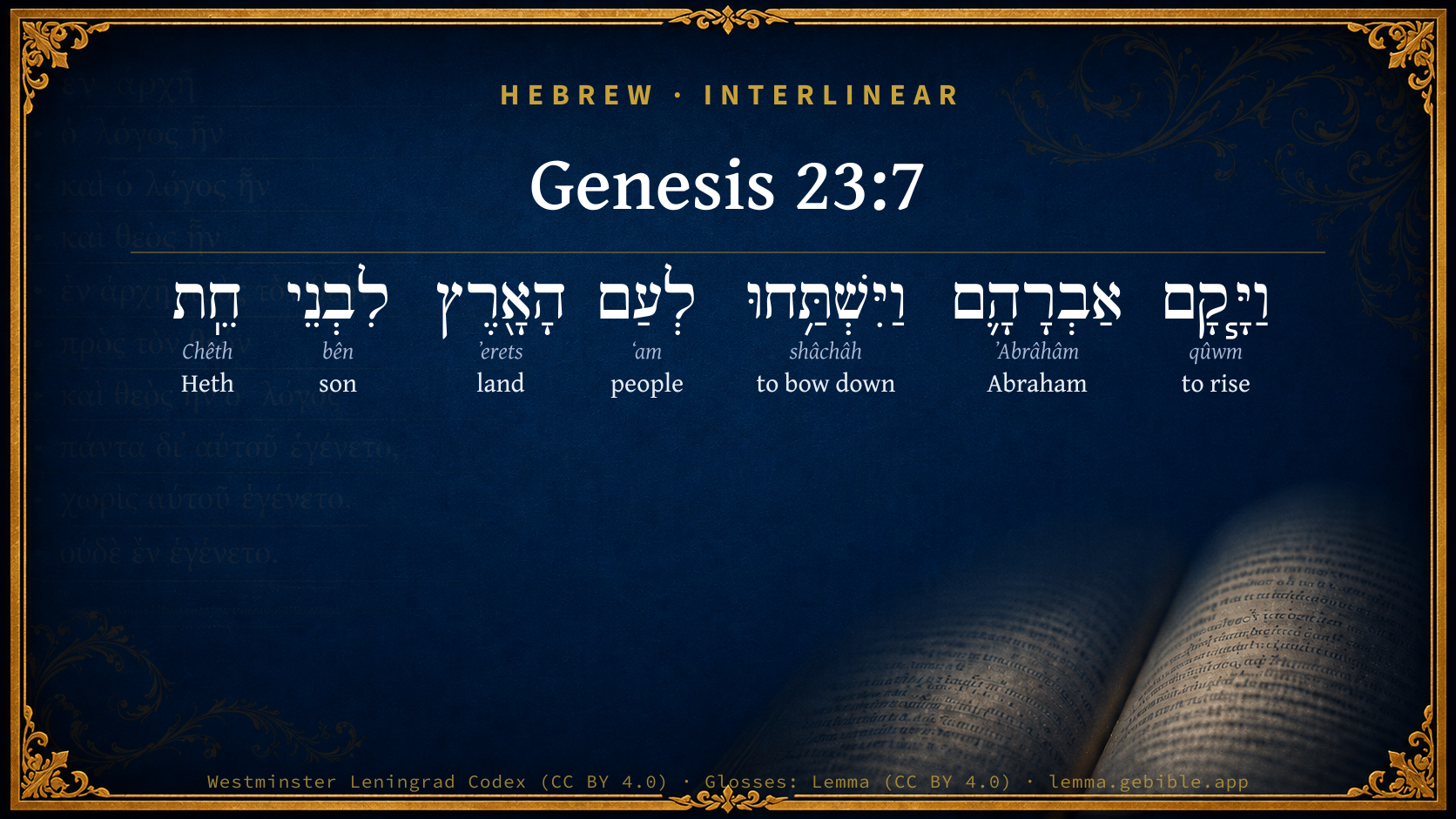
Genesis 23:7

Hebrew (Westminster Leningrad Codex) Genesis 23:7 appears in the Hebrew Old Testament. The text above is from the Westminster Leningrad Codex. Each word links to its Strong’s number, a concise gloss, and parsing drawn from the Open Scriptures Hebrew Bible morphology. Click any word for its full Brown-Driver-Briggs (BDB) entry.
Download image
Cite this verse

Genesis 23:7 (World English Bible). Public Domain. Lemma interlinear Bible study tool, https://lemma.gebible.app/v/genesis/23/7.

Show BibTeX & RIS
BibTeX
RIS
English Translation
Abraham rose up, and bowed himself to the people of the land, even to the children of Heth.
World English Bible · Public Domain
Download a study sheet

One document with this verse’s original text, its word-by-word gloss line, the meaning frame, cross-references with their text, attributed commentary, and full source and license credits — printable, and it pastes into notes with its structure intact.

This verse Autodidact and up

Study sheet (.html) Plain text (.txt)

A passage Seminary Student

Up to 50 verses in one chapter. A passage sheet keeps up to 6 commentary sources and 12 cross-references per verse, in the order this page ranks them, and says so on the sheet whenever that leaves anything out. Ask for a single verse and you get the Autodidact verse sheet above.

Everything on this page stays free to read, with no account — the sheet is a download of what is already on screen, not access to it.

Want to remove ads? Support Godless Engineer
Compare translations 3

The same verse in 3 English versions, stacked beneath the original-language interlinear above. Click any original word for its lexicon entry.

Each is an independent rendering of the whole verse — the interlinear is not word-aligned to these translations.

Highlighted words mark where these versions differ — a whole-verse word diff, not a word-by-word alignment.

  • World English Bible Public Domain
    Abraham rose up, and bowed himself to the people of the land, even to the children of Heth.
  • King James Version Public Domain
    And Abraham stood up, and bowed himself to the people of the land, even to the children of Heth.
  • unfoldingWord Literal Text CC BY-SA 4.0
    Then Abraham got up and bowed to the people of the land, to the sons of Heth,

unfoldingWord Literal Text — © unfoldingWord, licensed CC BY-SA 4.0. Word-aligned USFM3 via Door43 (git.door43.org/unfoldingWord/en_ult).

Versions to compare (up to 4)

3 of 4 selected

Show all 18 translations

Every available English version of this verse, each an independent rendering of the whole verse.

  • World English Bible Public Domain
    Abraham rose up, and bowed himself to the people of the land, even to the children of Heth.
  • Berean Standard Bible Public Domain
    Then Abraham rose and bowed down before the people of the land, the Hittites.
  • Majority Standard Bible Public Domain
    Then Abraham rose and bowed down before the people of the land, the Hittites.
  • King James Version Public Domain
    And Abraham stood up, and bowed himself to the people of the land, even to the children of Heth.
  • American Standard Version (1901) Public Domain
    And Abraham rose up, and bowed himself to the people of the land, even to the children of Heth.
  • Revised Version (1885) Public Domain
    And Abraham rose up, and bowed himself to the people of the land, even to the children of Heth.
  • Geneva Bible (1599) Public Domain
    Then Abraham stoode vp, and bowed him selfe before the people of the land of the Hittites.
  • Douay-Rheims (1899) Public Domain
    Abraham rose up, and bowed down to the people of the land, to wit the children of Heth:
  • Young's Literal Translation Public Domain
    And Abraham riseth and boweth himself to the people of the land, to the sons of Heth,
  • Literal Standard Version CC BY-SA 4.0
    And Abraham rises and bows himself to the people of the land, to the sons of Heth,
  • Unlocked Literal Bible CC BY-SA 4.0
    Abraham arose and bowed down to the people of the land, to the sons of Heth.
  • unfoldingWord Literal Text CC BY-SA 4.0
    Then Abraham got up and bowed to the people of the land, to the sons of Heth,
  • Darby Bible Public Domain
    And Abraham rose up, and bowed down to the people of the land, to the sons of Heth,
  • World Messianic Bible Public Domain
    Abraham rose up, and bowed himself to the people of the land, to the children of Heth.
  • Webster's Bible Public Domain
    And Abraham stood up and bowed himself to the people of the land, to the children of Heth.
  • Free Bible Version CC BY-SA 4.0
    Abraham got up and bowed low before the Hittites, the local people,
  • Bible in Basic English Public Domain
    And Abraham got up and gave honour to the children of Heth, the people of that land.
  • JPS Tanakh (1917) Public Domain
    And Abraham rose up, and bowed down to the people of the land, even to the children of Heth.

Literal Standard Version (2020), Covenant Press — licensed CC BY-SA 4.0. Text via the HelloAO Bible API (eBible.org). Unlocked Literal Bible (unfoldingWord) — licensed CC BY-SA 4.0. Text via the HelloAO Bible API (eBible.org). unfoldingWord Literal Text — © unfoldingWord, licensed CC BY-SA 4.0. Word-aligned USFM3 via Door43 (git.door43.org/unfoldingWord/en_ult). Free Bible Version, Dr. Jonathan Gallagher — licensed CC BY-SA 4.0. Text via the HelloAO Bible API (eBible.org).

Word by word

More ways to search: Search by grammar → Find every occurrence → Compare this word →

Practice this passage: Drill this verse → Learn its vocabulary →

About this verse

These counts appear in no published source. They are computed here, from the morphology-tagged text and Lemma’s own curated glosses. What Lemma adds →

7
words
7
distinct lemmas
Pentateuch
section

Notable vocabulary

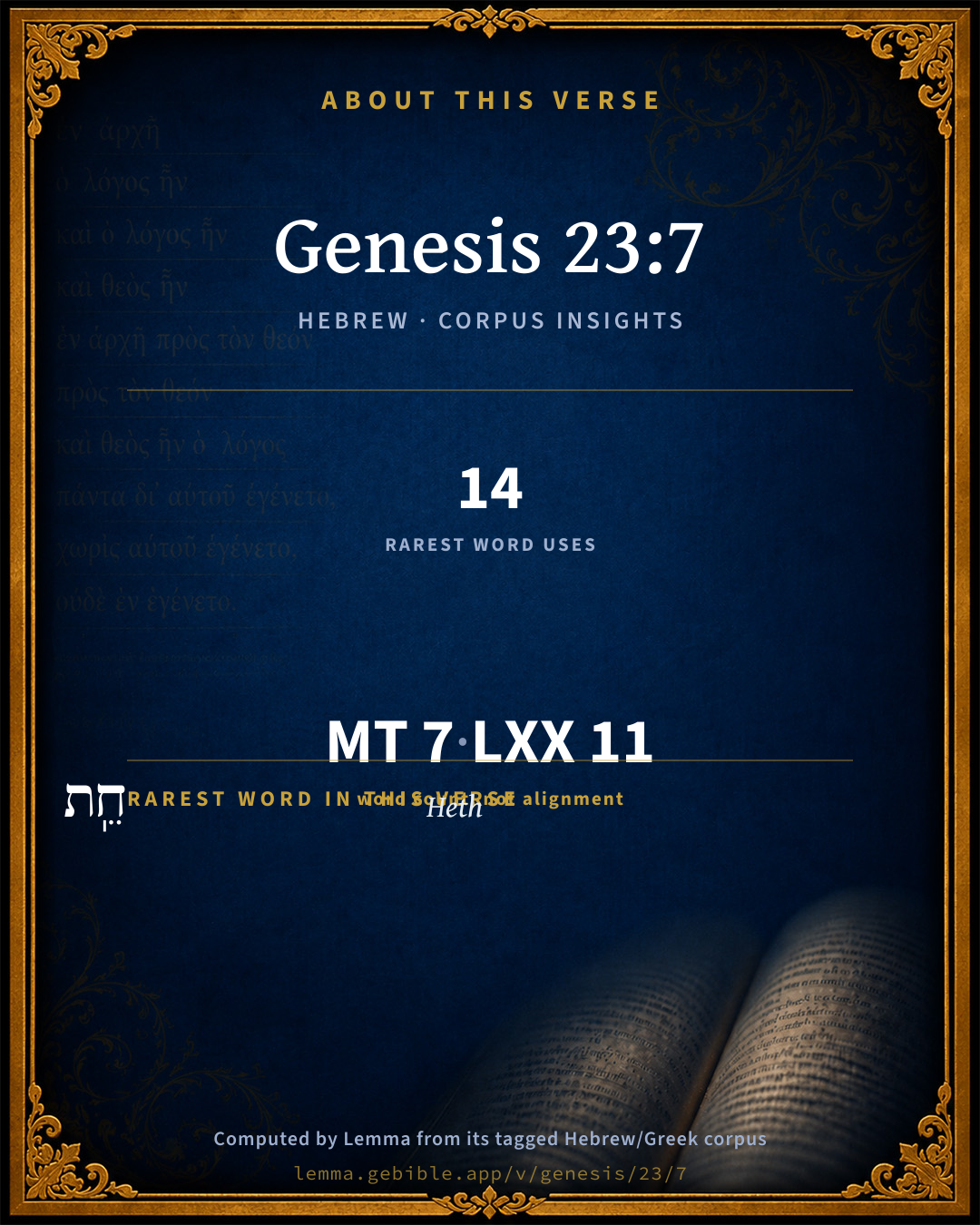
The rarest word here is חֵֽת Heth H2845 — appearing just 14 times in the whole Hebrew Bible.

Shared distinctive vocabulary

חֵֽת Heth H2845 occurs in 12 verses of the Hebrew Bible. Also found in:

Grammatical profile

  • 2 verbs
  • 5 nouns

Verb forms

  • וַיָּ֧קָם Qal · Sequential Imperfect
  • וַיִּשְׁתַּ֥חוּ Hithpael · Sequential Imperfect

Hebrew & Septuagint length

In English translation the verse runs 18 words from the Hebrew and 18 from the Septuagint (LXX English) — the same length.

A rough comparison of the two English renderings, which tokenize alike — not a word-level alignment.

Word counts can differ between the Hebrew and the Greek without any difference in meaning — e.g. the Hebrew direct-object marker אֵת has no separate Greek word, and Greek often adds the article ὁ.

In the original languages it is 7 Hebrew tokens and 11 Greek tokens — but the two are counted differently (Hebrew bundles its prefixes and suffixes into one token; the Greek is in lemma form), so that isn’t a like-for-like length.

Cross-references

6

Topical passages linked to Genesis 23:7 in the Treasury of Scripture Knowledge — connected by theme and wording, ordered by reader-vote popularity; previews shown in the World English Bible.

  • Hebrews 12:14 Follow after peace with all men, and the sanctification without which no man will see the Lord,
  • Genesis 18:2 He lifted up his eyes and looked, and saw that three men stood opposite him. When he saw them, he ran to meet them from the tent door, and bowed himself to the earth,
  • Genesis 19:1 The two angels came to Sodom at evening. Lot sat in the gate of Sodom. Lot saw them, and rose up to meet them. He bowed himself with his face to the earth,
  • Proverbs 18:24 A man of many companions may be ruined, But there is a friend who sticks closer than a brother.
  • Romans 12:17–18 Repay no one evil for evil. Respect what is honorable in the sight of all men.
  • 1 Peter 3:8 Finally, be all like-minded, compassionate, loving as brothers, tenderhearted, courteous,

Cross-references courtesy of OpenBible.info (CC BY 4.0).

Hebrew and Greek witnesses Masoretic Hebrew ↔ Greek Septuagint

The same verse in the two great witnesses to the Old Testament, shown verse-for-verse.

These are two independent witnesses, not word-aligned to each other, and the Septuagint is shown in lemma (dictionary) form.

Hebrew Genesis 23:7 Masoretic · Westminster Leningrad Codex

וַיָּ֧קָם אַבְרָהָ֛ם וַיִּשְׁתַּ֥חוּ לְעַם הָאָ֖רֶץ לִבְנֵי חֵֽת

Abraham rose up, and bowed himself to the people of the land, even to the children of Heth.

World English Bible · Public Domain

Greek LXX Genesis 23:7 Septuagint · lemma form

ἀναἵστημι δέ αβρααμ προςκυνέω ὁ λαός ὁ γῆ ὁ υἱός χετ

And Abraam rose up and did obeisance to the people of the land, to the sons of Chet.

LXX2012 (modern English Septuagint) · Public Domain

Hebrew: Westminster Leningrad Codex (CC BY 4.0). Greek: Septuagint (public domain); English from LXX2012 (modern English Septuagint) (Public Domain). How the Septuagint differs from the Hebrew →

Targum (Aramaic paraphrase)

2

The Targum is the ancient Jewish Aramaic paraphrase of the Hebrew Scriptures — an interpretive translation, not the Hebrew text itself. Onkelos (literal) and Pseudo-Jonathan (expansive) render the Torah, and Jonathan the Prophets. Coverage is partial: where no permissively-licensed English translation exists for a verse, only the Aramaic is shown. This is verse-level text, not a word-by-word alignment to the Hebrew.

  1. Targum Onkelos Torah (Genesis–Deuteronomy)
    וְקָם אַבְרָהָם וּסְגִיד לְעַמָּא דְאַרְעָא לִבְנֵי חִתָּאָה

    (no public-domain English translation for this verse)

    Targum Onkelos — Aramaic: “Onkelos Genesis” (public domain); “Onkelos Exodus” (public domain); “Onkelos Leviticus” (public domain); “Onkelos Numbers” (public domain); “Onkelos Deuteronomy” (public domain). English: “Sefaria Community Translation” (CC0 1.0 (public-domain dedication)); “J.W. Etheridge. The Targums of Onkelos and Jonathan Ben Uzziel on the Pentateuch. London: Longmans, Green, 1862” (public domain). Text via Sefaria.

  2. Targum Pseudo-Jonathan Torah (Genesis–Deuteronomy)
    וְקָם אַבְרָהָם וְגָחַן לְעַמָא דְאַרְעָא לִבְנֵי חִתָּאָה

    And Abraham rose and bowed to the people of the land, the sons of Hittah.

    Targum Pseudo-Jonathan — Aramaic: “Targum Jonathan on Genesis” (public domain); “Targum Jonathan on Exodus” (public domain); “Targum Jonathan on Leviticus” (public domain); “Targum Jonathan on Numbers” (public domain); “Targum Jonathan on Deuteronomy” (public domain). English: “The Targum of Jonathan ben Uzziel, trans. J. W. Etheridge, London, 1862” (public domain). Text via Sefaria.

Commentary

Notes on Genesis 23:7 from classic Christian and Jewish commentators (each source and its license shown beneath its notes). The classic Christian expositions comment on the surrounding passage and are grouped to its opening verse, so a note may address several verses; the Jewish commentaries on the Tanakh (Rashi and others) are per-verse, so they appear only where the commentator wrote on this verse.

Lemma curates 59 commentaries, every one of them public domain or Creative Commons licensed, each selected and text-cleaned for this edition rather than reprinted as found. About our sources →

Trapp's Complete Commentary

John Trapp

Gen 23:7 And Abraham stood up, and bowed himself to the people of the land, [even] to the children of Heth.

Ver. 7. Abraham stood up and bowed himself, &c.] It is very comely in Christians to salute willingly; and in words and gestures to show civil respect even to wicked men. Abraham’s behaviour to these Hittites may shame the most Christians; yea, the very Hittites themselves may teach them good manners. Even the savage cannibals, saith a grave divine, {a} may receive an answer of outward courtesy. If a very dog fawn upon us, we stroke him on the head, and clap him on the side. Much less is the common band of humanity untied by grace. If Elisha bade his man, or our Saviour his disciples, salute no man by the way, that was for haste’s sake; they should not hinder themselves in their journey by overmuch courtesy. Our Saviour was sweet and sociable in his whole conduct, and the proud Pharisees upbraided him for it. He never refused to go to any man’s table when invited, yea, to Zaccheus’ he invited himself, not for the pleasure of the dishes, but for the benefit of so winning a conversation. Courtesy allureth men’s minds, as fair flowers do their eyes. Pomponius Atticus so carried himself at Athens, ut communis infimis, par principibus videretur. {b} Alexander the Great, got the hearts of his foot soldiers, by calling them pezetairouv , his fellow footmen, {c} Aristotle, the better to insinuate into his hearers, read not to them (as other philosophers used to do) from a lofty seat or desk, but walking and talking with them familiarly, as with his friends, in Apollo’s porch, he made them great philosophers. {d} Vespasian was as highly esteemed by the people for his courtesy, as Coriolanus contemned and condemned of all for his rusticity. With one churlish breath Rehoboam lost ten tribes, whom he would, and might not, recover with his blood. But whatsoever David did pleased the people. What a deal of courtesy passed between Boaz and his reapers! "The Lord be with you," said he; "The Lord bless thee," said they. {Rth 2:4} The Turks’ salutation at this day is, Salaum aleek, Peace be to thee: the reply is, Aleek salaum, Peace be to thee also. {e} The Romans had their χαιρς and their υγιαινε, answerable to our Good day, and Good evening. {f} That finger next to the thumb they called Salutaris, because they put that finger to their mouth (as at this day the Roman dames do) when they saluted any. {g} Charles V is renowned for his courtesy: when he passed by John Frederick the elector of Saxony, he always took off his hat and bowed to him, though he were his prisoner, and had been taken by him in battle. And when he had in his power Melancthon, Pomeran, and other divines of the reformed religion, he courteously dismissed them. {h} As he is the best Christian that is most humble; so is he the truest gentleman that is most courteous. Your haughty upstarts, the French call gentle-villains.

{a} Dr Hall.

{b} Corn. Nepos in Vita Attici.

{c} Harpocrat. in voce πεζεταιρος.

{d} των διδασκαλικων επιβεβηκοτες θρονων. - Diog.

{e} Blount’s Voyage into the Levant.

{f} Dio in Vita Adriani.

{g} Becman., De Origin. in verbo Digitus .

{h} Parei Hist. Profan. Medul., p. 906. - Peacham’s Complete Gentaleman.

John Trapp, A Commentary or Exposition upon All the Books of the Old and New Testament (1647–1656) — public domain. Text from a community e-Sword module.

Joseph Benson's Commentary

Gen 23:7. Abraham bowed himself — Thus returning them thanks for their kind offer, with all proper decency and respect. Religion not only allows, but requires civility and good manners, and those gestures which express it, and every professor of it should carefully avoid rudeness and clownishness. “Love doth not behave itself unseemly.”

Joseph Benson's Commentary on the Old and New Testaments (1811–1818) — public domain. Text from a community e-Sword module.

Tyndale Open Study Notes

Tyndale Open Resources

23:7-16 Abraham wanted to buy Ephron’s cave at Machpelah, but Ephron wanted him to buy the entire field.

Tyndale Open Study Notes — © Tyndale Open Resources, licensed CC BY-SA 4.0. Text via the HelloAO Bible API.

John Calvin's Commentaries

7. And Abraham stood up. He declines the favor offered by the Hittites, as, some suppose, with this design, that he might not lay himself under obligation to them in so small a matter. But he rather wished to show, in this way, that he would receive no gratuitous possession from those inhabitants who were to be ejected by the hand of Gods in order that he might succeed in their place: for he always kept all his thoughts fixed on God, so that he far preferred His bare promise, to present dominion over the land. Moses also commends the modesty of the holy man, when he says that he ‘rose up to do reverence to the people of the land.’ As to the use of the word signifying ‘to adore,’ it is simply taken for the reverence, which any one declares, either by bowing the knee, or any other gesture of the body. This may be paid to men, as well as to God, but for a different end; men mutually either bend the knee, or bow the head, before each other, for the sake of civil honor; but if the same thing be done to them, for the sake of religion, it is profanation. For religion allows of no other worship them that of the true God. And they childishly trifle who make a pretext for their idolatry, in the words dulia and latria, since the Scripture, in general terms, forbids adoration to be transferred to men. But lest any one should be surprised that Abraham acted so suppliantly, and so submissively, we must be aware that it was done from common custom and use. For it is well known that the Orientals were immoderate in their use of ceremonies. If we compare the Greeks or Italians with ourselves, we are more sparing in the use of them than they. But Aristotle, in speaking of the Asiatics and other barbarians notes this fault, that they abound too much in adorations. Wherefore we must not measure the honor which Abraham paid to the princes of the land by our customs.

John Calvin's Commentaries (1540-1563) — public domain. Text from the Calvin Translation Society English edition (1840s-50s) via the Christian Classics Ethereal Library (ccel.org). Calvin's coverage is partial (roughly two-thirds of the Bible); uncommented books and verses are honest gaps, never fabricated. The 19th-century editor's footnotes and remarks are omitted so the notes are faithfully Calvin's own voice.

The Cambridge Bible for Schools and Colleges

gen. ed. J. J. S. Perowne

7. bowed himself] Abraham’s humble demeanour towards the people of the land doubtless conforms to the elaborate usages of Oriental bargaining. But it is also probably here emphatically recorded as indicating Abraham’s loneliness among the people of the land, and, therefore, in ironical contrast with the time when his descendants would conquer the Canaanites and possess their country.

the people of the land] Cf. Gen_42:6 (P). This is the phrase, ’am ha-âreṣ, so common in post-exilic literature for “the heathen”: compare “peoples of the land,” Ezr_10:2; Ezr_10:11; Neh_10:28; Neh_10:30.

The Cambridge Bible for Schools and Colleges (gen. ed. J. J. S. Perowne; Cambridge University Press, 1878–1918) — public domain. Text from a community e-Sword module.

John Gill's Exposition

And Abraham stood up,.... For, having made his speech to the children of Heth, he sat down waiting for an answer; or rather perhaps they obliged him to sit down, out of reverence to so great a personage; and when they had done speaking, he rose up:

and bowed himself to the people of the land; the principal of them, in token of the grateful sense he had of the honour they had done him, and of the great civility with which they had used him:

even to the children of Heth; this seems to be added to distinguish them from the common people, and as an explanation of the preceding clause; See Gill on Gen 23:3.

John Gill's Exposition of the Whole Bible (1746–1763) — public domain (CC PDM 1.0). Text via the HelloAO Bible API.

Haydock's Catholic Bible Commentary

Bowed down to the people. Adoravit, literally, adored. But this word here, as well as in many other places in the Latin Scriptures, is used to signify only an inferior honour and reverence paid to men, expressed by a bowing down of the body.

George Leo Haydock (1774–1849), Haydock's Catholic Family Bible and Commentary, 1859 edition — public domain. Excludes Psalms (Douay-Rheims chapter numbering differs from Protestant) and Deuterocanonical books (Catholic canon only).

Matthew Poole's English Annotations

i.e. Showed a civil respect to them in testimony of his thankfulness. Religion allows and requires civility, and those gestures which express it.

To the people of the land; to the governors of the people, who managed all public affairs in the people’s name and stead, and for their good.

The children of Heth, so called from Heth the son of Canaan, Gen 10:15.

Matthew Poole's English Annotations on the Holy Bible (1683–1685) — public domain. Text from a community e-Sword/MySword module.

The Pulpit Commentary

And Abraham stood up (the customary posture among Orientals in buying and selling being that of sitting), and bowed himself to the people of the land, even to the children of Hath an act of respect quite accordant with modern Oriental manners (vide Thomson, "Land and Book," p. 579).

The Pulpit Commentary (1880–1919), ed. H.D.M. Spence-Jones & Joseph S. Exell — public domain. Text from a community e-Sword module.

John Wesley's Explanatory Notes

Abraham returns them thanks for their kind offer, with all possible decency and respect. Religion teaches good manners, and those abuse it that place it in rudeness and clownishness.

John Wesley, Explanatory Notes Upon the Whole Bible (1754–1765) — public domain. Text via the GEBible commentary corpus.

unfoldingWord translationNotes

Door43 World Missions Community

bowed down

This means to bend over or kneel down very low to humbly express respect and honor toward someone. (See: Symbolic Language)

to the people of the land, to the sons of Heth

"to the sons of Heth who lived in the area"

the sons of Heth

Here "sons" stands for those who descended from Heth. See how you translated this in Genesis 23:3. AT: "the descendants of Heth" (See: How to Translate Names)

my dead

The nominal adjective "dead" can be stated as a verb or simply as "wife." AT: "my wife who has died" or "my wife" (See: Nominal Adjectives)

Ephron ... Zohar

These are names of men. (See: How to Translate Names)

the cave of Machpelah, which he owns, which is at the end of his field

"his cave that is at the end of his field in Machpelah"

the cave of Machpelah

"the cave in Machpela." Machpela was the name of an area or region. Ephron owned a field in Machpela and the cave that was in the field. (See: How to Translate Names)

which he owns

This tells something about the cave. Ephron owned the cave. (See: Distinguishing versus Informing or Reminding)

which is at the end of his field

This also tells something about the cave. The cave was at the end of Ephron's field. (See: Distinguishing versus Informing or Reminding)

sell it to me publicly

"sell it to me in front of you all" or "sell it to me in your presence"

as a property

"as a piece of land that I may own and use"

translationWords

Abraham

bow

grave

unfoldingWord translationNotes — © Distant Shores Media and the Door43 World Missions Community, licensed CC BY-SA 4.0. Source: git.door43.org/Door43/en_tn.

Radak

Rabbi David Kimhi (Radak)

ויקם אברהם וישתחו, he rose on his legs and folded them in a manner signifying gratitude for the positive response he had received from the בני חת, informing them next of precisely what it was that he was requesting.

Radak on the Tanakh — English translations: “Sefaria Community Translation” (CC0 1.0 (public-domain dedication)); “Eliyahu Munk, HaChut Hameshulash” (CC BY 4.0); “Rabbi Mike Feuer, Jerusalem Anthology” (CC BY 4.0); and “R. David Kimhi on the first book of Psalms, Translated by R.G. Finch, London, 1919” (public domain). Text via Sefaria.

Lesson kit

Teaching starters — assembled from the data on this page, not authored interpretation. Every prompt links to the verse data it draws on. Edit before teaching.

Genesis, in the Pentateuch, opens this verse with 7 words (7 distinct Hebrew lemmas). Its most distinctive word is Chêth (“Heth”). A historical commentator’s framing appears above. Read the whole chapter for the surrounding context.

Discussion questions

  1. How does “Heth” (Chêth) shape what this verse is saying?
  2. Genesis 10:15 shares the word «Heth» with this verse. How do the two illuminate each other?
  3. The translations on this page render this verse differently — a whole-verse word diff, not a word-by-word alignment. What might account for the different wordings?
  4. The verb «וַיָּ֧קָם» is Qal Sequential Imperfect. How does its form color the action?
  5. Reading how Trapp's Complete Commentary and Joseph Benson's Commentary read this verse, where do the two commentators agree and where do they part?

Things to notice

Reading settings

Reading text

Shown beneath each verse's original-language words.

Old Testament
Old Testament edition

Read the OT as the Masoretic Hebrew (MT) or the Greek Septuagint (LXX).

English shown for the Greek Septuagint (in the Hebrew ↔ Greek comparison).

Comparing translations? Open the Compare panel on any verse page to stack up to four side by side.