
1 Kings 9:6

Hebrew (Westminster Leningrad Codex) 1 Kings 9:6 appears in the Hebrew Old Testament. The text above is from the Westminster Leningrad Codex. Each word links to its Strong’s number, a concise gloss, and parsing drawn from the Open Scriptures Hebrew Bible morphology. Click any word for its full Brown-Driver-Briggs (BDB) entry.
Download image
Cite this verse

1 Kings 9:6 (World English Bible). Public Domain. Lemma interlinear Bible study tool, https://lemma.gebible.app/v/1-kings/9/6.

Show BibTeX & RIS
BibTeX
RIS
English Translation
But if you shall turn away from following me, you or your children, and not keep my commandments and my statutes which I have set before you, but shall go and serve other gods, and worship them;
World English Bible · Public Domain
Download a study sheet

One document with this verse’s original text, its word-by-word gloss line, the meaning frame, cross-references with their text, attributed commentary, and full source and license credits — printable, and it pastes into notes with its structure intact.

This verse Autodidact and up

Study sheet (.html) Plain text (.txt)

A passage Seminary Student

Up to 50 verses in one chapter. A passage sheet keeps up to 6 commentary sources and 12 cross-references per verse, in the order this page ranks them, and says so on the sheet whenever that leaves anything out. Ask for a single verse and you get the Autodidact verse sheet above.

Everything on this page stays free to read, with no account — the sheet is a download of what is already on screen, not access to it.

Want to remove ads? Support Godless Engineer
Compare translations 3

The same verse in 3 English versions, stacked beneath the original-language interlinear above. Click any original word for its lexicon entry.

Each is an independent rendering of the whole verse — the interlinear is not word-aligned to these translations.

Highlighted words mark where these versions differ — a whole-verse word diff, not a word-by-word alignment.

  • World English Bible Public Domain
    But if you shall turn away from following me, you or your children, and not keep my commandments and my statutes which I have set before you, but shall go and serve other gods, and worship them;
  • King James Version Public Domain
    But if ye shall at all turn from following me, ye or your children, and will not keep my commandments and my statutes which I have set before you, but go and serve other gods, and worship them:
  • unfoldingWord Literal Text CC BY-SA 4.0
    If turning, you turn, you or your sons, from after me, and you do not keep my commandments, my statutes that I have set to your faces, and you go and serve other gods and bow down to them,

unfoldingWord Literal Text — © unfoldingWord, licensed CC BY-SA 4.0. Word-aligned USFM3 via Door43 (git.door43.org/unfoldingWord/en_ult).

Versions to compare (up to 4)

3 of 4 selected

Show all 18 translations

Every available English version of this verse, each an independent rendering of the whole verse.

  • World English Bible Public Domain
    But if you shall turn away from following me, you or your children, and not keep my commandments and my statutes which I have set before you, but shall go and serve other gods, and worship them;
  • Berean Standard Bible Public Domain
    But if indeed you or your sons turn away from following Me and do not keep the commandments and statutes I have set before you, and if you go off to serve and worship other gods,
  • Majority Standard Bible Public Domain
    But if indeed you or your sons turn away from following Me and do not keep the commandments and statutes I have set before you, and if you go off to serve and worship other gods,
  • King James Version Public Domain
    But if ye shall at all turn from following me, ye or your children, and will not keep my commandments and my statutes which I have set before you, but go and serve other gods, and worship them:
  • American Standard Version (1901) Public Domain
    But if ye shall turn away from following me, ye or your children, and not keep my commandments and my statutes which I have set before you, but shall go and serve other gods, and worship them;
  • Revised Version (1885) Public Domain
    But if ye shall turn away from following me, ye or your children and not keep my commandments and my statutes which I have set before you, but shall go and serve other gods, and worship them:
  • Geneva Bible (1599) Public Domain
    But if ye and your children turne away from mee, and wil not keepe my commandements, and my statutes (which I haue set before you) but go and serue other gods, and worship them,
  • Douay-Rheims (1899) Public Domain
    But if you and your children revolting shall turn away from following me, and will not keep my commandments, and my ceremonies, which I have set before you, but will go and worship strange gods, and adore them:
  • Young's Literal Translation Public Domain
    `If ye at all turn back -- you and your sons -- from after Me, and keep not My commands -- My statutes, that I have set before you, and ye have gone and served other gods, and bowed yourselves to them,
  • Literal Standard Version CC BY-SA 4.0
    If you at all turn back—you and your sons—from after Me, and do not keep My commands [and] My statutes that I have set before you, and have gone and served other gods, and bowed yourselves to them,
  • Unlocked Literal Bible CC BY-SA 4.0
    But if you turn away, you or your children, and do not keep my commandments and my statutes that I have placed before you, and if you go and worship other gods and bow down to them,
  • unfoldingWord Literal Text CC BY-SA 4.0
    If turning, you turn, you or your sons, from after me, and you do not keep my commandments, my statutes that I have set to your faces, and you go and serve other gods and bow down to them,
  • Darby Bible Public Domain
    [But] if ye shall at all turn from following me, ye or your children, and will not keep my commandments, my statutes which I have set before you, but go and serve other gods, and worship them;
  • World Messianic Bible Public Domain
    But if you turn away from following me, you or your children, and not keep my commandments and my statutes which I have set before you, but go and serve other gods and worship them,
  • Webster's Bible Public Domain
    But if ye shall at all turn from following me, ye or your children, and will not keep my commandments and my statutes which I have set before you, but go and serve other gods, and worship them:
  • Free Bible Version CC BY-SA 4.0
    But if you or your descendants turn away and do not keep the laws and the commandments I have given you, and if you go and serve and worship other gods,
  • Bible in Basic English Public Domain
    But if you are turned from my ways, you or your children, and do not keep my orders and my laws which I have put before you, but go and make yourselves servants to other gods and give them worship:
  • JPS Tanakh (1917) Public Domain
    But if ye shall turn away from following Me, ye or your children, and not keep My commandments and My statutes which I have set before you, but shall go and serve other gods, and worship them;

Literal Standard Version (2020), Covenant Press — licensed CC BY-SA 4.0. Text via the HelloAO Bible API (eBible.org). Unlocked Literal Bible (unfoldingWord) — licensed CC BY-SA 4.0. Text via the HelloAO Bible API (eBible.org). unfoldingWord Literal Text — © unfoldingWord, licensed CC BY-SA 4.0. Word-aligned USFM3 via Door43 (git.door43.org/unfoldingWord/en_ult). Free Bible Version, Dr. Jonathan Gallagher — licensed CC BY-SA 4.0. Text via the HelloAO Bible API (eBible.org).

Word by word

More ways to search: Search by grammar → Find every occurrence → Compare this word →

Practice this passage: Drill this verse → Learn its vocabulary →

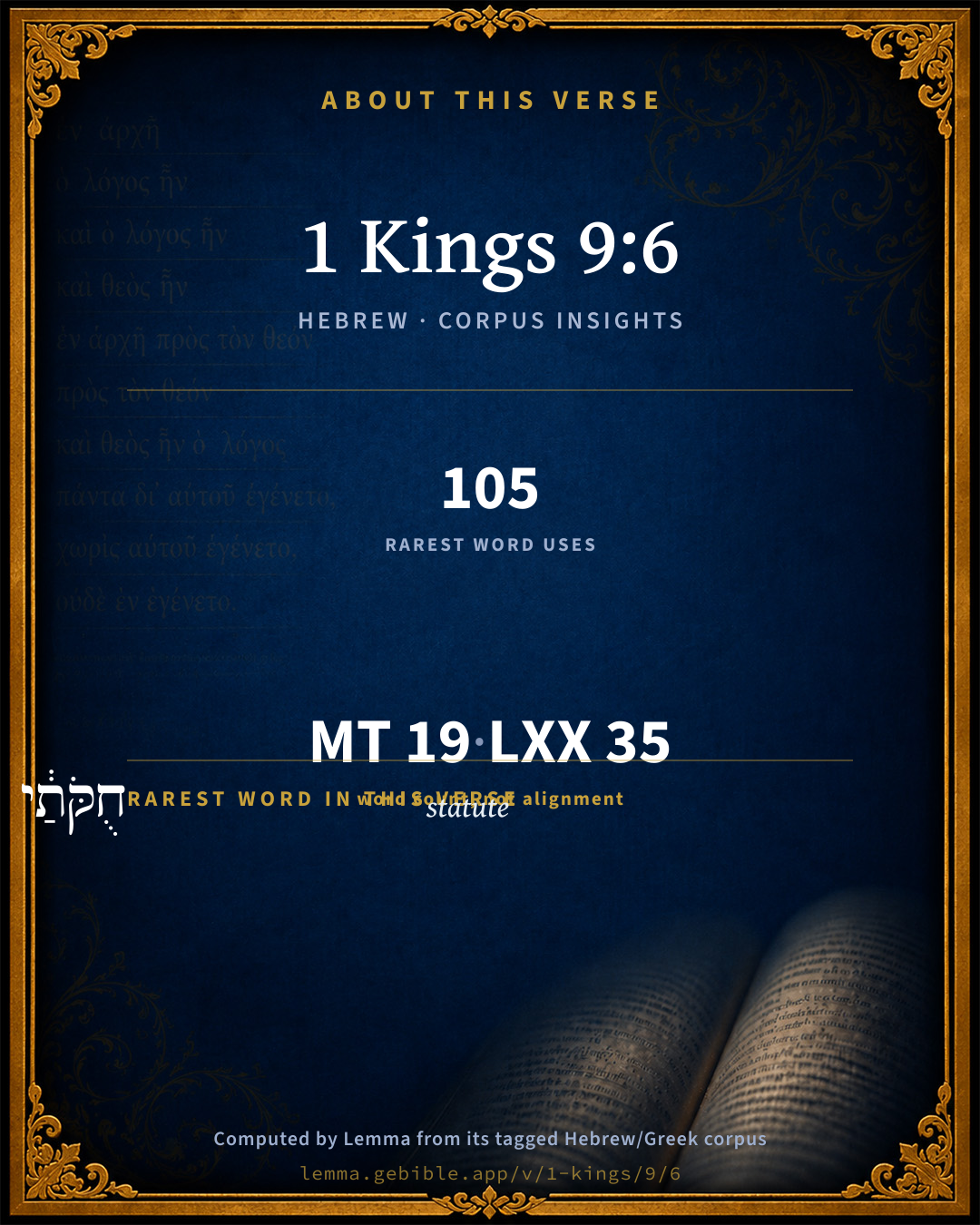
חֻקֹּתַ֔י
chuqqâh
H2708
“statutes · my”
Noun, Common, Both, Plural, Construct + Suffix, Personal, 1st Person, Common, Singular
Part of Speech
Noun
Type
Common
Gender
Both
Number
Plural
State
Construct
Full BDB Definition

Origin: from H2706

TWOT: 728b

statute, ordinance, limit, enactment, something prescribed - statute
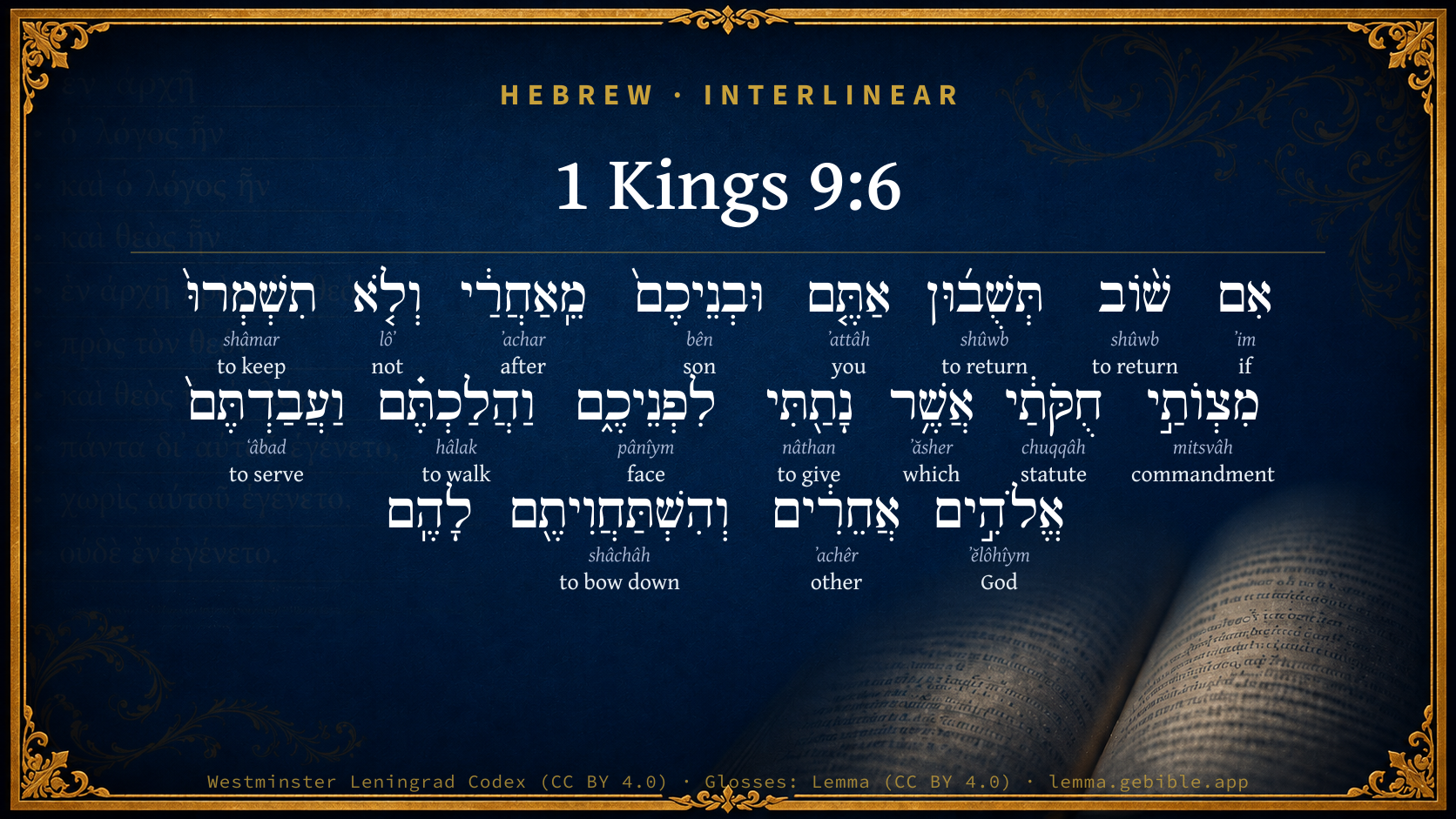
  1. אִם ʼim H518 “if” Conjunction
  2. שׁ֨וֹב shûwb H7725 “to return” Verb, Qal, Infinitive Absolute
  3. תְּשֻׁב֜וּן shûwb H7725 “to return” Verb, Qal, Imperfect, 2nd Person, Masculine, Plural + Suffix, n
  4. אַתֶּ֤ם ʼattâh H859 “you” Pronoun, Personal, 2nd Person, Masculine, Plural
  5. וּבְנֵיכֶם֙ bên H1121 “and · sons · your” Conjunction + Noun, Common, Masculine, Plural, Construct + Suffix, Personal, 2nd Person, Masculine, Plural
  6. מֵֽאַחֲרַ֔י ʼachar H310 “from · after · me” Preposition + Preposition + Suffix, Personal, 1st Person, Common, Singular
  7. וְלֹ֤א lôʼ H3808 “and · not” Conjunction + Particle, Negative
  8. תִשְׁמְרוּ֙ shâmar H8104 “to keep” Verb, Qal, Imperfect, 2nd Person, Masculine, Plural
  9. מִצְוֺתַ֣י mitsvâh H4687 “commandments · my” Noun, Common, Feminine, Plural, Construct + Suffix, Personal, 1st Person, Common, Singular
  10. אֲשֶׁ֥ר ʼăsher H834 “which” Particle, Relative
  11. נָתַ֖תִּי nâthan H5414 “to give” Verb, Qal, Perfect, 1st Person, Common, Singular
  12. לִפְנֵיכֶ֑ם pânîym H6440 “to/for · face(s) · your” Preposition + Noun, Common, Both, Plural, Construct + Suffix, Personal, 2nd Person, Masculine, Plural
  13. וַהֲלַכְתֶּ֗ם hâlak H1980 “and · to walk” Conjunction + Verb, Qal, Sequential Perfect, 2nd Person, Masculine, Plural
  14. וַעֲבַדְתֶּם֙ ʻâbad H5647 “and · to serve” Conjunction + Verb, Qal, Sequential Perfect, 2nd Person, Masculine, Plural
  15. אֱלֹהִ֣ים ʼĕlôhîym H430 “God(s)” Noun, Common, Masculine, Plural, Absolute
  16. אֲחֵרִ֔ים ʼachêr H312 “other” Adjective, Adjective, Masculine, Plural, Absolute
  17. וְהִשְׁתַּחֲוִיתֶ֖ם shâchâh H7812 “and · to bow down” Conjunction + Verb, Hishtaphel, Sequential Perfect, 2nd Person, Masculine, Plural

About this verse

These counts appear in no published source. They are computed here, from the morphology-tagged text and Lemma’s own curated glosses. What Lemma adds →

19
words
17
distinct lemmas
Historical
section

Grammatical profile

  • 7 verbs
  • 5 nouns
  • 1 adjective
  • 1 pronoun
  • 2 prepositions
  • 1 conjunction
  • 2 particles

Verb forms

  • שׁ֨וֹב Qal · Infinitive Absolute
  • תְּשֻׁב֜וּן Qal · Imperfect
  • תִשְׁמְרוּ֙ Qal · Imperfect
  • נָתַ֖תִּי Qal · Perfect
  • וַהֲלַכְתֶּ֗ם Qal · Sequential Perfect
  • וַעֲבַדְתֶּם֙ Qal · Sequential Perfect
  • וְהִשְׁתַּחֲוִיתֶ֖ם Hishtaphel · Sequential Perfect

Repetition

A word recurs within this verse — often emphatic in Hebrew:

  • שׁ֨וֹב to return H7725 ×2

Hebrew & Septuagint length

In English translation the verse runs 37 words from the Hebrew and 37 from the Septuagint (LXX English) — the same length.

A rough comparison of the two English renderings, which tokenize alike — not a word-level alignment.

Word counts can differ between the Hebrew and the Greek without any difference in meaning — e.g. the Hebrew direct-object marker אֵת has no separate Greek word, and Greek often adds the article ὁ.

In the original languages it is 19 Hebrew tokens and 35 Greek tokens — but the two are counted differently (Hebrew bundles its prefixes and suffixes into one token; the Greek is in lemma form), so that isn’t a like-for-like length.

Cross-references

9

Topical passages linked to 1 Kings 9:6 in the Treasury of Scripture Knowledge — connected by theme and wording, ordered by reader-vote popularity; previews shown in the World English Bible.

  • 2 Samuel 7:14–16 I will be his father, and he shall be my son: if he commit iniquity, I will chasten him with the rod of men, and with the stripes of the children of men;
  • 1 Chronicles 28:9 You, Solomon my son, know the God of your father, and serve him with a perfect heart and with a willing mind; for Yahweh searches all hearts, and understands all the imaginations of the thoughts: if you seek him, he will be found of you; but if you forsake him, he will cast you off forever.
  • Joshua 23:15–16 It shall happen, that as all the good things are come on you of which Yahweh your God spoke to you, so will Yahweh bring on you all the evil things, until he have destroyed you from off this good land which Yahweh your God has given you.
  • 1 Samuel 2:30 Therefore Yahweh, the God of Israel, says, I said indeed that your house, and the house of your father, should walk before me forever: but now Yahweh says, Be it far from me; for those who honor me I will honor, and those who despise me shall be lightly esteemed.
  • 1 Kings 11:4–10 For it happened, when Solomon was old, that his wives turned away his heart after other gods; and his heart was not perfect with Yahweh his God, as was the heart of David his father.
  • 2 Chronicles 7:19–22 But if you turn away, and forsake my statutes and my commandments which I have set before you, and shall go and serve other gods, and worship them;
  • 2 Chronicles 15:2 and he went out to meet Asa, and said to him, Hear you me, Asa, and all Judah and Benjamin: Yahweh is with you, while you are with him; and if you seek him, he will be found of you; but if you forsake him, he will forsake you.
  • Psalms 89:30 If his children forsake my law, And don't walk in my ordinances;
  • Psalms 89:32 Then I will punish their sin with the rod, And their iniquity with stripes.

Cross-references courtesy of OpenBible.info (CC BY 4.0).

Hebrew and Greek witnesses Masoretic Hebrew ↔ Greek Septuagint

The same verse in the two great witnesses to the Old Testament, shown verse-for-verse.

These are two independent witnesses, not word-aligned to each other, and the Septuagint is shown in lemma (dictionary) form.

Hebrew 1 Kings 9:6 Masoretic · Westminster Leningrad Codex

אִם שׁ֨וֹב תְּשֻׁב֜וּן אַתֶּ֤ם וּבְנֵיכֶם֙ מֵֽאַחֲרַ֔י וְלֹ֤א תִשְׁמְרוּ֙ מִצְוֺתַ֣י חֻקֹּתַ֔י אֲשֶׁ֥ר נָתַ֖תִּי לִפְנֵיכֶ֑ם וַהֲלַכְתֶּ֗ם וַעֲבַדְתֶּם֙ אֱלֹהִ֣ים אֲחֵרִ֔ים וְהִשְׁתַּחֲוִיתֶ֖ם לָהֶֽם

But if you shall turn away from following me, you or your children, and not keep my commandments and my statutes which I have set before you, but shall go and serve other gods, and worship them;

World English Bible · Public Domain

Greek LXX 1 Kings 9:6 Septuagint · lemma form

ἐάν δέ ἀποστρέφω ἀποστρέφω σύ καί ὁ τέκνον σύ ἀπό ἐγώ καί μή φυλάσσω ὁ ἐντολή ἐγώ καί ὁ πρόσταγμα ἐγώ ὅς δίδωμι μωυσῆς ἐνώπιον σύ καί πορεύομαι καί δουλεύω θεός ἕτερος καί προςκυνέω αὐτός

But if you⌃ or your children do in any wise revolt from me, and do not keep my commandments and my ordinances, which Moses set before you, and you⌃ go and serve other gods, and worship them:

LXX2012 (modern English Septuagint) · Public Domain

On this verse, The Cambridge Bible for Schools and Colleges discusses the Septuagint’s reading. Read the note in Commentary ↓

Hebrew: Westminster Leningrad Codex (CC BY 4.0). Greek: Septuagint (public domain); English from LXX2012 (modern English Septuagint) (Public Domain). How the Septuagint differs from the Hebrew →

Targum (Aramaic paraphrase)

1

The Targum is the ancient Jewish Aramaic paraphrase of the Hebrew Scriptures — an interpretive translation, not the Hebrew text itself. Onkelos (literal) and Pseudo-Jonathan (expansive) render the Torah, and Jonathan the Prophets. Coverage is partial: where no permissively-licensed English translation exists for a verse, only the Aramaic is shown. This is verse-level text, not a word-by-word alignment to the Hebrew.

  1. Targum Jonathan Prophets (Joshua–Malachi)
    אִם מֵיתַב תְּתוּבוּן אַתּוּן וּבְנֵיכוֹן מִבָּתַר פּוּלְחָנִי וְלָא תִטְרוּן פִּקוּדַי קְיָמַי דִי יְהָבִית קֳדָמֵיכוֹן וְתַהֲכוּן וְתִפְלְחוּן לְטַעֲוַת עַמְמַיָא וְתִסְגְדוּן לְהוֹן:

    (no public-domain English translation for this verse)

    Targum Jonathan — Aramaic: “Mikraot Gedolot” (public domain). English: “Sefaria Community Translation” (CC0 1.0 (public-domain dedication)); “London "Chaldee Paraphrase," 1871” (public domain). Text via Sefaria.

Commentary

Notes on 1 Kings 9:6 from classic Christian and Jewish commentators (each source and its license shown beneath its notes). The classic Christian expositions comment on the surrounding passage and are grouped to its opening verse, so a note may address several verses; the Jewish commentaries on the Tanakh (Rashi and others) are per-verse, so they appear only where the commentator wrote on this verse.

Lemma curates 59 commentaries, every one of them public domain or Creative Commons licensed, each selected and text-cleaned for this edition rather than reprinted as found. About our sources →

Trapp's Complete Commentary

John Trapp

1Ki 9:6 [But] if ye shall at all turn from following me, ye or your children, and will not keep my commandments [and] my statutes which I have set before you, but go and serve other gods, and worship them:

Ver. 6. But if you shall at all turn.] Heb., Turning turn; utterly and totally turn, sliding back from me by a perpetual backsliding; {Jer 8:5} if ye shall hold fast deceit, and refuse to return (ibid.).

John Trapp, A Commentary or Exposition upon All the Books of the Old and New Testament (1647–1656) — public domain. Text from a community e-Sword module.

The Biblical Illustrator

Joseph S. Exell

1Ki_9:6-9

But if ye shall at all turn from following Me.

A note of warning

A druggist in Ansonia, Conn., has an electric bell in a cabinet containing poisons. When the door is opened the bell rings, reminding the compounder he is handling poisons. What a grand thing it would be were it possible to sound an alarm every time a man puts forth his hand to touch that which will kill the soul. True, God in His great love has provided such an alarm, but, alas, men are prone to disregard its notes of alarm, and by and by it tolls forth its notes only to fall upon closed ears, and finally the bell, like that spoken of in the legend, is cut loose by the hand of a ruthless pirate, and its warning notes no longer are heard.

The Biblical Illustrator, edited by Joseph S. Exell (c. 1880s–1900s) — public domain. Text from a community e-Sword module.

Joseph Benson's Commentary

1Ki 9:6-7. If you shall at all turn from following me — Hebrew, If in turning you turn from me; that is, if you assuredly, and indeed, or, as some understand it, altogether turn from me; if you forsake my service, desert my altar, and go and serve other gods; (for that was the covenant-breaking sin;) if you or your children break off from me, and knowingly and wilfully violate my laws, this house will not save you. Then will I cut off Israel — By one judgment after another, till they become the most despicable people under the sun, though they be now the most honourable. This implies the destruction of the royal family, though it is not particularly threatened; for the king is of course undone if his kingdom be destroyed. And this house — will I cast out of my sight — I will not regard it, but will take away my presence and protection from it: it shall be abandoned and laid desolate. And Israel shall be a proverb — Their calamities and miseries shall be mentioned proverbially, to express extreme affliction and distress. And a byword among all people — Who would mock at their calamitous and deplorable state.

Joseph Benson's Commentary on the Old and New Testaments (1811–1818) — public domain. Text from a community e-Sword module.

Geneva Bible (1599)

Geneva Bible translators

God declareth that disobedience against him, is the cause of his displeasure, and so of all misery.

Geneva Bible (1599) marginal notes — public domain. Text via Bolls.life.

The Cambridge Bible for Schools and Colleges

gen. ed. J. J. S. Perowne

6. But if you shall at all turn from following me] The insertion of ‘at all’ here is an attempt to give some force to the Hebrew construction. It is a peculiarity of that language to use the infinitive of a verb followed by a finite tense to give emphasis to an expression. But undoubtedly ‘at all’ weakens the sense here. God’s warning is against utter apostasy, going and serving other gods. Hence there is more force in R.V. If ye shall turn away from following me.

and my statutes] There is no conjunction between the two nouns here, but there is in the parallel place in 2 Chronicles and in the versions it is represented. So small a letter as ו could easily drop out.

which I have set before you] The LXX. has ‘which Moses gave before you.’

The Cambridge Bible for Schools and Colleges (gen. ed. J. J. S. Perowne; Cambridge University Press, 1878–1918) — public domain. Text from a community e-Sword module.

John Gill's Exposition

But if you shall at all turn from following me, you or your children,.... From my worship, as the Targum; either Solomon or his successors, or the people of Israel and their posterity; should they turn their backs on God and his worship, meaning not in a single instance, or in some small degree; but as in the original, "if in turning ye turn" (e), that is, utterly, and entirely, or wholly turn from him and his worship to other gods, as follows:

and will not keep my commandments and my statutes, which I have set before you, but go and serve other gods, and worship them: neglecting the will and worship of God, go into idolatrous practices, as Solomon himself did.

(e) "si avertendo aversi fueritis", Pagninus, Montanus, &c.

John Gill's Exposition of the Whole Bible (1746–1763) — public domain (CC PDM 1.0). Text via the HelloAO Bible API.

Albert Barnes' Notes on the Bible

At all turn - Rather, “If ye shall wholly turn from following Me.” (See 2Ch 7:19.) The Israelites were not to be cut off, except for an entire defection.

Albert Barnes' Notes on the Bible (1834–1885) — public domain. Text from a community e-Sword/MySword module.

Haydock's Catholic Bible Commentary

But if. This threat had been denounced by Moses, (Deuteronomy xxix. 24.) and was repeated by Jeremias, (xxii. 8.) when it was on the point of being put in execution. (Menochius)

George Leo Haydock (1774–1849), Haydock's Catholic Family Bible and Commentary, 1859 edition — public domain. Excludes Psalms (Douay-Rheims chapter numbering differs from Protestant) and Deuterocanonical books (Catholic canon only).

Matthew Poole's English Annotations

If ye shall at all turn from following me; or rather,

if ye shall wholly turn, & c.; if you shall wilfully and obstinately depart from God, and violate his laws, as the doubling of the word implies. Whereby he also intimates that he would not be so rigid and severe towards them, as to mark every thing that was amiss; but would bear with much, as he did in David &c., only that he would not endure a total defection from him.

Matthew Poole's English Annotations on the Holy Bible (1683–1685) — public domain. Text from a community e-Sword/MySword module.

The Pulpit Commentary

But if ye shall at all rather altogether, or assuredly turn from following me The A.V entirely misrepresents the force of the Hebraism, If to turn, ye shall turn, which must mean complete, not partial, apostasy. Cf. 2Ch_7:19, and, 2Sa_7:14, 15 ye or your children as the promises of God are to us and our children, (Act_2:39) so are His threatenings, and will not keep my commandments and my statutes which I LXX Mwushv; Qui facit per allure, etc. have set before you, but go and serve other gods and worship them (Exo_20:5; Deu_5:9 Deu_13:2)

The Pulpit Commentary (1880–1919), ed. H.D.M. Spence-Jones & Joseph S. Exell — public domain. Text from a community e-Sword module.

unfoldingWord translationNotes

Door43 World Missions Community

my commandments and my statutes

Here the words "commandments" and "statutes" mean basically the same thing and emphasize all that Yahweh has commanded. (See: Doublet)

worship other gods and bow down to them

These two phrases mean basically the same thing and are combined for emphasis. (See: Parallelism)

set apart to my name

Here the word "name" is a metonym for the person who possesses something. AT: "set apart for myself" (See: Metonymy)

I will cast it out of my sight

The abstract noun "sight" can be expressed with the verb "see." Looking at something is a metaphor for protecting it. AT: "I will put it where I no longer have to see it" or "I will get rid of it so I no longer have to protect it" (See: Abstract Nouns and Metaphor)

translationWords

turn

worship

false god

bow

cut off

house

set apart

name

cast out

mock

people group

unfoldingWord translationNotes — © Distant Shores Media and the Door43 World Missions Community, licensed CC BY-SA 4.0. Source: git.door43.org/Door43/en_tn.

Lesson kit

Teaching starters — assembled from the data on this page, not authored interpretation. Every prompt links to the verse data it draws on. Edit before teaching.

1 Kings, in the Historical, opens this verse with 19 words (17 distinct Hebrew lemmas). Its most distinctive word is chuqqâh (“statute”). A historical commentator’s framing appears above. Read the whole chapter for the surrounding context.

Discussion questions

  1. How does “statute” (chuqqâh) shape what this verse is saying?
  2. 2 Samuel 7:14–16 shares this passage’s theme. How do the two illuminate each other?
  3. “to return” occurs 2× in this one verse. What is the effect of the repetition?
  4. These translations render this verse differently; the difference is in the English rendering, not the original. What questions does that raise?
  5. The verb «שׁ֨וֹב» is Qal Infinitive Absolute. How does its form color the action?
  6. Reading how Trapp's Complete Commentary and The Biblical Illustrator read this verse, where do the two commentators agree and where do they part?

Things to notice

Reading settings

Reading text

Shown beneath each verse's original-language words.

Old Testament
Old Testament edition

Read the OT as the Masoretic Hebrew (MT) or the Greek Septuagint (LXX).

English shown for the Greek Septuagint (in the Hebrew ↔ Greek comparison).

Comparing translations? Open the Compare panel on any verse page to stack up to four side by side.