
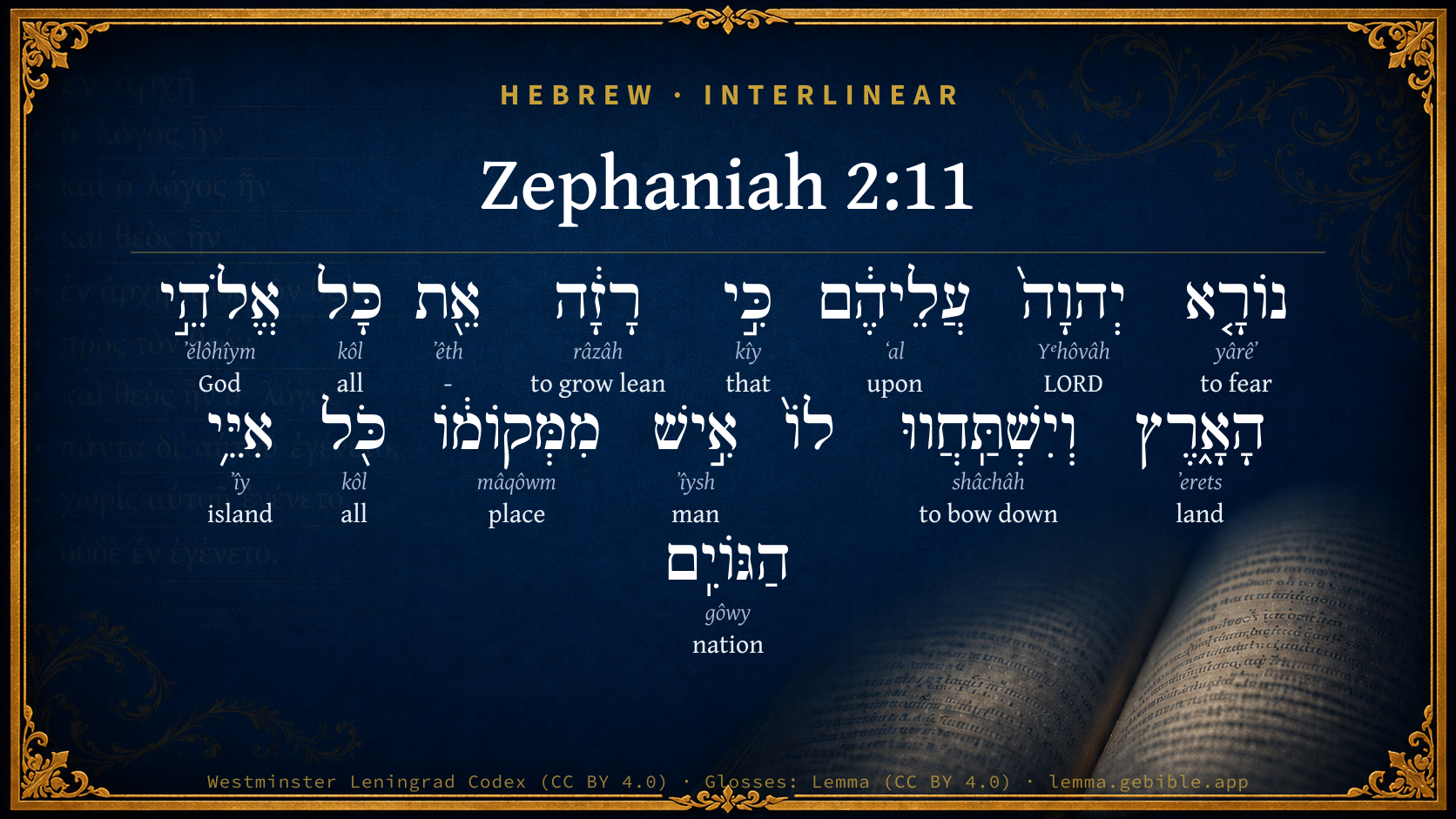
Zephaniah 2:11

Hebrew (Westminster Leningrad Codex) Zephaniah 2:11 appears in the Hebrew Old Testament. The text above is from the Westminster Leningrad Codex. Each word links to its Strong’s number, a concise gloss, and parsing drawn from the Open Scriptures Hebrew Bible morphology. Click any word for its full Brown-Driver-Briggs (BDB) entry.
Download image
Cite this verse

Zephaniah 2:11 (World English Bible). Public Domain. Lemma interlinear Bible study tool, https://lemma.gebible.app/v/zephaniah/2/11.

Show BibTeX & RIS
BibTeX
RIS
English Translation
Yahweh will be awesome to them, for he will famish all the gods of the land. Men will worship him, everyone from his place, even all the shores of the nations.
World English Bible · Public Domain
Download a study sheet

One document with this verse’s original text, its word-by-word gloss line, the meaning frame, cross-references with their text, attributed commentary, and full source and license credits — printable, and it pastes into notes with its structure intact.

This verse Autodidact and up

Study sheet (.html) Plain text (.txt)

A passage Seminary Student

Up to 50 verses in one chapter. A passage sheet keeps up to 6 commentary sources and 12 cross-references per verse, in the order this page ranks them, and says so on the sheet whenever that leaves anything out. Ask for a single verse and you get the Autodidact verse sheet above.

Everything on this page stays free to read, with no account — the sheet is a download of what is already on screen, not access to it.

Want to remove ads? Support Godless Engineer
Compare translations 3

The same verse in 3 English versions, stacked beneath the original-language interlinear above. Click any original word for its lexicon entry.

Each is an independent rendering of the whole verse — the interlinear is not word-aligned to these translations.

Highlighted words mark where these versions differ — a whole-verse word diff, not a word-by-word alignment.

  • World English Bible Public Domain
    Yahweh will be awesome to them, for he will famish all the gods of the land. Men will worship him, everyone from his place, even all the shores of the nations.
  • King James Version Public Domain
    The LORD will be terrible unto them: for he will famish all the gods of the earth; and men shall worship him, every one from his place, even all the isles of the heathen.
  • unfoldingWord Literal Text CC BY-SA 4.0
    Yahweh fearsome against them, for he will starve all of the gods of the earth. And all of the islands of the nations will bow down to him, a man from his place.

unfoldingWord Literal Text — © unfoldingWord, licensed CC BY-SA 4.0. Word-aligned USFM3 via Door43 (git.door43.org/unfoldingWord/en_ult).

Versions to compare (up to 4)

3 of 4 selected

Show all 18 translations

Every available English version of this verse, each an independent rendering of the whole verse.

  • World English Bible Public Domain
    Yahweh will be awesome to them, for he will famish all the gods of the land. Men will worship him, everyone from his place, even all the shores of the nations.
  • Berean Standard Bible Public Domain
    The LORD will be terrifying to them when He starves all the gods of the earth. Then the nations of every shore will bow in worship to Him, each in its own place.
  • Majority Standard Bible Public Domain
    The LORD will be terrifying to them when He starves all the gods of the earth. Then the nations of every shore will bow in worship to Him, each in its own place.
  • King James Version Public Domain
    The LORD will be terrible unto them: for he will famish all the gods of the earth; and men shall worship him, every one from his place, even all the isles of the heathen.
  • American Standard Version (1901) Public Domain
    Jehovah will be terrible unto them; for he will famish all the gods of the earth; and men shall worship him, every one from his place, even all the isles of the nations.
  • Revised Version (1885) Public Domain
    The LORD will be terrible unto them: for he will famish all the gods of the earth; and men shall worship him, every one from his place, even all the isles of the nations.
  • Geneva Bible (1599) Public Domain
    The Lord will be terrible vnto them: for he wil consume all the gods of the earth, and euery man shall worship him from his place, euen all the yles of the heathen.
  • Douay-Rheims (1899) Public Domain
    The Lord shall be terrible upon them, and shall consume all the gods of the earth: and they shall adore him every man from his own place, all the islands of the Gentiles.
  • Young's Literal Translation Public Domain
    Fearful `is' Jehovah against them, For He made bare all gods of the land, And bow themselves to Him, each from his place, Do all islanders of the nations.
  • Literal Standard Version CC BY-SA 4.0
    Fearful [is] YHWH against them, || For He made all gods of the land bare, || And all islanders of the nations bow themselves to Him, || Each from his place.
  • Unlocked Literal Bible CC BY-SA 4.0
    Then they will fear Yahweh, for he will taunt all the gods of the earth. Everyone will worship him, everyone from his own place, from every seashore.
  • unfoldingWord Literal Text CC BY-SA 4.0
    Yahweh fearsome against them, for he will starve all of the gods of the earth. And all of the islands of the nations will bow down to him, a man from his place.
  • Darby Bible Public Domain
    Jehovah will be terrible unto them; for he will famish all the gods of the earth; and all the isles of the nations shall worship him, every one from his place.
  • World Messianic Bible Public Domain
    The LORD will be awesome to them, for he will famish all the gods of the land. Men will worship him, everyone from his place, even all the shores of the nations.
  • Webster's Bible Public Domain
    The LORD will be terrible to them: for he will famish all the gods of the earth; and men shall worship him, every one from his place, even all the isles of the heathen.
  • Free Bible Version CC BY-SA 4.0
    The Lord will make them terribly afraid as he starves to death all the gods of the land. Every nation will worship the Lord wherever they are—all around the world.
  • Bible in Basic English Public Domain
    The Lord will let himself be seen by them: for he will make all the gods of the earth feeble; and men will go down before him in worship, everyone from his place, even all the sea-lands of the nations.
  • JPS Tanakh (1917) Public Domain
    The LORD will be terrible unto them; for He will famish all the gods of the earth; then shall all the isles of the nations worship Him, every one from its place.

Literal Standard Version (2020), Covenant Press — licensed CC BY-SA 4.0. Text via the HelloAO Bible API (eBible.org). Unlocked Literal Bible (unfoldingWord) — licensed CC BY-SA 4.0. Text via the HelloAO Bible API (eBible.org). unfoldingWord Literal Text — © unfoldingWord, licensed CC BY-SA 4.0. Word-aligned USFM3 via Door43 (git.door43.org/unfoldingWord/en_ult). Free Bible Version, Dr. Jonathan Gallagher — licensed CC BY-SA 4.0. Text via the HelloAO Bible API (eBible.org).

Word by word

More ways to search: Search by grammar → Find every occurrence → Compare this word →

Practice this passage: Drill this verse → Learn its vocabulary →

רָזָ֔ה
râzâh
H7329
“to grow lean”
Verb, Qal, Perfect, 3rd Person, Masculine, Singular
Part of Speech
Verb
Stem
Qal
Form
Perfect
Person
3rd Person
Gender
Masculine
Number
Singular
Full BDB Definition

Origin: a primitive root

TWOT: 2139

to be or become or grow lean - (Qal) to make lean - (Niphal) to be made lean
  1. נוֹרָ֤א yârêʼ H3372 “fearing” Verb, Niphal, Participle Active, Masculine, Singular, Absolute
  2. יְהוָה֙ Yᵉhôvâh H3068 “LORD” Noun, Proper
  3. עֲלֵיהֶ֔ם ʻal H5921 “upon · them” Preposition + Suffix, Personal, 3rd Person, Masculine, Plural
  4. כִּ֣י kîy H3588 “that” Conjunction
  5. אֵ֖ת ʼêth H853 “-” Particle, Direct Object
  6. כָּל kôl H3605 “all of” Noun, Common, Masculine, Singular, Construct
  7. אֱלֹהֵ֣י ʼĕlôhîym H430 “God(s) of” Noun, Common, Masculine, Plural, Construct
  8. הָאָ֑רֶץ ʼerets H776 “the · land” Particle, Definite Article + Noun, Common, Both, Singular, Absolute
  9. וְיִשְׁתַּֽחֲווּ shâchâh H7812 “and · to bow down” Conjunction + Verb, Hishtaphel, Imperfect, 3rd Person, Masculine, Plural
  10. אִ֣ישׁ ʼîysh H376 “man” Noun, Common, Masculine, Singular, Absolute
  11. מִמְּקוֹמ֔וֹ mâqôwm H4725 “from · place · his” Preposition + Noun, Common, Masculine, Singular, Construct + Suffix, Personal, 3rd Person, Masculine, Singular
  12. כֹּ֖ל kôl H3605 “all of” Noun, Common, Masculine, Singular, Construct
  13. אִיֵּ֥י ʼîy H339 “islands of” Noun, Common, Masculine, Plural, Construct
  14. הַגּוֹיִֽם gôwy H1471 “the · nations” Particle, Definite Article + Noun, Common, Masculine, Plural, Absolute

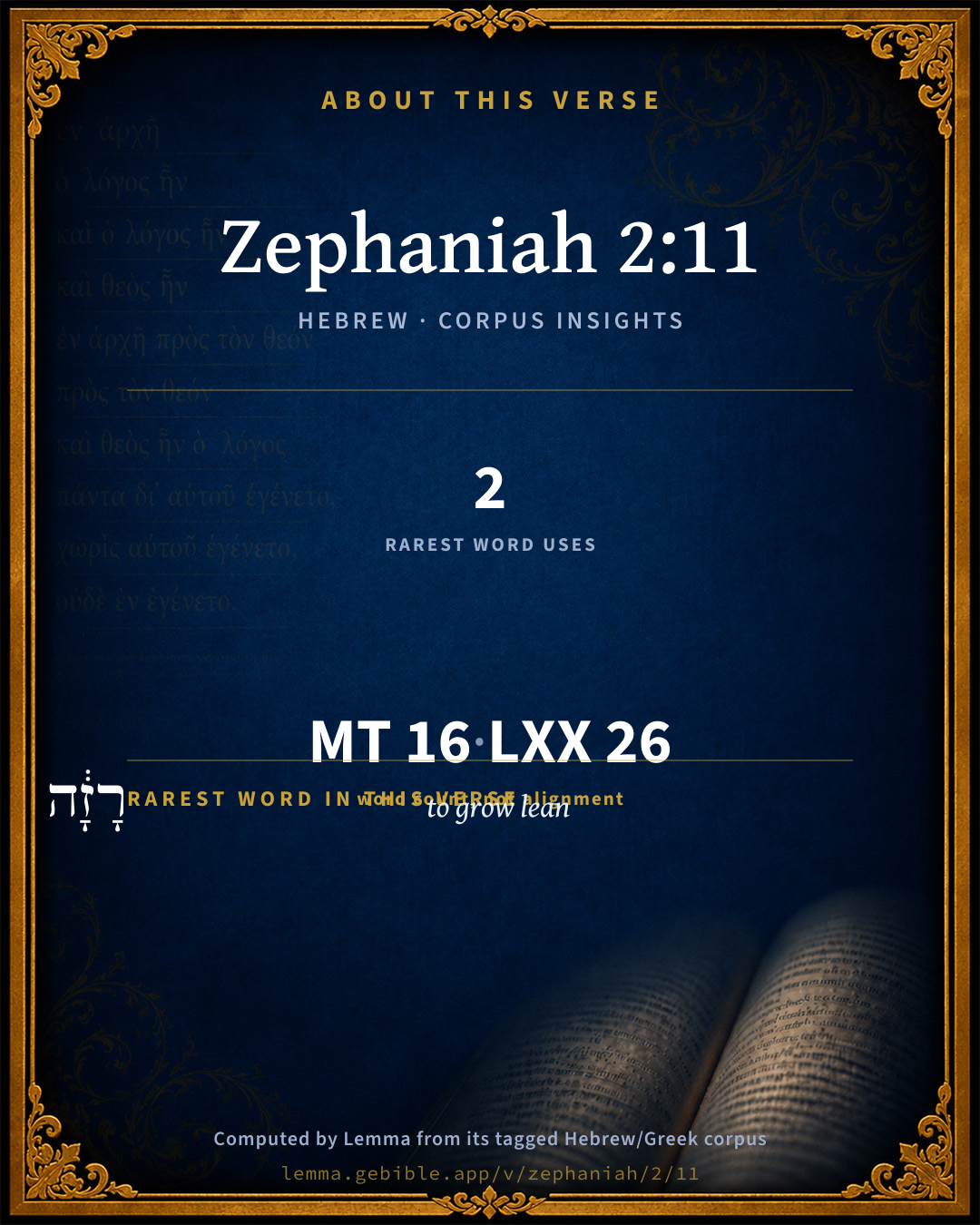
About this verse

These counts appear in no published source. They are computed here, from the morphology-tagged text and Lemma’s own curated glosses. What Lemma adds →

16
words
14
distinct lemmas
Prophets
section

Notable vocabulary

The rarest word here is רָזָ֔ה to grow lean H7329 — appearing just 2 times in the whole Hebrew Bible.

Shared distinctive vocabulary

רָזָ֔ה to grow lean H7329 occurs in 2 verses of the Hebrew Bible. Also found in:

Grammatical profile

  • 3 verbs
  • 9 nouns
  • 2 prepositions
  • 1 conjunction
  • 1 particle

Verb forms

  • נוֹרָ֤א Niphal · Participle Active
  • רָזָ֔ה Qal · Perfect
  • וְיִשְׁתַּֽחֲווּ Hishtaphel · Imperfect

Repetition

A word recurs within this verse — often emphatic in Hebrew:

Hebrew & Septuagint length

In English translation the verse runs 31 words from the Hebrew and 36 from the Septuagint (LXX English) — closely comparable.

A rough comparison of the two English renderings, which tokenize alike — not a word-level alignment.

Word counts can differ between the Hebrew and the Greek without any difference in meaning — e.g. the Hebrew direct-object marker אֵת has no separate Greek word, and Greek often adds the article ὁ.

In the original languages it is 16 Hebrew tokens and 26 Greek tokens — but the two are counted differently (Hebrew bundles its prefixes and suffixes into one token; the Greek is in lemma form), so that isn’t a like-for-like length.

Cross-references

30

Topical passages linked to Zephaniah 2:11 in the Treasury of Scripture Knowledge — connected by theme and wording, ordered by reader-vote popularity; previews shown in the World English Bible.

  • Micah 4:1–3 But in the latter days, It will happen that the mountain of Yahweh's temple will be established on the top of the mountains, And it will be exalted above the hills; And peoples will stream to it.
  • Zechariah 13:2 It will come to pass in that day, says Yahweh of Hosts, that I will cut off the names of the idols out of the land, and they will no more be remembered; and also I will cause the prophets and the spirit of impurity to pass out of the land.
  • Zechariah 14:9–21 Yahweh will be King over all the earth. In that day Yahweh will be one, and his name one.
  • Genesis 10:5 Of these were the isles of the nations divided in their lands, everyone after his language, after their families, in their nations.
  • Psalms 72:8–11 He shall have dominion also from sea to sea, From the River to the ends of the earth.
  • Psalms 117:1–2 Praise Yahweh, all you nations! Extol him, all you peoples!
  • Psalms 138:4 All the kings of the earth will give you thanks, Yahweh, For they have heard the words of your mouth.
  • Hosea 2:17 For I will take away the names of the Baals out of her mouth, And they will no more be mentioned by their name.
  • Zechariah 2:11 Many nations shall join themselves to Yahweh in that day, and shall be my people; and I will dwell in the midst of you, and you shall know that Yahweh of Hosts has sent me to you.
  • Malachi 1:11 For from the rising of the sun even to the going down of the same, my name is great among the nations, and in every place incense will be offered to my name, and a pure offering: for my name is great among the nations," says Yahweh of Hosts.
  • Deuteronomy 32:38 Which ate the fat of their sacrifices, And drank the wine of their drink-offering? Let them rise up and help you, Let them be your protection.
  • Psalms 2:8–12 Ask of me, and I will give the nations for your inheritance, The uttermost parts of the earth for your possession.
  • Psalms 22:27–30 All the ends of the earth shall remember and turn to Yahweh. All the relatives of the nations shall worship before you.
  • Psalms 72:17 His name endures forever. His name continues as long as the sun. Men shall be blessed by him. All nations will call him blessed.
  • Psalms 86:9 All nations you have made will come and worship before you, Lord. They shall glorify your name.
  • Psalms 97:6–8 The heavens declare his righteousness. All the peoples have seen his glory.
  • Isaiah 2:2–4 It shall happen in the latter days, that the mountain of Yahweh's house shall be established on the top of the mountains, And shall be raised above the hills; And all nations shall flow to it.
  • Isaiah 11:9–10 They shall not hurt nor destroy in all my holy mountain; for the earth shall be full of the knowledge of Yahweh, as the waters cover the sea.
  • Isaiah 24:14–16 These shall lift up their voice, they shall shout; for the majesty of Yahweh they cry aloud from the sea.
  • Isaiah 42:4 He will not fail nor be discouraged, until he have set justice in the earth; and the isles shall wait for his law.
  • Isaiah 42:10 Sing to Yahweh a new song, and his praise from the end of the earth; you who go down to the sea, and all that is therein, the isles, and the inhabitants of it.
  • Isaiah 49:1 Listen, isles, to me; and listen, you peoples, from far: Yahweh has called me from the womb; from the bowels of my mother has he made mention of my name:
  • Joel 2:11 Yahweh thunders his voice before his army; For his forces are very great; For he is strong who obeys his command; For the day of Yahweh is great and very awesome, And who can endure it?
  • Zephaniah 1:4 I will stretch out my hand against Judah, and against all the inhabitants of Jerusalem. I will cut off the remnant of Baal from this place: the name of the idolatrous and pagan priests,
  • Zephaniah 3:9 For then I will purify the lips of the peoples, that they may all call on the name of Yahweh, to serve him shoulder to shoulder.
  • Zechariah 8:20 Thus says Yahweh of Hosts: "Many peoples, and the inhabitants of many cities will yet come;
  • Zechariah 8:23 Thus says Yahweh of Hosts: "In those days, ten men will take hold, out of all the languages of the nations, they will take hold of the skirt of him who is a Jew, saying, 'We will go with you, for we have heard that God is with you.'"
  • John 4:21–23 Jesus said to her, "Woman, believe me, the hour comes, when neither in this mountain, nor in Jerusalem, will you worship the Father.
  • 1 Timothy 2:8 I desire therefore that the men in every place pray, lifting up holy hands without wrath and doubting.
  • Revelation 11:15 The seventh angel sounded, and great voices in heaven followed, saying, "The kingdom of the world has become the Kingdom of our Lord, and of his Christ. He will reign forever and ever!"

Cross-references courtesy of OpenBible.info (CC BY 4.0).

Hebrew and Greek witnesses Masoretic Hebrew ↔ Greek Septuagint

The same verse in the two great witnesses to the Old Testament, shown verse-for-verse.

These are two independent witnesses, not word-aligned to each other, and the Septuagint is shown in lemma (dictionary) form.

Hebrew Zephaniah 2:11 Masoretic · Westminster Leningrad Codex

נוֹרָ֤א יְהוָה֙ עֲלֵיהֶ֔ם כִּ֣י רָזָ֔ה אֵ֖ת כָּל אֱלֹהֵ֣י הָאָ֑רֶץ וְיִשְׁתַּֽחֲווּ לוֹ֙ אִ֣ישׁ מִמְּקוֹמ֔וֹ כֹּ֖ל אִיֵּ֥י הַגּוֹיִֽם

Yahweh will be awesome to them, for he will famish all the gods of the land. Men will worship him, everyone from his place, even all the shores of the nations.

World English Bible · Public Domain

Greek LXX Zephaniah 2:11 Septuagint · lemma form

ἐπιφαίνω κύριος ἐπί αὐτός καί ἐκὀλεθρεύω πᾶς ὁ θεός ὁ ἔθνος ὁ γῆ καί προςκυνέω αὐτός ἕκαστος ἐκ ὁ τόπος αὐτός πᾶς ὁ νήσος ὁ ἔθνος

The Lord shall appear against them, and shall utterly destroy all the gods of the nations of the earth; and they shall worship him every one from his place, even all the islands of the nations.

LXX2012 (modern English Septuagint) · Public Domain

On this verse, John Gill's Exposition discusses the Septuagint’s reading. Read the note in Commentary ↓

Hebrew: Westminster Leningrad Codex (CC BY 4.0). Greek: Septuagint (public domain); English from LXX2012 (modern English Septuagint) (Public Domain). How the Septuagint differs from the Hebrew →

Targum (Aramaic paraphrase)

1

The Targum is the ancient Jewish Aramaic paraphrase of the Hebrew Scriptures — an interpretive translation, not the Hebrew text itself. Onkelos (literal) and Pseudo-Jonathan (expansive) render the Torah, and Jonathan the Prophets. Coverage is partial: where no permissively-licensed English translation exists for a verse, only the Aramaic is shown. This is verse-level text, not a word-by-word alignment to the Hebrew.

  1. Targum Jonathan Prophets (Joshua–Malachi)
    דְחִילָא דַייָ לְמִפְרַקְהוֹן אֲרֵי אַמְעִיךְ יַת כֹּל דַחֲלַת אַרְעָא וְיִבְעוֹן מִן קֳדָמוֹהִי גְבַר מֵאַתְרֵיהּ כָּל נַגְוַת עַמְמַיָא:

    (no public-domain English translation for this verse)

    Targum Jonathan — Aramaic: “Mikraot Gedolot” (public domain). English: “Sefaria Community Translation” (CC0 1.0 (public-domain dedication)); “London "Chaldee Paraphrase," 1871” (public domain). Text via Sefaria.

Commentary

Notes on Zephaniah 2:11 from classic Christian and Jewish commentators (each source and its license shown beneath its notes). The classic Christian expositions comment on the surrounding passage and are grouped to its opening verse, so a note may address several verses; the Jewish commentaries on the Tanakh (Rashi and others) are per-verse, so they appear only where the commentator wrote on this verse.

Lemma curates 59 commentaries, every one of them public domain or Creative Commons licensed, each selected and text-cleaned for this edition rather than reprinted as found. About our sources →

Trapp's Complete Commentary

John Trapp

Zep 2:11 The LORD [will be] terrible unto them: for he will famish all the gods of the earth; and [men] shall worship him, every one from his place, [even] all the isles of the heathen.

Ver. 11. The Lord will be terrible unto them] For he shall march forth in battle array against proud persons, 1Pe 5:5, and stain the pride of all their glory (’Aντιτασσεται); he will pull them down from their pinnacle of self-exaltation, and make them know themselves to be but men. Attilas, king of the Huns, proudly gave out that the stars fell before him, the earth trembled at his presence, and that he would be the scourge of all nations. But what became of him? He died suddenly by a flux of blood, breaking out at his mouth and choking him, on his weddingday at night. It were easy to instance further, in Pharaoh, Nebuchadnezzar, Antiochus, Herod, the king of Tyro, &c. "With God is terrible majesty," Job 37:22, "he is terrible to the kings of the earth, while he cutteth off their spirits," Psa 76:12. Heb. he slippeth them off, as one should slip off a flower between one’s fingers, or a bunch of grapes off the vine; so soon is the business done.

For he will famish all the gods of the earth] He will cast them into an atrophy, into a consumption. This was fulfilled partly when Nebuchadnezzar destroyed the nations, and proclaimed the true God to be the only God, Dan 4:34, but principally when Christ came in the flesh, and sent out his apostles to decry those heathen deities, and to preach the everlasting gospel, "saying with a loud voice, Fear God, and give glory to him, a worship him that made heaven, earth, sea, and fountains of waters," Rev 14:7. Now it was that Satan fell like lightning from heaven, the oracles were silenced, the heathen emperors amazed at the prevailing power of the gospel in despite of them, the very names of most of the gods of the earth were abolished, the temple of Apollo at Delphi fired from heaven; and at that very time when Julian’s ambassadors were there to inquire what should be the issue of the Persian war. Thus the heathen superstition fell flat to the ground, their gods were famished for want of worshippers and sacrifices, &c. And the same we hope and wait for to befall the antichristian rout and religion. That idol is grown very lean, and hath lost a collop, as we say. Bellarmine is very sensible, and bewails the business, that ever since we began to count and call the Pope antichrist he hath suffered no small decays and losses in the Christian Churches. He hath indeed, and more and more shall do, till he be left as lean as a rake, and all his plumes pulled, his credit cracked, his honour laid in the dust.

And men shall worship him] Heb. Bow down to him. He is thy Lord, and bow thou down unto him, Psa 45:11. Body and soul both must stoop to God; and both at once, 2Co 6:14-18. Swenckfeldians (Stinkfeldians Luther called them, from their ill savour) take away all external service; so do the Nicodemites. Hypocrites draw nigh to God with their lips only, when their hearts are elsewhere; their bodies are in facellis, in torment, their hearts in sacculis, in a little bag, as Eze 33:31. But the true Israelites give God both inward and outward worship; he doth ponere dextram in pectore, as Persius phraseth it; being shod with the preparation of the gospel, he treads it not awry (ορθοποδει), neither too much outward, as the formalist, nor too much inward, as the Swenckfeldian. He looks upon our late worship scorners, our high attainers, as the last brood of Beelzebub; and reckons that to cast off ordinances is to cast away the remedy, 2Ch 36:15-16 Pro 29:1.

Every one from his place] Not at Jerusalem only, as once, Joh 4:21, but in all places, pure hands and hearts shall be lifted up, without wrath, without doubting, 1Ti 2:8; both in church and chamber; any place whatsoever shall be a sufficient oratory, so that God be worshipped in spirit and in truth, and the public not neglected.

Even all the isles of the heathen] That is, all countries, though not encompassed with the sea; for the Jews called all lands islands which they could not come to but by water. That God shall be worshipped in the four corners of the earth. {See Trapp on "Deu 6:4"} It was the last speech of dying Chrysostom, Glory be to God from all creatures. Let the Jesuits at the end of their books subscribe Laus Deo et beatae Virgini, Praise to God and happiness to ther Virgin. Let this be the badge of the beast; let us cry, To God alone be glory all the world over.

John Trapp, A Commentary or Exposition upon All the Books of the Old and New Testament (1647–1656) — public domain. Text from a community e-Sword module.

The Biblical Illustrator

Joseph S. Exell

Zep_2:11

And men shall worship Him.

Good things in the future

I. The destruction of idolatry. You may burn up all heathen temples and leave idolatry as rampant as ever.

II. The advancement of true worship. And men shall worship Him, every one from his place, even all the isles of the heathen. Observe--

1. The object of true worship. Men shall worship Him,--that is, Jehovah. Him, not it--not the universe, but the Infinite Personality that created it.

2. The scene of true worship. Every one from his place. Wherever he is. He need not go to any particular scene--to temple, chapel, or cathedral.

3. The extent of true worship. Even all the isles of the heathen. What a glorious future awaits this world! (Homilist.)

The Biblical Illustrator, edited by Joseph S. Exell (c. 1880s–1900s) — public domain. Text from a community e-Sword module.

Keil & Delitzsch

C. F. Keil & F. Delitzsch

"Fearful is Jehovah over them, for He destroyeth all the gods of the earth; that all the islands of the nations, every one from its place, may worship Him." Whilst עליהם refers to what precedes, the next clause in the reason assigned points to the announcement of judgment upon the remaining nations of the earth in Zep 2:12.; so that Zep 2:11 cannot be taken either as the conclusion of the previous threat, or as the commencement of the following one, but leads from the one to the other. Jehovah is terrible when He reveals Himself in the majesty of Judge of the world. The suffix appended to עליהם does not refer to עם יהוה, but to the להם in Zep 2:10, answering to the Moabites and Ammonites. Jehovah proves Himself terrible to these, because He has resolved to destroy all the gods of the earth. Râzâh, to make lean; hence to cause to vanish, to destroy. He causes the gods to vanish, by destroying the nations and kingdoms who relied upon these gods. He thereby reveals the nothingness of the gods, and brings the nations to acknowledge His sole deity (Mic 5:12). The fall of the false gods impels to the worship of the one true God. וישׁתּחווּ לו is the consequence, the fruit, and the effect of Jehovah's proving Himself terrible to the nations and their gods. איּי הגּוים, islands of the Gentiles, is an epithet taken from the islands and coastlands of Europe, to denote the whole of the heathen world (see at Isa 41:1). The distributive עישׁ ממּקומו refers to haggōyı̄m as the principal idea, though not in the sense of "every nation," but in that of every individual belonging to the nations. Mimmeqōmō, coming from his place: the meaning is not that the nations will worship Jehovah at their own place, in their own lands, in contradistinction to Mic 4:1; Zac 14:16, and other passages, where the nations go on pilgrimage to Mount Zion (Hitzig); but their going to Jerusalem is implied in the min (from), though it is not brought prominently out, as being unessential to the thought. With regard to the fulfilment, Bucer has correctly observed, that "the worship of Jehovah on the part of the heathen is not secured without sanguinary wars, that the type may not be taken for the fact itself, and the shadow for the body .... But the true completion of the whole in the kingdom of Christ takes place here in spirit and in faith, whilst in the future age it will be consummated in all its reality and in full fruition." Theodoret, on the other hand, is too one-sided in his view, and thinks only of the conversion of the heathen through the preaching of the gospel. "This prophecy," he says, "has received its true fulfilment through the holy apostles, and the saints who have followed them; ... and this takes place, not by the law, but by the teaching of the gospel."

Keil & Delitzsch — Biblical Commentary on the Old Testament (1861–1891) — public domain (CC PDM 1.0). Text via the HelloAO Bible API. (Old Testament only.)

Tyndale Open Study Notes

Tyndale Open Resources

2:11 nations . . . will worship the Lord: At the end of history, all people in all places will worship God alone (3:9; Ps 66:4; Mic 4:1-2; Zech 14:16).

Tyndale Open Study Notes — © Tyndale Open Resources, licensed CC BY-SA 4.0. Text via the HelloAO Bible API.

Geneva Bible (1599)

Geneva Bible translators

When he shall deliver his people and destroy their enemies and Idols, his glory shall shine throughout all the world.

Geneva Bible (1599) marginal notes — public domain. Text via Bolls.life.

Jamieson, Fausset & Brown

Robert Jamieson, A. R. Fausset & David Brown

famish--bring low by taking from the idols their former fame; as beasts are famished by their food being withheld. Also by destroying the kingdoms under the tutelage of idols (Psa 96:4; Isa 46:1).

gods of the earth--who have their existence only on earth, not in heaven as the true God.

every one from his place--each in his own Gentile home, taught by the Jews in the true religion: not in Jerusalem alone shall men worship God, but everywhere (Psa 68:29-30; Mal 1:11; Joh 4:21; Co1 1:2; Ti1 2:8). It does not mean, as in Isa 2:2; Mic 4:1-2; Zac 8:22; Zac 14:16 that they shall come from their several places to Jerusalem to worship [MAURER].

all . . . isles of . . . heathen--that is, all the maritime regions, especially the west, now being fulfilled in the gathering in of the Gentiles to Messiah.

Jamieson, Fausset & Brown — Commentary Critical and Explanatory on the Whole Bible (1871) — public domain (CC PDM 1.0). Text via the HelloAO Bible API.

Adam Clarke's Commentary

Verse 11. He will famish all the gods of the earth] They shall have no more sacrifices; their worship shall be entirely destroyed. Idolaters supposed that their gods actually fed on the fumes and spirituous exhalations that arose from the burnt-offerings which they made unto their idols. It is in reference to this opinion that the Lord says, "He will famish all the gods of the land."

Adam Clarke's Commentary on the Bible (1810–1826) — public domain. Text from a community e-Sword/MySword module.

John Calvin's Commentaries

He proceeds with the same subject,—that God would show his power in aiding his people. But he calls him a terrible God, who had for a time patiently endured the wantonness of his enemies, and thus became despised by them: for the ungodly, we know, never submit to God unless they are constrained by his hand; and then they are not bent so as willingly to submit to his authority; but when forced they are silent. This is what the Prophet means in these words; as though he had said, that the wicked now mock God, as they disregard his power, but that they shall find how terrible an avenger of his people he is, so that they would have to dread him. And then he compares the superstitions of the nations with true religion; as though he had said, that this would be to the Jews as a reward for their piety, inasmuch as they worshipped the only true God, and that all idols would be of no avail against the help of God. And this was a necessary admonition; for the ungodly seemed to triumph for a time, not only over a conquered people, but over God himself, and thus gloried in their superstitious and vain inventions. The Prophet, therefore, confirms their desponding minds; for God, he says, will at length consume all the gods of the nations

The verb רזה, reze, means strictly to make lean or to famish, but is to be taken here metaphorically, as signifying to consume. God then will famish all the inventions of the nations: and he alludes to that famine which idols had occasioned through the whole world; as though he had said, that God’s glory would shortly appear, which would exterminate whatever glory the false gods had obtained among them, so that it would melt away like fatness.

He at last adds, that the remotest nations would become suppliants to God; for by saying, adore him shall each from his place, he doubtless means, that however far off the countries might be, the distance would be no hindrance to God’s name being celebrated, when his power became known to remote lands. And, for the same reason, he mentions the islands of the nations, that is, countries beyond the sea: for the Hebrews, as it has been elsewhere observed, call those countries islands which are far distant, and divided by the sea. In short, the Prophet shows, that the redemption of the people would be so wonderful, that the fame of it would reach the farthest bounds of the earth, and constrain foreign nations to give glory to the true God, and that it would dissipate all the mists of superstition, so that idols would be exposed to scorn and contempt. It follows—

John Calvin's Commentaries (1540-1563) — public domain. Text from the Calvin Translation Society English edition (1840s-50s) via the Christian Classics Ethereal Library (ccel.org). Calvin's coverage is partial (roughly two-thirds of the Bible); uncommented books and verses are honest gaps, never fabricated. The 19th-century editor's footnotes and remarks are omitted so the notes are faithfully Calvin's own voice.

Ellicott's Commentary for English Readers

(11) Famish.—Literally as in margin “make lean:” to “cause to disappear.”

Every one from his place.—It is difficult to accept Keil’s theory of a pregnant construction, “each one coming from his place:” scil. to Jerusalem. This passage, therefore, is one of the very few which foretell that the worship of Jehovah shall find centres outside the Holy Land. The usual prediction, on the other hand, represents the converted nations as “flowing” to Jerusalem.

Isles.—Better, sea coasts.

A Bible Commentary for English Readers, edited by Charles John Ellicott (1878–1897) — public domain. Text from a community e-Sword module.

The Cambridge Bible for Schools and Colleges

gen. ed. J. J. S. Perowne

11. will be terrible unto them] lit. over them. Mal_1:14, “I am a treat king, and my name terrible among the nations.” For “terrible” Sept. reads, will appear.

he will famish all the gods] lit., as marg., make lean (Isa_17:4). Hitzig, followed by Keil, thinks the meaning to be, that by destroying all the nations the Lord will make lean or enfeeble all their gods, for the vigour of the god is proportionate to the robustness and power of the nation. This kind of reflection is not likely to have passed through the mind of the prophet. His idea appears to be that by terrible deeds Jehovah will make Himself known to the nations, who will fear Him alone, perceiving the impotency of their former gods; comp. Isa_2:20; Isa_30:22, and Ezekiel 25 ff. The use of the term make lean in regard to gods is certainly strange.

every one from his place] i.e. each individual person, not each nation. The phrase “from his place” seems to mean, everyone where he dwells, the idea being that, without making pilgrimages to Jerusalem (Isa_2:3; Zec_8:22; Zec_14:16), the peoples shall worship Jehovah, every man in his own land (Mal_1:11). The prep, from might have a pregnant sense, each coming from his place, but this meaning is decidedly less natural.

the isles of the heathen] The term “isles” appears to have been applied to the island-like coasts of the Mediterranean, and then to have been used of distant countries in general, Isa_41:1; Isa_59:18, Eze_39:6.

The Cambridge Bible for Schools and Colleges (gen. ed. J. J. S. Perowne; Cambridge University Press, 1878–1918) — public domain. Text from a community e-Sword module.

John Gill's Exposition

The Lord [will be] terrible unto them To the Moabites and Ammonites in the execution of his judgments upon them, and make their proud hearts tremble; for with him is terrible majesty; he is terrible to the kings of the earth, and cuts off the spirit of princes, ( Job 37:22 ) ( Psalms 76:12 ) or, as Kimchi observes, this may be understood of the people of God reproached by the Moabites and Ammonites, by whom the Lord is to be feared and reverenced with a godly and filial fear: so it may be rendered, "the Lord is to be feared by them" F5; and to this inclines the Targum, ``the fear of the Lord is to redeem them;'' for he will famish all the gods of the earth; particularly of those countries mentioned in the context, the Philistines, Moabites, Ammonites, Ethiopians, and Assyrians; as Dagon, Chemosh, Molech, Bel, and others; called "gods of the earth", in distinction from the God of heaven, to whom they are opposed; and because made of earthly matter, and worshipped by earthly and carnal men; these the Lord, who is above them, and can destroy them at pleasure, threatens to "famish"; or to bring "leanness" F6 upon them, as the word signifies; to bring them into a consumption, and cause them to pine away gradually, by little and little, till they are no more; and that by reducing the number of their worshippers, so that they shall not have the worship and honour paid them, nor the sacrifices offered to them, supposed by the heathens to be the food of their gods; and, this being the case, their priests would be starved and become lean, who used to be fat and plump. The Septuagint version renders it, "he will destroy all the gods of the nations of the earth"; which is approved of by Noldius, and preferred by him to other versions. This had its accomplishment in part, when these nations were subdued by Nebuchadnezzar; for idols were usually demolished when a kingdom was taken; and more fully when the Gospel was spread in the Gentile world by the apostles of Christ, and first ministers of the word; whereby the oracles of the heathens were struck dumb, and men were turned everywhere from the worship of idols; the idols themselves were destroyed, and their temples demolished, or converted to better uses; and will have a still greater accomplishment in the latter day, at the conversion of the Jews, and the bringing in the fulness of the Gentiles, when the worship of idols will cease everywhere. The Syriac version renders it, "all the kings of the earth"; very wrongly: and [men] shall worship him, everyone from his place; or, "in his place" F7; that is, every man shall worship the true God in the place where he is; he shall not go up to Jerusalem to worship, but in every place lift up holy bands to God, pray unto him, praise and serve him; the worship of God will be universal; he will be King over all the earth, and his name and service one, and shall not be limited and confined to any particular place, ( Malachi 1:11 ) : [even] all the isles of the heathen; or "Gentiles"; not only those places which are properly isles, as ours of Great Britain and Ireland; though there may be a particular respect had to such, and especially to ours, who have been very early and long favoured with the Gospel, and yet will be; but all places beyond the seas, or which the Jews went to by sea, they called isles. FOOTNOTES: F5 (Mhyle hwhy arwn) "timendus Jehovah super ipsis", Cocceius, Burkius. F6 (hzr) "emaciabit", Junius & Tremellius, Piscator; "quasi macie consumit", Vatablus; "quum emaciaverit", Cocceius; "quia emaciavit", Burkius. F7 (wmwqmm) .

John Gill's Exposition of the Whole Bible (1746–1763) — public domain (CC PDM 1.0). Text via the HelloAO Bible API.

Albert Barnes' Notes on the Bible

The Lord will be terrible unto - (upon) them that is, upon Moab and Ammon, and yet not in themselves only, but as instances of His just judgment. Whence it follows, “For He will famish all the gods of the earth” (Rup.). Miserable indeed, to whom the Lord is terrible! Whence is this? Is not God by Nature sweet and pleasurable and serene, and an Object of longing? For the Angels ever desire to look into Him, and, in a wonderful and unspeakable way, ever look and ever long to look. For miserable they, whose conscience makes them shrink from the face of Love. Even in this life they feel this shrinking, and, as if it were some lessening of their grief, they deny it, as though this could destroy the truth, which they ‘hold down in unrighteousness.’” Rom 1:18.

For He will famish all the gods of the earth - Taking away “the fat of their sacrifices, and the wine of their drink-offerings” Deu 32:38. Within 80 years from the death of our Lord , the governor of Pontus and Bithynia wrote officially to the Roman Emperor, that “the temples had been almost left desolate, the sacred rites had been for a long time intermitted, and that the victims had very seldom found a purchaser,” before the persecution of the Christians, and consulted him as to the amount of its continuance. Toward the close of the century, it was one of the Pagan complaints, which the Christian Apologist had to answer “they are daily melting away the revenues of our temples.” The prophet began to speak of the subdual of Moab and Ammon; he is borne on to the triumphs of Christ over all the gods of the Pagan, when the worship of God should not be at Jerusalem only, but “they shall worship Him, every one from his place.”

Even all the isles of the pagan - For this is the very note of the Gospel, that, Cyril: “each who through faith in Christ was brought to the knowledge of the truth, by Him, and with Him, “worshipeth from his place” God the Father; and God is no longer known in Judaea only, but the countries and cities of the Pagan, though they be separated by the intervening sea from Judaea, no less draw near to Christ, pray, glorify, thank Him unceasingly. For formerly “His name” was “great in Israel” Psa 76:1, but now He is well known to all everywhere; earth and sea are full of His glory, and so every one ‘worshipeth Him from his place;’ and this is what is said, ‘As I live, saith the Lord, all the earth shall be filled with the glory of the Lord’ Num 14:21.” “The isles” are any distant lands on the seashore (Jer 25:22, following; Eze 26:15, following; Psa 72:10), especially the very distant Isa 66:19; but also Asia Minor Dan 11:1, Dan 11:8 and the whole coast of Europe, and even the Indian Archipelago , since the ivory and ebony came from its “many isles.”

Zephaniah revives the term, by which Moses had spoken of the dispersion of the sons of Japhet: “By these were the ‘isles of the Gentiles’ divided in their lands, every one after his tongue” Gen 10:5. He adds the word, “all;” all, wherever they had been dispersed, every one from his place, shall worship God. One universal worship shall ascend to God from all everywhere. So Malachi prophesied afterward; “From the rising up of the sun even to the going down of the same My Name shall be great among the Gentiles, and “in every place” incense shall be offered unto God and a pure offering, for My Name shall be great among the pagan, saith the Lord of hosts” Mal 1:11. Even a Jew says here: “This, without doubt, refers to the time to come, when all the inhabitants of the world shall know that the Lord is God, and that His is the greatness and power and glory, and He shall be called the God of the whole earth.” The “isles” or “coasts of the sea” are the more the emblem of the Church, in that, Cyril: “lying, as it were, in the sea of this world and encompassed by the evil events in it, as with bitter waters, and lashed by the most vehement waves of persecutions, the Churches are yet founded, so that they cannot fall, and rear themselves aloft, and are not overwhelmed by afflictions. For, for Christ’s sake, the Churches cannot be shaken, and ‘the gates of hell shall not prevail against them’ Mat 16:18.”

Albert Barnes' Notes on the Bible (1834–1885) — public domain. Text from a community e-Sword/MySword module.

Haydock's Catholic Bible Commentary

Own place. The Jewish religion could be practised only at Jerusalem, so that this is one of the most striking predictions of the conversion of the world. The Jews in vain attempt to restrain it to the captives returning. See St. Jerome. (Calmet) --- They shall inform many of the truth, and be the means of their conversion. (Haydock) --- But God shall be adored in every place. (Menochius)

George Leo Haydock (1774–1849), Haydock's Catholic Family Bible and Commentary, 1859 edition — public domain. Excludes Psalms (Douay-Rheims chapter numbering differs from Protestant) and Deuterocanonical books (Catholic canon only).

Matthew Poole's English Annotations

The Lord will be terrible; or, the Lord, who is to be feared, is against or above them, and will make it appear that he is terrible in his doings.

Unto them; Moabites and Ammonites, and their gods, of whom they gloried.

He will famish; starve; though now their altars are filled with sacrifices, and their bowls run over, as if they designed to make their gods fat; but they shall want their sacrifices and drink offerings, these shall be few or quite cease, and their priests grow lean. There shall be a consumption among them all.

All the gods, idols, heathen gods,

of the earth; of those lands, Dagon, Chemosh, Molech, &c., that are gods no where else but on earth, and among the deceived; or gods of the earth., as sons of the earth, vile, spurious gods.

Men shall worship him; men of that country whose gods are undone, or all men, shall know, own, and worship the God of Israel.

Every one from his place, where he dwelleth, not only at Jerusalem, or in this mount, but every where.

All the isles; either literally, as we now see it fulfilled, or as the Jews interpret isles to be transmarine places. So they wait for his law, as foretold Isa 42:4.

Of the heathen; of all nations in all parts of the world. This is eminently fulfilled by the prevailing of the gospel.

Matthew Poole's English Annotations on the Holy Bible (1683–1685) — public domain. Text from a community e-Sword/MySword module.

The Pulpit Commentary

Before passing to the judgment on the nations of the south and north, the prophet shows the object of all these chastisements: God destroys idolatry in order that pure religion may reign over all the earth.

The Lord will be terrible unto them. The Lord shows himself as a terrible God over the Moabites and Ammonites, but only as parts of the heathen world, and with a view to a universal result This is the purpose of the revelation of himself as Judge. Septuagint, Epifanhsetai Kuriov ep autouv , "The Lord will appear against them." For he will famish all the gods of the earth. The verb means literally, "to make lean," and then "to destroy;" hence the LXX, exoloyreusei . The word may be chosen in order to express the idea that worshippers will no more be found to offer sacrifices and drink offerings to the gods (see Bel and the Dragon 6, 12). The nations being destroyed, the gods reverenced by them would vanish and be heard of no more. Men shall worship him. Idolatry abolished, men shall learn to worship Jehovah. Every one from his place. Every one shall worship God in his own place and country; the Lord shall be universally recognized, and his worship shall no longer be confined to one temple or one land, but wherever men dwell there shall they offer their homage and adoration. (comp. Isa_19:18, 19 Mal_1:11, where the same truth is signified) Such passages as Mic_4:1 and Zec_14:16, which seem to imply that all nations are to come up to the material Jerusalem to pay their devotions, require evidently a spiritual interpretation, and denote that the heathen converted to Christ shall be received into the Church, and join in the worship of the true Israel. The isles of the heathen; or, coasts of the nations; the most distant countries that lie across the seas. (Gen_10:5 Psa_72:10 Isa_11:11, etc.)

The Divine purpose in reference to the race, and the way of its fulfilment.

A very erroneous notion has been widely entertained respecting God"s relations to the peoples of the earth. The representation has been very current that, in selecting the Jewish tribes and constituting these his "peculiar treasure," the Most High left all other nations to their own resources, and that they became practically outcasts from his love and care. We have, however, abundant evidence that such is by no means the teaching of Scripture; that whilst with a view to the revealing and developing of his plan of redeeming mercy he did select the Jewish race, imparting to them special privileges and communicating to them a knowledge of his will, yet that all the nations were likewise under his government and nurture. We think of what is recorded in the Bible respecting Job the Chaldean, Balaam the heathen soothsayer, the mission of Elisha to the woman of Sarepta, and of Jonah to Nineveh, and the Divine revelations made to heathen monarchs, and, with all this before us, we cannot foster the notion that the world outside the pale of Judaism was disregarded by Heaven, but we see clearly that, whilst God was working out his special purposes of love to the race through the medium of" the chosen people," he was also in various ways by his Spirit striving with all the children of men. The beauty in the teachings of the Hebrew prophets consists in She fact that they were so ready to acknowledge all this; that they broke through the narrow boundary of exclusiveness which the Jews guarded so jealously, and told of the Divine working in all lands, and of the Divine intention to bless the entire race. The case of the Prophet Zephaniah is a conspicuous example of this. Whilst declaring the Divine judgments to light upon his own people, he also looked north and south, east and west, and saw the retributions which were to come upon the heathen nations. Nor did he rest here, but, peering still further into the future and apprehending the Divine Ruler as bringing order out of chaos, and out of trial and sorrow working good for the race, he paused in the midst of his dark announcements of coming woe to proclaim this loving design of his God (ver. 11), whilst at length, having ended his predictions of impending evil, he again turned to this cheering theme, and fingered upon it even to the very end of his prophecy. (Zep_3:8-20)

I THE DIVINE PURPOSE AS HERE EXPRESSED. This includes:

1. The complete extinction of idolatry. This is most expressly referred to here under the figure of starvation. The gods of the heathen should die through want and neglect. "He will famish all the gods of the earth" (ver. 11).

2. The full establishment of the worship of God. "And men shall worship him every one from his place" (ver. 11).

3. The universal acknowledgment of him by Gentile nations. "Even all the isles of the heathen" (ver. 11). The thought of the universality of this acknowledgment of the true God eventually is seen to be the more decidedly expressed here as we remember that in ancient times whole countries and continents were described as "the isles.

II THIS DIVINE PURPOSE IS TO BE WROUGHT OUT THROUGH THE OUTWARD DISCIPLINE OF CONFLICT AND TRIAL. "The Lord will be terrible unto them" (ver. 11). Men are to be humbled that God may be exalted. They pursue their own designs, and often care only for the realization of their own selfish ends, but "the Lord sitteth in the heavens," ruling over all, and, through all the conflicts and strifes, the turmoils and trials of individuals and nations, he is bringing to pass his loving purposes, and is leading on to the glory of the latter day.

III THE THOUGHT OF GOD AS WORKING THUS YIELDS INSPIRATION AND STRENGTH TO TRUE AND LOYAL HEARTS AMIDST THE DIFFICULTIES AND DISCOURAGEMENTS IN HOLY SERVICE. This was to Zephaniah the source of strength. Whilst faithful to his trust as the messenger of judgment he made to his own and to heathen nations the stern announcements of coming tribulation, he paused again and again to reflect upon the thought that these very judgments should be made to contribute to the accomplishment of God"s merciful and gracious design to bless and save the race.

Good things in the future.

"The Lord will be terrible unto them," etc. is to be feared above all the gods of the earth, for he will cause them to waste away; and all the inhabitants of the maritime regions shall worship him, each from his place." While announcing the destruction of the surrounding idolatrous nations, the prophet was inspired to predict the gradual but certain destruction of idolatry universally throughout the earth. The period predicted should be one in which all peculiarity of local worship should cease, and Divine worship be acceptable wherever presented in sincerity and truth" (Henderson). The passage reminds us of two good things that are in the future of our world.

I THE DESTRUCTION OF IDOLATRY. What is idolatry? It is the giving of our supreme affection to creature objects. It is not confined to the worship of heathen deities, which are for the most part the productions of human invention and art. The spirit of idolatry often exists where heathen idolatry is denounced. Whatever objects a man loves most is his god. In our England and throughout Christendom there are gods many, although they have no recognized temple. Wealth is a mighty god, power is a mighty idol, pleasure is a mighty idol, fame is a mighty idol. Before these idols the vast majority of the civilized world prostrate their souls in the ardour of devotion. The destruction of idolatry, therefore, does not mean the beating to dust or the consuming to ashes the idols that fill the temples of heathendom, but means the withdrawal of man"s supreme love from every object short of God. You may bum up all heathen temples, and leave idolatry as rampant as ever. To "famish all the gods of the earth" is to draw man"s supreme sympathy from all things except God. This is the great moral famine that is to be desired, to be prayed for and struggled after. The other good thing in the future of our world is

II THE ADVANCEMENT OF TRUE WORSHIP. "And men shall worship him, every one from his place, even all the isles of the heathen." Observe:

1. The object of true worship. "Men shall worship him," that is, Jehovah. Him, not it not the universe, but the infinite Personality that created it, the Fountain of all existence, all energy, all love, all blessedness. Him the Creator of the material, the Father of the spiritual.

2. The scene of true worship. "Every one from his place." Wherever he is. The worshipper need not go to any particular scene no temple, chapel, or cathedral. "From his place." It may be in solitude or in society, on the mountain brow or the seashore. "Neither in this mountain" nor on that mountain, but everywhere, "God is a Spirit.

3. The extent of true worship. "Even all the isles of the heathen.

CONCLUSION. What a glorious future awaits the world! How blessed will those ages be when every man of every tribe and clime shall have his heart centred in supreme love upon the one great Father of all! D.T.

The Pulpit Commentary (1880–1919), ed. H.D.M. Spence-Jones & Joseph S. Exell — public domain. Text from a community e-Sword module.

John Wesley's Explanatory Notes

Famish - Take away all their sacrifices and drink-offerings. The gods - Idols of those lands. From his place - Not only at Jerusalem, but everywhere.

John Wesley, Explanatory Notes Upon the Whole Bible (1754–1765) — public domain. Text via the GEBible commentary corpus.

Rashi

Rabbi Shlomo Yitzchaki (Rashi)

for He weakened He weakened their strength.

and... shall prostrate himself to Him when they see that their deity has deteriorated.

Rashi on the Tanakh — English translations: “The Judaica Press complete Tanach with Rashi, translated by A. J. Rosenberg” (CC BY 4.0); “Pentateuch with Rashi's commentary by M. Rosenbaum and A.M. Silbermann, 1929-1934” (public domain); “The Metsudah Tanach series, Lakewood, N.J” (CC BY 4.0); and “The Book of Joshua, Metsudah Publications, 1997” (CC BY 4.0). Text via Sefaria.

Lesson kit

Teaching starters — assembled from the data on this page, not authored interpretation. Every prompt links to the verse data it draws on. Edit before teaching.

Zephaniah, in the Prophets, opens this verse with 16 words (14 distinct Hebrew lemmas). Its most distinctive word is râzâh (“to grow lean”). A historical commentator’s framing appears above. Read the whole chapter for the surrounding context.

Discussion questions

  1. The word râzâh carries the sense “to grow lean.” How does it shape the verse?
  2. Isaiah 17:4 shares the word «to grow lean» with this verse. How do the two illuminate each other?
  3. “all” occurs 2× in this one verse. What is the effect of the repetition?
  4. The translations on this page render this verse differently — a whole-verse word diff, not a word-by-word alignment. What might account for the different wordings?
  5. The verb «נוֹרָ֤א» is Niphal Participle Active. How does its form color the action?
  6. Reading how Trapp's Complete Commentary and The Biblical Illustrator read this verse, where do the two commentators agree and where do they part?

Things to notice

Reading settings

Reading text

Shown beneath each verse's original-language words.

Old Testament
Old Testament edition

Read the OT as the Masoretic Hebrew (MT) or the Greek Septuagint (LXX).

English shown for the Greek Septuagint (in the Hebrew ↔ Greek comparison).

Comparing translations? Open the Compare panel on any verse page to stack up to four side by side.