
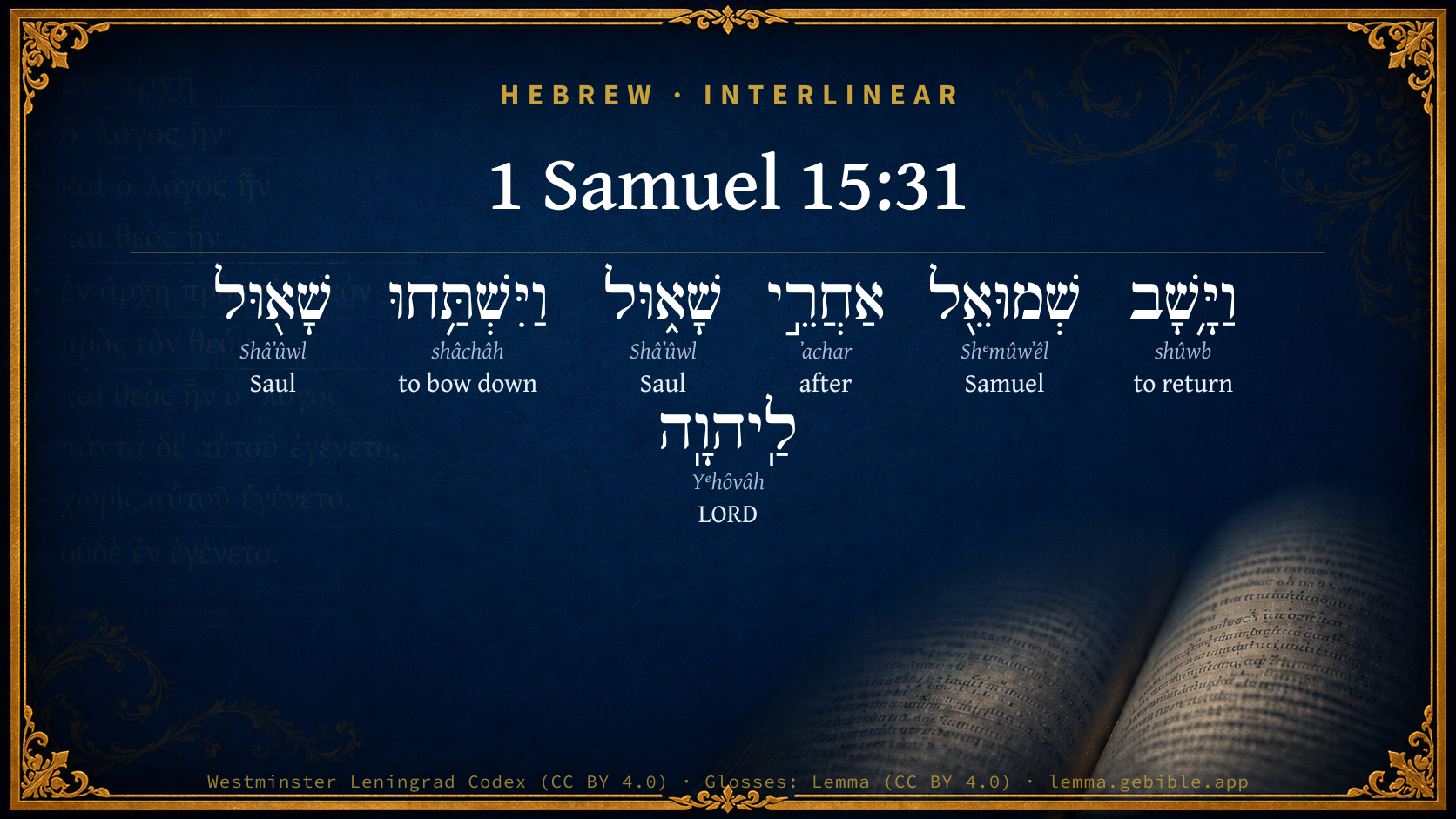
1 Samuel 15:31

Hebrew (Westminster Leningrad Codex) 1 Samuel 15:31 appears in the Hebrew Old Testament. The text above is from the Westminster Leningrad Codex. Each word links to its Strong’s number, a concise gloss, and parsing drawn from the Open Scriptures Hebrew Bible morphology. Click any word for its full Brown-Driver-Briggs (BDB) entry.
Download image
Cite this verse

1 Samuel 15:31 (World English Bible). Public Domain. Lemma interlinear Bible study tool, https://lemma.gebible.app/v/1-samuel/15/31.

Show BibTeX & RIS
BibTeX
RIS
English Translation
So Samuel turned again after Saul; and Saul worshiped Yahweh.
World English Bible · Public Domain
Download a study sheet

One document with this verse’s original text, its word-by-word gloss line, the meaning frame, cross-references with their text, attributed commentary, and full source and license credits — printable, and it pastes into notes with its structure intact.

This verse Autodidact and up

Study sheet (.html) Plain text (.txt)

A passage Seminary Student

Up to 50 verses in one chapter. A passage sheet keeps up to 6 commentary sources and 12 cross-references per verse, in the order this page ranks them, and says so on the sheet whenever that leaves anything out. Ask for a single verse and you get the Autodidact verse sheet above.

Everything on this page stays free to read, with no account — the sheet is a download of what is already on screen, not access to it.

Want to remove ads? Support Godless Engineer
Compare translations 3

The same verse in 3 English versions, stacked beneath the original-language interlinear above. Click any original word for its lexicon entry.

Each is an independent rendering of the whole verse — the interlinear is not word-aligned to these translations.

Highlighted words mark where these versions differ — a whole-verse word diff, not a word-by-word alignment.

  • World English Bible Public Domain
    So Samuel turned again after Saul; and Saul worshiped Yahweh.
  • King James Version Public Domain
    So Samuel turned again after Saul; and Saul worshipped the LORD.
  • unfoldingWord Literal Text CC BY-SA 4.0
    So Samuel returned behind Saul, and Saul worshiped Yahweh.

unfoldingWord Literal Text — © unfoldingWord, licensed CC BY-SA 4.0. Word-aligned USFM3 via Door43 (git.door43.org/unfoldingWord/en_ult).

Versions to compare (up to 4)

3 of 4 selected

Show all 18 translations

Every available English version of this verse, each an independent rendering of the whole verse.

  • World English Bible Public Domain
    So Samuel turned again after Saul; and Saul worshiped Yahweh.
  • Berean Standard Bible Public Domain
    So Samuel went back with Saul, and Saul worshiped the LORD.
  • Majority Standard Bible Public Domain
    So Samuel went back with Saul, and Saul worshiped the LORD.
  • King James Version Public Domain
    So Samuel turned again after Saul; and Saul worshipped the LORD.
  • American Standard Version (1901) Public Domain
    So Samuel turned again after Saul; and Saul worshipped Jehovah.
  • Revised Version (1885) Public Domain
    So Samuel turned again after Saul; and Saul worshipped the LORD.
  • Geneva Bible (1599) Public Domain
    So Samuel turned againe, and followed Saul: and Saul worshipped the Lord.
  • Douay-Rheims (1899) Public Domain
    So Samuel turned again after Saul: and Saul adored the Lord.
  • Young's Literal Translation Public Domain
    And Samuel turneth back after Saul, and Saul boweth himself to Jehovah;
  • Literal Standard Version CC BY-SA 4.0
    And Samuel turns back after Saul, and Saul bows himself to YHWH;
  • Unlocked Literal Bible CC BY-SA 4.0
    So Samuel turned again after Saul, and Saul worshiped Yahweh.
  • unfoldingWord Literal Text CC BY-SA 4.0
    So Samuel returned behind Saul, and Saul worshiped Yahweh.
  • Darby Bible Public Domain
    So Samuel turned again after Saul; and Saul worshipped Jehovah.
  • World Messianic Bible Public Domain
    So Samuel went back with Saul; and Saul worshiped the LORD.
  • Webster's Bible Public Domain
    So Samuel turned again after Saul; and Saul worshiped the LORD.
  • Free Bible Version CC BY-SA 4.0
    So Samuel went back with Saul after all, and Saul worshiped the Lord.
  • Bible in Basic English Public Domain
    So Samuel went back after Saul, and Saul gave worship to the Lord.
  • JPS Tanakh (1917) Public Domain
    So Samuel returned after Saul; and Saul worshipped the LORD.

Literal Standard Version (2020), Covenant Press — licensed CC BY-SA 4.0. Text via the HelloAO Bible API (eBible.org). Unlocked Literal Bible (unfoldingWord) — licensed CC BY-SA 4.0. Text via the HelloAO Bible API (eBible.org). unfoldingWord Literal Text — © unfoldingWord, licensed CC BY-SA 4.0. Word-aligned USFM3 via Door43 (git.door43.org/unfoldingWord/en_ult). Free Bible Version, Dr. Jonathan Gallagher — licensed CC BY-SA 4.0. Text via the HelloAO Bible API (eBible.org).

Word by word

More ways to search: Search by grammar → Find every occurrence → Compare this word →

Practice this passage: Drill this verse → Learn its vocabulary →

About this verse

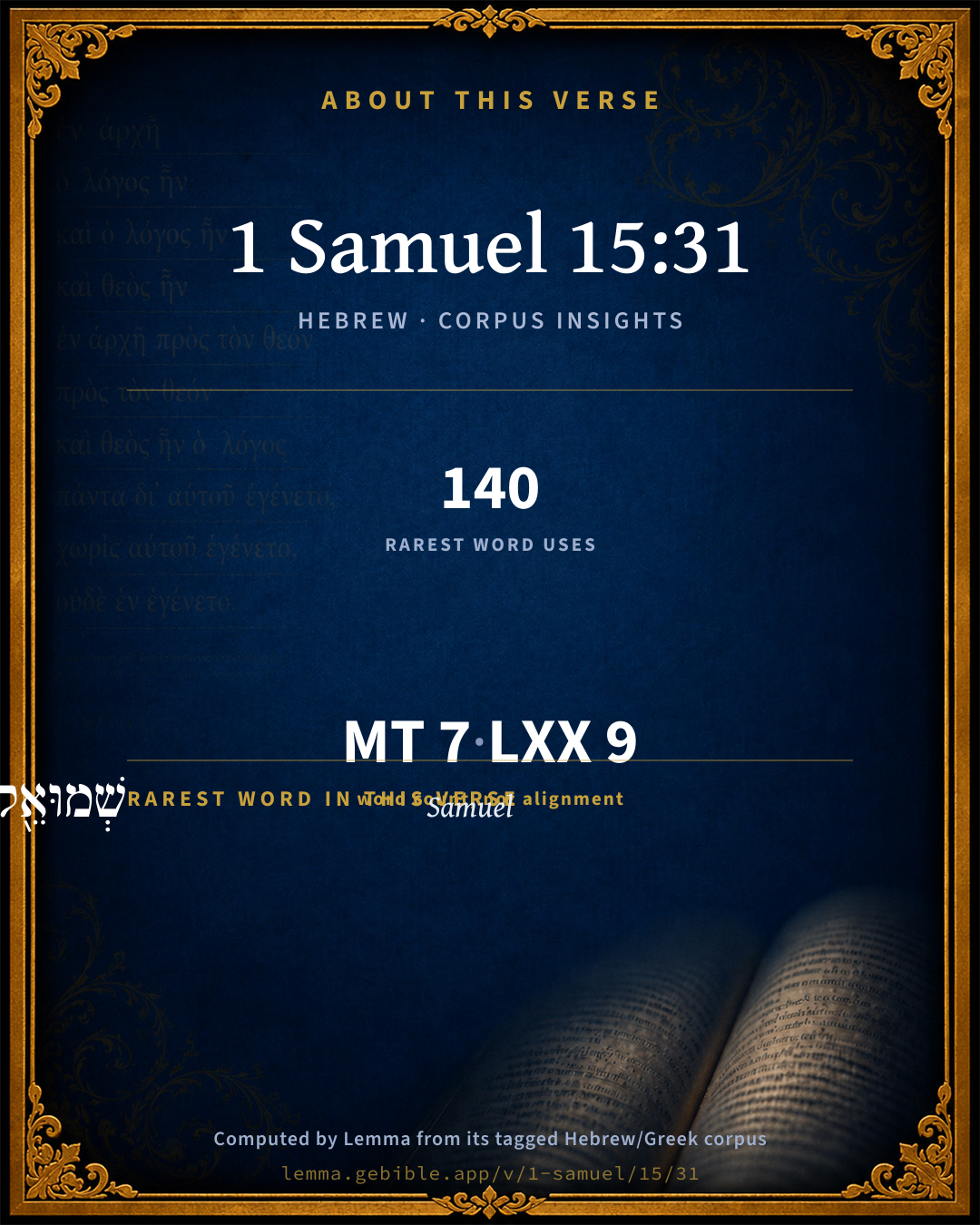
These counts appear in no published source. They are computed here, from the morphology-tagged text and Lemma’s own curated glosses. What Lemma adds →

7
words
6
distinct lemmas
Historical
section

Grammatical profile

  • 2 verbs
  • 4 nouns
  • 1 preposition

Verb forms

  • וַיָּ֥שָׁב Qal · Sequential Imperfect
  • וַיִּשְׁתַּ֥חוּ Hithpael · Sequential Imperfect

Repetition

A word recurs within this verse — often emphatic in Hebrew:

  • שָׁא֑וּל Saul H7586 ×2

Hebrew & Septuagint length

In English translation the verse runs 10 words from the Hebrew and 11 from the Septuagint (LXX English) — closely comparable.

A rough comparison of the two English renderings, which tokenize alike — not a word-level alignment.

Word counts can differ between the Hebrew and the Greek without any difference in meaning — e.g. the Hebrew direct-object marker אֵת has no separate Greek word, and Greek often adds the article ὁ.

In the original languages it is 7 Hebrew tokens and 9 Greek tokens — but the two are counted differently (Hebrew bundles its prefixes and suffixes into one token; the Greek is in lemma form), so that isn’t a like-for-like length.

Hebrew and Greek witnesses Masoretic Hebrew ↔ Greek Septuagint

The same verse in the two great witnesses to the Old Testament, shown verse-for-verse.

These are two independent witnesses, not word-aligned to each other, and the Septuagint is shown in lemma (dictionary) form.

Hebrew 1 Samuel 15:31 Masoretic · Westminster Leningrad Codex

וַיָּ֥שָׁב שְׁמוּאֵ֖ל אַחֲרֵ֣י שָׁא֑וּל וַיִּשְׁתַּ֥חוּ שָׁא֖וּל לַֽיהוָֽה

So Samuel turned again after Saul; and Saul worshiped Yahweh.

World English Bible · Public Domain

Greek LXX 1 Samuel 15:31 Septuagint · lemma form

καί ἀναστρέφω σαμουηλ ὀπίσω σαούλ καί προςκυνέω ὁ κύριος

So Samuel turned back after Saul, and he worshipped the Lord.

LXX2012 (modern English Septuagint) · Public Domain

On this verse, John Gill's Exposition discusses the Septuagint’s reading. Read the note in Commentary ↓

Hebrew: Westminster Leningrad Codex (CC BY 4.0). Greek: Septuagint (public domain); English from LXX2012 (modern English Septuagint) (Public Domain). How the Septuagint differs from the Hebrew →

Targum (Aramaic paraphrase)

1

The Targum is the ancient Jewish Aramaic paraphrase of the Hebrew Scriptures — an interpretive translation, not the Hebrew text itself. Onkelos (literal) and Pseudo-Jonathan (expansive) render the Torah, and Jonathan the Prophets. Coverage is partial: where no permissively-licensed English translation exists for a verse, only the Aramaic is shown. This is verse-level text, not a word-by-word alignment to the Hebrew.

  1. Targum Jonathan Prophets (Joshua–Malachi)
    וְתַב שְׁמוּאֵל בָּתַר שָׁאוּל וּסְגִיד שָׁאוּל קֳדָם יְיָ:

    (no public-domain English translation for this verse)

    Targum Jonathan — Aramaic: “Mikraot Gedolot” (public domain). English: “Sefaria Community Translation” (CC0 1.0 (public-domain dedication)); “London "Chaldee Paraphrase," 1871” (public domain). Text via Sefaria.

Commentary

Notes on 1 Samuel 15:31 from classic Christian and Jewish commentators (each source and its license shown beneath its notes). The classic Christian expositions comment on the surrounding passage and are grouped to its opening verse, so a note may address several verses; the Jewish commentaries on the Tanakh (Rashi and others) are per-verse, so they appear only where the commentator wrote on this verse.

Lemma curates 59 commentaries, every one of them public domain or Creative Commons licensed, each selected and text-cleaned for this edition rather than reprinted as found. About our sources →

Trapp's Complete Commentary

John Trapp

1Sa 15:31 So Samuel turned again after Saul; and Saul worshipped the LORD.

Ver. 31. So Samuel turned again after Saul.] Both to show his respect to him as his sovereign, and to do execution upon Agag.

John Trapp, A Commentary or Exposition upon All the Books of the Old and New Testament (1647–1656) — public domain. Text from a community e-Sword module.

Joseph Benson's Commentary

1Sa 15:31. So Samuel turned again — 1st, That the people might not, upon pretence of this sentence of rejection, withdraw their obedience from their sovereign; whereby they would both have sinned against God, and have been as sheep without a shepherd. 2d, That he might rectify Saul’s error, and execute God’s judgment upon Agag.

Joseph Benson's Commentary on the Old and New Testaments (1811–1818) — public domain. Text from a community e-Sword module.

Jamieson, Fausset & Brown

Robert Jamieson, A. R. Fausset & David Brown

Samuel turned again after Saul--not to worship along with him; but first, that the people might have no ground, on pretense of Saul's rejection, to withdraw their allegiance from him; and secondly, to compensate for Saul's error, by executing God's judgment upon Agag.

Jamieson, Fausset & Brown — Commentary Critical and Explanatory on the Whole Bible (1871) — public domain (CC PDM 1.0). Text via the HelloAO Bible API.

Ellicott's Commentary for English Readers

(31) So Samuel turned again after Saul.—The prophet, after the repeated and pressing request of the king, consents publicly to worship the Lord in his company. There is little doubt but that the principal motive which induced Samuel on this occasion not to withdraw himself from the public thanksgiving was a desire to prevent any disaffection towards the monarchy. His known disapproval of Saul’s conduct, and his declining the king’s earnest prayer to stay, would probably have been the signal to the discontented spirits in Israel to revolt, under the pretext that such a revolt would be pleasing to the great seer. Such a revolt in those critical times would have been disastrous to the growing prosperity of the chosen people.

It has been well suggested that many blessings came upon the unhappy Saul and the nation over which he ruled in answer to Samuel’s intercession on this occasion for him.

The result was what might have been looked for. Saul remained in undiminished power apparently; but the will of God, as declared by His servant Samuel, was slowly, but surely, accomplished. The doom of the reigning family pronounced by the prophet on this momentous occasion was irrevocable.

The story of Israel contained in this book shows how the march of events in solemn procession moved onward, every year bringing the ill-fated rebel king nearer the execution of the stern sentence which his own self-willed conduct had called down on him.

A Bible Commentary for English Readers, edited by Charles John Ellicott (1878–1897) — public domain. Text from a community e-Sword module.

The Cambridge Bible for Schools and Colleges

gen. ed. J. J. S. Perowne

31. So Samuel turned again] Changing his purpose in order to maintain the honour of the reigning king, for although Saul had forfeited his position as Jehovah’s chosen representative, he must still rule the nation.

The Cambridge Bible for Schools and Colleges (gen. ed. J. J. S. Perowne; Cambridge University Press, 1878–1918) — public domain. Text from a community e-Sword module.

John Gill's Exposition

So Samuel turned again after Saul,.... Though he before said he would not, Sa1 15:26 yet he did, changing his mind, as he might without being chargeable with a lie; and he also might have an impulse from the Lord so to do, and which he did not in order to worship with Saul, which it does not appear he did, but rather the contrary; but that Saul might not be despised by the people, and his authority lessened, while he continued king; and that he might do what Saul had neglected to do, destroy Agag: and Saul worshipped the Lord; alone, by offering sacrifice to him.

yet he did, changing his mind, as he might without being chargeable with a lie; and he also might have an impulse from the Lord so to do, and which he did not in order to worship with Saul, which it does not appear he did, but rather the contrary; but that Saul might not be despised by the people, and his authority lessened, while he continued king; and that he might do what Saul had neglected to do, destroy Agag: and Saul worshipped the Lord; alone, by offering sacrifice to him.

1 Samuel 15:32

sa1 15:32

sa1 15:32

sa1 15:32Then said Samuel, bring you hither to me Agag the king of the Amalekites,.... This he said very probably to some of Saul's officers, and in his presence, and before all the people met together for sacrifice:

and Agag came unto him delicately; fat and plump, as the Vulgate Latin version, and yet trembling, as that and the Septuagint; well dressed, in the garb and habit of a king, and with the air and majesty of one; or with pleasure and joy, as Kimchi, choosing rather to die than to be a captive, and live in such reproach as he did; though R. Isaiah and Ben Gersom give the sense of it, that he came bound in chains, and fetters of iron, according to the use of the word in Job 38:31.

and Agag said, surely the bitterness of death is past; this he said, either as not expecting to die, that since he had been spared by Saul, the king of the nation, a fierce and warlike prince, he had nothing to fear from an ancient man and a prophet, and who now bore not the sword of justice; and especially when he came into his presence, and saw his form, which showed him to be a man of clemency and mercy, as Ben Gersom observes: or as expecting it, and so Kimchi interprets it to this sense, "the bitterness of death is come"; and is near at hand, and will be soon over; or suggesting that that which was bitter, to others grievous and terrible, was to him sweet and desirable; but the former sense seems best by what follows.

John Gill's Exposition of the Whole Bible (1746–1763) — public domain (CC PDM 1.0). Text via the HelloAO Bible API.

Matthew Poole's English Annotations

Samuel turned again after Saul; not to worship the Lord with him, for that he did not; and therefore it is here mentioned that Saul only worshipped the Lord; but for two other reasons: first, that people might not upon pretence of this sentence of rejection immediately withdraw all respect and obedience to their sovereign; whereby they would both have sinned against God, and have been as sheep without a shepherd. Secondly, That he might rectify Saul’s error, and execute God’s judgment upon Agag.

Matthew Poole's English Annotations on the Holy Bible (1683–1685) — public domain. Text from a community e-Sword/MySword module.

Whedon's Commentary on the Bible

Daniel D. Whedon

31. Samuel turned again after Saul — He finally yielded to Saul’s pleading, but not until he had, by his stern and solemn acts and words, made on his mind deep and lasting impressions of God’s anger against him. It was also one object of his turning with Saul to execute the judgment of God upon the king of the Amalekites.

Daniel D. Whedon (gen. ed.), Commentary on the Old and New Testaments (1874–1909) — public domain. Text from a community e-Sword module.

The Pulpit Commentary

HOMILIES BY D. FRASER Ver. 31.

Tried again and rejected.

God proves his servants, and does not show them the fulness of his favour and confidence till they have been tested. Abraham was tried and found faithful; so was Moses; so was David; so was Daniel. Abraham, indeed, was not without fault, nor Moses either. David once sinned grievously. But all of these were proved true at heart and trustworthy. Saul is the conspicuous instance in the Old Testament of one who, when called to a high post in Jehovah"s service, and tested therein again and again, offended the Lord again and again, and was therefore rejected and disowned.

1. The question on which the king was tested was the same as before.Would he obey the voice of the Lord, and rule as his lieutenant, or would he be as the kings of the neighbouring nations and tribes, and use the power with which he was invested according to his own will and pleasure? On this critical question the prophet Samuel had exhorted both Saul and the people when the monarchy was instituted. If the king erred, he could not plead that he had not been forewarned. The accepted principle of

2. modern constitutional government is that the ruler exists and is bound to act for the public good, and not for his own aggrandisement or pleasure. At root this is the very principle which Samuel inculcated 3000 years ago. The Old Testament required a king to reign in the fear of the Lord, and loyally execute his will. The New Testament describes the ruler as a "minister of God for good." Now the Divine will and the public weal are really the same, and the most advanced political principle of modern intelligence is no other than the old doctrine of the Bible. There is no Divine right of kings to rule as they think proper. That doctrine of base political subservience is opposed to both the spirit and the letter of the sacred writings. The king is for God, not God for the king. The king is for the people, not the people for the king. The voice of the people may not always be the voice of God, but the good of the people is always the will of God.

3. The test to which the king was new subjected was, like the former one,specific, and publicly applied. Would he obey the Lord in the extermination of Amalek or no? And he disobeyed. If there was one of all the Amalekite race who deserved to forfeit his life, it was the king, Agag, a ruthless chief, whose sword, as Samuel expressed it, had "made women childless;" yet him Saul spared when he showed no mercy to others. It was not at all from a feeling of humanity or pity. To have scrupled about shedding the blood of a hereditary foe would not have occurred to any Oriental warrior of the period. But Saul would reserve the royal captive to grace his triumph, and be a household slave of the king of Israel. It was the pride of the chiefs and kings of that age to reduce the princes whom they had conquered to slavery in their courts. Adonibezek is said to have kept seventy such captives, whose hands and feet he had mutilated to unfit them for war, and who, as slaves, gathered from his table. Besides Agag, the best of the sheep and cattle belonging to Amalek were spared by Saul and his army. They used their success to enrich themselves, and forgot that the sentence of God against that nation was the only justification of the war.

1. The Divine censure on the disobedient king was pronounced by Samuel.The prophet was deeply grieved. He had loved the young man on whose lofty head he had poured the sacred oil, and whose failure to fulfil the early promise of his reign had already caused him, if not much surprise, distress unfeigned. And Samuel was concerned for the nation. If the new government was so soon discredited, and Saul forfeited his kingly seat, what but anarchy could come upon Israel, and with anarchy, subjection, as before, to the Philistines or some other warlike nation of the heathen? The

2. prophet fulfilled his commission, however painful; gravely reproved the king, brushed aside his excuses and evasions, and refused, not without a touch of scorn, his offered bribe of animals for sacrifice.

3. Samuel took occasion to declare that "to obey is better than sacrifice,and to hearken than the fat of rams." These words contain the very quintessence of the testimony of the prophets; not Samuel only, but Hoses, Micah, Isaiah, Jeremiah, and in fact all the great teachers whom Jehovah sent to his ancient people. Sacrificial oblations could never be accepted in lieu of practical obedience, and a rebellious, wilful temper was as offensive to the Lord as any kind of idolatry. Priests and Levites were appointed for religious ceremonial, but the great function of the prophets was to maintain the supremacy of what is moral over what is ceremonial, and to lift up fearless voices for mercy and truth, judgment and righteousness, integrity and probity, reverence for Jehovah, and obedience to his revealed will. Such was the testimony of the Lord Jesus himself, as the greatest of prophets. He recognised and respected the sacrifices appointed in the law, but did not in his conversations or discourses dwell on them. His aim was to cause men to hear the word of God, and do it. And such is the message or burden of all New Testament prophets, and of those who know how to guide and teach Christians. To be lax and indulgent on questions of moral conduct, while strict about services and offerings to God and the Church, is the part of a false prophet. The true prophet, while witnessing to free forgiveness in the blood of Christ, will enjoin all who seek that forgiveness to cease to do evil and learn to do well, will faithfully declare to them that they cannot be kept in the love of God if they are not obedient to his word.

1. The behaviour of Saul under reproof betrayed a shifty, superficialcharacter. He showed no real sense of sin, or desire of Divine forgiveness. David, during his reign, committed a more heinous offence against domestic and social morality than anything that Saul as yet had done; but he was pardoned and restored because when charged with the sin art the man he confessed it, and excused not himself. And then he cried to God, "Purge me with hyssop, and I shall be clean." But Saul, when charged with disobedience, showed no shame or sorrow on its account. He at once put himself in a defensive attitude, stooped to subterfuge, laid the blame on others, had no feeling but a desire to escape consequences. He would propitiate the Lord and his prophet by sacrifices; but his former religious sensibility was now almost quite gone from him, and he was becoming, like Esau, a "profane person," hard and godless. It is pitiful to see that the king looked no higher than to Samuel, and asked no

2. more than that the prophet would pardon him, and favour him so far as to join with him while he publicly worshipped the Lord. Evidently his object was to have his credit upheld by the venerated presence of Samuel; and, on his repeating the request, the prophet thought fit to yield to his wish, probably to avoid the weakening of the royal influence, and the premature fall of the monarchy.

3. The rejection of Saul took no sudden effect. Gravely and sadly it waspronounced by Samuel; but it brought about no immediate catastrophe. None the less was it a sure and fatal sentence. We know that Saul was not dethroned. He had a long reign, and died on the battle field. But the process was already begun which led him to dark Gilboa, which led one better than him to Hebron and to Jerusalem; and the remainder of this book is occupied in showing how the Divine rejection of Saul took effect, and how the Lord brought forward and trained the son of Jesse for the kingdom. It is a thought full of solemnity, that a man may long keep his place and hold his own in Christian society who yet is rejected by the Lord, and is growing at heart more and more profane, till at last the evil spirit rules him instead of the good, and he dies as one troubled and God forsaken. The process may be long, but it is none the less tragical. May God keep us from the beginnings of declension, and from all excusing of our sins, or laying of the fault upon others I Lord, take not thy Holy Spirit from us! F.

The Pulpit Commentary (1880–1919), ed. H.D.M. Spence-Jones & Joseph S. Exell — public domain. Text from a community e-Sword module.

John Wesley's Explanatory Notes

Turned - First, that the people might not upon pretense of this sentence of rejection, withdraw their obedience to their sovereign; whereby they would both have sinned against God, and have been as sheep without a shepherd. Secondly, that he might rectify Saul's error, and execute God's judgment upon Agag.

John Wesley, Explanatory Notes Upon the Whole Bible (1754–1765) — public domain. Text via the GEBible commentary corpus.

Lesson kit

Teaching starters — assembled from the data on this page, not authored interpretation. Every prompt links to the verse data it draws on. Edit before teaching.

1 Samuel, in the Historical, opens this verse with 7 words (6 distinct Hebrew lemmas). Its most distinctive word is Shᵉmûwʼêl (“Samuel”). A historical commentator’s framing appears above. Read the whole chapter for the surrounding context.

Discussion questions

  1. What does “Samuel” (Shᵉmûwʼêl) contribute to the verse as a whole?
  2. “Saul” occurs 2× in this one verse. What is the effect of the repetition?
  3. These translations render this verse differently; the difference is in the English rendering, not the original. What questions does that raise?
  4. The verb «וַיָּ֥שָׁב» is Qal Sequential Imperfect. How does its form color the action?
  5. Reading how Trapp's Complete Commentary and Joseph Benson's Commentary read this verse, where do the two commentators agree and where do they part?

Things to notice

Reading settings

Reading text

Shown beneath each verse's original-language words.

Old Testament
Old Testament edition

Read the OT as the Masoretic Hebrew (MT) or the Greek Septuagint (LXX).

English shown for the Greek Septuagint (in the Hebrew ↔ Greek comparison).

Comparing translations? Open the Compare panel on any verse page to stack up to four side by side.